Credible rectangles for high-dimensional posterior comparison
Pith reviewed 2026-06-29 05:57 UTC · model grok-4.3
The pith
Credible hyperrectangles from posterior distributions of correlation matrices enable direct comparison of two brain scans from the same patient.
A machine-rendered reading of the paper's core claim, the machinery that carries it, and where it could break.
Core claim
The paper claims that credible hyperrectangles derived from the posterior distributions provide interpretable tools for subject-level inference and longitudinal monitoring in brain connectivity analysis, enabling principled detection of significant connectivity differences both globally and locally while preserving joint dependency structures, with theoretical guarantees in the inverse-Wishart model including a Bernstein-von Mises theorem for correlation matrices and control of a Bayesian family-wise error rate.
What carries the argument
Credible hyperrectangles constructed from the posterior distributions of correlation matrices, which quantify uncertainty and allow comparison of high-dimensional dependent data.
Load-bearing premise
The inverse-Wishart model accurately captures the posterior distribution for correlation matrices in resting-state fMRI data.
What would settle it
Finding a real or simulated fMRI dataset where the credible hyperrectangles do not achieve the expected coverage or fail to control the Bayesian family-wise error rate at the stated level would challenge the theoretical guarantees.
Figures
read the original abstract
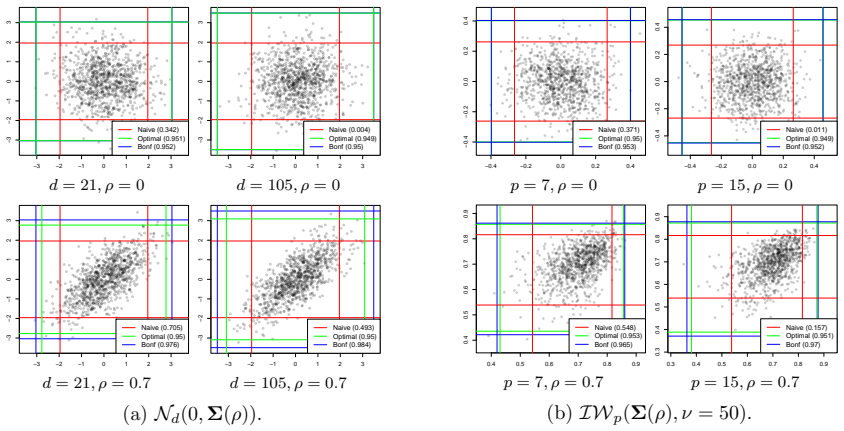
We propose a Bayesian framework for uncertainty quantification and comparison in brain connectivity graph analysis. Standard graph-based approaches typically rely on point estimates of correlation matrices, overlooking the uncertainty induced by high-dimensional estimation from limited data. Our methodology constructs and compares credible hyperrectangles derived from posterior distributions, providing interpretable tools for subject-level inference and longitudinal monitoring. We develop scalable algorithms for estimating these regions in high dimensions and establish theoretical guarantees in the inverse-Wishart model for resting-state fMRI data, including a Bernstein--von Mises theorem for correlation matrices and control of a Bayesian family-wise error rate. The proposed framework enables principled detection of significant connectivity differences both globally and locally while preserving joint dependency structures. While demonstrating competitive performance against multiple-testing procedures on synthetic datasets, our approach also facilitates the direct comparison of two distinct scans from a single patient, a capability currently absent from the literature. We leverage this novelty on real datasets to improve interpretability. Beyond fMRI data, the approach provides a general framework for comparison problems in high-dimensional dependent settings.
Editorial analysis
A structured set of objections, weighed in public.
Referee Report
Summary. The paper proposes a Bayesian framework for uncertainty quantification in high-dimensional correlation matrices arising from brain connectivity analysis. It constructs credible hyperrectangles from the posterior to enable global and local comparison of graphs, with scalable algorithms, theoretical results (Bernstein-von Mises theorem for correlation matrices and Bayesian family-wise error rate control) derived under the inverse-Wishart model, and an application to longitudinal subject-level inference on rs-fMRI data that is claimed to be novel.
Significance. If the inverse-Wishart posterior approximation is adequate and the hyperrectangles deliver the stated coverage and error-rate control, the method would provide a principled, dependency-preserving tool for direct within-subject scan comparison that is currently absent from the literature. The combination of high-dimensional theory and real-data demonstration could strengthen uncertainty-aware graphical modeling in neuroimaging and related fields.
major comments (2)
- [Abstract] Abstract and modeling section: the Bernstein-von Mises theorem and Bayesian family-wise error rate control are derived exclusively inside the inverse-Wishart model. No robustness analysis or diagnostic is supplied to assess whether the IW tails and dependence structure remain sufficiently accurate for the actual posterior of correlation matrices (or their differences) in resting-state fMRI; if they deviate materially, both rectangle coverage and error-rate control can fail even if the computational procedure is correct.
- [Abstract] The claim that the framework enables 'direct comparison of two distinct scans from a single patient' rests on the credible rectangles inheriting valid frequentist coverage from the BvM result. Because the BvM is model-specific, the manuscript must demonstrate that the IW posterior is close enough to the true sampling distribution of the sample correlation matrix for the coverage statement to transfer to real data; this step is load-bearing for the subject-level inference application.
minor comments (1)
- Notation for the credible hyperrectangle boundaries and the precise definition of the Bayesian family-wise error rate should be stated explicitly early in the manuscript to avoid ambiguity when the theoretical guarantees are invoked.
Simulated Author's Rebuttal
We thank the referee for the careful reading and constructive major comments. We agree that the model-specific nature of the theoretical results requires additional support for the real-data claims and will strengthen the manuscript accordingly.
read point-by-point responses
-
Referee: [Abstract] Abstract and modeling section: the Bernstein-von Mises theorem and Bayesian family-wise error rate control are derived exclusively inside the inverse-Wishart model. No robustness analysis or diagnostic is supplied to assess whether the IW tails and dependence structure remain sufficiently accurate for the actual posterior of correlation matrices (or their differences) in resting-state fMRI; if they deviate materially, both rectangle coverage and error-rate control can fail even if the computational procedure is correct.
Authors: We agree that the BvM theorem and BFWE control are derived exclusively under the inverse-Wishart model and that the current manuscript provides no robustness diagnostics against deviations in tails or dependence that may occur in rs-fMRI data. In the revision we will add a dedicated simulation subsection that generates data from heavier-tailed or non-Wishart correlation models, recomputes the credible rectangles under the IW posterior, and reports empirical coverage and BFWE rates to quantify sensitivity. revision: yes
-
Referee: [Abstract] The claim that the framework enables 'direct comparison of two distinct scans from a single patient' rests on the credible rectangles inheriting valid frequentist coverage from the BvM result. Because the BvM is model-specific, the manuscript must demonstrate that the IW posterior is close enough to the true sampling distribution of the sample correlation matrix for the coverage statement to transfer to real data; this step is load-bearing for the subject-level inference application.
Authors: We concur that the subject-level comparison claim is load-bearing on the IW approximation being sufficiently close to the true sampling distribution. The revision will include Monte Carlo experiments that draw correlation matrices from non-IW distributions calibrated to fMRI characteristics, apply the IW-based credible rectangles, and tabulate attained coverage; we will also revise the abstract and discussion to state the guarantees as conditional on model adequacy while retaining the IW as a computationally convenient and standard working model. revision: yes
Circularity Check
No circularity; theoretical guarantees derived conditionally on explicit IW model assumption
full rationale
The manuscript states that it establishes a Bernstein-von Mises theorem for correlation matrices and Bayesian family-wise error rate control inside the inverse-Wishart model. This is an explicit modeling premise rather than a self-referential reduction. No equations, fitted parameters renamed as predictions, self-citations used as load-bearing uniqueness theorems, or ansatzes smuggled via prior work appear in the supplied text. The derivation chain therefore remains self-contained within the stated model assumptions and does not collapse to its inputs by construction.
Axiom & Free-Parameter Ledger
Reference graph
Works this paper leans on
-
[1]
ISSN 1467-9892. doi: 10.1111/jtsa.12170. URLhttps://onlinelibrary.wiley.com/doi/abs/10.1111/jtsa. 12170. Julian Besag, Peter Green, David Higdon, and Kerrie Mengersen. Bayesian Computation and Stochastic Systems.Statistical Science, 10(1):3–41, Febru- ary
-
[2]
ISSN 0883-4237, 2168-8745. doi: 10.1214/ss/1177010123. URL https://projecteuclid.org/journals/statistical-science/volume-10/issue-1/ Bayesian-Computation-and-Stochastic-Systems/10.1214/ss/1177010123.full. Jacob Bien and Robert J Tibshirani. Sparse estimation of a covariance matrix.Biometrika, 98 (4):807–820,
-
[3]
Magnetic Resonance in Medicine34(4), 537–541 (1995)
ISSN 1522-2594. doi: 10.1002/mrm.1910340409. eprint: https://onlinelibrary.wiley.com/doi/pdf/10.1002/mrm.1910340409. Carlo Bonferroni. Teoria statistica delle classi e calcolo delle probabilita.Pubblicazioni del R istituto superiore di scienze economiche e commericiali di firenze, 8:3–62,
-
[4]
doi: 10.1016/j.jeconom.2018.03.020
ISSN 0304-4076. doi: 10.1016/j.jeconom.2018.03.020. URLhttps://www.sciencedirect.com/ science/article/pii/S0304407618300782. Alice Chevaux, Ali Fahkar, K´ evin Polisano, Ir` ene Gannaz, and Sophie Achard. Benchmarking Brain Connectivity Graph Inference: A Novel Validation Approach. In33rd European Signal Processing Conference (EUSIPCO 2025), Palerme, Ital...
-
[5]
doi: 10.3758/s13428-017-0862-1
ISSN 1554-3528. doi: 10.3758/s13428-017-0862-1. URLhttp://link.springer.com/10. 3758/s13428-017-0862-1. Christopher Ferrie. High posterior density ellipsoids of quantum states.New Journal of Physics, 16(2):023006, February
-
[6]
doi: 10.1088/1367-2630/16/2/023006
ISSN 1367-2630. doi: 10.1088/1367-2630/16/2/023006. URL https://doi.org/10.1088/1367-2630/16/2/023006. Publisher: IOP Publishing. 31 Michael D. Fox and Marcus E. Raichle. Spontaneous fluctuations in brain activity observed with functional magnetic resonance imaging.Nature Reviews Neuroscience, 8(9):700–711, September
-
[7]
ISSN 1471-0048. doi: 10.1038/nrn2201. URLhttps://www.nature.com/ articles/nrn2201. Publisher: Nature Publishing Group. Andrew Gelman, John B Carlin, Hal S Stern, and Donald B Rubin.Bayesian data analysis. Chapman and Hall/CRC,
-
[8]
ISSN 1932-6157, 1941-7330. doi: 10.1214/16-AOAS1015. URL https://projecteuclid.org/journals/annals-of-applied-statistics/volume-11/ issue-2/Hypothesis-testing-for-network-data-in-functional-neuroimaging/10. 1214/16-AOAS1015.full. Matthew F. Glasser, Stamatios N. Sotiropoulos, J. Anthony Wilson, Timothy S. Coalson, Bruce Fischl, Jesper L. Andersson, Junqia...
-
[9]
doi: 10.1016/j.neuroimage.2013.04.127
ISSN 1053-8119. doi: 10.1016/j.neuroimage.2013.04.127. URLhttps://www.sciencedirect.com/science/ article/pii/S1053811913005053. Jim Griffin. Expressing and Visualizing Model Uncertainty in Bayesian Variable Se- lection Using Cartesian Credible Sets.Bayesian Analysis, 20(4):1371–1397, De- cember
-
[10]
ISSN 1936-0975, 1931-6690. doi: 10.1214/25-BA1568. URL https://projecteuclid.org/journals/bayesian-analysis/volume-20/issue-4/ Expressing-and-Visualizing-Model-Uncertainty-in-Bayesian-Variable-Selection-Using/ 10.1214/25-BA1568.full. Publisher: International Society for Bayesian Analysis. L. R Haff. An identity for the Wishart distribution with applicatio...
-
[11]
URL https://www.jstor.org/stable/1391142
ISSN 1061-8600. URL https://www.jstor.org/stable/1391142. Sture Holm. A Simple Sequentially Rejective Multiple Test Procedure.Scandinavian Journal of Statistics, 6(2):65–70,
-
[12]
doi: 10.1016/j.ifacol.2024.10.004
ISSN 2405-8963. doi: 10.1016/j.ifacol.2024.10.004. URLhttps://www. sciencedirect.com/science/article/pii/S2405896324017506. Yiye Jiang, Alice Chevaux, Wendy Meiring, Alex Petersen, Guillaume Kon Kam King, Julyan Arbel, and Sophie Achard. Prior elicitation for Bayesian estimation of single-subject con- nectivity networks, May
-
[13]
Prior elicitation for Bayesian estimation of single-subject connectivity networks
URLhttp://arxiv.org/abs/2605.02587. arXiv:2605.02587 [stat.ME]. Ashwini Joshi, Terhi Ollila, Ilkka Immonen, and Sangita Kulathinal. Bayesian Simultaneous Credible Intervals for Effect Measures from Multiple Markers.Statistics in Biopharmaceutical Research, 15(3):638–653, July
work page internal anchor Pith review Pith/arXiv arXiv
-
[14]
doi: 10.1080/19466315.2022.2110935
ISSN 1946-6315. doi: 10.1080/19466315.2022.2110935. URLhttps://www.tandfonline.com/doi/full/10.1080/19466315.2022.2110935. 32 Junghi Kim, Jeffrey R. Wozniak, Bryon A. Mueller, Xiaotong Shen, and Wei Pan. Comparison of statistical tests for group differences in brain functional networks.NeuroImage, 101:681– 694, November
-
[15]
doi: 10.1016/j.neuroimage.2014.07.031
ISSN 1095-9572. doi: 10.1016/j.neuroimage.2014.07.031. Arnoˇ st Kom´ arek and Emmanuel Lesaffre. Bayesian semiparametric accelerated failure time model for paired doubly-interval-censored data.Statistical Modelling, 6(1):3–22,
-
[16]
Olivier Ledoit and Michael Wolf
doi: 10.1191/1471082X06st107oa. Olivier Ledoit and Michael Wolf. Honey, I shrunk the sample covariance matrix.UPF economics and business working paper, (691),
-
[17]
doi: 10.1016/j.mri.2007.02.012
ISSN 0730725X. doi: 10.1016/j.mri.2007.02.012. URLhttps://linkinghub.elsevier.com/retrieve/pii/ S0730725X07001415. Lydia Oujamaa, Chantal Delon-Martin, Chlo´ e Jaroszynski, Maite Termenon, Stein Silva, Jean- Fran¸ cois Payen, and Sophie Achard. Functional hub disruption emphasizes consciousness recovery in severe traumatic brain injury.Brain Communication...
-
[18]
doi: 10.1093/braincomms/fcad319
ISSN 2632-1297. doi: 10.1093/braincomms/fcad319. URLhttps://academic.oup. com/braincomms/article/doi/10.1093/braincomms/fcad319/7441049. Edmund T. Rolls, Chu-Chung Huang, Ching-Po Lin, Jianfeng Feng, and Marc Joliot. Auto- mated anatomical labelling atlas 3.NeuroImage, 206:116189, February
-
[19]
doi: 10.1016/j.neuroimage.2019.116189
ISSN 1053-8119. doi: 10.1016/j.neuroimage.2019.116189. URLhttps://www.sciencedirect.com/science/ article/pii/S1053811919307803. Partha Sarkar, Kshitij Khare, Malay Ghosh, and Matt P. Wand. High-Dimensional Bernstein Von-Mises Theorems for Covariance and Precision Matrices, July
-
[20]
URLhttp://arxiv. org/abs/2309.08556. arXiv:2309.08556 [math]. Stephen M. Smith, Christian F. Beckmann, Jesper Andersson, Edward J. Auerbach, Ja- nine Bijsterbosch, Gwena¨ elle Douaud, Eugene Duff, David A. Feinberg, Ludovica Grif- fanti, Michael P. Harms, Michael Kelly, Timothy Laumann, Karla L. Miller, Steen Moeller, Steve Petersen, Jonathan Power, Ghola...
-
[21]
doi: 10.1016/j.neuroimage.2013.05.039
ISSN 1095-9572. doi: 10.1016/j.neuroimage.2013.05.039. Niansheng Tang and Bin Yu. Simultaneous confidence interval for assessing non-inferiority with assay sensitivity in a three-arm trial with binary endpoints.Pharmaceutical Statistics, 19(5): 518–531, September
-
[22]
ISSN 1539-1612. doi: 10.1002/pst.2010. Ma¨ ıt´ e Termenon, Assia Jaillard, Chantal Delon-Martin, and Sophie Achard. Reliability of graph analysis of resting state fMRI using test-retest dataset from the Human Connectome Project.NeuroImage, 142:172,
-
[23]
URLhttps: //inserm.hal.science/inserm-01330966
doi: 10.1016/j.neuroimage.2016.05.062. URLhttps: //inserm.hal.science/inserm-01330966. N. Tzourio-Mazoyer, B. Landeau, D. Papathanassiou, F. Crivello, O. Etard, N. Delcroix, B. Ma- zoyer, and M. Joliot. Automated anatomical labeling of activations in SPM using a macro- scopic anatomical parcellation of the MNI MRI single-subject brain.NeuroImage, 15(1): 2...
-
[24]
ISSN 1053-8119. doi: 10.1006/nimg.2001.0978. 33 Brandon Whitcher, Peter Guttorp, and Donald B. Percival. Wavelet analysis of covariance with application to atmospheric time series.Journal of Geophysical Research: Atmospheres, 105(D11):14941–14962,
-
[25]
ISSN 2156-2202. doi: 10.1029/2000JD900110. URLhttps: //onlinelibrary.wiley.com/doi/abs/10.1029/2000JD900110. Andrew Zalesky, Alex Fornito, and Edward T. Bullmore. Network-based statistic: Identifying differences in brain networks.NeuroImage, 53(4):1197–1207, December
-
[26]
doi: 10.1016/j.neuroimage.2010.06.041
ISSN 1053-8119. doi: 10.1016/j.neuroimage.2010.06.041. URLhttps://www.sciencedirect.com/science/ article/pii/S1053811910008852. 34
discussion (0)
Sign in with ORCID, Apple, or X to comment. Anyone can read and Pith papers without signing in.