CREWS: Collaborative Robust Edge WiFi Sensing with Asynchronous and Incomplete Observations
Pith reviewed 2026-07-05 03:06 UTC · model glm-5.2
The pith
Stale WiFi Data Becomes Training Fuel, Not Trash
A machine-rendered reading of the paper's core claim, the machinery that carries it, and where it could break.
Core claim
The paper discovers that stale cached features from intermittently disconnected WiFi receivers, when bounded in staleness, produce representation shifts that are non-negatively aligned with the loss gradient — meaning they function as natural hard samples that regularize the aggregator's decision boundaries. This is established via a first-order Taylor analysis showing the stale-feature perturbation is proportional to the squared gradient norm. Combined with a cardinality-normalized set aggregator that makes gradient norms invariant to the number of active receivers, and elastic parameter alignment that bounds encoder drift, the system converts network-induced asynchrony and incompleteness a
What carries the argument
The cardinality-normalized set aggregator (mean-pooling over available receiver embeddings, yielding O(1) gradient norms independent of subset size); elastic parameter alignment (EMA-based proximal update pulling edge encoders toward a global consensus); staleness-aware adaptive replay (exponentially decaying cache weights combined with rarity-based sampling of missing receivers); and the convergence bound in Theorem 1 decomposing optimization error into four terms governed by complementarity coefficient ν, staleness decay λ_t, and participation rates.
If this is right
- If stale features genuinely act as hard samples, the same principle could apply to other split-learning or federated systems where stragglers are common — converting infrastructure unreliability into a generalization benefit rather than a cost.
- The cardinality-normalized aggregator's gradient stability property (Lemma 1) suggests that mean-pooling over set inputs is not just a design convenience but a structural requirement for training stability in systems with variable participation.
- The optimal replay coefficient formula (Corollary 4) provides a principled way to tune replay strength: when complementarity is high and caches are fresh, replay aggressively; when caches are stale and variance dominates, suppress replay. This could inform adaptive scheduling in other asynchronous distributed learning settings.
- The testbed results showing graceful degradation under physical device relocation (down to 7.56 pp loss vs. 64.76 pp for baselines) suggest the framework's robustness extends beyond synthetic dropout to genuine distribution shift, which is the practically relevant failure mode for deployed sensing systems.
Where Pith is reading between the lines
- The complementarity coefficient ν is asserted but not independently estimated from data. A natural extension would be to develop an online estimator for ν based on observed gradient correlations between fresh and replay subsets, enabling the system to detect when replay is counterproductive and automatically suppress it.
- The hard-sample analogy to adversarial training raises the question of whether the regularization benefit scales with the diversity of staleness patterns — i.e., whether having many different staleness levels in the cache provides richer regularization than uniformly stale features.
- The framework currently assumes a central server. The convergence analysis suggests that the key mechanism (replay-based bias compression) could in principle operate in a decentralized setting, but the elastic parameter alignment step would need reformulation without a global consensus point.
- The paper treats receiver availability as exogenous. An interesting extension would be to make the deadline W adaptive — tightening it when the system is well-trained and loosening it when coverage gaps are detected — creating a feedback loop between sensing quality and communication latency tolerance.
Load-bearing premise
The convergence guarantee depends on the assumption that stale cached features from missing receivers are complementary to fresh features — formally, that a complementarity coefficient ν is bounded away from zero. If missing nodes carry redundant rather than complementary views, replay could increase bias rather than compress it, and the theoretical benefit would vanish. The paper does not independently measure ν from data; it is posited as a modeling assumption.
What would settle it
Deploy CREWS in an environment where missing receivers consistently carry redundant (not complementary) views — for example, where spatially clustered receivers drop out together. If ν approaches zero, the aggregator bias term (1−2νλ_t+λ_t²)σ₁² should exceed the no-replay baseline, and accuracy should degrade below a simple discard-and-predict strategy.
Figures


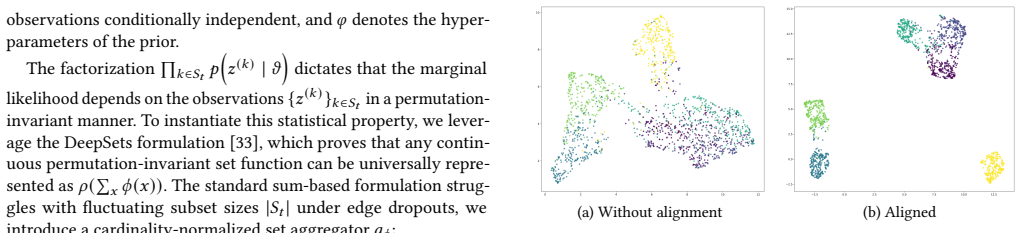



read the original abstract
Existing collaborative WiFi sensing systems rely on perfect node synchronization and complete data availability. However, real-world edge deployments suffer from heterogeneous computing and network dropouts, leading to asynchronous and incomplete features. We propose CREWS, a robust collaborative sensing framework that inherently resists these network volatility. First, CREWS employs a topology-agnostic aggregator invariant to the arrival order and subset size of incoming features. Second, rather than discarding delayed observations, it utilizes a staleness-aware adaptive replay mechanism. By treating stale features from lagging nodes as system-induced hard samples, CREWS transforms synchronization delays into beneficial training regularization. We theoretically prove the joint convergence of this architecture and demonstrate how replay bounds the bias-variance trade-off. Extensive evaluations and an 8-node heterogeneous hardware testbed demonstrate its superior resilience. Under severe conditions i.e., 50\% transient dropout rate or out-of-distribution jitter, CREWS restricts accuracy degradation to merely 2.2 percentage points, substantially outperforming state-of-the-art baselines.
Editorial analysis
A structured set of objections, weighed in public.
Referee Report
Summary. This paper proposes CREWS, a collaborative edge WiFi sensing framework that addresses asynchronous and incomplete observations in real-world deployments. The system has three components: (1) a topology-agnostic, cardinality-normalized set aggregator based on the DeepSets formulation, which is permutation-invariant and scale-invariant to subset size; (2) Elastic Parameter Alignment (EPA), which periodically synchronizes edge encoder parameters via an EMA update to counteract gradient starvation in intermittently participating receivers; and (3) a staleness-aware adaptive feature replay mechanism that treats delayed cached features as system-induced hard samples, with freshness-weighted and rarity-weighted sampling. The paper provides a joint convergence analysis (Theorem 1) showing O(1/T) convergence under stated assumptions, with the aggregator bias governed by a complementarity coefficient ν. Empirical evaluation is conducted on the public Widar 3.0 dataset and a self-collected CoSense dataset, plus an 8-node heterogeneous Jetson testbed. Under 50% dropout or straggler reversal conditions, CREWS substantially outperforms baselines (OneFi, FewSense, EfficientFi, PlugVFL).
Significance. The paper addresses a practically important problem — robust collaborative WiFi sensing under dynamic receiver availability — that is underexplored relative to cross-domain adaptation work. The split-learning architecture with set-based fusion is well-motivated by the exchangeability argument (de Finetti's theorem). The convergence analysis in Appendix C is self-contained and follows standard SGD techniques (polarization identity, smoothness-based descent). The derivation of the optimal replay coefficient (Corollary 4, Eq. 41) from the bias-variance trade-off function B(λ) is a clean, parameter-free result. The 8-node heterogeneous Jetson testbed with real WiFi CSI collection and the physical relocation experiments (Section 6.2) add significant practical value. The ablation in Table 2 isolating replay and EPA contributions is informative.
major comments (3)
- §4.3, Theorem 1 (Eq. 16) and Appendix C.2, Lemma 2 (Eq. 27): There is a gap between the tighter bias bound in Lemma 2 and the looser bound stated in Theorem 1. Lemma 2 establishes that the aggregator bias satisfies ˜σ₁² ≤ [(1−2νλ_t+λ_t²)/(1+λ_t)²]·σ₁², which is always ≤ σ₁² for ν ≥ 0 and λ_t ∈ [0,1]. However, Theorem 1 (Eq. 16) and Theorem 2 (Eq. 29) drop the (1+λ_t)² denominator, yielding the looser term (1−2νλ_t+λ_t²)σ₁², which can exceed σ₁² when ν is near zero. The proof of Theorem 2 (between Eqs. 31–33) makes this step by noting (1+λ_t) ≥ 1, but this loses the key property that replay never worsens the bias. Since the tighter bound is already proven in Lemma 2, the main theorem should present the tighter result or explicitly justify the looseness. This matters because the paper's narrative (§4.3, discussion of the aggregator bias term) emphasizes that replay 'compresses' the bias, a
- §4.3, Assumption 1(ii): The complementarity coefficient ν ∈ (0,1] is the load-bearing premise for bias compression, positing E[⟨Δ₁, Δ̄₂⟩] ≤ −νE[‖Δ₁‖²]. The paper acknowledges that ν quantifies 'spatial complementarity between S_t and R_t' but does not provide any independent estimate or empirical validation of this quantity. The concern is substantive: if missing receivers carry redundant rather than complementary views (e.g., similar angular projections per §3.1), their gradient biases would be positively correlated, and ν could be near zero. The ablation in Table 2 (B+R vs B under Straggler Reversal: 83.6% vs 69.6%) provides indirect evidence that replay helps in practice, but this is an accuracy-level observation, not a validation of the gradient-level geometric assumption. The authors should either (a) provide an empirical estimate of ν from the gradient statistics of trained models,
- §4.2, Eqs. (10)–(13) and Algorithm 1: The staleness-aware adaptive sampling mechanism introduces numerous free parameters (γ, β, ξ, η_s, κ, λ₀, μ, T_align, W). The paper does not provide a sensitivity analysis or guidance on how these were selected for the experiments. Given that the functional forms in Eqs. (12)–(13) are acknowledged as non-critical (footnote 1), it would strengthen the paper to show that performance is robust to reasonable variations in these hyperparameters, particularly γ (staleness decay) and β (rarity up-weighting), which most directly govern the replay behavior.
minor comments (8)
- §3.1, Eq. (1): The notation uses both 𝑓 (italic) for subcarrier frequency and 𝑓_𝑘(·) for the encoder function, which could cause confusion. Consider using a different symbol for one of them.
- Figure 2: The diagram is dense and some labels are difficult to read (e.g., gradient flow arrows, cache update paths). Consider simplifying or enlarging key components.
- §5.1: The CoSense dataset description is brief. Details on the 6 activities, number of samples per activity, and train/test split ratios would aid reproducibility.
- Table 1: The 'Own' in the caption appears to be a typo for 'CoSense'.
- §5.3, Table 2: The 'Balanced Loss' row shows B+R (94.1%) slightly underperforming B+F (96.2%), and the full model B+F+R (96.3%) barely improves over B+F. This suggests replay adds minimal value under uniform dropout. The paper should discuss this asymmetry between the Straggler Reversal and Balanced Loss settings more explicitly.
- Appendix B, Eq. (24): The approximation δ_t^(k) ≈ η J_k J_k^T ∇_{z_virt} L assumes one-step parameter lag. The extension to multi-step lag (general age_t(k)) is mentioned qualitatively but not formalized. A brief statement on how the bound degrades with age would strengthen the hard-sample argument.
- §6.2, Fig. 10(b): The '2-Group Swap' and '4-Group Swap' conditions are described in text but the figure only shows three bars per method. Clarify which deployment conditions correspond to which bars.
- References: Some 2025–2026 references (e.g., [17], [24], [40]) may be preprints; please verify final publication status and update citations accordingly.
Simulated Author's Rebuttal
We thank the referee for the careful and constructive review. All three major comments are well-taken. We will (1) tighten the main theorem to use the sharper bound from Lemma 2, (2) add an empirical estimate of the complementarity coefficient ν from trained models, and (3) include a hyperparameter sensitivity analysis. Details are below.
read point-by-point responses
-
Referee: §4.3, Theorem 1 (Eq. 16) and Appendix C.2, Lemma 2 (Eq. 27): There is a gap between the tighter bias bound in Lemma 2 and the looser bound stated in Theorem 1. Lemma 2 establishes that the aggregator bias satisfies σ̃₁² ≤ [(1−2νλ_t+λ_t²)/(1+λ_t)²]·σ₁², which is always ≤ σ₁² for ν ≥ 0 and λ_t ∈ [0,1]. However, Theorem 1 (Eq. 16) and Theorem 2 (Eq. 29) drop the (1+λ_t)² denominator, yielding the looser term (1−2νλ_t+λ_t²)σ₁², which can exceed σ₁² when ν is near zero. The proof of Theorem 2 (between Eqs. 31–33) makes this step by noting (1+λ_t) ≥ 1, but this loses the key property that replay never worsens the bias. Since the tighter bound is already proven in Lemma 2, the main theorem should present the tighter result or explicitly justify the looseness.
Authors: The referee is correct. The tighter bound from Lemma 2, which includes the (1+λ_t)² denominator and guarantees that the aggregator bias never exceeds σ₁², is already proven in our appendix. Dropping this denominator in Theorems 1 and 2 was an unnecessary loosening that loses the important property that replay never worsens the bias. We will revise Theorem 1 (Eq. 16) and Theorem 2 (Eq. 29) to present the tighter bound [(1−2νλ_t+λ_t²)/(1+λ_t)²]·σ₁² directly. We will also update the discussion in §4.3 to explicitly note that the bias is uniformly bounded by σ₁², which strengthens the narrative that replay compresses rather than inflates the aggregator bias. The proof in Appendix C.3 already derives the tighter form at the intermediate step (using η̃_t = η_φ(1+λ_t) combined with Lemma 2); we will simply retain it rather than relaxing it. revision: yes
-
Referee: §4.3, Assumption 1(ii): The complementarity coefficient ν ∈ (0,1] is the load-bearing premise for bias compression, positing E[⟨Δ₁, Δ̄₂⟩] ≤ −νE[‖Δ₁‖²]. The paper acknowledges that ν quantifies 'spatial complementarity between S_t and R_t' but does not provide any independent estimate or empirical validation of this quantity. The concern is substantive: if missing receivers carry redundant rather than complementary views (e.g., similar angular projections per §3.1), their gradient biases would be positively correlated, and ν could be near zero. The ablation in Table 2 (B+R vs B under Straggler Reversal: 83.6% vs 69.6%) provides indirect evidence that replay helps in practice, but this is an accuracy-level observation, not a validation of the gradient-level geometric assumption. The authors should either (a) provide an empirical estimate of ν from the gradient statistics of trained models,
Authors: This is a fair and substantive concern. We agree that ν is the load-bearing premise for bias compression and that the current manuscript lacks a direct empirical validation of this gradient-level geometric assumption. We will address this by adding an empirical estimate of ν from trained models. Specifically, we will instrument the training process to compute E[⟨Δ₁, Δ̄₂⟩] and E[‖Δ₁‖²] from the actual gradient statistics of the aggregator at multiple checkpoints on both the Widar 3.0 and CoSense datasets, and report the resulting ν estimates. We will also examine the regime the referee raises — when missing receivers carry redundant views — by analyzing the correlation between ν and the angular diversity of the receiver deployment (per the directional ambiguity discussion in §3.1). This will show whether the spatial diversity inherent in multi-view WiFi sensing naturally yields positive complementarity, or whether ν degrades in specific configurations. We will include these measurements as a new subsection or table in the revised manuscript. revision: yes
-
Referee: §4.2, Eqs. (10)–(13) and Algorithm 1: The staleness-aware adaptive sampling mechanism introduces numerous free parameters (γ, β, ξ, η_s, κ, λ₀, μ, T_align, W). The paper does not provide a sensitivity analysis or guidance on how these were selected for the experiments. Given that the functional forms in Eqs. (12)–(13) are acknowledged as non-critical (footnote 1), it would strengthen the paper to show that performance is robust to reasonable variations in these hyperparameters, particularly γ (staleness decay) and β (rarity up-weighting), which most directly govern the replay behavior.
Authors: The referee is right that a sensitivity analysis would strengthen the paper, especially for γ and β which most directly govern replay behavior. We will add a sensitivity analysis in the revised manuscript showing CREWS performance under systematic variations of γ (staleness decay rate) and β (rarity up-weighting strength), as well as the other key hyperparameters. We expect this to confirm that performance is robust to reasonable variations, consistent with our footnote acknowledging that the specific functional forms are non-critical as long as the calibration is monotonic in both freshness and rarity. We will also add a table listing the specific hyperparameter values used in all experiments and brief guidance on their selection. revision: yes
Circularity Check
No significant circularity: convergence theorem is derived from standard assumptions without self-citation chains or fitted-input-as-prediction patterns.
full rationale
The paper's central theoretical claim (Theorem 1, Eq. 16) is derived from Assumption 1 using standard SGD convergence techniques (L-smoothness, polarization identity, Young's inequality) in Appendix C. The proof chain is self-contained: Lemma 2 (bias compression) follows algebraically from the complementarity condition E[⟨Δ₁, Δ̄₂⟩] ≤ −νE[‖Δ₁‖²] stated in Assumption 1(ii); Lemma 3 (variance bound) follows from Assumption 1(i); Theorems 2 and 3 combine these via telescoping. No step reduces to its inputs by construction. The optimal replay coefficient (Corollary 4, Eq. 41) is derived analytically by differentiating the bias-variance trade-off function B(λ) — it is not fitted to data and then presented as a prediction. The adaptive mechanism λ_t = λ₀^{ā_t(R_t)} is explicitly described as a heuristic approximation to λ*, not a fit to the target result. The paper does cite DeepSets [33] and de Finetti's theorem for the set aggregator design, but these are external results used as building blocks, not self-citations that load-bear the central claim. The complementarity coefficient ν is asserted as a modeling assumption rather than independently validated — this is a correctness/assumption-strength concern, not a circularity issue, since the theorem is honestly conditional on Assumption 1(ii) and does not claim to derive ν from data. The empirical evaluation (Tables 1-2, Figs. 6-10) uses external baselines (OneFi, FewSense, EfficientFi, PlugVFL) and real hardware, providing independent benchmarks. No fitted parameter is renamed as a prediction, no self-citation chain forces the conclusion, and no ansatz is smuggled in via citation.
Axiom & Free-Parameter Ledger
free parameters (10)
- γ (staleness decay rate) =
not stated
- β (rarity up-weighting strength) =
not stated
- ξ (smoothing constant) =
not stated
- η_s (rarity-freshness balance) =
not stated
- κ (sigmoid sharpness) =
not stated
- μ (EMA alignment coefficient) =
not stated
- T_align (alignment interval) =
not stated
- W (deadline window) =
not stated
- λ₀ (base replay coefficient) =
not stated
- η_ϕ, η_θ (learning rates) =
constrained by η_ϕ ≤ 1/(2L₁), η_θ ≤ 1/(4L₂)
axioms (4)
- domain assumption Assumption 1(i): L_nom and L_rep are L₁-smooth in ϕ; F is L₂-smooth in each θ_k; stochastic gradients satisfy E[‖g−∇F‖²] ≤ σ²_B.
- ad hoc to paper Assumption 1(ii): Gradient biases of fresh subset and replay subset relative to global gradient are bounded by σ₁², and complementarity ν ∈ (0,1] exists such that E[⟨Δ₁, Δ̄₂⟩] ≤ −νE[‖Δ₁‖²].
- domain assumption Assumption 1(iii): Participation-conditioned gradient of each encoder satisfies E[‖E[∇_{θ_k} L_nom | k ∈ S_t] − ∇_{θ_k} F‖²] ≤ σ₂².
- domain assumption Short-delay, same-label assumption for staleness analysis: y_{t'_k} = y_t and X^{(k)}_{t'_k} ≈ X^{(k)}_t.
invented entities (1)
-
Complementarity coefficient ν
no independent evidence
Reference graph
Works this paper leans on
-
[1]
Aditya Arun, William Hunter, Roshan Ayyalasomayajula, and Dinesh Bharadia
-
[2]
WAIS: Leveraging WiFi for Resource-Efficient SLAM. InProceedings of the 22nd Annual International Conference on Mobile Systems, Applications and Services. 561–574
-
[3]
Xi Chen, Hang Li, Chenyi Zhou, Xue Liu, Di Wu, and Gregory Dudek. 2022. Fi- dora: Robust WiFi-based indoor localization via unsupervised domain adaptation. IEEE Internet of Things Journal9, 12 (2022), 9872–9888
work page 2022
-
[4]
Tianqi Fan, Sen Qiu, Wei Gong, and Yuguang Fang. 2025. Multi-Source Domain Generalization for CSI-Based Human Activity Recognition.IEEE Transactions on Mobile Computing24, 10 (2025), 11034–11045
work page 2025
-
[5]
Kaijie Gong, Yi Gao, and Wei Dong. 2024. Privacy-Preserving and Cross-Domain Human Sensing by Federated Domain Adaptation with Semantic Knowledge Cor- rection.Proceedings of the ACM on Interactive, Mobile, Wearable and Ubiquitous Technologies8, 1 (2024), 1–26
work page 2024
-
[6]
Goodfellow, Jonathon Shlens, and Christian Szegedy
Ian J. Goodfellow, Jonathon Shlens, and Christian Szegedy. 2015. Explaining and Harnessing Adversarial Examples. InInternational Conference on Learning Representations
work page 2015
-
[7]
Yinghui He, Jianwei Liu, Mo Li, Guanding Yu, Jinsong Han, and Kui Ren. 2023. Sencom: Integrated sensing and communication with practical wifi. InProceed- ings of the 29th Annual International Conference on Mobile Computing and Net- working. 1–16
work page 2023
-
[8]
John Healy and Leland McInnes. 2024. Uniform manifold approximation and projection.Nature Reviews Methods Primers4, 1 (2024), 82
work page 2024
-
[9]
Steven M. Hernandez and Eyuphan Bulut. 2022. WiFederated: Scalable WiFi Sensing Using Edge-Based Federated Learning.IEEE Internet of Things Journal9, 14 (2022), 12628–12640
work page 2022
-
[10]
Bing Li, Wei Cui, Le Zhang, Qi Yang, Min Wu, and Joey Tianyi Zhou. 2024. Democ- ratizing Federated WiFi-Based Human Activity Recognition Using Hypothesis Transfer.IEEE Transactions on Mobile Computing23, 12 (2024), 15132–15148
work page 2024
-
[11]
Hao Li, Zheng Xu, Gavin Taylor, Christoph Studer, and Tom Goldstein. 2018. Visualizing the Loss Landscape of Neural Nets.Advances in Neural Information Processing Systems31
work page 2018
-
[12]
Xinyi Li, Fengyi Song, Mina Luo, Kang Li, Liqiong Chang, Xiaojiang Chen, and Zheng Wang. 2023. Caring: Towards Collaborative and Cross-domain Wi-Fi Sensing.IEEE Transactions on Mobile Computing(2023), 1–14
work page 2023
-
[13]
Zhuotao Lian, Qingkui Zeng, Zhusen Liu, Haoda Wang, Chuan Ma, Weizhi Meng, Chunhua Su, and Kouichi Sakurai. 2024. Privacy-enhanced federated WiFi sensing for health monitoring in internet of things.IEEE Internet of Things Journal12, 3 (2024), 2994–3002
work page 2024
-
[14]
Yan Liu, Anlan Yu, Leye Wang, Bin Guo, Yang Li, Enze Yi, and Daqing Zhang
-
[15]
UniFi: A Unified Framework for Generalizable Gesture Recognition with Wi-Fi Signals Using Consistency-guided Multi-View Networks.Proceedings of the ACM on Interactive, Mobile, Wearable and Ubiquitous Technologies7, 4 (2023), 1–29
work page 2023
-
[16]
Alejandro Blanco Pizarro, Joan Palacios Beltrán, Marco Cominelli, Francesco Gringoli, and Joerg Widmer. 2021. Accurate ubiquitous localization with off- the-shelf IEEE 802.11ac devices. InProceedings of the 19th Annual International Conference on Mobile Systems, Applications, and Services. 241–254
work page 2021
-
[17]
Kun Qian, Chenshu Wu, Zheng Yang, Yunhao Liu, and Kyle Jamieson. 2017. Widar: Decimeter-Level Passive Tracking via Velocity Monitoring with Com- modity Wi-Fi. InProceedings of the 18th ACM International Symposium on Mobile Ad Hoc Networking and Computing. 1–10
work page 2017
-
[18]
Ratnam, Hao Chen, Hao-Hsuan Chang, Abhishek Sehgal, and Jianzhong Zhang
Vishnu V. Ratnam, Hao Chen, Hao-Hsuan Chang, Abhishek Sehgal, and Jianzhong Zhang. 2024. Optimal Preprocessing of WiFi CSI for Sensing Applica- tions.IEEE Transactions on Wireless Communications23, 9 (2024), 10820–10833
work page 2024
-
[19]
Yamini Shankar and Ayon Chakraborty. 2026. AutoCompress: Improving network efficiency for distributed wireless sensing applications.Pervasive and Mobile Computing117 (2026), 102178
work page 2026
-
[20]
Vijay Kumar Singh, Aryan Walecha, Ashutosh Gera, Rishabh Jay, Arani Bhat- tacharya, and Mukulika Maity. 2025. Slim-Sense: A Resource Efficient WiFi Sensing Framework towards Integrated Sensing and Communication.Proceed- ings of the ACM on Interactive, Mobile, Wearable and Ubiquitous Technologies9, 1, Article 17 (2025), 33 pages
work page 2025
-
[21]
Jianchao Song, Usman Shuaibu Musa, Yixin Chen, Papa Pene, Yifan Guo, and Wei Yu. 2025. Federated Learning for Edge WiFi Sensing: Improving Few-Shot Learn- ing Across Various Classifications. In2025 IEEE 22nd International Conference on Mobile Ad-Hoc and Smart Systems. 10–18
work page 2025
-
[22]
Jingwei Sun, Zhixu Du, Anna Dai, Saleh Baghersalimi, Alireza Amirshahi, David Atienza, and Yiran Chen. 2024. PlugVFL: Robust and IP-Protecting Vertical Federated Learning against Unexpected Quitting of Parties. InIEEE International Conference on Big Data. 1124–1133
work page 2024
-
[23]
Kindt, Alejandro Masrur, Samarjit Chakraborty, Graziano Pravadelli, and Florenc Demrozi
Cristian Turetta, Philipp H. Kindt, Alejandro Masrur, Samarjit Chakraborty, Graziano Pravadelli, and Florenc Demrozi. 2024. Environmental Microchanges in WiFi Sensing. InDesign, Automation & Test in Europe Conference & Exhibition. 1–2
work page 2024
-
[24]
Dazhuo Wang, Jianfei Yang, Wei Cui, Lihua Xie, and Sumei Sun. 2024. AirFi: Empowering WiFi-Based Passive Human Gesture Recognition to Unseen Envi- ronment via Domain Generalization.IEEE Transactions on Mobile Computing23, 2 (2024), 1156–1168
work page 2024
-
[25]
Fangxin Wang, Wei Gong, and Jiangchuan Liu. 2019. On Spatial Diversity in WiFi-Based Human Activity Recognition: A Deep Learning-Based Approach. IEEE Internet of Things Journal6, 2 (2019), 2035–2047
work page 2019
-
[26]
Fei Wang, Tingting Zhang, Wei Xi, Han Ding, Ge Wang, Di Zhang, Yuanhao Cui, Fan Liu, Jinsong Han, Jie Xu, and Tony Xiao Han. 2026. A Survey on Wi-Fi Sensing Generalizability: Taxonomy, Techniques, Datasets, and Future Research Prospects.IEEE Communications Surveys & Tutorials(2026), 1–1
work page 2026
-
[27]
Hongbo Wang, Xin Li, Jiachun Li, Haojin Zhu, and Jun Luo. 2025. VR-Fi: Posi- tioning and Recognizing Hand Gestures via VR-Embedded Wi-Fi Sensing.IEEE Transactions on Mobile Computing24, 9 (2025), 8287–8300
work page 2025
-
[28]
Yuxi Wang, Kaishun Wu, and Lionel M. Ni. 2017. WiFall: Device-Free Fall Detection by Wireless Networks.IEEE Transactions on Mobile Computing16, 2 (2017), 581–594
work page 2017
-
[29]
Rui Xiao, Jianwei Liu, Jinsong Han, and Kui Ren. 2021. OneFi: One-Shot Recogni- tion for Unseen Gesture via COTS WiFi. InProceedings of the 19th ACM Conference on Embedded Networked Sensor Systems. 206–219
work page 2021
-
[30]
Jianfei Yang, Xinyan Chen, Han Zou, Chris Xiaoxuan Lu, Dazhuo Wang, Sumei Sun, and Lihua Xie. 2023. SenseFi: A library and benchmark on deep-learning- empowered WiFi human sensing.Patterns4, 3 (2023), 100703
work page 2023
-
[31]
Jianfei Yang, Xinyan Chen, Han Zou, Dazhuo Wang, Qianwen Xu, and Lihua Xie. 2022. EfficientFi: Toward Large-Scale Lightweight WiFi Sensing via CSI Compression.IEEE Internet of Things Journal9, 15 (2022), 13086–13095
work page 2022
-
[32]
Guolin Yin, Junqing Zhang, Guanxiong Shen, and Yingying Chen. 2024. FewSense, Towards a Scalable and Cross-Domain Wi-Fi Sensing System Us- ing Few-Shot Learning.IEEE Transactions on Mobile Computing23, 1 (2024), 453–468
work page 2024
-
[33]
Jason Yosinski, Jeff Clune, Yoshua Bengio, and Hod Lipson. 2014. How transfer- able are features in deep neural networks?. InAdvances in Neural Information Processing Systems, Vol. 27
work page 2014
-
[34]
Siamak Yousefi, Hirokazu Narui, Sankalp Dayal, Stefano Ermon, and Shahrokh Valaee. 2017. A Survey on Behavior Recognition Using WiFi Channel State Information.IEEE Communications Magazine55, 10 (2017), 98–104
work page 2017
-
[35]
Manzil Zaheer, Satwik Kottur, Siamak Ravanbhakhsh, Barnabás Póczos, Ruslan Salakhutdinov, and Alexander J Smola. 2017. Deep Sets. InProceedings of the 31st International Conference on Neural Information Processing Systems. 3394–3404
work page 2017
-
[36]
Sai Zhang, Ting Jiang, Xue Ding, Yi Zhong, and Haoge Jia. 2023. Federated Learning-based Framework for Cross-Environment Human Action Recognition Using Wi-Fi Signal. InIEEE Global Communications Conference Workshops. 638– 643
work page 2023
-
[37]
Xie Zhang, Chengpei Tang, Kang Yin, and Qingqian Ni. 2022. WiFi-Based Cross- Domain Gesture Recognition via Modified Prototypical Networks.IEEE Internet of Things Journal9, 11 (2022), 8584–8596
work page 2022
-
[38]
Yi Zhang, Yue Zheng, Kun Qian, Guidong Zhang, Yunhao Liu, Chenshu Wu, and Zheng Yang. 2022. Widar3.0: Zero-Effort Cross-Domain Gesture Recognition With Wi-Fi.IEEE Transactions on Pattern Analysis and Machine Intelligence44, 11 (2022), 8671–8688
work page 2022
-
[39]
Zijian Zhao, Zhijie Cai, Tingwei Chen, Xiaoyang Li, Hang Li, Qimei Chen, and Guangxu Zhu. 2025. KNN-MMD: Cross Domain Wireless Sensing Via Local Distribution Alignment.IEEE Transactions on Mobile Computing(2025), 1–18
work page 2025
-
[40]
Zijian Zhao, Tingwei Chen, Fanyi Meng, Hang Li, Xiaoyang Li, and Guangxu Zhu
-
[41]
InIEEE Conference on Computer Communications Workshops
Finding the Missing Data: A BERT-Inspired Approach Against Package Loss in Wireless Sensing. InIEEE Conference on Computer Communications Workshops. 1–6
-
[42]
Zhipeng Zhou, Feng Wang, Jihong Yu, Ju Ren, Zhi Wang, and Wei Gong. 2022. Target-oriented semi-supervised domain adaptation for WiFi-based HAR. In IEEE Conference on Computer Communications. 420–429
work page 2022
-
[43]
Guozhen Zhu, Yuqian Hu, Chenshu Wu, Wei-Hsiang Wang, Beibei Wang, and K. J. Ray Liu. 2025. Experience Paper: Scaling WiFi Sensing to Millions of Commodity Devices for Ubiquitous Home Monitoring. arXiv:2506.04322 10 A First-Order Analysis of Gradient Norm under Cardinality Variations In this section, we provide a first-order analysis to illustrate how the ...
-
[44]
can be rewritten as 𝜙𝑡+1 =𝜙 𝑡 − ˜𝜂𝑡 ˆ𝑔𝑡 . The weights1 /(1 +𝜆 𝑡 ) and 𝜆𝑡 /(1 +𝜆 𝑡 ) sum to one, so ˆ𝑔𝑡 is a convex combination of the fresh and replay gradients. this rewriting merely redistributes the scaling between the learning rate and the gradient direction, without altering the actual parameter update. C.2 Auxiliary Lemmas Define the gradient biases...
-
[45]
≤2(𝛼 2+𝛽2)𝜎 2 𝐵 = 2(1+𝜆 2 𝑡 ) (1+𝜆 𝑡 )2 𝜎2 𝐵 . Finally,1+𝜆 2 𝑡 ≤ (1+𝜆 𝑡 )2 for𝜆 𝑡 ≥0yieldsVar( ˆ𝑔𝑡 ) ≤2𝜎 2 𝐵.□ C.3 Convergence of the Aggregator Theorem 2 (Aggregator Convergence).Under Assumption 1, with𝜂 𝜙 ≤1/(2𝐿 1), after𝑇rounds of training,we have 1 𝑇 𝑇−1∑︁ 𝑡=0 E ∥∇𝜙 F (𝜙𝑡 ) ∥2 ≤ 2(F (𝜙 0) − F ∗) 𝑇 𝜂𝜙 + (1−2𝜈𝜆 𝑡 +𝜆 2 𝑡 )𝜎 2 1 +2𝐿 1𝜂𝜙 (1+𝜆 2 𝑡 )𝜎 2 𝐵, ...
discussion (0)
Sign in with ORCID, Apple, or X to comment. Anyone can read and Pith papers without signing in.