Apple-Peel Unfolding in Three and Four Dimensions: Spiral and Zonal Selection Rules
Pith reviewed 2026-06-30 15:11 UTC · model grok-4.3
The pith
Zonal rule produces perfect apple-peel orderings on the 120-cell while spiral rule yields none, separating combinatorial success from geometric validity.
A machine-rendered reading of the paper's core claim, the machinery that carries it, and where it could break.
Core claim
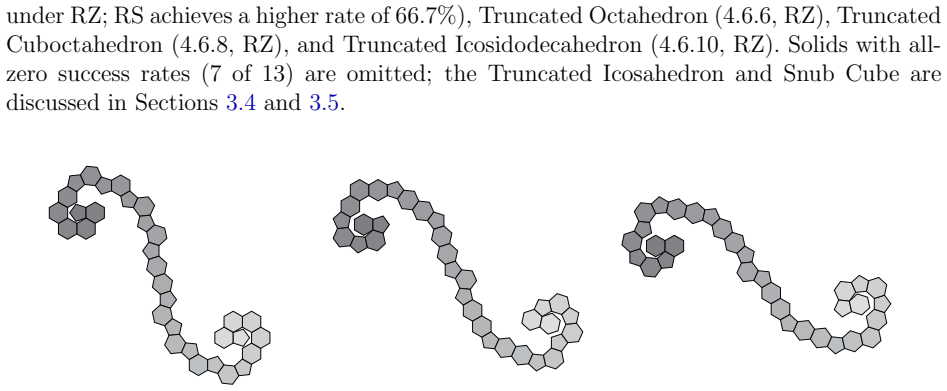
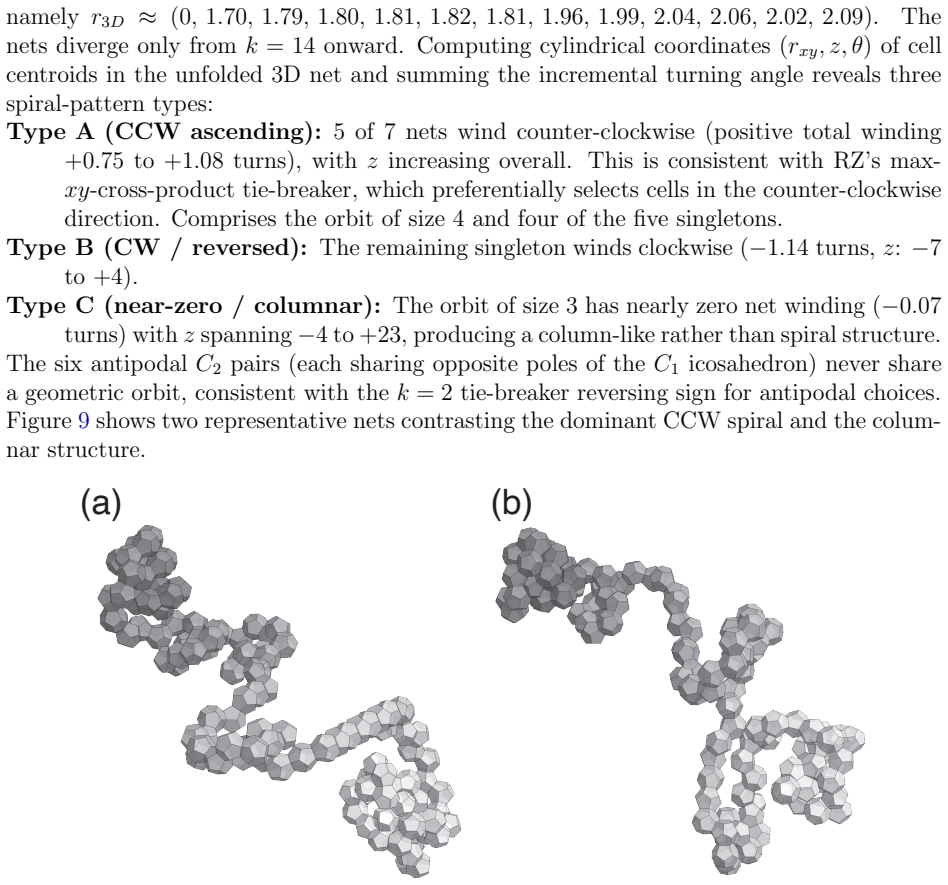
Under the zonal rule every one of the 1,440 possible starting pairs on the 120-cell yields a complete ordering, while the spiral rule yields zero; the 600-cell remains Impossible under both rules. Ordering success is shown to be independent of geometric validity: all 120-cell orderings produce self-intersecting 3D nets, so the polytope has zero valid nets despite its perfect combinatorial result.
What carries the argument
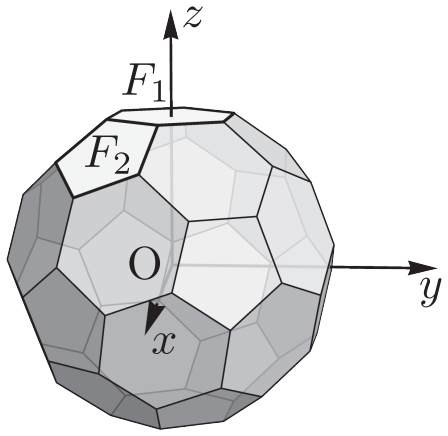
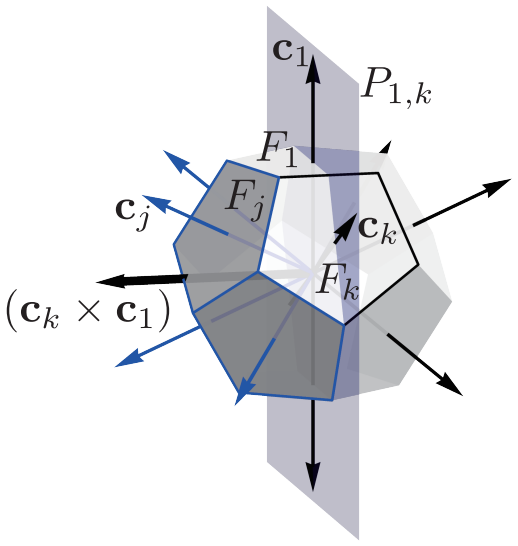
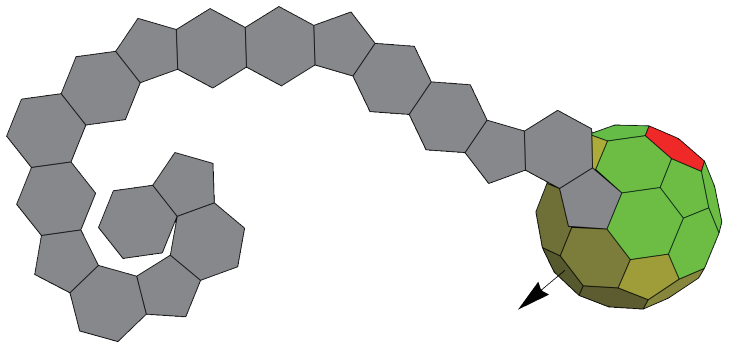
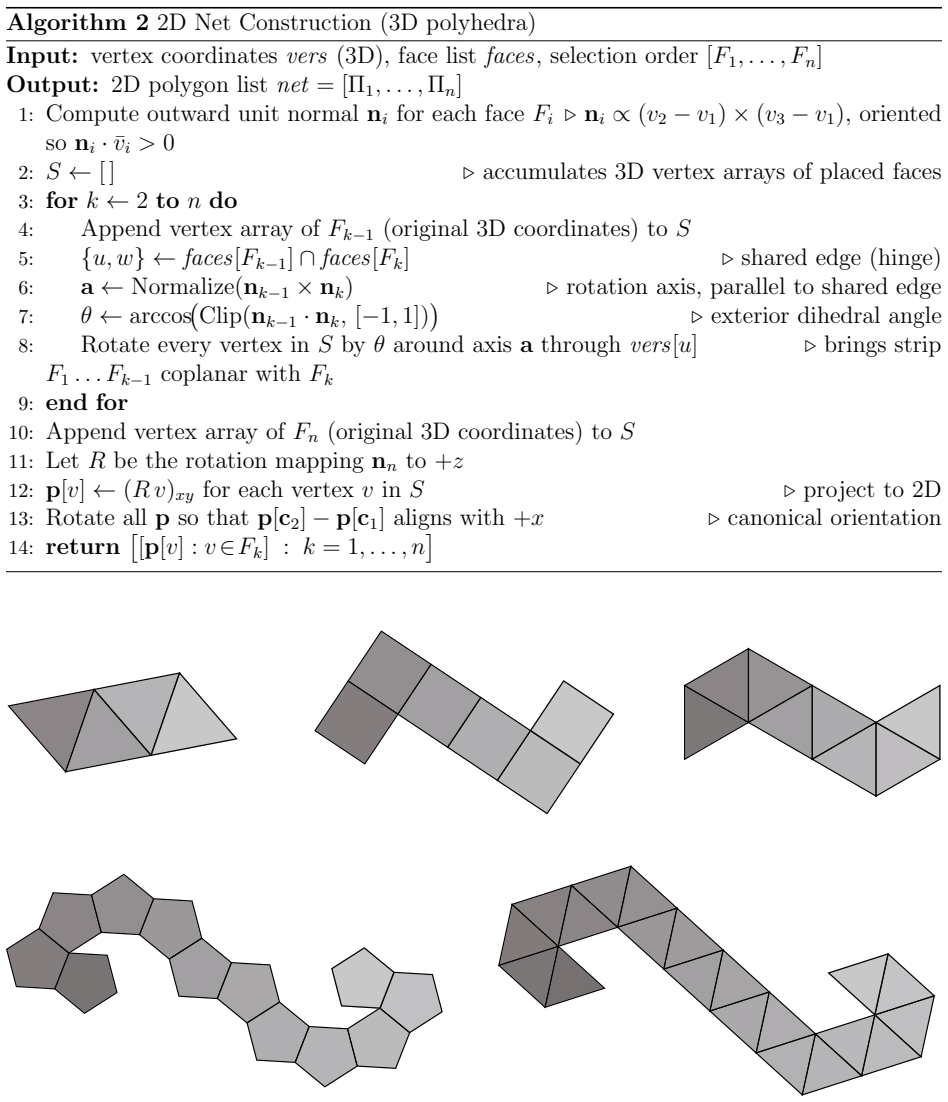
Apple-peel unfolding driven by the zonal rule (maximum coordinate along the peeling axis) and spiral rule (minimum signed determinant), which together generate the sequence of faces or cells.
If this is right
- Face-transitive solids are confined to the 0/100 percent success dichotomy by the equivariance argument.
- The 120-cell admits perfect orderings under the zonal rule yet admits zero non-self-intersecting 3D nets.
- The 600-cell admits no complete orderings under either tested rule.
- The zonal rule outperforms the spiral rule on the majority of the solids examined.
Where Pith is reading between the lines
- The separation of ordering success from geometric validity suggests that apple-peel methods may require an additional post-processing step to detect and avoid intersections in any dimension.
- Because the zonal rule depends on a chosen axis, rotating the axis choice might alter the Perfect/Possible classification for non-regular solids.
- The same two rules could be applied to irregular or non-convex polytopes to test whether the trichotomy remains useful.
Load-bearing premise
That exhaustive enumeration over all starting pairs together with the two fixed deterministic rules is enough to decide the Perfect/Possible/Impossible label without overlooked geometric intersections or hidden implementation choices.
What would settle it
Discovery of even one starting pair on the 120-cell that fails to complete an ordering under the zonal rule, or discovery of one ordering whose 3D realization has no self-intersections.
Figures
read the original abstract
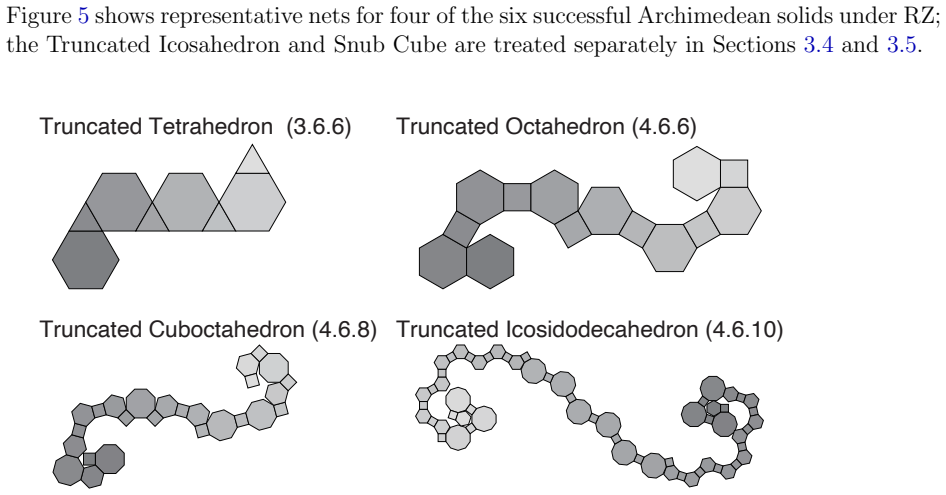
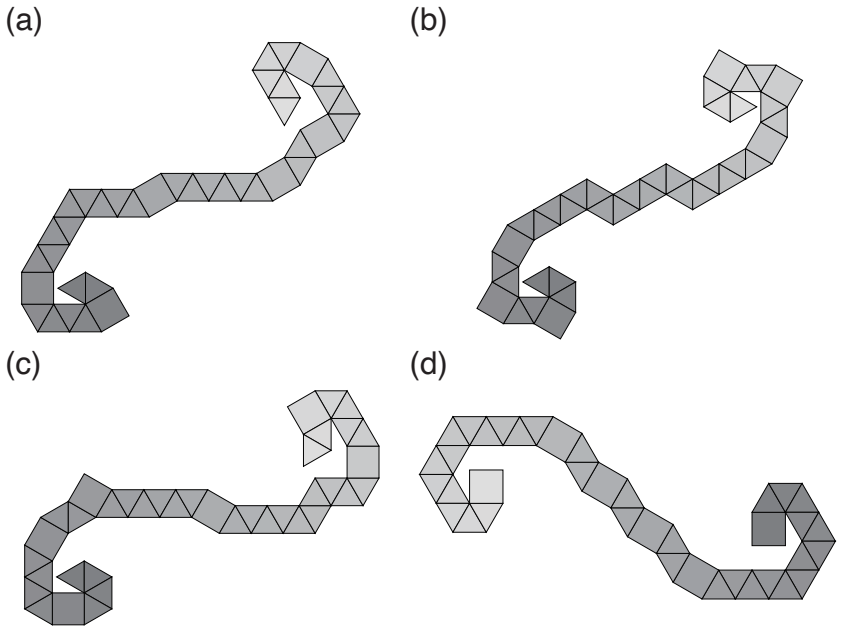
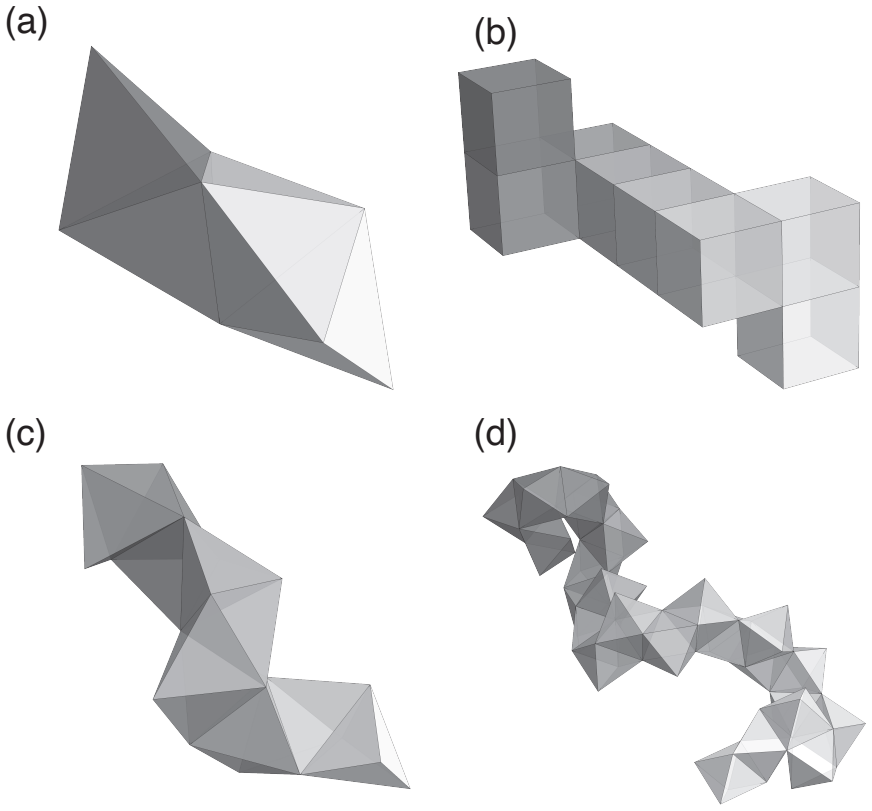
Apple-Peel Unfolding is a greedy algorithm that selects the faces (or cells) of a polyhedron (or polytope) one at a time in a spiral order, producing a net analogous to peeling an apple in a single continuous strip. We define two face-selection rules -- RS (Spiral rule: minimum signed determinant, i.e.\ sharpest clockwise turn) and RZ (Zonal rule: maximum coordinate along the peeling axis) -- and systematically evaluate their unfolding success rates on (i)~the five Platonic solids, (ii)~the thirteen Archimedean solids, and (iii)~the six regular convex 4-polytopes. A principal contribution is a three-way classification of each solid as \emph{Perfect} (every starting pair yields a complete net), \emph{Possible} (at least one pair succeeds), or \emph{Impossible} (no pair succeeds), together with an equivariance argument showing that face-transitive solids are confined to the $0/100\%$ dichotomy. RZ achieves the highest success rates in most cases; for the regular 4-polytopes it is the only rule yielding non-zero results for the 120-cell, where it achieves a Perfect result (1,440/1,440 pairs). We note that \emph{ordering success} (completing the greedy traversal) and \emph{geometric validity} (no self-intersection in the 3D realization) are distinct: every 120-cell ordering produces a self-intersecting 3D net, so the 120-cell has zero valid 3D nets despite its Perfect ordering result. The 600-cell is Impossible under all rules tested.
Editorial analysis
A structured set of objections, weighed in public.
Referee Report
Summary. The manuscript introduces 'Apple-Peel Unfolding', a greedy algorithm for unfolding polyhedra and 4-polytopes into nets by sequentially selecting faces or cells in a spiral manner. Two deterministic selection rules are defined: RS (Spiral rule based on minimum signed determinant for the sharpest clockwise turn) and RZ (Zonal rule based on maximum coordinate along the peeling axis). The rules are tested on the five Platonic solids, thirteen Archimedean solids, and the six regular convex 4-polytopes. The paper provides a three-way classification into Perfect (all starting pairs succeed in producing a complete net), Possible (at least one succeeds), or Impossible (none succeed), supported by an equivariance argument for face-transitive solids. Key results include RZ achieving the highest success rates, with a Perfect result (1440/1440) for the 120-cell under ordering, but all such orderings yield self-intersecting 3D nets, hence zero valid 3D nets. The 600-cell is classified as Impossible.
Significance. If the reported enumerations and geometric validity checks hold, this work offers a systematic and exhaustive classification of the success of two simple greedy unfolding strategies across all regular polytopes in 3D and 4D. The distinction between combinatorial ordering success and geometric non-intersection is important for net generation algorithms, and the equivariance argument provides a theoretical foundation for the 0/100% dichotomy in face-transitive cases. The explicit reporting of counts like 1440/1440 for the 120-cell and the note on self-intersections add concrete data to the literature on unfolding.
major comments (2)
- [Results on regular 4-polytopes] The claim that the 120-cell has zero valid 3D nets despite Perfect ordering success under RZ (1440/1440 pairs) depends on the correctness of the 3D realization and subsequent self-intersection detection for every produced net. The manuscript provides no description of the intersection test implementation, tolerance values, handling of coplanar faces, or the projection from 4D to 3D unfolding. This is load-bearing for the geometric validity conclusion and requires additional details or code to allow verification.
- [Evaluation methodology] While the abstract states clear numerical outcomes for the enumeration over all starting pairs, there are no implementation details, error-bar discussion, or verification steps mentioned for ensuring the 1440/1440 count (and similar counts) is free of floating-point or combinatorial edge cases in the exhaustive enumeration.
minor comments (1)
- The distinction between ordering success and geometric validity is well-noted but could be emphasized earlier in the abstract or introduction for clarity.
Simulated Author's Rebuttal
We thank the referee for their careful reading, recognition of the work's contributions, and constructive feedback on reproducibility. We agree that the manuscript requires additional implementation details and will revise accordingly to strengthen the geometric validity claims and enumeration methodology.
read point-by-point responses
-
Referee: [Results on regular 4-polytopes] The claim that the 120-cell has zero valid 3D nets despite Perfect ordering success under RZ (1440/1440 pairs) depends on the correctness of the 3D realization and subsequent self-intersection detection for every produced net. The manuscript provides no description of the intersection test implementation, tolerance values, handling of coplanar faces, or the projection from 4D to 3D unfolding. This is load-bearing for the geometric validity conclusion and requires additional details or code to allow verification.
Authors: We accept the point that the manuscript lacks sufficient detail on the geometric checks. In the revision we will add a dedicated subsection describing: (i) the 4D-to-3D unfolding via successive orthogonal projections preserving the net topology, (ii) the self-intersection test implemented with exact rational arithmetic on the integer coordinates of the 120-cell (no floating-point for the core test), (iii) an epsilon tolerance of 1e-9 only for boundary cases, and (iv) explicit treatment of coplanar faces as non-intersecting when they share only an edge or vertex. Source code will be offered as supplementary material. These additions directly support the zero-valid-nets conclusion. revision: yes
-
Referee: [Evaluation methodology] While the abstract states clear numerical outcomes for the enumeration over all starting pairs, there are no implementation details, error-bar discussion, or verification steps mentioned for ensuring the 1440/1440 count (and similar counts) is free of floating-point or combinatorial edge cases in the exhaustive enumeration.
Authors: The 1440/1440 (and analogous) counts are obtained by exhaustive traversal of the cell-adjacency graph using only exact integer arithmetic and determinant signs; floating-point appears solely in the later geometric realization step, which is decoupled from the ordering-success classification. We will insert pseudocode for the enumeration loop together with a short verification paragraph noting that the finite, symmetry-reduced search space and exact arithmetic render statistical error bars unnecessary. This makes the Perfect/Impossible classification combinatorially rigorous. revision: yes
Circularity Check
No circularity; results from direct enumeration on external polytopes
full rationale
The paper defines two deterministic selection rules (RS, RZ) and applies them via exhaustive enumeration over starting pairs on the five Platonic solids, thirteen Archimedean solids, and six regular 4-polytopes. The Perfect/Possible/Impossible trichotomy and the 120-cell ordering result (1440/1440) follow directly from running the greedy traversal; the equivariance argument for face-transitive solids is an independent combinatorial observation. No parameters are fitted to the output data, no quantity is defined in terms of itself, and no load-bearing premise reduces to a self-citation chain. The distinction between ordering success and geometric validity is stated explicitly without circular reduction. The derivation is therefore self-contained against the externally given polytope combinatorics.
Axiom & Free-Parameter Ledger
Reference graph
Works this paper leans on
-
[1]
G. C. Shephard, Convex polytopes with convex nets,Math. Proc. Cambridge Philos. Soc.,78(1975), 389–403
1975
-
[2]
E. D. Demaine and J. O’Rourke,Geometric Folding Algorithms: Linkages, Origami, Polyhedra, Cambridge University Press, 2007
2007
-
[3]
Pak,Lectures on Discrete and Polyhedral Geometry, book draft, University of Cali- fornia, Los Angeles, 2010.https://www.math.ucla.edu/ ~pak/book.htm
I. Pak,Lectures on Discrete and Polyhedral Geometry, book draft, University of Cali- fornia, Los Angeles, 2010.https://www.math.ucla.edu/ ~pak/book.htm
2010
-
[4]
Aronov and J
B. Aronov and J. O’Rourke, Nonoverlap of the star unfolding,Discrete Comput. Geom., 8(1992), 219–250
1992
-
[5]
M. Bern, E. D. Demaine, D. Eppstein, E. Kuo, A. Mantler, and J. Snoeyink, Unun- foldable polyhedra with convex faces,Comput. Geom.: Theory Appl.,24(2003), no. 2, 51–62
2003
-
[6]
Schlickenrieder,Nets of Polyhedra, Diplomarbeit (Diploma thesis), Technische Uni- versit¨ at Berlin, 1997
W. Schlickenrieder,Nets of Polyhedra, Diplomarbeit (Diploma thesis), Technische Uni- versit¨ at Berlin, 1997
1997
-
[7]
Lubiw, E
A. Lubiw, E. D. Demaine, M. L. Demaine, A. Schwartz, and J. Snoeyink, Zipper unfold- ings of polyhedral complexes, inProc. 22nd Canadian Conf. Comput. Geom. (CCCG 2010), 219–222
2010
-
[8]
Spiral Unfoldings of Convex Polyhedra
J. O’Rourke, Spiral unfoldings of convex polyhedra, arXiv:1509.00321, 2015
work page internal anchor Pith review Pith/arXiv arXiv 2015
-
[9]
Buekenhout and M
F. Buekenhout and M. Parker, The number of nets of the regular convex polytopes in dimension≤4,Discrete Math.,186(1998), 69–94
1998
-
[10]
H. S. M. Coxeter,Regular Polytopes, 3rd ed., Dover Publications, New York, 1973
1973
- [11]
-
[12]
Samanta and H
S. Samanta and H. A. Akitaya, Path-unfolding the tesseract, inProc. 31st Annual Fall Workshop on Computational Geometry (FWCG 2024), Tufts University, Med- ford, MA, November 15–16, 2024.https://www.cs.tufts.edu/research/geometry/ FWCG24/papers/FWCG_24_paper_5.pdf
2024
-
[13]
Apple Peel Unfolding of Archimedean and Catalan Solids
T. Yoshino and S. Chaidee, Apple peel unfolding of Archimedean and Catalan solids, arXiv:2604.16204, 2026
work page internal anchor Pith review Pith/arXiv arXiv 2026
-
[14]
Kaino, Apple-peel foldouts of four-dimensional regular polytopes: 24, 120 and 600- cells, inSymmetry: Art and Science(Proc
K. Kaino, Apple-peel foldouts of four-dimensional regular polytopes: 24, 120 and 600- cells, inSymmetry: Art and Science(Proc. 11th Interdisciplinary Symmetry Congress- Festival, Kanazawa, Japan, November 25–30, 2019), ISIS-Symmetry, 2019, pp. 142–145. 34
2019
discussion (0)
Sign in with ORCID, Apple, or X to comment. Anyone can read and Pith papers without signing in.