Multi-Scale Magnetic Field Observations Reveal how Colliding Flows Trigger Star Formation
Pith reviewed 2026-06-29 06:09 UTC · model grok-4.3
The pith
U-shaped magnetic field patterns show colliding flows dragging and strengthening fields to regulate star formation across scales.
A machine-rendered reading of the paper's core claim, the machinery that carries it, and where it could break.
Core claim
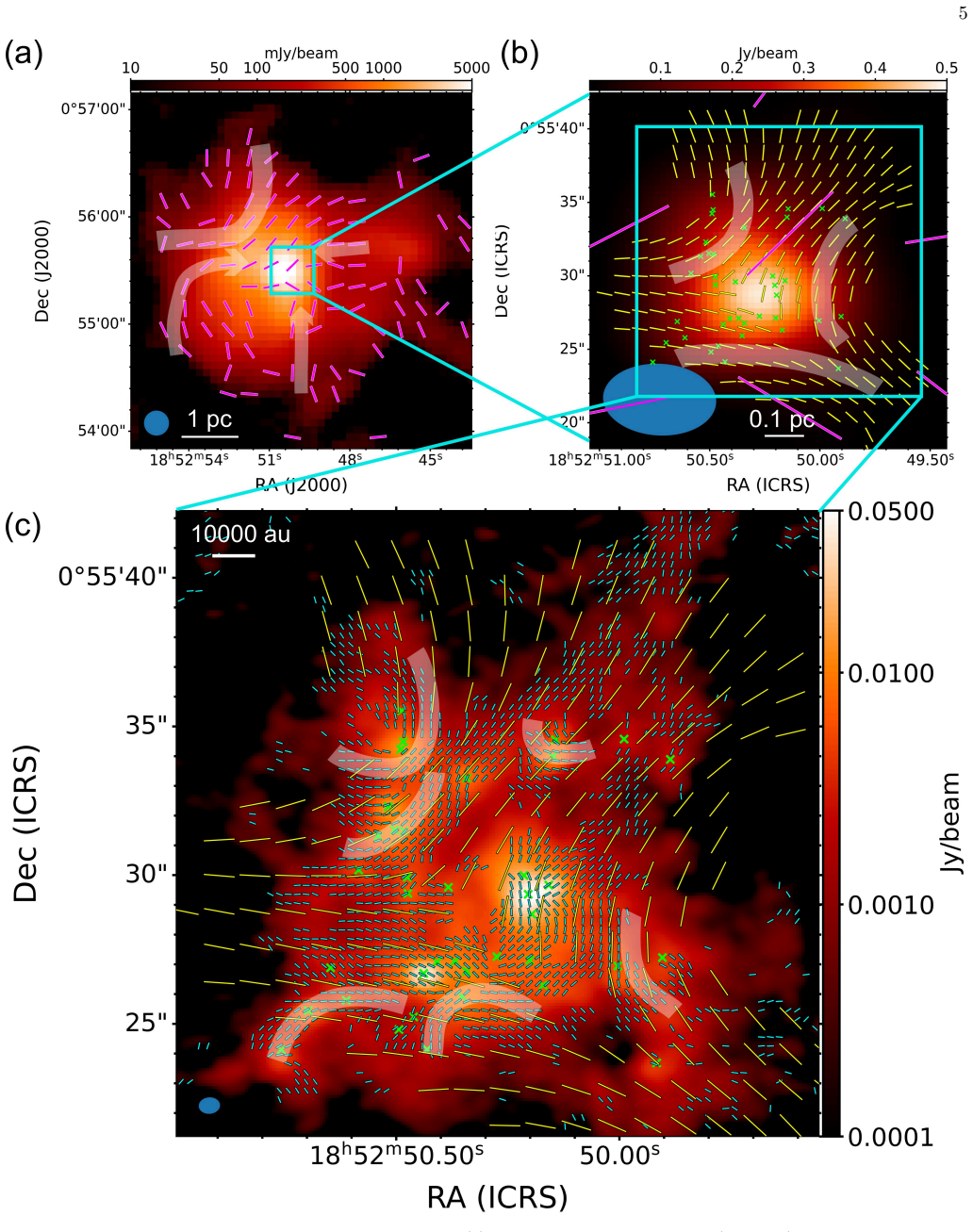
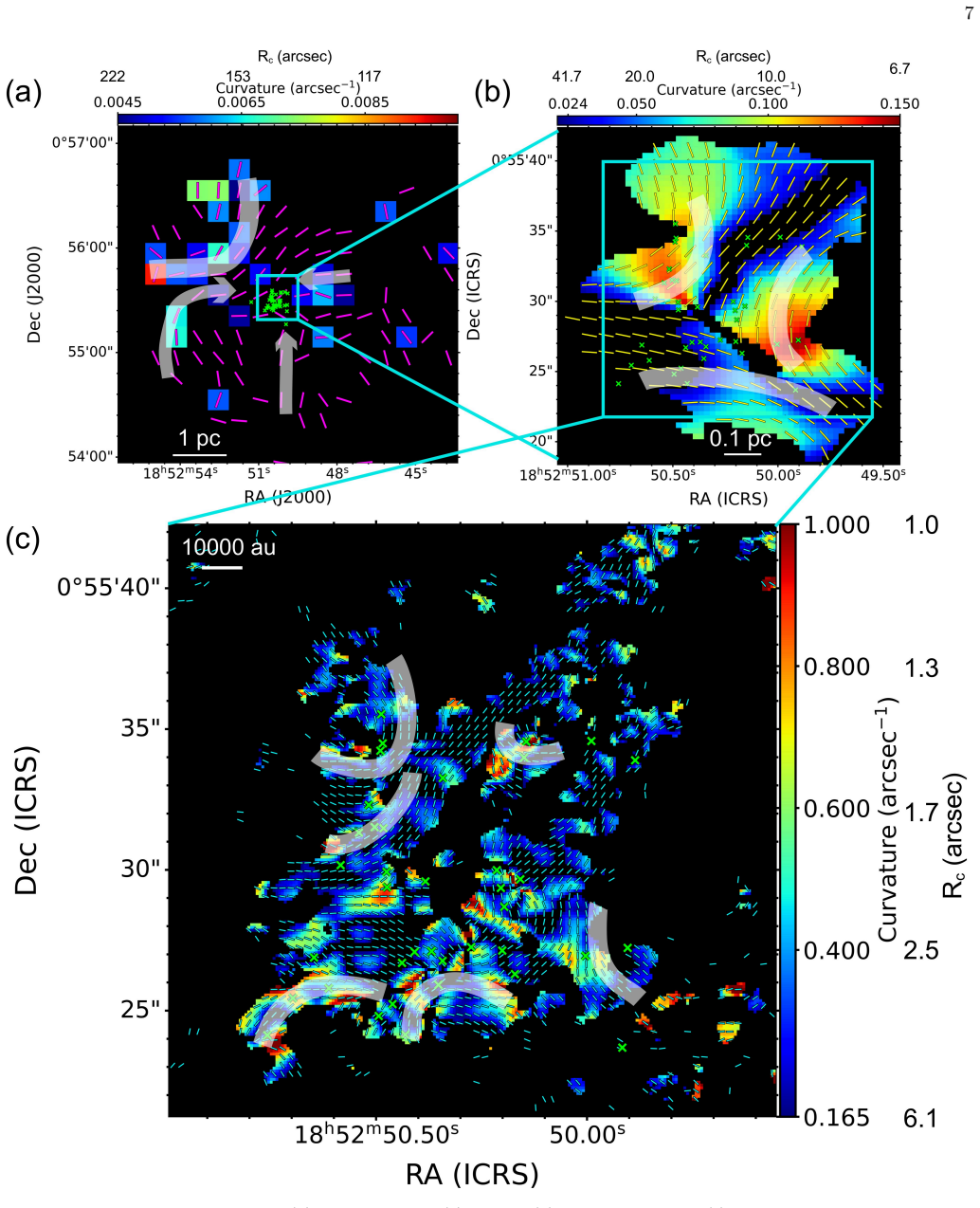
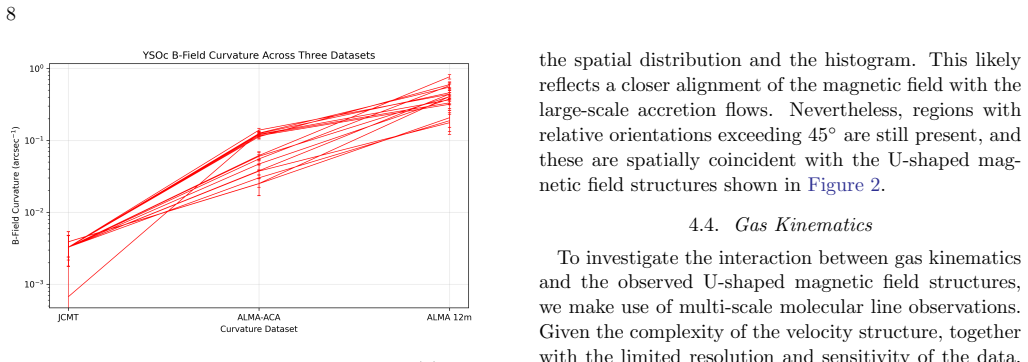
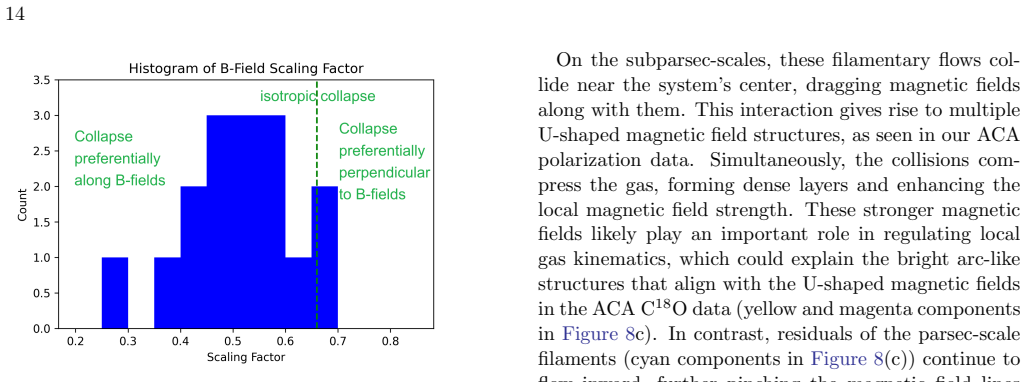
The observations reveal continuous U-shaped magnetic field morphologies from parsec to subparsec scales that converge on a central protocluster, with increasing curvature directly tracing a growing magnetic tension force that scales as B proportional to rho to the power 0.5, implying that colliding flows enhance the field to the point where it can regulate massive star formation.
What carries the argument
U-shaped magnetic field patterns whose increasing curvature directly measures the growing tension force in field lines dragged by colliding flows.
If this is right
- The magnetic field, enhanced by large-scale flow collisions, links parsec-scale dynamics to a subparsec hub-filament system.
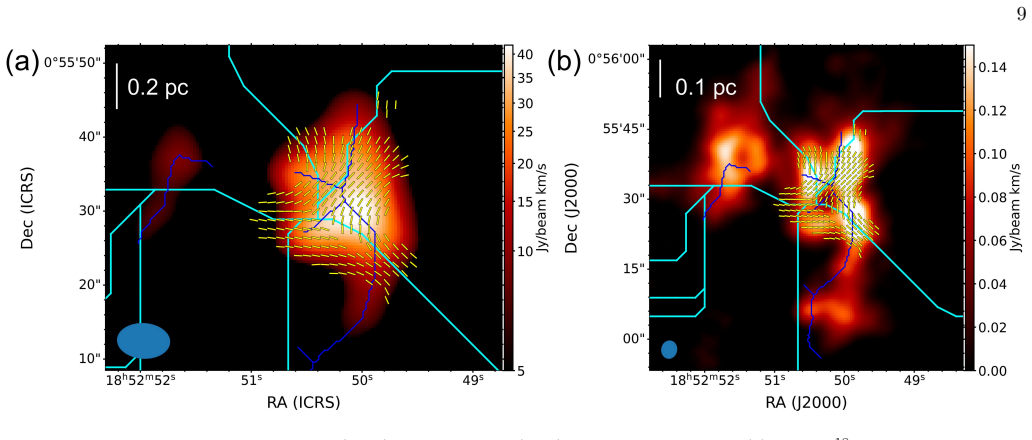
- The field tension becomes strong enough to guide the kinematics of streamers accreting onto dense cores on 4000 au scales.
- Colliding flows can trigger massive protocluster formation by strengthening the magnetic field to a regulatory level.
Where Pith is reading between the lines
- Similar multi-scale polarization mapping in other regions could test whether this colliding-flow mechanism is common in massive star formation.
- The 0.5 scaling index may point to a specific force balance that simulations of flow collisions could be checked against for consistency.
- If the interpretation holds, it implies that magnetic fields play a more active role in channeling accretion than previously modeled in isolated core studies.
Load-bearing premise
The observed U-shaped polarization patterns are produced by colliding flows dragging the magnetic field lines rather than by rotation, outflows, or projection effects, and the measured curvature directly quantifies the tension force without significant contamination.
What would settle it
Independent measurements of field strength across the same scales that fail to show the reported 0.5 scaling index, or higher-resolution data revealing dominant rotation or outflow signatures instead of consistent U-shapes, would disprove the central claim.
Figures
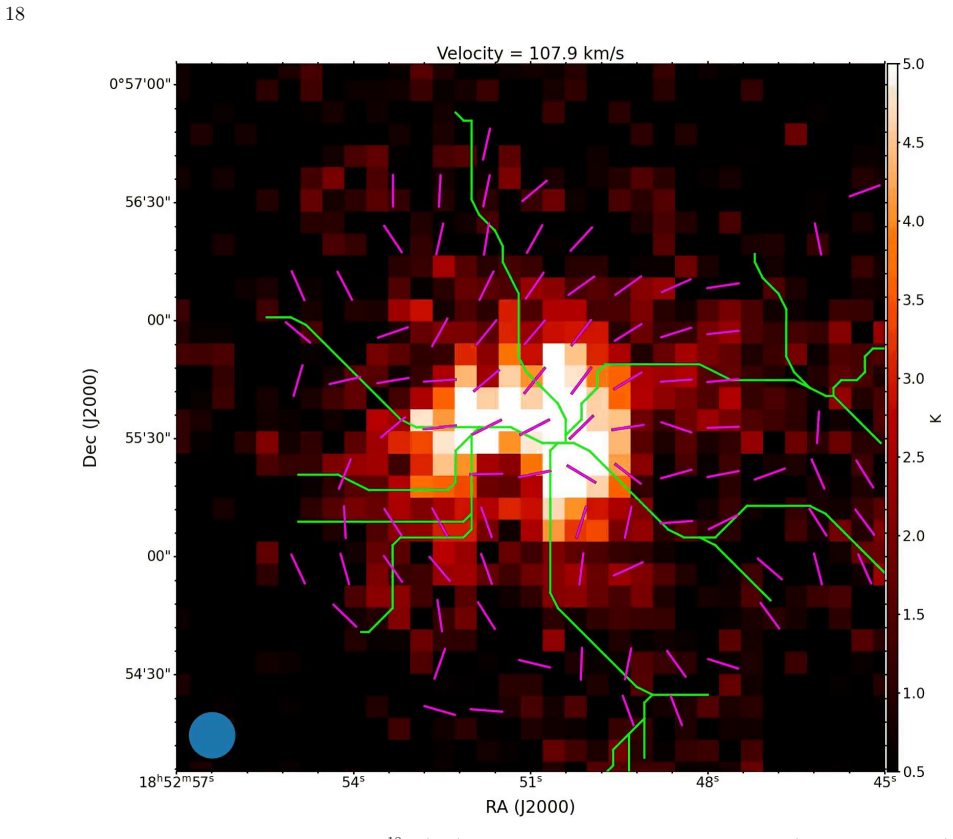
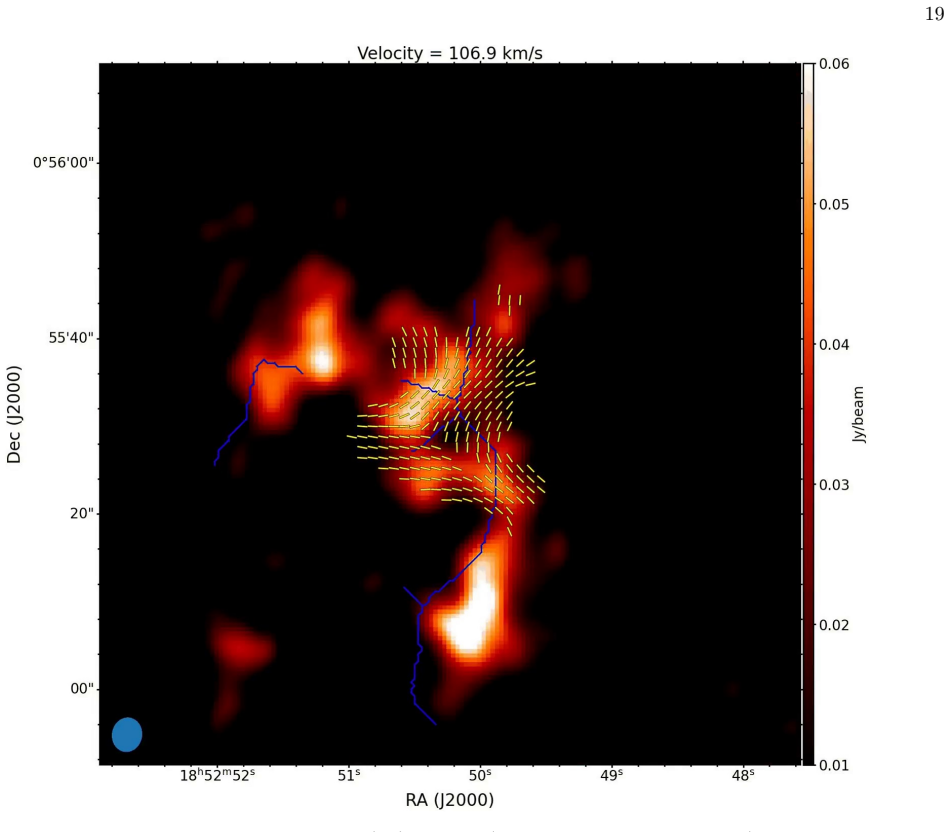
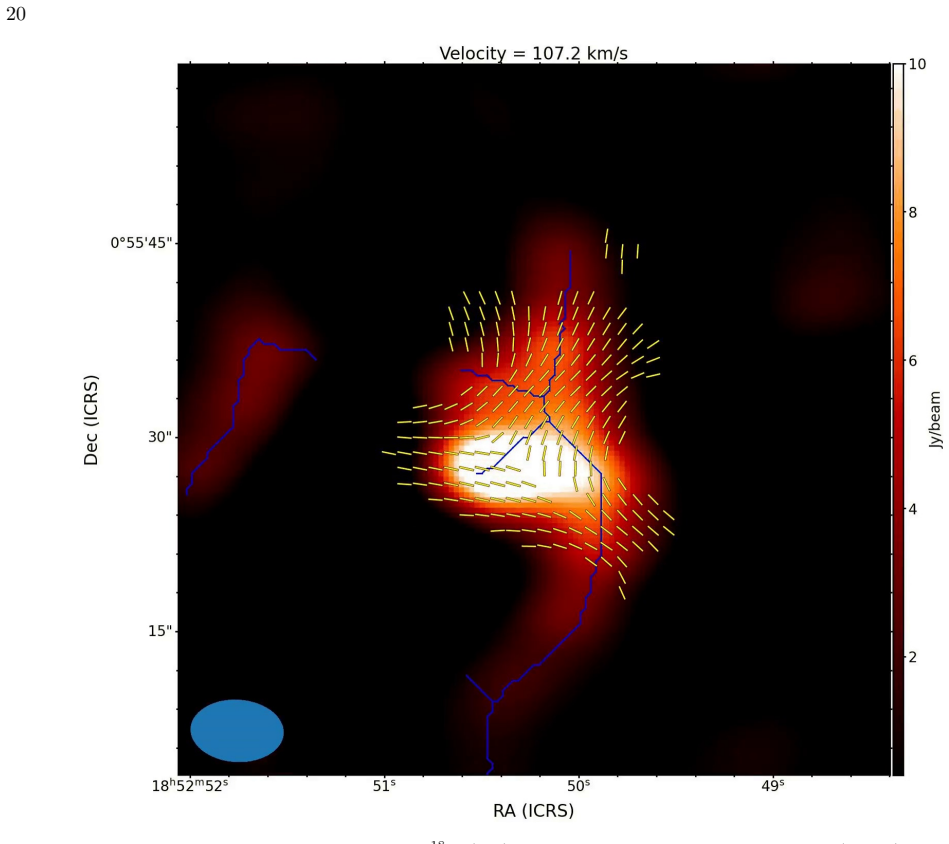
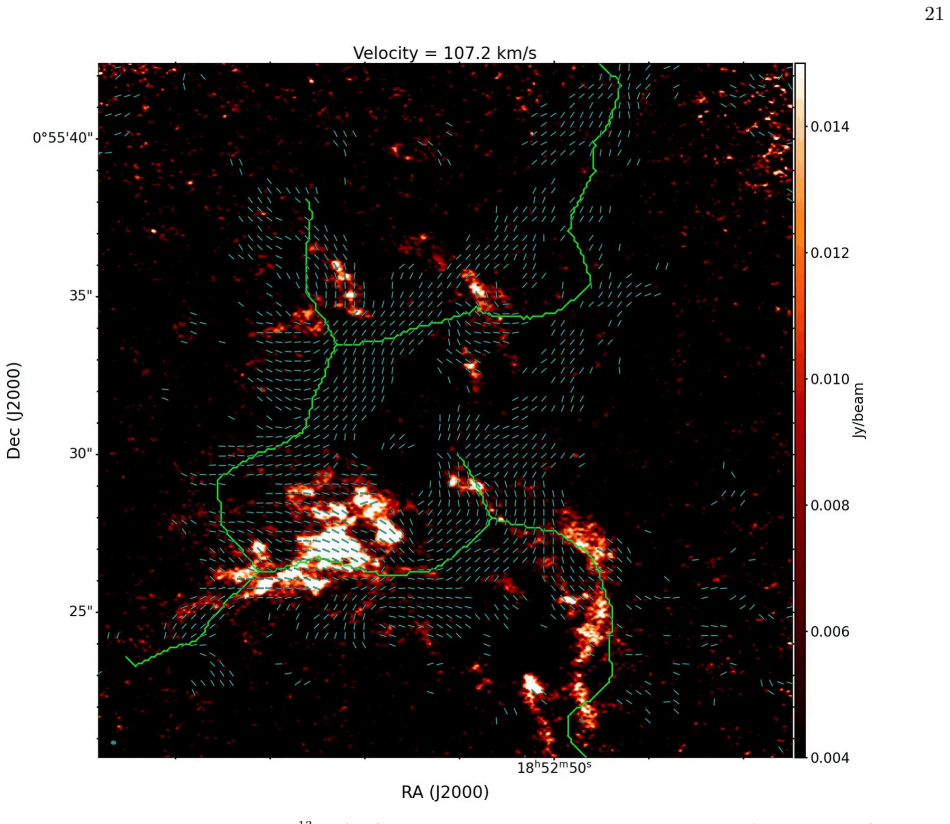
read the original abstract
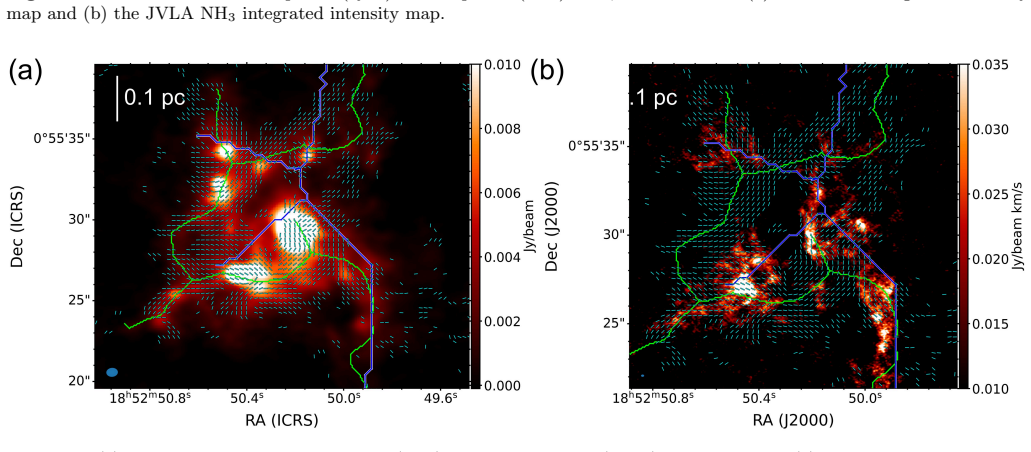
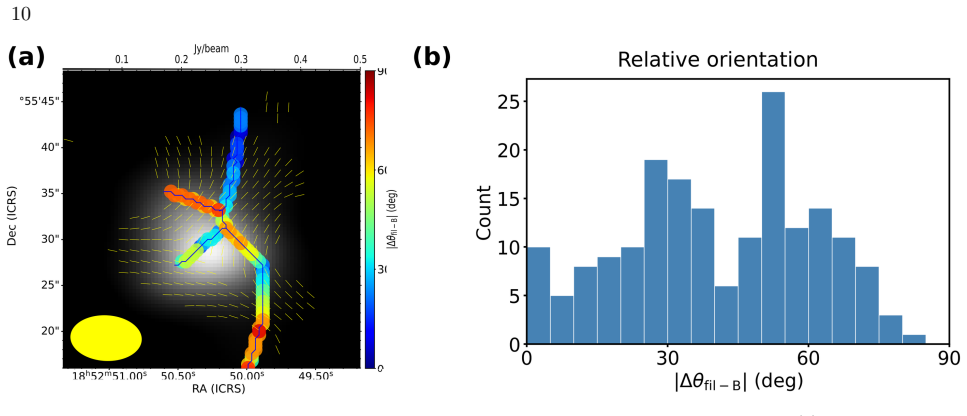
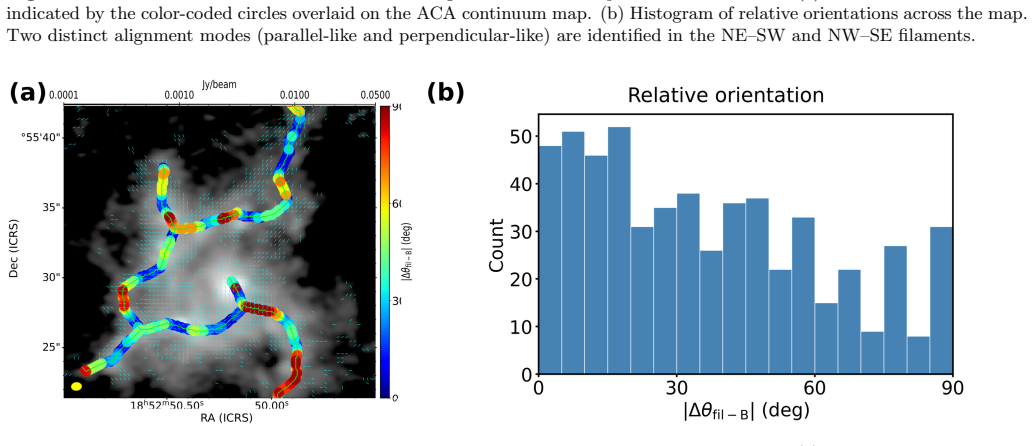
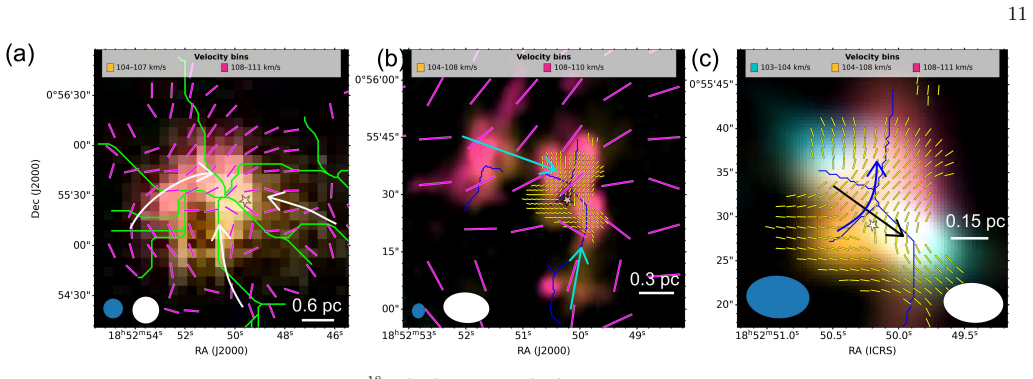
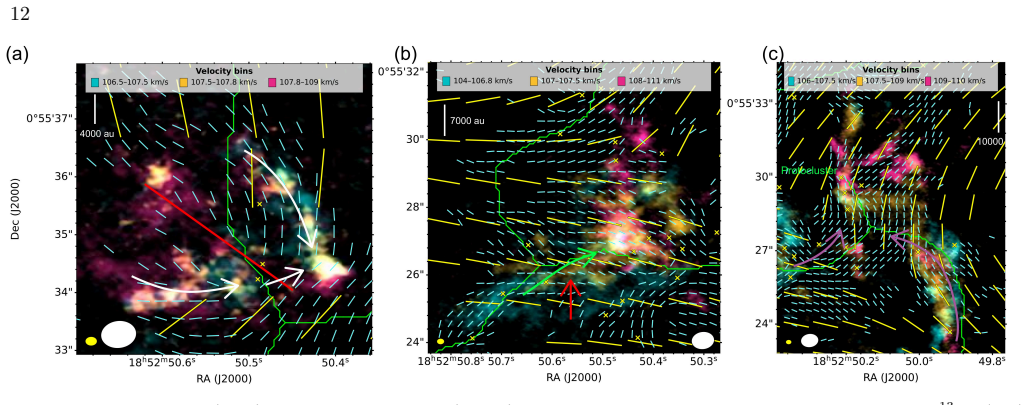
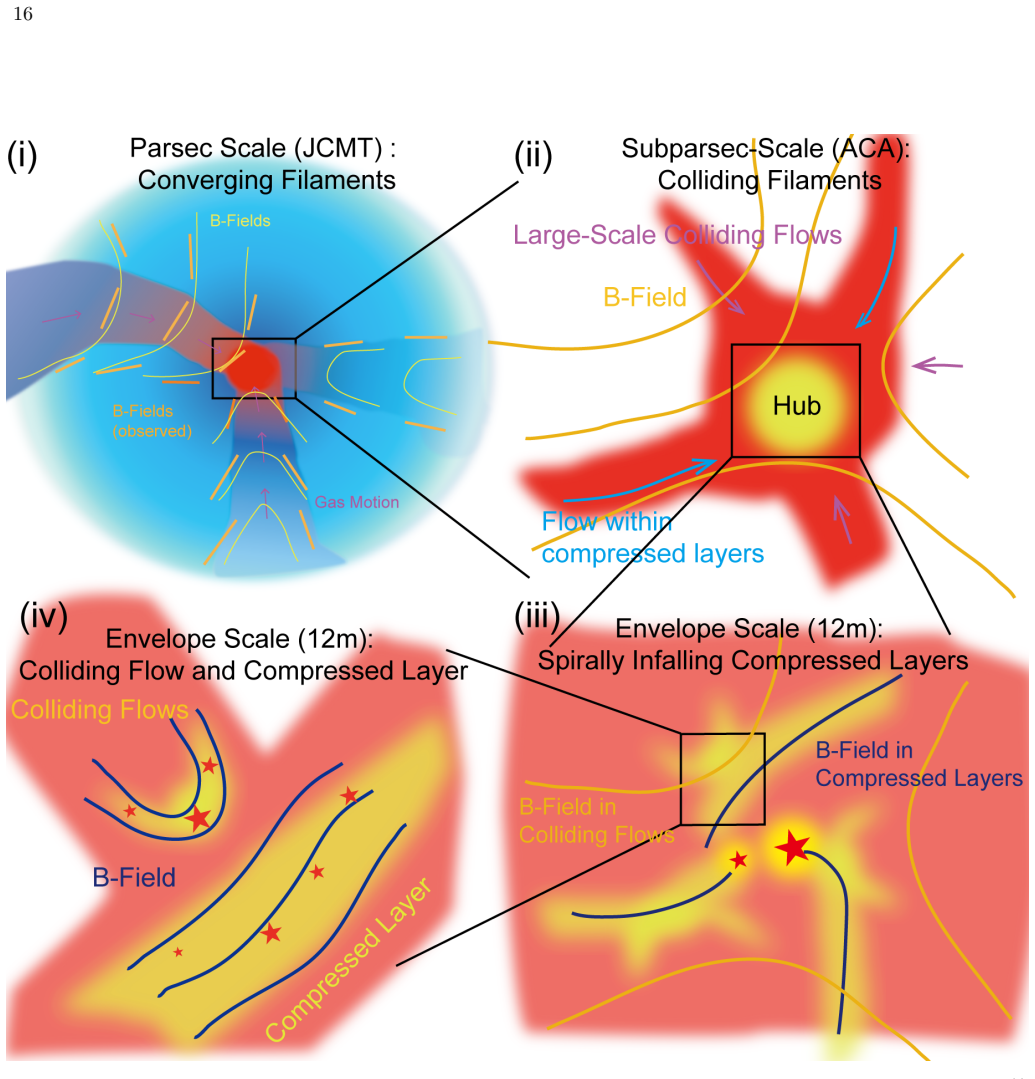
Magnetic fields play a crucial yet complex role in star formation, while their connection between large-scale filamentary clouds and small-scale young stellar objects remains poorly understood. We present new continuum polarization observations from the JCMT, ACA, and ALMA that provide continuous magnetic field measurements from approximately 5 pc down to approximately 4000 au, tracing for the first time the evolution of field morphology seamlessly across all key scales within a massive star-forming system. Our polarization maps reveal multiple U-shaped magnetic field structures pointing toward the central protocluster, aligned with accreting filaments from parsec to subparsec scales and converging at the compact center. This morphology suggests an environment of colliding flows that drag magnetic fields and trigger massive protocluster formation. On approximately 4000 au scales, we identify compact U-shaped fields likely guiding the kinematics of streamers accreting onto dense cores. The increasing curvature of these U-shaped patterns is a direct measure of a growing magnetic field tension force, implying a magnetic field strength scaling index of 0.50 +/- 0.10. These results indicate that the field, possibly enhanced by large-scale flow collisions, becomes strong enough to regulate star formation, linking parsec-scale colliding flows, a subparsec hub-filament system, and the triggering of massive star formation.
Editorial analysis
A structured set of objections, weighed in public.
Referee Report
Summary. The paper presents multi-scale polarization observations (JCMT, ACA, ALMA) tracing magnetic field morphology continuously from ~5 pc to ~4000 au in a massive star-forming system. It reports U-shaped field structures aligned with accreting filaments, interprets these as signatures of colliding flows dragging the fields, and derives a magnetic field strength scaling index of 0.50 ± 0.10 from the increasing curvature of the U-shapes, concluding that the field becomes strong enough to regulate star formation.
Significance. If the central interpretation holds, the work supplies one of the few seamless observational links between parsec-scale flows and sub-parsec core accretion, with a quantitative scaling relation that could be tested against simulations. The continuous multi-instrument coverage is a clear technical strength.
major comments (3)
- [Abstract / results] Abstract and results section: the headline claim equates observed increase in U-shaped polarization curvature directly to growing magnetic tension force and a B scaling index of 0.50 ± 0.10. No explicit equation is supplied that converts measured curvature radius to the tension term (B·∇)B/4π, nor is dominance over magnetic pressure or other forces demonstrated at each scale.
- [Abstract / discussion] Abstract and discussion: the attribution of U-shaped morphology to colliding flows (rather than rotation, outflows, gravitational convergence, or projection) is presented without quantitative tests against alternative dynamical models or synthetic polarization maps that include line-of-sight integration and beam smearing.
- [Results] Results: no independent B-field strength estimates (DCF, Zeeman, or otherwise) are reported at multiple scales to anchor or validate the derived scaling index; the index therefore rests entirely on the curvature-to-tension conversion whose robustness is not quantified.
minor comments (2)
- [Figures] Figure captions should explicitly state the spatial resolution and polarization angle uncertainty at each scale to allow readers to assess beam-smearing effects on curvature measurements.
- [Results] The error budget on the reported index (0.50 ± 0.10) is not detailed; the text should clarify how measurement uncertainties in curvature propagate into the final uncertainty.
Simulated Author's Rebuttal
We thank the referee for the positive assessment of the multi-scale observational coverage and for the constructive major comments. We address each point below and will revise the manuscript accordingly to strengthen the presentation of the force balance and interpretation.
read point-by-point responses
-
Referee: [Abstract / results] Abstract and results section: the headline claim equates observed increase in U-shaped polarization curvature directly to growing magnetic tension force and a B scaling index of 0.50 ± 0.10. No explicit equation is supplied that converts measured curvature radius to the tension term (B·∇)B/4π, nor is dominance over magnetic pressure or other forces demonstrated at each scale.
Authors: We agree that an explicit equation linking curvature radius R to the tension term (B·∇)B/4π ≈ B²/R (in cgs units) was omitted from the abstract and results summary. The scaling index of 0.50 ± 0.10 follows from assuming tension dominates the observed curvature increase across scales. We will insert the equation, derive the index step-by-step, and add a force-balance comparison (tension vs. pressure and gravity) at representative scales in the revised results section. revision: yes
-
Referee: [Abstract / discussion] Abstract and discussion: the attribution of U-shaped morphology to colliding flows (rather than rotation, outflows, gravitational convergence, or projection) is presented without quantitative tests against alternative dynamical models or synthetic polarization maps that include line-of-sight integration and beam smearing.
Authors: The interpretation rests on the observed alignment of U-shapes with velocity-coherent accreting filaments and their convergence at the protocluster. While the manuscript discusses why rotation and outflows are inconsistent with the parsec-scale morphology and kinematics, we did not include synthetic polarization maps. We will expand the discussion with additional arguments against projection effects and gravitational convergence alone, and note the absence of full synthetic tests as a limitation. revision: partial
-
Referee: [Results] Results: no independent B-field strength estimates (DCF, Zeeman, or otherwise) are reported at multiple scales to anchor or validate the derived scaling index; the index therefore rests entirely on the curvature-to-tension conversion whose robustness is not quantified.
Authors: Our dataset does not contain the line-of-sight velocity dispersion or Zeeman measurements needed for independent DCF or Zeeman estimates at all scales. The scaling is derived from the curvature method under the assumption that tension sets the observed U-shape radius. We will add a dedicated subsection quantifying the assumptions, uncertainties, and sensitivity of the index to those assumptions. revision: yes
Circularity Check
No significant circularity; scaling index derived from observed curvature morphology
full rationale
The paper's central claim rests on multi-scale polarization maps showing U-shaped field structures whose increasing curvature is interpreted as growing magnetic tension, yielding a B scaling index of 0.50 ± 0.10. This index follows directly from measured curvature changes across scales rather than from any fitted parameter that is then relabeled as a prediction. No self-citation chain, ansatz smuggling, or self-definitional loop is present in the provided abstract or described derivation; the result is an observational inference under standard polarization-to-B assumptions. This matches the reader's assessment of minor (score-2) circularity risk only from interpretive assumptions, not from definitional reduction.
Axiom & Free-Parameter Ledger
free parameters (1)
- magnetic field strength scaling index =
0.50 +/- 0.10
axioms (1)
- domain assumption Dust continuum polarization reliably traces the plane-of-sky magnetic field orientation
Reference graph
Works this paper leans on
-
[1]
, " * write output.state after.block = add.period write newline
ENTRY address archivePrefix author booktitle chapter doi edition editor eprint howpublished institution journal key month number organization pages publisher school series title misctitle type volume year version url label extra.label sort.label short.list INTEGERS output.state before.all mid.sentence after.sentence after.block FUNCTION init.state.consts ...
-
[2]
write newline
" write newline "" before.all 'output.state := FUNCTION format.url url empty "" new.block "" url * "" * if FUNCTION format.eprint eprint empty "" archivePrefix empty "" archivePrefix "arXiv" = new.block " " eprint * " " * new.block " " eprint * " " * if if if FUNCTION format.doi doi empty "" " " doi * " " * if FUNCTION format.pid doi empty eprint empty ur...
-
[3]
- [1] #1 = = ^ ^ ^ .\!\!^ d .\!\!^ h .\!\!^ m .\!\!^ s .\!\!^ @mss
thebibliography [1] 20pt to REFERENCES 6pt =0pt 10pt plus 3pt =0pt =0pt =1pt plus 1pt =0pt =0pt -12pt =13pt plus 1pt =20pt =13pt plus 1pt \@M =10000 =-1.0em =0pt =0pt 0pt =0pt =1.0em @enumiv\@empty 10000 10000 `\.\@m \@noitemerr \@latex@warning Empty `thebibliography' environment \@ifnextchar \@reference \@latexerr Missing key on reference command Each re...
discussion (0)
Sign in with ORCID, Apple, or X to comment. Anyone can read and Pith papers without signing in.