From Waves to Graphs: A Ray-Tracing-Inspired Neural Radio Propagation Model
Pith reviewed 2026-06-29 00:12 UTC · model grok-4.3
The pith
A graph extracted from a 3D point cloud lets neural message passing predict radio signal strength following ray-tracing rules.
A machine-rendered reading of the paper's core claim, the machinery that carries it, and where it could break.
Core claim
By converting a 3D propagation environment into a point cloud and then into an equivalent graph, neural message passing over the graph can accurately infer radio-related quantities such as received signal strength in three dimensions, while learning from both synthetic ray-tracing data and real-world measurements.
What carries the argument
The equivalent graph representation of the radio environment, on which neural message passing is performed to propagate radio quantities.
If this is right
- The model functions as a radio-environment digital twin for network planning tasks.
- Inference runs at low latency once the graph is built, supporting repeated queries.
- Training is possible on both synthetic data from existing ray tracers and real measurement traces.
- The same graph structure supports estimation of multiple radio quantities beyond single-link signal strength.
Where Pith is reading between the lines
- The graph encoding could be extended to include time-varying elements such as moving vehicles if node and edge features are updated dynamically.
- Similar point-cloud-to-graph pipelines might apply to acoustic or optical propagation if the message-passing rules are adjusted for the governing wave physics.
- Hierarchical or multi-resolution graphs could be tested to handle city-scale scenes without prohibitive memory use.
Load-bearing premise
The point-cloud-to-graph conversion must keep enough geometric and material detail that message passing can reproduce the results of physical ray propagation.
What would settle it
Measure prediction error on a held-out set of receiver locations whose signal strengths were obtained either from a calibrated ray tracer or from field measurements in the same 3D scene.
Figures
read the original abstract
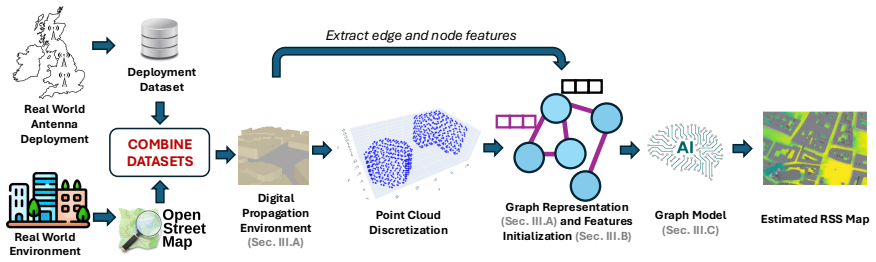
Artificial intelligence-driven radio propagation models provide agile and robust solutions for mobile network operators in their effort to ensure the optimal performance of the wireless ecosystem and support its efficient expansion. In this paper, we introduce GRAPHWAVE, a neural graph-driven propagation solver hinging on the governing principles of ray tracing. The proposed model leverages a digitized version of the propagation environment to build a point cloud and extract an equivalent graph representation of the radio environment. By applying neural message passing over the equivalent graph, it allows the model to accurately infer radio-related quantities, e.g., received signal strength, in a three-dimensional environment. We showcase the use of GRAPHWAVE as a radio environment digital twin and we demonstrate that the model can learn from synthetic and real-world data while achieving low inference times.
Editorial analysis
A structured set of objections, weighed in public.
Referee Report
Summary. The paper introduces GRAPHWAVE, a neural graph-driven propagation solver inspired by ray-tracing principles. It converts a digitized 3D radio environment into a point cloud, derives an equivalent graph representation, and applies neural message passing to predict radio quantities such as received signal strength. The model is positioned as a digital twin that learns from both synthetic and real-world data while offering low inference times.
Significance. If the graph construction and message-passing steps can be shown to faithfully reproduce multi-path propagation effects, the approach would supply a fast, learnable surrogate for classical ray tracing that is directly usable for network planning and digital-twin applications. The explicit grounding in ray-tracing geometry is a positive feature that distinguishes it from purely data-driven baselines.
major comments (2)
- [Abstract / §3 (graph construction)] The central claim (abstract and §3) that neural message passing over the point-cloud-derived graph accurately infers RSS requires that the graph construction step encodes line-of-sight, reflection, diffraction, and material coefficients along multi-bounce paths. No derivation or bound is supplied showing that the chosen node/edge features and connectivity preserve the information needed for these interactions; without such an argument the equivalence to ray tracing remains an unverified assumption.
- [§4–5 (results)] Validation experiments (presumably §4–5) must demonstrate that prediction error remains low when the number of bounces or the material diversity increases. If the reported accuracy holds only for simple LOS or single-bounce scenarios, the claim of general 3-D applicability is not supported.
minor comments (2)
- [Abstract] The abstract states that the model “achieves low inference times” but supplies no wall-clock or complexity comparison against a conventional ray tracer on the same scenes.
- [§3] Notation for the graph construction (node features, edge attributes, message-passing update rules) should be introduced with explicit equations rather than prose descriptions.
Simulated Author's Rebuttal
We thank the referee for the constructive comments. We address each major comment below and describe the revisions planned for the manuscript.
read point-by-point responses
-
Referee: [Abstract / §3 (graph construction)] The central claim (abstract and §3) that neural message passing over the point-cloud-derived graph accurately infers RSS requires that the graph construction step encodes line-of-sight, reflection, diffraction, and material coefficients along multi-bounce paths. No derivation or bound is supplied showing that the chosen node/edge features and connectivity preserve the information needed for these interactions; without such an argument the equivalence to ray tracing remains an unverified assumption.
Authors: We agree that the manuscript does not supply a formal derivation or bound establishing that the graph features and connectivity fully preserve the required multi-path information. In the revision we will expand §3 with an explicit mapping from ray-tracing geometry to the chosen node and edge attributes (distances, incidence angles, material coefficients, and connectivity rules), together with a qualitative argument showing how successive message-passing steps can accumulate contributions from line-of-sight, single-bounce, and higher-order paths. We will also note the assumptions and limitations of this encoding. revision: yes
-
Referee: [§4–5 (results)] Validation experiments (presumably §4–5) must demonstrate that prediction error remains low when the number of bounces or the material diversity increases. If the reported accuracy holds only for simple LOS or single-bounce scenarios, the claim of general 3-D applicability is not supported.
Authors: The existing experiments cover a range of scenarios that include multiple bounces and several material types, yet we acknowledge that the breadth may be insufficient to substantiate the general 3-D claim. In the revised results section we will add targeted experiments that systematically increase the maximum number of bounces (up to five) and the number of distinct materials, reporting the corresponding RSS prediction errors and comparing them against the simpler cases already presented. revision: yes
Circularity Check
No circularity: model description contains no equations, fitted predictions, or self-citation chains
full rationale
The provided abstract and description introduce GRAPHWAVE as a neural graph model that converts a 3D environment to a point cloud then graph and applies message passing to infer RSS. No equations, parameters fitted to data then renamed as predictions, or load-bearing self-citations appear. The approach is presented as an empirical neural solver inspired by ray tracing rather than a derivation that reduces to its inputs by construction. This matches the default expectation of a non-circular paper.
Axiom & Free-Parameter Ledger
Reference graph
Works this paper leans on
-
[1]
The roadmap to 6g: Ai empowered wireless networks,
K. B. Letaief et al., “The roadmap to 6g: Ai empowered wireless networks,”IEEE Commun. Mag., vol. 57, no. 8, pp. 84–90, 2019
2019
-
[2]
Artificial intelligence enabled radio propagation for communications—part ii: Scenario identification and channel modeling,
C. Huang et al., “Artificial intelligence enabled radio propagation for communications—part ii: Scenario identification and channel modeling,”IEEE Trans. Antennas Propag., vol. 70, no. 6, 2022
2022
-
[3]
Empowering wireless network applications with deep learning-based radio propagation models,
S. Bakirtzis et al., “Empowering wireless network applications with deep learning-based radio propagation models,”IEEE Wirel. Com- mun., 2025
2025
-
[4]
Macrocell path-loss prediction using artificial neural networks,
E. Ostlin et al., “Macrocell path-loss prediction using artificial neural networks,”IEEE Trans. Veh. Technol, vol. 59, no. 6, pp. 2735–2747, 2010
2010
-
[5]
A ray launching-neural network approach for radio wave propagation analysis in complex indoor environments,
L. Azpilicueta et al., “A ray launching-neural network approach for radio wave propagation analysis in complex indoor environments,” IEEE Trans. Antennas Propag, vol. 62, no. 5, pp. 2777–2786, 2014
2014
-
[6]
Cellular network radio propagation modeling with deep convolutional neural networks,
X. Zhang et al., “Cellular network radio propagation modeling with deep convolutional neural networks,” inProc. 26th ACM SIGKDD Int. Conf. Knowl. Discovery & Data Mining,, 2020, pp. 2378–2386
2020
-
[7]
Radiounet: Fast radio map estimation with convolu- tional neural networks,
R. Levie et al., “Radiounet: Fast radio map estimation with convolu- tional neural networks,”IEEE Trans. Wirel. Commun., vol. 20, no. 6, pp. 4001–4015, 2021
2021
-
[8]
EM DeepRay: An expedient, generalizable and realistic data-driven indoor propagation model,
S. Bakirtzis et al., “EM DeepRay: An expedient, generalizable and realistic data-driven indoor propagation model,”IEEE Trans. Antennas Propag., vol. 70, no. 6, pp. 4140–4154, 2022
2022
-
[9]
Radionet: Transformer based radio map pre- diction model for dense urban environments,
Y . Tian et al., “Radionet: Transformer based radio map pre- diction model for dense urban environments,”arXiv preprint arXiv:2105.07158, 2021
-
[10]
Ray tracing for radio propagation modeling: Principles and applications,
Z. Yun et al., “Ray tracing for radio propagation modeling: Principles and applications,”IEEE access, vol. 3, pp. 1089–1100, 2015
2015
-
[11]
D. K. Cheng et al.,Field and wave electromagnetics. Pearson Educa- tion India, 1989
1989
-
[12]
Data-driven radio propagation modeling using graph neural networks,
A. Bufort et al., “Data-driven radio propagation modeling using graph neural networks,”arXiv preprint arXiv:2501.06236, 2025
-
[13]
A graph neural network based radio map construc- tion method for urban environment,
G. Chen et al., “A graph neural network based radio map construc- tion method for urban environment,”IEEE Communications Letters, vol. 27, no. 5, pp. 1327–1331, 2023
2023
-
[14]
Neural message passing for quantum chemistry,
J. Gilmer et al., “Neural message passing for quantum chemistry,” inInternational conference on machine learning, PMLR, 2017, pp. 1263–1272
2017
-
[15]
E (n) equivariant graph neural networks,
V . G. Satorras et al., “E (n) equivariant graph neural networks,” inInternational conference on machine learning, PMLR, 2021, pp. 9323–9332
2021
-
[16]
OpenStreetMap contributors,Planet dump retrieved from https://planet.osm.org, https://www.openstreetmap.org, 2017
2017
-
[17]
[Online]
Blender Foundation,Blender - A 3D Modelling and Rendering Tool, Accessed: 2025-03-26. [Online]. Available: https://www.blender.org/
2025
-
[18]
Sionna rt: Differentiable ray tracing for radio propagation modeling,
J. Hoydis et al., “Sionna rt: Differentiable ray tracing for radio propagation modeling,” in2023 IEEE Globecom Workshops (GC Wkshps), 2023, pp. 317–321.DOI: 10.1109/GCWkshps58843.2023. 10465179
-
[19]
Comparison of propagation models accuracy for wimax on 3.5 ghz,
J. Milanovic et al., “Comparison of propagation models accuracy for wimax on 3.5 ghz,” in2007 14th IEEE Int. Conf. Electr. Cir. Syst., IEEE, 2007, pp. 111–114
2007
discussion (0)
Sign in with ORCID, Apple, or X to comment. Anyone can read and Pith papers without signing in.