Tailoring Defects in Photonic Time Crystals for Coherent Energy Control
Pith reviewed 2026-06-29 05:25 UTC · model grok-4.3
The pith
Defects in photonic time crystals can be optimized to achieve prescribed coherent amplification and suppression of optical energy.
A machine-rendered reading of the paper's core claim, the machinery that carries it, and where it could break.
Core claim
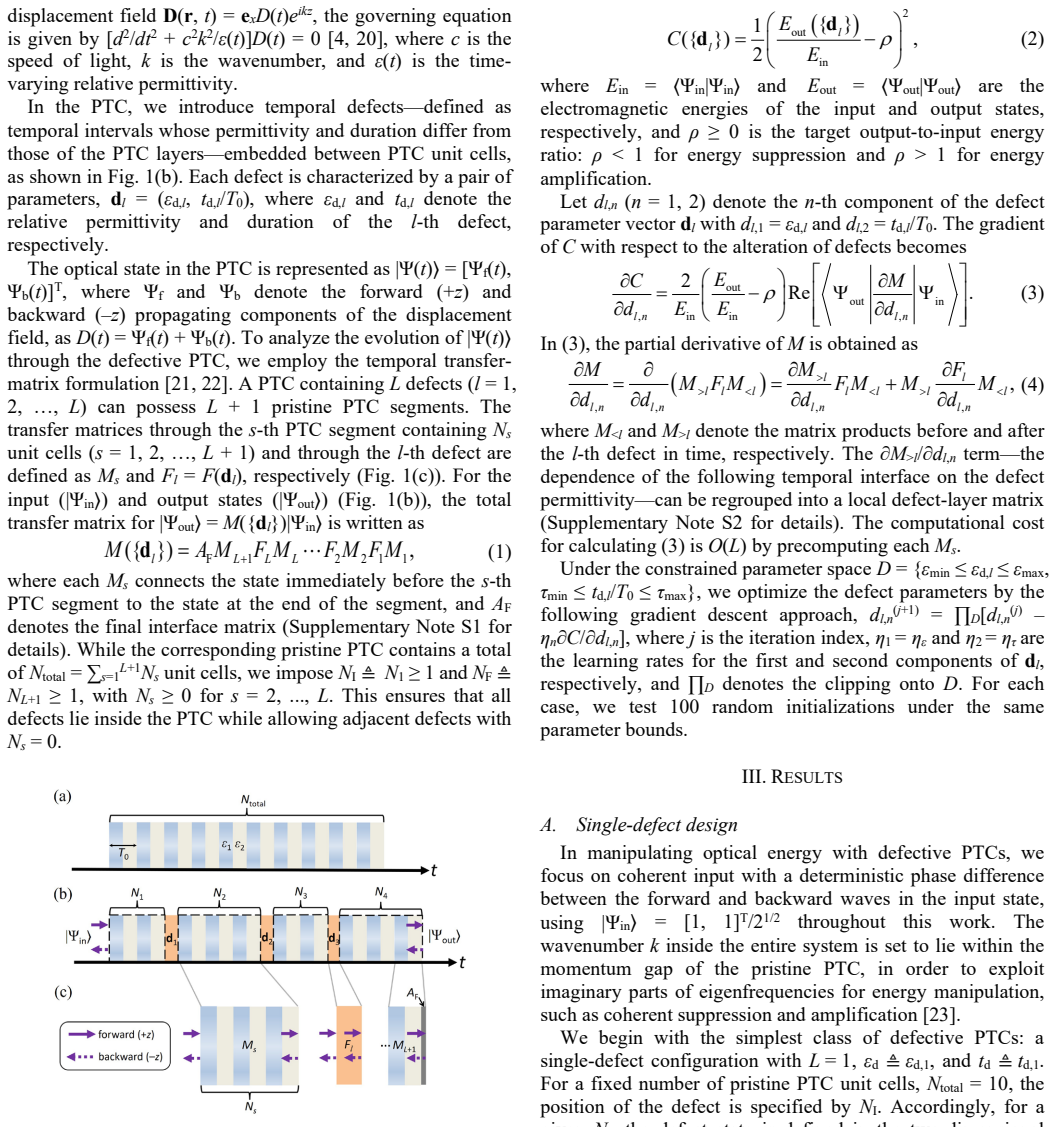
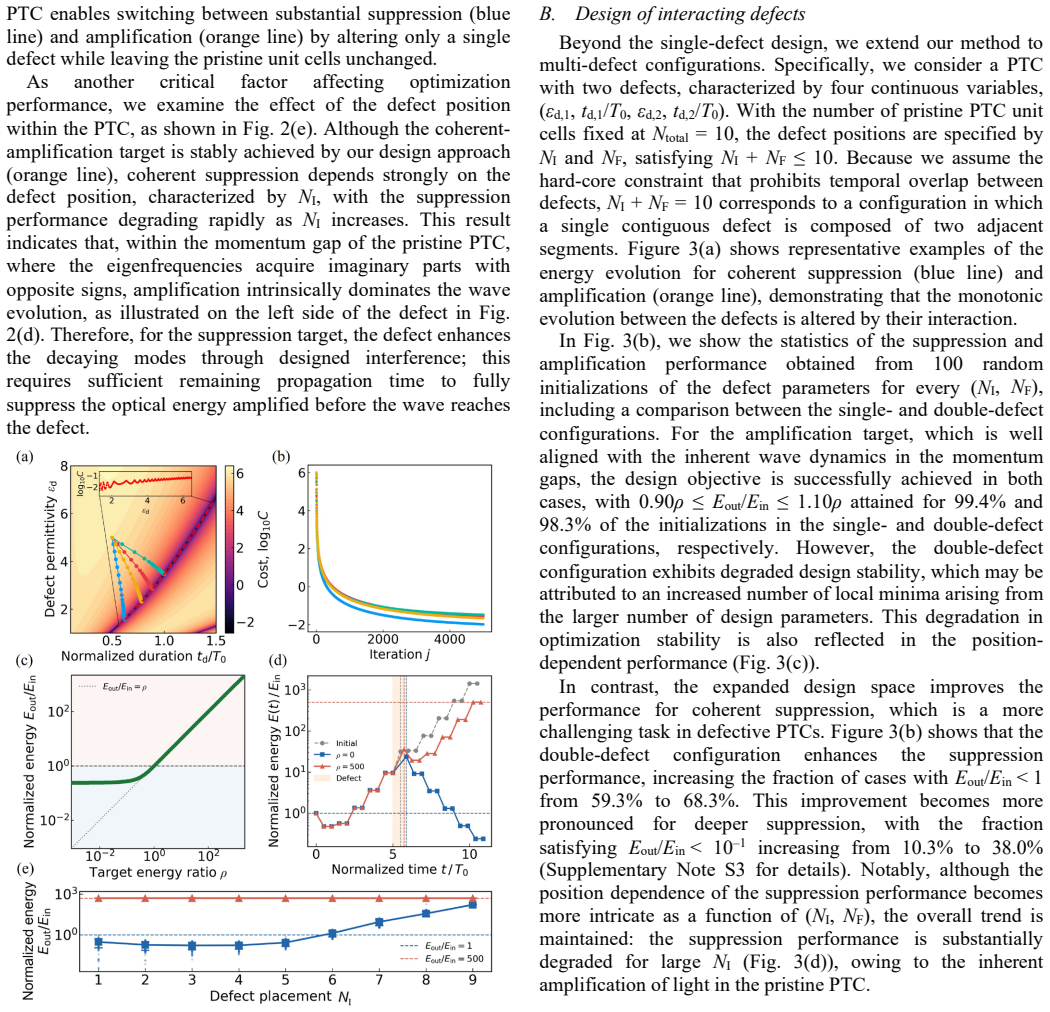
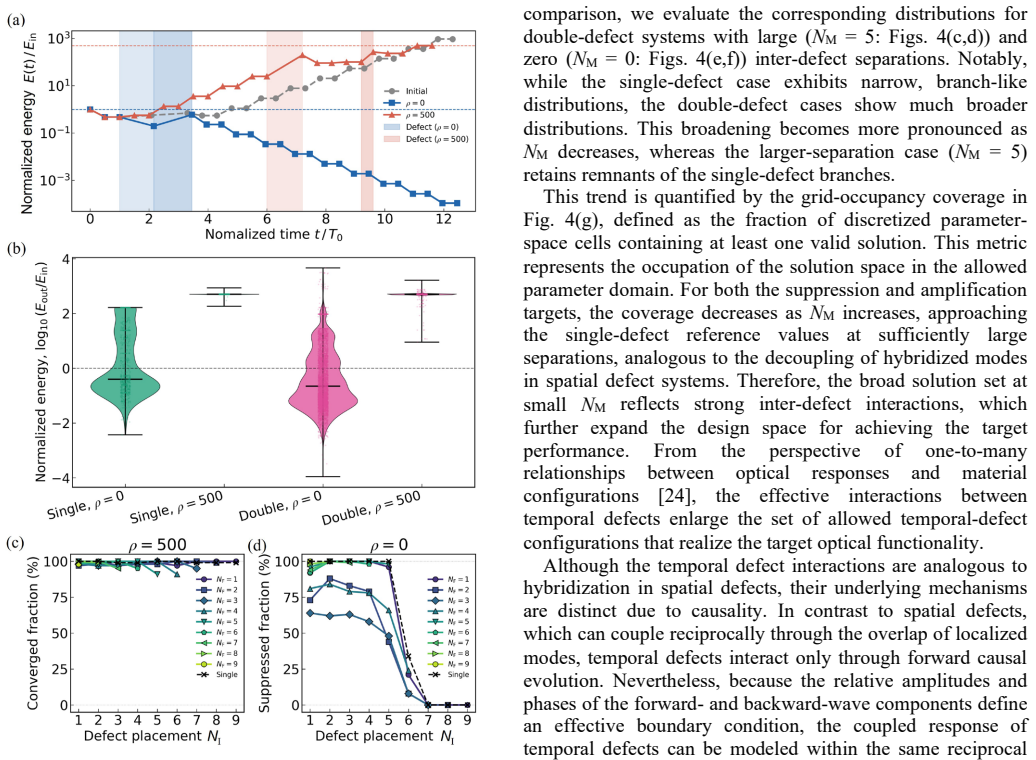
By optimizing defect permittivity and duration using analytic gradients of time transfer matrices, prescribed coherent energy amplification and suppression is realized in defective photonic time crystals. A single defect enables continuous energy tailoring, while coupled defects expand the design space and markedly improve suppression, revealing an intrinsic asymmetry due to the amplifying nature of the momentum gap.
What carries the argument
The time transfer matrix formalism applied to defective photonic time crystals, which enables analytic optimization of defect parameters to control energy flow.
If this is right
- A single defect enables continuous energy tailoring.
- There is an intrinsic asymmetry between amplification and suppression due to the momentum gap.
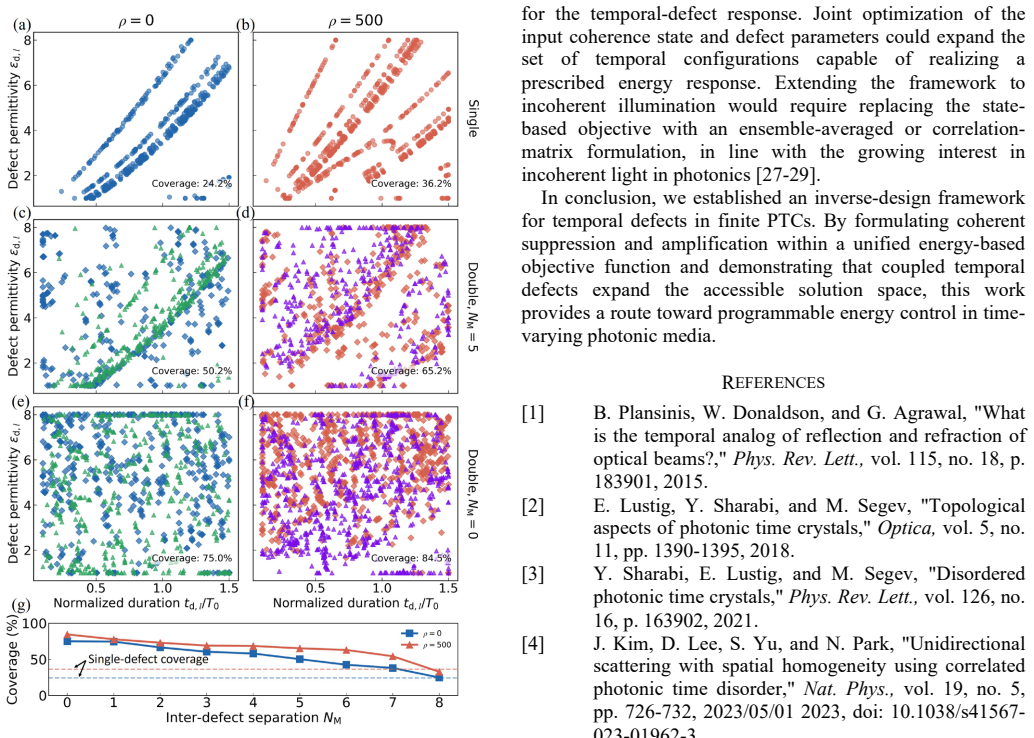
- Coupled defects expand the design space and improve suppression performance.
- Temporal-defect engineering provides a route to programmable coherent energy control in time-varying photonic systems.
Where Pith is reading between the lines
- This framework might allow integration with existing photonic devices for active energy management.
- Similar optimization could apply to other time-periodic systems beyond optics.
- Experimental realization would require verifying that defects match the assumed temporal profiles without extra losses.
Load-bearing premise
The time transfer matrix formalism accurately captures the dynamics of defective photonic time crystals and defects can be realized with the assumed temporal profiles without additional scattering or loss.
What would settle it
A numerical simulation or experiment where the energy amplification or suppression deviates significantly from the values predicted by the optimized defect parameters using the time transfer matrix method.
Figures
read the original abstract
Recent advances in time-varying photonics have revealed new degrees of freedom for manipulating optical states, arising from the distinctive nature of the temporal axis: causality and open-system dynamics. A representative example is photonic time crystals (PTCs) characterized by discrete time-translational symmetry, which exhibit space-analogous yet distinct phenomena, such as momentum gaps and amplifying-decaying Floquet-mode pairs. Although PTCs enable optical-energy amplification beyond conventional gain media, their application as programmable energy-functional devices remains challenging. Here, we propose a design framework for tailoring optical energy via defective PTCs. By optimizing defect permittivity and duration using analytic gradients of time transfer matrices, we realize prescribed coherent energy amplification and suppression. We show that a single defect enables continuous energy tailoring, while revealing an intrinsic asymmetry between amplification and suppression due to the inherently amplifying nature of the momentum gap. Extending the framework to coupled defects expands the design space and markedly improves suppression, establishing temporal-defect engineering as a route to programmable coherent energy control.
Editorial analysis
A structured set of objections, weighed in public.
Referee Report
Summary. The manuscript proposes a design framework for tailoring optical energy in defective photonic time crystals (PTCs). It optimizes defect permittivity and duration via analytic gradients of time transfer matrices to achieve prescribed coherent amplification and suppression. A single defect is shown to enable continuous energy tailoring, with an intrinsic asymmetry between amplification and suppression arising from the amplifying nature of the momentum gap; coupled defects are reported to expand the design space and improve suppression.
Significance. If the central claims hold, the work supplies a concrete optimization route for programmable coherent energy control in time-varying media, extending PTCs beyond passive amplification toward functional devices. The explicit use of analytic gradients of transfer matrices is a methodological strength that supports reproducibility and efficient design-space exploration.
major comments (3)
- [optimization framework (abstract/methods)] § on the optimization framework (abstract and methods): the central claim that analytic gradients of time transfer matrices suffice to realize prescribed energy values rests on the untested assumption that the idealized temporal profiles exactly reproduce the field evolution. No derivation or numerical check is supplied showing that finite rise times, dispersion, or interface scattering leave the Floquet-mode coupling unaltered; this is load-bearing for both the single-defect and coupled-defect results.
- [single-defect results] Results section on single-defect tailoring: the reported continuous energy tailoring and the claimed asymmetry between amplification and suppression are presented without tabulated energy-gain values, error metrics, or comparison against full-wave simulations, making it impossible to assess whether the transfer-matrix model reproduces the target amplification/suppression to within the stated precision.
- [coupled-defects results] Coupled-defects section: the statement that coupled defects 'markedly improve suppression' lacks a quantitative baseline (e.g., suppression ratio versus number of defects or versus a single optimized defect), so the improvement cannot be evaluated for significance or generality.
minor comments (2)
- [Abstract] Abstract, final sentence: the phrase 'establishing temporal-defect engineering as a route' is a forward-looking claim that should be tempered to 'suggests' or supported by a concrete outlook paragraph.
- [methods] Notation: the time transfer matrix is introduced without an explicit definition of its elements or the ordering convention for the temporal interfaces; a short appendix or inline equation would remove ambiguity for readers unfamiliar with the formalism.
Simulated Author's Rebuttal
We thank the referee for the constructive feedback. We address each major comment below, indicating revisions where the manuscript will be updated to strengthen clarity and quantitative support.
read point-by-point responses
-
Referee: [optimization framework (abstract/methods)] § on the optimization framework (abstract and methods): the central claim that analytic gradients of time transfer matrices suffice to realize prescribed energy values rests on the untested assumption that the idealized temporal profiles exactly reproduce the field evolution. No derivation or numerical check is supplied showing that finite rise times, dispersion, or interface scattering leave the Floquet-mode coupling unaltered; this is load-bearing for both the single-defect and coupled-defect results.
Authors: The time-transfer-matrix formalism provides an exact solution for the idealized, piecewise-constant temporal profiles used throughout the work. We agree that a discussion of robustness to non-ideal effects would improve the manuscript. In revision we will add a dedicated subsection with a perturbative analysis of small but finite rise times and their influence on Floquet-mode coupling and energy tailoring, thereby clarifying the model assumptions. revision: yes
-
Referee: [single-defect results] Results section on single-defect tailoring: the reported continuous energy tailoring and the claimed asymmetry between amplification and suppression are presented without tabulated energy-gain values, error metrics, or comparison against full-wave simulations, making it impossible to assess whether the transfer-matrix model reproduces the target amplification/suppression to within the stated precision.
Authors: We will insert tabulated energy-gain values and error metrics (target versus achieved) for the single-defect cases. Although the transfer-matrix solution is analytically exact inside the model, we will also include a representative comparison against time-domain numerical integration to confirm agreement within the idealized setting. revision: yes
-
Referee: [coupled-defects results] Coupled-defects section: the statement that coupled defects 'markedly improve suppression' lacks a quantitative baseline (e.g., suppression ratio versus number of defects or versus a single optimized defect), so the improvement cannot be evaluated for significance or generality.
Authors: We will add quantitative baselines in the revised coupled-defects section, including tables or supplementary plots that report suppression ratios for single-defect versus multi-defect configurations and as a function of defect number, allowing direct evaluation of the reported improvement. revision: yes
Circularity Check
No significant circularity; optimization is independent of targets
full rationale
The abstract and provided text describe a design framework that optimizes defect permittivity and duration via analytic gradients of time transfer matrices to achieve user-prescribed amplification or suppression values. This is a standard inverse-design procedure with no indication that the achieved energy values are used to define or fit the transfer-matrix model itself. No equations, self-citations, or ansatzes are shown that would reduce the central claim to its inputs by construction. The framework is presented as solving for parameters given targets, not as a tautological renaming or fitted prediction. Therefore the derivation chain is self-contained against external benchmarks.
Axiom & Free-Parameter Ledger
Reference graph
Works this paper leans on
-
[1]
What is the temporal analog of reflection and refraction of optical beams?,
B. Plansinis, W. Donaldson, and G. Agrawal, "What is the temporal analog of reflection and refraction of optical beams?," Phys. Rev. Lett., vol. 115, no. 18, p. 183901, 2015
2015
-
[2]
Topological aspects of photonic time crystals,
E. Lustig, Y. Sharabi, and M. Segev, "Topological aspects of photonic time crystals," Optica, vol. 5, no. 11, pp. 1390-1395, 2018
2018
-
[3]
Disordered photonic time crystals,
Y. Sharabi, E. Lustig, and M. Segev, "Disordered photonic time crystals," Phys. Rev. Lett., vol. 126, no. 16, p. 163902, 2021
2021
-
[4]
Unidirectional scattering with spatial homogeneity using correlated photonic time disorder,
J. Kim, D. Lee, S. Yu, and N. Park, "Unidirectional scattering with spatial homogeneity using correlated photonic time disorder," Nat. Phys., vol. 19, no. 5, pp. 726-732, 2023/05/01 2023, doi: 10.1038/s41567- 023-01962-3
-
[5]
Temporal multilayer structures in discrete physical systems towards arbitrary- dimensional non - Abelian Aharonov- Bohm interferences,
Z. Dong, X. Wu, Y. Yang, P. Yu, X. Chen, and L. Yuan, "Temporal multilayer structures in discrete physical systems towards arbitrary- dimensional non - Abelian Aharonov- Bohm interferences," Nat. Commun., vol. 15, no. 1, p. 7392, 2024
2024
-
[6]
Temporal Goos -Hänchen Shift in Synthetic Discrete -Time Heterolattices,
C. Qin et al. , "Temporal Goos -Hänchen Shift in Synthetic Discrete -Time Heterolattices," Phys. Rev. Lett., vol. 133, no. 8, p. 083802, 2024
2024
-
[7]
Time refraction and time reflection above critical angle for total internal reflection,
L. Bar -Hillel et al. , "Time refraction and time reflection above critical angle for total internal reflection," Phys. Rev. Lett., vol. 132, no. 26, p. 263802, 2024
2024
-
[8]
Emulating time refraction at photonic time interfaces via smooth temporal transitions,
M. Antyufeyeva and V. Pacheco -Peña, "Emulating time refraction at photonic time interfaces via smooth temporal transitions," Phys. Rev. Appl., vol. 24, no. 3, p. 034004, 2025
2025
-
[9]
Analogs of spontaneous emission and lasing in photonic time crystals,
K. Lee et al., "Analogs of spontaneous emission and lasing in photonic time crystals," Phys. Rev. Lett., vol. 136, no. 9, p. 093802, 2026
2026
-
[10]
Photonics of time -varying media,
E. Galiffi et al. , "Photonics of time -varying media," Adv. Photonics, vol. 4, no. 1, pp. 014002- 014002, 2022
2022
-
[11]
All-optical polarization control in time-varying low -index films via plasma symmetry breaking,
W. Jaffray et al., "All-optical polarization control in time-varying low -index films via plasma symmetry breaking," Nat. Photon., pp. 1-9, 2026
2026
-
[12]
Programmable photonic time circuits for highly scalable universal unitaries,
X. Piao, S. Yu, and N. Park, "Programmable photonic time circuits for highly scalable universal unitaries," Phys. Rev. Lett., vol. 132, no. 10, p. 103801, 2024
2024
-
[13]
Scalable unitary computing using time -parallelized photonic lattices,
H. Park, B. Chae, H. Jang, S. Yu, and X. Piao, "Scalable unitary computing using time -parallelized photonic lattices," vol. 14, no. 27, pp. 5527 -5535, 2025, doi: doi:10.1515/nanoph-2025-0498
-
[14]
Optical Arbitrary Vector -Matrix Multiplication in a Single Time -Varying Ring,
Z. Chen et al. , "Optical Arbitrary Vector -Matrix Multiplication in a Single Time -Varying Ring," Laser Photonics Rev., vol. n/a, no. n/a, p. e71242, 2026/05/05 2026, doi: 10.1002/lpor.71242
-
[15]
Expanding momentum bandgaps in photonic time crystals through resonances,
X. Wang, P. Garg, M. S. Mirmoosa, A. G. Lamprianidis, C. Rockstuhl, and V. S. Asadchy, "Expanding momentum bandgaps in photonic time crystals through resonances," Nat. Photon., vol. 19, no. 2, pp. 149- 155, 2025/02/01 2025, doi: 10.1038/s41566-024-01563-3
-
[16]
Amplified emission and lasing in photonic time crystals,
M. Lyubarov, Y. Lumer, A. Dikopoltsev, E. Lustig, Y. Sharabi, and M. Segev, "Amplified emission and lasing in photonic time crystals," Science, vol. 377, no. 6604, pp. 425-428, 2022
2022
-
[17]
J. D. Joannopoulos, S. G. Johnson, J. N. Winn, and R. D. Meade, Photonic crystals: molding the flow of light (Princeton University Press). 2011
2011
-
[18]
Defect in photonic time crystals,
S. Sadhukhan and S. Ghosh, "Defect in photonic time crystals," Phys. Rev. A, vol. 108, no. 2, p. 023511, 08/16/ 2023, doi: 10.1103/PhysRevA.108.023511
-
[19]
Tunable defect modes in temporal Fabry –Pérot cavities based on photonic time crystals,
Y. Huang, H. Zhang, K. Wu, and G. P. Wang, "Tunable defect modes in temporal Fabry –Pérot cavities based on photonic time crystals," J. Opt. Soc. Am. B, vol. 43, no. 4, pp. 804 -809, 2026/04/01 2026, doi: 10.1364/JOSAB.587297
-
[20]
Universal Statistics of Waves in a Random Time - Varying Medium,
R. Carminati, H. Chen, R. Pierrat, and B. Shapiro, "Universal Statistics of Waves in a Random Time - Varying Medium," Phys. Rev. Lett., vol. 127, no. 9, p. 094101, 08/27/ 2021, doi: 10.1103/PhysRevLett.127.094101
-
[21]
Dynamics of light propagation in spatiotemporal dielectric structures,
F. Biancalana, A. Amann, A. V. Uskov, and E. P. O’Reilly, "Dynamics of light propagation in spatiotemporal dielectric structures," Phys. Rev. E, vol. 75, no. 4, p. 046607, 04/20/ 2007, doi: 10.1103/PhysRevE.75.046607
-
[22]
Theory and applications of photonic time crystals: a tutorial,
M. M. Asgari, P. Garg, X. Wang, M. S. Mirmoosa, C. Rockstuhl, and V. Asadchy, "Theory and applications of photonic time crystals: a tutorial," Adv. Opt. Photonics, vol. 16, no. 4, pp. 958- 1063, 2024/12/31 2024, doi: 10.1364/AOP.525163
-
[23]
Optical coherent perfect absorption and amplification in a time -varying medium,
E. Galiffi, A. C. Harwood, S. Vezzoli, R. Tirole, A. Alù, and R. Sapienza, "Optical coherent perfect absorption and amplification in a time -varying medium," Nat. Photon., vol. 20, no. 2, pp. 163 -169, 2026/02/01 2026, doi: 10.1038/s41566-025-01833-8
-
[24]
Hearing the shape of a drum for light: isospectrality in photonics,
S. Park, I. Lee, J. Kim, N. Park, and S. Yu, "Hearing the shape of a drum for light: isospectrality in photonics," Nanophotonics, vol. 11, no. 11, pp. 2763- 2778, 2022, doi: 10.1515/nanoph-2021-0614
-
[25]
Correspondence between neuroevolution and gradient descent,
S. Whitelam, V. Selin, S. -W. Park, and I. Tamblyn, "Correspondence between neuroevolution and gradient descent," Nat. Commun., vol. 12, no. 1, p. 6317, 2021
2021
-
[26]
Designing neural networks through neuroevolution,
K. O. Stanley, J. Clune, J. Lehman, and R. Miikkulainen, "Designing neural networks through neuroevolution," Nat. Mach. Intell., vol. 1, no. 1, pp. 24-35, 2019
2019
-
[27]
Efficient Inverse Design of Large -Area Metasurfaces for Incoherent Light,
R. Pestourie, W. Yao, B. Kanté, and S. G. Johnson, "Efficient Inverse Design of Large -Area Metasurfaces for Incoherent Light," ACS Photonics, vol. 10, no. 4, pp. 854- 860, 2023/04/19 2023, doi: 10.1021/acsphotonics.2c01015
-
[28]
Partial coherence enhances parallelized photonic computing,
B. Dong et al. , "Partial coherence enhances parallelized photonic computing," Nature, vol. 632, no. 8023, pp. 55- 62, 2024/08/01 2024, doi: 10.1038/s41586-024-07590-y
-
[29]
Phase conjugation with spatially incoherent light in complex media,
Y. Baek, H. B. De Aguiar, and S. Gigan, "Phase conjugation with spatially incoherent light in complex media," Nat. Photon., vol. 17, no. 12, pp. 1114-1119, 2023. 1 Supplementary Information for “T ailoring Defects in Photonic Time Crystals for Coherent Energy Control” Dayeong Lee1*, Jongheon Yeo1*, Gitae Lee1, Jungmin Kim1,2‡, Namkyoo Park2§, and Sunkyu Y...
2023
discussion (0)
Sign in with ORCID, Apple, or X to comment. Anyone can read and Pith papers without signing in.