Neural-Network-based Viscosity Closure for Non-Newtonian Multiphase Flows
Reviewed by Pith T0 review T1 audit T2 compute T3 formal T4 kernel 2026-06-29 05:06 UTCgrok-4.3pith:UUUYHSGRrecord.jsonopen to challenge →
The pith
A neural network trained on rheometer data serves as the viscosity closure inside a Cahn-Hilliard-Navier-Stokes solver and reproduces experimental droplet rise velocities.
A machine-rendered reading of the paper's core claim, the machinery that carries it, and where it could break.
Core claim
A neural network trained on experimental rheometry data and exported via ONNX produces simulated rise velocities that fall within the experimentally measured spread and a steady-state droplet shape that agrees with observations for the characterized silicone inks when used as the viscosity closure inside a Cahn-Hilliard-Navier-Stokes finite element solver.
What carries the argument
The ONNX-exported neural network queried at runtime by the CHNS solver to supply local viscosity from the instantaneous shear rate, with Lipschitz regularization applied during training to keep the viscosity field smooth.
If this is right
- A single solver binary can handle Newtonian and non-Newtonian materials by swapping only the closure call.
- New ink formulations require only rheometer data collection and network retraining, not new code inside the flow solver.
- The adaptive mesh refinement already concentrates degrees of freedom where shear rates and interfaces are steepest.
- The separation of rheology characterization from solver development allows experimental groups to supply closures without finite-element expertise.
Where Pith is reading between the lines
- The same ONNX workflow could be applied to other local constitutive relations such as viscoelastic stress tensors if suitable experimental data exist.
- Because the network is queried pointwise, the method extends immediately to other finite-element or finite-volume codes that already support external function calls.
- If shear-rate history or temperature dependence becomes important, the network input vector can be enlarged without changing the solver interface.
Load-bearing premise
Viscosity measured as a function of shear rate alone on a rheometer is sufficient to determine the local viscosity field inside the dynamic, interface-containing flow solved by the CHNS equations.
What would settle it
A simulation of one of the characterized silicone inks in which the predicted rise velocity lies outside the experimental measurement spread while the network still reproduces the original rheometer curve to high accuracy.
Figures



read the original abstract
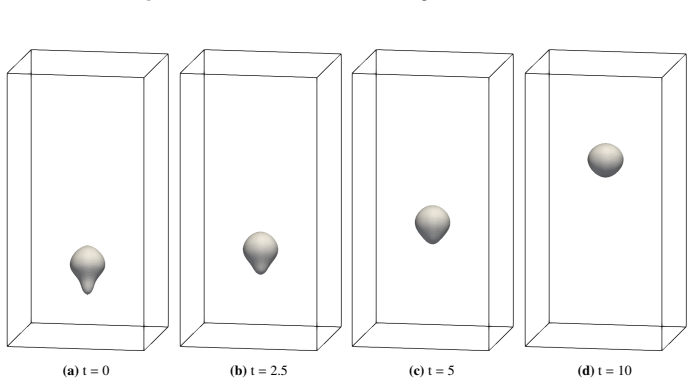
Materials used in polymer-based additive manufacturing processes, such as Digital Light Processing (DLP) and direct ink writing (DIW), typically exhibit non-Newtonian rheology. Carreau--Yasuda and power-law models describe basic shear-thinning and shear-thickening behavior well, but applying them to a new material requires choosing a functional form, deriving it, and re-implementing it inside the flow solver. We present a deployment workflow in which a neural network trained on experimental rheometry data serves as the viscosity closure inside a Cahn--Hilliard--Navier--Stokes (CHNS) finite element solver. Lipschitz regularization during training produces smooth viscosity predictions, and the trained network is exported in the Open Neural Network Exchange (ONNX) format and queried by the solver at runtime via the ONNX runtime, without solver modification or network reimplementation. The framework is built on a parallel octree-based adaptive mesh refinement infrastructure that concentrates resolution at the fluid interface. We validate the CHNS solver against benchmark shear-thinning bubble-rise cases from the literature, reproducing reported bubble shapes across varying power-law indices and Weber numbers. We characterized two silicone ink formulations, recorded their rise dynamics in perfluorodecalin on high-speed video, and used the resulting data to test the full workflow. Simulated rise velocities fall within the experimentally measured spread, and the simulated steady-state droplet shape agrees with the observed one. This work contributes to a growing body of literature on integrating neural constitutive closures into multiphysics simulations, and demonstrates a practical path for deploying experimentally trained rheological surrogates inside finite element solvers.
Editorial analysis
A structured set of objections, weighed in public.
Referee Report
Summary. The paper introduces a workflow for using a neural network trained on experimental rheometry data as a viscosity closure (via ONNX export) inside a parallel adaptive-mesh Cahn-Hilliard-Navier-Stokes solver for non-Newtonian multiphase flows. It validates the solver on literature shear-thinning bubble-rise benchmarks and then applies the full pipeline to two characterized silicone inks, reporting that simulated rise velocities lie within the experimental spread and that steady-state shapes match high-speed video observations.
Significance. If the central claim holds, the work supplies a reproducible, solver-agnostic route for embedding experimentally trained rheological surrogates into multiphysics codes without manual reimplementation of constitutive models. The combination of Lipschitz-regularized training, ONNX deployment, and octree AMR infrastructure is a concrete engineering contribution to data-driven non-Newtonian simulation.
major comments (2)
- [Validation against experimental data] Validation section (experimental droplet-rise comparison): the reported agreement with rise velocity and shape tests the integrated workflow but does not isolate whether the single-variable NN closure η(γ̇) remains adequate once the flow becomes unsteady and spatially inhomogeneous near a moving interface. No discussion is provided of possible thixotropy, viscoelastic normal stresses, or interfacial rheology in the silicone inks that would violate the steady-homogeneous rheometer assumption.
- [Neural-network viscosity closure and CHNS coupling] Workflow description: the claim that the NN can be queried at runtime with the instantaneous local shear rate computed from the velocity gradient inside the CHNS solver rests on the untested premise that rheometer-derived η(γ̇) suffices everywhere, including in regions of high interface curvature and transient shear. No auxiliary test (e.g., comparison against a known viscoelastic or thixotropic model) is shown to bound the error introduced by this assumption.
minor comments (1)
- [Training procedure] The abstract states that Lipschitz regularization produces smooth viscosity predictions, yet the manuscript does not quantify the resulting Lipschitz constant or demonstrate that the ONNX-evaluated field remains sufficiently smooth for the finite-element discretization.
Simulated Author's Rebuttal
We thank the referee for the constructive and detailed comments. We address each major comment below and indicate where revisions will be made to the manuscript.
read point-by-point responses
-
Referee: [Validation against experimental data] Validation section (experimental droplet-rise comparison): the reported agreement with rise velocity and shape tests the integrated workflow but does not isolate whether the single-variable NN closure η(γ̇) remains adequate once the flow becomes unsteady and spatially inhomogeneous near a moving interface. No discussion is provided of possible thixotropy, viscoelastic normal stresses, or interfacial rheology in the silicone inks that would violate the steady-homogeneous rheometer assumption.
Authors: We agree that the experimental comparisons validate the end-to-end workflow rather than isolating the performance of the NN closure under unsteady or spatially varying conditions. The inks were characterized exclusively with steady shear rheometry, and no separate measurements of thixotropy, viscoelasticity, or interfacial effects were conducted. The observed agreement in rise velocity (within experimental spread) and steady shape provides indirect support for the closure in these cases, but does not bound errors from the steady-homogeneous assumption. We will add an explicit limitations paragraph in the discussion section acknowledging these assumptions and their potential violation for other materials. revision: partial
-
Referee: [Neural-network viscosity closure and CHNS coupling] Workflow description: the claim that the NN can be queried at runtime with the instantaneous local shear rate computed from the velocity gradient inside the CHNS solver rests on the untested premise that rheometer-derived η(γ̇) suffices everywhere, including in regions of high interface curvature and transient shear. No auxiliary test (e.g., comparison against a known viscoelastic or thixotropic model) is shown to bound the error introduced by this assumption.
Authors: The paper's primary contribution is the solver-agnostic deployment workflow (Lipschitz-regularized training, ONNX export, runtime querying) rather than exhaustive validation of the single-variable closure against all possible rheological complexities. Benchmark cases use known power-law and Carreau-Yasuda models, while the experimental cases use the measured inks directly. No auxiliary comparison to viscoelastic or thixotropic constitutive models was performed, as this lies outside the stated scope of demonstrating practical integration of experimental rheometry data. We will revise the methods and conclusions sections to state the modeling assumption more explicitly and list the absence of such auxiliary tests as a limitation and avenue for future work. revision: partial
Circularity Check
No circularity: NN closure trained on independent rheometry, validated on separate video and literature benchmarks
full rationale
The paper trains an NN on experimental rheometry data (shear-rate vs viscosity curves) and deploys it via ONNX inside a CHNS solver. Validation uses separate high-speed video of droplet rise (rise velocity and shape) plus literature benchmark cases for shear-thinning bubbles. No equation or step reduces the reported agreement to quantities already fitted inside the training set. The workflow is self-contained against external data; the central claim does not reduce by construction to its inputs. Minor self-citations on the solver infrastructure or prior NN work are not load-bearing for the reported validation results.
Axiom & Free-Parameter Ledger
free parameters (1)
- Neural network weights and biases
axioms (2)
- domain assumption Viscosity depends only on the local shear rate (no dependence on pressure, temperature, or history).
- domain assumption The underlying CHNS finite-element solver correctly transports the interface and computes the flow field once supplied with an accurate local viscosity.
Reference graph
Works this paper leans on
-
[1]
Yasuda, R
K. Yasuda, R. Armstrong, R. Cohen, Shear flow properties of concentrated solutions of linear and star branched polystyrenes, Rheologica Acta 20 (1981) 163–178
1981
-
[2]
T. F. Tadros, Rheology of dispersions: principles and applications, John Wiley & Sons, 2011
2011
-
[3]
J. B. Freund, R. H. Ewoldt, Quantitative rheological model selection: good fits versus credible models using bayesian inference, Journal of Rheology 59 (2015) 667–701
2015
-
[4]
Hysing, S
S. Hysing, S. Turek, D. Kuzmin, N. Parolini, E. Burman, S. Ganesan, L. Tobiska, Quantitative benchmark computations of two-dimensional bubble dynamics, International Journal for Numerical Methods in Fluids 60 (2009) 1259–1288
2009
-
[5]
Bunner, G
B. Bunner, G. Tryggvason, Direct numerical simulations of three-dimensional bubbly flows, Physics of Fluids 11 (1999) 1967–1969
1999
-
[6]
Sussman, E
M. Sussman, E. G. Puckett, A coupled level set and volume-of-fluid method for computing 3d and axisymmetric incompressible two-phase flows, Journal of computational physics 162 (2000) 301–337
2000
-
[7]
J. Hua, J. F. Stene, P. Lin, Numerical simulation of 3d bubbles rising in viscous liquids using a front tracking method, Journal of Computational Physics 227 (2008) 3358–3382
2008
-
[8]
M. R. Pivello, M. M. Villar, R. Serfaty, A. M. Roma, A. d. Silveira-Neto, A fully adaptive front tracking method for the simulation of two phase flows, International Journal of Multiphase Flow 58 (2014) 72–82
2014
-
[9]
M. K. Tripathi, K. C. Sahu, R. Govindarajan, Dynamics of an initially spherical bubble rising in quiescent liquid, Nature communications 6 (2015) 6268
2015
-
[10]
M. K. Tripathi, K. Sahu, G. Karapetsas, K. Sefiane, O. Matar, Non-isothermal bubble rise: non-monotonic dependence of surface tension on temperature, Journal of Fluid Mechanics 763 (2015) 82–108
2015
-
[11]
Chella, J
R. Chella, J. Vinals, Mixing of a two-phase fluid by cavity flow, Physical Review E 53 (1996) 3832
1996
-
[12]
Jacqmin, Calculation of two-phase navier–stokes flows using phase-field modeling, Journal of computational physics 155 (1999) 96–127
D. Jacqmin, Calculation of two-phase navier–stokes flows using phase-field modeling, Journal of computational physics 155 (1999) 96–127
1999
-
[13]
V . E. Badalassi, H. D. Ceniceros, S. Banerjee, Computation of multiphase systems with phase field models, Journal of computational physics 190 (2003) 371–397
2003
-
[14]
M. A. Khanwale, Energy stable and conservative numerical schemes for simulating two-phase flows using Cahn- Hilliard Navier Stokes equations, Ph.D. thesis, Iowa State University, 2021
2021
-
[15]
M. A. Khanwale, K. Saurabh, M. Ishii, H. Sundar, J. A. Rossmanith, B. Ganapathysubramanian, A projection- based, semi-implicit time-stepping approach for the cahn-hilliard navier-stokes equations on adaptive octree meshes, Journal of Computational Physics 475 (2023) 111874. 18
2023
- [16]
-
[17]
M. J. Berger, P. Colella, Local adaptive mesh refinement for shock hydrodynamics, Journal of computational Physics 82 (1989) 64–84
1989
-
[18]
Schmidmayer, F
K. Schmidmayer, F. Petitpas, E. Daniel, Adaptive mesh refinement algorithm based on dual trees for cells and faces for multiphase compressible flows, Journal of Computational Physics 388 (2019) 252–278
2019
-
[19]
C.-H. Yang, G. Scovazzi, A. Krishnamurthy, B. Ganapathysubramanian, Simulating incompressible flows over complex geometries using the shifted boundary method with incomplete adaptive octree meshes, Journal of Computational Physics (2025) 114334
2025
-
[20]
C.-H. Yang, G. Scovazzi, A. Krishnamurthy, B. Ganapathysubramanian, Octree-based adaptive mesh refinement and the shifted boundary method for efficient fluid dynamics simulations, Advances in Computational Science and Engineering 4 (2025) 57–84
2025
-
[21]
R. P. Chhabra, S. A. Patel, Bubbles, drops, and particles in non-Newtonian fluids, CRC press, 2023
2023
-
[22]
Tsamopoulos, Y
J. Tsamopoulos, Y . Dimakopoulos, N. Chatzidai, G. Karapetsas, M. Pavlidis, Steady bubble rise and deformation in newtonian and viscoplastic fluids and conditions for bubble entrapment, Journal of Fluid Mechanics 601 (2008) 123–164
2008
-
[23]
Clift, J
R. Clift, J. Grace, M. Weber, Drops, bubbles and particles, 1978
1978
-
[24]
Zhang, C
L. Zhang, C. Yang, Z.-S. Mao, Numerical simulation of a bubble rising in shear-thinning fluids, Journal of Non-Newtonian Fluid Mechanics 165 (2010) 555–567
2010
-
[25]
Premlata, M
A. Premlata, M. K. Tripathi, B. Karri, K. C. Sahu, Dynamics of an air bubble rising in a non-newtonian liquid in the axisymmetric regime, Journal of non-Newtonian fluid mechanics 239 (2017) 53–61
2017
-
[26]
M. Pang, M. Lu, Numerical study on dynamics of single bubble rising in shear-thinning power-law fluid in different gravity environment, Vacuum 153 (2018) 101–111
2018
-
[27]
B. Hu, M. Pang, Numerical study on the influence of liquid viscosity ratio on the hydrodynamics of a single bubble in shear-thinning liquid, Applied Mathematical Modelling 103 (2022) 122–140
2022
-
[28]
A. M. Tartakovsky, C. O. Marrero, P. Perdikaris, G. D. Tartakovsky, D. Barajas-Solano, Learning parameters and constitutive relationships with physics informed deep neural networks, arXiv preprint arXiv:1808.03398 (2018)
work page internal anchor Pith review Pith/arXiv arXiv 2018
-
[29]
Reyes, A
B. Reyes, A. A. Howard, P. Perdikaris, A. M. Tartakovsky, Learning unknown physics of non-newtonian fluids, Physical Review Fluids 6 (2021) 073301
2021
-
[30]
Thakur, M
S. Thakur, M. Raissi, A. M. Ardekani, Viscoelasticnet: A physics informed neural network framework for stress discovery and model selection, Journal of Non-Newtonian Fluid Mechanics 330 (2024) 105265
2024
-
[31]
Mahmoudabadbozchelou, S
M. Mahmoudabadbozchelou, S. Jamali, Rheology-informed neural networks (RhINNs) for forward and inverse metamodelling of complex fluids, Scientific reports 11 (2021) 12015
2021
-
[32]
Mahmoudabadbozchelou, K
M. Mahmoudabadbozchelou, K. M. Kamani, S. A. Rogers, S. Jamali, Unbiased construction of constitutive re- lations for soft materials from experiments via rheology-informed neural networks, Proceedings of the National Academy of Sciences 121 (2024) e2313658121
2024
-
[33]
Tucny, M
J.-M. Tucny, M. Durve, A. Montessori, S. Succi, Learning of viscosity functions in rarefied gas flows with physics-informed neural networks, Computers & Fluids 269 (2024) 106114. 19
2024
- [34]
- [35]
-
[36]
Negrini, G
E. Negrini, G. Citti, L. Capogna, System identification through lipschitz regularized deep neural networks, Journal of Computational Physics 444 (2021) 110549
2021
-
[37]
H.-T. D. Liu, F. Williams, A. Jacobson, S. Fidler, O. Litany, Learning smooth neural functions via lipschitz regularization, in: ACM SIGGRAPH 2022 Conference Proceedings, 2022, pp. 1–13
2022
-
[38]
O. R. developers, Onnx runtime,https://onnxruntime.ai/, 2021. Version: 1.15.1
2021
-
[39]
Magaletti, F
F. Magaletti, F. Picano, M. Chinappi, L. Marino, C. M. Casciola, The sharp-interface limit of the cahn– hilliard/navier–stokes model for binary fluids, Journal of Fluid Mechanics 714 (2013) 95–126
2013
-
[40]
N. J. Wagner, J. F. Brady, Shear thickening in colloidal dispersions, Physics Today 62 (2009) 27–32
2009
-
[41]
D. P. Huttenlocher, G. A. Klanderman, W. J. Rucklidge, Comparing images using the hausdorffdistance, IEEE Transactions on pattern analysis and machine intelligence 15 (2002) 850–863
2002
-
[42]
signature
G. Borgefors, Hierarchical chamfer matching: A parametric edge matching algorithm, IEEE Transactions on pattern analysis and machine intelligence 10 (1988) 849–865. 20 Appendix A. Image Processing Framework To extract rise velocity and trajectory data from the high-speed videos, a custom image processing algorithm was developed for systematic detection an...
1988
discussion (0)
Sign in with ORCID, Apple, or X to comment. Anyone can read and Pith papers without signing in.