Remarks about the Moebius-Kantor graph
Pith reviewed 2026-06-28 20:27 UTC · model grok-4.3
The pith
The Moebius-Kantor graph admits a metric preserved uniquely by the Pauli group multiplication.
A machine-rendered reading of the paper's core claim, the machinery that carries it, and where it could break.
Core claim
The Moebius-Kantor graph MK carries a metric d so that (MK,d) has only one algebraic group structure (P(1),*) that preserves the metric. It makes the Pauli group natural, similarly as the Moebius ladder M(16) makes the dihedral group D(16) natural, forcing the algebraic structure from the metric structure.
What carries the argument
The metric d on the Moebius-Kantor graph under which only the Pauli group multiplication preserves distances.
If this is right
- The Pauli group multiplication is the unique distance-preserving group law on this metric.
- The same metric-forcing mechanism applies to the dihedral group on the Moebius ladder.
- The graph remains a Cayley graph for the other two groups, but those operations fail to preserve the chosen distances.
- Lefschetz numbers computed on the graph illustrate the Brouwer fixed-point theorem independently of the group choice.
Where Pith is reading between the lines
- Different choices of metric on the same graph could be tested to see whether any other group structure becomes unique.
- The embedding of the graph as a subgraph of the tesseract and its role in the Hopf fibration may supply candidate distance functions to check.
- The uniqueness result could be checked computationally by enumerating all distance-preserving bijections and verifying which ones form the Pauli group.
Load-bearing premise
There exists a metric on the graph such that among its three possible group structures only the Pauli group preserves all pairwise distances.
What would settle it
An explicit definition of the metric d together with a verification that the semi-dihedral or dihedral multiplication also leaves all distances invariant.
Figures






read the original abstract
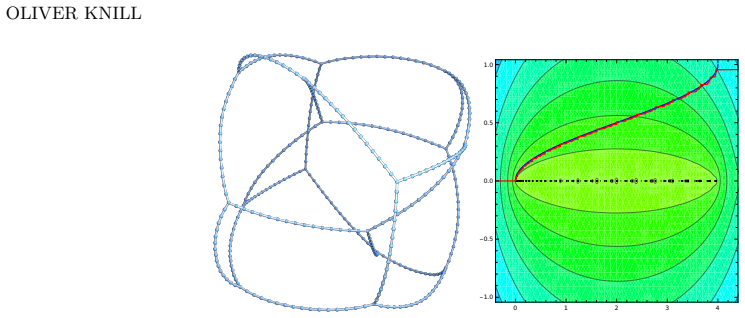
The Moebius-Kantor graph MK=G(8,3) is a Cayley graph of three non-abelian groups, the Pauli group P(1), the semi-dihedral group SD(16), as well as the dihedral group D(16) of order 16. In topological graph theory, it illustrates the Heawood number 7 of the torus and leads to the Tucker group Aut(MK), the unique group of genus 2. We compute the Lefschetz numbers to illustrate the Brouwer-Lefschetz fixed point theorem. MK is also the dual of the 2-skeleton complex of the 3-sphere G. The graph represents one of flat Clifford tori of a Hopf fibration in the 3-sphere G=K(2,2,2,2) reflecting that Coxeter saw that MK is a subgraph of the tesseract G*. It carries a metric d so that (MK,d) has only one algebraic group structure (P(1),*) that preserves the metric. It makes the Pauli group natural, similarly as the Moebius ladder M(16) makes the dihedral group D(16) natural, forcing the algebraic structure from the metric structure.
Editorial analysis
A structured set of objections, weighed in public.
Referee Report
Summary. The manuscript remarks on the Moebius-Kantor graph MK = G(8,3). It states that MK is a Cayley graph for the Pauli group P(1), the semidihedral group SD(16), and the dihedral group D(16). It notes topological properties including illustration of the Heawood number, computation of Lefschetz numbers for the Brouwer-Lefschetz theorem, duality with the 2-skeleton of a 3-sphere, and representation of flat Clifford tori in a Hopf fibration. The central claim is that MK carries a metric d such that only the Pauli group multiplication preserves the metric, making P(1) natural in a manner analogous to the Möbius ladder M(16) for D(16).
Significance. If the metric uniqueness claim holds with an explicit construction and verification, the work would supply a geometric criterion distinguishing one of the three Cayley realizations on the same vertex set, potentially strengthening links between graph metrics and algebraic structures in topological graph theory. The Lefschetz-number computations and Hopf-fibration remarks are standard applications and do not appear to introduce new results.
major comments (1)
- [Abstract] Abstract (final paragraph): the assertion that MK carries a metric d such that only (P(1),*) preserves the metric is load-bearing for the claim that the Pauli group is made 'natural' by the metric structure. No formula for d is supplied, no definition of 'preserves the metric' (e.g., left-invariance, isometry of left multiplication, or invariance of the distance matrix) is given, and no verification is provided that the Cayley realizations for SD(16) and D(16) fail the same condition. The analogy to M(16) supplies motivation but does not substitute for the missing explicit check.
minor comments (2)
- [Abstract] Abstract: the statement 'We compute the Lefschetz numbers' is made without reporting the actual values or indicating which maps are considered, rendering the illustration of the Brouwer-Lefschetz theorem unverifiable from the text.
- [Abstract] Abstract: the claim that the Tucker group Aut(MK) is 'the unique group of genus 2' is stated without a reference or a brief justification; a citation to the relevant classification would clarify the assertion.
Simulated Author's Rebuttal
We thank the referee for the careful reading and for highlighting the need for explicit support of our central claim. We address the major comment below.
read point-by-point responses
-
Referee: [Abstract] Abstract (final paragraph): the assertion that MK carries a metric d such that only (P(1),*) preserves the metric is load-bearing for the claim that the Pauli group is made 'natural' by the metric structure. No formula for d is supplied, no definition of 'preserves the metric' (e.g., left-invariance, isometry of left multiplication, or invariance of the distance matrix) is given, and no verification is provided that the Cayley realizations for SD(16) and D(16) fail the same condition. The analogy to M(16) supplies motivation but does not substitute for the missing explicit check.
Authors: We agree that the claim requires an explicit construction, definition, and verification to be fully substantiated. In the revised manuscript we will supply the formula for the metric d (the graph distance induced by the standard generating set of P(1)), define metric preservation to mean that left multiplication by every group element is an isometry of (MK,d), and include a direct check showing that the corresponding left actions of SD(16) and D(16) fail to be isometries. This will make the analogy with M(16) rigorous rather than merely motivational. revision: yes
Circularity Check
No circularity: uniqueness claim presented as observation without reducing derivation
full rationale
The paper states that MK carries a metric d making only the Pauli group multiplication preserve distances, presented as an observation parallel to the Moebius ladder case. No equations, fitted parameters, or self-citation chains are exhibited that would make the uniqueness hold by construction. Topological computations (Lefschetz numbers, Heawood number, Tucker group) are independent and do not rely on the metric claim. The statement does not invoke a uniqueness theorem from prior self-work or smuggle an ansatz; it remains an external assertion open to verification outside the paper's inputs.
Axiom & Free-Parameter Ledger
Reference graph
Works this paper leans on
-
[1]
Adams, M
Z. Adams, M. Z. Cassim, C. Hou, O. Knill, V. Seco Roopnaraine, and M. H. Saleem. God numbers for graphs, games and groups, 2026
2026
-
[2]
Albertson and W.R
M.O. Albertson and W.R. Stromquist. Locally planar toroidal graphs are 5-colorable.Proc. Amer. Math. Soc., 84(3):449–457, 1982
1982
-
[3]
Banchoff.Beyond the Third Dimension, Geometry, Computer Graphics and Higher Dimensions
T. Banchoff.Beyond the Third Dimension, Geometry, Computer Graphics and Higher Dimensions. Scien- tific American Library, 1990
1990
-
[4]
Hamiltonian decomposition of cayley graphs of degree 4.Journal of Combinatorial Theory, Series B, 46:142–153, 1989
J.-C Bermond, O Favaron, and M Maheo. Hamiltonian decomposition of cayley graphs of degree 4.Journal of Combinatorial Theory, Series B, 46:142–153, 1989
1989
-
[5]
Birkhoff.Aesthetic measure
G.D. Birkhoff.Aesthetic measure. Harvard University Press, 1933
1933
-
[6]
H. S. M. Coxeter. Self-dual configurations and regular graphs.Bulletin of the American Mathematical Society, 56:413–455, 1950. 13 MOEBIUS KANTOR
1950
-
[7]
Thorne C.W
K.S. Thorne C.W. Misner and J.A. Wheeler.Gravitation. Freeman, San Francisco, 1973
1973
-
[8]
Ferguson and C
H. Ferguson and C. Ferguson. Celebrating mathematics in stone and bronze.Notices Amer. Math. Soc., 57(7):840–850, 2010
2010
-
[9]
S.W. Golomb. Rubik’s cube and quarks: Twists on the eight corner cells of rubik’s cube provide a model for many aspects of quark behavior.American Scientist, 70:257–259, 1982
1982
-
[10]
Gross and T.W
J.L. Gross and T.W. Tucker.Topological Graph Theory. John Wiley and Sons, 1987
1987
-
[11]
Hurwitz.Zahlentheorie der Quaternionen
A. Hurwitz.Zahlentheorie der Quaternionen. Springer, 1919
1919
-
[12]
M. Kac. Can one hear the shape of a drum?Amer. Math. Monthly, 73:1–23, 1966
1966
-
[13]
O. Knill. The McKean-Singer Formula in Graph Theory. http://arxiv.org/abs/1301.1408, 2012
work page internal anchor Pith review Pith/arXiv arXiv 2012
-
[14]
O. Knill. A Brouwer fixed point theorem for graph endomorphisms.Fixed Point Th. and Appl., 85, 2013
2013
-
[15]
O. Knill. Universality for Barycentric subdivision. http://arxiv.org/abs/1509.06092, 2015
work page internal anchor Pith review Pith/arXiv arXiv 2015
-
[16]
O. Knill. Hear the Euler characteristic of a simplicial complex. https://arxiv.org/abs/1711.09527, 2017
work page internal anchor Pith review Pith/arXiv arXiv 2017
-
[17]
O. Knill. An elementary Dyadic Riemann hypothesis. https://arxiv.org/abs/1801.04639, 2018
work page internal anchor Pith review Pith/arXiv arXiv 2018
-
[18]
O. Knill. The energy of a simplicial complex.Linear Algebra and its Applications, 600:96–129, 2020
2020
- [19]
-
[20]
O. Knill. Eigenvalue bounds of the Kirchhoff Laplacian.Lin. Alg. and its Appl., 701:1–21, 2024
2024
- [21]
-
[22]
O. Knill. Geodesics for discrete manifolds, 2025
2025
-
[23]
Knill and E
O. Knill and E. Slavkovsky. Visualizing mathematics using 3d printers. In C. Fonda E. Canessa and M. Zennaro, editors,Low-Cost 3D Printing for science, education and Sustainable Development. ICTP, 2013
2013
-
[24]
McKean and I.M
H.P. McKean and I.M. Singer. Curvature and the eigenvalues of the Laplacian.J. Differential Geometry, 1(1):43–69, 1967
1967
-
[25]
Nowakowski and I
R. Nowakowski and I. Rival. Fixed-edge theorem for graphs with loops.J. Graph Theory, 3:339–350, 1979
1979
-
[26]
Plato. Timaeus. The Internet Classics Archive, 360 BCE. https://classics.mit.edu/Plato/timaeus.html
-
[27]
T. Regge. General relativity without coordinates.Nuovo Cimento (10), 19:558–571, 1961
1961
-
[28]
Singmaster.Rubik’s magic cube
D. Singmaster.Rubik’s magic cube. Enslow Publishers, 1981
1981
-
[29]
Skinner.Sacred Geometry
S. Skinner.Sacred Geometry. Sterling, 2006
2006
-
[30]
T.W. Tucker. There is one group of genus two.J. of Combin. Theory, 36, 1984
1984
-
[31]
Weisstein
E.W. Weisstein. M¨ obius-kantor graph. MathWorld–A Wolfram Resource. https://mathworld.wolfram.com/Moebius-KantorGraph.html
-
[32]
A.T. White. On the genus of a group.Trans. of the AMS, 173:203–214, 1972. Department of Mathematics, Harvard University, Cambridge, MA, 02138 14
1972
discussion (0)
Sign in with ORCID, Apple, or X to comment. Anyone can read and Pith papers without signing in.