Analysis of a two patch model for disease vector-animal dynamics with non-linear anthropization-driven migration
Pith reviewed 2026-06-28 20:13 UTC · model grok-4.3
The pith
Two-patch model shows intermediate anthropization drives vector dynamics through concurrent bifurcations
A machine-rendered reading of the paper's core claim, the machinery that carries it, and where it could break.
Core claim
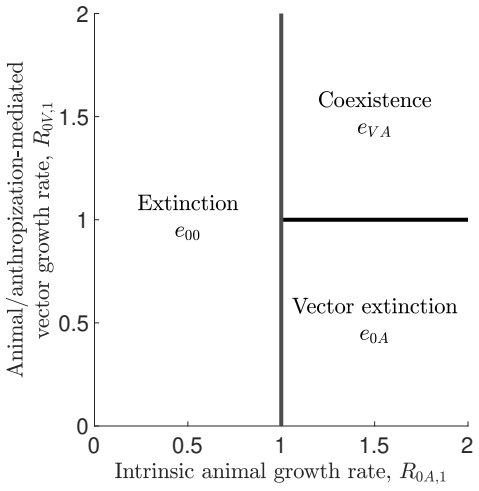
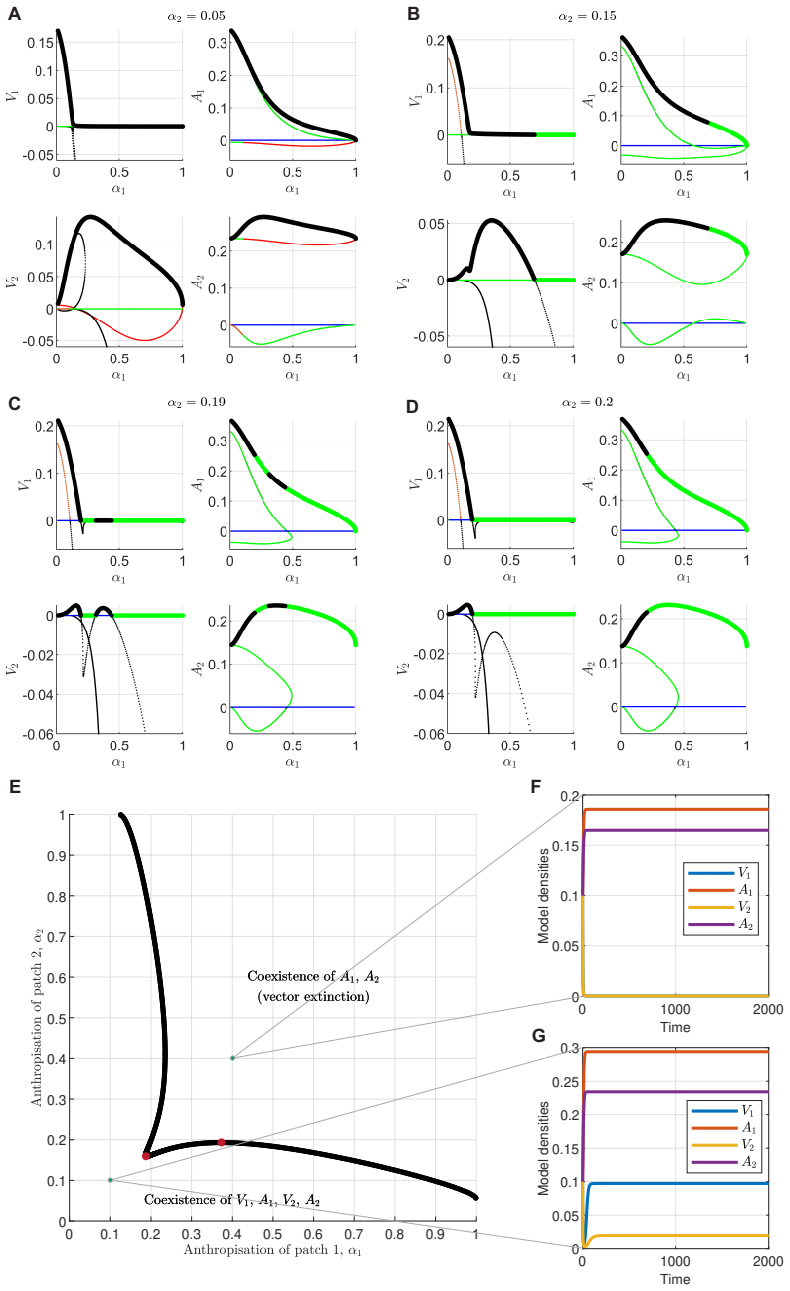
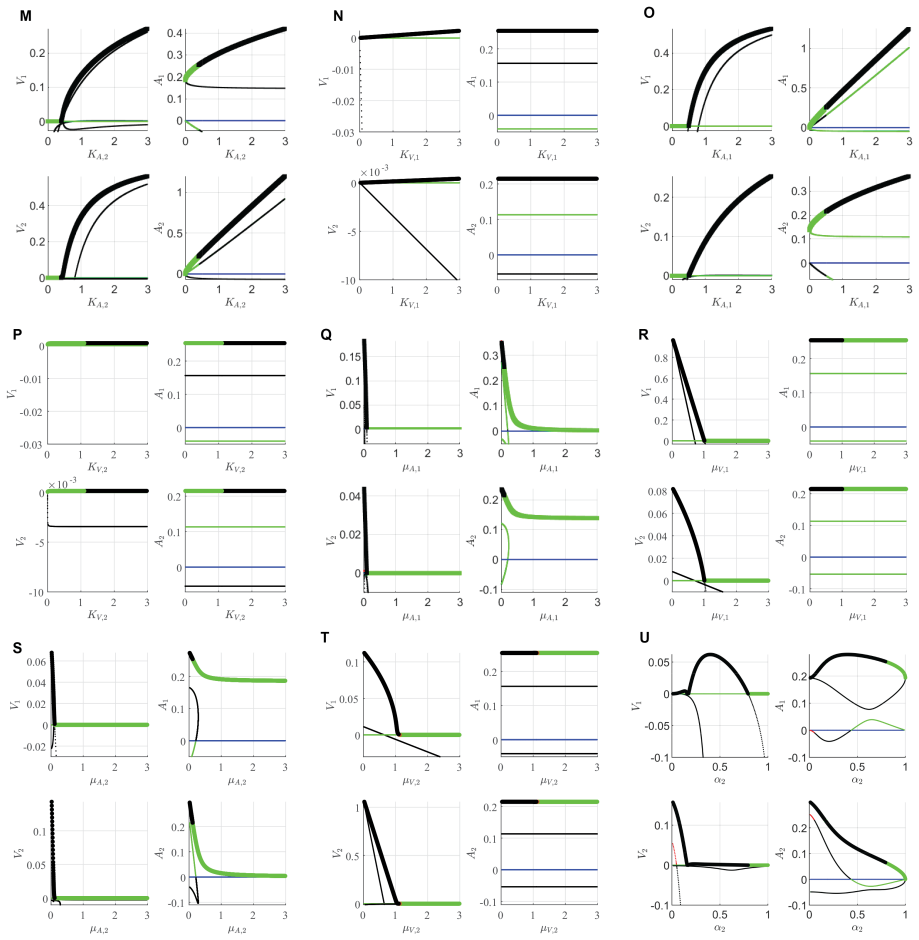
The central discovery is that low anthropogenic activity permits a vector-animal coexistence state while high anthropization leads to a vector extinction state, with the transition at intermediate levels occurring via a sequence of concurrent bifurcations along the anthropization axis.
What carries the argument
Nonlinear anthropization-driven migration terms between the two patches, which allow for analytical stability analysis and numerical bifurcation analysis of the long-term dynamics.
If this is right
- Low anthropogenic activity supports a stable coexistence equilibrium of vectors and animals.
- High anthropization results in extinction of the vector population.
- The transition between these states at intermediate anthropization can involve multiple concurrent bifurcations rather than a monotonic change.
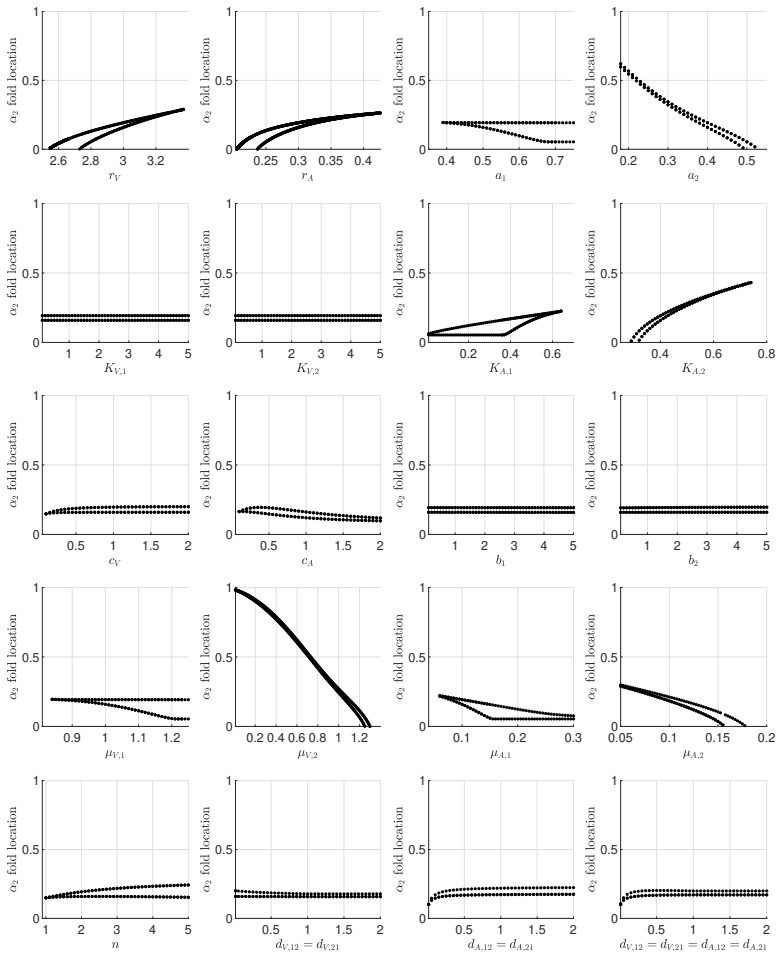
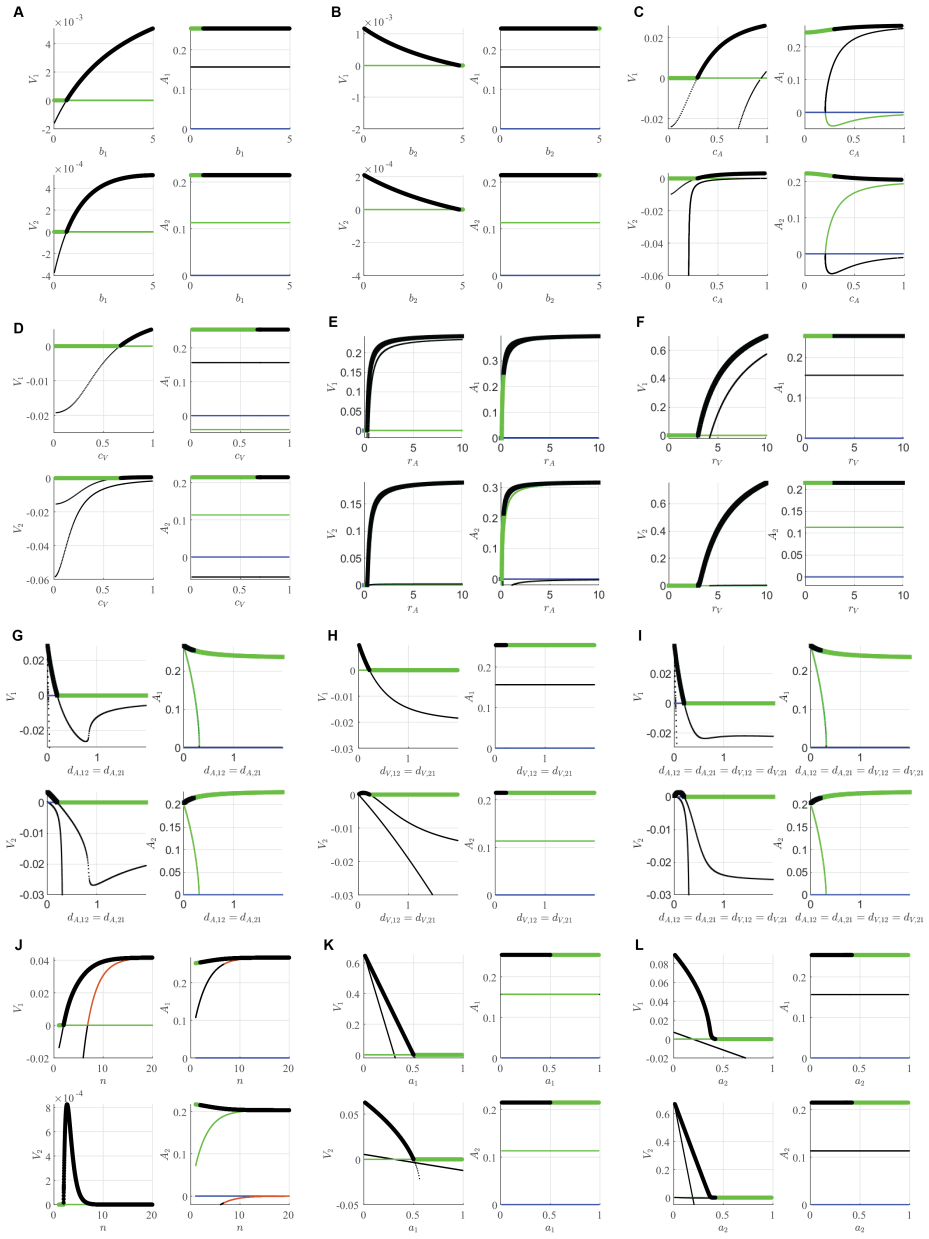
- Model parameters related to anthropization levels determine the shape of the long-term population dynamics.
Where Pith is reading between the lines
- The results imply that efforts to manage disease vectors by altering habitats may encounter unexpected population rebounds or drops at certain modification intensities.
- Similar bifurcation sequences could be explored in models with more than two patches or with additional ecological factors.
- Empirical studies in real landscapes could test for non-monotonic responses in vector densities across gradients of human activity.
Load-bearing premise
The migration between patches depends on anthropization through a particular nonlinear mathematical form that is chosen to be analytically tractable.
What would settle it
Data from field surveys across a gradient of human-modified landscapes that either confirm or refute the existence of multiple abrupt changes in vector abundance at intermediate modification levels.
Figures
read the original abstract
Landscape dynamics are key drivers of the movement and distribution of sylvatic hematophagous disease vectors and their (wild) animal hosts. Their habitats are undergoing increasing change, particularly fragmentation, through anthropogenic activity. In this article, we present and analyse a novel mathematical model that explicitly combines anthropization-induced landscape dynamics with the population dynamics of hematophagous vectors and (wild) animals dynamics. We develop a phenomenological and analytically tractable two-patch model in which the migration terms between the patches nonlinearly depend on the anthropization level of the patches. Our model analysis comprising analytical stability analysis and numerical bifurcation analysis provides information on how changes in model parameters, especially anthropization levels, shape the long-term dynamics in the model. Precisely, we find that low anthropogenic activity allows for a vector-animal coexistence state, while high anthropization leads to a vector extinction state. However, we establish that for intermediate anthropization levels, the transition between the two states is not necessarily monotonic, but may instead occur via a sequence of concurrent bifurcations along the anthropization axis.
Editorial analysis
A structured set of objections, weighed in public.
Referee Report
Summary. The paper develops a two-patch phenomenological model coupling vector and wild-animal population dynamics to anthropization-driven migration, where migration rates depend nonlinearly on patch anthropization levels. Analytical local stability analysis combined with numerical bifurcation analysis is used to show that low anthropization permits a vector-animal coexistence equilibrium, high anthropization drives vector extinction, and intermediate anthropization produces a non-monotonic transition between these states realized through a sequence of concurrent bifurcations along the anthropization axis.
Significance. If the central bifurcation result holds under the stated assumptions, the work demonstrates that anthropogenic landscape change can induce qualitatively richer dynamical transitions than simple monotonic extinction scenarios, which is relevant for vector-borne disease modeling. The combination of analytically tractable migration terms with explicit bifurcation tracking is a methodological strength that allows the non-monotonicity to be located precisely.
major comments (2)
- [Abstract and §2] Abstract and §2 (model formulation): the reported sequence of concurrent bifurcations at intermediate anthropization rests entirely on the specific nonlinear functional form chosen for the migration rates (the phenomenological expression that remains analytically tractable). No sensitivity analysis or comparison against alternative saturating or threshold forms is presented; changing this dependence could remove the intermediate bifurcation sequence while preserving the low- and high-anthropization endpoints.
- [§4] §4 (bifurcation analysis): the numerical continuation results that establish the non-monotonic transition do not report the precise parameter values, continuation tolerances, or software used, nor do they include a check that the concurrent bifurcations persist under small perturbations of the migration function; this information is load-bearing for the claim that the transition “may instead occur via a sequence of concurrent bifurcations.”
minor comments (1)
- [§2] Notation for the two patches and the anthropization parameter could be introduced more explicitly in the model diagram or first equations to aid readers outside mathematical epidemiology.
Simulated Author's Rebuttal
We thank the referee for their thoughtful review and constructive comments on our manuscript. We address each major comment below.
read point-by-point responses
-
Referee: [Abstract and §2] Abstract and §2 (model formulation): the reported sequence of concurrent bifurcations at intermediate anthropization rests entirely on the specific nonlinear functional form chosen for the migration rates (the phenomenological expression that remains analytically tractable). No sensitivity analysis or comparison against alternative saturating or threshold forms is presented; changing this dependence could remove the intermediate bifurcation sequence while preserving the low- and high-anthropization endpoints.
Authors: We agree that the reported non-monotonic transition depends on the specific nonlinear form chosen for the migration rates, which was selected to maintain analytical tractability. This is a genuine limitation of the present analysis. In the revised manuscript we will add a sensitivity study that recomputes the bifurcation diagrams for alternative functional forms (linear, saturating Michaelis-Menten, and threshold/step-function) and reports whether the intermediate sequence of concurrent bifurcations survives these changes. revision: yes
-
Referee: [§4] §4 (bifurcation analysis): the numerical continuation results that establish the non-monotonic transition do not report the precise parameter values, continuation tolerances, or software used, nor do they include a check that the concurrent bifurcations persist under small perturbations of the migration function; this information is load-bearing for the claim that the transition “may instead occur via a sequence of concurrent bifurcations.”
Authors: We acknowledge the omission of these numerical details. The revised version will explicitly state the parameter values, continuation tolerances, and software package employed. We will also add a short robustness subsection that perturbs the migration function by small random or parametric variations and confirms that the concurrent-bifurcation sequence remains intact under these perturbations. revision: yes
Circularity Check
No circularity; results derived from explicit model equations via stability and bifurcation analysis.
full rationale
The paper constructs a phenomenological two-patch ODE model with migration rates specified as a chosen nonlinear function of the anthropization parameter (for tractability). All reported states (coexistence at low anthropization, extinction at high, non-monotonic transitions via bifurcations at intermediate levels) are obtained by direct application of analytical stability criteria and numerical continuation to those equations. No parameter fitting to target outcomes occurs, no self-citation supplies a load-bearing uniqueness theorem, and no step equates a derived quantity to its own input by construction. The derivation chain is therefore self-contained against the model assumptions.
Axiom & Free-Parameter Ledger
Reference graph
Works this paper leans on
-
[1]
Biophysical Climate Impacts of Recent Changes in Global Forest Cover
R. Alkama and A. Cescatti. “Biophysical Climate Impacts of Recent Changes in Global Forest Cover” . In: Science 351.6273 (2016), pp. 600–604. doi: 10.1126/science.aac8083
-
[2]
The risk matrix of vector-borne diseases in metapopulation networks and its relation with local and global R 0
A. Anzo-Hernández, B. Bonilla-Capilla, J. Velázquez-Castro, J. Velázquez-Castro, and A. Fraguela- Collar. “The risk matrix of vector-borne diseases in metapopulation networks and its relation with local and global R 0” . In: Commun. Nonlinear Sci. Numer. Simul. (2018)
2018
-
[3]
A metapopulation model for malaria with transmission-blocking partial immunity in hosts
J. Arino, A. Ducrot, and P. Zongo. “A metapopulation model for malaria with transmission-blocking partial immunity in hosts” . en. In: J. Math. Biol. 64.3 (2012), pp. 423–448
2012
-
[4]
The Ross-Macdonald model in a patchy environment
P. Auger, E. Kouokam, G. Sallet, M. Tchuente, and B. Tsanou. “The Ross-Macdonald model in a patchy environment” . en. In: Math. Biosci. 216.2 (2008), pp. 123–131
2008
-
[5]
Three decades of land cover change in East Africa
E. L. Bullock, S. P. Healey, Z. Yang, P. Oduor, N. Gorelick, S. Omondi, E. Ouko, and W. B. Cohen. “Three decades of land cover change in East Africa” . en. In: Land (Basel) 10.2 (2021), p. 150
2021
-
[6]
Modélisation de la dynamique spatio-temporelle d’une population de moustiques, sources de nuisances et vecteurs d’agents pathogènes
P. Cailly. “Modélisation de la dynamique spatio-temporelle d’une population de moustiques, sources de nuisances et vecteurs d’agents pathogènes” . French. PhD thesis. Université de Caen Basse-Normandie, 2011
2011
-
[7]
Low Level of Anthropization Linked to Harsh Vertebrate Biodiversity Declines in Amazonia
I. Cantera, O. Coutant, C. Jézéquel, J.-B. Decotte, T. Dejean, A. Iribar, R. Vigouroux, A. Valentini, J. Murienne, and S. Brosse. “Low Level of Anthropization Linked to Harsh Vertebrate Biodiversity Declines in Amazonia” . In: Nature Communications 13 (2022), p. 3290. doi: 10.1038/s41467-022- 30842-2. pmid: 35672313
-
[8]
Land use, environmental, and food consumption patterns in sub-Saharan Africa, 2000–2015: A review
J. C. Chiaka and L. Zhen. “Land use, environmental, and food consumption patterns in sub-Saharan Africa, 2000–2015: A review” . en. In: Sustainability 13.15 (2021), p. 8200
2000
-
[9]
West nile virus prevalence across landscapes is mediated by local effects of agriculture on vector and host communities
D. W. Crowder, E. A. Dykstra, J. M. Brauner, A. Duffy, C. Reed, E. Martin, W. Peterson, Y. Carrière, P. Dutilleul, and J. P. Owen. “West nile virus prevalence across landscapes is mediated by local effects of agriculture on vector and host communities” . en. In: PLoS One 8.1 (2013), e55006
2013
-
[10]
Global dynamics of mosquito population model with seasonality and spatial heterogeneity
M. Cui, F. Li, and F. Geng. “Global dynamics of mosquito population model with seasonality and spatial heterogeneity” . en. In: Math. Methods Appl. Sci. 48.12 (2025), pp. 11850–11862
2025
-
[11]
Global Buffering of Temperatures under Forest Canopies
P. De Frenne, F. Zellweger, F. Rodríguez-Sánchez, B. R. Scheffers, K. Hylander, M. Luoto, M. Vellend, K. Verheyen, and J. Lenoir. “Global Buffering of Temperatures under Forest Canopies” . In: Nature Ecology & Evolution 3.5 (2019), pp. 744–749. doi: 10.1038/s41559-019-0842-1
-
[12]
E. J. Doedel, B. E. Oldeman, A. R. Champneys, F. Dercole, T. Fairgrieve, Y. Kuznetsov, R. Paen- roth, B. Sandstede, X. Wang, and C. Zhang. AUTO-07p: Continuation and Bifurcation Software for Oridinary Differential Equations . Tech. rep. 2012. 14
2012
-
[13]
Modeling and Simulations of Mosquito Dispersal. The Case of Aedes albopictus
C. Dufourd and Y. Dumont. “Modeling and Simulations of Mosquito Dispersal. The Case of Aedes albopictus” . In: 1.2 (2012)
2012
-
[14]
Impact of environmental factors on mosquito dispersal in the prospect of sterile insect technique control
C. Dufourd and Y. Dumont. “Impact of environmental factors on mosquito dispersal in the prospect of sterile insect technique control” . en. In: Comput. Math. Appl. 66.9 (2013), pp. 1695–1715
2013
-
[15]
Spatio-temporal Modeling of Mosquito Distribution
Y. Dumont, C. Dufourd, M. D. Todorov, and C. I. Christov. “Spatio-temporal Modeling of Mosquito Distribution” . In: Albena, (Bulgaria), 2011, pp. 162–167. doi: 10.1063/1.3659916
-
[16]
Human–Wildlife Interactions in a Tropical Forest Context: Modeling, Analysis, and Simulations
Y. Dumont, M. Hétier, and V. Yatat-Djeumen. “Human–Wildlife Interactions in a Tropical Forest Context: Modeling, Analysis, and Simulations” . In: Mathematical Methods in the Applied Sciences n/a.n/a (). doi: https://doi.org/10.1002/mma.70777 . eprint: https://onlinelibrary.wiley. com/doi/pdf/10.1002/mma.70777
-
[17]
Efficacy of Wolbachia-based mosquito control: Predictions of a spatially discrete mathematical model
D. Dye and J. W. Cain. “Efficacy of Wolbachia-based mosquito control: Predictions of a spatially discrete mathematical model” . en. In: PLoS One 19.3 (2024), e0297964
2024
-
[18]
L. Eigentler. Code repository for O.W. Happi-Tchakounte, I.V. Yatat-Djeumen, L. Eigentler, P. Couteron. Analysis of a two patch model for disease vector-animal dynamics with anthropization-driven migration. 2025. doi: 10.5281/ZENODO.17882418
-
[19]
E. C. Ellis, J. O. Kaplan, D. Q. Fuller, S. Vavrus, K. Klein Goldewijk, and P. H. Verburg. “Used Planet: A Global History” . In: Proceedings of the National Academy of Sciences 110.20 (2013), pp. 7978–7985. doi: 10.1073/pnas.1217241110
-
[20]
Landscape epidemiology: An emerging perspective in the mapping and modelling of disease and disease risk factors
N. N. Emmanuel, N. Loha, M. O. Okolo, and O. K. Ikenna. “Landscape epidemiology: An emerging perspective in the mapping and modelling of disease and disease risk factors” . en. In: Asian Pac. J. Trop. Dis. 1.3 (2011), pp. 247–250
2011
-
[21]
A model for yellow fever with migration
L. Esteva, C. Vargas, and H. M. Yang. “A model for yellow fever with migration” . en. In: Comp and Math Methods 1.6 (2019)
2019
-
[22]
Ecological effects on the dynamics of West Nile virus and avian Plasmodium: The importance of mosquito communities and landscape
M. Ferraguti, J. Martínez-de la Puente, and J. Figuerola. “Ecological effects on the dynamics of West Nile virus and avian Plasmodium: The importance of mosquito communities and landscape” . en. In: Viruses 13.7 (2021), p. 1208
2021
-
[23]
Patterns and changes of land use and land-use efficiency in Africa 1980–2005: an analysis based on the human appropriation of net primary production framework
T. Fetzel, M. Niedertscheider, H. Haberl, F. Krausmann, and K.-H. Erb. “Patterns and changes of land use and land-use efficiency in Africa 1980–2005: an analysis based on the human appropriation of net primary production framework” . en. In: Reg. Environ. Change 16.5 (2016), pp. 1507–1520
1980
-
[24]
The negative effects of habitat fragmentation operate at the scale of dispersal
R. J. Fletcher Jr, B. E. Reichert, and K. Holmes. “The negative effects of habitat fragmentation operate at the scale of dispersal” . en. In: Ecology 99.10 (2018), pp. 2176–2186
2018
-
[25]
Anthropogenic Disturbance and the Risk of Flea-Borne Disease Trans- mission
M. M. Friggens and P. Beier. “Anthropogenic Disturbance and the Risk of Flea-Borne Disease Trans- mission” . In: Oecologia 164.3 (2010), pp. 809–820. doi: 10.1007/s00442-010-1747-5
-
[26]
Climate Change and Habitat Conversion Favour the Same Species
L. O. Frishkoff, D. S. Karp, J. R. Flanders, J. Zook, E. A. Hadly, G. C. Daily, and L. K. M’Gonigle. “Climate Change and Habitat Conversion Favour the Same Species” . In: Ecology Letters 19.9 (2016), pp. 1081–1090. doi: 10.1111/ele.12645
-
[27]
Estimating the final size of vector-borne epidemics in metapopulation networks: methodologies and comparisons
U. J. Giménez-Mujica, J. Velázquez-Castro, A. Anzo-Hernández, T. P. Herrera-Ramírez, and I. Bar- radas. “Estimating the final size of vector-borne epidemics in metapopulation networks: methodologies and comparisons” . en. In: Bol. Soc. Mat. Mex. 31.1 (2025)
2025
-
[28]
P. A. Hancock, S. A. Ritchie, C. J. M. Koenraadt, T. W. Scott, A. A. Hoffmann, and H. C. J. Godfray. “Predicting the spatial dynamics of Wolbachia infections in Aedes aegypti arbovirus vector populations in heterogeneous landscapes” . In: Journal of Applied Ecology 56.7 (2019), pp. 1674–1686. doi: 10.1111/1365-2664.13423
-
[29]
Mathematical modelling of the mosquito Aedes polynesiensis in a heterogeneous environment
K. Heath, M. B. Bonsall, J. Marie, and H. C. Bossin. “Mathematical modelling of the mosquito Aedes polynesiensis in a heterogeneous environment” . In: Mathematical Biosciences 348 (2022), p. 108811. doi: https://doi.org/10.1016/j.mbs.2022.108811
-
[30]
Higley, L
L. Higley, L. Karr, and L. Pedigo. Manual of Entomology and Pest Management . Macmillan, 1989. 15
1989
-
[31]
Vector borne diseases on an urban environment: The effects of heterogeneity and human circulation
A. Iggidr, J. Koiller, M. L. F. Penna, G. Sallet, M. A. Silva, and M. O. Souza. “Vector borne diseases on an urban environment: The effects of heterogeneity and human circulation” . en. In: Ecol. Complex. 30 (2017), pp. 76–90
2017
-
[32]
Holocene Shifts in the Assembly of Plant and Animal Communities Implicate Human Impacts
S. Kathleen Lyons, K. L. Amatangelo, A. K. Behrensmeyer, A. Bercovici, J. L. Blois, M. Davis, W. A. DiMichele, A. Du, J. T. Eronen, J. Tyler Faith, G. R. Graves, N. Jud, C. Labandeira, C. V. Looy, B. McGill, J. H. Miller, D. Patterson, S. Pineda-Munoz, R. Potts, B. Riddle, R. Terry, A. Tóth, W. Ulrich, A. Villaseñor, S. Wing, H. Anderson, J. Anderson, D. ...
-
[33]
Impact of human population on land degradation. A critical literature review
C. Kimani. “Impact of human population on land degradation. A critical literature review” . In: Journal of Environment 1.2 (2021), pp. 1–14
2021
-
[34]
A. Kolimenakis, S. Heinz, M. L. Wilson, V. Winkler, L. Yakob, A. Michaelakis, D. Papachristos, C. Richardson, and O. Horstick. “The Role of Urbanisation in the Spread of Aedes Mosquitoes and the Diseases They Transmit—A Systematic Review” . In: PLOS Neglected Tropical Diseases 15.9 (2021), e0009631. doi: 10.1371/journal.pntd.0009631
-
[35]
Pathogenic landscapes: Interactions between land, people, disease vectors, and their animal hosts
E. F. Lambin, A. Tran, S. O. Vanwambeke, C. Linard, and V. Soti. “Pathogenic landscapes: Interactions between land, people, disease vectors, and their animal hosts” . In: International Journal of Health Geographics 9.1 (2010), p. 54
2010
-
[36]
modélisation mathématique de la dynamique des mouches tsé-tsé et l’optimisation de la Technique de l’Insecte Stérile (TIS)
W. C. Likeufack. “modélisation mathématique de la dynamique des mouches tsé-tsé et l’optimisation de la Technique de l’Insecte Stérile (TIS)” . Master’s thesis. University of Yaoundé 1, 2025
2025
-
[37]
J. S. Lord, Z. Mthombothi, V. K. Lagat, F. Atuhaire, and J. W. Hargrove. “Host-Seeking Efficiency Can Explain Population Dynamics of the Tsetse Fly Glossina Morsitans Morsitans in Response to Host Density Decline” . En. In: Plos Neglected Tropical Diseases 11.7 (2017). Ed. by J. G. Valenzuela, E0005730. doi: 10.1371/journal.pntd.0005730
-
[38]
Mathematical modelling of Mosquito Dispersal for MalariaVector Control
A. M. Lutambi. “Mathematical modelling of Mosquito Dispersal for MalariaVector Control” . PhD thesis. University of Basel, 2013. doi: 10.5451/UNIBAS-006120662
-
[39]
Mathematical modelling of mosquito dispersal in a heterogeneous environment
A. M. Lutambi, M. A. Penny, T. Smith, and N. Chitnis. “Mathematical modelling of mosquito dispersal in a heterogeneous environment” . In: Mathematical Biosciences 241.2 (2013), pp. 198–216. doi: https: //doi.org/10.1016/j.mbs.2012.11.013
-
[40]
A spatial agent-based simulation model of the dengue vector Aedes aegypti to explore its population dynamics in urban areas
S. Maneerat and E. Daudé. “A spatial agent-based simulation model of the dengue vector Aedes aegypti to explore its population dynamics in urban areas” . en. In: Ecol. Modell. 333 (2016), pp. 66–78
2016
-
[41]
C. P. McCormack, A. C. Ghani, and N. M. Ferguson. “Fine-scale modelling finds that breeding site fragmentation can reduce mosquito population persistence” . In: Communications Biology 2.1 (2019), p. 273. doi: 10.1038/s42003-019-0525-0
-
[42]
A metapopulation model for chikungunya including populations mobility on a large-scale network
D. Moulay and Y. Pigné. “A metapopulation model for chikungunya including populations mobility on a large-scale network” . en. In: J. Theor. Biol. 318 (2013), pp. 129–139
2013
-
[43]
Spatial modeling of invasion dynamics : applications to biological control of Aedes spp. (Diptera culicidae)
T. Q. N. Nguyen. “Spatial modeling of invasion dynamics : applications to biological control of Aedes spp. (Diptera culicidae)” . Theses. Université Paris-Nord - Paris XIII, 2024
2024
-
[44]
Unhealthy landscapes: Policy recommendations on land use change and infectious disease emergence
J. A. Patz, P. Daszak, G. M. Tabor, A. A. Aguirre, M. Pearl, J. Epstein, N. D. Wolfe, A. M. Kilpatrick, J. Foufopoulos, D. Molyneux, D. J. Bradley, and Members of the Working Group on Land Use Change Disease Emergence. “Unhealthy landscapes: Policy recommendations on land use change and infectious disease emergence” . en. In: Environ. Health Perspect. 112...
2004
-
[45]
L. Roques and O. Bonnefon. “Modelling Population Dynamics in Realistic Landscapes with Linear Ele- ments: A Mechanistic-Statistical Reaction-Diffusion Approach” . In: PLOS ONE 11.3 (2016), e0151217. doi: 10.1371/JOURNAL.PONE.0151217
-
[46]
Host movement, transmission hot spots, and vector-borne disease dynamics on spatial networks
O. Saucedo and J. H. Tien. “Host movement, transmission hot spots, and vector-borne disease dynamics on spatial networks” . In: Infectious Disease Modelling 7.4 (2022), pp. 742–760. doi: https://doi. org/10.1016/j.idm.2022.10.006. 16
-
[47]
A Pantropical Analysis of the Impacts of Forest Degradation and Conversion on Local Temperature
R. A. Senior, J. K. Hill, P. González del Pliego, L. K. Goode, and D. P. Edwards. “A Pantropical Analysis of the Impacts of Forest Degradation and Conversion on Local Temperature” . In: Ecology and Evolution 7.19 (2017), pp. 7897–7908. doi: 10.1002/ece3.3262
-
[48]
The roles of habitat isolation, landscape connectivity and host community in tick-borne pathogen ecology
G. Shaw, M. Lilly, V. Mai, J. Clark, S. Summers, K. Slater, S. Karpathy, A. Nakano, A. Crews, A. Lawrence, J. Salomon, S. B. Sambado, and A. Swei. “The roles of habitat isolation, landscape connectivity and host community in tick-borne pathogen ecology” . en. In: R. Soc. Open Sci. 11.11 (2024), p. 240837
2024
-
[49]
M. R. da Silva, P. H. G. Lugão, and G. Chapiro. “Modeling and simulation of the spatial population dynamics of the Aedes aegypti mosquito with an insecticide application” . In: Parasites & Vectors 13.1 (2020), pp. 1–13. doi: 10.1186/S13071-020-04426-2
-
[50]
Predator–Prey model with Holling response function of type II and SIS infectious disease
J. J. Tewa, V. Yatat-Djeumen, and S. Bowong. “Predator–Prey model with Holling response function of type II and SIS infectious disease” . In: Applied Mathematical Modelling 37.7 (2013), pp. 4825–4841. doi: https://doi.org/10.1016/j.apm.2012.10.003
-
[51]
Tibayrenc
M. Tibayrenc. Genetics and evolution of infectious diseases . Elsevier, 2024
2024
-
[52]
An agent‐based movement model to assess the impact of landscape fragmentation on disease transmission
J. A. Tracey, S. N. Bevins, S. VandeWoude, and K. R. Crooks. “An agent‐based movement model to assess the impact of landscape fragmentation on disease transmission” . en. In: Ecosphere 5.9 (2014), pp. 1–24
2014
-
[53]
W. Walter. Ordinary Differential Equations . Springer, 1998
1998
-
[54]
J. J. Williams, A. E. Bates, and T. Newbold. “Human-Dominated Land Uses Favour Species Affiliated with More Extreme Climates, Especially in the Tropics” . In: Ecography 43.3 (2020), pp. 391–405. doi: 10.1111/ecog.04806. A Proof of Theorem 1 Straightforward computations lead that the extinction state e00 = (0, 0) is always an equilibrium of system (4); when...
discussion (0)
Sign in with ORCID, Apple, or X to comment. Anyone can read and Pith papers without signing in.