Offloading L7 Policies to the Kernel
Pith reviewed 2026-06-28 20:12 UTC · model grok-4.3
The pith
L7FP enforces most L7 policies in kernel eBPF by synthesizing programs from high-level rules, cutting service mesh latency up to 6x.
A machine-rendered reading of the paper's core claim, the machinery that carries it, and where it could break.
Core claim
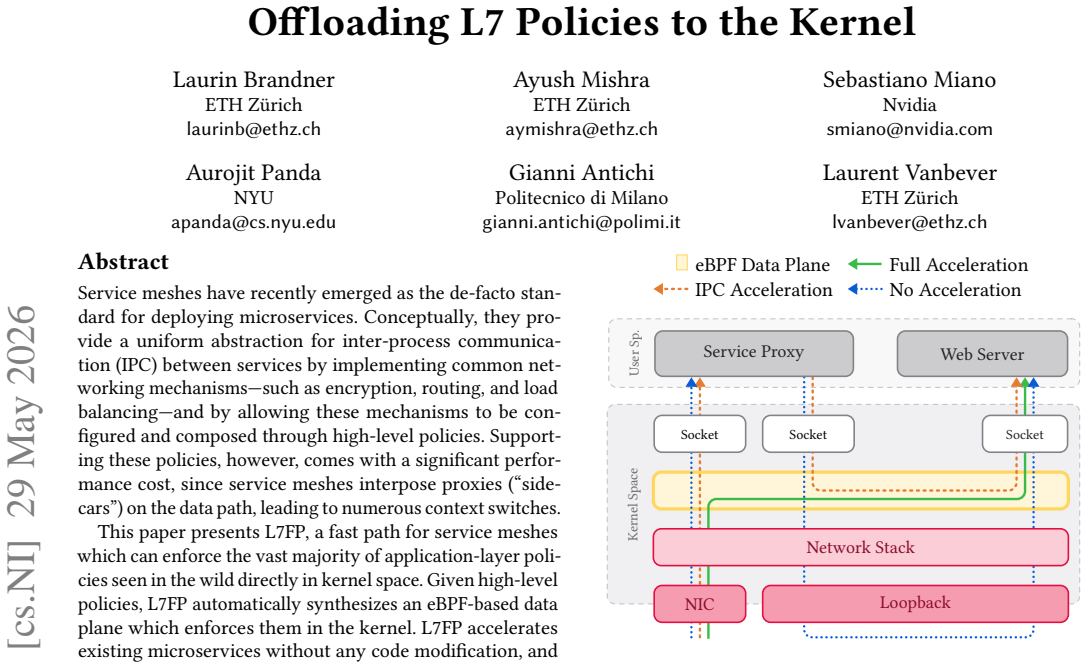
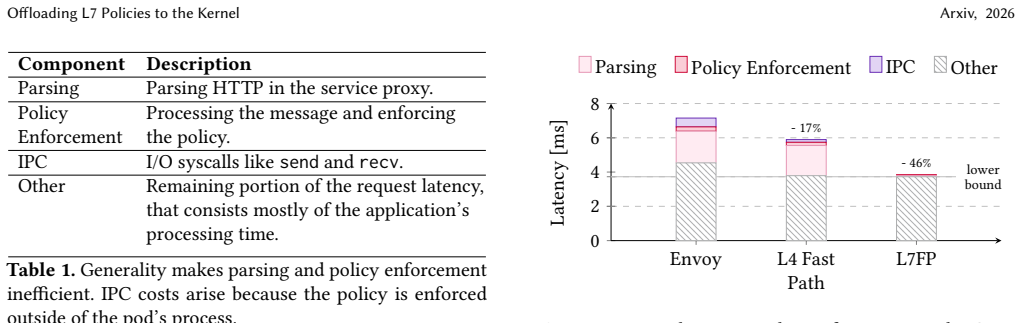
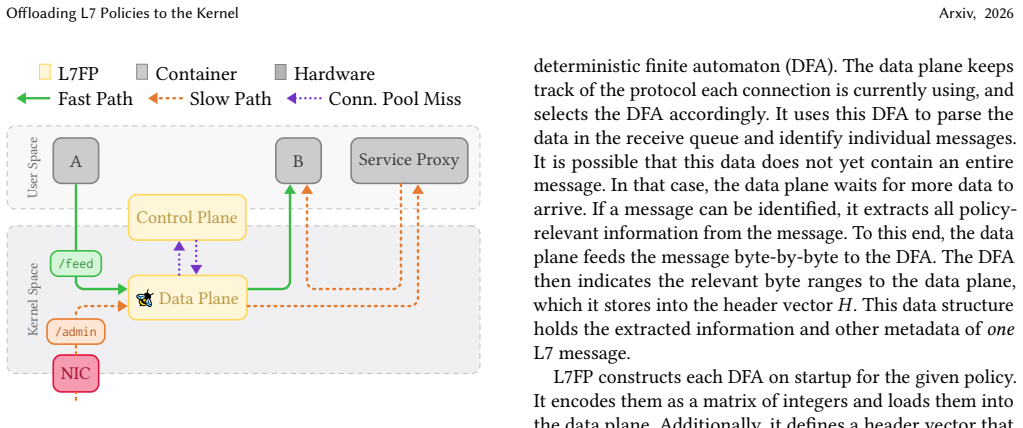
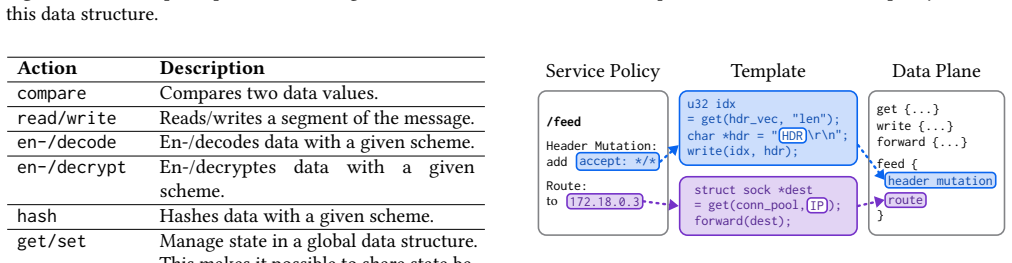
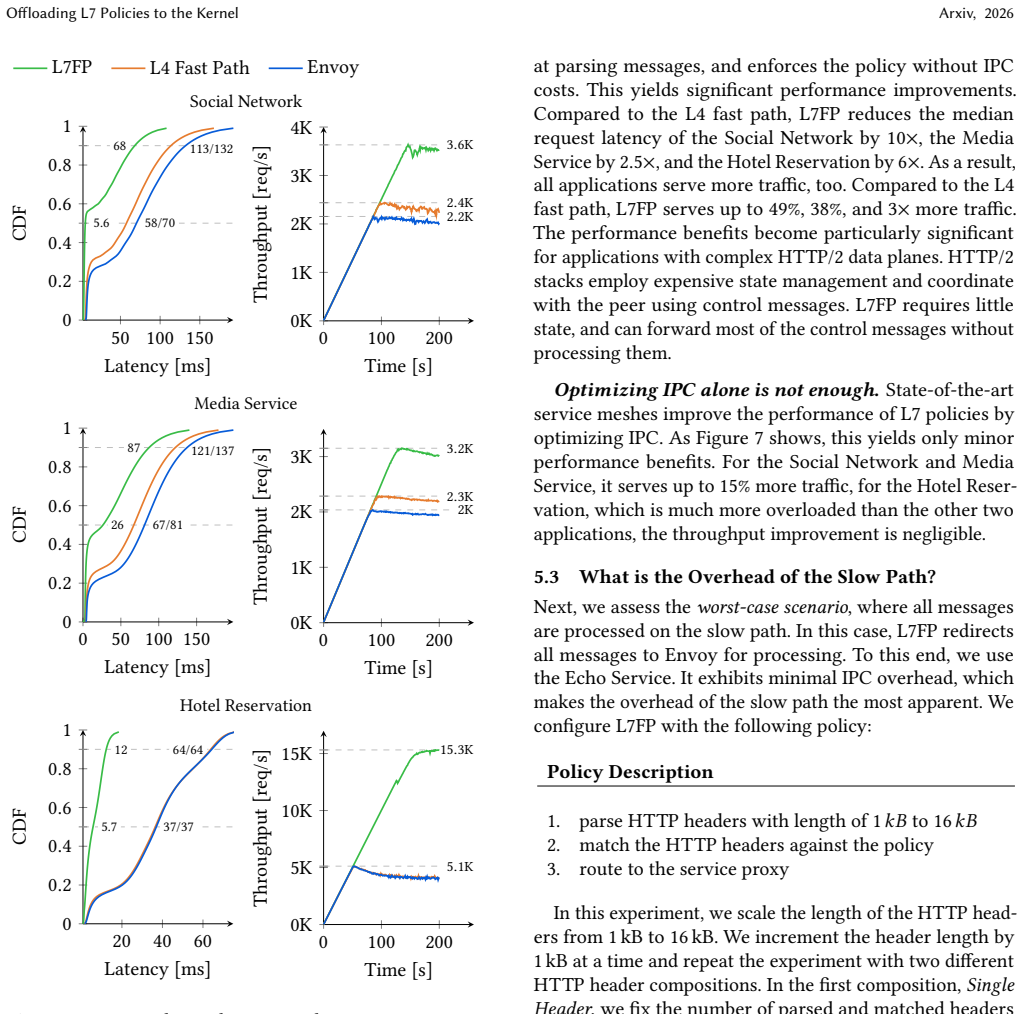
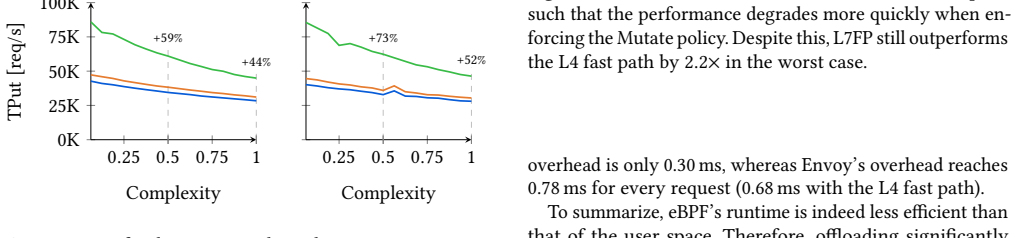
L7FP is a fast path for service meshes which can enforce the vast majority of application-layer policies seen in the wild directly in kernel space. Given high-level policies, L7FP automatically synthesizes an eBPF-based data plane which enforces them in the kernel. L7FP accelerates existing microservices without any code modification, and transparently falls back to existing service proxies for the few unsupported policies. It fully supports TLS and HTTP/2 and delivers up to 6 times lower median request latency while sustaining 3 times more throughput than state-of-the-art service meshes.
What carries the argument
Automatic synthesis of eBPF programs from high-level L7 policies to create a kernel-resident fast path that handles enforcement.
If this is right
- Microservices run faster with no source changes or redeployment.
- Service mesh throughput rises by a factor of three on realistic workloads.
- Only a small fraction of policies ever reach the slower user-space path.
- Existing proxy-based meshes can adopt the kernel path without breaking compatibility.
Where Pith is reading between the lines
- Operators could reduce the number of dedicated proxy CPU cores needed per service instance.
- Kernel networking stacks might evolve to expose more L7 primitives natively if this pattern spreads.
- Similar synthesis techniques could target other policy domains such as rate limiting or observability.
Load-bearing premise
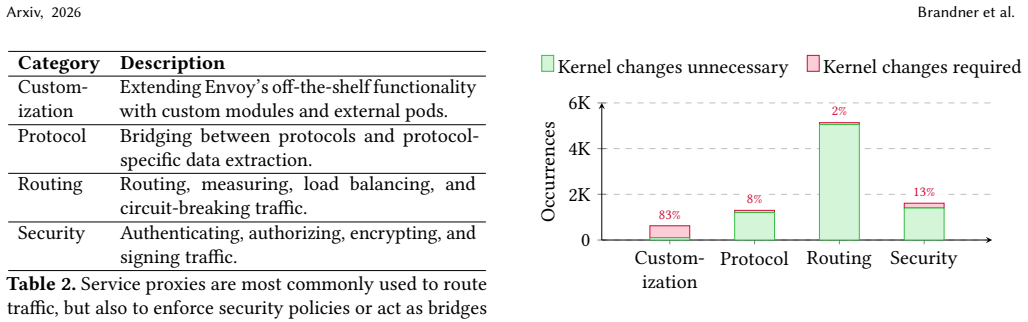
The vast majority of real-world application-layer policies can be correctly and completely expressed as eBPF programs that run safely inside the kernel.
What would settle it
A trace of production microservice traffic showing that a large share of observed L7 policies trigger fallback to user-space proxies, erasing the reported latency and throughput gains.
Figures

read the original abstract
Service meshes have recently emerged as the de-facto standard for deploying microservices. Conceptually, they provide a uniform abstraction for inter-process communication (IPC) between services by implementing common networking mechanisms -- such as encryption, routing, and load balancing -- and by allowing these mechanisms to be configured and composed through high-level policies. Supporting these policies, however, comes with a significant performance cost, since service meshes interpose proxies (``sidecars'') on the data path, leading to numerous context switches. This paper presents L7FP, a fast path for service meshes which can enforce the vast majority of application-layer policies seen in the wild directly in kernel space. Given high-level policies, L7FP automatically synthesizes an eBPF-based data plane which enforces them in the kernel. L7FP accelerates existing microservices without any code modification, and transparently falls back to existing service proxies (the slow path) for the few unsupported policies. We fully implemented L7FP, with support for both TLS and HTTP/2. Compared to state-of-the-art service meshes, L7FP reduces the median request latency of realistic applications by up to $6\times$ while sustaining $3\times$ more throughput.
Editorial analysis
A structured set of objections, weighed in public.
Referee Report
Summary. The paper presents L7FP, a kernel fast path for service meshes that automatically synthesizes eBPF programs to enforce the majority of L7 policies (TLS and HTTP/2) directly in the kernel. It claims transparent fallback to user-space proxies for unsupported policies, no application changes required, and performance gains of up to 6× lower median latency and 3× higher throughput versus state-of-the-art service meshes on realistic applications.
Significance. If the synthesis covers the vast majority of production L7 policies without frequent fallback and the reported speedups are reproducible, the work would meaningfully reduce the overhead of service-mesh sidecars while preserving their policy model.
major comments (2)
- [Abstract and Evaluation (implied)] The central performance claim (6× latency, 3× throughput) is realized only when the synthesized fast path handles the workload. The manuscript states that fallback occurs for 'the few unsupported policies' but supplies no measurement—e.g., success rate or distribution—of how many policies from representative deployments (Istio/Linkerd configs, production traces) synthesize successfully versus requiring the slow path. This quantification is load-bearing for extrapolating the headline numbers beyond the specific evaluated applications.
- [Abstract] The abstract asserts that the system 'was fully implemented and evaluated' with support for TLS and HTTP/2, yet provides no details on synthesis correctness verification, policy coverage metrics, baseline proxy configurations, or statistical significance of the reported speedups. These omissions prevent verification of the soundness of the implementation claims.
minor comments (1)
- Clarify the exact set of L7 policy primitives supported by the eBPF synthesizer versus those that trigger fallback.
Simulated Author's Rebuttal
We thank the referee for the detailed and constructive review. The two major comments highlight important gaps in quantification and verification details. We address each below and will revise the manuscript accordingly to improve clarity and reproducibility.
read point-by-point responses
-
Referee: The central performance claim (6× latency, 3× throughput) is realized only when the synthesized fast path handles the workload. The manuscript states that fallback occurs for 'the few unsupported policies' but supplies no measurement—e.g., success rate or distribution—of how many policies from representative deployments (Istio/Linkerd configs, production traces) synthesize successfully versus requiring the slow path. This quantification is load-bearing for extrapolating the headline numbers beyond the specific evaluated applications.
Authors: We agree that explicit quantification of synthesis success rates across representative policy sets is necessary to support extrapolation of the performance results. The current evaluation focuses on realistic applications where the fast path applies, but we did not include aggregate coverage statistics from Istio/Linkerd configurations or production traces. We will add this analysis in a revised Section 5 (or new subsection), reporting success rates and fallback frequency on sampled production-like policy sets. revision: yes
-
Referee: The abstract asserts that the system 'was fully implemented and evaluated' with support for TLS and HTTP/2, yet provides no details on synthesis correctness verification, policy coverage metrics, baseline proxy configurations, or statistical significance of the reported speedups. These omissions prevent verification of the soundness of the implementation claims.
Authors: The full manuscript contains implementation details (Sections 3–4) and evaluation methodology (Section 5), including baseline proxy versions and how correctness was validated via differential testing against user-space proxies. However, we acknowledge that the abstract and evaluation sections lack explicit coverage metrics, configuration details, and statistical reporting (e.g., confidence intervals or number of runs). We will expand the abstract if space permits, add a dedicated paragraph on verification approach, and include statistical details plus baseline configurations in the revised evaluation section. revision: yes
Circularity Check
No circularity in derivation chain
full rationale
The paper describes an implementation (L7FP) that synthesizes eBPF programs from high-level L7 policies and evaluates it via benchmarks against service meshes. No equations, fitted parameters, predictions derived from inputs, or self-citation chains appear in the provided text. The performance claims (6× latency, 3× throughput) rest on direct measurement of the implemented system rather than any reduction to self-referential definitions or ansatzes. The coverage assumption noted by the skeptic is an evaluation gap, not a circular derivation step.
Axiom & Free-Parameter Ledger
axioms (1)
- domain assumption eBPF verifier guarantees safety for the synthesized L7 policy programs
Reference graph
Works this paper leans on
-
[1]
Marcelo Abranches, Erika Hunhoff, Rohan Eswara, Oliver Michel, and Eric Keller. 2024. LinuxFP: Transparently accelerating linux net- working. In2024 IEEE 44th International Conference on Distributed Computing Systems (ICDCS). IEEE, 543–554
2024
-
[2]
Daroc Alden. 2025. Taking BPF programs beyond one-million in- structions. Retrieved January 22, 2026 fromhttps://lwn.net/Articles/ 1017116/
2025
-
[3]
Gianni Antichi and Gábor Rétvári. 2020. Full-stack SDN: The Next Big Challenge?. InProceedings of the Symposium on SDN Research (SOSR ’20). ACM, 48–54.https://doi.org/10.1145/3373360.3380834
-
[4]
auth0. 2026. JSON Web Tokens. Retrieved January 22, 2026 from https://jwt.io
2026
-
[5]
Go Authors. 2026. Go HTTP/2 Library. Retrieved January 20, 2026 fromhttps://pkg.go.dev/golang.org/x/net/http2/hpack#HeaderField
2026
-
[6]
Adam Belay, George Prekas, Ana Klimovic, Samuel Grossman, Christos Kozyrakis, and Edouard Bugnion. 2014. IX: A Protected Dataplane Operating System for High Throughput and Low Latency. In11th USENIX Symposium on Operating Systems Design and Implementation (OSDI 14). USENIX Association, Broomfield, CO, 49–65.https://www. usenix.org/conference/osdi14/techni...
2014
-
[7]
Fatéma Zahra Benchara, Mohamed Youssfi, Omar Bouattane, and Hassan Ouajji. 2016. A new efficient distributed computing middle- ware based on cloud micro-services for HPC. In2016 5th International Conference on Multimedia Computing and Systems (ICMCS). 354–359. https://doi.org/10.1109/ICMCS.2016.7905644
-
[8]
Sanjit Bhat and Hovav Shacham. 2022. Formal verification of the linux kernel ebpf verifier range analysis
2022
-
[9]
S. Bhatia, C. Consel, A.-F. Le Meur, and C. Pu. 2004. Automatic special- ization of protocol stacks in operating system kernels. In29th Annual IEEE International Conference on Local Computer Networks. 152–159. https://doi.org/10.1109/LCN.2004.28
-
[10]
Marco Spaziani Brunella, Giacomo Belocchi, Marco Bonola, Salva- tore Pontarelli, Giuseppe Siracusano, Giuseppe Bianchi, Aniello Cam- marano, Alessandro Palumbo, Luca Petrucci, and Roberto Bifulco. 2022. hXDP: Efficient software packet processing on FPGA NICs.Commun. ACM65, 8 (July 2022), 92–100.https://doi.org/10.1145/3543668
-
[11]
Calico. 2026. Calico. Retrieved January 22, 2026 fromhttps://www. tigera.io/project-calico
2026
-
[12]
Jingrong Chen, Yongji Wu, Shihan Lin, Yechen Xu, Xinhao Kong, Thomas Anderson, Matthew Lentz, Xiaowei Yang, and Danyang Zhuo
-
[13]
In20th USENIX Symposium on Networked Systems Design and Implementation (NSDI 23)
Remote Procedure Call as a Managed System Service. In20th USENIX Symposium on Networked Systems Design and Implementation (NSDI 23). USENIX Association, Boston, MA, 141–159.https://www. usenix.org/conference/nsdi23/presentation/chen-jingrong
-
[14]
Ruining Chen and Guoao Sun. 2018. A Survey of Kernel-Bypass Tech- niques in Network Stack. InProceedings of the 2018 2nd International Conference on Computer Science and Artificial Intelligence (CSAI ’18). ACM, 474–477.https://doi.org/10.1145/3297156.3297242
-
[15]
Oliver RA Chick, Lucian Carata, James Snee, Nikilesh Balakrishnan, and Ripduman Sohan. 2016. Shadow kernels: A general mechanism for kernel specialization in existing operating systems.ACM SIGOPS Operating Systems Review50, 1 (2016), 3–8
2016
-
[16]
Cilium. 2026. Cilium GitHub Repository. Retrieved August 1, 2025 fromhttps://github.com/cilium/cilium
2026
-
[17]
Cilium. 2026. Cilium Service Mesh. Retrieved January 22, 2026 from https://cilium.io/use-cases/service-mesh
2026
-
[18]
Linux Community. 2026. BPF Kernel Functions (kfuncs). Retrieved January 22, 2026 fromhttps://docs.kernel.org/bpf/kfuncs.html
2026
-
[19]
Linux Community. 2026. Linux Kernel Crypto API. Retrieved January 22, 2026 fromhttps://www.kernel.org/doc/html/v4.20/crypto/index. html
2026
- [20]
-
[21]
eBPF Community. 2026. eBPF. Retrieved July 27, 2025 fromhttps: //ebpf.io
2026
-
[22]
Envoy. 2026. Envoy. Retrieved August 1, 2025 fromhttps://www. envoyproxy.io
2026
-
[23]
Linux Foundation. 2015. Data Plane Development Kit (DPDK). Re- trieved May 28, 2026 fromhttp://www.dpdk.org
2015
-
[24]
Yu Gan, Yanqi Zhang, Dailun Cheng, Ankitha Shetty, Priyal Rathi, Nayan Katarki, Ariana Bruno, Justin Hu, Brian Ritchken, Brendon Jackson, Kelvin Hu, Meghna Pancholi, Yuan He, Brett Clancy, Chris Colen, Fukang Wen, Catherine Leung, Siyuan Wang, Leon Zaruvinsky, Mateo Espinosa, Rick Lin, Zhongling Liu, Jake Padilla, and Christina Delimitrou. 2019. An Open-S...
-
[25]
Grafana. 2026. Grafana k6: Load testing for engineering teams. Re- trieved January 22, 2026 fromhttps://k6.io
2026
-
[26]
gRPC Authors. 2015. gRPC. Retrieved January 20, 2026 fromhttps: //grpc.io/
2015
-
[27]
Shuveb Hussain. 2020. What is io_uring? Retrieved January 22, 2026 fromhttps://unixism.net/loti/what_is_io_uring.html
2020
-
[28]
Toke Høiland-Jørgensen, Jesper Dangaard Brouer, Daniel Borkmann, John Fastabend, Tom Herbert, David Ahern, and David Miller. 2018. The eXpress data path: fast programmable packet processing in the operating system kernel. InProceedings of the 14th International Confer- ence on emerging Networking EXperiments and Technologies (CoNEXT ’18). ACM, 54–66.https...
-
[29]
Internet Engineering Task Force (IETF). 2015. HPACK: Header Com- pression for HTTP/2. Retrieved January 22, 2026 fromhttps: //datatracker.ietf.org/doc/html/rfc7541
2015
-
[30]
Istio. 2026. Istio. Retrieved January 22, 2026 fromhttps://istio.io
2026
-
[31]
Istio. 2026. Istio Ambient. Retrieved January 22, 2026 fromhttps: //istio.io/latest/docs/ambient/overview
2026
-
[32]
Istio. 2026. Istio GitHub Repository. Retrieved August 1, 2025 from https://github.com/istio/istio
2026
-
[33]
Devki Nandan Jha, Saurabh Garg, Prem Prakash Jayaraman, Rajkumar Buyya, Zheng Li, Graham Morgan, and Rajiv Ranjan. 2021. A study on the evaluation of HPC microservices in containerized environment. Concurrency and Computation: Practice and Experience33, 7 (2021), 1–1
2021
-
[34]
Richard Jones. 2026. Ketama. Retrieved January 22, 2026 from https://github.com/RJ/ketama
2026
-
[35]
Richard Jones. 2026. xxHash: Extremely fast non-cryptographic hash function. Retrieved January 22, 2026 fromhttps://xxhash.com/doc/v0. 8.2/index.html
2026
-
[36]
Gopal Kakivaya, Lu Xun, Richard Hasha, Shegufta Bakht Ahsan, Todd Pfleiger, Rishi Sinha, Anurag Gupta, Mihail Tarta, Mark Fussell, Vipul Modi, Mansoor Mohsin, Ray Kong, Anmol Ahuja, Oana Pla- ton, Alex Wun, Matthew Snider, Chacko Daniel, Dan Mastrian, Yang Li, Aprameya Rao, Vaishnav Kidambi, Randy Wang, Abhishek Ram, Sumukh Shivaprakash, Rajeet Nair, Alan...
-
[37]
The kernel development community. 2026. Kernel Connection Mul- tiplexor. Retrieved January 22, 2026 fromhttps://docs.kernel.org/ networking/kcm.html
2026
-
[38]
The kernel development community. 2026. Kernel TLS offload. Re- trieved January 22, 2026 fromhttps://docs.kernel.org/networking/tls- 13 Arxiv, 2026 Brandner et al. offload.html
2026
-
[39]
The kernel development community. 2026. Stream Parser (strparser). Retrieved May 28, 2026 fromhttps://docs.kernel.org/networking/ strparser.html
2026
-
[40]
Ashwin Kumar, Abhik Bose, Khushboo Tiwari, Arnav Mishra, Ab- hishek Dixit, Abuhujair Khan, and Mythili Vutukuru. 2024. Fea- sibility of Application Layer Header Parsing in eBPF and P4. In 2024 IFIP Networking Conference (IFIP Networking). 475–481.https: //doi.org/10.23919/IFIPNetworking62109.2024.10619855
work page doi:10.23919/ifipnetworking62109.2024.10619855 2024
-
[41]
Wubin Li, Yves Lemieux, Jing Gao, Zhuofeng Zhao, and Yanbo Han
-
[42]
In2019 IEEE International Conference on Service- Oriented System Engineering (SOSE)
Service Mesh: Challenges, State of the Art, and Future Re- search Opportunities. In2019 IEEE International Conference on Service- Oriented System Engineering (SOSE). IEEE, 122–1225.https://doi.org/ 10.1109/sose.2019.00026
-
[43]
Shengkai Lin, Shizhen Zhao, Peirui Cao, Xinchi Han, Quan Tian, Wenfeng Liu, Qi Wu, Donghai Han, and Xinbing Wang. 2023. ON- Cache: A Cache-Based Low-Overhead Container Overlay Network. https://doi.org/10.48550/ARXIV.2305.05455
-
[44]
Linkerd. 2026. Linkerd. Retrieved January 22, 2026 fromhttps: //linkerd.io
2026
-
[45]
Ilias Marinos, Robert N.M. Watson, and Mark Handley. 2014. Net- work stack specialization for performance.ACM SIGCOMM Com- puter Communication Review44, 4 (August 2014), 175–186.https: //doi.org/10.1145/2740070.2626311
-
[46]
Sean McArthur. 2026. Rust HTTP Library. Retrieved January 20, 2026 fromhttps://docs.rs/http/latest/http/header/struct.HeaderValue.html# method.set_sensitive
2026
-
[47]
Nick McKeown, Tom Anderson, Hari Balakrishnan, Guru Parulkar, Larry Peterson, Jennifer Rexford, Scott Shenker, and Jonathan Turner
-
[48]
https://doi.org/10.1145/1355734.1355746
OpenFlow: enabling innovation in campus networks.ACM SIGCOMM Computer Communication Review38, 2 (March 2008), 69–74. https://doi.org/10.1145/1355734.1355746
-
[49]
Dylan McNamee, Jonathan Walpole, Calton Pu, Crispin Cowan, Charles Krasic, Ashvin Goel, Perry Wagle, Charles Consel, Gilles Muller, and Renauld Marlet. 2001. Specialization tools and techniques for systematic optimization of system software.ACM Transactions on Computer Systems (TOCS)19, 2 (2001), 217–251
2001
-
[50]
Sebastiano Miano, Xiaoqi Chen, Ran Ben Basat, and Gianni An- tichi. 2023. Fast In-kernel Traffic Sketching in eBPF.ACM SIG- COMM Computer Communication Review53, 1 (January 2023), 3–13. https://doi.org/10.1145/3594255.3594256
-
[51]
YoungGyoun Moon, SeungEon Lee, Muhammad Asim Jamshed, and KyoungSoo Park. 2020. AccelTCP: Accelerating Network Applications with Stateful TCP Offloading. In17th USENIX Symposium on Networked Systems Design and Implementation (NSDI 20). USENIX Association, Santa Clara, CA, 77–92.https://www.usenix.org/conference/nsdi20/ presentation/moon
2020
-
[52]
Justin Ngai. 2025. Kernel-Resident Regex and Jails: DFA-powered eBPF filtering and certificate-safe agent isolation at fleet scale. Retrieved January 20, 2026 fromhttps://lpc.events/event/19/contributions/2176
2025
-
[53]
Somu Perianayagam, HaiFeng He, Mohan Rajagopalan, Gregory An- drews, and Saumya Debray. 2006. Profile-guided specialization of an operating system kernel. InProc. Workshop on Binary Instrumentation and Applications
2006
-
[54]
Ben Pfaff, Justin Pettit, Teemu Koponen, Ethan Jackson, Andy Zhou, Jarno Rajahalme, Jesse Gross, Alex Wang, Joe Stringer, Pravin Shelar, Keith Amidon, and Martin Casado. 2015. The Design and Implemen- tation of Open vSwitch. In12th USENIX Symposium on Networked Systems Design and Implementation (NSDI 15). USENIX Association, Oakland, CA, 117–130.https://w...
2015
-
[55]
C. Pu, T. Autrey, A. Black, C. Consel, C. Cowan, J. Inouye, L. Kethana, J. Walpole, and K. Zhang. 1995. Optimistic incremental specialization: streamlining a commercial operating system. InProceedings of the Fifteenth ACM Symposium on Operating Systems Principles(Copper Mountain, Colorado, USA)(SOSP ’95). Association for Computing Machinery, New York, NY,...
-
[56]
Calton Pu, Andrew P Black, Crispin Cowan, Jonathan Walpole, and Charles Consel. 1997. Microlanguages for operating system special- ization. (1997)
1997
-
[57]
Shixiong Qi, Leslie Monis, Ziteng Zeng, Ian-chin Wang, and K. K. Ramakrishnan. 2022. SPRIGHT: extracting the server from server- less computing! high-performance eBPF-based event-driven, shared- memory processing. InProceedings of the ACM SIGCOMM 2022 Confer- ence (SIGCOMM ’22). ACM.https://doi.org/10.1145/3544216.3544259
-
[58]
Luigi Rizzo, Marta Carbone, and Gaetano Catalli. 2012. Transparent acceleration of software packet forwarding using netmap. In2012 Proceedings IEEE INFOCOM. IEEE, 2471–2479
2012
-
[59]
Mohammad Reza Saleh Sedghpour, Cristian Klein, and Johan Tordsson
-
[60]
InProceedings of the 2022 ACM/SPEC on International Conference on Performance Engineering (ICPE ’22)
An Empirical Study of Service Mesh Traffic Management Policies for Microservices. InProceedings of the 2022 ACM/SPEC on International Conference on Performance Engineering (ICPE ’22). ACM, 17–27.https: //doi.org/10.1145/3489525.3511686
-
[61]
Harshit Saokar, Soteris Demetriou, Nick Magerko, Max Kontorovich, Josh Kirstein, Margot Leibold, Dimitrios Skarlatos, Hitesh Khandelwal, and Chunqiang Tang. 2023. ServiceRouter: Hyperscale and Minimal Cost Service Mesh at Meta. In17th USENIX Symposium on Operating Systems Design and Implementation (OSDI 23). USENIX Association, Boston, MA, 969–985.https:/...
2023
-
[62]
Divyanshu Saxena, William Zhang, Shankara Pailoor, Isil Dillig, and Aditya Akella. 2025. Copper and Wire: Bridging Expressiveness and Performance for Service Mesh Policies. InProceedings of the 30th ACM International Conference on Architectural Support for Programming Lan- guages and Operating Systems, Volume 1 (ASPLOS ’25). ACM, 233–248. https://doi.org/...
-
[63]
Korakit Seemakhupt, Brent E Stephens, Samira Khan, Sihang Liu, Hassan Wassel, Soheil Hassas Yeganeh, Alex C Snoeren, Arvind Kr- ishnamurthy, David E Culler, and Henry M Levy. 2023. A cloud-scale characterization of remote procedure calls. InProceedings of the 29th Symposium on Operating Systems Principles. 498–514
2023
-
[64]
Farbod Shahinfar, Sebastiano Miano, Aurojit Panda, and Gianni An- tichi. 2025. Demystifying Performance of eBPF Network Applica- tions.Proc. ACM Netw.3, CoNEXT3, Article 16 (Sept. 2025), 21 pages. https://doi.org/10.1145/3749216
-
[65]
Farbod Shahinfar, Sebastiano Miano, Giuseppe Siracusano, Roberto Bifulco, Aurojit Panda, and Gianni Antichi. 2023. Automatic Kernel Offload Using BPF. InProceedings of the 19th Workshop on Hot Topics in Operating Systems (HOTOS ’23). ACM, 143–149.https://doi.org/10. 1145/3593856.3595888
-
[66]
Rajath Shashidhara, Tim Stamler, Antoine Kaufmann, and Simon Peter
-
[67]
In 19th USENIX Symposium on Networked Systems Design and Implemen- tation (NSDI 22)
FlexTOE: Flexible TCP Offload with Fine-Grained Parallelism. In 19th USENIX Symposium on Networked Systems Design and Implemen- tation (NSDI 22). USENIX Association, Renton, WA, 87–102.https: //www.usenix.org/conference/nsdi22/presentation/shashidhara
-
[68]
Giulio Sidoretti, Sebastiano Miano, Stefano Salsano, Gianni Antichi, and Aurojit Panda. 2023. Application Layer Processing Offload in the Kernel
2023
-
[69]
Mark Slee, Aditya Agarwal, and Marc Kwiatkowski. 2007. Thrift: Scalable cross-language services implementation.Facebook white paper5, 8 (2007), 127
2007
-
[70]
Enge Song, Yang Song, Chengyun Lu, Tian Pan, Shaokai Zhang, Jianyuan Lu, Jiangu Zhao, Xining Wang, Xiaomin Wu, Minglan Gao, Zongquan Li, Ziyang Fang, Biao Lyu, Pengyu Zhang, Rong Wen, Li Yi, Zhigang Zong, and Shunmin Zhu. 2024. Canal Mesh: A Cloud-Scale Sidecar-Free Multi-Tenant Service Mesh Architecture. InProceedings of the ACM SIGCOMM 2024 Conference (...
-
[71]
Hao Sun and Zhendong Su. 2024. Validating the eBPF Verifier via State Embedding. In18th USENIX Symposium on Operating Systems Design and Implementation (OSDI 24). USENIX Association, Santa Clara, CA, 615–628.https://www.usenix.org/conference/osdi24/presentation/ sun-hao
2024
-
[72]
2023.Verifying the Verifier: eBPF Range Analysis Verification
Harishankar Vishwanathan, Matan Shachnai, Srinivas Narayana, and Santosh Nagarakatte. 2023.Verifying the Verifier: eBPF Range Analysis Verification. Springer Nature Switzerland, 226–251.https://doi.org/ 10.1007/978-3-031-37709-9_12
-
[73]
Xiangfeng Zhu, Guozhen She, Bowen Xue, Yu Zhang, Yongsu Zhang, Xuan Kelvin Zou, Xiongchun Duan, Peng He, Arvind Krishnamurthy, Matthew Lentz, Danyang Zhuo, and Ratul Mahajan. 2022. Dissecting Service Mesh Overheads.https://doi.org/10.48550/ARXIV.2207.00592
-
[74]
Danyang Zhuo, Kaiyuan Zhang, Yibo Zhu, Hongqiang Harry Liu, Matthew Rockett, Arvind Krishnamurthy, and Thomas Anderson. 2019. Slim: OS Kernel Support for a Low-Overhead Container Overlay Net- work. In16th USENIX Symposium on Networked Systems Design and Implementation (NSDI 19). USENIX Association, Boston, MA, 331–344. https://www.usenix.org/conference/ns...
2019
discussion (0)
Sign in with ORCID, Apple, or X to comment. Anyone can read and Pith papers without signing in.