High-redshift GRB 140304A at z = 5.282 with flaring activity: A multi-wavelength study
Pith reviewed 2026-06-28 21:42 UTC · model grok-4.3
The pith
Positive spectral lag in GRB 140304A tracks its hard-to-soft spectral evolution during prompt emission.
A machine-rendered reading of the paper's core claim, the machinery that carries it, and where it could break.
Core claim
Parameter evolution shows hard-to-soft change in spectral peak energy and magnetic field strength, matching typical long GRBs. GRB 140304A exhibits a rare spectral lag pattern: positive lag appears in early BAT light curves but none in XRT curves. Systematic time delays exist among flare peaks in the three bands, yet optical flares match the morphology of X-ray and gamma-ray flares. The positive lag connects to the hard-to-soft evolution, and the flares link to prompt emission through synchrotron radiation produced by rapid bulk acceleration in the emitting region.
What carries the argument
The morphological correspondence and time delays among multi-band flares interpreted as evidence for synchrotron radiation during rapid bulk acceleration in the emitting region.
If this is right
- The positive spectral lag follows from the hard-to-soft evolution of peak energy, matching patterns in other long GRBs.
- Gamma-ray, X-ray, and optical flares connect temporally and morphologically to the prompt emission phase.
- High-redshift GRBs can display late flaring that constrains correlations across wavelengths.
- The emitting region in GRB 140304A undergoes rapid bulk acceleration that produces the observed flares via synchrotron radiation.
Where Pith is reading between the lines
- If the flares share the prompt mechanism, the central engine or outflow must remain active or restart at late times.
- Similar lag and flare patterns in additional high-z bursts would suggest the acceleration process operates across cosmic epochs.
- The absence of lag in XRT data may mark a transition where spectral evolution stabilizes or a different emission component dominates.
Load-bearing premise
The morphological similarity and time delays between flares in different bands indicate they share the same physical mechanism as the prompt emission rather than arising separately.
What would settle it
Detection of similar flares in another high-z GRB that lack matching shapes across bands or show inconsistent time delays would undermine the shared synchrotron mechanism.
Figures



read the original abstract
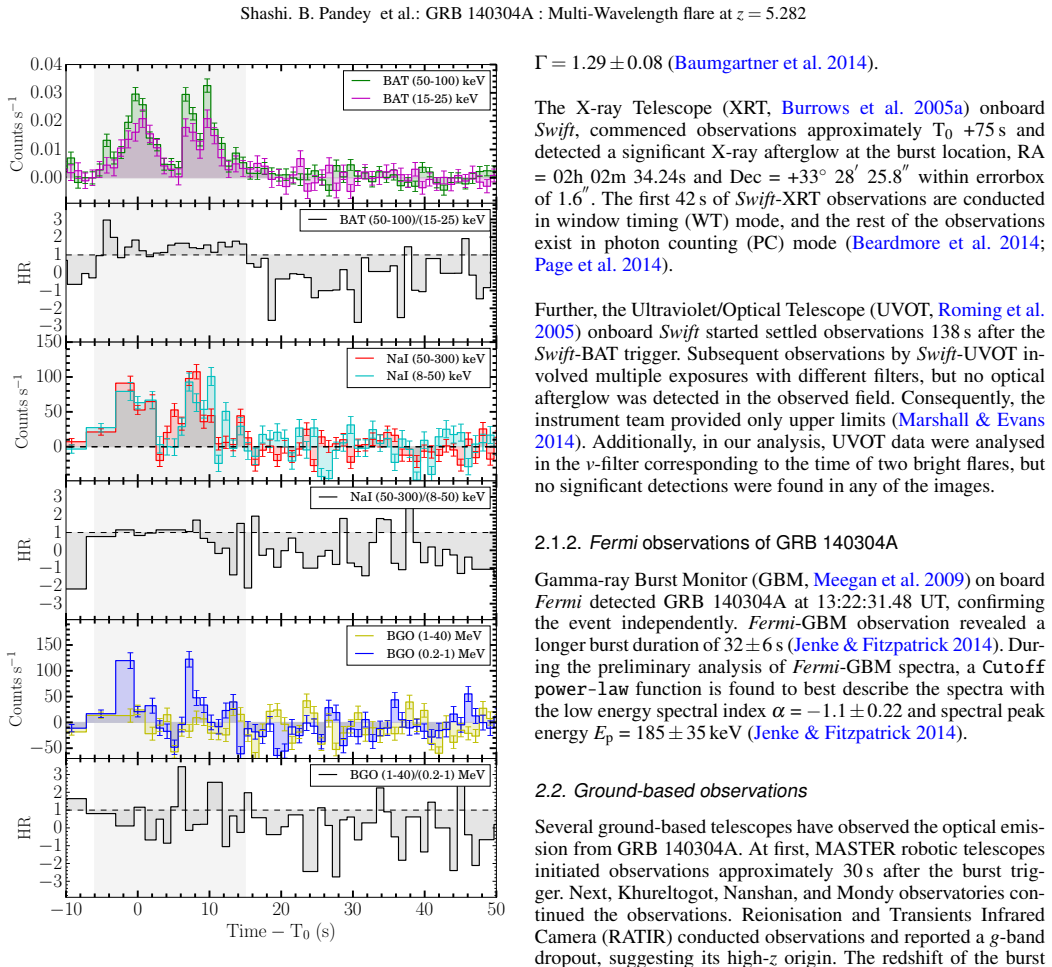
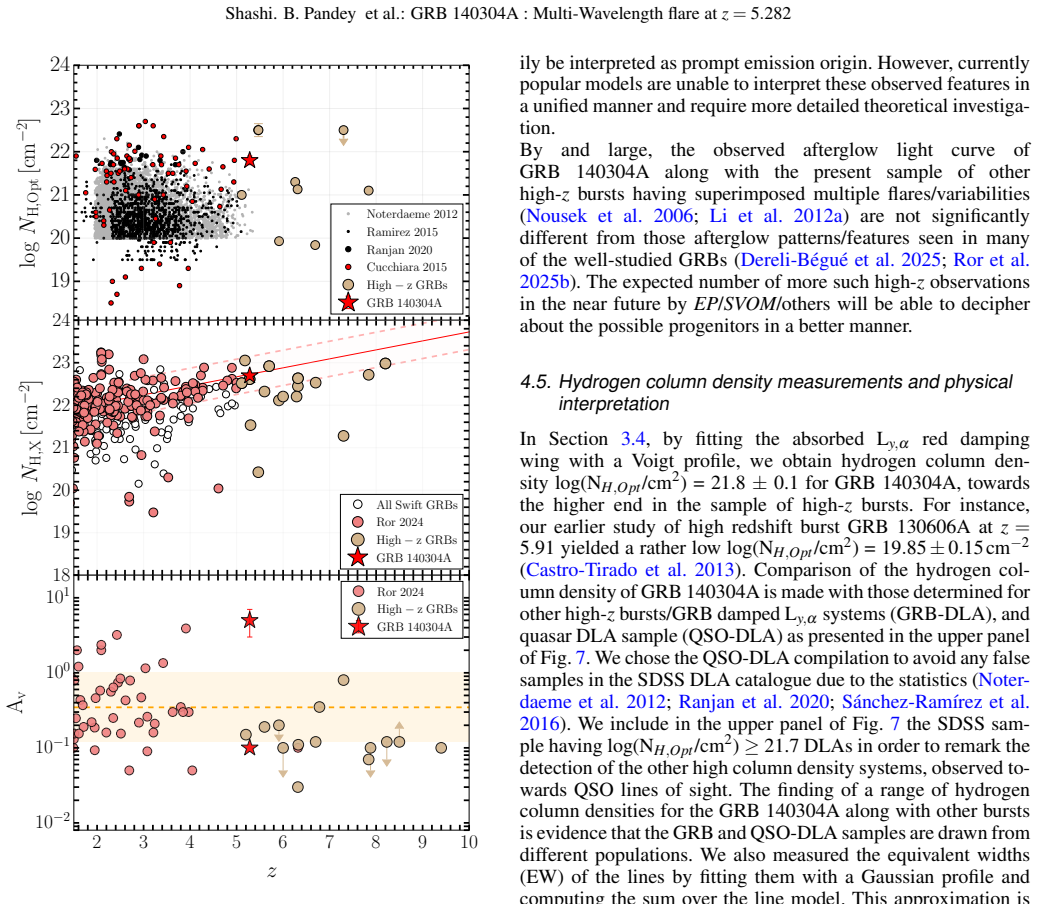
Context. This article presents a detailed multi-wavelength analysis of GRB 140304A at z = 5.282, having uncommon late-time flaring features. The aim is to study GRB 140304A and other similar bursts to understand stellar evolution and formation processes at high-z. Aims. GRBs at high-z, possible flaring activities at different frequencies seen at relatively late-times, help to constrain temporal correlation among contemporaneous flares. In the present study, we plan to constrain such a temporal and spectral study for a sample of high-z bursts, including GRB 140304A. Methods. We use Swift, Fermi, and ground-based observations to constrain the temporal and spectral properties of the prompt and afterglow emissions. Using the cross-correlation function, we calculate the spectral lag in the light curves observed in two energy bands of Swift's Burst Alert Telescope (BAT) and X-ray Telescope (XRT). Results. Parameter evolution of the prompt emission analysis reveals a hard-to-soft evolution of the spectral peak energy (Ep) and the magnetic field strength (B), consistent with the typical population of long GRBs. For GRB 140304A, a rare pattern of spectral lag evolution having positive lag in the early BAT light curves, but no lag is observed in the XRT light curves. We have also observed systematic time delays among the peak times of flares in three different bands, but the optical flares exhibit a morphological correspondence with X-ray or gamma-ray flares. Conclusions. Our analysis shows that the observed positive spectral lag in GRB 140304A is closely related to the hard-to-soft spectral evolution during the prompt emission phase, as seen in some of the other long GRBs. Additionally, there is a clear connection between gamma-ray, X-ray and optical flares with prompt emission, which are produced through synchrotron radiation during rapid bulk acceleration within the emitting region.
Editorial analysis
A structured set of objections, weighed in public.
Referee Report
Summary. The paper presents a multi-wavelength analysis of GRB 140304A at z=5.282 using Swift, Fermi, and ground-based data. It examines prompt emission properties including hard-to-soft evolution of the spectral peak energy Ep and magnetic field B, computes spectral lags via cross-correlation function between BAT and XRT bands (finding positive lag early in BAT but none in XRT), identifies systematic time delays among gamma-ray, X-ray, and optical flares with morphological similarities, and concludes that the lag relates to spectral evolution while the flares connect to prompt emission through synchrotron radiation produced during rapid bulk acceleration in the emitting region.
Significance. If the flare interpretation holds with quantitative backing, the work would strengthen constraints on emission mechanisms in high-redshift long GRBs and the link between prompt and late-time activity. The reported spectral lag pattern and Ep evolution are consistent with known long GRB populations. The manuscript employs standard observational techniques (CCF for lags, spectral fitting) but the central flare claim rests on qualitative timing and morphology without demonstrated parameter consistency across bands.
major comments (1)
- [Conclusions] Conclusions: The claim that gamma-ray, X-ray, and optical flares are produced through synchrotron radiation during rapid bulk acceleration within the emitting region is based on reported systematic time delays and morphological correspondence. No quantitative support is shown, such as forward-modeling of light-curve shapes, derivation of consistent B-field or Lorentz-factor values across bands, or exclusion of separate internal-shock origins. This leaves the causal interpretation under-constrained for the central claim.
Simulated Author's Rebuttal
We thank the referee for the constructive feedback on our manuscript. We address the major comment regarding the quantitative support for the flare interpretation point by point below.
read point-by-point responses
-
Referee: [Conclusions] Conclusions: The claim that gamma-ray, X-ray, and optical flares are produced through synchrotron radiation during rapid bulk acceleration within the emitting region is based on reported systematic time delays and morphological correspondence. No quantitative support is shown, such as forward-modeling of light-curve shapes, derivation of consistent B-field or Lorentz-factor values across bands, or exclusion of separate internal-shock origins. This leaves the causal interpretation under-constrained for the central claim.
Authors: We agree that the central claim in the Conclusions relies on the observed systematic time delays between gamma-ray, X-ray, and optical flares together with their morphological similarities, without additional quantitative elements such as forward-modeling of the light-curve profiles or explicit derivation of consistent B-field strengths and Lorentz factors across the three bands. The manuscript does present Ep and B evolution for the prompt phase and notes the connection to prompt emission via synchrotron radiation, but these are not extended to a multi-band parameter consistency check for the flares themselves, nor is an alternative internal-shock scenario quantitatively excluded. We will revise the Conclusions (and relevant discussion sections) to present the synchrotron-in-accelerating-region scenario as a plausible interpretation supported by the timing and morphological evidence, while explicitly acknowledging the absence of the quantitative modeling mentioned by the referee and briefly discussing possible alternative origins. This change will be made in the revised manuscript. revision: yes
Circularity Check
No circularity: results derived from direct data analysis
full rationale
The paper performs observational analysis of GRB 140304A using cross-correlation functions on BAT/XRT light curves to measure spectral lags and spectral fitting to track Ep and B evolution. The central claims link the positive lag to observed hard-to-soft Ep evolution and note morphological/time-delay correspondences among flares, without any reduction of predictions to fitted inputs by construction, self-definitional loops, or load-bearing self-citations. The synchrotron/rapid-acceleration interpretation is presented as a qualitative inference from timing data rather than a derived quantity that collapses to the inputs.
Axiom & Free-Parameter Ledger
free parameters (2)
- Spectral peak energy Ep
- Magnetic field strength B
axioms (1)
- domain assumption Synchrotron radiation as the emission mechanism linking flares to prompt emission
Forward citations
Cited by 1 Pith paper
-
Early Optical Follow-up of Gamma-Ray Bursts: The Critical Role of Robotic Telescopes
A review of early optical GRB features including prompt emission, reverse shocks, and afterglow onset, highlighting robotic telescopes' role in constraining jet Lorentz factors and magnetization.
Reference graph
Works this paper leans on
-
[1]
2011, , 526, A154
Afonso , P., Greiner , J., Pian , E., et al. 2011, , 526, A154
2011
-
[2]
P., Alexandroff , R., Allende Prieto , C., et al
Ahn , C. P., Alexandroff , R., Allende Prieto , C., et al. 2012, , 203, 21
2012
-
[3]
P., Anand , S., et al
Ahumada , T., Singer , L. P., Anand , S., et al. 2021, Nature Astronomy, 5, 917
2021
-
[4]
2006, Monthly Notices of the Royal Astronomical Society, 372, 233
Amati, L. 2006, Monthly Notices of the Royal Astronomical Society, 372, 233
2006
-
[5]
P., Al Rasyid , H., Dainotti , M
Arumaningtyas , E. P., Al Rasyid , H., Dainotti , M. G., & Yonetoku , D. 2024, Galaxies, 12, 51
2024
-
[6]
2025 a , , 281, 20
Aryan , A., Chen , T.-W., Yang , S., et al. 2025 a , , 281, 20
2025
-
[7]
B., Gupta , R., Ror , A
Aryan , A., Pandey , S. B., Gupta , R., Ror , A. K., & Castro-Tirado , A. J. 2025 b , in Revista Mexicana de Astronomia y Astrofisica Conference Series, Vol. 59, Revista Mexicana de Astronomia y Astrofisica Conference Series, 145--152
2025
-
[8]
B., Abdo , A
Atwood , W. B., Abdo , A. A., Ackermann , M., et al. 2009, , 697, 1071
2009
-
[9]
Augustine , K. A. & Chang , H.-K. 2025, , 981, 173
2025
-
[10]
1993, , 413, 281
Band , D., Matteson , J., Ford , L., et al. 1993, , 413, 281
1993
-
[11]
Band , D. L. 1997, , 486, 928
1997
-
[12]
Barkov , M. V. & Pozanenko , A. S. 2011, , 417, 2161
2011
-
[13]
D., Barbier , L
Barthelmy , S. D., Barbier , L. M., Cummings , J. R., et al. 2005, , 120, 143
2005
-
[14]
D., Baumgartner , W
Barthelmy , S. D., Baumgartner , W. H., Cummings , J. R., et al. 2010, GRB Coordinates Network, 11218, 1
2010
-
[15]
D., Krimm , H
Barthelmy , S. D., Krimm , H. A., Laha , S., et al. 2024, GRB Coordinates Network, 35761, 1
2024
-
[16]
G., Savaglio , S., et al
Basa , S., Cuby , J. G., Savaglio , S., et al. 2012, , 542, A103
2012
-
[17]
H., Barthelmy , S
Baumgartner , W. H., Barthelmy , S. D., Cummings , J. R., et al. 2014, GRB Coordinates Network, 15927, 1
2014
-
[18]
P., Evans , P
Beardmore , A. P., Evans , P. A., Goad , M. R., & Osborne , J. P. 2014, GRB Coordinates Network, 15925, 1
2014
-
[19]
& Kumar , P
Beniamini , P. & Kumar , P. 2016, , 457, L108
2016
-
[20]
L., et al
Berger , E., Chary , R., Cowie , L. L., et al. 2007, , 665, 102
2007
-
[21]
2010, SWarp: Resampling and Co-adding FITS Images Together , Astrophysics Source Code Library, record ascl:1010.068
Bertin , E. 2010, SWarp: Resampling and Co-adding FITS Images Together , Astrophysics Source Code Library, record ascl:1010.068
2010
-
[22]
& Arnouts , S
Bertin , E. & Arnouts , S. 1996, , 117, 393
1996
-
[23]
Blandford , R. D. & McKee , C. F. 1976, Physics of Fluids, 19, 1130
1976
-
[24]
L., Damerdji , Y., et al
Bo \"e r , M., Atteia , J. L., Damerdji , Y., et al. 2006, , 638, L71
2006
-
[25]
2018, , 609, A62
Bolmer , J., Greiner , J., Kr \"u hler , T., et al. 2018, , 609, A62
2018
-
[26]
M., Fragos , T., Salafia , O
Briel , M. M., Fragos , T., Salafia , O. S., et al. 2025, , 701, A84
2025
-
[27]
2025, , 695, A239
Brivio , R., Campana , S., Covino , S., et al. 2025, , 695, A239
2025
-
[28]
2011, , 739, L55
Bromberg , O., Nakar , E., & Piran , T. 2011, , 739, L55
2011
-
[29]
& Loeb , A
Bromm , V. & Loeb , A. 2006, , 642, 382
2006
-
[30]
Y., Krushinsky , V
Burdanov , A. Y., Krushinsky , V. V., & Popov , A. A. 2014, Astrophysical Bulletin, 69, 368
2014
-
[31]
Burgess , J. M. 2014, , 445, 2589
2014
-
[32]
M., B \'e gu \'e , D., Greiner , J., et al
Burgess , J. M., B \'e gu \'e , D., Greiner , J., et al. 2020, Nature Astronomy, 4, 174
2020
-
[33]
N., Hill , J
Burrows , D. N., Hill , J. E., Nousek , J. A., et al. 2005 a , , 120, 165
2005
-
[34]
N., Romano , P., Falcone , A., et al
Burrows , D. N., Romano , P., Falcone , A., et al. 2005 b , Science, 309, 1833
2005
-
[35]
2012, in Society of Photo-Optical Instrumentation Engineers (SPIE) Conference Series, Vol
Butler , N., Klein , C., Fox , O., et al. 2012, in Society of Photo-Optical Instrumentation Engineers (SPIE) Conference Series, Vol. 8446, Ground-based and Airborne Instrumentation for Astronomy IV, ed. I. S. McLean , S. K. Ramsay , & H. Takami , 844610
2012
-
[36]
M., Kutyrev , A., et al
Butler , N., Watson , A. M., Kutyrev , A., et al. 2014 a , GRB Coordinates Network, 15937, 1
2014
-
[37]
M., Kutyrev , A., et al
Butler , N., Watson , A. M., Kutyrev , A., et al. 2014 b , GRB Coordinates Network, 15928, 1
2014
-
[38]
2022, Nature Astronomy, 6, 1101
Campana , S., Ghirlanda , G., Salvaterra , R., et al. 2022, Nature Astronomy, 6, 1101
2022
-
[39]
C., de Ugarte Postigo , A., et al
Campana , S., Th \"o ne , C. C., de Ugarte Postigo , A., et al. 2010, , 402, 2429
2010
-
[40]
J., Gupta , R., Pandey , S
Castro-Tirado , A. J., Gupta , R., Pandey , S. B., et al. 2024, , 683, A55
2024
-
[41]
J., Jel \' nek , M., V \' tek , S., et al
Castro-Tirado , A. J., Jel \' nek , M., V \' tek , S., et al. 2008, in Society of Photo-Optical Instrumentation Engineers (SPIE) Conference Series, Vol. 7019, Advanced Software and Control for Astronomy II, ed. A. Bridger & N. M. Radziwill , 70191V
2008
-
[42]
GRB 130606A within a sub-DLA at redshift 5.91
Castro-Tirado , A. J., S \'a nchez-Ram \' rez , R., Ellison , S. L., et al. 2013, arXiv; In-prepration, arXiv:1312.5631
work page internal anchor Pith review Pith/arXiv arXiv 2013
-
[43]
B., Butler , N
Cenko , S. B., Butler , N. R., Ofek , E. O., et al. 2010, , 140, 224
2010
-
[44]
Z., Peng , Z
Chang , X. Z., Peng , Z. Y., Chen , J. M., et al. 2021, , 922, 34
2021
-
[45]
B., et al
Chornock, R., Berger, E., Fox, D. B., et al. 2014, arXiv: Cosmology and Nongalactic Astrophysics
2014
-
[46]
Y., Tanvir , N
Cordier , B., Wei , J. Y., Tanvir , N. R., et al. 2025, , 704, L7
2025
-
[47]
2015, , 804, 51
Cucchiara , A., Fumagalli , M., Rafelski , M., et al. 2015, , 804, 51
2015
-
[48]
J., Fox , D
Cucchiara , A., Levan , A. J., Fox , D. B., et al. 2011, , 736, 7
2011
-
[49]
2014 a , GRB Coordinates Network, 15921, 1
de Ugarte Postigo , A., Gorosabel , J., Xu , D., et al. 2014 a , GRB Coordinates Network, 15921, 1
2014
-
[50]
2011, , 525, A109
de Ugarte Postigo , A., Horv \'a th , I., Veres , P., et al. 2011, , 525, A109
2011
-
[51]
2014 b , GRB Coordinates Network, 15924, 1
de Ugarte Postigo , A., Xu , D., Gorosabel , J., et al. 2014 b , GRB Coordinates Network, 15924, 1
2014
-
[52]
C., et al
D'Elia , V., Maselli , A., Stroh , M. C., et al. 2013, GRB Coordinates Network, 15623, 1
2013
-
[53]
2025, Submitted to ApJ, arXiv:2512.07731
Dereli-B \'e gu \'e , H., Pe'er , A., B \'e gu \'e , D., Ryde , F., & Gowri , A. 2025, Submitted to ApJ, arXiv:2512.07731
-
[54]
& Wyithe , J
Dijkstra , M. & Wyithe , J. S. B. 2007, , 379, 1589
2007
-
[55]
A., Beardmore , A
Evans , P. A., Beardmore , A. P., Burrows , D. N., et al. 2014, GRB Coordinates Network, 15915, 1
2014
-
[56]
A., Beardmore , A
Evans , P. A., Beardmore , A. P., Page , K. L., et al. 2009, , 397, 1177
2009
-
[57]
A., Beardmore , A
Evans , P. A., Beardmore , A. P., Page , K. L., et al. 2007, , 469, 379
2007
-
[58]
D., Morris , D., Racusin , J., et al
Falcone , A. D., Morris , D., Racusin , J., et al. 2007, , 671, 1921
2007
-
[59]
D., Kutyrev , A
Fox , O. D., Kutyrev , A. S., Rapchun , D. A., et al. 2012, in Society of Photo-Optical Instrumentation Engineers (SPIE) Conference Series, Vol. 8453, High Energy, Optical, and Infrared Detectors for Astronomy V, ed. A. D. Holland & J. W. Beletic , 84531O
2012
-
[60]
L., Madore , B
Freedman , W. L., Madore , B. F., Gibson , B. K., et al. 2001, , 553, 47
2001
-
[61]
L., Lien , A
Fryer , C. L., Lien , A. Y., Fruchter , A., et al. 2022, , 929, 111
2022
-
[62]
2013, , 57, 141
Gao , H., Lei , W.-H., Zou , Y.-C., Wu , X.-F., & Zhang , B. 2013, , 57, 141
2013
-
[63]
& M \'e sz \'a ros , P
Gao , H. & M \'e sz \'a ros , P. 2015, Advances in Astronomy, 2015, 192383
2015
-
[64]
2021, , 656, A134
Gao , H.-X., Geng , J.-J., & Huang , Y.-F. 2021, , 656, A134
2021
-
[65]
Gehrels, N. et al. 2004, The Astrophysical Journal, 611, 1005
2004
-
[66]
, et al
Godet , O., Nasser , G., Atteia , J. ., et al. 2014, in Society of Photo-Optical Instrumentation Engineers (SPIE) Conference Series, Vol. 9144, Space Telescopes and Instrumentation 2014: Ultraviolet to Gamma Ray, ed. T. Takahashi , J.-W. A. den Herder , & M. Bautz , 914424
2014
-
[67]
V., Mazets , E
Golenetskii , S. V., Mazets , E. P., Aptekar , R. L., & Ilinskii , V. N. 1983, , 306, 451
1983
-
[68]
Z., Butler , N
Golkhou , V. Z., Butler , N. R., & Littlejohns , O. M. 2015, , 811, 93
2015
-
[69]
1986, , 308, L47
Goodman , J. 1986, , 308, L47
1986
-
[70]
2014 a , GRB Coordinates Network, 15914, 1
Gorbovskoy , E., Lipunov , V., Pruzhinskaya , M., et al. 2014 a , GRB Coordinates Network, 15914, 1
2014
-
[71]
2014 b , GRB Coordinates Network, 15932, 1
Gorbovskoy , E., Lipunov , V., Pruzhinskaya , M., et al. 2014 b , GRB Coordinates Network, 15932, 1
2014
-
[72]
Greiner , J., Kr \"u hler , T., Fynbo , J. P. U., et al. 2009, , 693, 1610
2009
-
[73]
H., Meynet , G., Ekstr \"o m , S., & Georgy , C
Groh , J. H., Meynet , G., Ekstr \"o m , S., & Georgy , C. 2014, , 564, A30
2014
-
[74]
2022, , 511, 1694
Gupta , R., Gupta , S., Chattopadhyay , T., et al. 2022, , 511, 1694
2022
-
[75]
R., Pandey , S
Gupta , R., Oates , S. R., Pandey , S. B., et al. 2021, , 505, 4086
2021
-
[76]
W., Young , K
Hakkila , J., Giblin , T. W., Young , K. C., et al. 2007, , 169, 62
2007
-
[77]
E., Malesani , D., Fynbo , J
Hartoog , O. E., Malesani , D., Fynbo , J. P. U., et al. 2015, , 580, A139
2015
-
[78]
E., Morris , D
Hill , J. E., Morris , D. C., Sakamoto , T., et al. 2006, , 639, 303
2006
-
[79]
T., Irwin , M
Hodgkin , S. T., Irwin , M. J., Hewett , P. C., & Warren , S. J. 2009, , 394, 675
2009
-
[80]
o ller , M., J \
Hubrig , S., Sch \"o ller , M., J \"a rvinen , S. P., et al. 2024, , 686, L4
2024
discussion (0)
Sign in with ORCID, Apple, or X to comment. Anyone can read and Pith papers without signing in.