Robust class-gated single-pixel diffractive optical neural network with random-aberration-aware training
Pith reviewed 2026-06-28 21:05 UTC · model grok-4.3
The pith
A single-pixel optical neural network classifies images at 5 kHz by reading the timing of intensity peaks from class-specific masks.
A machine-rendered reading of the paper's core claim, the machinery that carries it, and where it could break.
Core claim
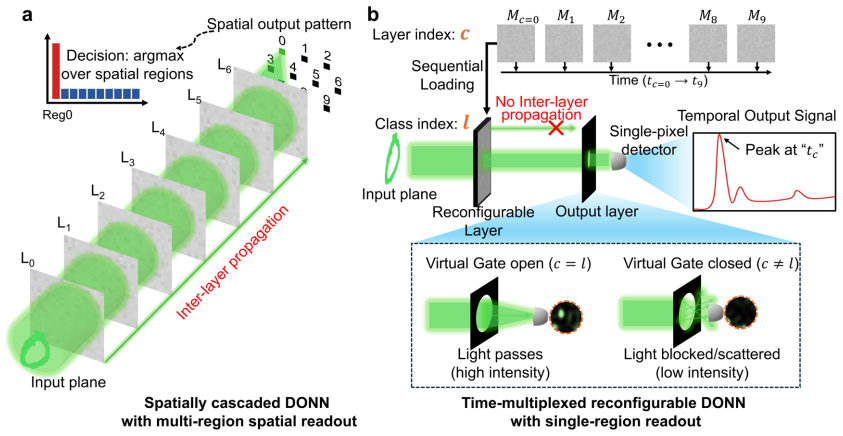
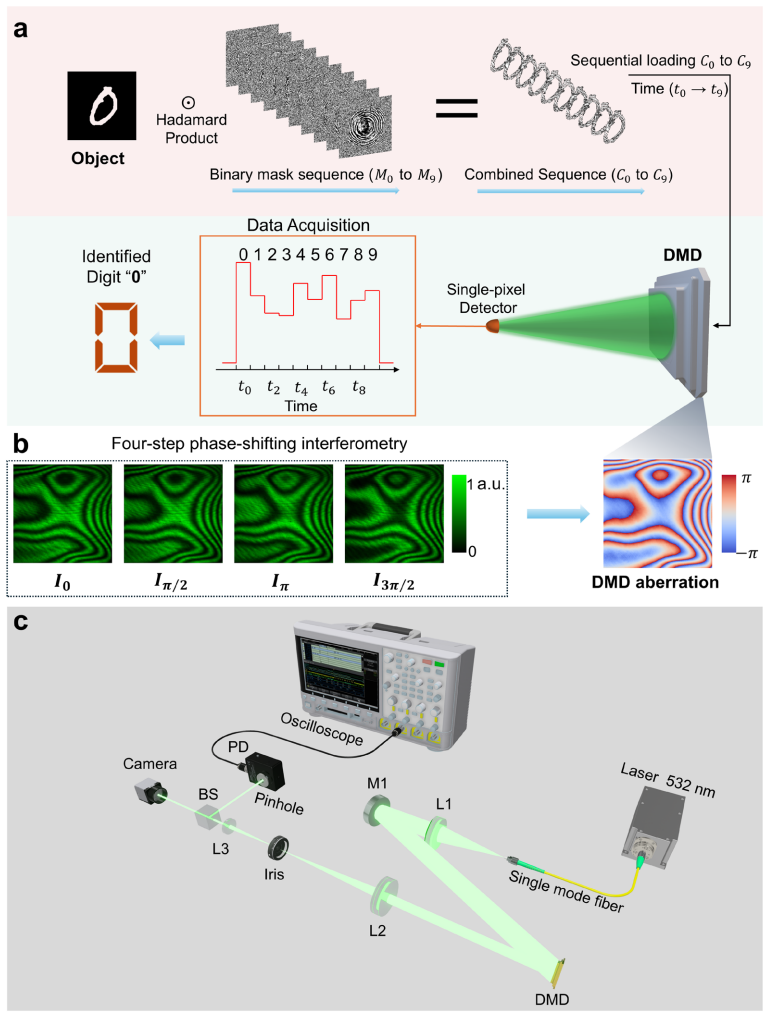
By implementing a class-gated virtual optical gate that time-multiplexes class-specific masks and training with random-phase augmentation, the single-pixel DONN converts spatial image data into a temporal intensity signature whose peak timing yields the label, achieving 90.0 percent MNIST and 80.0 percent Fashion-MNIST accuracy at 5 kHz while remaining tolerant to phase aberrations and mechanical misalignments without exact hardware modeling.
What carries the argument
The virtual optical gate created by time-multiplexing class-specific masks on the DMD, which produces a detector peak only for the matching class, made robust by random-phase augmentation during training.
If this is right
- The system operates at a 5 kHz readout rate while reaching 90.0 percent accuracy on MNIST and 80.0 percent on Fashion-MNIST.
- Single-pixel detection removes the frame-rate ceiling imposed by 2D electronic sensors.
- Random-phase augmentation supplies tolerance to phase aberrations and mechanical misalignments without requiring precise hardware models.
- Gigahertz-compatible single-pixel components combined with this architecture open a route to real-time optical intelligent sensing.
Where Pith is reading between the lines
- The same temporal encoding could support tasks beyond classification if the mask sequence is lengthened or reordered.
- Vibration or temperature drifts in deployed systems might be handled without retraining because of the built-in aberration tolerance.
- Pairing the architecture with faster single-pixel detectors could raise the operating speed well above 5 kHz.
Load-bearing premise
Random phase augmentation applied during training captures the range of aberrations and misalignments that occur on the physical hardware.
What would settle it
A hardware test in which the trained masks are used with phase aberrations or alignment shifts outside the augmentation distribution and classification accuracy falls substantially below the reported 90 percent on MNIST.
Figures
read the original abstract
Optical computing offers the theoretical potential for high-speed, energy-efficient inference, yet its practical deployment remains constrained by fundamental input-output bottlenecks, particularly the reliance on electronic sensors with limited frame rates and stringent alignment requirements between optical components. Here, we demonstrate an image-class-gated single-pixel DONN that overcomes these limitations by converting spatial complexity into a temporal intensity signature. Using a minimal architecture comprising a reconfigurable digital micromirror device and a single-pixel photodetector, we implement a virtual optical gate. The system time-multiplexes class-specific masks, causing the detector response to peak only when the mask index matches the input class. This allows the predicted label to be read out via peak timing rather than spatial localization, eliminating 2D sensor constraints. To bridge the persistent sim-to-real gap, we introduce a physics-aware training strategy using random-phase augmentation. This method renders the model intrinsically tolerant to phase aberrations and mechanical misalignments without requiring precise hardware modeling. Our prototype achieves 90.0%(MNIST) and 80.0% (Fashion-MNIST) accuracy at a readout rate of 5 kHz. By combining gigahertz-compatible single-pixel detection with robust and alignment-tolerant training, this work provides a scalable, hardware-efficient pathway toward real-time optical intelligent sensing.
Editorial analysis
A structured set of objections, weighed in public.
Referee Report
Summary. The manuscript presents a class-gated single-pixel diffractive optical neural network (DONN) implemented with a reconfigurable digital micromirror device (DMD) and a single-pixel photodetector. Class-specific masks are time-multiplexed so the detector response peaks only for the matching class, allowing label readout from peak timing rather than spatial localization. A physics-aware training strategy employing random-phase augmentation is introduced to achieve intrinsic tolerance to phase aberrations and mechanical misalignments without precise hardware modeling. The prototype is reported to achieve 90.0% accuracy on MNIST and 80.0% accuracy on Fashion-MNIST at a 5 kHz readout rate, offering a hardware-efficient route to real-time optical sensing.
Significance. If the reported accuracies and robustness hold under experimental validation, the work would constitute a meaningful step toward practical optical computing by demonstrating high-speed inference with minimal hardware (single-pixel detection) and reduced alignment sensitivity. The temporal encoding approach and augmentation-based sim-to-real strategy address key bottlenecks in optical neural networks and could enable scalable, gigahertz-compatible systems.
major comments (2)
- [Abstract] Abstract: The headline accuracies (90.0% MNIST, 80.0% Fashion-MNIST) and the claim of successful sim-to-real transfer are stated without any experimental details, error bars, dataset splits, number of trials, or ablation studies comparing performance with versus without random-phase augmentation on the physical prototype. This information is load-bearing for evaluating whether the reported results support the central claim.
- [Abstract] Abstract (paragraph on sim-to-real gap): The assertion that random-phase augmentation produces intrinsic tolerance to phase aberrations and misalignments without precise hardware modeling is not supported by any quantification of the phase-variance distribution used in training, any comparison of simulated versus measured wavefront errors or alignment drifts, or any hardware ablation results. This directly underpins the robustness and scalability claims.
Simulated Author's Rebuttal
We thank the referee for their constructive feedback on the abstract. We address each major comment below and have revised the manuscript to strengthen the presentation of experimental details and supporting evidence for the sim-to-real claims.
read point-by-point responses
-
Referee: [Abstract] Abstract: The headline accuracies (90.0% MNIST, 80.0% Fashion-MNIST) and the claim of successful sim-to-real transfer are stated without any experimental details, error bars, dataset splits, number of trials, or ablation studies comparing performance with versus without random-phase augmentation on the physical prototype. This information is load-bearing for evaluating whether the reported results support the central claim.
Authors: We agree that the abstract would benefit from additional context to allow readers to assess the claims more readily. The detailed experimental protocol, including dataset splits, number of trials, error bars, and ablation studies, is provided in Sections 3 and 4 of the manuscript. To address the concern, we have revised the abstract to briefly reference the experimental validation across multiple trials and the inclusion of ablation studies confirming the contribution of random-phase augmentation. revision: yes
-
Referee: [Abstract] Abstract (paragraph on sim-to-real gap): The assertion that random-phase augmentation produces intrinsic tolerance to phase aberrations and misalignments without precise hardware modeling is not supported by any quantification of the phase-variance distribution used in training, any comparison of simulated versus measured wavefront errors or alignment drifts, or any hardware ablation results. This directly underpins the robustness and scalability claims.
Authors: The phase-variance distribution and hardware ablation results under misalignments are described in the methods and results sections. We acknowledge that the abstract could more explicitly tie these elements to the robustness claim. We have revised the abstract to include a concise reference to the augmentation parameters and the observed tolerance demonstrated by the ablation experiments. revision: yes
Circularity Check
No circularity: experimental accuracies are measured outcomes, not reductions of training inputs
full rationale
The paper presents a hardware prototype whose reported accuracies (90% MNIST, 80% Fashion-MNIST at 5 kHz) are framed as direct experimental measurements on physical hardware. The random-phase augmentation is introduced as a training technique to improve sim-to-real transfer, but the manuscript supplies no equations, fitted parameters, or derivations in which the final accuracy figures are defined by or equivalent to the augmentation distribution itself. No self-citation chains, uniqueness theorems, or ansatzes are invoked to force the central claims. The derivation chain is therefore self-contained against external benchmarks (physical readout), warranting a score of 0.
Axiom & Free-Parameter Ledger
Reference graph
Works this paper leans on
-
[1]
LeCun, Y
Y . LeCun, Y . Bengio, G. Hinton, Deep learning. Nature 521, 436–444 (2015)
2015
-
[2]
J. Park, B. Bai, D. Ryu, T. Liu, C. Lee, Y. Luo, M. J. Lee, L. Huang, J. Shin, Y. Zhang, D. Ryu, Y . Li, G. Kim, H. Min, A. Ozcan, Y . Park, Artificial intelligence-enabled quantitative phase imaging methods for life sciences. Nat. Methods 20, 1645 –1660 (2023)
2023
-
[3]
Kuutti, R
S. Kuutti, R. Bowden, Y . Jin, P . Barber, S. Fallah, A Survey of Deep Learning Applications to Autonomous Vehicle Control. IEEE Trans. Intell. Transp. Syst. 22, 712 –733 (2021)
2021
-
[4]
Jumper, R
J. Jumper, R. Evans, A. Pritzel, T. Green, M. Figurnov, O. Ronneberger, K. Tunyasuvunakool, R. Bates, A. Žídek, A. Potapenko, A. Bridgland, C. Meyer, S. A. A. Kohl, A. J. Ballard, A. Cowie, B. Romera-Paredes, S. Nikolov, R. Jain, J. Adler, T. Back, S. Pet ersen, D. Reiman, E. Clancy, M. Zielinski, M. Steinegger, M. Pacholska, T. Berghammer, S. Bodenstein,...
2021
-
[5]
Upadhyay, N
A. Upadhyay, N. S. Chandel, K. P. Singh, S. K. Chakraborty, B. M. Nandede, M. Kumar, A. Subeesh, K. Upendar, A. Salem, A. Elbeltagi, Deep learning and computer vision in plant disease detection: a comprehensive review of techniques, models, and trends in precision agriculture. Artif. Intell. Rev. 58, 92 (2025)
2025
-
[6]
Sparks of Artificial General Intelligence: Early experiments with GPT-4
S. Bubeck, V . Chandrasekaran, R. Eldan, J. Gehrke, E. Horvitz, E. Kamar, P. Lee, Y . T. Lee, Y . Li, S. Lundberg, H. Nori, H. Palangi, M. T. Ribeiro, Y . Zhang, Sparks of Artificial General Intelligence: Early experiments with GPT-4. arXiv arXiv:2303.12712 [Preprint] (2023)
work page internal anchor Pith review Pith/arXiv arXiv 2023
-
[7]
M. M. Waldrop, The chips are down for Moore’s law. Nature 530, 144 (2016)
2016
-
[8]
P. L. McMahon, The physics of optical computing. Nat. Rev. Phys. 5, 717 –734 (2023)
2023
-
[9]
T. Fu, J. Zhang, R. Sun, Y . Huang, W. Xu, S. Yang, Z. Zhu, H. Chen, Optical neural networks: progress and challenges. Light Sci. Appl. 13, 263 (2024)
2024
-
[10]
Savage, Light could lower AI’s appetite for power
N. Savage, Light could lower AI’s appetite for power. Nat. Nanotechnol. 21, 6–8 (2026)
2026
-
[11]
Zhang, H
Q. Zhang, H. Yu, M. Barbiero, B. Wang, M. Gu, Artificial neural networks enabled by nanophotonics. Light Sci. Appl. 8, 42 (2019)
2019
-
[12]
Wetzstein, A
G. Wetzstein, A. Ozcan, S. Gigan, S. Fan, D. Englund, M. Soljačić, C. Denz, D. A. B. Miller, D. Psaltis, Inference in artificial intelligence with deep optics and photonics. Nature 588, 39–47 (2020)
2020
-
[13]
B. J. Shastri, A. N. Tait, T. Ferreira de Lima, W. H. P. Pernice, H. Bhaskaran, C. D. Wright, P. R. Prucnal, Photonics for artificial intelligence and neuromorphic computing. Nat. Photonics 15, 102 –114 (2021)
2021
-
[14]
X. Xu, M. Tan, B. Corcoran, J. Wu, A. Boes, T. Nguyen, S. Chu, B. Little, D. Hicks, R. Morandotti, A. Mitchell, D. Moss, 11 TOPS photonic convolutional accelerator for optical neural networks. Nature 589, 44–51 (2021)
2021
-
[15]
J. Hu, D. Mengu, D. C. Tzarouchis, B. Edwards, N. Engheta, A. Ozcan, Diffractive optical computing in free space. Nat. Commun. 15, 1525 (2024)
2024
-
[16]
X. Lin, Y . Rivenson, N. T. Yardimci, M. Veli, Y . Luo, M. Jarrahi, A. Ozcan, All-optical machine learning using diffractive deep neural networks. Science 361, 1004–1008 (2018)
2018
-
[17]
C. He, D. Zhao, F. Fan, H. Zhou, X. Li, Y . Li, J. Li, F. Dong, Y .-X. Miao, Y . Wang, L. Huang, Pluggable multitask diffractive neural networks based on cascaded metasurfaces. Opto-Electron. Adv. 7, 230005–9 (2024)
2024
-
[18]
W. Liu, Y . Huang, R. Sun, T. Fu, S. Yang, H. Chen, Ultra-compact multi-task processor based on in-memory optical computing. Light Sci. Appl. 14, 134 (2025)
2025
-
[19]
T. Fu, Y . Zang, Y . Huang, Z. Du, H. Huang, C. Hu, M. Chen, S. Yang, H. Chen, Photonic machine learning with on-chip diffractive optics. Nat. Commun. 14, 70 (2023)
2023
-
[20]
G. Qu, G. Cai, X. Sha, Q. Chen, J. Cheng, Y . Zhang, J. Han, Q. Song, S. Xiao, All-Dielectric Metasurface Empowered Optical- Electronic Hybrid Neural Networks. Laser Photonics Rev. 16, 2100732 (2022)
2022
-
[21]
H. Yu, Z. Huang, S. Lamon, B. Wang, H. Ding, J. Lin, Q. Wang, H. Luan, M. Gu, Q. Zhang, All-optical image transportation through a multimode fibre using a miniaturized diffractive neural network on the distal facet. Nat. Photon. 1–8 (2025)
2025
-
[22]
Kupianskyi, S
H. Kupianskyi, S. A. R. Horsley, D. B. Phillips, All- optically untangling light propagation through multimode fibers. Optica 11, 101 –112 (2024)
2024
-
[24]
Z. Wang, L. Chang, F. Wang, T. Li, T. Gu, Integrated photonic metasystem for image classifications at telecommunication wavelength. Nat. Commun. 13, 2131 (2022)
2022
-
[25]
T. Yan, J. Wu, T. Zhou, H. Xie, F. Xu, J. Fan, L. Fang, X. Lin, Q. Dai, Fourier-space Diffractive Deep Neural Network. Phys. Rev. Lett. 123, 023901 (2019)
2019
-
[26]
E. Goi, X. Chen, Q. Zhang, B. P. Cumming, S. Schoenhardt, H. Luan, M. Gu, Nanoprinted high-neuron-density optical linear perceptrons performing near-infrared inference on a CMOS chip. Light Sci. Appl. 10, 40 (2021)
2021
-
[27]
H. Chen, J. Feng, M. Jiang, Y . Wang, J. Lin, J. Tan, P. Jin, Diffractive Deep Neural Networks at Visible Wavelengths. Engineering 7, 1483 –1491 (2021)
2021
-
[28]
X. Luo, Y . Hu, X. Ou, X. Li, J. Lai, N. Liu, X. Cheng, A. Pan, H. Duan, Metasurface-enabled on-chip multiplexed diffractive neural networks in the visible. Light Sci. Appl. 11, 158 (2022)
2022
-
[29]
C. Qian, X. Lin, X. Lin, J. Xu, Y . Sun, E. Li, B. Zhang, H. Chen, Performing optical logic operations by a diffractive neural network. Light Sci. Appl. 9, 59 (2020)
2020
-
[30]
P. Wang, W. Xiong, Z. Huang, Y . He, Z. Xie, J. Liu, H. Ye, Y . Li, D. Fan, S. Chen, Orbital angular momentum mode logical operation using optical diffractive neural network. Photon. Res. 9, 2116–2124 (2021)
2021
-
[31]
Y . Luo, D. Mengu, A. Ozcan, Cascadable all-optical NAND gates using diffractive networks. Sci. Rep. 12, 7121 (2022)
2022
-
[32]
X. Liu, D. Zhang, L. Wang, T. Ma, Z. Liu, J.-J. Xiao, Parallelized and Cascadable Optical Logic Operations by Few-Layer Diffractive Optical Neural Network. Photonics 10, 503 (2023)
2023
-
[33]
Mengu, A
D. Mengu, A. Ozcan, All- Optical Phase Recovery: Diffractive Computing for Quantitative Phase Imaging. Adv. Opt. Mater. 10, 2200281 (2022)
2022
-
[34]
C.-Y . Shen, J. Li, Y . Li, T. Gan, L. Bai, M. Jarrahi, A. Ozcan, Multiplane quantitative phase imaging using a wavelength -multiplexed diffractive optical processor. Adv. Photon. 6, 056003 (2024)
2024
-
[35]
C.-Y . Shen, J. Li, T. Gan, Y . Li, M. Jarrahi, A. Ozcan, All -optical phase conjugation using diffractive wavefront processing. Nat. Commun. 15, 4989 (2024)
2024
-
[36]
J. Shi, C. Chen, H. Zhang, P. Luo, Y . Wei, F. Dong, Z. Li, C. Shen, H. Cai, J. Zhang, X. Fang, N. Chi, M. Gu, Ultrahigh -speed optical encryption enabled by spatiotemporal noise chaffing. Nat. Commun. 16, 10142 (2025)
2025
-
[37]
B. Bai, R. Lee, Y . Li, T. Gan, Y . Wang, M. Jarrahi, A. Ozcan, Information -hiding cameras: Optical concealment of object information into ordinary images. Sci. Adv. 10, 24(2024)
2024
-
[38]
Z. Liu, S. Gao, Z. Lai, Y . Li, Z. Ao, J. Li, J. Tu, Y . Wu, W. Liu, Z. Li, Broadband, Low-Crosstalk, and Massive-Channels OAM Modes De/Multiplexing Based on Optical Diffraction Neural Network. Laser Photonics Rev. 17, 2200536 (2023)
2023
-
[39]
T. Xia, Z. Xie, Q. Zhang, W. Xiao, H. Yang, Y . Hu, H. Duan, Y . Cai, X. Yuan, Ultrabroadband, achromatic, and non -diffracting perfect optical vortex generation via radial momentum control in dielectric metasurfaces. Nat. Commun. 16, 11610 (2025)
2025
-
[40]
S. Chen, Y . Li, Y . Wang, H. Chen, A. Ozcan, Optical generative models. Nature 644, 903–911 (2025)
2025
-
[41]
Y . Chen, X. Sun, L. Tan, Y . Jiang, Y . Zhou, W. Zhang, G. Zhai, All-optical synthesis chip for large-scale intelligent semantic vision generation. Science 390, 1259 –1265 (2025)
2025
-
[42]
Mengu, Y
D. Mengu, Y . Zhao, N. T. Yardimci, Y . Rivenson, M. Jarrahi, A. Ozcan, Misalignment resilient diffractive optical networks. Nanophotonics 9, 4207–4219 (2020)
2020
-
[43]
T. Xu, Z. Luo, S. Liu, L. Fan, Q. Xiao, B. Wang, D. Wang, C. Huang, 1 Perfecting Imperfect Physical Neural Networks using Sharpness -Aware 2 Training. Nat. Commun. (2026). https://doi.org/10.1038/s41467 -026-68470-9
-
[44]
S. Zhou, Y . Li, M. Lou, W. Gao, Z. Shi, C. Yu, C. Ding, Physics-aware Roughness Optimization for Diffractive Optical Neural Networks. In Proc. 60th ACM/IEEE Design Automation Conf. (DAC), 1–6 (2023)
2023
-
[45]
G. Zhao, X. Shu, R. Zhou, High -performance real-world optical computing trained by in situ gradient-based model-free optimization. IEEE Trans. Pattern Anal. Mach. Intell. 47, 7194 –7205 (2025)
2025
-
[46]
T. Zhou, L. Fang, T. Yan, J. Wu, In situ optical backpropagation training of diffractive optical neural networks. Photon. Res. 8, 940–953 (2020)
2020
-
[47]
Z. Xue, T. Zhou, Z. Xu, S. Yu, Q. Dai, L. Fang, Fully forward mode training for optical neural networks. Nature 632, 280–286 (2024)
2024
discussion (0)
Sign in with ORCID, Apple, or X to comment. Anyone can read and Pith papers without signing in.