Subjective Time Deformation in Intertemporal Choice: A Functional Data Analysis Approach
Pith reviewed 2026-06-28 20:23 UTC · model grok-4.3
The pith
Heterogeneity in intertemporal choice shows up as distinct functional shapes of subjective time deformation rather than scalar discount-rate differences alone.
A machine-rendered reading of the paper's core claim, the machinery that carries it, and where it could break.
Core claim
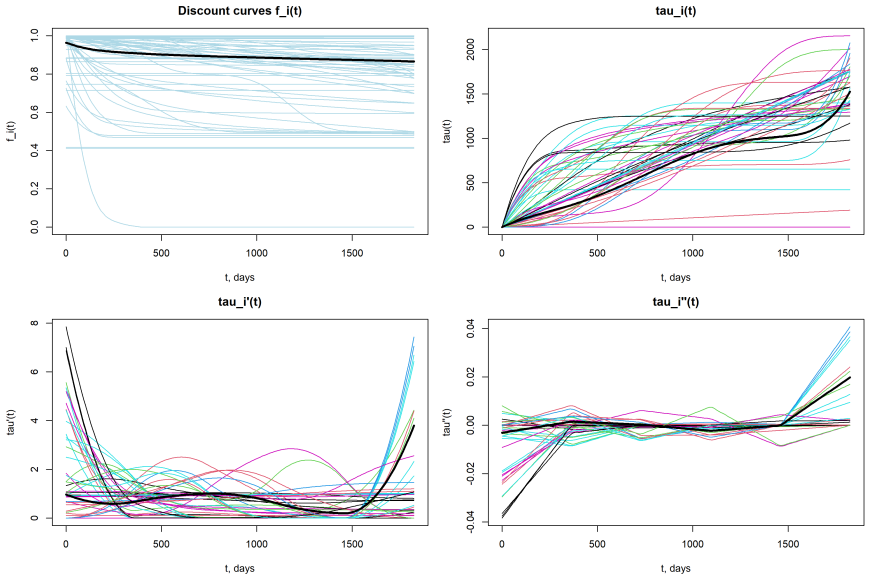
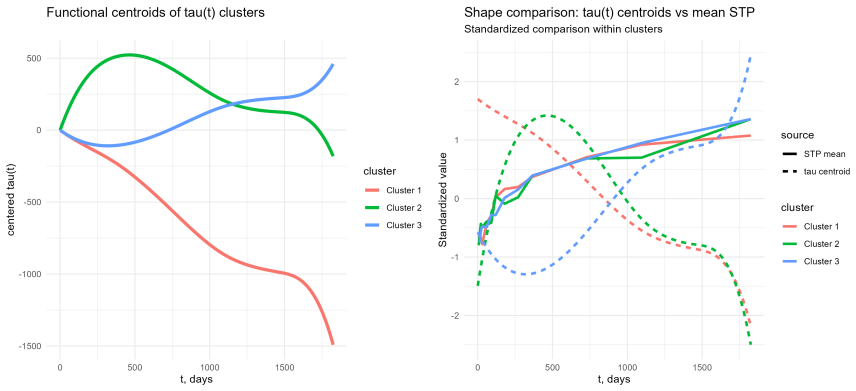
Heterogeneity in intertemporal choice is not fully captured by scalar discount-rate variation; instead, the full shape of each person's discounting trajectory can be reconstructed as a normalized implicit subjective-time function, and functional principal component analysis plus clustering on those functions reveals a low-dimensional structure consisting of three stable profiles of temporal deformation.
What carries the argument
Monotone smoothing of discrete equivalence judgments to produce individual discount curves, followed by functional principal component analysis and clustering on the resulting normalized subjective-time trajectories.
If this is right
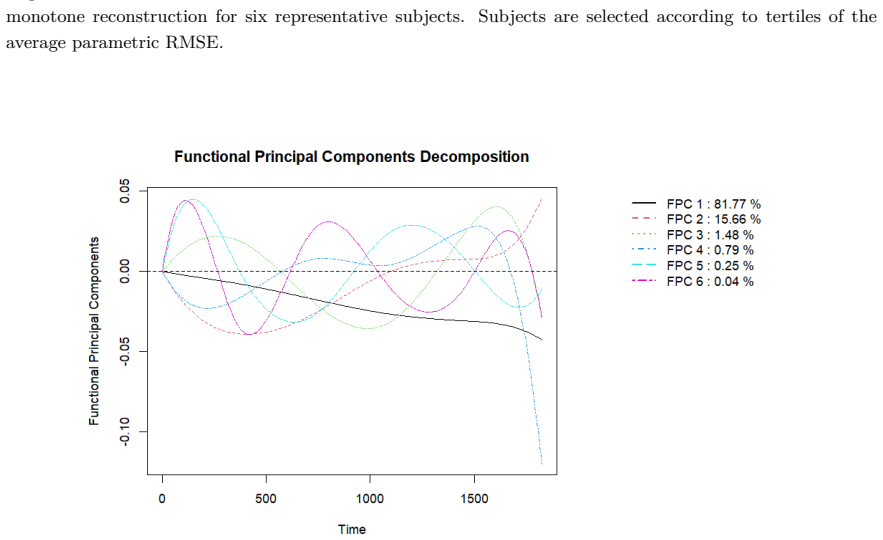
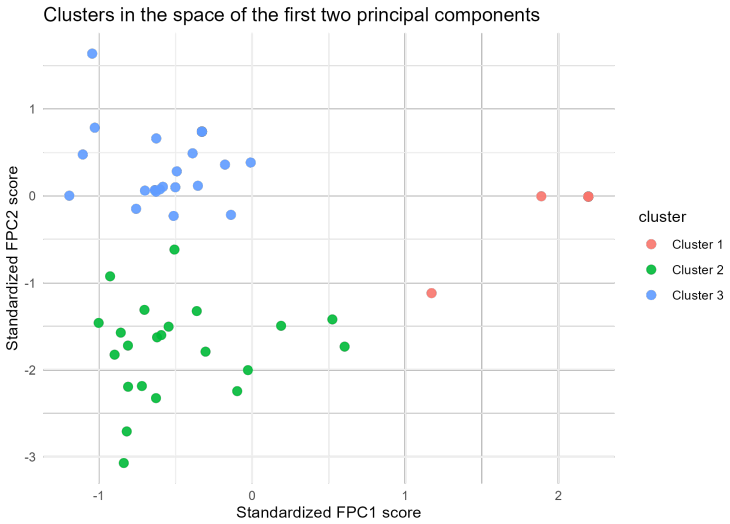
- The first two functional principal components explain 97.44 percent of variability in the implicit trajectories.
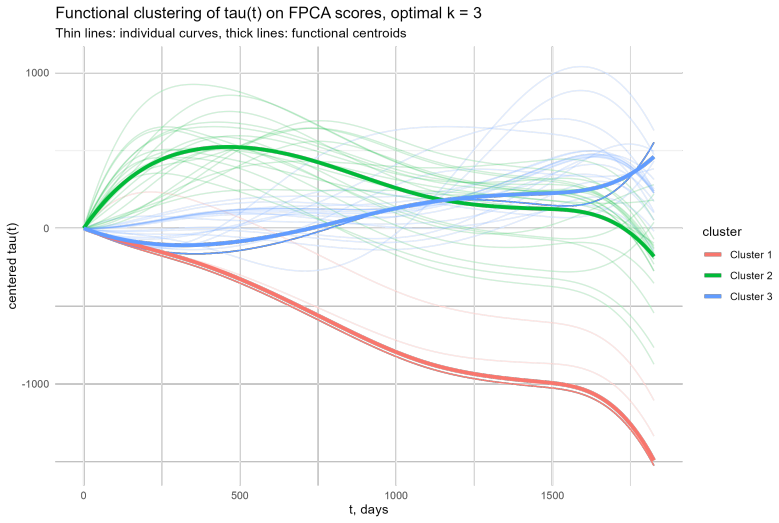
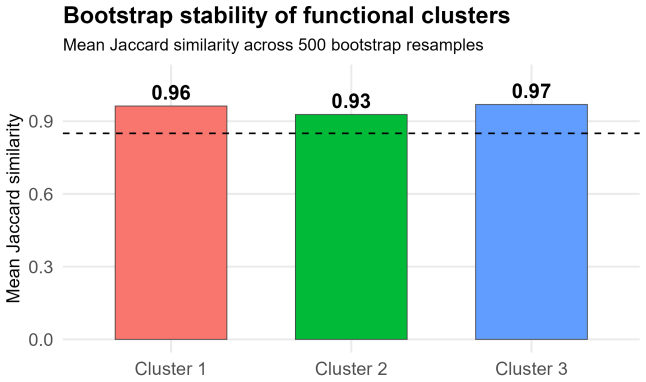
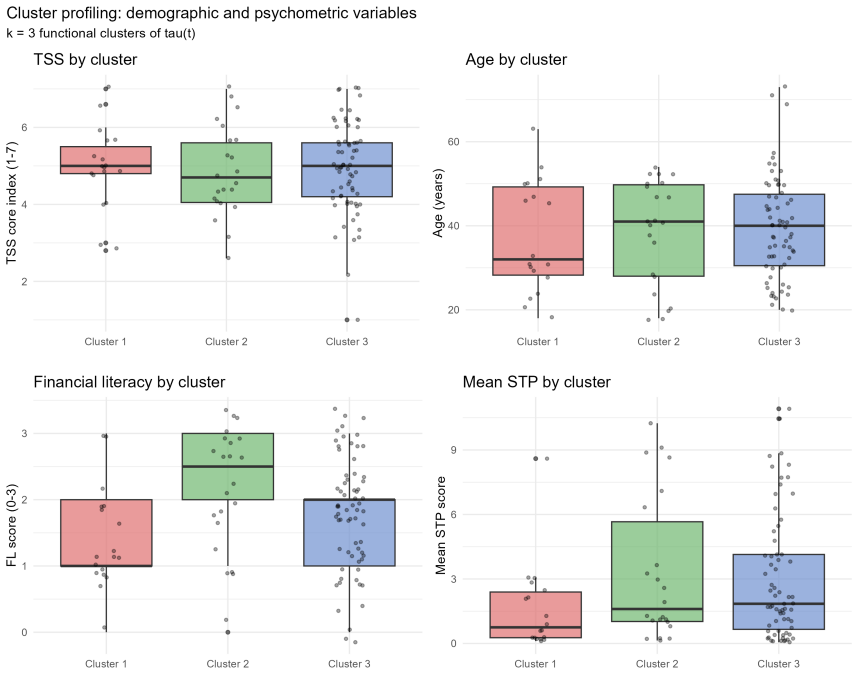
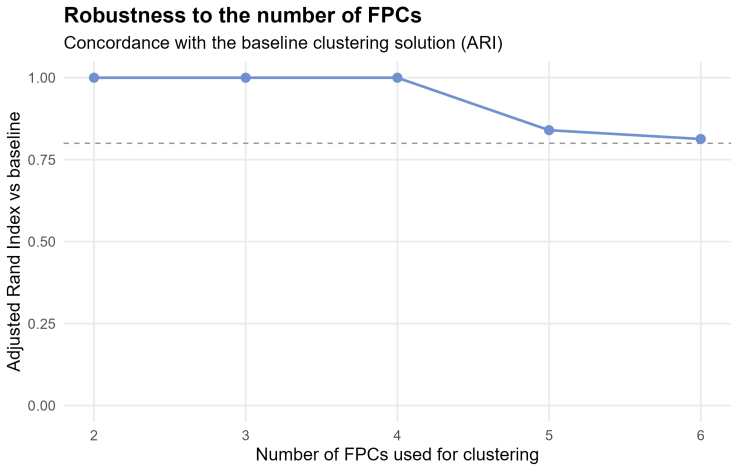
- Functional clustering identifies three stable profiles of temporal deformation that survive bootstrap stability analysis.
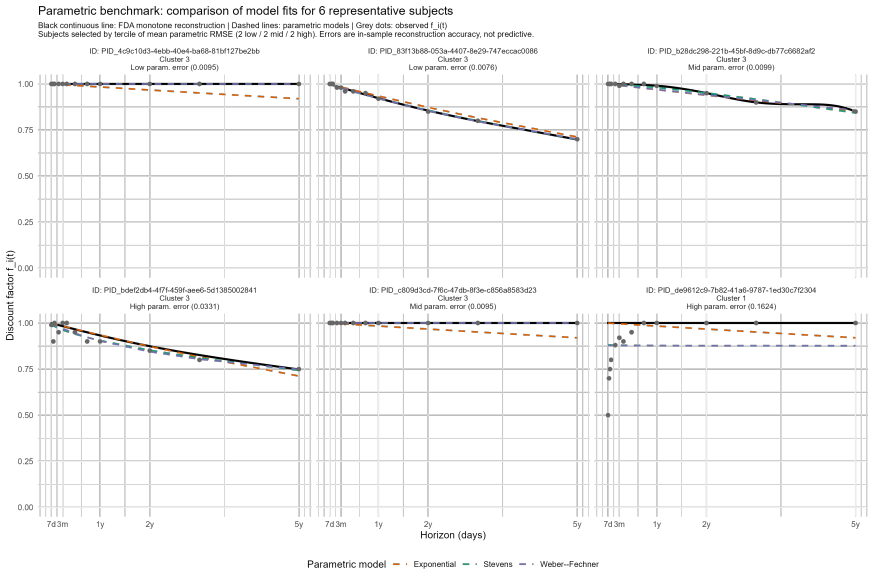
- Parametric models based on exponential, Weber-Fechner, and Stevens specifications fit many individuals accurately but do not recover the functional clustering partition.
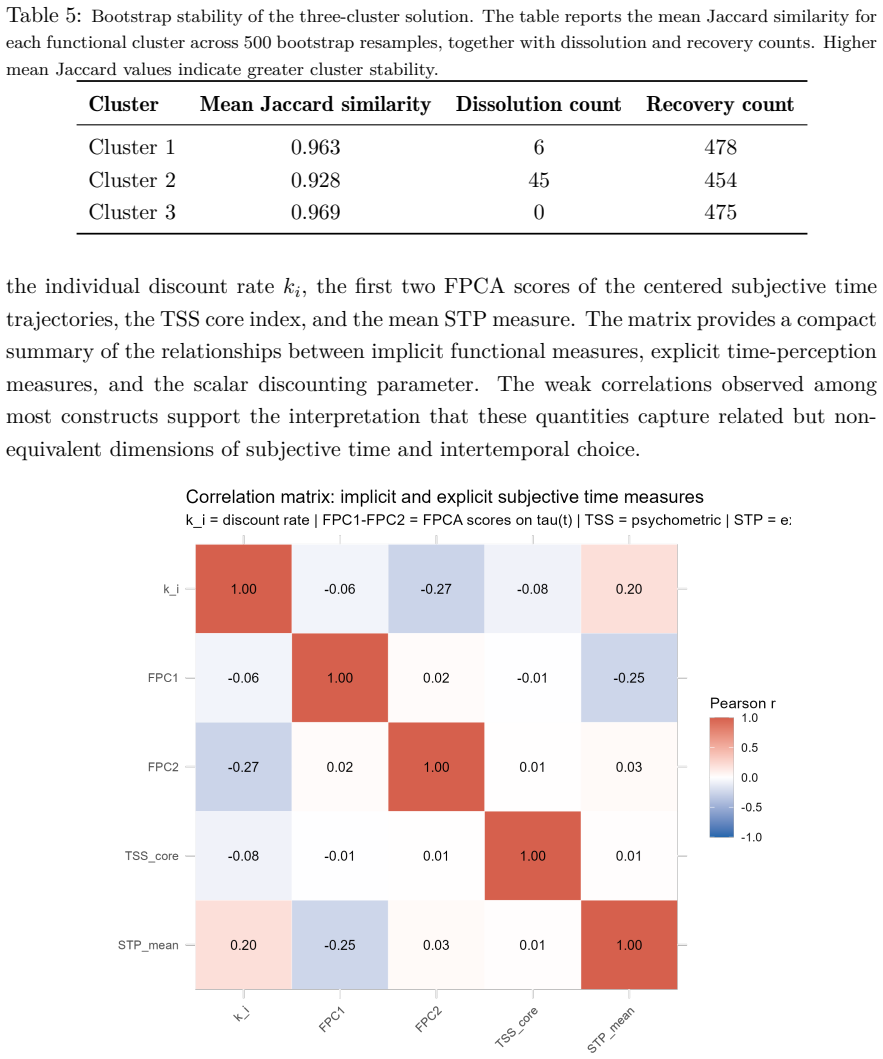
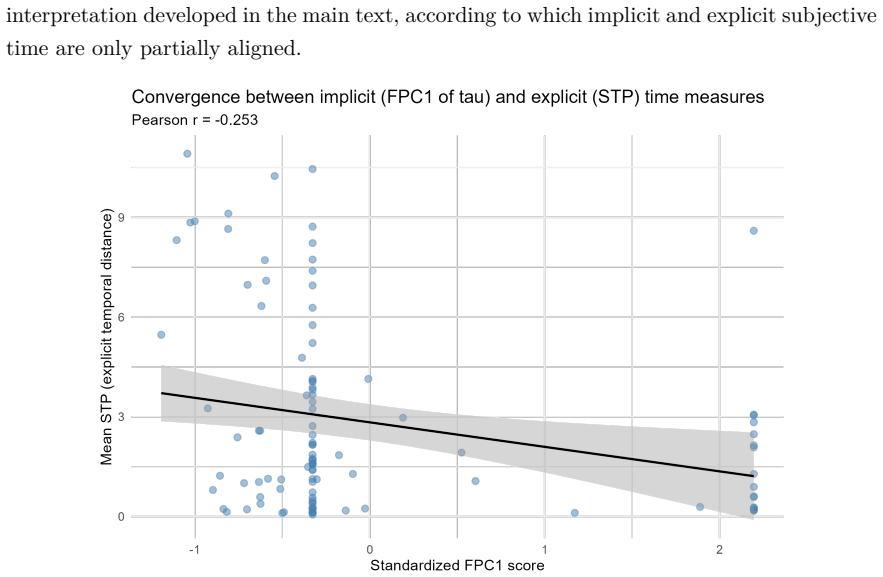
- Reconstructed implicit trajectories show only partial alignment with directly reported explicit subjective-time perception measures.
Where Pith is reading between the lines
- The low-dimensional structure suggests that a small set of basis functions could approximate most individual differences in discounting behavior for modeling purposes.
- If the three profiles correlate with observable traits such as age or cognitive measures, they could be used to stratify participants in future choice experiments.
- The partial mismatch between implicit and explicit time measures indicates that choice-based reconstruction may capture decision-specific deformations not reported in direct perception tasks.
Load-bearing premise
Discrete intertemporal equivalence judgments from the questionnaire can be turned into individual discount curves by monotone smoothing without introducing systematic distortion to the recovered subjective-time trajectories.
What would settle it
Repeating the full pipeline on an independent sample of similar size and finding that the first two functional principal components explain far less than 97 percent of variability or that the clustering yields unstable or non-replicable profiles would falsify the low-dimensional structure claim.
Figures
read the original abstract
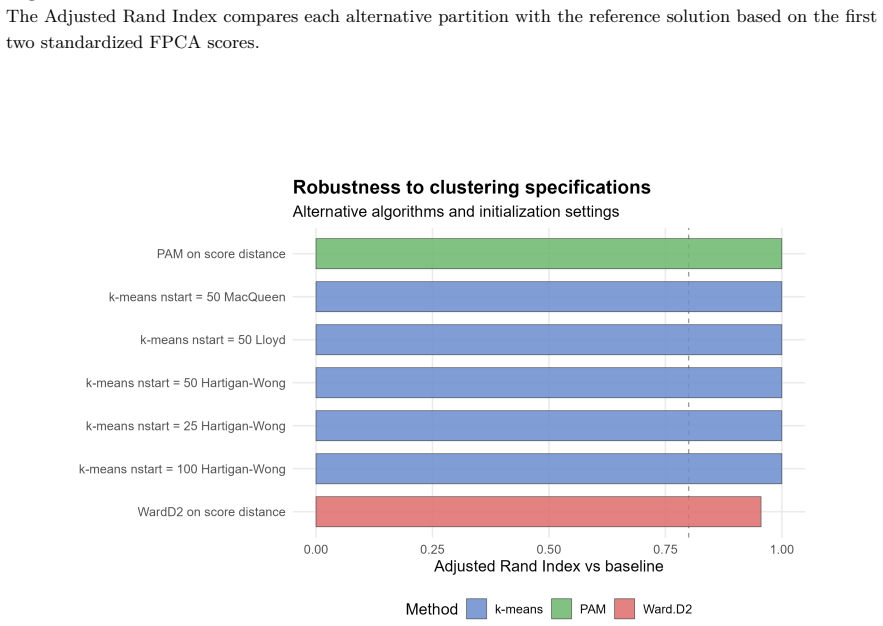
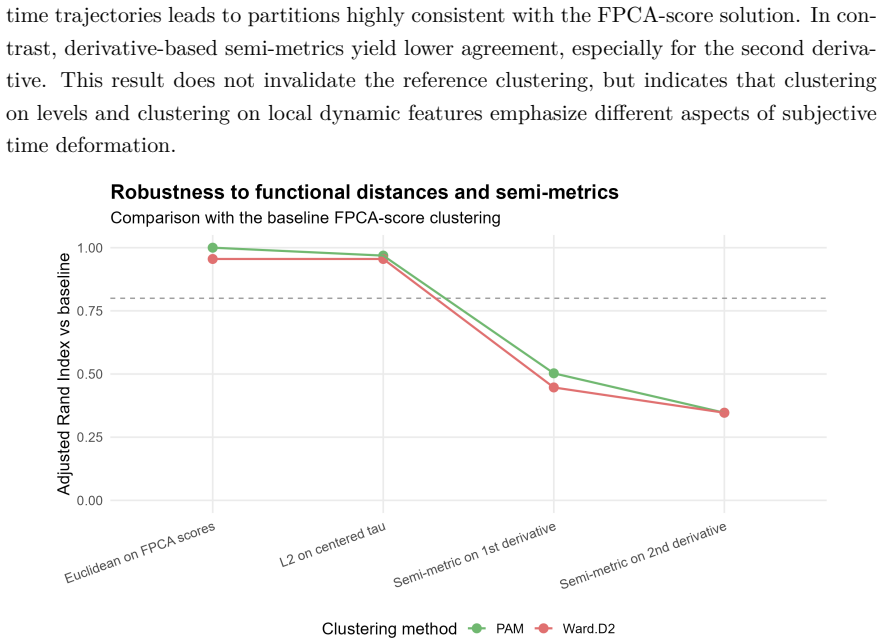
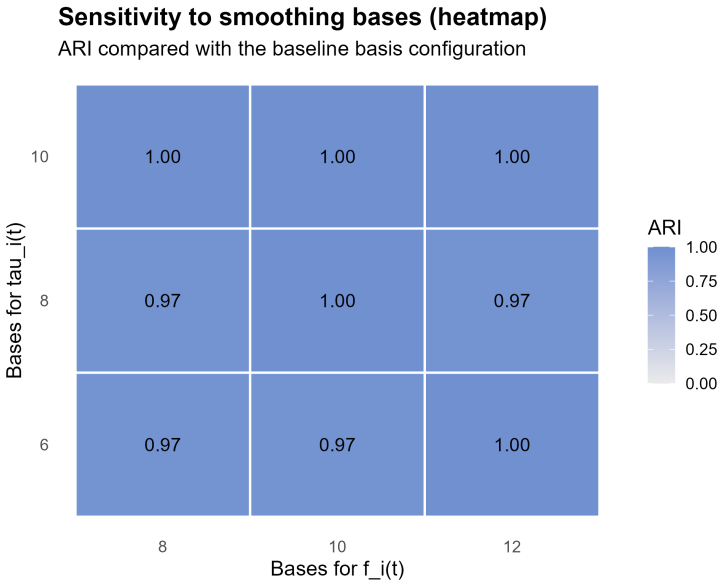
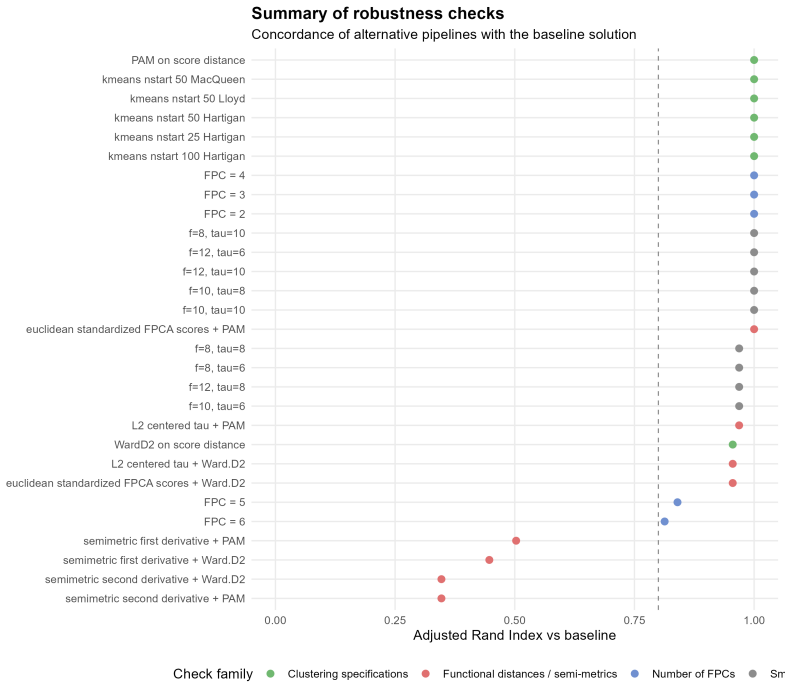
Intertemporal choice data are usually summarized through scalar discount-rate parameters or fitted by predetermined parametric discount functions, although relevant information may lie in the shape of the whole discounting trajectory. This paper proposes a Functional Data Analysis framework for reconstructing and analyzing implicit subjective-time trajectories from discrete intertemporal equivalence judgments. Monetary equivalence responses from a multilingual questionnaire are transformed into individual discount curves, regularized by monotone smoothing, and used to recover normalized implicit subjective-time trajectories. The trajectories are examined through derivative summaries, Functional Principal Component Analysis, and clustering on standardized component scores. The empirical application, based on 107 participants, shows that heterogeneity in intertemporal choice is not fully captured by scalar discount-rate variation. The first two functional principal components explain 97.44% of the variability, indicating a low-dimensional structure. Functional clustering identifies three stable profiles of temporal deformation, supported by bootstrap stability analysis and sensitivity checks on components, algorithms, distances, smoothing specifications, and outlier treatment. Parametric benchmarks based on exponential, Weber-Fechner, and Stevens specifications provide accurate fits for many individuals, but do not fully recover the functional clustering structure. The comparison with explicit subjective-time perception measures reveals only partial alignment between implicit trajectories reconstructed from choices and directly reported temporal perception. Functional Data Analysis provides an applied statistical framework for representing intertemporal choice heterogeneity as variation in functional shape, complementing scalar discount-rate and parametric subjective-time models.
Editorial analysis
A structured set of objections, weighed in public.
Referee Report
Summary. The manuscript proposes a Functional Data Analysis framework to reconstruct normalized implicit subjective-time trajectories from discrete intertemporal equivalence judgments in a multilingual questionnaire (n=107). Monetary responses are converted to discount curves via monotone smoothing, then analyzed with derivative summaries, FPCA (first two components explain 97.44% variance), and functional clustering into three profiles. The central claim is that scalar discount-rate variation does not fully capture heterogeneity in intertemporal choice; parametric benchmarks (exponential, Weber-Fechner, Stevens) fit many individuals but miss the functional clustering structure, while explicit time-perception measures show only partial alignment. Bootstrap stability and sensitivity checks on smoothing, components, algorithms, distances, and outliers are reported.
Significance. If the monotone-smoothing reconstruction is shown to be faithful, the work supplies a useful nonparametric complement to scalar and parametric models by demonstrating low-dimensional functional structure in discounting trajectories. The reported bootstrap stability, sensitivity analyses, and direct comparison to three parametric families are concrete strengths that make the empirical findings falsifiable and reproducible within the manuscript's scope.
major comments (2)
- [§3] §3 (monotone smoothing and trajectory recovery): The central claim that FPCA and clustering reveal genuine heterogeneity beyond scalar rates depends on the preprocessing step that converts discrete judgments into continuous normalized trajectories. Although the abstract and results mention sensitivity checks on smoothing specifications, no simulation study is described that generates discrete equivalence judgments from known parametric forms (e.g., exponential or hyperbolic) and verifies faithful recovery of the original trajectories after smoothing and normalization. Without this direct fidelity test, it remains possible that regularization artifacts contribute to the reported 97.44% variance in the first two components or the three-cluster partition.
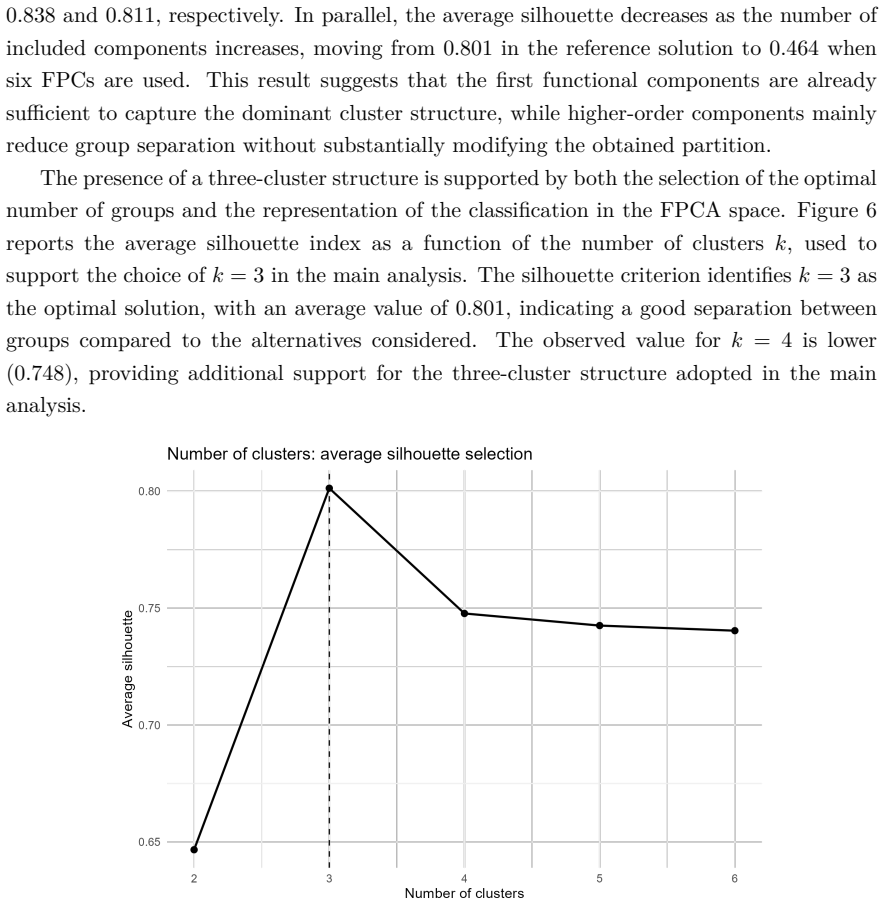
- [§4.2] §4.2 (functional clustering): The number of clusters is listed as a free parameter in the analysis pipeline. The manuscript reports bootstrap stability for the three-profile solution but does not describe an objective selection procedure (e.g., silhouette, gap statistic, or cross-validated prediction error) or show results for neighboring values of k. Because the low-dimensional claim is tied to the existence of these specific stable profiles, the justification for k=3 versus other values needs to be made explicit and load-bearing.
minor comments (2)
- [§3] Notation for the normalized implicit subjective-time function (e.g., how the normalization to [0,1] interval is performed after smoothing) should be stated once in a single equation early in §3 rather than re-described in multiple places.
- [§2] Table 1 (participant demographics) and the multilingual questionnaire description would benefit from an explicit statement of the exact number of equivalence judgments per participant and the range of delays used.
Simulated Author's Rebuttal
We thank the referee for the constructive comments. We address each major point below and indicate planned revisions.
read point-by-point responses
-
Referee: [§3] §3 (monotone smoothing and trajectory recovery): The central claim that FPCA and clustering reveal genuine heterogeneity beyond scalar rates depends on the preprocessing step that converts discrete judgments into continuous normalized trajectories. Although the abstract and results mention sensitivity checks on smoothing specifications, no simulation study is described that generates discrete equivalence judgments from known parametric forms (e.g., exponential or hyperbolic) and verifies faithful recovery of the original trajectories after smoothing and normalization. Without this direct fidelity test, it remains possible that regularization artifacts contribute to the reported 97.44% variance in the first two components or the three-cluster partition.
Authors: We agree that a dedicated simulation study testing recovery from known parametric generating processes would provide stronger validation of the monotone-smoothing step. The existing sensitivity checks vary smoothing parameters but do not simulate from ground-truth trajectories. In the revised manuscript we will add such a simulation: generate discrete equivalence judgments from exponential, hyperbolic, and Weber-Fechner models, apply the full pipeline (monotone smoothing, normalization, FPCA, clustering), and report integrated squared error and cluster-recovery metrics between true and reconstructed trajectories. revision: yes
-
Referee: [§4.2] §4.2 (functional clustering): The number of clusters is listed as a free parameter in the analysis pipeline. The manuscript reports bootstrap stability for the three-profile solution but does not describe an objective selection procedure (e.g., silhouette, gap statistic, or cross-validated prediction error) or show results for neighboring values of k. Because the low-dimensional claim is tied to the existence of these specific stable profiles, the justification for k=3 versus other values needs to be made explicit and load-bearing.
Authors: The k=3 solution was chosen on the basis of bootstrap stability and profile interpretability. We acknowledge that formal model-selection criteria were not reported. In revision we will add gap-statistic and silhouette analyses for k=2 to 5, together with bootstrap stability results for k=2, 3, and 4, to demonstrate that the three-profile partition is both stable and preferred by these criteria. revision: yes
Circularity Check
No circularity: empirical FDA pipeline is data-driven and externally validated
full rationale
The paper applies standard functional data analysis (monotone smoothing, FPCA, clustering) to questionnaire responses from 107 participants. Reported results (97.44% variance in first two FPCs, three stable clusters) are computed directly from the processed trajectories rather than being algebraically forced by any fitted parameter or self-citation. Bootstrap stability, sensitivity checks on smoothing parameters, and explicit comparison against exponential/Weber-Fechner/Stevens benchmarks are independent of the target functional summaries. No equations or uniqueness theorems reduce the central claims to the inputs by construction; the derivation chain remains self-contained against the observed data.
Axiom & Free-Parameter Ledger
free parameters (2)
- monotone smoothing parameter
- number of functional clusters
axioms (1)
- domain assumption Discount functions derived from equivalence judgments are monotonically decreasing
Reference graph
Works this paper leans on
-
[1]
A new approach to intertem- poral choice: The delay function.Symmetry, 12(5):807, May 2020
Salvador Cruz Rambaud and Isabel González Fernández. A new approach to intertem- poral choice: The delay function.Symmetry, 12(5):807, May 2020. ISSN 2073-8994. doi: 10.3390/sym12050807. URLhttp://dx.doi.org/10.3390/sym12050807
-
[2]
Salvador Cruz Rambaud and Javier Sánchez García. A formal analysis of inconsistent decisions in intertemporal choice through subjective time perception.Heliyon, 9(11): e21077, November 2023. ISSN 2405-8440. doi: 10.1016/j.heliyon.2023.e21077. URL http://dx.doi.org/10.1016/j.heliyon.2023.e21077
-
[3]
Salvador Cruz Rambaud, Piedad Ortiz Fernández, and Isabel María Parra Oller. A systematic review of the main anomalies in intertemporal choice.Journal of Behavioral and Experimental Economics, 104:101999, June 2023. ISSN 2214-8043. doi: 10.1016/j. socec.2023.101999. URLhttp://dx.doi.org/10.1016/j.socec.2023.101999
work page doi:10.1016/j 2023
-
[4]
Measuring the subjective passage of time: A sociophysics modeling
Serge Galam. Measuring the subjective passage of time: A sociophysics modeling. Entropy, 26(6):528, June 2024. ISSN 1099-4300. doi: 10.3390/e26060528. URLhttp: //dx.doi.org/10.3390/e26060528
-
[5]
Kyu Kim and Gal Zauberman
B. Kyu Kim and Gal Zauberman. Perception of anticipatory time in temporal dis- counting.Journal of Neuroscience, Psychology, and Economics, 2(2):91–101, November 37
-
[6]
ISSN 1937-321X. doi: 10.1037/a0017686. URLhttp://dx.doi.org/10.1037/ a0017686
-
[7]
B. Kyu Kim and Gal Zauberman. Psychological time and intertemporal preference. Current Opinion in Psychology, 26:90–93, April 2019. ISSN 2352-250X. doi: 10.1016/ j.copsyc.2018.06.005. URLhttp://dx.doi.org/10.1016/j.copsyc.2018.06.005
-
[8]
G. Loewenstein and D. Prelec. Anomalies in intertemporal choice: Evidence and an interpretation.The Quarterly Journal of Economics, 107(2):573–597, May 1992. ISSN 1531-4650. doi: 10.2307/2118482. URLhttp://dx.doi.org/10.2307/2118482
-
[9]
George Loewenstein and Richard H. Thaler. Anomalies: Intertemporal choice.Journal of Economic Perspectives, 3(4):181–193, November 1989. ISSN 0895-3309. doi: 10. 1257/jep.3.4.181. URLhttp://dx.doi.org/10.1257/jep.3.4.181
-
[10]
Roberta Martino, Annamaria Porreca, Viviana Ventre, and Fabrizio Maturo. Explor- ing intertemporal decision-making dynamics through functional data analysis: investi- gating variations in different discount function’s dimensions.Quality & Quantity, 59 (3):2171–2196, April 2024. ISSN 1573-7845. doi: 10.1007/s11135-024-01869-y. URL http://dx.doi.org/10.1007...
-
[11]
Fabrizio Maturo and Rosanna Verde. Combining unsupervised and supervised learning techniques for enhancing the performance of functional data classifiers.Computational Statistics, 39(1):239–270, July 2022. ISSN 1613-9658. doi: 10.1007/s00180-022-01259-8. URLhttp://dx.doi.org/10.1007/s00180-022-01259-8
-
[12]
Fabrizio Maturo, Annamaria Porreca, Viviana Ventre, Roberta Martino, and Salvador Cruz Rambaud. Functional clustering of discount functions for behavioural investor profiling.Applied Stochastic Models in Business and Industry, 42(3), May 2026. ISSN 1526-4025. doi: 10.1002/asmb.70101. URLhttp://dx.doi.org/10.1002/asmb.70101
-
[13]
James J. McGrath and James F. O’Hanlon. Method for measuring the rate of subjective time.Perceptual and Motor Skills, 24(3):1235–1240, June 1967. ISSN 1558-688X. doi: 10.2466/pms.1967.24.3c.1235. URLhttp://dx.doi.org/10.2466/pms.1967.24.3c
-
[14]
Drazen Prelec. Decreasing impatience: A criterion for non-stationary time preference and “hyperbolic” discounting.The Scandinavian Journal of Economics, 106(3):511– 532, October 2004. ISSN 1467-9442. doi: 10.1111/j.0347-0520.2004.00375.x. URL http://dx.doi.org/10.1111/j.0347-0520.2004.00375.x
-
[15]
J. O. Ramsay and B. W. Silverman.Functional Data Analysis. Springer New York,
-
[16]
ISBN 9780387227511. doi: 10.1007/b98888. URLhttp://dx.doi.org/10.1007/ b98888. 38
-
[17]
Paul A. Samuelson. A note on measurement of utility.The Review of Economic Studies, 4(2):155, February 1937. ISSN 0034-6527. doi: 10.2307/2967612. URLhttp://dx.doi. org/10.2307/2967612
-
[18]
Taiki Takahashi, Hidemi Oono, and Mark H. B. Radford. Psychophysics of time per- ception and intertemporal choice models.Physica A: Statistical Mechanics and its Applications, 387(8-9):2066–2074, March 2008. ISSN 0378-4371. doi: 10.1016/j.physa. 2007.11.047. URLhttp://dx.doi.org/10.1016/j.physa.2007.11.047
-
[19]
Some empirical evidence on dynamic inconsistency.Economics Letters, 8(3):201–207, January 1981
Richard Thaler. Some empirical evidence on dynamic inconsistency.Economics Letters, 8(3):201–207, January 1981. ISSN 0165-1765. doi: 10.1016/0165-1765(81)90067-7. URL http://dx.doi.org/10.1016/0165-1765(81)90067-7
-
[20]
Viviana Ventre, Roberta Martino, Salvador Cruz Rambaud, Fabrizio Maturo, and An- namaria Porreca. An original approach to anomalies in intertemporal choices through functional data analysis: Theory and application for the study of hikikomori syndrome. Socio-Economic Planning Sciences, 92:101840, April 2024. ISSN 0038-0121. doi: 10. 1016/j.seps.2024.101840...
-
[21]
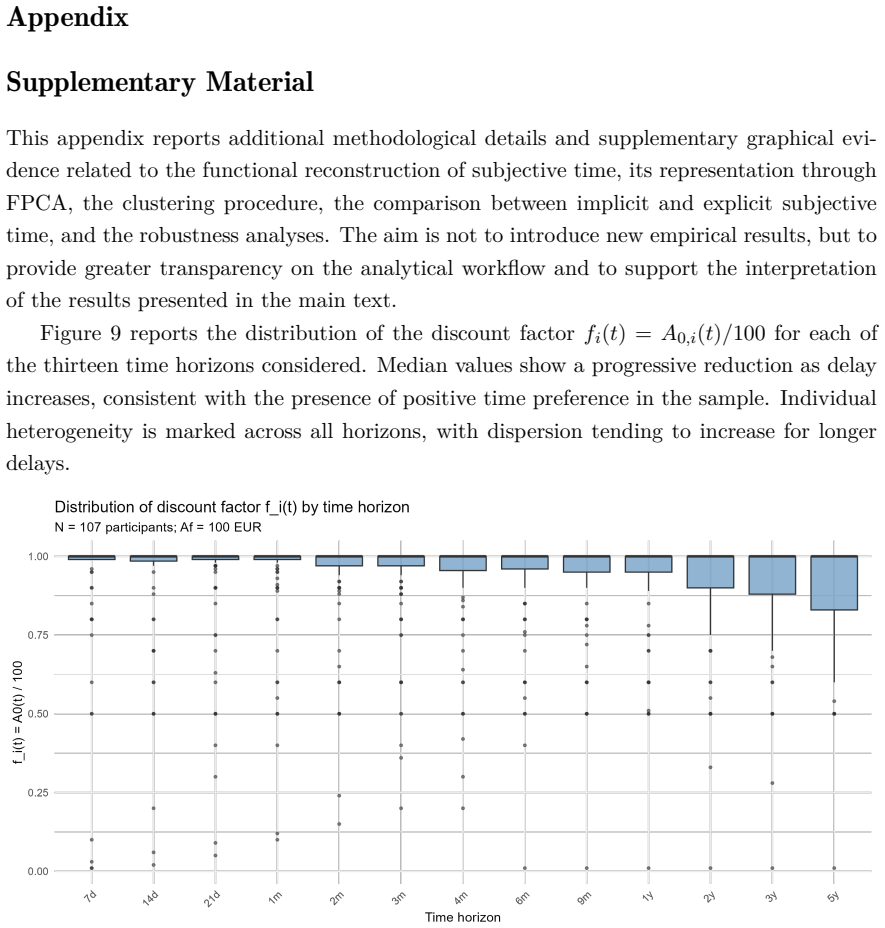
Gal Zauberman, B. Kyu Kim, Selin A. Malkoc, and James R. Bettman. Discounting time and time discounting: Subjective time perception and intertemporal preferences. Journal of Marketing Research, 46(4):543–556, August 2009. ISSN 1547-7193. doi: 10.1509/jmkr.46.4.543. URLhttp://dx.doi.org/10.1509/jmkr.46.4.543. 39 Appendix Supplementary Material This appendi...
discussion (0)
Sign in with ORCID, Apple, or X to comment. Anyone can read and Pith papers without signing in.