Constant mean curvature surfaces in the sub-Lorentzian Heisenberg group
Pith reviewed 2026-06-28 20:52 UTC · model grok-4.3
The pith
A family of boost-symmetric surfaces with constant horizontal mean curvature in the sub-Lorentzian Heisenberg group is conjectured to solve the isoperimetric problem.
A machine-rendered reading of the paper's core claim, the machinery that carries it, and where it could break.
Core claim
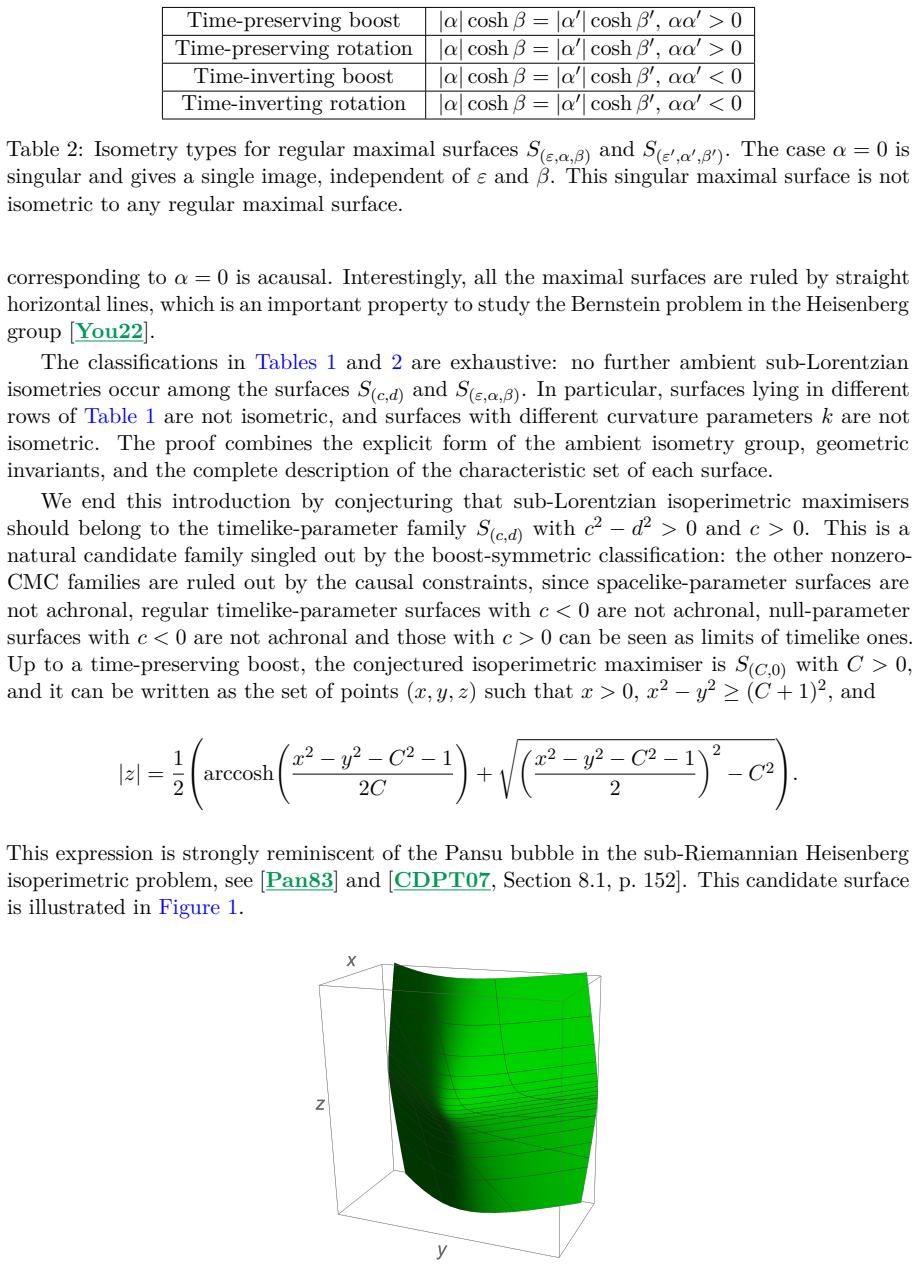
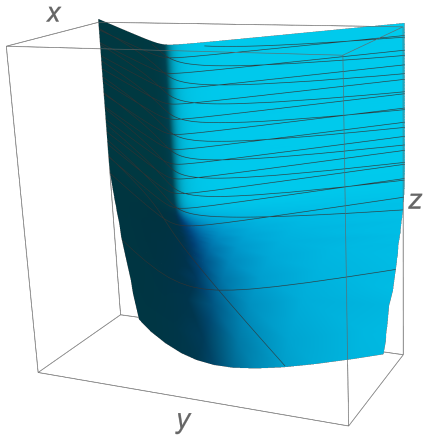
From this classification, we single out a family of smooth, acausal, boost-symmetric surfaces with nonzero constant mean curvature. Written as a two-sheeted graph over the exterior of a future hyperbola, this family is a natural sub-Lorentzian analogue of the Pansu bubbles and leads us to conjecture that it gives the isoperimetric maximisers in the sub-Lorentzian Heisenberg group.
What carries the argument
The complete classification of smooth boost-symmetric constant mean curvature surfaces by characteristic sets, causal behaviour, and sub-Lorentzian isometry classes.
If this is right
- Smooth isoperimetric candidates have constant horizontal mean curvature away from the characteristic set.
- The identified family consists of acausal surfaces that remain regular for the isoperimetric problem.
- These surfaces supply explicit examples against which the isoperimetric conjecture in the sub-Lorentzian Heisenberg group can be tested.
- The classification organises all boost-symmetric constant-mean-curvature surfaces into finitely many isometry classes.
Where Pith is reading between the lines
- If isoperimetric maximisers need not be boost-symmetric, asymmetric competitors could exceed the ratio attained by the identified family.
- The first-variation formula and classification method may apply directly to other sub-Lorentzian or sub-Riemannian three-dimensional geometries.
- Numerical computation of the isoperimetric ratio attained by the two-sheeted graph family would provide a concrete test of the conjecture.
Load-bearing premise
The classification and conjecture rest on restricting attention to boost-symmetric surfaces.
What would settle it
Existence of a smooth isoperimetric surface that is not boost-symmetric and achieves a strictly larger isoperimetric ratio than the identified family.
Figures
read the original abstract
We study constant horizontal mean curvature surfaces in the sub-Lorentzian Heisenberg group. We derive the first-variation formula for horizontal area under volume-preserving radial variations and show that smooth isoperimetric candidates have constant horizontal mean curvature away from the characteristic set. We then give a complete classification of smooth boost-symmetric constant mean curvature surfaces: their characteristic sets, causal behaviour, and ambient sub-Lorentzian isometry classes. From this classification, we single out a family of smooth, acausal, boost-symmetric surfaces with nonzero constant mean curvature. Written as a two-sheeted graph over the exterior of a future hyperbola, this family is a natural sub-Lorentzian analogue of the Pansu bubbles and leads us to conjecture that it gives the isoperimetric maximisers in the sub-Lorentzian Heisenberg group.
Editorial analysis
A structured set of objections, weighed in public.
Referee Report
Summary. The paper derives a first-variation formula for horizontal area under volume-preserving radial variations in the sub-Lorentzian Heisenberg group, shows that smooth isoperimetric candidates have constant horizontal mean curvature away from the characteristic set, and gives a complete classification of smooth boost-symmetric constant mean curvature surfaces (their characteristic sets, causal behaviour, and isometry classes). It identifies a specific family of smooth, acausal, boost-symmetric nonzero-CMC surfaces realized as two-sheeted graphs over the exterior of a future hyperbola and conjectures that this family consists of the isoperimetric maximizers.
Significance. If the first-variation formula and the classification of boost-symmetric CMC surfaces are correct, the work supplies a direct sub-Lorentzian analogue of the Pansu bubbles together with an explicit first-variation tool that can be used for further isoperimetric analysis in this geometry.
major comments (1)
- [Abstract] Abstract: the conjecture that the identified two-sheeted boost-symmetric family 'gives the isoperimetric maximisers' is load-bearing for the paper's stated motivation, yet the classification and first-variation formula are derived only under the boost-symmetry assumption; no symmetry-forcing result, calibration argument, or comparison with non-symmetric competitors is supplied to justify that maximizers must lie in this class.
Simulated Author's Rebuttal
We thank the referee for their careful reading of the manuscript and for identifying this point concerning the abstract. We respond to the major comment below.
read point-by-point responses
-
Referee: [Abstract] Abstract: the conjecture that the identified two-sheeted boost-symmetric family 'gives the isoperimetric maximisers' is load-bearing for the paper's stated motivation, yet the classification and first-variation formula are derived only under the boost-symmetry assumption; no symmetry-forcing result, calibration argument, or comparison with non-symmetric competitors is supplied to justify that maximizers must lie in this class.
Authors: The first-variation formula is derived without any symmetry assumption, and the classification is explicitly restricted to the boost-symmetric case; both results stand independently of the conjecture. The conjecture itself is framed as arising from the classification together with the known analogy to the rotationally symmetric Pansu bubbles in the sub-Riemannian Heisenberg group. The manuscript does not assert, nor does it attempt to prove, that every isoperimetric maximizer must be boost-symmetric; no symmetry-forcing theorem, calibration, or direct comparison with non-symmetric surfaces is claimed or supplied. We therefore view the conjecture as an open statement motivated by the explicit family we construct, rather than a proven characterization. Because the paper already presents the statement as a conjecture and does not rely on it for any of the proved results, we do not believe a change to the abstract is required. revision: no
Circularity Check
No circularity: classification derived from first-variation formula and explicit symmetry reduction; conjecture stated as such
full rationale
The paper derives the first-variation formula for horizontal area, shows CMC is necessary for isoperimetric candidates, and classifies boost-symmetric CMC surfaces by direct computation of their characteristic sets and causal properties. The family is singled out from this classification and the isoperimetric conjecture is explicitly labeled as a conjecture resting on the boost-symmetry restriction. No step equates a derived quantity to its input by construction, renames a fitted parameter as a prediction, or relies on a load-bearing self-citation whose content reduces to the present work. The derivation chain is therefore self-contained.
Axiom & Free-Parameter Ledger
axioms (1)
- standard math Smoothness of surfaces away from the characteristic set and well-defined horizontal distribution on the sub-Lorentzian Heisenberg group.
Reference graph
Works this paper leans on
-
[1]
Cambridge University Press, 2020.doi:10.1017/9781108677325
Cambridge Studies in Advanced Math- ematics. Cambridge University Press, 2020.doi:10.1017/9781108677325. [ADG17] L. Ambrosio, S. Di Marino and N. Gigli. ‘Perimeter as relaxed Minkowski content in metric measure spaces’.Nonlinear Anal.153 (2017), pp. 78–88.doi:10.1016/j.na.2016.03.010. [Bar88] R. Bartnik. ‘Remarks on cosmological spacetimes and constant me...
- [2]
-
[3]
arXiv:2509.06563 [math.DG]. [CDPT07] L. Capogna, D. Danielli, S. D. Pauls and J. T. Tyson. ‘An introduction to the Heisenberg group and the sub-Riemannian isoperimetric problem’. Progress in Mathematics 259 (2007), pp. xvi+223.doi: 10.1007/978-3-7643-8133-2. [CHMY05] J.-H. Cheng, J.-F. Hwang, A. Malchiodi and P. Yang. ‘Minimal surfaces in pseudohermitian ...
-
[4]
arXiv:2401.03949 [math.DG]. [CM24b] F. Cavalletti and A. Mondino. ‘Optimal transport in Lorentzian synthetic spaces, synthetic timelike Ricci curvature lower bounds and applications’.Cambridge Journal of Mathematics 12.2 (2024), pp. 417–534.doi:10.4310/CJM.2024.v12.n2.a3. [DGN07] D. Danielli, N. Garofalo and D.-M. Nhieu. ‘Sub-Riemannian calculus on hypers...
-
[5]
arXiv:2409.20359 [math.DG]. [GR21] G. Giovannardi and M. Ritoré. ‘Regularity of Lipschitz boundaries with prescribed sub-Finsler mean curvature in the Heisenberg groupH1’.Journal of Differential Equations302 (2021), pp. 474–495.doi:10.1016/j.jde.2021.08.040. [GR24] G. Giovannardi and M. Ritoré. ‘The Bernstein problem for(X,Y )-Lipschitz surfaces in three-...
-
[6]
Banach Center Publ. Polish Acad. Sci. Inst. Math., Warsaw, 2004, pp. 57–65. doi: 10.4064/bc65-0-4. 47 [Gro06] M. Grochowski. ‘Reachable sets for the Heisenberg sub-Lorentzian structure onR3. An estimate for the distance function’.J. Dyn. Control Syst.12.2 (2006), pp. 145–160.doi: 10.1007/s10450-006-0378-y. [HP08] R.K.HladkyandS.D.Pauls.‘Constantmeancurvat...
-
[7]
Quantitative Lorentzian isoperimetric inequalities
arXiv: 2510.26755 [math.DG]. [LS21] B. Lambert and J. Scheuer. ‘Isoperimetric problems for spacelike domains in generalized Robertson-Walker spaces’.J. Evol. Equ.21.1 (2021), pp. 377–389.doi:10.1007/s00028-020-0 0584-z. [MM04] R. Monti and D. Morbidelli. ‘Isoperimetric inequality in the Grushin plane’.The Journal of Geometric Analysis14.2 (2004), pp. 355–...
work page internal anchor Pith review Pith/arXiv arXiv doi:10.1007/s00028-020-0 2021
discussion (0)
Sign in with ORCID, Apple, or X to comment. Anyone can read and Pith papers without signing in.