Enhancing Galaxy Classification with U-Net Variational Autoencoders. III. Disk-like Galaxy Identification in JWST Samples of up to redshift 4
Pith reviewed 2026-06-28 22:00 UTC · model grok-4.3
The pith
Disk-like galaxies are identified among massive systems in JWST data up to redshift 4 using a U-Net Variational Autoencoder.
A machine-rendered reading of the paper's core claim, the machinery that carries it, and where it could break.
Core claim
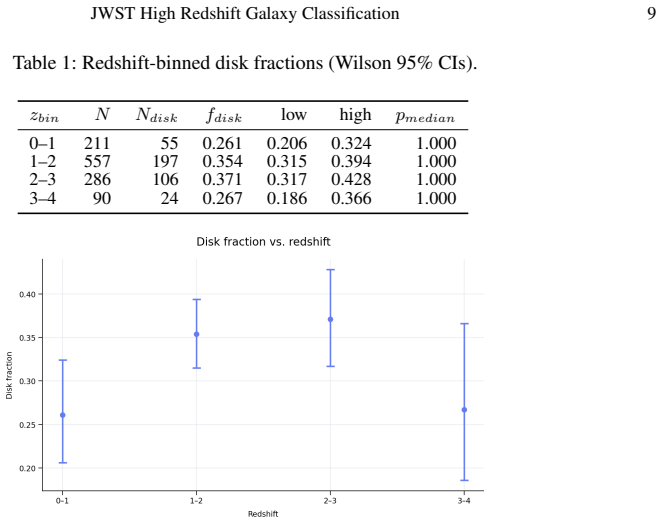
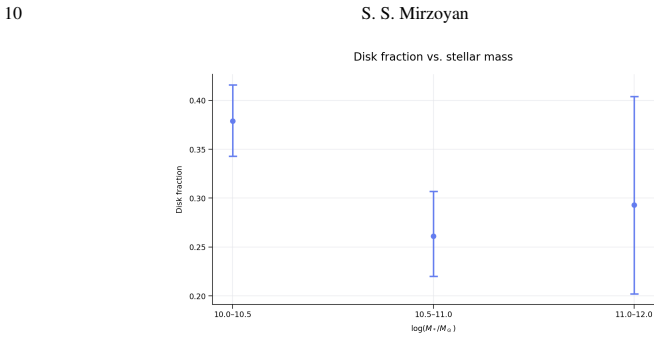
Within this population our classifier detects 382 disk-like galaxies with a subset showing uncertain features. This expanded dataset allows examination of the distribution of disk-like systems in a statistically meaningful high-redshift regime including epochs where well-ordered disks are traditionally expected to be rare. The results demonstrate that disk-like structures persist across a broad range of redshifts and stellar masses suggesting that massive disks may be more common in the early universe than previously assumed.
What carries the argument
The U-Net Variational Autoencoder classifier applied after denoising to detect disk-like morphologies in JWST images.
If this is right
- Disk-like galaxies exist in statistically meaningful numbers at redshifts where they were expected to be rare.
- Massive disks appear across a broad range of stellar masses and redshifts up to 4.
- Denoising plus machine-learning classification enables morphological studies of large JWST galaxy samples.
- Traditional expectations about the rarity of ordered disks at early times may need revision.
Where Pith is reading between the lines
- The detections could imply that disk assembly processes operated efficiently at earlier cosmic times than many formation models currently allow.
- Applying the same pipeline to even higher-redshift or lower-mass samples might map the onset of disk formation more precisely.
- Cross-checking the machine-learning labels against independent morphological indicators such as kinematic data would strengthen or refute the morphological assignments.
Load-bearing premise
The U-Net Variational Autoencoder classifier identifies disk-like morphologies in high-redshift JWST images without major biases from noise resolution or redshift-dependent appearance changes.
What would settle it
A systematic visual or spectroscopic reclassification of the 382 candidates that finds most are not disks due to misidentification from redshift effects or noise would falsify the persistence claim.
Figures
read the original abstract
In this third study of the series, we extend our U-Net Variational Autoencoder-based galaxy classification framework to a significantly larger JWST sample spanning the redshift range $0.5 < z < 4$. Focusing on massive systems with stellar masses exceeding $10^{10}\,M_\odot$, we analyze 1,380 galaxies that satisfy these criteria and apply our previously developed denoising and classification pipeline to identify disk-like morphologies across cosmic time. Within this population, our classifier detects 382 disk-like galaxies, with a subset showing uncertain features consistent with the expected performance limits of current deep-learning models. This expanded dataset allows us to examine the distribution of disk-like systems in a statistically meaningful high-redshift regime, including epochs where well-ordered disks are traditionally expected to be rare. The results demonstrate that disk-like structures persist across a broad range of redshifts and stellar masses, suggesting that massive disks may be more common in the early universe than previously assumed. These findings emphasize the value of combining advanced denoising techniques with machine-learning-based morphological analysis for characterizing galaxy populations in large JWST surveys.
Editorial analysis
A structured set of objections, weighed in public.
Referee Report
Summary. The paper applies a previously developed U-Net Variational Autoencoder denoising and classification pipeline to 1,380 massive galaxies (M_* > 10^10 M_⊙) in JWST data spanning 0.5 < z < 4, reports detection of 382 disk-like systems, and concludes that disk-like morphologies persist across this redshift range and are more common at high redshift than traditionally assumed.
Significance. If the classifier returns unbiased labels, the result would indicate that well-ordered massive disks form earlier than expected in standard models, with implications for the timing of disk assembly and the role of mergers versus in-situ growth. The work also illustrates a scalable ML approach for morphological classification in large JWST surveys.
major comments (1)
- [Abstract] Abstract: The central claim that disk-like structures persist to z=4 and are more common than assumed rests on the U-Net VAE returning accurate disk/non-disk labels on JWST images at 0.5<z<4, yet the manuscript supplies no quantitative validation (confusion matrices, false-positive rates, recovery fractions versus redshift or stellar mass, or tests against simulated high-z images with cosmological dimming and band-shifting) to demonstrate that performance limits do not introduce redshift-dependent biases.
minor comments (1)
- [Abstract] Abstract: The phrase 'a subset showing uncertain features consistent with the expected performance limits' is stated without accompanying numbers or a breakdown by redshift bin, which would help readers assess the fraction of the sample affected.
Simulated Author's Rebuttal
We thank the referee for their constructive feedback. We respond to the major comment below.
read point-by-point responses
-
Referee: [Abstract] Abstract: The central claim that disk-like structures persist to z=4 and are more common than assumed rests on the U-Net VAE returning accurate disk/non-disk labels on JWST images at 0.5<z<4, yet the manuscript supplies no quantitative validation (confusion matrices, false-positive rates, recovery fractions versus redshift or stellar mass, or tests against simulated high-z images with cosmological dimming and band-shifting) to demonstrate that performance limits do not introduce redshift-dependent biases.
Authors: We agree that the current manuscript does not supply new quantitative validation metrics (such as confusion matrices or recovery fractions versus redshift) specifically for the JWST sample at 0.5 < z < 4. The U-Net VAE pipeline and its performance were validated in Papers I and II of the series. To address the referee's concern about potential redshift-dependent biases from cosmological dimming and band-shifting, we will add these quantitative tests using simulated high-redshift images in a revised version of the manuscript. revision: yes
Circularity Check
No circularity: observational application of prior classifier to independent JWST sample
full rationale
The paper's chain consists of applying a previously developed U-Net VAE denoising and classification pipeline (from parts I and II) to a new, independent sample of 1380 massive galaxies at 0.5 < z < 4 drawn from JWST observations, then reporting the count of 382 disk-like systems and interpreting the distribution. This is a direct application to external data rather than any derivation that reduces by construction to fitted parameters, self-defined quantities, or a self-citation chain. No equations or steps in the provided text exhibit self-definitional loops, fitted inputs renamed as predictions, or uniqueness theorems imported from the same authors. The result is therefore self-contained against the observational inputs.
Axiom & Free-Parameter Ledger
Reference graph
Works this paper leans on
-
[1]
L., et al
Andalman, Z. L., et al. 2025, On the origin of the high star formation efficiency in massive galaxies at Cosmic Dawn, MNRAS, 540, 3350
2025
- [2]
-
[3]
2011, The EFIGI catalogue of 4458 nearby galaxies with detailed morphology, A&A, 532, A74
Baillard, A., et al. 2011, The EFIGI catalogue of 4458 nearby galaxies with detailed morphology, A&A, 532, A74
2011
-
[4]
Belli, S., et al. 2025, The Blue Jay Survey: Deep JWST spectroscopy for a representative sample of galaxies at cosmic noon, arXiv:2510.11775
-
[5]
F., et al
Bell, E. F., et al. 2026, The low-mass and structured stellar halo of M83 argues against a merger origin for its starburst and extended neutral hydrogen disk, ApJ, 997, 153
2026
-
[6]
Buta, R. J. 2019, The systematics of galaxy morphology in the de Vaucouleurs revised Hubble–Sandage classification system: application to the EFIGI sample, MNRAS, 488, 590
2019
-
[7]
Carreira, C., et al. 2026, JWST Advanced Deep Extragalactic Survey (JADES) Data Release 5: Catalogs of inferred morphological properties, arXiv:2601.15957
-
[8]
L., et al
Finkelstein, S. L., et al. 2025, The Cosmic Evolution Early Release Science Survey (CEERS), ApJL
2025
-
[9]
S., & Welling, M
Cohen, T. S., & Welling, M. 2016, Group Equivariant Convolutional Networks, in Proc. of the 33rd International Conference on Machine Learning (ICML), 2990
2016
-
[10]
Conselice, C. J. 2014, The evolution of galaxy structure over cosmic time, ARA&A, 52, 291
2014
-
[11]
Conselice, C. J. 2020, The Cosmic Evolution of Galaxy Structure, IOP Publishing
2020
-
[12]
2023, Discovery of the highest redshift galaxies with JWST, AAS Meeting Abstracts, 241, 153–07
Conselice, C., et al. 2023, Discovery of the highest redshift galaxies with JWST, AAS Meeting Abstracts, 241, 153–07
2023
-
[13]
J., et al
Conselice, C. J., et al. 2024, EPOCHS Paper V: The dependence of galaxy formation on galaxy structure at z<7 from JWST, MNRAS, 531, 4857
2024
-
[14]
2026, An updated efficient galaxy morphology classification model based on ConvNeXt encoding with UMAP dimensionality reduction, AJ, 171, 59
Fang, G., et al. 2026, An updated efficient galaxy morphology classification model based on ConvNeXt encoding with UMAP dimensionality reduction, AJ, 171, 59
2026
-
[15]
P., et al
Gardner, J. P., et al. 2006, The James Webb Space Telescope, Space Sci. Rev., 123, 485
2006
-
[16]
2018, The size evolution of star-forming and quenched galaxies in the IllustrisTNG simulation, MNRAS, 474, 3976
Genel, S., et al. 2018, The size evolution of star-forming and quenched galaxies in the IllustrisTNG simulation, MNRAS, 474, 3976
2018
-
[17]
2025, DAWN JWST Archive: Morphology from profile fitting of over 340,000 galaxies, arXiv:2505.21622
Genin, A., et al. 2025, DAWN JWST Archive: Morphology from profile fitting of over 340,000 galaxies, arXiv:2505.21622
-
[18]
2017, The Early Evolution of Galactic Disks: Structure, Dynamics and Feedback, Disk Instabilities Across Cosmic Scales, 5
Genzel, R. 2017, The Early Evolution of Galactic Disks: Structure, Dynamics and Feedback, Disk Instabilities Across Cosmic Scales, 5
2017
-
[19]
2025, Galaxy Morphological Classification with Zernike Moments and Machine Learning, ApJS, 277, 10
Ghaderi, H., et al. 2025, Galaxy Morphological Classification with Zernike Moments and Machine Learning, ApJS, 277, 10
2025
-
[20]
A., et al
Grogin, N. A., et al. 2011, The Cosmic Assembly Near-infrared Deep Extragalactic Legacy Survey (CANDELS), HST WFC3/ACS Deep Survey Description, Survey overview available at https://www.ipac.caltech.edu/project/candels
2011
-
[21]
2017, On Calibration of Modern Neural Networks, in Proc
Guo, C., et al. 2017, On Calibration of Modern Neural Networks, in Proc. of the 34th International Conference on Machine Learning (ICML), 1321
2017
-
[22]
and Ozernoy L.M., 1981, Accretion of the cloud of gas debris of stars disrupted by the tidal forces of a supermassive black hole, A&A, 95, 39
Gurzadyan, V.G. and Ozernoy L.M., 1981, Accretion of the cloud of gas debris of stars disrupted by the tidal forces of a supermassive black hole, A&A, 95, 39
1981
-
[23]
Auto-Encoding Variational Bayes
Kingma, D. P., & Welling, M. 2014, Auto-Encoding Variational Bayes, arXiv:1312.6114
work page internal anchor Pith review Pith/arXiv arXiv 2014
-
[24]
2024, Hot gas accretion fuels star formation faster than cold accretion in high-redshift galaxies, MNRAS, 534, 918
Kocjan, Z., et al. 2024, Hot gas accretion fuels star formation faster than cold accretion in high-redshift galaxies, MNRAS, 534, 918
2024
-
[25]
2024, JWST reveals a surprisingly high fraction of galaxies being spiral-like at 0.5 z 4 , ApJL, 968, L15
Kuhn, V., et al. 2024, JWST reveals a surprisingly high fraction of galaxies being spiral-like at 0.5 z 4 , ApJL, 968, L15
2024
-
[26]
H., Park, C., Hwang, H
Lee, J. H., Park, C., Hwang, H. S., & Kwon, M. 2024, Morphology of Galaxies in JWST Fields: Initial Distribution and Evolution of Galaxy Morphology, ApJ, 936, 112
2024
-
[27]
2023, Cold gas disks in main-sequence galaxies at cosmic noon, A&A, 672, A106
Lelli, F., et al. 2023, Cold gas disks in main-sequence galaxies at cosmic noon, A&A, 672, A106
2023
-
[28]
2011, Galaxy Zoo 1: data release of morphological classifications for nearly 900,000 galaxies, MNRAS, 410, 166
Lintott, C., et al. 2011, Galaxy Zoo 1: data release of morphological classifications for nearly 900,000 galaxies, MNRAS, 410, 166
2011
-
[29]
2022, A ConvNet for the 2020s, in Proc
Liu, Z., et al. 2022, A ConvNet for the 2020s, in Proc. of the IEEE/CVF Conference on Computer Vision and Pattern Recognition (CVPR), 11976
2022
-
[30]
M., et al
Lotz, J. M., et al. 2004, A new nonparametric approach to galaxy morphological classification, AJ, 128, 163
2004
-
[31]
A., et al
Mager, V. A., et al. 2018, Galaxy structure in the ultraviolet: wavelength dependence of morphological parameters, ApJ, 864, 123
2018
-
[32]
UMAP: Uniform Manifold Approximation and Projection for Dimension Reduction
McInnes, L., et al. 2018, UMAP: Uniform Manifold Approximation and Projection for Dimension Reduction, arXiv:1802.03426
work page internal anchor Pith review Pith/arXiv arXiv 2018
- [33]
-
[34]
S., et al
Mirzoyan, S. S., et al. 2019, Machine learning and Kolmogorov analysis to reveal gravitational lenses, MNRAS Lett., 489, L32
2019
-
[35]
Mirzoyan, S. S. 2025a, Enhancing Galaxy Classification with U-Net VAEs for Denoising, RAA, 25, 095006
-
[36]
Mirzoyan, S. S. 2025b, Enhancing Galaxy Classification with U-Net VAEs. II. JWST High-Redshift Sample, RAA, 26, 025010
-
[37]
Mirzoyan, S. S., Avagyan, A., & Gurzadyan, V. G. 2026, Disk-like Galaxies at 4 < z < 7.7 : JWST/NIRCam Morphologies Revealed by Denoising VAE--GCNN Classification, MNRAS Lett., in press, arXiv:2604.14599
work page internal anchor Pith review Pith/arXiv arXiv 2026
-
[38]
2010, Galaxy Formation and Evolution, Cambridge Univ
Mo, H., et al. 2010, Galaxy Formation and Evolution, Cambridge Univ. Press
2010
-
[39]
Naab, T., & Ostriker, J. P. 2017, Theoretical challenges in galaxy formation, ARA&A, 55, 59
2017
-
[40]
W., et al
Nightingale, J. W., et al. 2023, PyAutoLens: Automated Modeling of Strong Gravitational Lenses, JOSS, 8, 5073
2023
-
[41]
Pandya, S., et al. 2023, E(2) -equivariant neural networks for robust galaxy morphology classification, arXiv:2311.01500
-
[42]
1988, TTidal disruption of stars by black holes of 106-108 solar masses in nearby galaxies, Nature, 333, 523
Rees, M. 1988, TTidal disruption of stars by black holes of 106-108 solar masses in nearby galaxies, Nature, 333, 523
1988
-
[43]
J., et al
Rieke, M. J., et al. 2005, Overview of the James Webb Space Telescope Near-Infrared Camera (NIRCam), Proc. SPIE, 5904, 1
2005
-
[44]
J., et al
Rieke, M. J., et al. 2023, The JWST Near-Infrared Camera (NIRCam), PASP, 135, 028001
2023
-
[45]
2023, Data from the JWST Advanced Deep Extragalactic Survey (JADES), MAST Release
Rieke, M., et al. 2023, Data from the JWST Advanced Deep Extragalactic Survey (JADES), MAST Release
2023
-
[46]
R., et al
Rigby, J. R., et al. 2023, The Science Performance of the James Webb Space Telescope: Early Results, ApJ, 943, 38
2023
-
[47]
Ronneberger, O., et al. T. 2015, U-Net: Convolutional Networks for Biomedical Image Segmentation, in Proc. MICCAI, 234
2015
-
[48]
Sacchi, A. 2025, Detection of Anisotropies in the Circumgalactic Medium of Disk Galaxies: Supermassive Black Hole Activity or Star Formation-driven Outflows?, arXiv:2501.18681
-
[49]
M., Kolesnikov, I., de Carvalho, R
Sampaio, V.M. 2026, Morphology across cosmic time: assessing the evolution and interplay of disk and bulge-dominated galaxies in the CANDELS survey, arXiv:2506.12205
-
[50]
2005, The classification of galaxies: Early history and ongoing developments, Annu
Sandage, A. 2005, The classification of galaxies: Early history and ongoing developments, Annu. Rev. Astron. Astrophys., 43, 581
2005
-
[51]
2007, The Cosmic Evolution Survey (COSMOS): Overview, ApJS, 172, 1
Scoville, N., et al. 2007, The Cosmic Evolution Survey (COSMOS): Overview, ApJS, 172, 1
2007
-
[52]
Sharma, G., et al. 2026, The MAGPI Survey: co-evolution of baryons and dark matter in star-forming disk-like galaxies at 0.1 < z < 0.85,, arXiv:2601.12315
-
[53]
2025, COSMOS2025: The COSMOS-Web galaxy catalog, A&A, 704, A339
Shuntov, M., et al. 2025, COSMOS2025: The COSMOS-Web galaxy catalog, A&A, 704, A339
2025
-
[54]
S., & Gallagher, J
Sparke, L. S., & Gallagher, J. S. 2000, Galaxies in the Universe: An Introduction, Cambridge Univ. Press
2000
-
[55]
2024, The structure and morphology of galaxies during the Epoch of Reionization revealed by JWST, ApJ, 960, 104
Sun, W., et al. 2024, The structure and morphology of galaxies during the Epoch of Reionization revealed by JWST, ApJ, 960, 104
2024
-
[56]
2025, Automatic machine learning framework to study AGN host morphology, ApJ, 981, 5
Tian, C., et al. 2025, Automatic machine learning framework to study AGN host morphology, ApJ, 981, 5
2025
-
[57]
2026, Structural Evolution of Stellar Disks from z 3 to the Present with JWST, MNRAS, in press
Tsukui, T., Yoachim, P., Comerón, S., et al. 2026, Structural Evolution of Stellar Disks from z 3 to the Present with JWST, MNRAS, in press
2026
-
[58]
2014, 3D-HST + CANDELS: Evolution of the size–mass distribution since z=3 , ApJ, 788, 28
van der Wel, A., et al. 2014, 3D-HST + CANDELS: Evolution of the size–mass distribution since z=3 , ApJ, 788, 28
2014
-
[59]
2024, On the Nature of Disks at High Redshift Seen by JWST/CEERS with Contrastive Learning and Cosmological Simulations, ApJ, 961, 51
Vega-Ferrero, J., Huertas-Company, M., Costantin, L., et al. 2024, On the Nature of Disks at High Redshift Seen by JWST/CEERS with Contrastive Learning and Cosmological Simulations, ApJ, 961, 51
2024
-
[60]
2022, Galaxy Zoo DECaLS: Detailed visual morphology for 314,000 galaxies, MNRAS, 509, 3966
Walmsley, M., et al. 2022, Galaxy Zoo DECaLS: Detailed visual morphology for 314,000 galaxies, MNRAS, 509, 3966
2022
-
[61]
2021, General E(2)-Equivariant Steerable CNNs, in Advances in Neural Information Processing Systems (NeurIPS), 14334
Weiler, M., & Cesa, G. 2021, General E(2)-Equivariant Steerable CNNs, in Advances in Neural Information Processing Systems (NeurIPS), 14334
2021
-
[62]
W., et al
Willett, K. W., et al. 2013, Galaxy Zoo 2: detailed morphological classifications for 304,122 SDSS galaxies, MNRAS, 435, 2835
2013
-
[63]
2024, A galaxy image augmentation method using few-shot learning and GANs, RAA, 24, 035015
Yao, Y., et al. 2024, A galaxy image augmentation method using few-shot learning and GANs, RAA, 24, 035015
2024
-
[64]
2026, Clump-like structures in high-redshift galaxies from JADES, arXiv:2601.15965
Zhu, Y., et al. 2026, Clump-like structures in high-redshift galaxies from JADES, arXiv:2601.15965
discussion (0)
Sign in with ORCID, Apple, or X to comment. Anyone can read and Pith papers without signing in.