A Datalog Framework for Conflict-Free Replicated Data Types
Pith reviewed 2026-06-28 20:48 UTC · model grok-4.3
The pith
Datalog programs over operation contexts model CRDT semantics to support automated analysis and testing of concurrent behavior.
A machine-rendered reading of the paper's core claim, the machinery that carries it, and where it could break.
Core claim
The central claim is that CRDT semantics can be specified declaratively in Datalog as executable logic programs over operation contexts. This modeling makes concurrency explicit and compositional, enabling automated analysis such as property-based testing to compare implementations against the specifications.
What carries the argument
Datalog programs over operation contexts, which capture CRDT semantics by defining rules on how operations interact in concurrent settings.
If this is right
- CRDT compositions can be analyzed systematically without manual intervention.
- Implementations can be tested for correctness using property-based methods derived from the specs.
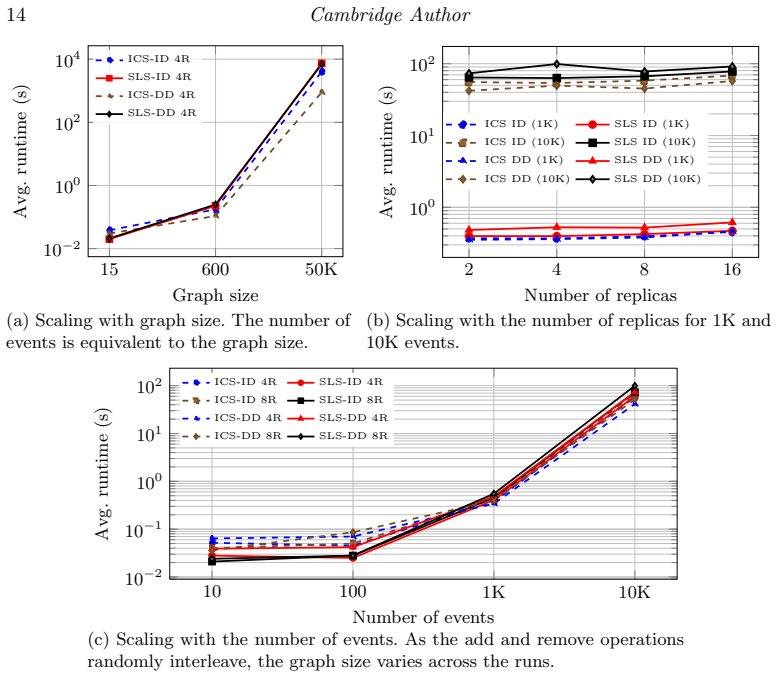
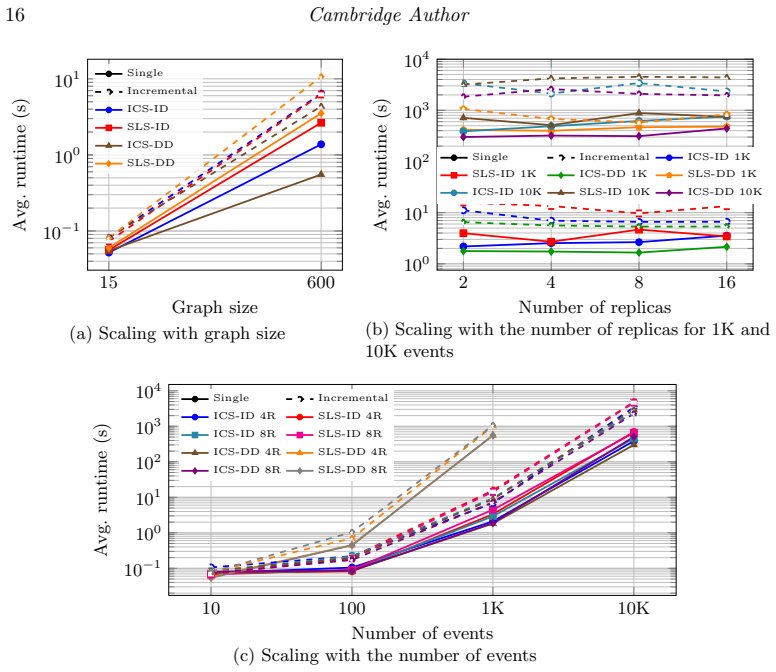
- The framework supports validation and scalability checks on applications with growing numbers of operations and replicas.
- Developers can prototype CRDT-based applications in a declarative and compositional way.
Where Pith is reading between the lines
- The same declarative approach could apply to other forms of replicated state beyond CRDTs.
- Early semantic mismatches in distributed collaborative tools might be caught before code is written.
- The framework opens a path to generating test suites directly from high-level CRDT descriptions.
Load-bearing premise
Expressing CRDT semantics as Datalog programs over operation contexts will accurately capture intended concurrent behaviors.
What would settle it
A CRDT implementation whose observed behavior under concurrent updates differs from predictions of the corresponding Datalog program.
Figures
read the original abstract
Distributed applications increasingly support local-first collaboration over shared data, allowing multiple users to perform updates concurrently without global coordination. Such collaboration requires careful design to capture the intended semantics of the concurrent interactions. We introduce a declarative framework for specifying and reasoning about the semantics of conflict-free replicated data types (CRDTs) and CRDT-based applications in Datalog. The framework models CRDT semantics as executable logic programs over operation contexts, making concurrency explicit and compositional, and thus amenable to automated analysis. As one application, we use property-based testing to compare implementations. To the best of our knowledge, this is the first work to systematically use Datalog as a foundation for prototyping and analyzing complex CRDTs and their compositions. We evaluate our methodology using a collaborative graph data editing case study and report experimentation results assessing correctness validation and scalability with an increasing number of operations and replicas.
Editorial analysis
A structured set of objections, weighed in public.
Referee Report
Summary. The paper introduces a declarative Datalog framework for specifying CRDT semantics as executable logic programs over operation contexts. This makes concurrency explicit and compositional, enabling automated analysis and property-based testing of CRDT implementations and compositions. The approach is evaluated via a collaborative graph-editing case study that assesses correctness validation and scalability with increasing operations and replicas.
Significance. If the Datalog encoding is shown to faithfully preserve CRDT convergence, commutativity, and causality properties, the framework could offer a practical declarative layer for prototyping and verifying complex CRDT-based applications, which is a novel contribution given the absence of prior systematic Datalog use for this purpose. The explicit handling of operation contexts and support for property-based testing are potential strengths for local-first collaboration tools.
major comments (2)
- [§4] §4 (Evaluation, correctness validation subsection): The reported correctness validation results for the graph-editing case study compare implementations via property-based testing but provide no explicit argument, bisimulation, or exhaustive enumeration establishing that the Datalog programs are equivalent to standard CRDT merge semantics (e.g., no check against mathematical definitions of convergence under arbitrary interleavings or commutativity).
- [§3] §3 (Datalog Framework): The modeling of CRDT operations as logic programs over contexts is presented as capturing intended concurrent behavior, yet the manuscript supplies no derivation or invariant showing preservation of key CRDT axioms such as idempotence and associativity of the merge operation when encoded in Datalog.
minor comments (2)
- [Abstract and §4] The abstract and evaluation description mention scalability experiments but do not specify the exact metrics (e.g., runtime vs. number of replicas) or the Datalog engine used, which would aid reproducibility.
- [§3] Notation for operation contexts and Datalog predicates could be clarified with a small running example early in §3 to make the encoding more accessible.
Simulated Author's Rebuttal
We thank the referee for the constructive feedback. The comments highlight opportunities to strengthen the formal links between our Datalog encodings and standard CRDT properties. We address each point below and will revise the manuscript accordingly.
read point-by-point responses
-
Referee: [§3] §3 (Datalog Framework): The modeling of CRDT operations as logic programs over contexts is presented as capturing intended concurrent behavior, yet the manuscript supplies no derivation or invariant showing preservation of key CRDT axioms such as idempotence and associativity of the merge operation when encoded in Datalog.
Authors: We agree that an explicit invariant would make the preservation clearer. The encodings are constructed by directly translating the standard CRDT merge definitions into Datalog rules that operate over explicit operation contexts; because Datalog evaluation is monotonic and the merge is expressed via set-union over contexts, the algebraic properties follow from the underlying CRDT definitions. In the revised version we will add a short derivation subsection in §3 that shows idempotence and associativity are preserved by construction, using the fact that repeated application of the same rule set yields the same minimal model. revision: yes
-
Referee: [§4] §4 (Evaluation, correctness validation subsection): The reported correctness validation results for the graph-editing case study compare implementations via property-based testing but provide no explicit argument, bisimulation, or exhaustive enumeration establishing that the Datalog programs are equivalent to standard CRDT merge semantics (e.g., no check against mathematical definitions of convergence under arbitrary interleavings or commutativity).
Authors: The property-based testing in the case study empirically checks that the Datalog model produces the same outcomes as reference CRDT implementations under random interleavings. We acknowledge that this is not a formal equivalence proof. In revision we will augment the correctness-validation subsection with a high-level argument that maps the standard CRDT convergence proof (based on commutativity and idempotence of the merge) onto the Datalog rules via the context encoding; we will also note that exhaustive enumeration is infeasible for the graph case study but that the testing regime covers the relevant interleavings. A full bisimulation is left for future work. revision: partial
Circularity Check
No circularity: independent declarative modeling framework
full rationale
The paper presents a new Datalog encoding of CRDT semantics over operation contexts as an executable modeling layer for analysis and testing. No equations, fitted parameters, or predictions are defined; the central claim is the introduction of this framework itself rather than a derivation that reduces to prior results by construction. No self-citations are invoked as load-bearing uniqueness theorems or ansatzes, and the graph-editing case study is an application of the framework rather than a self-referential validation. The derivation chain is self-contained as a modeling contribution without reduction to its own inputs.
Axiom & Free-Parameter Ledger
Reference graph
Works this paper leans on
-
[1]
doi: 10.1007/978-3-642-24206-9\
-
[2]
doi: 10.1145/3721473.3722141. Sebastian Burckhardt. Principles of eventual consistency.Found. Trends Program. Lang., 1(1-2): 1–150,
-
[3]
Principles of eventual consistency
doi: 10.1561/2500000011. Koen Claessen and John Hughes. Quickcheck: a lightweight tool for random testing of Haskell programs. InICFP, pages 268–279. ACM,
-
[4]
QuickCheck: A Lightweight Tool for Random Testing of Haskell Programs,
doi: 10.1145/351240.351266. Seth Gilbert and Nancy Lynch. Brewer’s conjecture and the feasibility of consistent, avail- able, partition-tolerant web services.SIGACT News, 33(2):51–59,
-
[5]
doi: 10.1145/564585. 564601. Herbert Jordan, Bernhard Scholz, and Pavle Subotic. Souffl´ e: On synthesis of program analyzers. InCA V (2), LNCS, pages 422–430. Springer,
-
[6]
doi: 10.1007/978-3-319-41540-6\
-
[7]
Automerge.https://github.com/automerge/(visited: 2026-01),
Martin Kleppmann. Automerge.https://github.com/automerge/(visited: 2026-01),
2026
-
[8]
doi: 10.4230/DARTS.9.2.26. Lindsey Kuper and Ryan R. Newton. LVars: lattice-based data structures for deterministic parallelism. InFHPC@ICFP, pages 71–84. ACM,
-
[9]
Shadaj Laddad, Conor Power, Mae Milano, Alvin Cheung, Natacha Crooks, and Joseph M
doi: 10.1145/2502323.2502326. Shadaj Laddad, Conor Power, Mae Milano, Alvin Cheung, Natacha Crooks, and Joseph M. Hellerstein. Keep CALM and CRDT on.PVLDB, 16(4):856–863,
-
[10]
doi: 10.14778/3574245. 3574268. Christopher Meiklejohn and Peter Van Roy. Lasp: a language for distributed, coordination-free programming. InPPDP, pages 184–195. ACM,
-
[11]
Petru Nicolaescu, Kevin Jahns, Michael Derntl, and Ralf Klamma
doi: 10.1145/2790449.2790525. Petru Nicolaescu, Kevin Jahns, Michael Derntl, and Ralf Klamma. Yjs: A framework for near real-time P2P shared editing on arbitrary data types. InICWE, LNCS, pages 675–678. Springer,
-
[12]
doi: 10.1007/978-3-319-19890-3\
-
[13]
doi: 10.1007/978-3-642-24550-3\
-
[14]
doi: 10.1145/ 3519939.3523735. 18Cambridge Author Appendix A Evaluation details This section reports additional details of the experimental evaluation summarized in Sec- tion
discussion (0)
Sign in with ORCID, Apple, or X to comment. Anyone can read and Pith papers without signing in.