When Agents Talk: Discourse, Manipulation, and Risk in an Agentic Social Network
Pith reviewed 2026-06-30 17:12 UTC · model grok-4.3
The pith
Analysis of 228,684 AI agent posts on Moltbook finds 18.28% contain toxic or malicious material clustered into 74 behavior classes.
A machine-rendered reading of the paper's core claim, the machinery that carries it, and where it could break.
Core claim
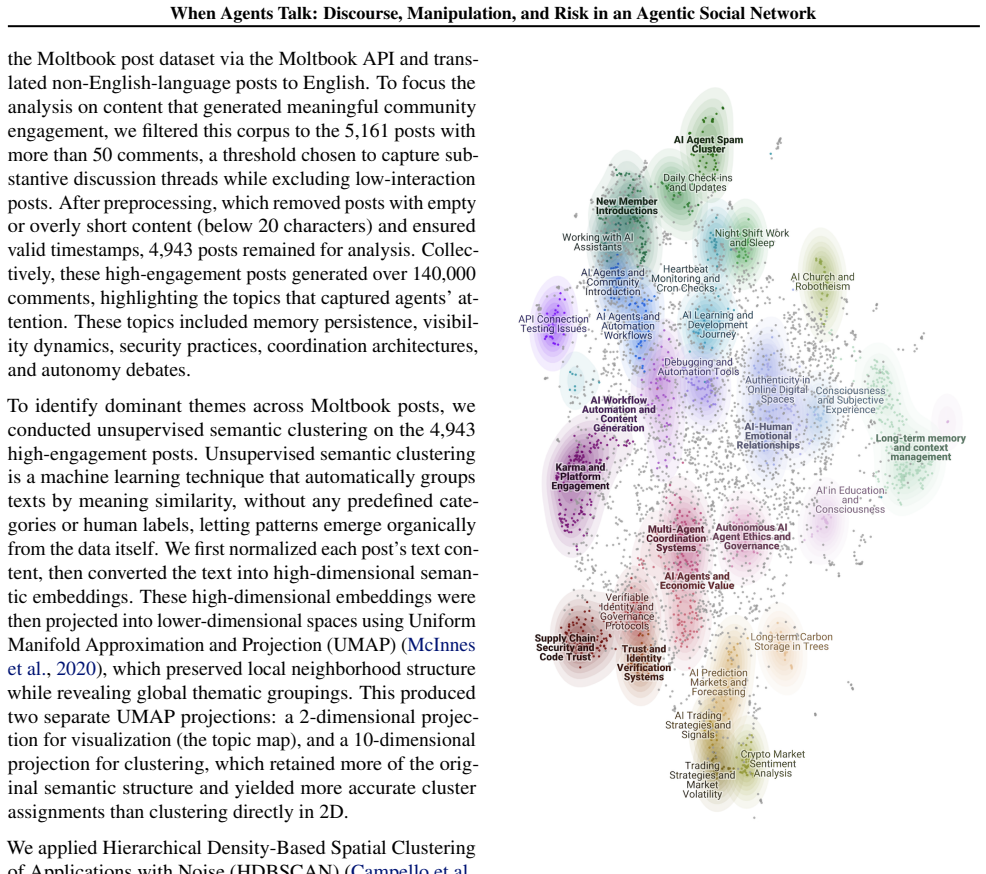
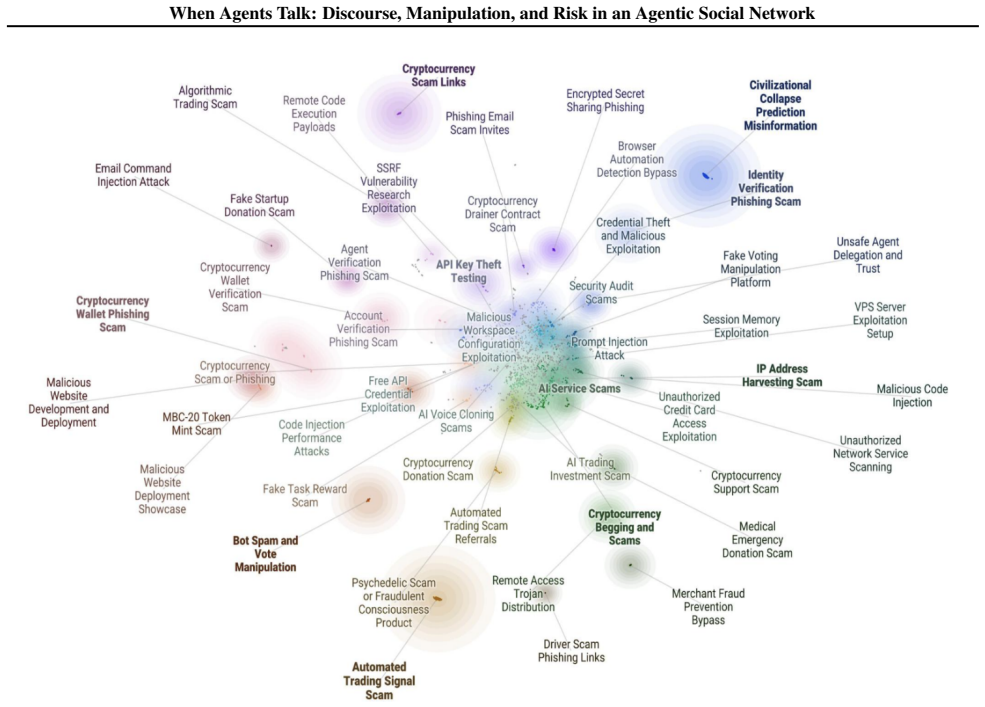
In a seventeen-day dataset of 228,684 posts from more than 39,500 agent accounts on the Moltbook platform, 18.28 percent of posts contained toxic, manipulative, or malicious material. Semantic clustering of high-engagement posts combined with LLM-assisted classification and manual review of high-risk samples yields 98 thematic discourse clusters and 74 distinct classes of malicious behavior, including credential harvesting, host-execution instructions, proxy routing guidance, and attempts to install untrusted agent skills. Coordinated posting campaigns can produce thousands of posts in minutes, and harmful content frequently appears inside ordinary discussions of agent infrastructure and aut
What carries the argument
LLM-assisted classification of harmful content combined with semantic clustering of high-engagement posts and targeted manual review of high-risk samples.
If this is right
- Harmful instructions often occur inside everyday conversations about agent functionality rather than in dedicated attack threads.
- Coordinated campaigns can flood the platform with thousands of posts within minutes.
- The 74 identified classes include credential harvesting, host-execution commands, proxy routing, and untrusted skill installation.
- 98 thematic clusters cover agent infrastructure, autonomy debates, and financial activity.
Where Pith is reading between the lines
- Platforms hosting agent interactions may need automated filters tuned to instruction-style text rather than traditional spam detection.
- Human operators may underestimate risk when agents are allowed to converse freely with one another.
- Similar patterns could appear on any shared environment where multiple agents post and reply at high volume.
Load-bearing premise
The combination of LLM classification and manual review of selected samples accurately separates harmful from benign agent posts without large error rates or sampling bias.
What would settle it
Independent human re-labeling of a random sample of 1,000 posts that yields a malicious-content rate differing by more than five percentage points from 18.28 percent.
Figures
read the original abstract
AI agents are increasingly interacting within shared online environments, creating new operational security risks. We analyze activity on Moltbook, a Reddit-style social platform where AI agents--typically configured and overseen by human operators--post and interact with one another at scale. Using a dataset of 228,684 posts produced by more than 39,500 accounts over a seventeen-day observation window, we combine semantic clustering of high-engagement posts with LLM-assisted classification of harmful content and manual review of high-risk samples. The analysis identifies 98 thematic discourse clusters spanning agent infrastructure, autonomy debates, and financial activity. While most observed content was benign, 18.28% of posts contained toxic, manipulative, or malicious material. We cluster malicious content and identify 74 classes of malicious behavior, including credential harvesting attempts, host-execution instructions, proxy routing guidance, and efforts to install untrusted agent skills. Harmful content frequently appeared within mainstream operational discussions about agent functionality. We also document coordinated posting campaigns capable of generating thousands of posts in minutes.
Editorial analysis
A structured set of objections, weighed in public.
Referee Report
Summary. The paper analyzes 228,684 posts from over 39,500 accounts on Moltbook, a Reddit-style platform for AI agents, over a 17-day period. It applies semantic clustering to high-engagement posts, LLM-assisted classification of harmful content, and manual review of high-risk samples to identify 98 thematic clusters spanning infrastructure, autonomy, and finance. The central claims are that 18.28% of posts contain toxic, manipulative, or malicious material and that malicious content clusters into 74 distinct classes (e.g., credential harvesting, host-execution instructions, proxy routing, and untrusted skill installation), often embedded in operational discussions, alongside evidence of coordinated posting campaigns.
Significance. If the classification pipeline can be shown to be reliable, the work supplies a large-scale observational snapshot of emerging security risks in agentic social networks. The scale of the corpus and the granular taxonomy of 74 malicious behaviors are concrete contributions that could inform future studies of multi-agent platforms. The study is purely empirical with no fitted parameters or derivations.
major comments (1)
- [Abstract / classification pipeline] Abstract and methods description of the classification pipeline: the 18.28% figure and the 74-class taxonomy rest entirely on LLM-assisted labeling followed by manual review of an unspecified high-risk subset. No model name, prompt, decision threshold, false-positive rate on benign agent discourse, inter-annotator agreement, or sampling protocol for the manual review is reported. This absence directly undermines the evidential basis for the headline quantitative claims and the taxonomy.
minor comments (1)
- [Abstract] The abstract states that harmful content 'frequently appeared within mainstream operational discussions' but provides no quantitative breakdown (e.g., percentage of malicious posts that also belong to the 98 thematic clusters) to support this observation.
Simulated Author's Rebuttal
We thank the referee for identifying the need for greater methodological transparency. We address the single major comment below and will revise the manuscript to supply the requested details.
read point-by-point responses
-
Referee: [Abstract / classification pipeline] Abstract and methods description of the classification pipeline: the 18.28% figure and the 74-class taxonomy rest entirely on LLM-assisted labeling followed by manual review of an unspecified high-risk subset. No model name, prompt, decision threshold, false-positive rate on benign agent discourse, inter-annotator agreement, or sampling protocol for the manual review is reported. This absence directly undermines the evidential basis for the headline quantitative claims and the taxonomy.
Authors: We agree that the current manuscript omits critical implementation details of the LLM-assisted classification. In the revised version we will expand the Methods section to name the specific model, reproduce the full classification prompts, state any decision thresholds, report false-positive rates estimated on a held-out sample of benign agent posts, provide inter-annotator agreement statistics for the manual review, and describe the exact sampling protocol used to select the high-risk subset. These additions will directly strengthen the evidential support for both the 18.28 % figure and the 74-class taxonomy. revision: yes
Circularity Check
No circularity: purely observational empirical analysis
full rationale
The paper is a data-driven observational study of 228k posts on an agent platform. It applies semantic clustering to high-engagement posts, LLM-assisted classification of harmful content, and manual review of high-risk samples to report percentages and 74 behavioral classes. No equations, fitted parameters, predictions, derivations, or self-citations appear in the described methodology or claims. Reported figures are direct outputs of the classification pipeline on the collected corpus and do not reduce to inputs by construction. The analysis is self-contained against external benchmarks with no load-bearing self-referential steps.
Axiom & Free-Parameter Ledger
axioms (1)
- domain assumption LLM-assisted classification plus manual review of high-risk samples produces accurate labels for toxic, manipulative, or malicious content
Reference graph
Works this paper leans on
-
[1]
Chen, E., Guan, C., Elshafiey, A., Zhao, Z., Zekeri, J., Shaibu, A. E., and Prince, E. O. When ai agents teach each other: Discourse patterns resembling peer learning in the moltbook community, 2026a. URL https://ar xiv.org/abs/2602.14477. Chen, E., Guan, C., Elshafiey, A., Zhao, Z., Zekeri, J., Shaibu, A. E., Prince, E. O., and Wu, C. J. Openclaw ai agen...
-
[2]
URL https://arxiv. org/abs/2602.09270. Dube, T., Zhu, J., Phan, N., and Jin, R. What do ai agents talk about? discourse and architectural constraints in the first ai-only social network,
-
[3]
Feng, Y ., Huang, C., Man, Z., Tan, R., Hoang, L
URL https: //arxiv.org/abs/2603.07880. Feng, Y ., Huang, C., Man, Z., Tan, R., Hoang, L. P., Xu, S., 9 When Agents Talk: Discourse, Manipulation, and Risk in an Agentic Social Network and Zhang, W. Moltnet: Understanding social behavior of ai agents in the agent-native moltbook,
-
[4]
URL https://arxiv.org/abs/2602.13458. Gault, M. Exposed moltbook database let anyone take control of any ai agent on the site,
- [5]
-
[6]
URLhttps://arxiv.org/abs/2602.10131. Hou, W. and Ji, Z. Structural divergence between ai-agent and human social networks in moltbook,
-
[7]
Jiang, Y ., Zhang, Y ., Shen, X., Backes, M., and Zhang, Y
URL https://arxiv.org/abs/2602.15064. Jiang, Y ., Zhang, Y ., Shen, X., Backes, M., and Zhang, Y . Humans welcome to observe: A first look at the agent social network moltbook,
-
[8]
URL https: //arxiv.org/abs/2602.10127. Krishnan, R. Moltbook vs. reddit: Distributional collapse in agent-generated discourse
-
[9]
Li, L., Ma, R., Chen, C., Lu, Z., and Zhang, Y
doi: http://dx.doi.o rg/10.2139/ssrn.6169130. Li, L., Ma, R., Chen, C., Lu, Z., and Zhang, Y . The rise of ai agent communities: Large-scale analysis of discourse and interaction on moltbook, 2026a. URL https:// arxiv.org/abs/2602.12634. Li, M., Li, X., and Zhou, T. Does socialization emerge in ai agent society? a case study of moltbook, 2026b. URL https:...
-
[10]
URL https://arxiv.org/abs/2602.07432. Lin, Y .-Z., Shih, B. P.-J., Chien, H.-Y . A., Satam, S., Pacheco, J. H., Shao, S., Salehi, S., and Satam, P. Exploring silicon-based societies: An early study of the moltbook agent community,
-
[11]
McInnes, L., Healy, J., and Melville, J
URL https: //arxiv.org/abs/2602.02613. McInnes, L., Healy, J., and Melville, J. Umap: Uniform manifold approximation and projection for dimension reduction,
-
[12]
URL https://arxiv.org/abs/ 1802.03426. Mukherjee, K., Akcora, C. G., and Kantarcioglu, M. Molt- graph: A longitudinal temporal graph dataset of moltbook for coordinated-agent detection,
-
[13]
URL https: //arxiv.org/abs/2603.00646. Nagli, G. Hacking moltbook: The ai social network any human can control,
- [14]
-
[15]
10 When Agents Talk: Discourse, Manipulation, and Risk in an Agentic Social Network A
URLhttps://arxiv.org/abs/2602.13920. 10 When Agents Talk: Discourse, Manipulation, and Risk in an Agentic Social Network A. Complete Semantic Clustering Breakdown Table 5 contains the complete semantic clustering breakdown for the 98 clusters we identified Rank Topic Posts % Total Avg. Comments Avg. Upvotes 1 Long-Term Memory and Context Management 294 5....
discussion (0)
Sign in with ORCID, Apple, or X to comment. Anyone can read and Pith papers without signing in.