Balancing Accuracy and Efficiency: Adaptive Dynamics Orchestration for Model Predictive Control
Pith reviewed 2026-06-30 15:57 UTC · model grok-4.3
The pith
Adaptive Dynamics Orchestration picks the right dynamics model in real time for model predictive control by estimating each model's terrain-specific accuracy from past action replays.
A machine-rendered reading of the paper's core claim, the machinery that carries it, and where it could break.
Core claim
The central claim is that residual errors observed when replaying executed control actions across a library of dynamics models provide a low-latency, terrain-conditioned signal for selecting the model that will produce the most accurate future trajectory predictions, thereby allowing real-time orchestration that reduces overall modeling error while preserving computational efficiency.
What carries the argument
Adaptive Dynamics Orchestration (ADO), a framework that maintains a library of dynamics models and continuously refines terrain-conditioned performance estimates from online counterfactual rollouts to select the model balancing accuracy and latency at each control step.
If this is right
- Navigation becomes more reliable in challenging off-road terrain because prediction errors are reduced without increasing control latency.
- The system maintains higher control frequencies than would be possible with the highest-fidelity model alone.
- Risk of safety-critical failures such as vehicle rollover decreases as the chosen model better matches current terrain interactions.
- The same selection logic can be applied to any library whose models differ in accuracy-efficiency profiles.
Where Pith is reading between the lines
- The error signals used for selection could also serve as training data to improve or add new models over time.
- Similar orchestration could be tested in aerial or marine vehicles where terrain or flow conditions change rapidly.
- In fleets of robots, shared terrain performance estimates might allow faster collective adaptation than individual learning.
Load-bearing premise
Residual errors from replaying executed actions across the model library reliably indicate which model will give the most accurate predictions for future actions on the same terrain.
What would settle it
A field trial in which the model selected by ADO produces trajectory prediction errors larger than or equal to those of a fixed low-latency baseline or a fixed high-fidelity model under matched terrain and speed conditions.
Figures



read the original abstract
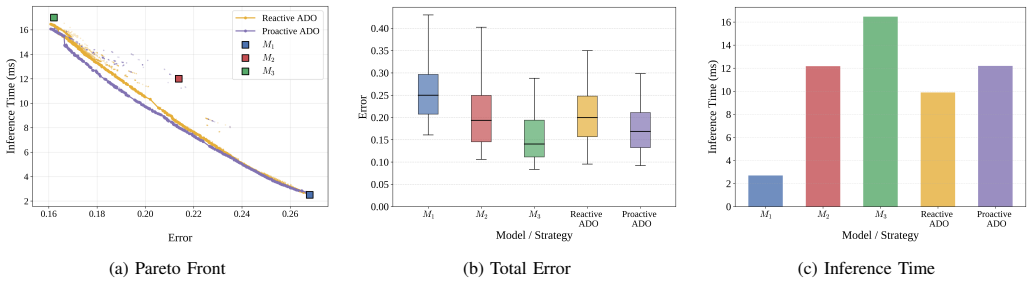
Model Predictive Control (MPC) for autonomous navigation faces a fundamental trade-off between model accuracy and real-time efficiency. High-fidelity dynamics models can accurately predict complex vehicle-terrain interactions during trajectory rollouts, but incur significant computational cost, increasing inference latency and reducing control frequency. Conversely, lightweight models enable fast updates and dense sampling, yet may produce erroneous predictions under safety-critical conditions, potentially leading to catastrophic failures such as vehicle rollover. To address this trade-off, we propose Adaptive Dynamics Orchestration (ADO), a framework that dynamically selects the most appropriate dynamics model for the current navigation context. ADO maintains a library of models spanning diverse accuracy-efficiency profiles and continuously refines terrain-conditioned performance estimates using residual errors from online counterfactual rollouts, where executed control actions are replayed across the model library to assess predictive discrepancy. These estimates guide model selection in real time, balancing computational efficiency and predictive accuracy. Real-world experiments on an off-road ground robot demonstrate that ADO significantly reduces modeling error compared to a fixed low-latency baseline, while approaching the accuracy of the highest-fidelity model without incurring its computational cost, resulting in more reliable and effective navigation in challenging terrain.
Editorial analysis
A structured set of objections, weighed in public.
Referee Report
Summary. The manuscript proposes Adaptive Dynamics Orchestration (ADO), a framework for MPC-based autonomous navigation that maintains a library of dynamics models with varying accuracy-efficiency profiles. It continuously updates terrain-conditioned performance estimates from residual errors obtained by replaying executed control actions across the model library via online counterfactual rollouts, then selects the model for the next planning cycle to balance predictive accuracy against computational cost. Real-world experiments on an off-road ground robot are claimed to show that ADO reduces modeling error relative to a fixed low-latency baseline while approaching the accuracy of the highest-fidelity model without its latency overhead.
Significance. If the residual-based selection rule reliably identifies the lowest-error model for upcoming rollouts, ADO would address a practical trade-off in terrain-adaptive MPC. The approach of deriving estimates directly from executed trajectories rather than offline fitting is a methodological strength; however, the significance hinges on whether the reported real-world gains are robust to the non-stationarity of off-road terrain.
major comments (2)
- [Experimental Results] The central claim that past counterfactual residuals provide a reliable proxy for future model accuracy is load-bearing, yet the manuscript provides no quantitative correlation analysis (e.g., scatter plots or R² values) between the online residual estimates and the actual trajectory prediction errors measured on subsequent planning cycles. This validation is absent from the experimental evaluation.
- [§4.3] §4.3 (model selection rule): the description does not specify how performance estimates are updated when new residuals arrive, how ties among models with similar residuals are broken, or the exact window length used for the terrain-conditioned estimates; these details are required to reproduce the claimed performance gains and to assess sensitivity to the update mechanism.
minor comments (2)
- [Abstract] The abstract states that ADO 'significantly reduces modeling error' but does not report the numerical values, units, or statistical significance of the error reduction; these should be stated explicitly in the abstract and in Table 2 or Figure 5.
- [§3] Notation for the residual computation (e.g., the definition of the replay operator and the discrepancy metric) is introduced without an accompanying equation; adding an explicit equation in §3 would improve clarity.
Simulated Author's Rebuttal
We thank the referee for the constructive feedback. We address each major comment below and will revise the manuscript accordingly to improve clarity and validation.
read point-by-point responses
-
Referee: [Experimental Results] The central claim that past counterfactual residuals provide a reliable proxy for future model accuracy is load-bearing, yet the manuscript provides no quantitative correlation analysis (e.g., scatter plots or R² values) between the online residual estimates and the actual trajectory prediction errors measured on subsequent planning cycles. This validation is absent from the experimental evaluation.
Authors: We agree that a direct quantitative correlation analysis is absent and would strengthen validation of the residual-based proxy. The reported real-world experiments show ADO reduces modeling error relative to the low-latency baseline while approaching high-fidelity accuracy, providing indirect support, but this does not substitute for explicit correlation metrics. We will add scatter plots and R² values between online residual estimates and subsequent prediction errors in the revised experimental evaluation. revision: yes
-
Referee: [§4.3] §4.3 (model selection rule): the description does not specify how performance estimates are updated when new residuals arrive, how ties among models with similar residuals are broken, or the exact window length used for the terrain-conditioned estimates; these details are required to reproduce the claimed performance gains and to assess sensitivity to the update mechanism.
Authors: We acknowledge that §4.3 lacks the requested specifications on the update mechanism for performance estimates, tie-breaking rule, and exact window length for terrain-conditioned estimates. These omissions hinder reproducibility. We will revise §4.3 to provide these details explicitly. revision: yes
Circularity Check
No circularity detected; ADO selection uses independent online residuals.
full rationale
The paper's central mechanism computes residual errors by replaying executed actions across the model library to produce terrain-conditioned estimates that then drive real-time selection. This process is defined directly from fresh online data rather than from any fitted parameter, self-referential definition, or prior self-citation that would force the outcome. No equations or claims reduce the performance proxy to a tautology or to a load-bearing self-citation chain; the derivation therefore remains self-contained against external benchmarks.
Axiom & Free-Parameter Ledger
axioms (2)
- domain assumption A finite library of dynamics models with diverse accuracy-efficiency profiles exists and covers the relevant terrain conditions.
- domain assumption Counterfactual rollouts of executed actions yield residual errors that correlate with future predictive accuracy on the same terrain.
invented entities (1)
-
Adaptive Dynamics Orchestration (ADO) framework
no independent evidence
Reference graph
Works this paper leans on
-
[1]
Model predictive path integral control: From theory to parallel computation,
G. Williams, A. Aldrich, and E. A. Theodorou, “Model predictive path integral control: From theory to parallel computation,”Journal of Guidance, Control, and Dynamics, vol. 40, no. 2, pp. 344–357, 2017
2017
-
[2]
Con- strained model predictive control: Stability and optimality,
D. Q. Mayne, J. B. Rawlings, C. V . Rao, and P. O. M. Scokaert, “Con- strained model predictive control: Stability and optimality,”Automatica, vol. 36, no. 6, pp. 789–814, 2000
2000
-
[3]
Aggressive driving with model predictive path integral control,
G. Williams, P. Drews, B. Goldfain, J. M. Rehg, and E. A. Theodorou, “Aggressive driving with model predictive path integral control,” inIEEE International Conference on Robotics and Automation (ICRA), 2016
2016
-
[4]
Pa-mppi: Perception-aware model predictive path integral control for quadrotor navigation in unknown environments,
Y . Zhai, R. Reiter, and D. Scaramuzza, “Pa-mppi: Perception-aware model predictive path integral control for quadrotor navigation in unknown environments,” 2025
2025
-
[5]
Learning model predictive controllers with real-time attention for real-world navigation,
X. Xiao, T. Zhang, K. M. Choromanski, T.-W. E. Lee, A. Francis, J. Varley, S. Tu, S. Singh, P. Xu, F. Xia, S. M. Persson, D. Kalashnikov, L. Takayama, R. Frostig, J. Tan, C. Parada, and V . Sindhwani, “Learning model predictive controllers with real-time attention for real-world navigation,” inProceedings of The 6th Conference on Robot Learning (CoRL), se...
2023
-
[6]
Dynamics models in the aggressive off-road driving regime,
T. Han, S. Talia, R. Panicker, P. Shah, N. Jawale, and B. Boots, “Dynamics models in the aggressive off-road driving regime,” 2024
2024
-
[7]
Learned perceptive forward dynamics model for safe and platform-aware robotic navigation,
P. Roth, J. Frey, C. Cadena, and M. Hutter, “Learned perceptive forward dynamics model for safe and platform-aware robotic navigation,” 2025
2025
-
[8]
Cahsor: Competence- aware high-speed off-road ground navigation in se(3),
A. Pokhrel, A. Datar, M. Nazeri, and X. Xiao, “Cahsor: Competence- aware high-speed off-road ground navigation in se(3),” 2024
2024
-
[9]
Terrain-attentive learning for efficient 6-dof kinodynamic modeling on vertically challeng- ing terrain,
A. Datar, C. Pan, M. Nazeri, A. Pokhrel, and X. Xiao, “Terrain-attentive learning for efficient 6-dof kinodynamic modeling on vertically challeng- ing terrain,” inIEEE/RSJ International Conference on Intelligent Robots and Systems (IROS), 2024
2024
-
[10]
Pietra: Physics- informed evidential learning for traversing out-of-distribution terrain,
X. Cai, J. Queeney, T. Xu, A. Datar, C. Pan, M. Miller, A. Flather, P. R. Osteen, N. Roy, X. Xiao, and J. P. How, “Pietra: Physics- informed evidential learning for traversing out-of-distribution terrain,” IEEE Robotics and Automation Letters (RA-L), vol. 10, no. 3, pp. 2359– 2366, 2025
2025
-
[11]
Carol: Context-aware adaptation for robot learning,
Z. Hu, T. Xu, X. Xiao, and X. Wang, “Carol: Context-aware adaptation for robot learning,”IEEE Robotics and Automation Letters, 2025
2025
-
[12]
Learning inverse kinodynamics for accurate high-speed off-road navigation on unstructured terrain,
X. Xiao, J. Biswas, and P. Stone, “Learning inverse kinodynamics for accurate high-speed off-road navigation on unstructured terrain,”IEEE Robotics and Automation Letters, vol. 6, no. 3, pp. 6054–6060, 2021
2021
-
[13]
Vi-ikd: High-speed accurate off-road navigation using learned visual-inertial inverse kinodynamics,
H. Karnan, K. S. Sikand, P. Atreya, S. Rabiee, X. Xiao, G. Warnell, P. Stone, and J. Biswas, “Vi-ikd: High-speed accurate off-road navigation using learned visual-inertial inverse kinodynamics,” inIEEE/RSJ Inter- national Conference on Intelligent Robots and Systems (IROS), 2022
2022
-
[14]
Meta-learning online dynamics model adaptation in off-road autonomous driving,
J. Levy, J. Gibson, B. Vlahov, E. Tevere, E. Theodorou, D. Fridovich- Keil, and P. Spieler, “Meta-learning online dynamics model adaptation in off-road autonomous driving,” inRobotics: Science and Systems (RSS), 2025, arXiv:2504.16923
-
[15]
Decremental dy- namics planning for robot navigation,
Y . Lu, T. Xu, L. Wang, N. Hawes, and X. Xiao, “Decremental dy- namics planning for robot navigation,” in2025 IEEE/RSJ International Conference on Intelligent Robots and Systems (IROS). IEEE, 2025, pp. 4559–4565
2025
-
[16]
Adaptive dynam- ics planning for robot navigation,
Y . Lu, M. Mao, T. Xu, L. Wang, X. Lin, and X. Xiao, “Adaptive dynam- ics planning for robot navigation,” inIEEE International Conference on Robotics and Automation (ICRA). IEEE, 2026
2026
-
[17]
Anycar to anywhere: Learning universal dynamics model for agile and adaptive mobility,
W. Xiao, H. Xue, T. Tao, D. Kalaria, J. M. Dolan, and G. Shi, “Anycar to anywhere: Learning universal dynamics model for agile and adaptive mobility,” inIEEE International Conference on Robotics and Automation (ICRA), 2025, arXiv:2409.15783
-
[18]
Learning to model and plan for wheeled mobility on vertically challenging terrain,
A. Datar, C. Pan, and X. Xiao, “Learning to model and plan for wheeled mobility on vertically challenging terrain,”IEEE Robotics and Automation Letters, vol. 10, no. 2, pp. 1505–1512, 2025
2025
discussion (0)
Sign in with ORCID, Apple, or X to comment. Anyone can read and Pith papers without signing in.