Experimental observation of strong field stabilization
Pith reviewed 2026-06-28 19:19 UTC · model grok-4.3
The pith
Trapped neutral atoms exhibit stabilization of a ground state against intense oscillating fields.
A machine-rendered reading of the paper's core claim, the machinery that carries it, and where it could break.
Core claim
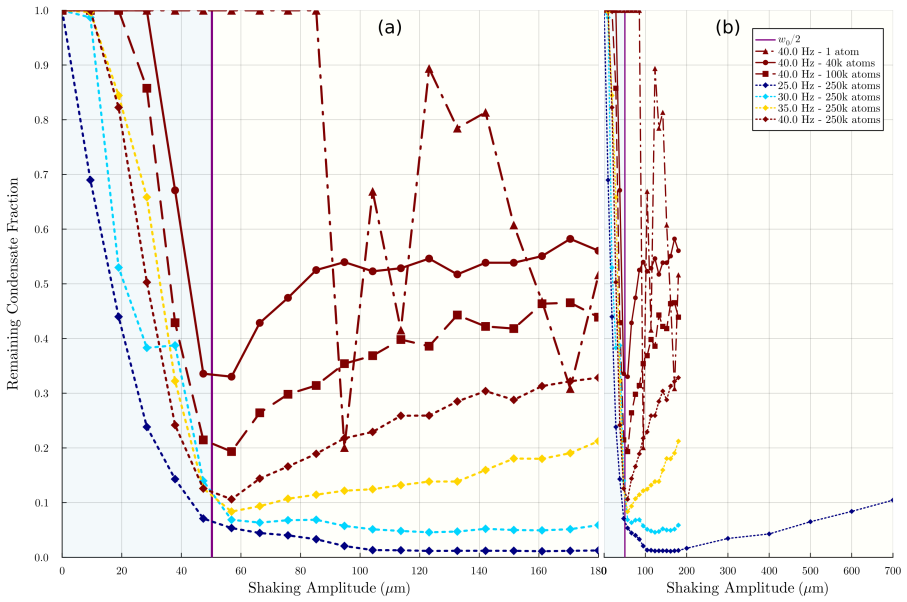
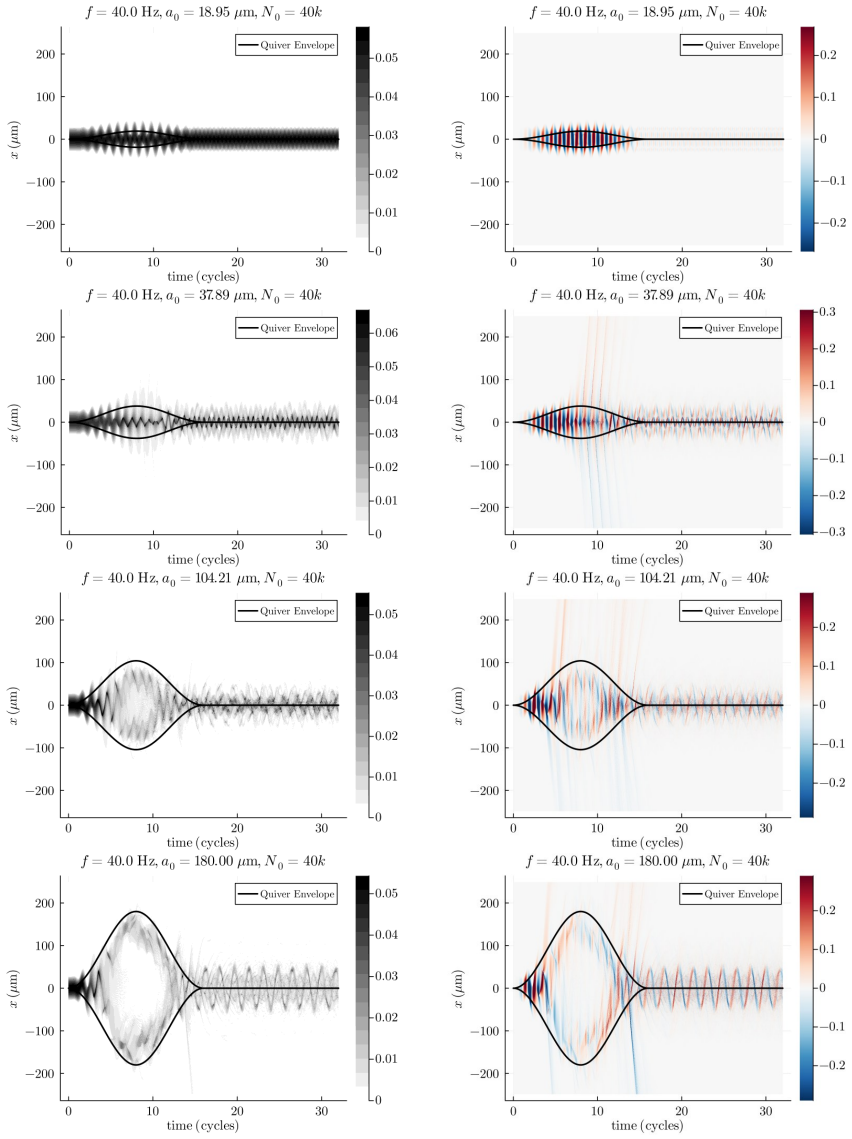
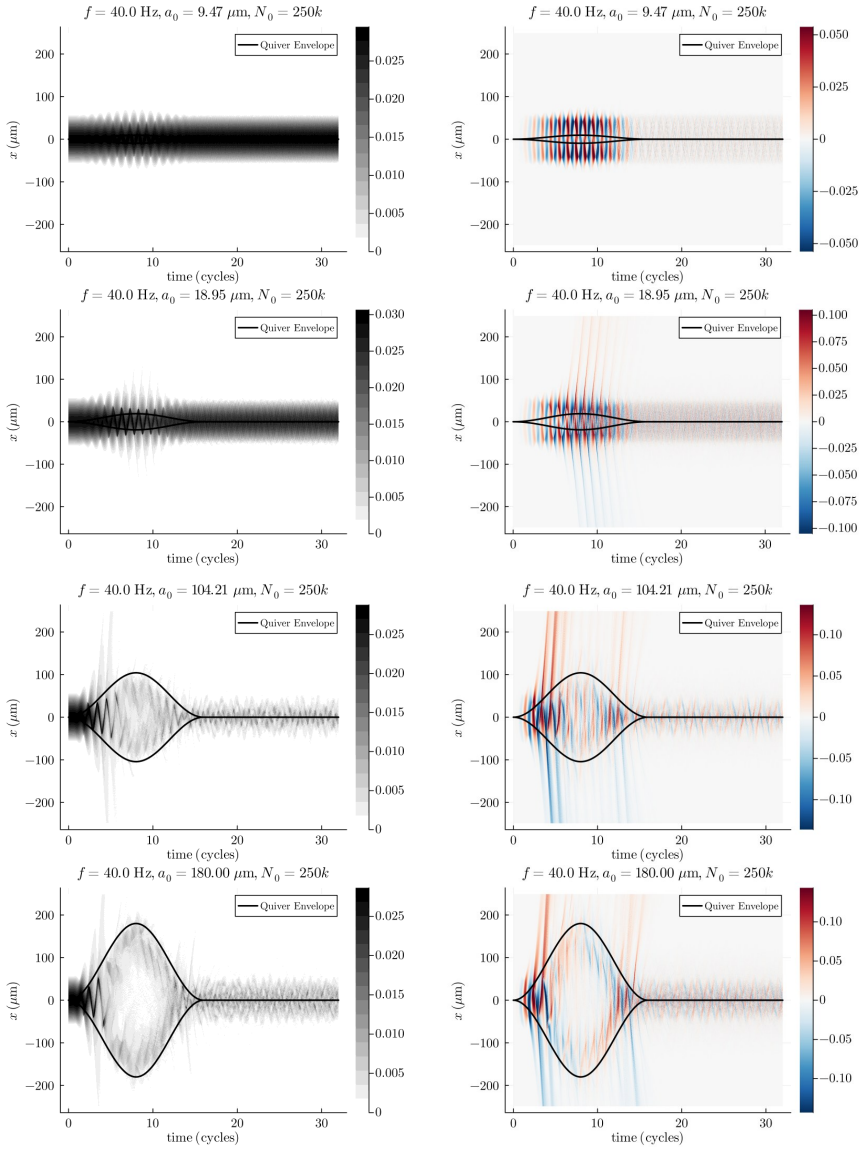
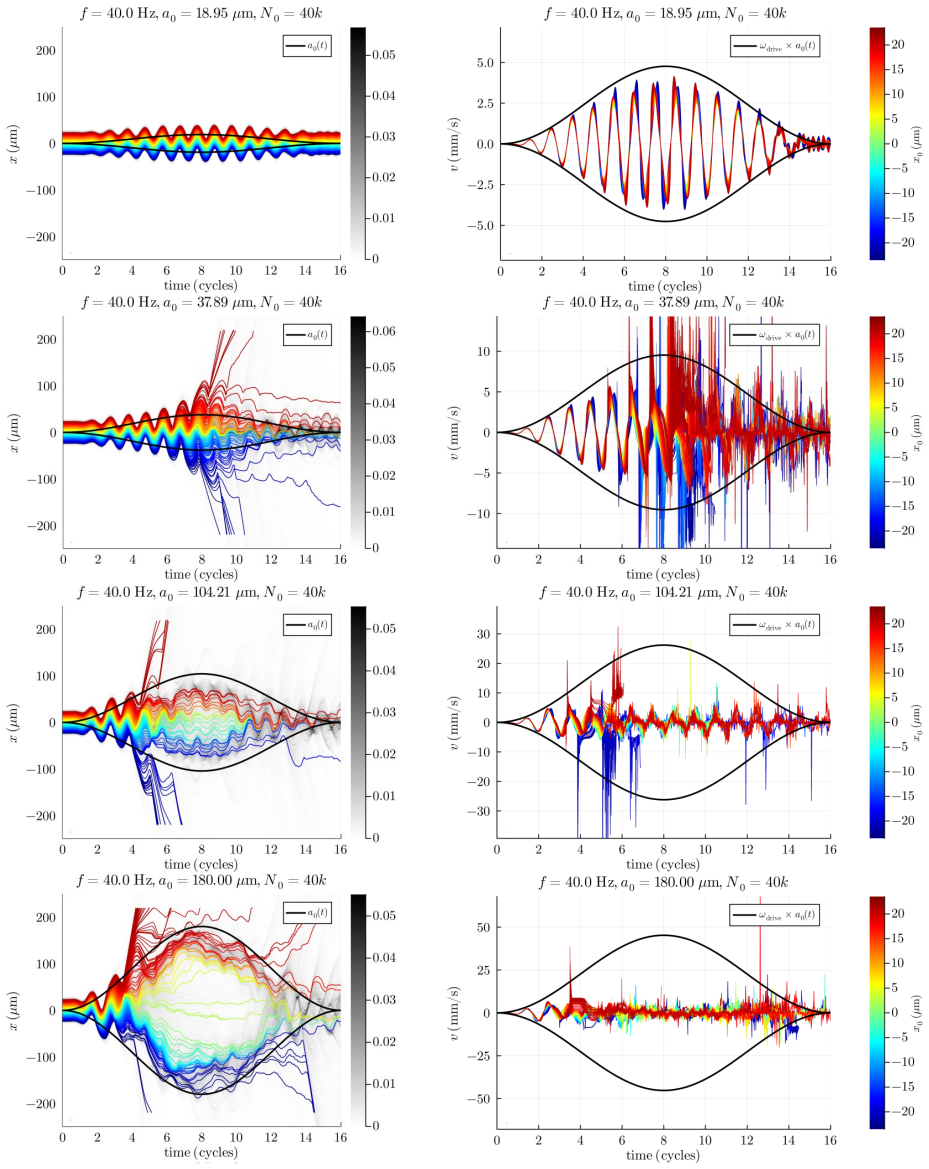
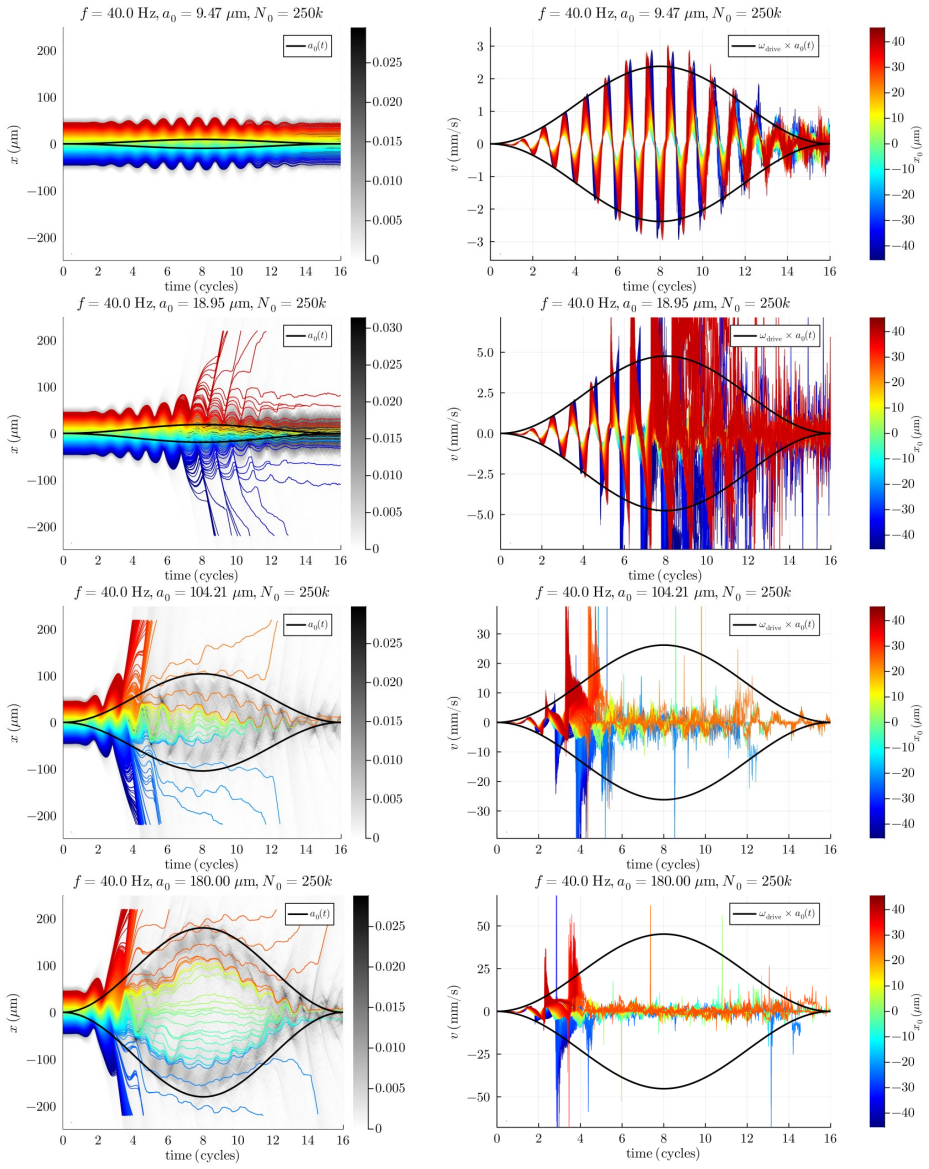
Using trapped neutral atoms to emulate the dynamics of bound electrons in an extremely strong laser field, the experiment observes strong-field stabilization of a ground state. This includes imaging the predicted spatial bifurcation of the bound state wavefunction, measuring an ionization rate that is non-monotonic in field amplitude, and mapping the regime where stabilization occurs. The effect persists down to drive frequencies on the order of the lowest-energy excitations.
What carries the argument
Trapped neutral atoms as stand-ins for bound electrons in strong oscillating fields, used to image wavepacket bifurcation and track non-monotonic ionization rates.
If this is right
- Stabilization persists at drive frequencies comparable to the lowest natural excitations of the system.
- The approach maps out the full regime of stabilization experimentally.
- It supplies a complementary laboratory tool for strong-field phenomena near or beyond the reach of current laser technology.
Where Pith is reading between the lines
- The emulation method could be adapted to test stabilization in other quantum systems where direct laser access is impractical.
- Non-monotonic ionization behavior may appear in natural high-intensity oscillating environments such as certain astrophysical plasmas.
- Control of the stabilization threshold via trap parameters might offer new routes to suppress unwanted ionization in atomic physics experiments.
Load-bearing premise
The trapped atoms reproduce the quantum dynamics of a bound electron in a real intense laser field without confounding effects from the trapping potential or atom-atom interactions.
What would settle it
If the measured ionization rate continues to rise monotonically with field amplitude instead of turning over, or if the imaged wavefunction shows no spatial bifurcation into separate components.
Figures
read the original abstract
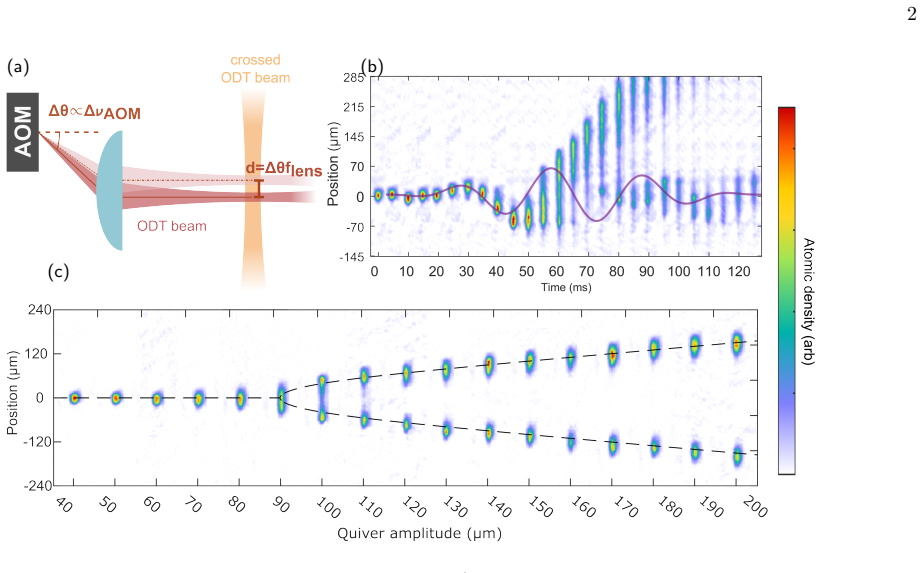
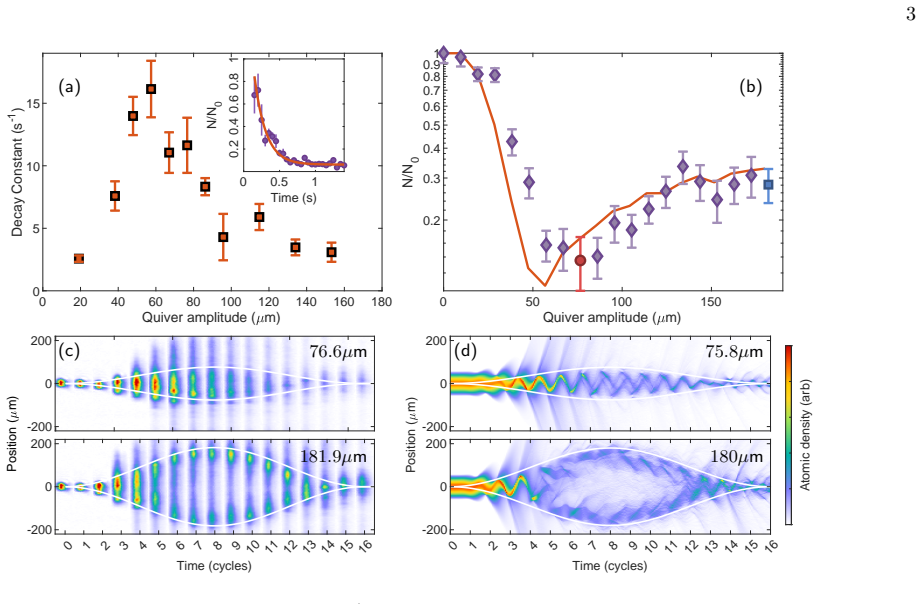
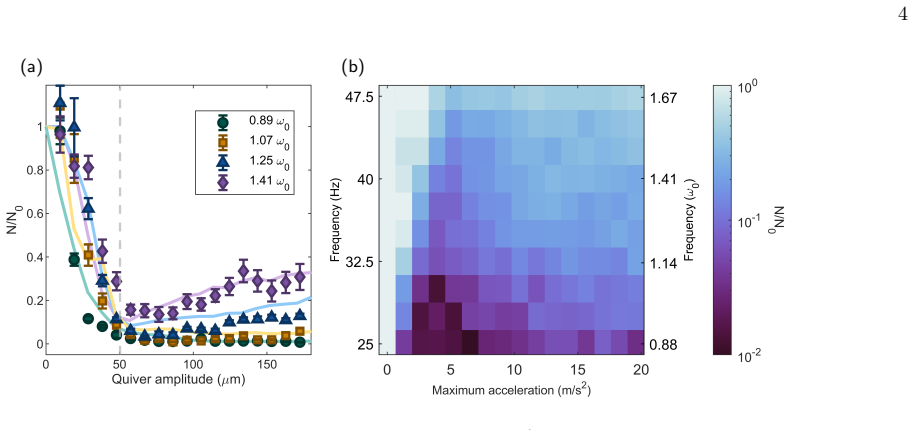
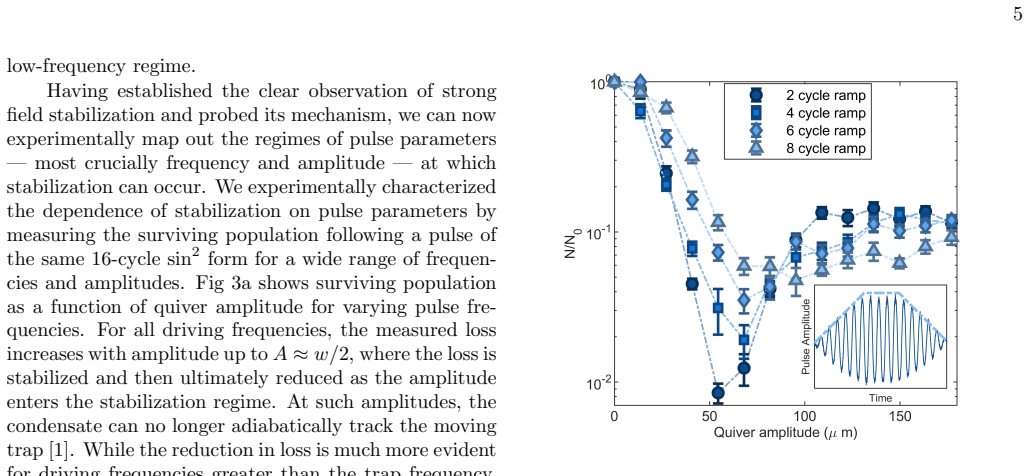
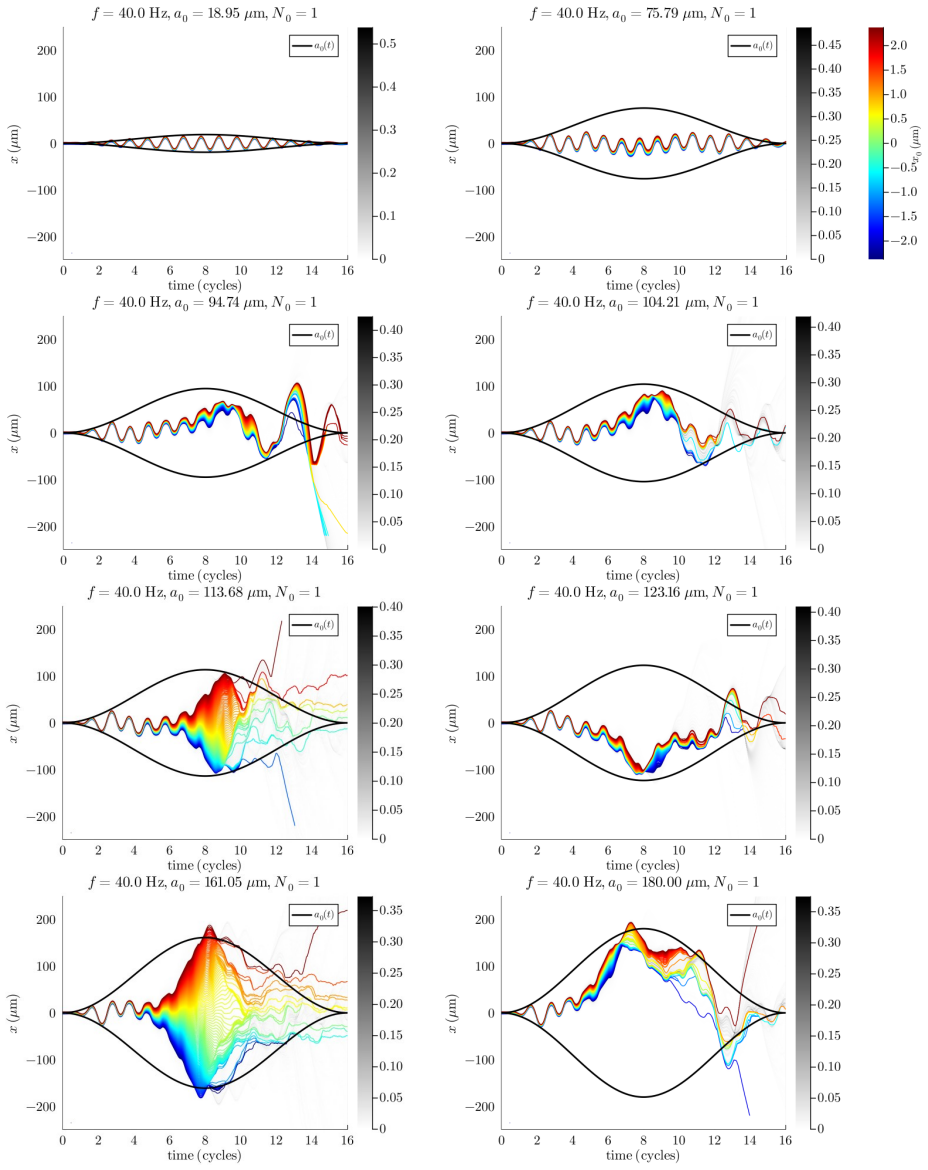
Strong oscillating fields are expected to tear apart bound quantum states. Theoretical studies predict a striking reversal: that as the field intensity is raised above some threshold, bound states like atoms can become increasingly stable, accompanied by a spatial bifurcation of the bound state wavefunction. This strong field stabilization was predicted decades ago in the context of atoms in pulsed laser fields, but has resisted experimental observation due to extreme intensity requirements and theoretical controversy. Here we report the experimental observation of strong-field stabilization of a ground state, using trapped neutral atoms to emulate the dynamics of bound electrons in an extremely strong laser field. We image the predicted wavepacket bifurcation, measure an ionization rate non-monotonic in field amplitude, and map out the regime of stabilization. Stabilization persists down to surprisingly low drive frequencies, on the order of the lowest-energy excitations. These results confirm a long-standing prediction in extreme quantum dynamics, and showcase a complementary tool for probing strong-field phenomena near and beyond the frontier of current laser technology.
Editorial analysis
A structured set of objections, weighed in public.
Referee Report
Summary. The manuscript reports the experimental observation of strong-field stabilization using trapped neutral atoms to emulate the quantum dynamics of bound electrons in an intense oscillating laser field. Key results include imaging of the predicted wavepacket bifurcation, measurement of a non-monotonic ionization rate versus field amplitude, and delineation of the stabilization regime, which extends to drive frequencies on the order of the lowest-energy excitations.
Significance. If the analog mapping holds without significant confounding from the trap or interactions, the result would confirm a decades-old theoretical prediction in strong-field physics that has eluded direct laser-based observation due to intensity and pulse constraints. The approach provides a potentially useful complementary platform for studying extreme quantum dynamics near or beyond current laser frontiers.
major comments (1)
- [Experimental setup and analog mapping discussion] The central claim depends on the trapped-atom system faithfully reproducing the single-particle dynamics of an electron in a free strong oscillating field, including the bifurcation and non-monotonic ionization. The trapping potential introduces an external harmonic confinement absent from the theoretical case, and finite density may add mean-field or collisional effects; the manuscript must demonstrate quantitatively (via simulation, control measurements, or parameter estimates) that these remain negligible across the reported range, as this directly affects whether the observations can be mapped to the stabilization prediction.
minor comments (2)
- [Results] Clarify the precise definition and measurement protocol for the 'ionization rate' used to demonstrate non-monotonicity, including how background losses or trap-induced effects are subtracted.
- [Abstract and discussion] The statement that stabilization 'persists down to surprisingly low drive frequencies' would benefit from an explicit comparison (e.g., ratio or plot) to the theoretical threshold or to the atomic excitation energies.
Simulated Author's Rebuttal
We thank the referee for their careful reading and constructive comments. We address the single major comment below.
read point-by-point responses
-
Referee: The central claim depends on the trapped-atom system faithfully reproducing the single-particle dynamics of an electron in a free strong oscillating field, including the bifurcation and non-monotonic ionization. The trapping potential introduces an external harmonic confinement absent from the theoretical case, and finite density may add mean-field or collisional effects; the manuscript must demonstrate quantitatively (via simulation, control measurements, or parameter estimates) that these remain negligible across the reported range, as this directly affects whether the observations can be mapped to the stabilization prediction.
Authors: We agree that quantitative validation of the analog mapping is required. The manuscript already includes order-of-magnitude estimates showing the trap frequency is much lower than the drive frequency and that mean-field shifts are small compared to the drive amplitude. To strengthen the claim, we will add explicit numerical simulations comparing the trapped and free-electron cases, plus supporting control data, in the revised manuscript. revision: yes
Circularity Check
No circularity: experimental observation with no derivation chain
full rationale
The paper is an experimental report of observations using trapped atoms to emulate strong-field stabilization. No derivation, first-principles calculation, or fitted parameter is presented that reduces to the claimed result by construction. The abstract and description emphasize direct imaging of wavepacket bifurcation and measurement of non-monotonic ionization rates, with no equations or self-citations that would create a self-definitional or fitted-input loop. The analog mapping is an experimental design choice subject to external validation, not a mathematical reduction internal to the paper.
Axiom & Free-Parameter Ledger
Reference graph
Works this paper leans on
-
[1]
Structure of a quantized vortex in boson systems.Il Nuovo Cimento (1955- 1965), 20(3):454–477, 1961
Eugene P Gross. Structure of a quantized vortex in boson systems.Il Nuovo Cimento (1955- 1965), 20(3):454–477, 1961
1955
-
[2]
Vortex lines in an imperfect bose gas.Sov
Lev P Pitaevskii. Vortex lines in an imperfect bose gas.Sov. Phys. JETP, 13(2):451–454, 1961
1961
-
[3]
Construction of higher order symplectic integrators.Physics letters A, 150(5- 7):262–268, 1990
Haruo Yoshida. Construction of higher order symplectic integrators.Physics letters A, 150(5- 7):262–268, 1990
1990
-
[4]
R. Dum, A. Sanpera, K.-A. Suominen, M. Brewczyk, M. Ku´ s, K. Rzazewski, and M. Lewen- stein. Wave Packet Dynamics with Bose-Einstein Condensates.Physical Review Letters, 80(18):3899–3902, May 1998
1998
-
[5]
Lev Pitaevskii and Sandro Stringari.Bose-Einstein condensation and superfluidity, volume
-
[6]
Oxford University Press, 2016
2016
-
[7]
Calculation of resonance energies and widths using the complex absorbing potential method.Journal of Physics B: Atomic, Molecular and Optical Physics, 26(23):4503, 1993
UV Riss and H-D Meyer. Calculation of resonance energies and widths using the complex absorbing potential method.Journal of Physics B: Atomic, Molecular and Optical Physics, 26(23):4503, 1993
1993
-
[8]
Kramers.Collected scientific papers
H.A. Kramers.Collected scientific papers. North-Holland, Amsterdam, 1956
1956
-
[9]
Perturbation method for atoms in intense light beams.Physical Review Letters, 21(12):838, 1968
Walter C Henneberger. Perturbation method for atoms in intense light beams.Physical Review Letters, 21(12):838, 1968
1968
-
[10]
https://dlmf.nist.gov/10.35
NIST Digital Library of Mathematical Functions.§10.35 generating function and associated series. https://dlmf.nist.gov/10.35. Accessed: 2026-01-30
2026
-
[11]
Maxwell, David M
Javier Arg¨ uello-Luengo, Javier Rivera-Dean, Philipp Stammer, Andrew S. Maxwell, David M. Weld, Marcelo F. Ciappina, and Maciej Lewenstein. Analog simulation of high-harmonic generation in atoms.PRX Quantum, 5(1):010328, February 2024
2024
-
[12]
E. A. Volkova, A. M. Popov, and O. V. Tikhonova. Ionization and stabilization of atoms in a high-intensity, low-frequency laser field.Journal of Experimental and Theoretical Physics, 113(3):394–406, September 2011
2011
-
[13]
Quantentheorie in hydrodynamischer form.Zeitschrift f¨ ur Physik, 40(3– 4):322–326, 1927
Erwin Madelung. Quantentheorie in hydrodynamischer form.Zeitschrift f¨ ur Physik, 40(3– 4):322–326, 1927
1927
-
[14]
A Suggested Interpretation of the Quantum Theory in Terms of ”Hidden” Variables
David Bohm. A Suggested Interpretation of the Quantum Theory in Terms of ”Hidden” Variables. I.Phys. Rev., 85:166–179, Jan 1952
1952
-
[15]
A Suggested Interpretation of the Quantum Theory in Terms of ”Hidden” Variables
David Bohm. A Suggested Interpretation of the Quantum Theory in Terms of ”Hidden” Variables. II.Phys. Rev., 85:180–193, Jan 1952. 34
1952
-
[16]
´Angel S Sanz and Salvador Miret-Art´ es.A Trajectory Description of Quantum Processes. II. Applications: A Bohmian Perspective, volume 831. Springer, 2013
2013
-
[17]
Dynamics of tunneling ionization using Bohmian me- chanics.Phys
Nicolas Douguet and Klaus Bartschat. Dynamics of tunneling ionization using Bohmian me- chanics.Phys. Rev. A, 97:013402, Jan 2018
2018
-
[18]
Strong-field ionization phenomena re- vealed by quantum trajectories.Phys
Taylor Moon, Klaus Bartschat, and Nicolas Douguet. Strong-field ionization phenomena re- vealed by quantum trajectories.Phys. Rev. Lett., 133:073201, Aug 2024
2024
-
[19]
Cambridge university press, 1995
Peter R Holland.The quantum theory of motion: an account of the de Broglie-Bohm causal interpretation of quantum mechanics. Cambridge university press, 1995
1995
-
[20]
Theory of bose- einstein condensation in trapped gases.Reviews of modern physics, 71(3):463, 1999
Franco Dalfovo, Stefano Giorgini, Lev P Pitaevskii, and Sandro Stringari. Theory of bose- einstein condensation in trapped gases.Reviews of modern physics, 71(3):463, 1999
1999
-
[21]
Springer, 2005
Robert E Wyatt.Quantum dynamics with trajectories: introduction to quantum hydrodynam- ics. Springer, 2005
2005
-
[22]
N. B. Delone and Vladmir P. Krainov. Atomic stabilization in a laser field.Physics-Uspekhi, 38, 1995
1995
-
[23]
M. P. de Boer. Indications of high-intensity adiabatic stabilization in neon.Physical Review Letters, 71(20):3263–3266, 1993
1993
-
[24]
M. P. de Boer, J. H. Hoogenraad, R. B. Vrijen, R. C. Constantinescu, L. D. Noordam, and H. G. Muller. Adiabatic stabilization against photoionization: An experimental study.Physical Review A, 50(5):4085–4098, November 1994
1994
-
[25]
Nondispersive electronic wave packets in mul- tiphoton processes.Physical review letters, 75(8):1487, 1995
Andreas Buchleitner and Dominique Delande. Nondispersive electronic wave packets in mul- tiphoton processes.Physical review letters, 75(8):1487, 1995
1995
-
[26]
Non-dispersive wave packets in periodically driven quantum systems.Physics reports, 368(5):409–547, 2002
Andreas Buchleitner, Dominique Delande, and Jakub Zakrzewski. Non-dispersive wave packets in periodically driven quantum systems.Physics reports, 368(5):409–547, 2002
2002
-
[27]
Scars of kramers–henneberger atoms
Elena Floriani, Jonathan Dubois, and Cristel Chandre. Scars of kramers–henneberger atoms. The European Physical Journal D, 78(12):152, 2024
2024
-
[28]
D. A. Kirzhnits.Field Theoretical Methods in Many-Body Systems, volume 8 ofInternational Series of Monographs in Natural Philosophy. Pergamon Press, Oxford, 1967
1967
-
[29]
Cambridge Univer- sity Press, 1987
Victor Nikolaevich Popov.Functional integrals and collective excitations. Cambridge Univer- sity Press, 1987
1987
-
[30]
Springer Science & Business Media, 2013
Stig Lundqvist and Norman H March.Theory of the inhomogeneous electron gas. Springer Science & Business Media, 2013
2013
-
[31]
Orbital-free density functional theory: An attractive electronic structure method for large-scale first-principles simulations.Chemical Reviews, 123(21):12039–12104, 2023
Wenhui Mi, Kai Luo, SB Trickey, and Michele Pavanello. Orbital-free density functional theory: An attractive electronic structure method for large-scale first-principles simulations.Chemical Reviews, 123(21):12039–12104, 2023
2023
-
[32]
Equations of state of elements based on the generalized fermi-thomas theory.Physical Review, 75(10):1561, 1949
Richard Phillips Feynman, Nicholas Metropolis, and Edward Teller. Equations of state of elements based on the generalized fermi-thomas theory.Physical Review, 75(10):1561, 1949. 35
1949
-
[33]
Photoabsorption and charge oscillation of the thomas—fermi atom.Reviews of modern physics, 45(3):333, 1973
JA Ball, JA Wheeler, and EL Firemen. Photoabsorption and charge oscillation of the thomas—fermi atom.Reviews of modern physics, 45(3):333, 1973
1973
-
[34]
Time-dependent thomas-fermi approach for electron dynamics in metal clusters.Physical review letters, 80(25):5520, 1998
A Domps, P-G Reinhard, and E Suraud. Time-dependent thomas-fermi approach for electron dynamics in metal clusters.Physical review letters, 80(25):5520, 1998
1998
-
[35]
Self-consistent equations including exchange and correlation effects.Physical review, 140(4A):A1133, 1965
Walter Kohn and Lu Jeu Sham. Self-consistent equations including exchange and correlation effects.Physical review, 140(4A):A1133, 1965
1965
-
[36]
Density-functional approach to local-field effects in finite systems: Photoabsorption in the rare gases.Physical Review A, 21(5):1561, 1980
A Zangwill and Paul Soven. Density-functional approach to local-field effects in finite systems: Photoabsorption in the rare gases.Physical Review A, 21(5):1561, 1980
1980
-
[37]
Density-functional theory for time-dependent systems
Erich Runge and Eberhard KU Gross. Density-functional theory for time-dependent systems. Physical review letters, 52(12):997, 1984
1984
-
[38]
Boitsov, Karen Z
Aleksandr V. Boitsov, Karen Z. Hatsagortsyan, and Christoph H. Keitel. Quasiperiodic dy- namics in the nondipole x-ray strong field ionization in stabilization regime, 2026
2026
-
[39]
Variational derivation of nuclear hydrodynamics.Physics Letters B, 63(1):8–10, 1976
MJ Giannoni, D Vautherin, M Veneroni, and DM Brink. Variational derivation of nuclear hydrodynamics.Physics Letters B, 63(1):8–10, 1976
1976
-
[40]
F. Bloch. Bremsverm¨ ogen von atomen mit mehreren elektronen.Zeitschrift f¨ ur Physik, 81:363– 376, 1933
1933
-
[41]
L. H. Thomas. The calculation of atomic fields.Mathematical Proceedings of the Cambridge Philosophical Society, 23:542–548, 1927
1927
-
[42]
Un metodo statistico per la determinazione di alcune propriet` a dell’atomo
Enrico Fermi. Un metodo statistico per la determinazione di alcune propriet` a dell’atomo. Rendiconti Accademia Nazionale dei Lincei, 6:602–607, 1927
1927
-
[43]
C. F. von Weizs¨ acker. Zur theorie der kernmassen.Zeitschrift f¨ ur Physik, 96:431–458, 1935
1935
-
[44]
Quantum corrections to the Thomas-Fermi equation.Soviet Phys
DA Kirzhnits. Quantum corrections to the Thomas-Fermi equation.Soviet Phys. JETP, 5, 1957
1957
-
[45]
P. A. M. Dirac. Note on exchange phenomena in the Thomas atom.Mathematical Proceedings of the Cambridge Philosophical Society, 26:376–385, 1930
1930
-
[46]
Attosecond physics.Reviews of modern physics, 81(1):163– 234, 2009
Ferenc Krausz and Misha Ivanov. Attosecond physics.Reviews of modern physics, 81(1):163– 234, 2009
2009
-
[47]
Mottelson.Nuclear Structure, Volume I: Single-Particle Motion
Aage Bohr and Ben R. Mottelson.Nuclear Structure, Volume I: Single-Particle Motion. W. A. Benjamin, New York and Amsterdam, 1969
1969
-
[48]
Mottelson.Nuclear Structure, Volume II: Nuclear Deformations
Aage Bohr and Ben R. Mottelson.Nuclear Structure, Volume II: Nuclear Deformations. World Scientific, Singapore, 1998
1998
-
[49]
H. A. Bethe. Thomas-Fermi theory of nuclei.Physical Review, 167(4):879, 1968
1968
-
[50]
A. M. Zheltikov. Keldysh parameter for laser-nucleus interactions.Physical Review A, 112(6):063501, 2025
2025
-
[51]
Molecule without Electrons: Binding Bare Nuclei with Strong Laser Fields.Physical Review Letters, 90(24), 2003
Olga Smirnova, Michael Spanner, and Misha Ivanov. Molecule without Electrons: Binding Bare Nuclei with Strong Laser Fields.Physical Review Letters, 90(24), 2003. 36
2003
-
[52]
Quantum fluids of light.Reviews of Modern Physics, 85(1):299–366, 2013
Iacopo Carusotto and Cristiano Ciuti. Quantum fluids of light.Reviews of Modern Physics, 85(1):299–366, 2013
2013
-
[53]
Propagation of a quantum fluid of light in a cavityless nonlinear optical medium: General theory and response to quantum quenches.Physical Review A, 92(4):043802, 2015
Pierre- ´Elie Larr´ e and Iacopo Carusotto. Propagation of a quantum fluid of light in a cavityless nonlinear optical medium: General theory and response to quantum quenches.Physical Review A, 92(4):043802, 2015
2015
-
[54]
Femtosecond filamentation in transparent media
Arnaud Couairon and Andr´ e Mysyrowicz. Femtosecond filamentation in transparent media. Physics reports, 441(2-4):47–189, 2007
2007
-
[55]
Observation of two-dimensional dynamic localization of light.Physical review letters, 104(22):223903, 2010
Alexander Szameit, Ivan L Garanovich, Matthias Heinrich, Andrey A Sukhorukov, Felix Dreisow, Thomas Pertsch, Stefan Nolte, Andreas T¨ unnermann, Stefano Longhi, and Yuri S Kivshar. Observation of two-dimensional dynamic localization of light.Physical review letters, 104(22):223903, 2010. 37
2010
discussion (0)
Sign in with ORCID, Apple, or X to comment. Anyone can read and Pith papers without signing in.