Halo stars harbour few wide ultracool companions
Pith reviewed 2026-06-28 20:39 UTC · model grok-4.3
The pith
Metal-poor halo stars have at most a 4% frequency of wide ultracool companions.
A machine-rendered reading of the paper's core claim, the machinery that carries it, and where it could break.
Core claim
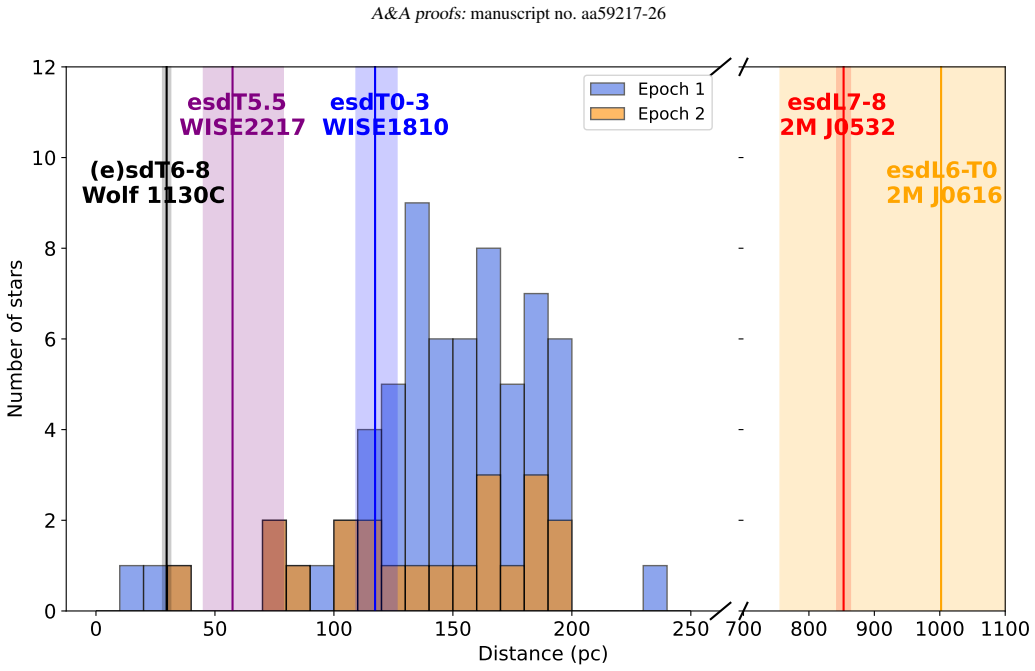
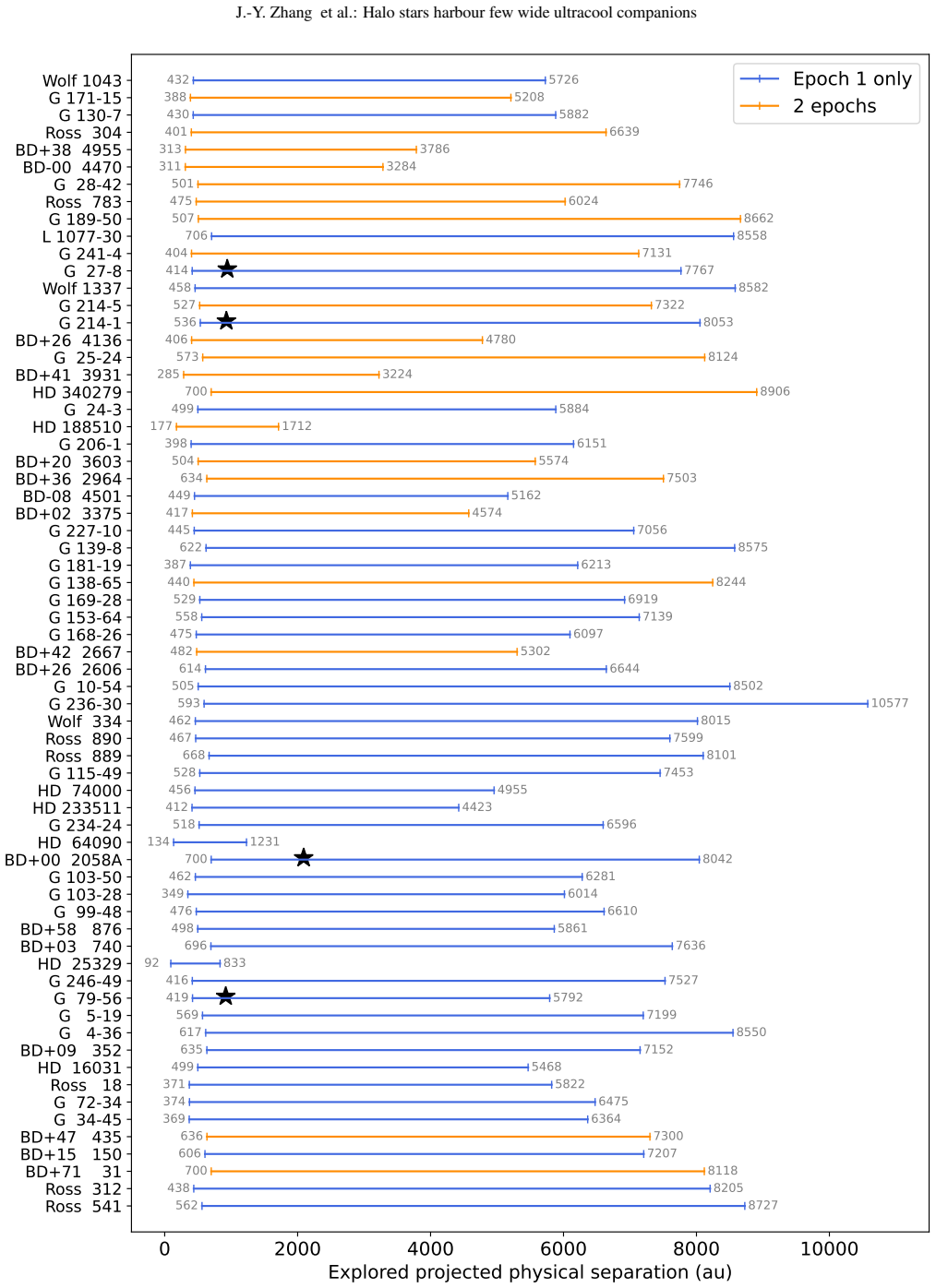
The survey reached limiting magnitudes sufficient to detect extreme subdwarfs earlier than esdT0 out to 250 pc. No bona fide wide ultracool companion was identified. An upper limit of 4.0 percent at 90 percent is placed on the frequency of wide ultracool companions to metal-poor halo stars. Four wide stellar companions were recovered and confirmed with Gaia, giving a frequency of 6.1+7.2-4.0 percent at 90 percent . Wide ultracool companions are therefore intrinsically rare around metal-poor halo stars, with an occurrence rate at most comparable to that of wide stellar companions, and current data show no evidence for a metallicity dependence.
What carries the argument
J-band imaging combined with two- to four-year proper-motion follow-up to identify common proper-motion sources at wide separations.
If this is right
- Wide ultracool companions are intrinsically rare around metal-poor halo stars.
- Their occurrence rate is at most comparable to the rate of wide stellar companions.
- No evidence appears for a metallicity dependence in the wide ultracool companion frequency.
- Formation and retention processes in binaries operate less efficiently for ultracool secondaries.
Where Pith is reading between the lines
- Binary population models must incorporate reduced retention efficiency for low-mass secondaries when metallicity is low.
- Repeating the search on larger halo samples or on disk stars at matched sensitivity would test whether the rarity is unique to the halo population.
Load-bearing premise
The combination of survey depth, proper-motion baseline, and sample selection captured essentially all wide ultracool companions that exist, with negligible incompleteness.
What would settle it
Discovery of one or more confirmed wide ultracool companions to halo stars at separations of a few hundred to a few thousand au within the magnitude and distance limits of the survey.
Figures
read the original abstract
We conducted the first search for wide ultracool companions to metal-poor halo stars. A sample of nearby halo stars with spectroscopically determined metallicities and high proper motions was imaged in the $J$ band and examined for faint candidate companions. Follow-up imaging over baselines of two to four years enabled a search for common proper-motion sources. The survey reached average limiting magnitudes of $J_{\mathrm{lim}}=22.8$ and $23.0$ mag (Vega) in the first and second epochs, respectively, sufficient to detect extreme subdwarfs earlier than esdT0 out to 250 pc. No bona fide wide ultracool companion was identified over projected separations of a few hundred to a few thousand au. We therefore derive an upper limit of $4.0\%$ (at a $90\%$ confidence level) on the frequency of wide ultracool companions to metal-poor halo stars. Four wide stellar companions were recovered and confirmed with Gaia, yielding a wide stellar companion frequency of $6.1^{+7.2}_{-4.0}\%$ (at a $90\%$ confidence level). We conclude that wide ultracool companions are intrinsically rare around metal-poor halo stars and that their occurrence rate is, at most, comparable to that of wide stellar companions. Current observations provide no evidence for a metallicity dependence of the wide ultracool companion frequency around stars. Formation and retention processes in binary systems are likely to operate less efficiently for ultracool secondaries.
Editorial analysis
A structured set of objections, weighed in public.
Referee Report
Summary. The paper reports the first targeted J-band imaging survey of nearby metal-poor halo stars selected for spectroscopic metallicities and high proper motions, searching for wide ultracool companions at separations of a few hundred to a few thousand au. No bona fide ultracool companions were identified after proper-motion confirmation over 2-4 year baselines, yielding a 4.0% upper limit (90% CL) on their frequency. Four wide stellar companions were recovered and confirmed with Gaia, giving a stellar companion frequency of 6.1^{+7.2}_{-4.0}% (90% CL). The authors conclude that wide ultracool companions are intrinsically rare around halo stars, at most comparable in rate to wide stellar companions, with no evidence for a metallicity dependence and less efficient formation/retention for ultracool secondaries.
Significance. If the null result holds after accounting for completeness, this provides the first direct constraint on wide ultracool companion frequency around metal-poor halo stars and an internal control via the recovered stellar companions. The Poisson upper limit is consistent with the implied sample size of ~58 stars, and the J-band depth and proper-motion baselines are presented as sufficient to reach esdT0 and earlier types out to 250 pc. This adds a falsifiable observational limit that can be tested against future surveys or population synthesis models of binary formation in low-metallicity environments.
minor comments (3)
- The abstract states the 4.0% upper limit but does not explicitly state the effective sample size or the precise Poisson formula used; adding this (even if detailed in §3 or §4) would make the derivation immediately verifiable from the summary.
- The claim of 'no evidence for a metallicity dependence' would benefit from a brief quantitative comparison in the discussion to published wide ultracool companion rates for solar-metallicity field stars (e.g., citing specific occurrence rates from the literature).
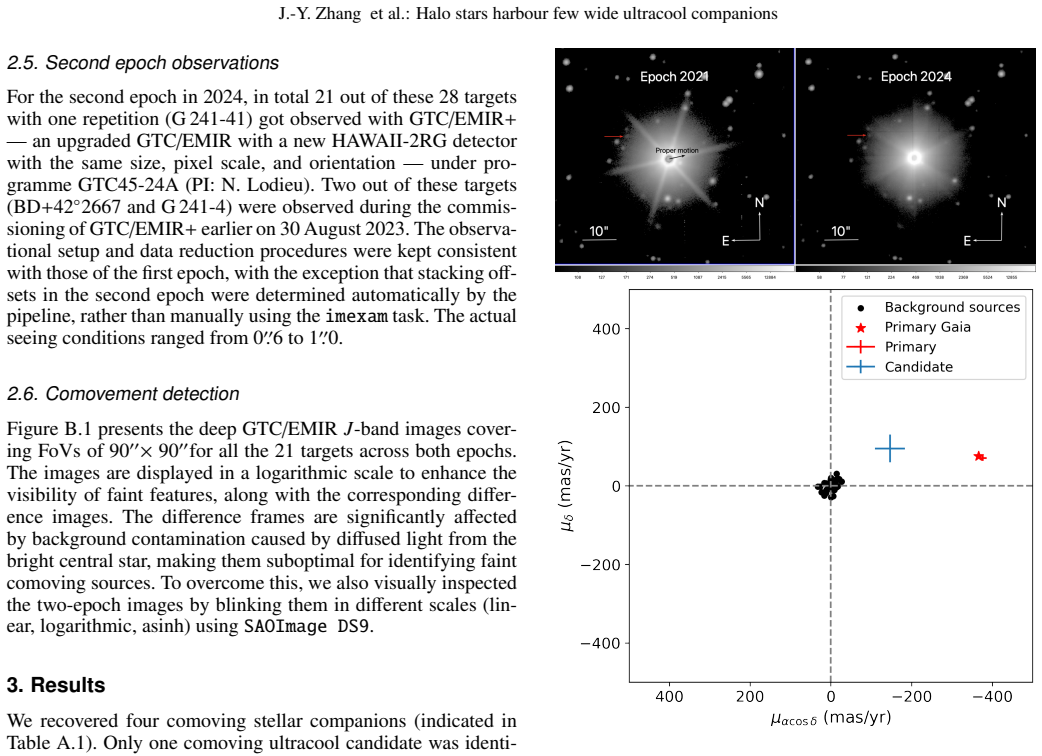
- Figure or table presenting the recovered stellar companions and their properties would strengthen the internal control argument; if present, ensure the caption explicitly notes how they validate the common-PM selection.
Simulated Author's Rebuttal
We thank the referee for their constructive review and recommendation of minor revision. The report accurately summarizes the survey design, null result for ultracool companions, and recovered stellar companions. No major comments were raised that require substantive changes to the scientific conclusions.
Circularity Check
No significant circularity identified
full rationale
The paper is an observational imaging survey reporting a null detection of wide ultracool companions to halo stars and deriving a standard Poisson upper limit (4.0% at 90% CL) from zero events in a sample of ~58 stars. The central claim rests on direct measurements (J-band depth, proper-motion baselines, recovered stellar companions as control) with no fitted parameters, self-definitional equations, or load-bearing self-citations that reduce the result to its inputs by construction. The derivation chain is self-contained against external benchmarks and does not invoke any of the enumerated circularity patterns.
Axiom & Free-Parameter Ledger
axioms (1)
- standard math Standard binomial or Poisson statistics for converting a null detection into a 90% confidence upper limit on frequency.
Reference graph
Works this paper leans on
-
[1]
J., Faherty, J
Aganze, C., Burgasser, A. J., Faherty, J. K., et al. 2016, AJ, 151, 46 Astropy Collaboration, Price-Whelan, A. M., Lim, P. L., et al. 2022, ApJ, 935, 167 Astropy Collaboration, Price-Whelan, A. M., Sip˝ocz, B. M., et al. 2018, AJ, 156, 123 Astropy Collaboration, Robitaille, T. P., Tollerud, E. J., et al. 2013, A&A, 558, A33
2016
-
[2]
Bate, M. R. 2012, MNRAS, 419, 3115
2012
-
[3]
Bidelman, W. P. 1985, ApJS, 59, 197
1985
-
[4]
P., Liu, M
Bowler, B. P., Liu, M. C., & Cushing, M. C. 2009, ApJ, 706, 1114
2009
-
[5]
P., Liu, M
Bowler, B. P., Liu, M. C., Shkolnik, E. L., & Tamura, M. 2015, ApJS, 216, 7
2015
-
[6]
2024, astropy/photutils: 2.0.2
Bradley, L., Sip˝ocz, B., Robitaille, T., et al. 2024, astropy/photutils: 2.0.2
2024
-
[7]
J., Kirkpatrick, J
Burgasser, A. J., Kirkpatrick, J. D., Burrows, A., et al. 2003, ApJ, 592, 1186
2003
-
[8]
W., Latham, D
Carney, B. W., Latham, D. W., Laird, J. B., & Aguilar, L. A. 1994, AJ, 107, 2240
1994
-
[9]
2003, PASP, 115, 763
Chabrier, G. 2003, PASP, 115, 763
2003
-
[10]
Chambers, K. C., Magnier, E. A., Metcalfe, N., et al. 2016, arXiv e-prints, arXiv:1612.05560
work page internal anchor Pith review Pith/arXiv arXiv 2016
-
[11]
Chinchilla, P., Béjar, V . J. S., Lodieu, N., et al. 2019, in Highlights on Spanish As- trophysics X, ed. B. Montesinos, A. Asensio Ramos, F. Buitrago, R. Schödel, E. Villaver, S. Pérez-Hoyos, & I. Ordóñez-Etxeberria, 283–289 dal Ponte, M., Santiago, B., Carnero Rosell, A., et al. 2020, MNRAS, 499, 5302
2019
-
[12]
B., Henry, T
Dieterich, S. B., Henry, T. J., Golimowski, D. A., Krist, J. E., & Tanner, A. M. 2012, AJ, 144, 64
2012
-
[13]
K., Burgasser, A
Faherty, J. K., Burgasser, A. J., Walter, F. M., et al. 2012, ApJ, 752, 56 Gaia Collaboration. 2020, VizieR Online Data Catalog: Gaia EDR3 (Gaia Col- laboration, 2020), VizieR On-line Data Catalog: I/350. Originally published in: 2021A&A...649A...1G Gaia Collaboration, Arenou, F., Babusiaux, C., et al. 2023, A&A, 674, A34 Gaia Collaboration, Prusti, T., d...
2012
-
[14]
E., Scholz, R
Gizis, J. E., Scholz, R. D., Irwin, M., & Jahreiss, H. 1997, MNRAS, 292, L41 González-Payo, J., Cortés-Contreras, M., Lodieu, N., et al. 2021, A&A, 650, A190
1997
-
[15]
& Lineweaver, C
Grether, D. & Lineweaver, C. H. 2006, ApJ, 640, 1051
2006
-
[16]
2023, arXiv e-prints, arXiv:2306.12363
Holwerda, B., Pirzkal, N., Burgasser, A., & Hsu, C.-C. 2023, arXiv e-prints, arXiv:2306.12363
-
[17]
C., Zakamska, N
Hwang, H.-C., Ting, Y .-S., Schlaufman, K. C., Zakamska, N. L., & Wyse, R. F. G. 2021, MNRAS, 501, 4329
2021
-
[18]
D., Hartkopf, W
Jao, W.-C., Mason, B. D., Hartkopf, W. I., Henry, T. J., & Ramos, S. N. 2009, AJ, 137, 3800
2009
-
[19]
Kirkpatrick, J. D. 2005, ARA&A, 43, 195
2005
-
[20]
D., Henry, T
Kirkpatrick, J. D., Henry, T. J., & Irwin, M. J. 1997, AJ, 113, 1421
1997
-
[21]
D., Looper, D
Kirkpatrick, J. D., Looper, D. L., Burgasser, A. J., et al. 2010, ApJS, 190, 100
2010
-
[22]
W., Mierle, K., Blanton, M., & Roweis, S
Lang, D., Hogg, D. W., Mierle, K., Blanton, M., & Roweis, S. 2010, AJ, 139, 1782 Lépine, S., Rich, R. M., & Shara, M. M. 2003, ApJ, 591, L49 Lépine, S., Rich, R. M., & Shara, M. M. 2007, ApJ, 669, 1235
2010
-
[23]
Y ., et al
Lodieu, N., Pérez Garrido, A., Zhang, J. Y ., et al. 2025, A&A, 694, A129
2025
-
[24]
D., McCaughrean, M
Lodieu, N., Scholz, R. D., McCaughrean, M. J., et al. 2005, A&A, 440, 1061
2005
-
[25]
R., & Martín, E
Lodieu, N., Zapatero Osorio, M. R., & Martín, E. L. 2009, A&A, 499, 729
2009
-
[26]
R., Martín, E
Lodieu, N., Zapatero Osorio, M. R., Martín, E. L., Rebolo López, R., & Gauza, B. 2022, A&A, 663, A84
2022
-
[27]
Luyten, W. J. 1979, NLTT catalogue. V olume_I.+90__to_+30_. V olume._II. +30__to_0_., V ol. 1
1979
-
[28]
N., Kirkpatrick, J
Mace, G. N., Kirkpatrick, J. D., Cushing, M. C., et al. 2013, ApJ, 777, 36
2013
-
[29]
N., Mann, A
Mace, G. N., Mann, A. W., Skiff, B. A., et al. 2018, ApJ, 854, 145
2018
-
[30]
Marcy, G. W. & Butler, R. P. 2000, PASP, 112, 137
2000
-
[31]
M., Leggett, S
Meisner, A. M., Leggett, S. K., Logsdon, S. E., et al. 2023, AJ, 166, 57
2023
-
[32]
Metchev, S. A. & Hillenbrand, L. A. 2009, ApJS, 181, 62
2009
-
[33]
M., & Badenes, C
Moe, M., Kratter, K. M., & Badenes, C. 2019, ApJ, 875, 61
2019
-
[34]
Mohandasan, A., Smart, R. L., Reylé, C., et al. 2025, A&A, submitted, arXiv:2503.22559
-
[35]
M., et al
Montes, D., González-Peinado, R., Tabernero, H. M., et al. 2018, MNRAS, 479, 1332
2018
-
[36]
C., Sozzetti, A., et al
Mortier, A., Santos, N. C., Sozzetti, A., et al. 2012, A&A, 543, A45
2012
-
[37]
V ., Kuzmin, A
Nesterov, V . V ., Kuzmin, A. V ., Ashimbaeva, N. T., et al. 1995, A&AS, 110, 367
1995
-
[38]
1986, ApJS, 61, 667
Norris, J. 1986, ApJS, 61, 667
1986
-
[39]
E., & Samaddar, D
Riaz, B., Gizis, J. E., & Samaddar, D. 2008, ApJ, 672, 1153
2008
-
[40]
2011, A&A, 525, A95
Sahlmann, J., Ségransan, D., Queloz, D., et al. 2011, A&A, 525, A95
2011
-
[41]
C., Burgasser, A
Schneider, A. C., Burgasser, A. J., Gerasimov, R., et al. 2020, ApJ, 898, 77
2020
-
[42]
D., Lodieu, N., & McCaughrean, M
Scholz, R. D., Lodieu, N., & McCaughrean, M. J. 2004, A&A, 428, L25
2004
-
[43]
Stetson, P. B. 1987, PASP, 99, 191
1987
-
[44]
& Meyer, M
Susemiehl, N. & Meyer, M. R. 2022, A&A, 657, A48
2022
-
[45]
1986, in Society of Photo-Optical Instrumentation Engineers (SPIE) Conference Series, V ol
Tody, D. 1986, in Society of Photo-Optical Instrumentation Engineers (SPIE) Conference Series, V ol. 627, Instrumentation in astronomy VI, ed. D. L. Crawford, 733
1986
-
[46]
D., Shapiro, S
Weinberg, M. D., Shapiro, S. L., & Wasserman, I. 1987, ApJ, 312, 367
1987
-
[47]
G., Henry, T
Winters, J. G., Henry, T. J., Jao, W.-C., et al. 2019, AJ, 157, 216 Zapatero Osorio, M. R. & Martín, E. L. 2004, A&A, 419, 167
2019
-
[48]
L., Comte, G., et al
Zhang, S., Luo, A. L., Comte, G., et al. 2021, ApJ, 908, 131
2021
-
[49]
2019, MNRAS, 489, 1423
Zhang, Z. 2019, MNRAS, 489, 1423
2019
-
[50]
H., Pinfield, D
Zhang, Z. H., Pinfield, D. J., Burningham, B., et al. 2013, MNRAS, 434, 1005
2013
-
[51]
H., Pinfield, D
Zhang, Z. H., Pinfield, D. J., Gálvez-Ortiz, M. C., et al. 2018, MNRAS, 479, 1383
2018
-
[52]
M., Baranec, C., Riddle, R
Ziegler, C., Law, N. M., Baranec, C., Riddle, R. L., & Fuchs, J. T. 2015, ApJ, 804, 30
2015
-
[53]
2004, in Revista Mexicana de Astrono- mia y Astrofisica Conference Series, V ol
Zinnecker, H., Köhler, R., & Jahreiß, H. 2004, in Revista Mexicana de Astrono- mia y Astrofisica Conference Series, V ol. 21, Revista Mexicana de Astrono- mia y Astrofisica Conference Series, ed. C. Allen & C. Scarfe, 33–36 Žerjal, M., Dominguez-Tagle, C., Sedighi, N., et al. 2025, A&A, accepted, arXiv:2503.22497 Article number, page 9 of 16 A&A proofs:ma...
discussion (0)
Sign in with ORCID, Apple, or X to comment. Anyone can read and Pith papers without signing in.