Hard X-ray Sources in Fermi UFOs
Pith reviewed 2026-06-28 20:54 UTC · model grok-4.3
The pith
Seventeen unidentified gamma-ray sources overlap with hard X-ray sources, leading to associations with blazars, Seyfert galaxies, and other objects.
A machine-rendered reading of the paper's core claim, the machinery that carries it, and where it could break.
Core claim
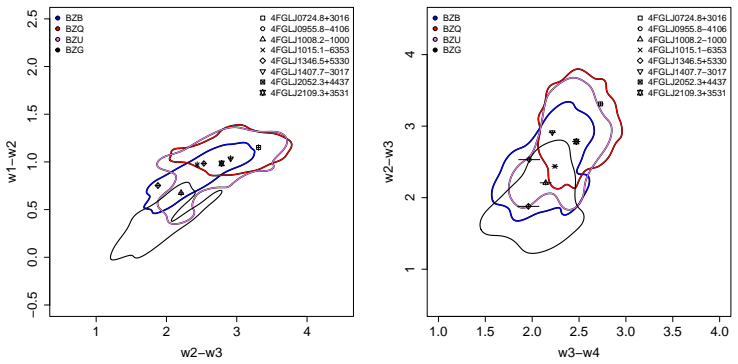
We found 17 UFOs with overlapping hard X-ray sources and associated 15 with known objects, including 2 blazars, 5 Seyfert galaxies, 2 X-ray binaries, 1 generic X-ray source, 2 cataclysmic variables, and 3 variable stars. Blazars and Seyferts are likely the lower-energy counterparts to the UFOs based on their mid-IR colors and spectral energy distributions indicating jetted emission.
What carries the argument
Positional compatibility between UFOs and hard X-ray sources in the Palermo Swift-BAT and SRG/ART-XC catalogs, combined with follow-up soft X-ray observations to identify and classify counterparts.
If this is right
- Blazars and Seyfert galaxies are probable lower-energy counterparts to the UFOs because of their significant jetted, non-thermal emission.
- X-ray binaries represent potential counterparts since this class has previously been observed emitting gamma-rays.
- The generic X-ray source, proposed as a pulsar candidate, could be the lower-energy counterpart to its UFO.
- Cataclysmic variables, if confirmed as gamma-ray emitters, would be the first such sources of their kind.
- Association of the three variable stars with the UFOs is considered unlikely.
Where Pith is reading between the lines
- Extending this cross-matching approach to additional catalogs could help classify more of the remaining UFOs.
- Multi-wavelength monitoring to check for correlated variability between gamma-ray and X-ray bands would strengthen the associations.
- Some of these sources might represent new populations of gamma-ray emitters if the cataclysmic variable candidates are verified.
Load-bearing premise
Positional overlap between a gamma-ray UFO and a hard X-ray source indicates they are the same physical object rather than unrelated sources aligned by chance.
What would settle it
High-resolution observations or timing analysis showing that the gamma-ray and X-ray emissions do not come from the same location or vary independently.
Figures
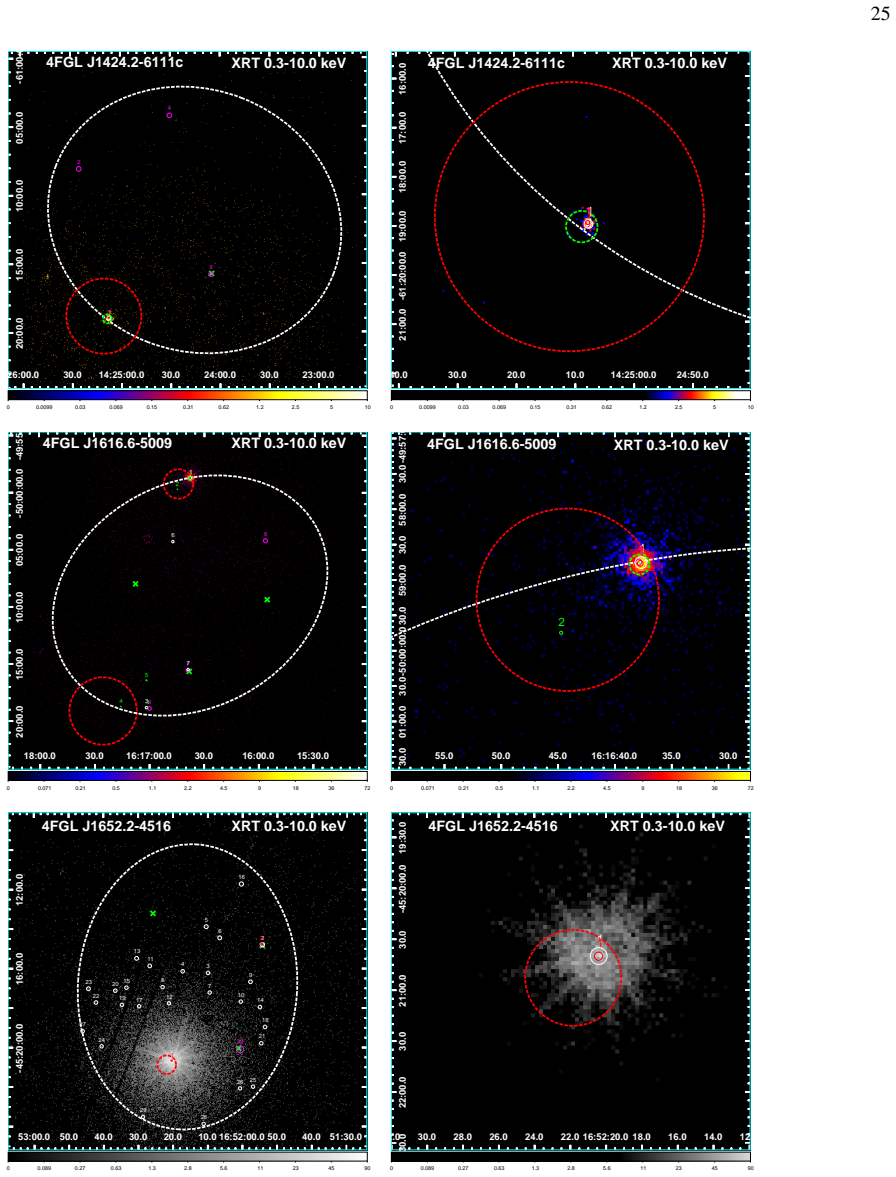
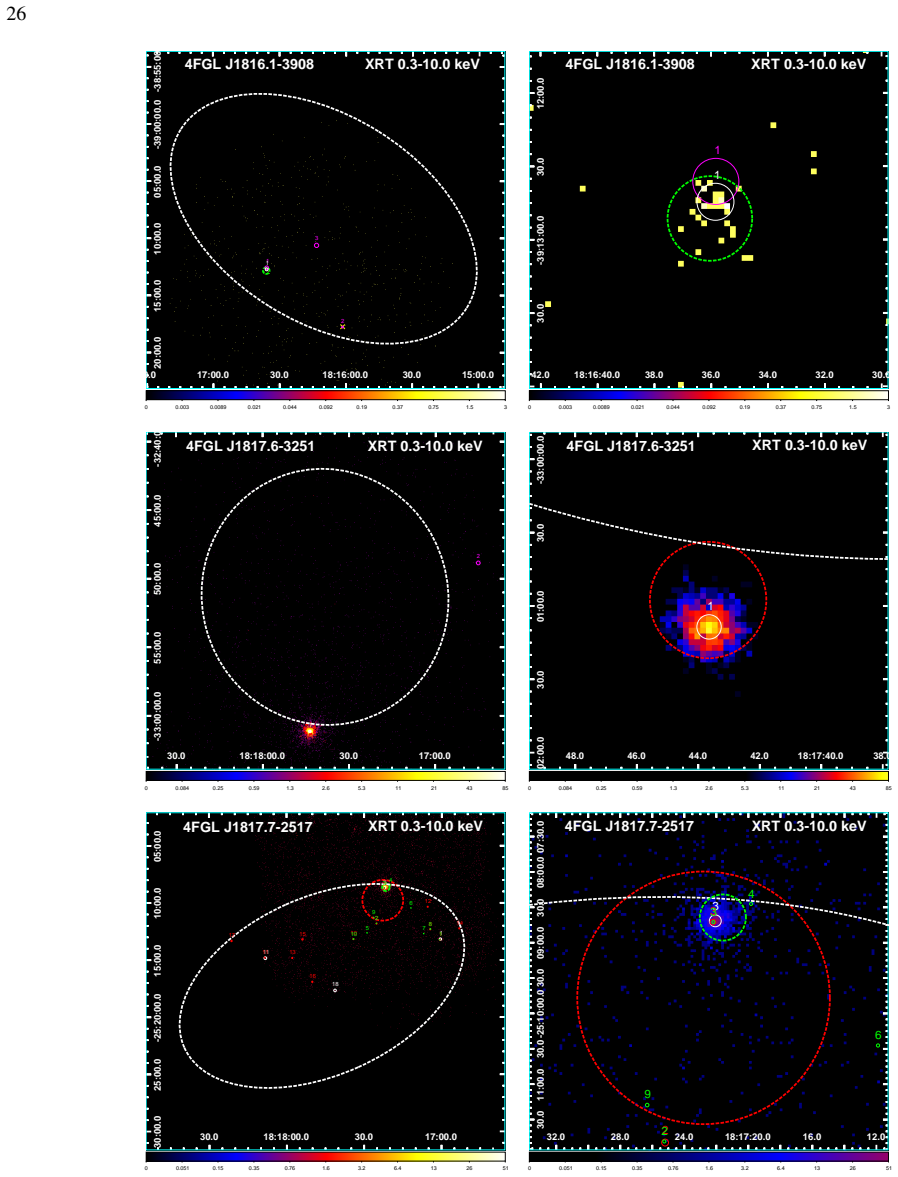
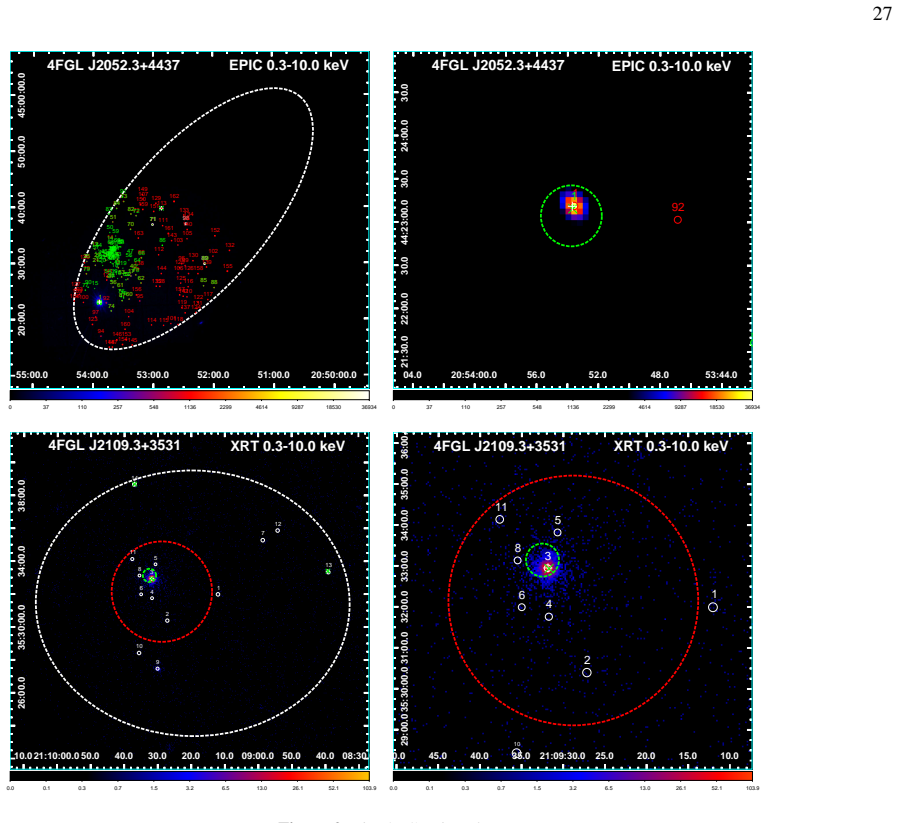
read the original abstract
Identification and/or association of unidentified $\gamma$-ray sources with lower-energy counterparts represents a key challenge in modern astronomy, due to the relatively large positional uncertainty provided by $\gamma$-ray detectors. We selected Unidentified Fermi Objects (UFOs) positionally compatible with hard X-ray sources in the latest Palermo Swift-BAT hard X-ray Catalog and in the SRG/ART-XC all-sky X-ray survey Catalog, to identify lower-energy sources and possibly associate them to the UFOs. We found 17 UFOs with overlapping hard X-ray sources. We then collected soft X-ray data from Swift-XRT, Chandra-ACIS, XMM-Newton-EPIC, and eROSITA, identified 16 soft X-ray counterparts to the hard X-ray sources, and associate 15 with known astronomical objects, classified as: blazars/blazars candidates (2 sources), Seyfert galaxies (5 sources), X-ray binaries (2 sources), generic X-ray sources (1 source), cataclysmic variables (2 sources), and variable stars (3 sources). Blazars and Seyfert galaxies are likely lower-energy counterparts to the UFOs, since their mid-IR colors and broad-band spectral energy distributions suggest significant jetted, non-thermal emission. X-ray binaries can be potential lower-energy counterparts to the UFOs, since this class of sources has been already observed to emit $\gamma$-rays. The generic X-ray source has been proposed as a pulsar candidate, and we therefore suggest that it can be the lower-energy counterpart to the UFO. Cataclysmic variables have been suggested as potential $\gamma$-ray emitters so, if confirmed, the 2 sources classified as cataclysmic variables would represent the first $\gamma$-ray emitting sources of this kind. Finally, we consider the association of the 3 variable stars with the UFOs unlikely.
Editorial analysis
A structured set of objections, weighed in public.
Referee Report
Summary. The manuscript reports a catalog cross-match between Unidentified Fermi Objects (UFOs) and hard X-ray sources from the Palermo Swift-BAT and SRG/ART-XC catalogs, identifying 17 positional overlaps. Soft X-ray counterparts are found for 16 of these using Swift-XRT, Chandra, XMM-Newton, and eROSITA data; 15 are then associated with known classes (2 blazars/blazar candidates, 5 Seyferts, 2 XRBs, 1 generic X-ray source, 2 CVs, 3 variable stars). The authors argue that blazars and Seyferts are likely lower-energy counterparts on the basis of mid-IR colors and SEDs, while noting that XRBs and the pulsar candidate are plausible and that CVs would be novel if confirmed.
Significance. If the 17 positional matches are shown to be statistically significant rather than chance alignments, the work would supply a short list of candidate multi-wavelength counterparts for a subset of Fermi UFOs and could motivate targeted follow-up observations of the suggested blazar, Seyfert, and XRB associations.
major comments (1)
- [Abstract and results describing the 17 UFOs] Abstract and results section on the 17 overlaps: the selection criterion is stated as 'positionally compatible' with BAT and ART-XC entries, yet no calculation of the random coincidence probability is presented (using the reported positional uncertainties, the surface density of hard X-ray sources, or a control sample of offset positions). All downstream classifications and statements that specific classes 'are likely lower-energy counterparts' rest on these 17 matches being physical associations.
Simulated Author's Rebuttal
We thank the referee for the constructive report. The single major comment correctly identifies that the manuscript does not quantify the probability of chance alignments for the 17 positional matches. We address this below and will revise the paper to include the requested statistical assessment.
read point-by-point responses
-
Referee: Abstract and results section on the 17 overlaps: the selection criterion is stated as 'positionally compatible' with BAT and ART-XC entries, yet no calculation of the random coincidence probability is presented (using the reported positional uncertainties, the surface density of hard X-ray sources, or a control sample of offset positions). All downstream classifications and statements that specific classes 'are likely lower-energy counterparts' rest on these 17 matches being physical associations.
Authors: We agree that a quantitative estimate of random coincidence probability is required to substantiate the physical nature of the 17 matches and the subsequent classifications. In the revised manuscript we will add a new subsection (likely in Section 3 or 4) that computes the expected number of chance alignments. The calculation will use the reported positional uncertainties of the Fermi UFOs and the BAT/ART-XC sources, the local surface density of hard X-ray sources, and, where feasible, a control sample of offset positions. This will allow us to report the statistical significance of the associations and to qualify the strength of the downstream claims accordingly. revision: yes
Circularity Check
No circularity: pure observational catalog matching
full rationale
The paper performs positional cross-matching between Fermi UFOs and hard X-ray catalogs (BAT, ART-XC), followed by soft X-ray counterpart identification and classification against known object types using external catalogs and SEDs. No equations, fitted parameters, predictions, or self-citations appear in the derivation chain. The central claim rests on reported positional overlaps and literature classifications; these steps do not reduce to the inputs by construction, nor invoke any of the enumerated circularity patterns. The absence of a false-positive probability calculation is a methodological limitation affecting evidential strength, not a circularity issue.
Axiom & Free-Parameter Ledger
Reference graph
Works this paper leans on
-
[1]
doi:10.1088/0004-637X/741/1/30 Ackermann, M., Ajello, M., Allafort, A., et al. 2012a, ApJ, 747, 2,
-
[2]
doi:10.1088/0004-637X/747/2/104 Ackermann, M., Ajello, M., Allafort, A., et al. 2012b, ApJ, 753, 1,
-
[3]
doi:10.1088/0004-637X/753/1/83 Ackermann, M., Ajello, M., Allafort, A., et al. 2013, Science, 339, 6121, 807. doi:10.1126/science.1231160 Almeida, A., Anderson, S. F., Argudo-Fern´andez, M., et al. 2023, ApJS, 267, 2, 44. doi:10.3847/1538-4365/acda98 Ballet, J., Burnett, T. H., Digel, S. W., et al. 2020, arXiv:2005.11208. doi:10.48550/arXiv.2005.11208 Bal...
-
[4]
doi:10.1093/pasj/62.3.769 Chen, Y .-P., Zaw, I., Farrar, G. R., et al. 2022, ApJS, A Uniformly Selected, Southern-sky 6dF, Optical AGN Catalog, 258, 2, 29. doi:10.3847/1538-4365/ac4157 Chernyakova, M. & Malyshev, D. 2020, Multifrequency Behaviour of High Energy Cosmic Sources - XIII. 3-8 June 2019. Palermo,
-
[5]
doi:10.22323/1.362.0045 Cooper, N., Dainotti, M. G., Narendra, A., et al. 2023, MNRAS, 525, 2, 1731. doi:10.1093/mnras/stad2193 Coti Zelati, F., Papitto, A., de Martino, D., et al. 2019, A&A, Prolonged sub-luminous state of the new transitional pulsar candidate CXOU J110926.4-650224, 622, A211. doi:10.1051/0004-6361/201834835 Cui, X.-Q., Zhao, Y .-H., Chu...
-
[6]
doi:10.1088/0067-0049/206/2/12 D’Abrusco, R., Massaro, F., Paggi, A., et al. 2014, ApJS, 215, 1,
-
[7]
doi:10.1088/0067-0049/215/1/14 D’Elia, V ., Perri, M., Puccetti, S., et al. 2013, A&A, 551, A142. doi:10.1051/0004-6361/201220863 de Martino, D., Belloni, T., Falanga, M., et al. 2013, A&A, 550, A89. doi:10.1051/0004-6361/201220393 Dermer, C. D. & Powale, G. 2013, A&A, 553, A34. doi:10.1051/0004-6361/201220394 Dessauges-Zavadsky, M., Pindao, M., Maeder, A...
-
[8]
doi:10.1088/0004-637X/708/1/584 Emonts, B. H. C., Tadhunter, C. N., Morganti, R., et al. 2009, MNRAS, 396, 3, 1522. doi:10.1111/j.1365-2966.2009.14807.x Esposito, J. A., Bertsch, D. L., Chen, A. W., et al. 1999, ApJS, In-Flight Calibration of EGRET on the Compton Gamma-Ray Observatory, 123, 1, 203. doi:10.1086/313227 Fitzpatrick, E. L. & Massa, D. 2007, A...
-
[9]
2004, ApJ, 611, 1005, doi: 10.1086/422091
doi:10.1086/422091 Giacconi, R., Branduardi, G., Briel, U., et al. 1979, ApJ, 230, 540. doi:10.1086/157110 GLAST Facility Science Team, Gehrels, N., & Michelson, P. 1999, Astroparticle Physics, 11, 1-2, 277. doi:10.1016/S0927-6505(99)00066-3 Hiemstra, B., M´endez, M., Done, C., et al. 2011, MNRAS, A strong and broad Fe line in the XMM-Newton spectrum of t...
-
[10]
doi:10.3847/1538-4365/aa9c44 Liu, J.-R., Wang, J.-M., Fermi-LAT Collaboration, et al. 2025, Nature Astronomy, 9, 1086. doi:10.1038/s41550-025-02538-2 Longhurst, E. 2020, AAS Meeting Abstracts, 235, 305.08. Madzime, S. T. & Meintjes, P. J. 2024, High Energy Astrophysics in Southern Africa 2023, 20. Mahony, E. K., Sadler, E. M., Murphy, T., et al. 2010, ApJ...
-
[11]
doi:10.1088/0004-637X/718/2/587 Malizia, A., Bassani, L., Bazzano, A., et al. 2012, MNRAS, 426, 3,
-
[12]
doi:10.1111/j.1365-2966.2012.21755.x Mandarakas, N. 2023, The Multimessenger Chakra of Blazar Jets, 375, 71. doi:10.1017/S1743921323000625 Mart´ı-Devesa, G. & Olivera-Nieto, L. 2025, ApJL, 979, 2, L40. doi:10.3847/2041-8213/ada14f Masetti, N., Parisi, P., Palazzi, E., et al. 2013, A&A, Unveiling the nature of INTEGRAL objects through optical spectroscopy....
-
[13]
doi:10.1086/345888 Nevalainen, J., Markevitch, M., & Lumb, D. 2005, ApJ, 629, 1,
-
[14]
doi:10.1086/431198 Nolan, P. L., Abdo, A. A., Ackermann, M., et al. 2012, ApJS, 199, 2, 31. doi:10.1088/0067-0049/199/2/31 Nousek, J. A., Garmire, G. P., Ricker, G. R., et al. 1987, Astrophysical Letters and Communications, 26, 35. Oh, K., Koss, M., Markwardt, C. B., et al. 2018, ApJS, 235, 1, 4. doi:10.3847/1538-4365/aaa7fd Paggi, A., Bonato, M., Raiteri...
-
[15]
doi:10.22323/1.331.0044 Park, S. Q., Barmby, P., Willner, S. P., et al. 2010, ApJ, 717, 2,
-
[16]
2013, EAS Publications Series, 61, 255
doi:10.1088/0004-637X/717/2/1181 Pavlenko, E., Malanushenko, V ., Shugarov, S., et al. 2013, EAS Publications Series, 61, 255. doi:10.1051/eas/1361039 Pavlinsky, M., Tkachenko, A., Levin, V ., et al. 2021, A&A, 650, A42. doi:10.1051/0004-6361/202040265 Petrov, L., Mahony, E. K., Edwards, P. G., et al. 2013, MNRAS, 432, 2, 1294. doi:10.1093/mnras/stt550 Po...
-
[17]
doi:10.1093/mnras/stae1827 15 Table 1.List of 4FGL UFOs with at least one 4PBC source overlapping the UFO uncertainty ellipse. Note that UFO 4FGL J1616.6-5009 has two overlapping 4PBC source, namely 4PBC J1616.7-4959 and 4PBC J1617.4-5019. 4FGL Name4FGL RA4FGL Dec4FGL semimaj4FGL semimin4FGL PA4PBC Name 4PBC association4PBC RA4PBC Dec4PBC errF15−150 keVΓ1...
discussion (0)
Sign in with ORCID, Apple, or X to comment. Anyone can read and Pith papers without signing in.