Non-detection of HC(S)SH: Estimating Upper Limits and Constraining Chemistry
Pith reviewed 2026-06-28 18:26 UTC · model grok-4.3
The pith
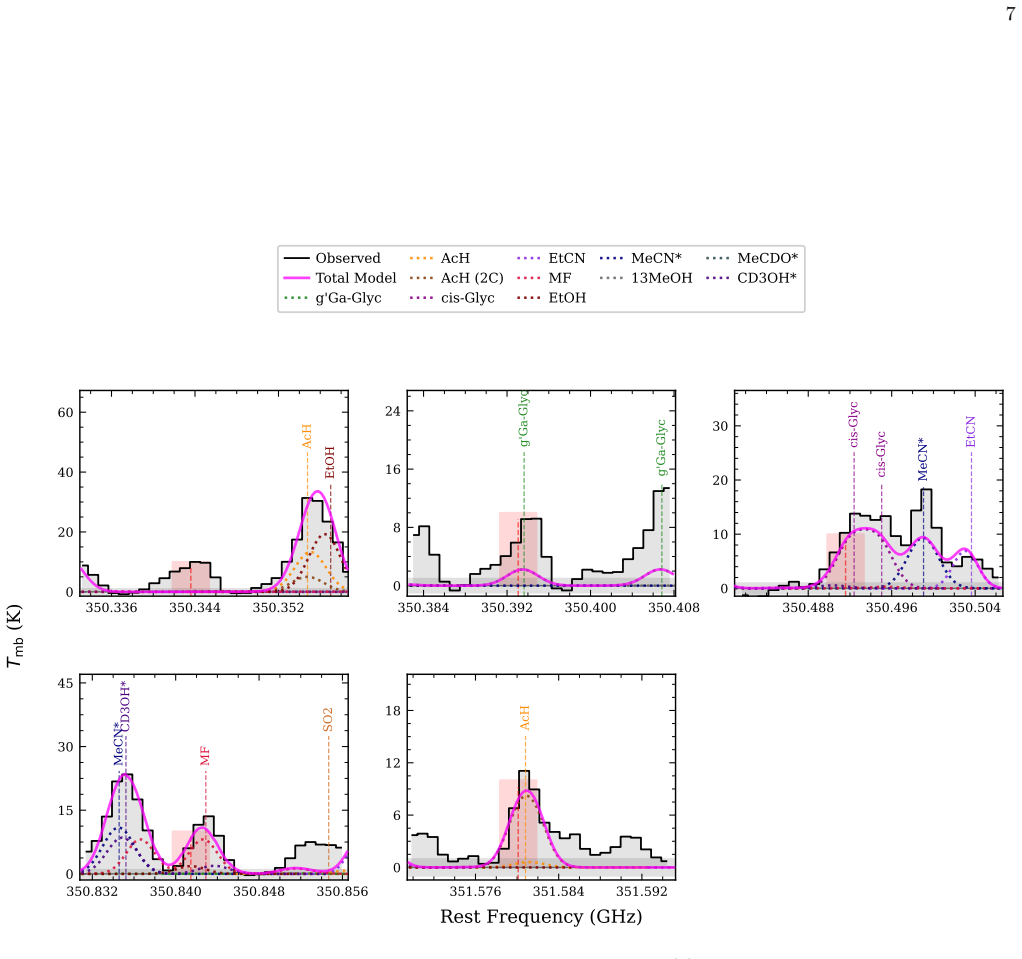
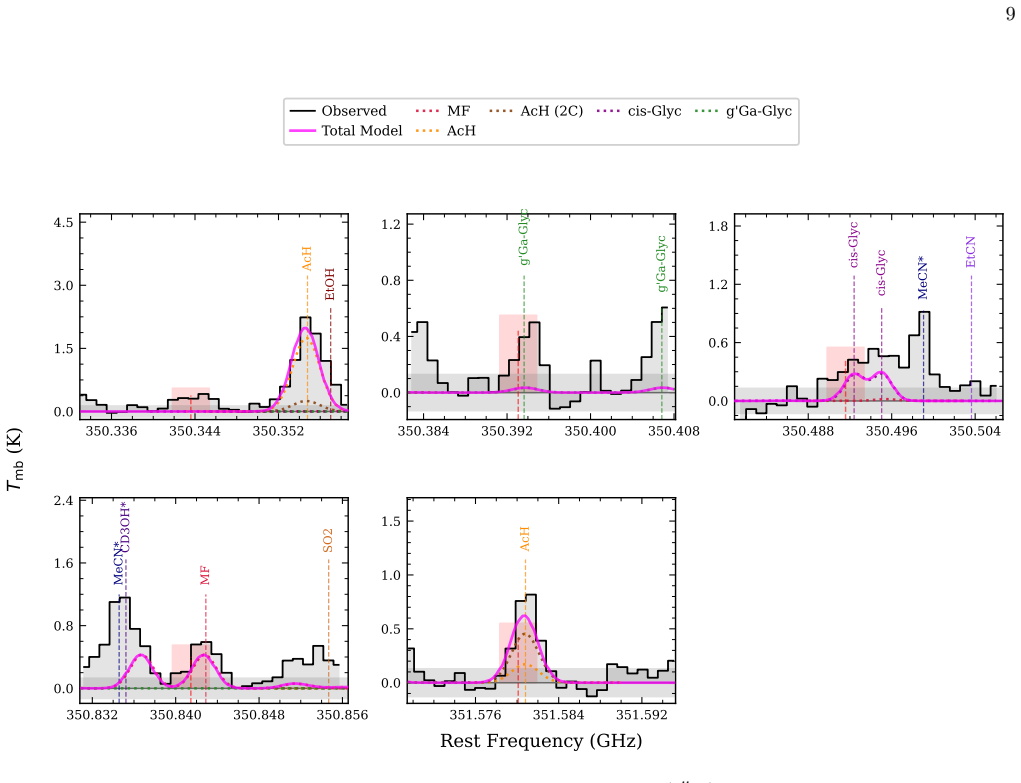
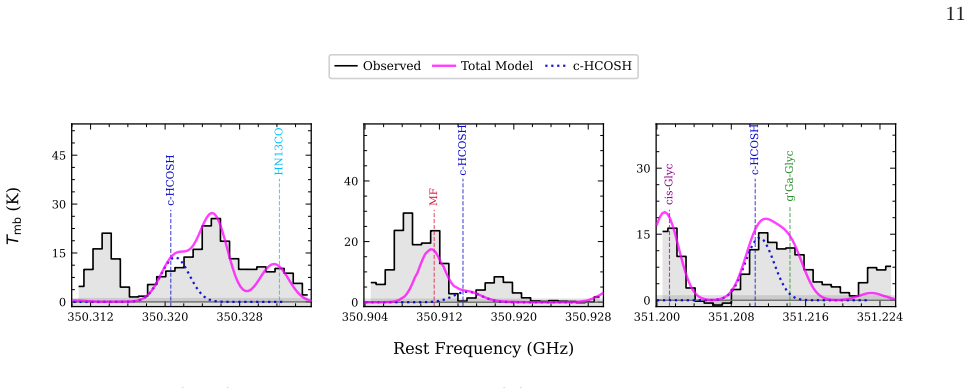
Reanalysis of ALMA data finds no evidence for t-HC(S)SH in NGC 1333 IRAS 4A2 and attributes the prior claim to blending with other molecules.
A machine-rendered reading of the paper's core claim, the machinery that carries it, and where it could break.
Core claim
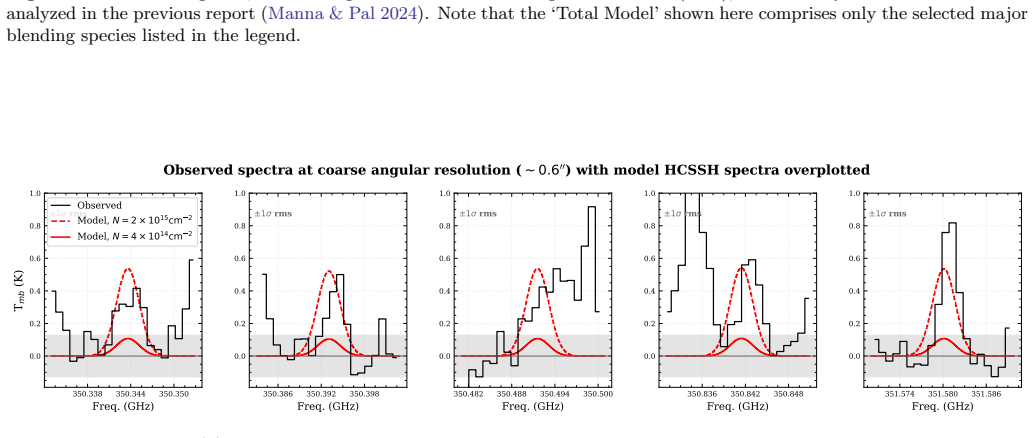
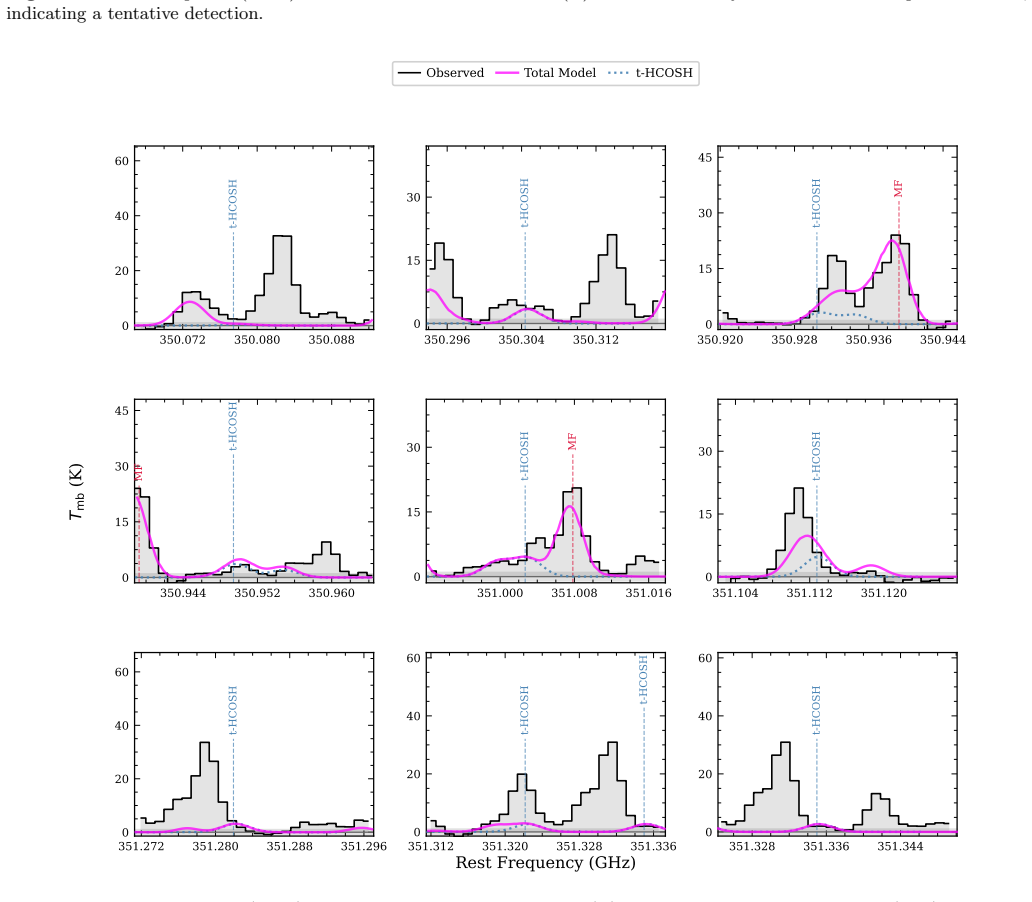
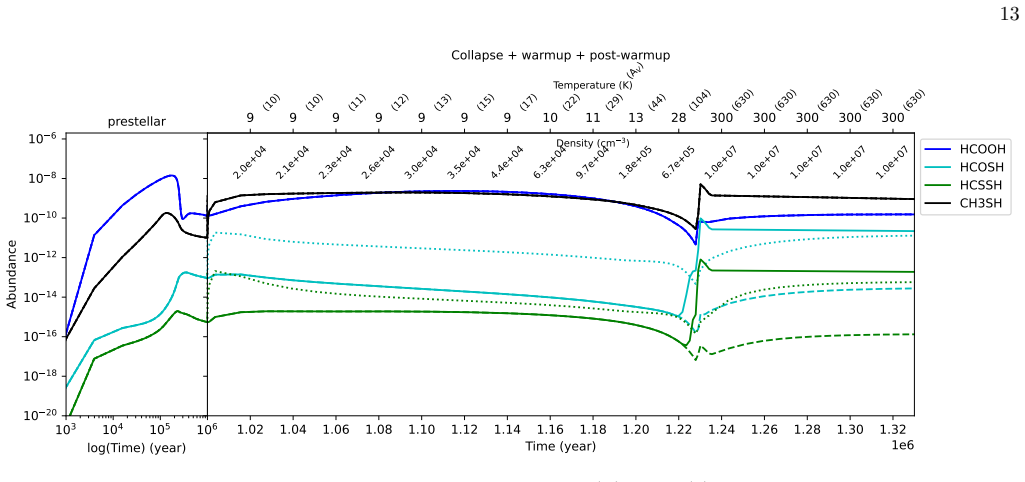
The central claim is that t-HC(S)SH is not present at detectable levels: all reported transitions match known species exactly, with no remaining unblended features attributable to t-HC(S)SH, yielding N_t-HC(S)SH <= 4 x 10^14 cm^-2 and a fractional abundance <= 1 x 10^-10. Astrochemical models place this non-detection in context, showing that the original claim likely arose from spectral blending and inconsistent assumptions, and that such doubly sulfur-substituted species are expected to be rare in these environments.
What carries the argument
Comprehensive spectral modeling that assigns every observed line to known molecules, combined with astrochemical simulations that predict abundances of sulfur-bearing species under hot corino conditions.
If this is right
- The original detection claim is explained by spectral blending rather than a real presence of t-HC(S)SH.
- Astrochemical models correctly forecast that molecules with two sulfur atoms remain scarce in hot corino gas.
- Future searches for sulfur species must apply the same level of line-by-line verification to avoid false positives.
- The derived upper limits provide concrete benchmarks for refining chemical networks involving interstellar sulfur.
Where Pith is reading between the lines
- Similar reanalyses of other claimed detections of rare sulfur organics could tighten constraints on the missing sulfur problem.
- The same modeling approach could be extended to additional ALMA datasets targeting doubly substituted molecules in different star-forming regions.
- Non-detections of this kind may steer laboratory efforts toward measuring spectra of even less abundant sulfur carriers.
Load-bearing premise
The molecular line catalog and spectral modeling are complete enough to rule out any contribution from t-HC(S)SH to the observed features.
What would settle it
Detection of one or more unblended spectral lines at the exact frequencies and relative intensities predicted for t-HC(S)SH that cannot be reproduced by any combination of known molecules.
Figures
read the original abstract
The search for dithioformic acid (t-HC(S)SH) in star-forming regions is crucial for understanding interstellar sulfur chemistry and addressing the 'missing sulfur' problem. Motivated by a recent claim of t-HC(S)SH detection in NGC 1333 IRAS 4A2, we independently reanalyzed the same ALMA dataset using comprehensive spectral and chemical modeling. We find no credible evidence for t-HC(S)SH: all reported transitions are fully accounted for by known, abundant molecules, with no unblended features unique to t-HC(S)SH. We critically reassess the reported detection, deriving stringent upper limits on the column density (N_t-HC(S)SH <= 4 x 10^14 cm^-2) and the fractional abundance (<= 1 x 10^-10 relative to H2). Our astrochemical models place these limits in context, showing the claimed detection likely results from spectral blending and inconsistent modeling assumptions. The non-detection aligns with chemical expectations given the rarity of complex and doubly sulfur-substituted molecules in hot corino environments. Furthermore, our analysis establishes a rigorous framework to guide future searches for sulfur-bearing species and highlights the critical importance of thorough line identification and modeling practices in astrochemistry.
Editorial analysis
A structured set of objections, weighed in public.
Referee Report
Summary. The manuscript reanalyzes public ALMA observations of the hot corino NGC 1333 IRAS 4A2, concluding there is no credible detection of t-HC(S)SH. All previously reported transitions are fully reproduced by known abundant carriers with no unblended residuals attributable to t-HC(S)SH; the authors derive N_t-HC(S)SH ≤ 4 imes 10^14 cm^-2 and a fractional abundance ≤ 1 imes 10^-10 relative to H2. Astrochemical models are invoked to argue that the prior claimed detection arose from blending and inconsistent assumptions, and that the non-detection is consistent with the expected rarity of complex doubly sulfur-substituted species.
Significance. If the non-detection and upper limits are robust, the result directly constrains interstellar sulfur chemistry and the 'missing sulfur' problem by showing that complex S-bearing molecules with two sulfur atoms remain below detectable levels in hot corinos. The re-use of public data together with the modeling framework supplies a concrete template for future line searches and highlights the need for exhaustive carrier accounting.
major comments (2)
- [Spectral modeling] Spectral modeling section: the central non-detection claim requires that the adopted line catalog (CDMS/JPL) plus radiative-transfer assumptions fully reproduce every reported feature with zero residual that could accommodate even a small t-HC(S)SH column. The manuscript must demonstrate this explicitly (e.g., by showing post-fit residuals across the reported transitions and testing catalog completeness at the source excitation temperature and velocity structure); without such verification the upper-limit derivation rests on an untested assumption.
- [Upper-limit derivation] Upper-limit paragraph and associated figure: the quoted column-density limit of 4 imes 10^14 cm^-2 is obtained under specific LTE or non-LTE assumptions, source size, and velocity components. These parameters must be stated and justified with a sensitivity test; otherwise the limit cannot be assessed as conservative or directly comparable to the earlier claimed detection.
minor comments (2)
- [Abstract] Abstract: the ALMA project code or dataset identifier should be stated so readers can immediately locate the public data.
- Figure captions and spectral plots: ensure every panel labels the known carriers that account for the features and marks the exact rest frequencies of the t-HC(S)SH transitions under consideration.
Simulated Author's Rebuttal
We thank the referee for the careful review and constructive comments on our reanalysis of the ALMA data for t-HC(S)SH. We address each major point below and have incorporated additional verification material into the revised manuscript.
read point-by-point responses
-
Referee: [Spectral modeling] Spectral modeling section: the central non-detection claim requires that the adopted line catalog (CDMS/JPL) plus radiative-transfer assumptions fully reproduce every reported feature with zero residual that could accommodate even a small t-HC(S)SH column. The manuscript must demonstrate this explicitly (e.g., by showing post-fit residuals across the reported transitions and testing catalog completeness at the source excitation temperature and velocity structure); without such verification the upper-limit derivation rests on an untested assumption.
Authors: We agree that explicit verification strengthens the non-detection claim. In the revised manuscript we have added a dedicated figure (new Figure X) displaying the observed spectra, best-fit model from known carriers, and post-subtraction residuals for all previously reported t-HC(S)SH transitions. Residuals are consistent with noise and show no unaccounted features at the expected velocities. We also verified catalog completeness by generating synthetic spectra at the derived Tex and velocity structure using the full CDMS/JPL entries available at the time of analysis; no missing strong lines from known species were identified that could mimic t-HC(S)SH. These additions directly address the concern. revision: yes
-
Referee: [Upper-limit derivation] Upper-limit paragraph and associated figure: the quoted column-density limit of 4 times 10^14 cm^-2 is obtained under specific LTE or non-LTE assumptions, source size, and velocity components. These parameters must be stated and justified with a sensitivity test; otherwise the limit cannot be assessed as conservative or directly comparable to the earlier claimed detection.
Authors: The LTE assumption, adopted source size (0.5 arcsec), and single velocity component are already stated in Section 3.2 and the caption of Figure 3. We have added a new paragraph and supplementary table that reports a sensitivity analysis: varying source size by ±50%, Tex by ±20 K, and including a second velocity component changes the derived 3-sigma upper limit by at most a factor of 1.8. The quoted value of 4 × 10^14 cm^-2 therefore remains a conservative limit under the explored range. These details have been inserted to allow direct comparison with the prior claim. revision: yes
Circularity Check
No significant circularity in independent reanalysis of public ALMA data
full rationale
The paper's core claim rests on re-examination of public ALMA observations of NGC 1333 IRAS 4A2. All reported transitions are shown to match known abundant molecules using standard external catalogs (CDMS/JPL) and radiative transfer modeling; upper limits follow directly from the absence of unique unblended features. Astrochemical models appear only for post-hoc context, not as inputs to the non-detection. No self-citation chains, fitted parameters renamed as predictions, or self-definitional steps are present in the derivation. The result is externally falsifiable against the same public dataset and catalogs.
Axiom & Free-Parameter Ledger
axioms (1)
- domain assumption Standard assumptions in interstellar chemistry modeling about reaction rates, abundances, and line catalogs are sufficient to interpret the spectra.
Reference graph
Works this paper leans on
-
[1]
Ag´ undez, M., Marcelino, N., Cernicharo, J., & Tafalla, M. 2018, A&A, 611, L1, doi: 10.1051/0004-6361/201832743 Ag´ undez, M., Molpeceres, G., Cabezas, C., et al. 2025, A&A, 693, L20, doi: 10.1051/0004-6361/202453459 Ag´ undez, M., & Wakelam, V. 2013, Chemical Reviews, 113, 8710, doi: 10.1021/cr4001176
-
[2]
Araki, M., Sanz-Novo, M., Endres, C. P., et al. 2026, Nature Astronomy, doi: 10.1038/s41550-025-02749-7
-
[3]
Bak, B., Nielsen, O., Svanholt, H., & Christiansen, J. J. 1979, Journal of Molecular Spectroscopy, 75, 134, doi: 10.1016/0022-2852(79)90154-1
-
[4]
Belloche, A., Garrod, R. T., M¨ uller, H. S. P., & Menten, K. M. 2014, Science, 345, 1584, doi: 10.1126/science.1256678
-
[5]
Brown, P. D., Charnley, S. B., & Millar, T. J. 1988, MNRAS, 231, 409, doi: 10.1093/mnras/231.2.409
-
[6]
2024, A&A, 686, L3, doi: 10.1051/0004-6361/202450323
Cabezas, C., Ag´ undez, M., Endo, Y., et al. 2024, A&A, 686, L3, doi: 10.1051/0004-6361/202450323
-
[7]
2024, A&A, 682, L4, doi: 10.1051/0004-6361/202349105
Cernicharo, J., Ag´ undez, M., Cabezas, C., et al. 2024, A&A, 682, L4, doi: 10.1051/0004-6361/202349105
-
[8]
2021a, A&A, 650, L14, doi: 10.1051/0004-6361/202141297 —
Cernicharo, J., Cabezas, C., Endo, Y., et al. 2021a, A&A, 650, L14, doi: 10.1051/0004-6361/202141297 —. 2021b, A&A, 646, L3, doi: 10.1051/0004-6361/202040013
-
[9]
2021c, A&A, 648, L3, doi: 10.1051/0004-6361/202140642
Cernicharo, J., Cabezas, C., Ag´ undez, M., et al. 2021c, A&A, 648, L3, doi: 10.1051/0004-6361/202140642
-
[10]
1997, The Astrophysical Journal, 481, 396
Charnley, S. 1997, The Astrophysical Journal, 481, 396
1997
-
[11]
A., Raghavachari, K., Redfern, P
Curtiss, L. A., Raghavachari, K., Redfern, P. C., & Pople, J. A. 1997, JChPh, 106, 1063, doi: 10.1063/1.473182
-
[12]
Das, A., Gorai, P., & Chakrabarti, S. K. 2019, A&A, 628, A73, doi: 10.1051/0004-6361/201834923
-
[13]
2015, ApJ, 808, 21, doi: 10.1088/0004-637X/808/1/21
Das, A., Majumdar, L., Sahu, D., et al. 2015, ApJ, 808, 21, doi: 10.1088/0004-637X/808/1/21
-
[14]
2025, Metallic species in interstellar medium: Astrochemical modeling
Das, A., Sil, M., & Caselli, P. 2025, Metallic species in interstellar medium: Astrochemical modeling. https://arxiv.org/abs/2506.19463
-
[15]
2021, Frontiers in Astronomy and Space Sciences, 8, doi: 10.3389/fspas.2021.671622
Das, A., Sil, M., Ghosh, R., et al. 2021, Frontiers in Astronomy and Space Sciences, 8, doi: 10.3389/fspas.2021.671622
-
[16]
Das, A., Sil, M., Gorai, P., Chakrabarti, S. i. K., & Loison, J. C. 2018, ApJs, 237, 9, doi: 10.3847/1538-4365/aac886
-
[17]
B., Tercero, B., Cernicharo, J., et al
Esplugues, G. B., Tercero, B., Cernicharo, J., et al. 2013, A&A, 556, A143, doi: 10.1051/0004-6361/201321285
-
[18]
Fortman, S. M., Medvedev, I. R., Neese, C. F., & De Lucia, F. C. 2010, ApJL, 725, L11, doi: 10.1088/2041-8205/725/1/L11
-
[19]
2025, A&A, 695, A78, doi: 10.1051/0004-6361/202452191
Frediani, J., De Simone, M., Testi, L., et al. 2025, A&A, 695, A78, doi: 10.1051/0004-6361/202452191
-
[20]
J., Trucks, G
Frisch, M. J., Trucks, G. W., Schlegel, H. B., et al. 2013, Gaussian 09 Revision D.01
2013
-
[21]
Fuente, A., Goicoechea, J. R., Pety, J., et al. 2017, ApJL, 851, L49, doi: 10.3847/2041-8213/aaa01b
-
[22]
Fuente, A., Navarro, D. G., Caselli, P., et al. 2019, A&A, 624, A105, doi: 10.1051/0004-6361/201834654 Garc´ ıa de la Concepci´ on, J., Colzi, L., Jim´ enez-Serra, I., et al. 2022, A&A, 658, A150, doi: 10.1051/0004-6361/202142287
-
[23]
Garrod, R. T., Belloche, A., M¨ uller, H. S. P., & Menten, K. M. 2017, A&A, 601, A48, doi: 10.1051/0004-6361/201630254
-
[24]
Garrod, R. T., & Pauly, T. 2011, The Astrophysical Journal, 735, 15, doi: 10.1088/0004-637X/735/1/15
-
[25]
Garrod, R. T., Wakelam, V., & Herbst, E. 2007, A&A, 467, 1103, doi: 10.1051/0004-6361:20066704
-
[26]
2020, 895, 86, doi: 10.3847/1538-4357/ab8871
Gorai, P., Bhat, B., Sil, M., et al. 2020, 895, 86, doi: 10.3847/1538-4357/ab8871
-
[27]
2017, The Astrophysical Journal, 836, 70, doi: 10.3847/1538-4357/836/1/70
Gorai, P., Das, A., Das, A., et al. 2017, The Astrophysical Journal, 836, 70, doi: 10.3847/1538-4357/836/1/70
-
[28]
Hasegawa, T. I., & Herbst, E. 1993, MNRAS, 261, 83, doi: 10.1093/mnras/261.1.83
-
[29]
Hasegawa, T. I., Herbst, E., & Leung, C. M. 1992, ApJs, 82, 167, doi: 10.1086/191713
-
[30]
Herbst, E., & van Dishoeck, E. F. 2009, ARA&A, 47, 427, doi: 10.1146/annurev-astro-082708-101654
-
[31]
M., Friberg, P., Kaifu, N., et al
Irvine, W. M., Friberg, P., Kaifu, N., et al. 1990, A&A, 229, L9 Jim´ enez-Escobar, A., & Mu˜ noz Caro, G. M. 2011, A&A, 536, A91, doi: 10.1051/0004-6361/201014821 Jørgensen, J. K., M¨ uller, H. S. P., Calcutt, H., et al. 2018, A&A, 620, A170, doi: 10.1051/0004-6361/201731667
-
[32]
Laas, J. C., & Caselli, P. 2019, A&A, 624, A108, doi: 10.1051/0004-6361/201834446
-
[33]
2016, MNRAS, 456, 4101, doi: 10.1093/mnras/stv2866
Loison, J.-C., Ag´ undez, M., Marcelino, N., et al. 2016, MNRAS, 456, 4101, doi: 10.1093/mnras/stv2866
-
[34]
2017, A&A, 606, A121, doi: 10.1051/0004-6361/201630334
Lopez-Sepulcre, A., Sakai, N., Neri, R., et al. 2017, A&A, 606, A121, doi: 10.1051/0004-6361/201630334
-
[35]
Manna, A., & Pal, S. 2024, ACS Earth and Space Chemistry, 8, 2401, doi: 10.1021/acsearthspacechem.4c00142 Mart´ ın-Dom´ enech, R., Jim´ enez-Serra, I., Mu˜ noz Caro, G. M., et al. 2016, A&A, 585, A112, doi: 10.1051/0004-6361/201526271
-
[36]
2007, in Astronomical Society of the Pacific Conference Series, Vol
Golap, K. 2007, in Astronomical Society of the Pacific Conference Series, Vol. 376, Astronomical Data Analysis Software and Systems XVI, ed. R. A. Shaw, F. Hill, & D. J. Bell, 127 30
2007
-
[37]
V., Ka ˚Auchov´ a, Z., Herczku, P., et al
Mifsud, D. V., Ka ˚Auchov´ a, Z., Herczku, P., et al. 2021, SSRv, 217, 14, doi: 10.1007/s11214-021-00792-0
-
[38]
Millar, T. J., Walsh, C., Van de Sande, M., & Markwick, A. J. 2024, A&A, 682, A109, doi: 10.1051/0004-6361/202346908
-
[39]
K., Iqbal, W., Gorai, P., et al
Mondal, S. K., Iqbal, W., Gorai, P., et al. 2023, A&A, 669, A71, doi: 10.1051/0004-6361/202243802
-
[40]
Mondal, S. K., Gorai, P., Sil, M., et al. 2021, ApJ, 922, 194, doi: 10.3847/1538-4357/ac1f31 M¨ uller, H. S. P., Schl¨ oder, F., Stutzki, J., & Winnewisser, G. 2005, Journal of Molecular Structure, 742, 215, doi: 10.1016/j.molstruc.2005.01.027 M¨ uller, H. S. P., Belloche, A., Xu, L.-H., et al. 2016, A&A, 587, A92, doi: 10.1051/0004-6361/201527470 ¨Oberg,...
-
[41]
2009, A&A, 504, 891, doi: 10.1051/0004-6361/200912559
Linnartz, H. 2009, A&A, 504, 891, doi: 10.1051/0004-6361/200912559
-
[42]
2021, A&A, 647, A162, doi: 10.1051/0004-6361/202040147
Perdigon, J., de Laverny, P., Recio-Blanco, A., et al. 2021, A&A, 647, A162, doi: 10.1051/0004-6361/202040147
-
[43]
Pickett, H. M., Poynter, R. L., Cohen, E. A., et al. 1998, JQSRT, 60, 883, doi: 10.1016/S0022-4073(98)00091-0
-
[44]
2018, A&A, 612, A56, doi: 10.1051/0004-6361/201732397
Prudenzano, D., Laas, J., Bizzocchi, L., et al. 2018, A&A, 612, A56, doi: 10.1051/0004-6361/201732397
-
[45]
2024, The Astrophysical Journal, 975, 181
Ramachandran, R., Sil, M., Gorai, P., et al. 2024, The Astrophysical Journal, 975, 181
2024
-
[46]
J., Markwick-Kemper, A., & ALMA Working Group on Spectral Line Frequencies
Remijan, A. J., Markwick-Kemper, A., & ALMA Working Group on Spectral Line Frequencies. 2007, in American Astronomical Society Meeting Abstracts, Vol. 211, American Astronomical Society Meeting Abstracts, 132.11
2007
-
[47]
Remijan, A. J., Changala, P. B., Xue, C., et al. 2025, ApJ, 982, 191, doi: 10.3847/1538-4357/adb84c
-
[48]
2024, ApJ, 975, 174, doi: 10.3847/1538-4357/ad736e Rodr´ ıguez-Almeida, L
Rey-Montejo, M., Jim´ enez-Serra, I., Mart´ ın-Pintado, J., et al. 2024, ApJ, 975, 174, doi: 10.3847/1538-4357/ad736e Rodr´ ıguez-Almeida, L. F., Jim´ enez-Serra, I., Rivilla, V. M., et al. 2021, ApJL, 912, L11, doi: 10.3847/2041-8213/abf7cb
-
[49]
Roy, A., Das, A., Sil, M., et al. 2025, Binding energy distributions of alcohols, thiols, and their precursors on interstellar water ice surfaces. https://arxiv.org/abs/2509.00431
-
[50]
2016, MNRAS, 459, 3756, doi: 10.1093/mnras/stw887
Ruaud, M., Wakelam, V., & Hersant, F. 2016, MNRAS, 459, 3756, doi: 10.1093/mnras/stw887
-
[51]
2020, ApJ, 899, 65, doi: 10.3847/1538-4357/aba0a5
Sahu, D., Liu, S.-Y., Das, A., Garai, P., & Wakelam, V. 2020, ApJ, 899, 65, doi: 10.3847/1538-4357/aba0a5
-
[52]
Sahu, D., Liu, S.-Y., Su, Y.-N., et al. 2019, ApJ, 872, 196, doi: 10.3847/1538-4357/aaffda S´ anchez-Monge,´A., Schilke, P., Ginsburg, A., Cesaroni, R., & Schmiedeke, A. 2018, A&A, 609, A101, doi: 10.1051/0004-6361/201730425
-
[53]
M., Jim´ enez-Serra, I., et al
Sanz-Novo, M., Rivilla, V. M., Jim´ enez-Serra, I., et al. 2024a, ApJ, 965, 149, doi: 10.3847/1538-4357/ad2c01
-
[54]
Sanz-Novo, M., Rivilla, V. M., M¨ uller, H. S. P., et al. 2024b, ApJL, 965, L26, doi: 10.3847/2041-8213/ad3945
-
[55]
Sanz-Novo, M., Rivilla, V. M., Endres, C. P., et al. 2025, ApJL, 980, L37, doi: 10.3847/2041-8213/adafa7
-
[56]
2021, The Astronomical Journal, 162, 119, doi: 10.3847/1538-3881/ac09f9
Sil, M., Srivastav, S., Bhat, B., et al. 2021, The Astronomical Journal, 162, 119, doi: 10.3847/1538-3881/ac09f9
-
[57]
2024, A&A, 690, A252, doi: 10.1051/0004-6361/202451642
Sil, M., Roy, A., Gorai, P., et al. 2024, A&A, 690, A252, doi: 10.1051/0004-6361/202451642
-
[58]
Snyder, L. E., Lovas, F. J., Hollis, J. M., et al. 2005, ApJ, 619, 914, doi: 10.1086/426677
-
[59]
2022, MNRAS, 515, 3524, doi: 10.1093/mnras/stac1904
Srivastav, S., Sil, M., Gorai, P., et al. 2022, MNRAS, 515, 3524, doi: 10.1093/mnras/stac1904
-
[60]
2019, ApJ, 885, 98, doi: 10.3847/1538-4357/ab4818
Su, Y.-N., Liu, S.-Y., Li, Z.-Y., et al. 2019, ApJ, 885, 98, doi: 10.3847/1538-4357/ab4818
-
[61]
2025, ApJL, 993, L42, doi: 10.3847/2041-8213/ae0e6b
Tasa-Chaveli, A., S´ anchez-Monge,´A., Fuente, A., et al. 2025, ApJL, 993, L42, doi: 10.3847/2041-8213/ae0e6b
-
[62]
2015, in SF2A-2015: Proceedings of the Annual meeting of the French Society of Astronomy and Astrophysics, ed
Boiziot, M. 2015, in SF2A-2015: Proceedings of the Annual meeting of the French Society of Astronomy and Astrophysics, ed. F. Martins, S. Boissier, V. Buat, L. Cambr´ esy, & P. Petit, 313–316
2015
-
[63]
Vidal, T. H. G., Loison, J.-C., Jaziri, A. Y., et al. 2017, mnras, 469, 435, doi: 10.1093/mnras/stx828
-
[64]
2004, Astronomy & Astrophysics, 422, 159, doi: 10.1051/0004-6361:20047186
Castets, A. 2004, Astronomy & Astrophysics, 422, 159, doi: 10.1051/0004-6361:20047186
-
[65]
Wakelam, V., Loison, J. C., Mereau, R., & Ruaud, M. 2017, Molecular Astrophysics, 6, 22, doi: 10.1016/j.molap.2017.01.002
-
[66]
Xue, C., Remijan, A. J., Brogan, C. L., et al. 2019, ApJ, 882, 118, doi: 10.3847/1538-4357/ab32e0
discussion (0)
Sign in with ORCID, Apple, or X to comment. Anyone can read and Pith papers without signing in.