A Reproducible UAV-Assisted VANET Dataset Generator for Fragmentation Risk Analysis in Intelligent Transportation Systems
Pith reviewed 2026-06-28 15:53 UTC · model grok-4.3
The pith
An ns-3 framework generates modular, reproducible datasets labeled for short-term fragmentation risk in UAV-assisted VANETs.
A machine-rendered reading of the paper's core claim, the machinery that carries it, and where it could break.
Core claim
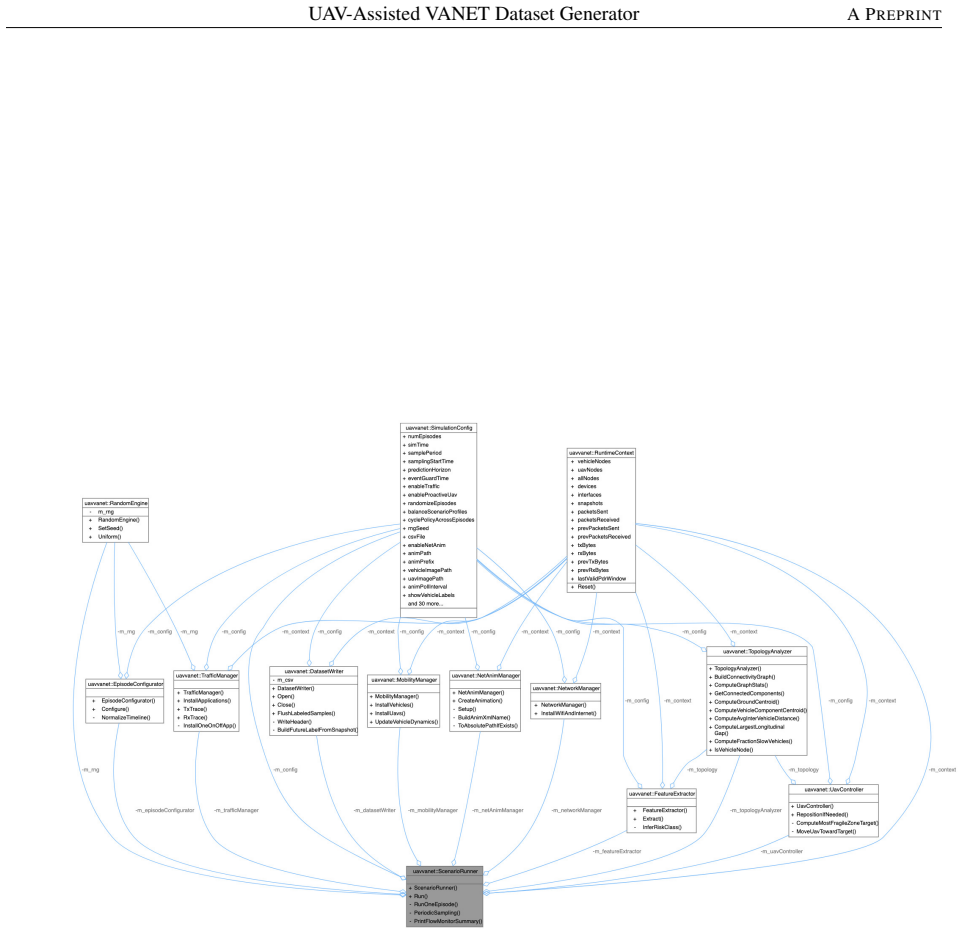
The proposed framework simulates a two-lane highway scenario in which vehicles move in opposite directions while UAVs operate as aerial support nodes. It incorporates multiple data collection profiles, including free-flow traffic, localized accidents, sparse extended topologies, dense bursty traffic, and mixed stress conditions. During each simulation episode, the generator periodically extracts mobility, topology, UAV coverage, and communication-window features, then assigns each sample a future fragmentation label based on the network state observed after a configurable prediction horizon.
What carries the argument
The ns-3-based simulation engine running configurable highway episodes that extract feature vectors and attach future fragmentation labels according to a user-specified prediction horizon across five traffic profiles.
If this is right
- Supervised models can be trained directly on the generated samples to forecast fragmentation risk several seconds ahead.
- Different UAV placement policies can be compared by measuring how each policy shifts the distribution of future labels.
- The modular structure permits addition of new traffic patterns or feature extractors without rebuilding the core generator.
- Connectivity management algorithms can be evaluated offline using the labeled traces before field deployment.
Where Pith is reading between the lines
- Datasets produced by the generator could serve as benchmarks for comparing alternative prediction horizons or feature sets.
- Transfer from simulated labels to real-world performance would need separate validation against instrumented vehicle fleets.
- The same engine might be extended to output energy or latency metrics alongside fragmentation labels.
- Online use of the generator could support adaptive UAV repositioning when a model signals rising fragmentation probability.
Load-bearing premise
The simulated vehicle movements, UAV placements, and resulting connectivity patterns match the fragmentation dynamics that would appear in actual roadside deployments.
What would settle it
Running the same traffic and UAV trajectories in a physical testbed and checking whether the observed fragmentation events match the labels assigned by the simulator at the chosen prediction horizon.
Figures
read the original abstract
Vehicular Ad Hoc Networks (VANETs) are a key component of Intelligent Transportation Systems, enabling cooperative communication among vehicles and between vehicles and roadside infrastructure. However, their highly dynamic topology makes them vulnerable to network fragmentation, particularly in highway scenarios, low-density traffic conditions, localized accident zones, and communication-stressed environments. Although Unmanned Aerial Vehicles (UAVs) have been increasingly investigated as temporary aerial relays for improving VANET connectivity, reusable, future-labeled, and reproducible datasets designed to support short-term fragmentation risk analysis remain limited. This paper proposes a reproducible UAV-assisted VANET dataset generator for short-term fragmentation risk prediction. The proposed framework simulates a two-lane highway scenario in which vehicles move in opposite directions while UAVs operate as aerial support nodes. It incorporates multiple data collection profiles, including free-flow traffic, localized accidents, sparse extended topologies, dense bursty traffic, and mixed stress conditions. During each simulation episode, the generator periodically extracts mobility, topology, UAV coverage, and communication-window features, then assigns each sample a future fragmentation label based on the network state observed after a configurable prediction horizon. An illustrative generated dataset is descriptively characterized in terms of scenario balance, UAV policy balance, future-label distribution, scenario-specific label behavior, and representative feature ranges. By providing a modular, extensible, and reproducible ns-3-based data-generation framework, this work offers a practical basis for future supervised learning studies and connectivity management strategies in UAV-assisted VANETs.
Editorial analysis
A structured set of objections, weighed in public.
Referee Report
Summary. The paper presents a modular, extensible ns-3-based generator for UAV-assisted VANET datasets on a two-lane highway. It simulates multiple traffic profiles (free-flow, accidents, sparse, dense, mixed), periodically extracts mobility/topology/UAV-coverage/communication-window features, and assigns future fragmentation labels using a configurable prediction horizon. An illustrative dataset is characterized descriptively by scenario balance, UAV policy balance, label distribution, and feature ranges; the work positions the framework as a reproducible basis for supervised learning on fragmentation risk.
Significance. If the generator is implemented exactly as described and released with code and configuration files, the contribution supplies a practical, reusable pipeline that can accelerate supervised-learning studies on UAV-assisted VANET connectivity. The explicit reproducibility emphasis and the separation of scenario profiles from labeling logic are genuine strengths that address a documented scarcity of future-labeled VANET datasets.
major comments (2)
- [Abstract / Dataset characterization] Abstract and § on dataset characterization: no validation results, error analysis, or comparison against real-world traces or existing mobility models are supplied, so the claim that the generated labels form a 'practical basis for … supervised learning studies' on fragmentation risk cannot be assessed.
- [Methodology / Labeling procedure] Methodology (simulation and labeling pipeline): the central assumption that the chosen mobility, topology, and UAV-coverage models plus the future-label assignment accurately reflect real-world fragmentation dynamics is stated without sensitivity analysis to the free parameters (prediction horizon, UAV policy parameters) or any discussion of model fidelity.
minor comments (1)
- [Figures / Tables] Figure captions and table headings could more explicitly link each extracted feature to the ns-3 module or trace file that produces it.
Simulated Author's Rebuttal
We thank the referee for the constructive comments. Our responses address the major points by clarifying the scope of the contribution as a reproducible simulation framework and outlining planned revisions to improve clarity on assumptions and limitations.
read point-by-point responses
-
Referee: [Abstract / Dataset characterization] Abstract and § on dataset characterization: no validation results, error analysis, or comparison against real-world traces or existing mobility models are supplied, so the claim that the generated labels form a 'practical basis for … supervised learning studies' on fragmentation risk cannot be assessed.
Authors: We agree that no real-world validation, error analysis, or comparisons to traces or other mobility models are provided. The manuscript's contribution is the ns-3-based generator itself, with emphasis on modularity, extensibility, and reproducibility via released code and configurations. The abstract claim refers to this framework supplying a practical basis for future supervised-learning work, not to validated real-world accuracy. We will revise the abstract and dataset characterization section to explicitly state the simulation-based scope, note the lack of real-world validation, and temper the language accordingly. revision: partial
-
Referee: [Methodology / Labeling procedure] Methodology (simulation and labeling pipeline): the central assumption that the chosen mobility, topology, and UAV-coverage models plus the future-label assignment accurately reflect real-world fragmentation dynamics is stated without sensitivity analysis to the free parameters (prediction horizon, UAV policy parameters) or any discussion of model fidelity.
Authors: The central focus is the generator architecture and labeling pipeline description. We acknowledge the absence of sensitivity analysis and explicit model-fidelity discussion. In revision we will add a new subsection on modeling assumptions (drawing from standard ns-3 modules for mobility and UAV coverage), their known limitations, and sensitivity results for the prediction horizon and UAV policy parameters, thereby addressing model fidelity. revision: yes
Circularity Check
No significant circularity
full rationale
The manuscript presents an ns-3 simulation pipeline that generates labeled datasets by directly executing user-specified mobility, topology, UAV coverage, and future-labeling rules; no equations, fitted parameters, or predictions are claimed to be derived from first principles or prior results. All outputs are defined by construction from the input scenario parameters and simulation configuration, with no self-definitional loops, fitted-input predictions, or load-bearing self-citations. The work is therefore self-contained as a reproducible generator rather than a derivation whose central claim reduces to its own inputs.
Axiom & Free-Parameter Ledger
free parameters (2)
- prediction horizon
- UAV policy parameters
axioms (1)
- domain assumption ns-3 mobility and propagation models faithfully reproduce highway VANET dynamics
Reference graph
Works this paper leans on
-
[1]
Vaishali Pawar, Nilima Zade, Deepali V ora, Vaishali Khairnar, Aurenice Oliveira, Ketan Kotecha, and Ambarish Kulkarni. Intelligent transportation system with 5g vehicle-to-everything (V2X): Architectures, vehicular use cases, emergency vehicles, current challenges, and future directions.IEEE Access, 12:183937–183960, 2024. doi:10.1109/ACCESS.2024.3506815
-
[2]
Hamayoun Shahwani, Syed Attique Shah, Muhammad Ashraf, Muhammad Akram, Jaehoon Paul Jeong, and Jitae Shin. A comprehensive survey on data dissemination in vehicular ad hoc networks.V ehicular Communications, 34:100420, 2022. doi:10.1016/j.vehcom.2021.100420
-
[3]
P. C. Neelakantan and A. V . Babu. Connectivity analysis of vehicular ad hoc networks from a physical layer perspective.Wireless Personal Communications, 71(1):45–70, 2013. doi:10.1007/s11277-012-0795-z
-
[4]
Muhammad Mansoor Ashraf, Saadi Boudjit, Sherali Zeadally, Nour El Houda Bahloul, and Nouman Bashir. Inte- grating unmanned aerial vehicles (UA Vs) with vehicular ad hoc networks (V ANETs): Architectures, applications, and opportunities.Computer Networks, 255:110873, 2024. doi:10.1016/j.comnet.2024.110873
-
[5]
Samkit Jain, Vinod Kumar Jain, and Subodh Mishra. An efficient multi-objective UA V-assisted RSU deployment (MOURD) scheme for V ANET.Ad Hoc Networks, 163:103598, 2024. doi:10.1016/j.adhoc.2024.103598
-
[6]
Tingting Yuan, Wilson da Rocha Neto, Christian Esteve Rothenberg, Katia Obraczka, Chadi Barakat, and Thierry Turletti. Machine learning for next-generation intelligent transportation systems: A survey.Transactions on Emerging Telecommunications Technologies, 33(4):e4427, 2022. doi:10.1002/ett.4427
-
[7]
George F. Riley and Thomas R. Henderson. The ns-3 network simulator. InModeling and Tools for Network Simulation, pages 15–34. Springer, 2010. doi:10.1007/978-3-642-12331-3_2
-
[8]
SUMO–simulation of urban mobility: An overview
Michael Behrisch, Laura Bieker, Jakob Erdmann, and Daniel Krajzewicz. SUMO–simulation of urban mobility: An overview. InProceedings of SIMUL 2011, the Third International Conference on Advances in System Simulation. ThinkMind, 2011. 24 UA V-Assisted V ANET Dataset GeneratorA PREPRINT
2011
-
[9]
Arijit Dutta, Luis Miguel Samaniego Campoverde, Mauro Tropea, and Floriano De Rango. A comprehensive review of recent developments in V ANET for traffic, safety & remote monitoring applications.Journal of Network and Systems Management, 32(4):73, 2024. doi:10.1007/s10922-024-09853-5
-
[10]
Connectivity analysis in V ANETs with dynamic ranges.Telecom, 6(2):33, 2025
Kenneth Okello, Elijah Mwangi, and Ahmed H Abd El-Malek. Connectivity analysis in V ANETs with dynamic ranges.Telecom, 6(2):33, 2025. doi:10.3390/telecom6020033
-
[11]
Xinrui Gu, Shengfeng Wang, Zhiqing Wei, and Zhiyong Feng. Cluster-based RSU deployment strategy for vehicular ad hoc networks with integration of communication, sensing and computing.Journal of Information and Intelligence, 2(4):325–338, 2024. doi:10.1016/j.jiixd.2024.02.002
-
[12]
Network partitioning problem and UA Vs’ integration for efficient connectivity restoration: A systematic review.International Journal of Communication Systems, 38(3):e6107,
Aditi Zear, Virender Ranga, and Kriti Bhushan. Network partitioning problem and UA Vs’ integration for efficient connectivity restoration: A systematic review.International Journal of Communication Systems, 38(3):e6107,
-
[13]
doi:10.1002/dac.6107
-
[14]
Flying to the res- cue: UA V-assisted urgent alert transmission in V ANET
Leila Bouchrit, Sajeh Zairi, Ikbal C Msadaa, Amine Dhraief, and Kahlil Drira. Flying to the res- cue: UA V-assisted urgent alert transmission in V ANET. In2023 IEEE International Conference on Enabling Technologies: Infrastructure for Collaborative Enterprises (WETICE), pages 1–6. IEEE, 2023. doi:10.1109/WETICE57085.2023.10477830
-
[15]
Sethu Narayanan K, Manu Prakash M, Vetrivelan P, and Ajeyprasaath KB. Integrated V ANETs and FANETs driven multimodal smart transportation system for delivery.IETE Journal of Research, 71(2):492–498, 2025. doi:10.1080/03772063.2024.2420741
-
[16]
Meixin Ye, Zhenfeng Zhou, Lijun Zhu, Fanghui Huang, Tao Li, Dawei Wang, Yi Jin, and Yixin He. Improving transmission in integrated unmanned aerial vehicle–intelligent connected vehicle networks with selfish nodes using opportunistic approaches.Drones, 9(1):12, 2025. doi:10.3390/drones9010012
-
[17]
Kanwal Rashid, Yousaf Saeed, Abid Ali, Faisal Jamil, Reem Alkanhel, and Ammar Muthanna. An adaptive real-time malicious node detection framework using machine learning in vehicular ad-hoc networks (V ANETs). Sensors, 23(5):2594, 2023. doi:10.3390/s23052594
-
[18]
Umesh Bodkhe and Sudeep Tanwar. Indian sumo traffic scenario-based misbehaviour detection dataset for connected vehicles.Multimodal Transportation, 4(1):100148, 2025. doi:10.1016/j.multra.2024.100148
-
[19]
Thuvva Anjali, Rajeev Goyal, and GN Balaji. X-gevon-a novel explainable intelligent network to detect the multiple attacks in vanet systems.Discover Computing, 28(1):185, 2025. doi:10.1007/s10791-025-09696-x
-
[20]
Secil Ercan, Marwane Ayaida, and Nadhir Messai. Misbehavior detection for position falsification attacks in V ANETs using machine learning.IEEE Access, 10:1893–1904, 2022. doi:10.1109/ACCESS.2021.3136706
-
[21]
Himanshu Setia, Amit Chhabra, Sunil K Singh, Sudhakar Kumar, Sarita Sharma, Varsha Arya, Brij B Gupta, and Jinsong Wu. Securing the road ahead: Machine learning-driven DDoS attack detection in V ANET cloud environments.Cyber Security and Applications, 2:100037, 2024. doi:10.1016/j.csa.2024.100037
-
[22]
Onur Polat, Saadin Oyucu, Muammer Türko ˘glu, Hüseyin Polat, Ahmet Aksoz, and Fahri Yardımcı. Hybrid AI-powered real-time distributed denial of service detection and traffic monitoring for software-defined-based vehicular ad hoc networks: A new paradigm for securing intelligent transportation networks.Applied Sciences, 14 (22):10501, 2024. doi:10.3390/app...
-
[23]
RSU-based online intrusion detection and mitigation for V ANET.Sensors, 22 (19):7612, 2022
Ammar Haydari and Yasin Yilmaz. RSU-based online intrusion detection and mitigation for V ANET.Sensors, 22 (19):7612, 2022. doi:10.3390/s22197612
-
[24]
R Gopi, Mahantesh Mathapati, B Prasad, Ahmad Sultan, Fahd N Al-Wesabi, Manal Abdullah Alohali, and Anwer Mustafa Hilal. Intelligent DoS attack detection with congestion control technique for V ANETs.Computers, Materials, & Continua, 72(1):141–156, 2022. doi:10.32604/cmc.2022.023306
-
[25]
Muawia A Elsadig, Abdelrahman Altigani, Yasir Mohamed, Abdul Hakim Mohamed, Akbar Kannan, Mohamed Bashir, and Mousab AE Adiel. Connected vehicles security: A lightweight machine learning model to detect V ANET attacks.World Electric V ehicle Journal, 16(6):324, 2025. doi:10.3390/wevj16060324. 25 UA V-Assisted V ANET Dataset GeneratorA PREPRINT A Comparati...
-
[26]
Review of 5G-enabled V2X architectures and vehicular communication requirements
5G V2X architectures, emergency vehicle communication, cooperative driving, and ITS use cases. Review of 5G-enabled V2X architectures and vehicular communication requirements. No Supports the need for reliable and low-latency vehicular communication, but does not address fragmentation prediction or supervised dataset generation
-
[27]
Review and taxonomy of UA V–V ANET integration ap- proaches
UA V integration with V ANETs, including architectures, applications, and open challenges. Review and taxonomy of UA V–V ANET integration ap- proaches. Yes Establishes UA Vs as promising aerial relays for V ANETs, but does not propose a reproducible generator for fragmentation risk forecasting
-
[28]
Review of V ANET communication technologies, routing, clustering, monitoring, and service support mechanisms
V ANET connectivity, safety applications, traffic monitoring, and remote sensing services. Review of V ANET communication technologies, routing, clustering, monitoring, and service support mechanisms. No Highlights the importance of connectivity-aware V ANET design, but does not provide a reusable simulation-based dataset generator for future fragmentatio...
-
[29]
Analytical connectivity modeling considering variable radio range, fading, and communication uncertainty
V ANET connectivity analysis under dynamic communication ranges. Analytical connectivity modeling considering variable radio range, fading, and communication uncertainty. No Shows that V ANET fragmentation cannot be analyzed only through graph proxim- ity; however, it does not generate future-labeled fragmentation datasets
-
[30]
Road-network-based RSU deployment model using hierarchi- cal placement criteria
Cluster-based RSU deployment integrating communication, sensing, and computing. Road-network-based RSU deployment model using hierarchi- cal placement criteria. No Demonstrates the impact of road topology and infrastructure placement on con- nectivity, but focuses on fixed RSUs rather than UA V-assisted predictive dataset generation
-
[31]
Systematic review of partition detection, recovery, and UA V- assisted reconnection mechanisms
Network partitioning and UA V-based connectiv- ity restoration. Systematic review of partition detection, recovery, and UA V- assisted reconnection mechanisms. Yes Treats fragmentation as a network partitioning problem, but focuses on recovery after disconnection rather than predicting future fragmentation before performance collapse
-
[32]
UA V–V ANET highway communication scenario for urgent message dissemination
UA V-assisted urgent alert transmission in sparse rural highway V ANETs. UA V–V ANET highway communication scenario for urgent message dissemination. Yes Demonstrates that UA V relays can mitigate sparse highway connectivity gaps, but does not construct labeled datasets for short-term fragmentation prediction
-
[33]
System-level integration of vehicular and flying ad hoc networks for smart transportation services
Integrated V ANET–FANET multimodal smart transportation for delivery services. System-level integration of vehicular and flying ad hoc networks for smart transportation services. Yes Reflects the convergence of vehicular and aerial networks, but remains service- oriented rather than dataset-oriented for fragmentation risk analysis
-
[34]
UA V-assisted vehicular delay-tolerant network model with opportunistic transmission
Transmission improvement in integrated UA V– Intelligent Connected Vehicle networks. UA V-assisted vehicular delay-tolerant network model with opportunistic transmission. Yes Addresses intermittent connectivity and delivery performance, but does not provide reusable supervised learning data for future fragmentation prediction
-
[35]
OMNeT++ and SUMO-based V ANET simulation traces for machine learning-based malicious node detection
Adaptive real-time malicious node detection in V ANETs. OMNeT++ and SUMO-based V ANET simulation traces for machine learning-based malicious node detection. No Shows the usefulness of simulator-derived V ANET datasets for supervised learning, but targets security detection rather than topology degradation or fragmentation forecasting
-
[36]
Ahmedabad SUMO Traffic scenario and AhmST dataset for false data injection and misbehavior classification
SUMO-based misbehavior detection dataset for connected vehicles in an Indian ITS scenario. Ahmedabad SUMO Traffic scenario and AhmST dataset for false data injection and misbehavior classification. No Improves geographical diversity and reproducibility in V ANET datasets, but focuses on misbehavior detection rather than UA V-assisted future fragmentation risk
-
[37]
SUMO, OMNeT++, and Python-based dataset construction with deep learning and explainability
Explainable intelligent network for detecting multiple V ANET attacks. SUMO, OMNeT++, and Python-based dataset construction with deep learning and explainability. No Combines dataset generation, learning, and interpretability, but remains attack- centered and does not define future fragmentation labels
-
[38]
V ANET message and mobility-related features for machine learning-based position falsification detection
Position falsification attack detection in V ANETs. V ANET message and mobility-related features for machine learning-based position falsification detection. No Highlights the value of engineered mobility and position features, but does not address connectivity fragmentation or future-oriented risk labeling
-
[39]
V ANET cloud network-flow data analyzed using machine learning and fuzzification
DDoS attack detection in V ANET cloud environ- ments. V ANET cloud network-flow data analyzed using machine learning and fuzzification. No Demonstrates the effectiveness of learning-based traffic analysis, but does not consider UA V coverage, graph fragmentation indicators, or future disconnection labels
-
[40]
Software-defined V ANET architecture with real-time DDoS detection using 1D-CNN and decision tree models
Hybrid AI-powered DDoS detection and traffic monitoring in SD-V ANETs. Software-defined V ANET architecture with real-time DDoS detection using 1D-CNN and decision tree models. No Shows the value of real-time AI-based V ANET monitoring, but focuses on cyberat- tack detection rather than future fragmentation prediction
-
[41]
Traffic simulation and infrastructure-based monitoring through RSU-supported anomaly detection
RSU-based online intrusion detection and mitigation in V ANETs. Traffic simulation and infrastructure-based monitoring through RSU-supported anomaly detection. No Uses infrastructure monitoring to improve V ANET security, whereas the proposed work emphasizes UA V-assisted topology monitoring and future fragmentation labeling
-
[42]
V ANET simulation environment with optimization and GRU- based DoS detection
DoS attack detection with congestion control in V ANETs. V ANET simulation environment with optimization and GRU- based DoS detection. No Links attacks and congestion to communication degradation, but does not provide a modular future-labeled dataset generator for fragmentation risk
-
[43]
Simulated V ANET security dataset with feature selection, class balancing, and lightweight classification
Lightweight machine learning model for V ANET attack detection. Simulated V ANET security dataset with feature selection, class balancing, and lightweight classification. No Reinforces the importance of preprocessing and feature reduction, but remains security-oriented rather than topology-aware fragmentation forecasting. Proposed work UA V-assisted V ANE...
discussion (0)
Sign in with ORCID, Apple, or X to comment. Anyone can read and Pith papers without signing in.