Optimal Transport Reconstruction of Biased Tracers in Primordial Non-Gaussian Fields
Pith reviewed 2026-06-28 13:35 UTC · model grok-4.3
The pith
Optimal transport reconstruction of initial conditions from biased tracers in local primordial non-Gaussian fields improves when the unseen mass is modeled with its own scale-dependent bias.
A machine-rendered reading of the paper's core claim, the machinery that carries it, and where it could break.
Core claim
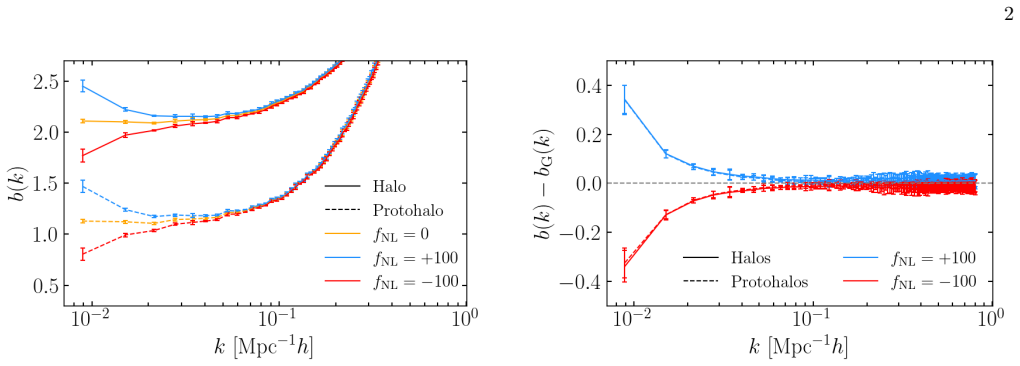
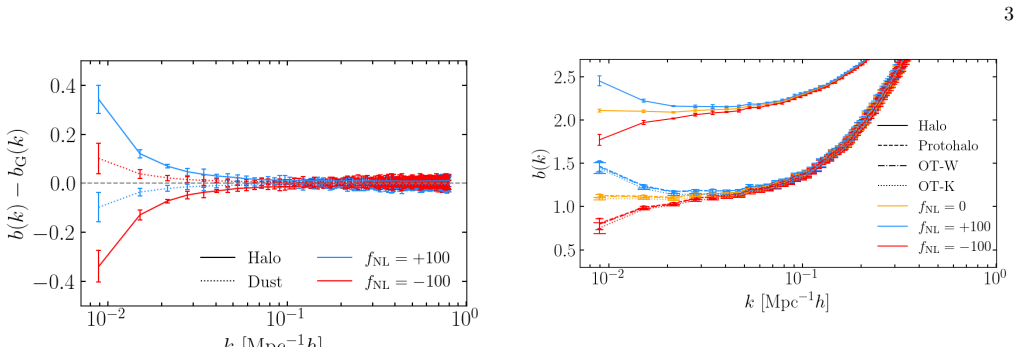
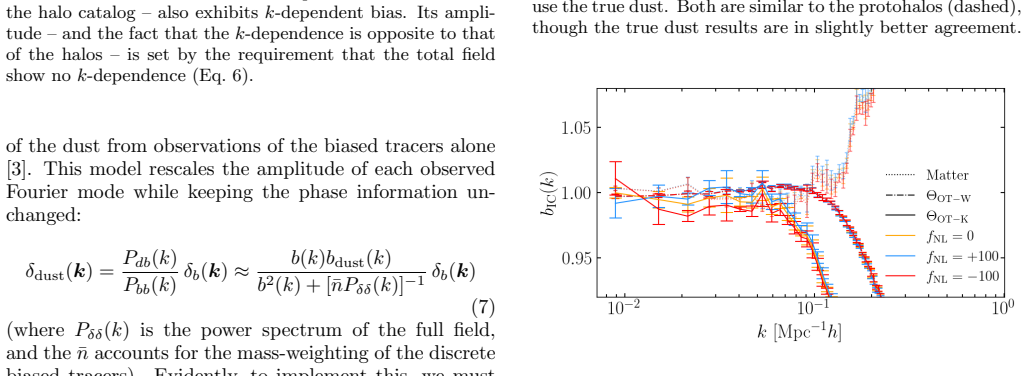
For local primordial non-Gaussianity, the large-scale clustering of biased tracers carries a scale-dependent signature proportional to f_NL times b_phi that is absent from the full matter field. Optimal transport reconstruction exploits this difference by assigning the unseen mass a dust component with its own characteristic scale dependence; the quality of the recovered initial positions improves as the model for this dust is made more realistic.
What carries the argument
The optimal transport map from observed positions of biased tracers to initial positions, extended by treating the unseen mass as dust whose scale-dependent bias compensates for the signature present only in the tracers.
If this is right
- The method recovers initial conditions without requiring the displacement field itself to be Gaussian.
- Reconstruction error decreases once the dust component is assigned a scale-dependent bias whose amplitude differs from that of the tracers.
- The approach isolates the product f_NL times b_phi through the difference between tracer and full-field clustering.
- The reconstruction remains valid for the class of local primordial non-Gaussian models currently of interest in cosmology.
Where Pith is reading between the lines
- Surveys that measure both galaxies and the total mass (via weak lensing or intensity mapping) could supply an empirical dust model that further tightens the reconstruction.
- The same logic may apply to other forms of primordial non-Gaussianity whose bias signatures are also absent from the full field.
- If the dust model can be calibrated on small scales where non-Gaussian effects are weaker, the method could be applied to progressively larger survey volumes.
Load-bearing premise
The scale-dependent clustering signature induced by local non-Gaussianity is present in biased tracers but absent from the complete matter field.
What would settle it
A set of N-body simulations with known local non-Gaussian initial conditions in which the reconstruction error on the initial displacement field fails to decrease when the dust model is switched from a constant bias to a scale-dependent bias matching the full field.
Figures
read the original abstract
Optimal transport provides an efficient method to infer the displacement of objects by mapping their initial positions to their present-day locations over cosmic time; equivalently, it enables the reconstruction of initial positions from measurements taken at later times. The method has been shown to be accurate even if positions for only a biased subset of the particles are measured, provided that the initial displacement field was Gaussian. The method does not rely on the assumption of a Gaussian displacement field, and thus may be extended to the reconstruction of non-Gaussian initial conditions. Here, we demonstrate how this is achieved for a class of "local" primordial non-Gaussian fields of current interest in cosmology. For these models, there is a distinctive signature in the large scale clustering of biased tracers which depends on the product of the primordial amplitude $f_{\rm NL}$ and the nature of the tracers $b_\phi$. Our method exploits the fact that this signature is not present in the full field; it is only present in biased fields. Therefore, the mass that is not in the biased subset, what we call the "dust", also has a characteristic scale-dependence, albeit of a different amplitude. We show that the quality of the optimal transport reconstruction improves as the model for this dust becomes more realistic.
Editorial analysis
A structured set of objections, weighed in public.
Referee Report
Summary. The manuscript extends optimal transport reconstruction of initial conditions to local primordial non-Gaussianity (PNG) models. It exploits the absence of the f_NL b_phi scale-dependent bias signature in the full matter field (present only in biased tracers) to assign a compensating scale dependence to the unobserved 'dust' mass, and claims that reconstruction quality improves as the dust model becomes more realistic.
Significance. If the central result holds, the work provides a mass-conserving, non-Gaussian-displacement extension of OT methods that could improve initial-condition reconstruction for f_NL constraints from biased tracers in large-scale structure surveys. The approach is internally consistent with standard local PNG perturbation theory and does not introduce free parameters or circular definitions.
minor comments (2)
- [Abstract] Abstract: the claim that reconstruction quality 'improves as the model for this dust becomes more realistic' would be strengthened by a quantitative metric (e.g., displacement error or power-spectrum recovery) even in the abstract or a summary table.
- The manuscript should explicitly state the specific local PNG template (e.g., the form of the potential or the bispectrum shape) used in the demonstration to allow direct comparison with existing f_NL forecasts.
Simulated Author's Rebuttal
We thank the referee for the positive assessment of our work and for recommending minor revision. No specific major comments were raised in the report, so we have no point-by-point responses to provide. We will address any minor issues identified during the revision process.
Circularity Check
No significant circularity detected
full rationale
The derivation chain is self-contained and does not reduce any central claim to a fitted parameter, self-definition, or load-bearing self-citation. The method exploits the established distinction from local PNG perturbation theory that the f_NL b_phi scale-dependent bias appears only in biased tracers and is absent from the unbiased matter field at linear order; this is an external input, not derived within the paper. Optimal transport reconstruction is then applied to the complementary dust component with a compensating scale dependence, with no equations shown to be tautological by construction or renamed known results. The abstract and description present an extension that relies on mass conservation and field properties rather than internal fitting loops.
Axiom & Free-Parameter Ledger
invented entities (1)
-
dust
no independent evidence
Reference graph
Works this paper leans on
-
[1]
L´ evy, R
B. L´ evy, R. Mohayaee, and S. von Hausegger,A fast semi-discrete optimal transport algorithm for the unique reconstruction of the early Universe, Tech. Rep. (Univer- sit´ e de Lorraine, CNRS, Inria, Institut d’Astrophysique de Paris, Oxford U., 2020)
2020
-
[2]
F. Nikakhtar, R. K. Sheth, B. L´ evy, and R. Mohayaee, Phys. Rev. Lett.129, 251101 (2022), arXiv:2203.01868 [astro-ph.CO]
arXiv 2022
-
[3]
F. Nikakhtar, N. Padmanabhan, B. L´ evy, R. K. Sheth, and R. Mohayaee, Phys. Rev. D108, 083534 (2023), arXiv:2307.03671 [astro-ph.CO]
arXiv 2023
-
[4]
F. Nikakhtar, R. K. Sheth, N. Padmanabhan, B. L´ evy, and R. Mohayaee, Phys. Rev. D109, 123512 (2024), arXiv:2403.11951 [astro-ph.CO]
arXiv 2024
-
[5]
O. Dor´ e, J. Bock, M. Ashby, P. Capak, A. Cooray, R. de Putter, T. Eifler, N. Flagey, Y. Gong, S. Habib, K. Heit- mann, C. Hirata, W.-S. Jeong, R. Katti, P. Korngut, E. Krause, D.-H. Lee, D. Masters, P. Mauskopf, G. Mel- nick, B. Mennesson, H. Nguyen, K. ¨Oberg, A. Pullen, A. Raccanelli, R. Smith, Y.-S. Song, V. Tolls, S. Unwin, T. Venumadhav, M. Viero, ...
Pith/arXiv arXiv 2014
-
[6]
E. Chaussidon, C. Y` eche, A. de Mattia, C. Pay- erne, P. McDonald, A. J. Ross, S. Ahlen, D. Bianchi, D. Brooks, E. Burtin, T. Claybaugh, A. de la Ma- corra, P. Doel, S. Ferraro, A. Font-Ribera, J. E. Forero- Romero, E. Gazta˜ naga, H. Gil-Mar´ ın, S. G. A. Gontcho, G. Gutierrez, J. Guy, K. Honscheid, C. Howlett, D. Huterer, R. Kehoe, D. Kirkby, T. Kisner...
arXiv 2025
-
[7]
Constraining primordial non-gaussianity from desi dr1 quasars and planck pr4 cmb lensing,
S. Chiarenza, A. Krolewski, M. Bonici, E. Chaussidon, R. de Belsunce, W. Percival, J. N. Aguilar, S. Ahlen, A. B. Lizancos, D. Bianchi, D. Brooks, T. Claybaugh, A. Cuceu, K. Dawson, A. de la Macorra, P. Doel, S. Fer- raro, A. Font-Ribera, J. E. Forero-Romero, E. Gaz- ta˜ naga, S. G. A. Gontcho, G. Gutierrez, H. K. Herrera- Alcantar, K. Honscheid, D. Huter...
Pith/arXiv arXiv 2025
- [8]
-
[9]
Brenier, U
Y. Brenier, U. Frisch, M. H´ enon, G. Loeper, S. Matarrese, R. Mohayaee, and A. Sobolevskii, Mon. Not. R. Astron. Soc.346(2003)
2003
-
[10]
R. Mohayaee, H. Mathis, S. Colombi, and J. Silk, Mon. Not. R. Astron. Soc.365, 939 (2006), arXiv:astro- ph/0501217 [astro-ph]
arXiv 2006
-
[11]
L´ evy, ESAIM M2AN (Mathematical Modeling and Analysis) (2015)
B. L´ evy, ESAIM M2AN (Mathematical Modeling and Analysis) (2015)
2015
-
[12]
S. von Hausegger, B. L´ evy, and R. Mohayaee, Phys. Rev. Lett.128, 201302 (2022), arXiv:2110.08868 [astro- ph.CO]
arXiv 2022
-
[13]
R. K. Sheth and G. Tormen, Mon. Not. R. Astron. Soc. 308, 119 (1999), arXiv:astro-ph/9901122 [astro-ph]
Pith/arXiv arXiv 1999
-
[14]
N. Dalal, O. Dor´ e, D. Huterer, and A. Shirokov, Phys. Rev. D77, 123514 (2008), arXiv:0710.4560 [astro-ph]
Pith/arXiv arXiv 2008
-
[15]
W. R. Coulton, F. Villaescusa-Navarro, D. Jamieson, M. Baldi, G. Jung, D. Karagiannis, M. Liguori, L. Verde, and B. D. Wandelt, The Astrophysical Journal943, 64 (2023)
2023
-
[16]
N. Hamaus, U. Seljak, and V. Desjacques, Phys. Rev. D 84, 083509 (2011), arXiv:1104.2321 [astro-ph.CO]
Pith/arXiv arXiv 2011
-
[17]
H. J. Mo and S. D. M. White, Mon. Not. R. Astron. Soc. 282, 347 (1996), arXiv:astro-ph/9512127 [astro-ph]
Pith/arXiv arXiv 1996
-
[18]
V. Desjacques, M. Crocce, R. Scoccimarro, and R. K. Sheth, Phys. Rev. D82, 103529 (2010), arXiv:1009.3449 [astro-ph.CO]
Pith/arXiv arXiv 2010
-
[19]
P. Ganeshaiah Veena, R. Lilow, and A. Nusser, Mon. Not. R. Astron. Soc.522, 5291 (2023), arXiv:2212.06439 [astro-ph.CO]
arXiv 2023
discussion (0)
Sign in with ORCID, Apple, or X to comment. Anyone can read and Pith papers without signing in.