Single-Photon Infrared Imaging with a Silicon Camera Based on Long-Wavelength-Pumping Two-Photon Absorption
Pith reviewed 2026-06-28 13:34 UTC · model grok-4.3
The pith
A silicon EMCCD camera detects single telecom photons via long-wavelength-pumped non-degenerate two-photon absorption.
A machine-rendered reading of the paper's core claim, the machinery that carries it, and where it could break.
Core claim
The authors experimentally demonstrate an ultra-sensitive imaging system for telecom photons based on the non-degenerate two-photon absorption in a silicon-based EMCCD. The proposed long-wavelength-pumping scheme with mid-infrared pulsed excitation could not only effectively increase the two-photon absorption coefficient, but also significantly suppress the background noise caused by the harmonic absorption of the strong pumping field. In comparison to the photoelectric response via the degenerate two-photon absorption, the implemented configuration could offer over 30-folded enhancement of the photon-counting rate in the infrared imaging. The resulting detection sensitivity up to 1 photon/p
What carries the argument
long-wavelength-pumping non-degenerate two-photon absorption in a silicon EMCCD
Load-bearing premise
The observed counting-rate increase and noise suppression are caused by the long-wavelength-pumping non-degenerate two-photon absorption mechanism rather than by unstated changes in alignment, pump intensity, or sensor settings.
What would settle it
A side-by-side measurement of counting rate with the mid-infrared pump on versus off, while holding alignment, intensity, and camera settings fixed, would show whether the claimed 30-fold gain arises from the proposed absorption process.
Figures


read the original abstract
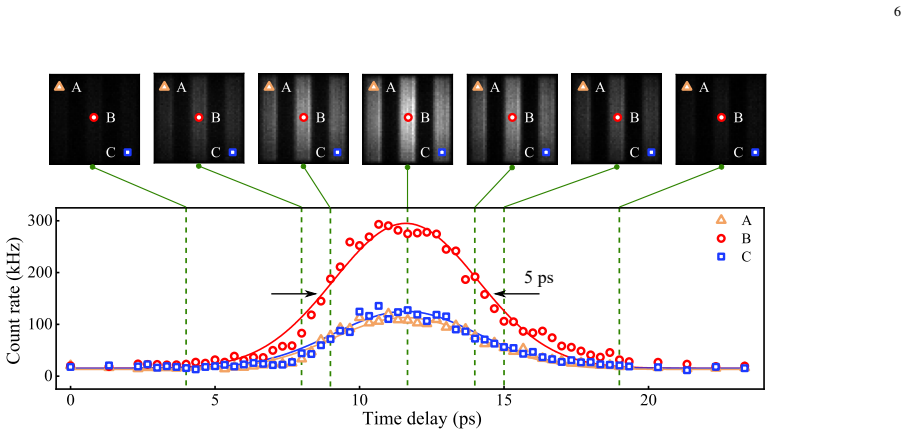
We experimentally demonstrated an ultra-sensitive imaging system for telecom photons based on the non-degenerate two-photon absorption in a silicon-based electron multiplying charge-coupled device (EMCCD). The proposed long-wavelength-pumping scheme with mid-infrared pulsed excitation could not only effectively increase the two-photon absorption coefficient, but also significantly suppress the background noise caused by the harmonic absorption of the strong pumping field. In comparison to the photoelectric response via the degenerate two-photon absorption, the implemented configuration could offer over 30-folded enhancement of the photon-counting rate in the infrared imaging. The resulting detection sensitivity up to 1 photon/pixel/pulse was unprecedentedly approached, thus facilitating the single-photon operation. The elimination of the stringent phase matching as typically required in the optical parametric conversion has led to a high spatial resolution of 13 $\mu$m. Moreover, the on-chip nonlinearity of the optical imager would enable a broadband spectral window and an enlarged field of view. In combination with the 5-ps temporal resolution due to the coincident optical gating, the presented imaging system would find various promising applications, such as low-light fluorescence lifetime microscopy and photon counting time-of-flight 3D imaging.
Editorial analysis
A structured set of objections, weighed in public.
Referee Report
Summary. The manuscript experimentally demonstrates an ultra-sensitive telecom-photon imaging system based on non-degenerate two-photon absorption (TPA) in a silicon EMCCD camera using long-wavelength mid-infrared pulsed pumping. It reports that this scheme increases the TPA coefficient while suppressing harmonic-absorption noise, yielding >30-fold enhancement of the photon-counting rate relative to degenerate TPA, a detection sensitivity of 1 photon/pixel/pulse, 13 μm spatial resolution, and 5 ps temporal resolution via optical gating, thereby enabling single-photon operation without phase-matching constraints.
Significance. If the reported sensitivity and enhancement are substantiated by quantitative controls and raw data, the work would constitute a notable experimental advance in on-chip nonlinear infrared imaging. The elimination of phase-matching requirements, combined with silicon-camera compatibility, broadband operation, and large field of view, could open practical routes to single-photon IR detection for applications such as fluorescence lifetime microscopy and time-of-flight imaging.
major comments (2)
- [Abstract] Abstract: the central claims of 'over 30-folded enhancement of the photon-counting rate' and 'detection sensitivity up to 1 photon/pixel/pulse' are stated without accompanying raw counts, error bars, statistical tests, or calibrated before/after data, preventing independent evaluation of the sensitivity figure.
- [Abstract] Abstract: the attribution of the observed rate increase and noise reduction specifically to the long-wavelength-pumping non-degenerate TPA mechanism (larger β and suppressed harmonic absorption) is not supported by quantitative controls that hold total intensity, beam overlap, alignment, and EMCCD gain/settings fixed between the degenerate and non-degenerate cases; without such isolation the 30-fold claim cannot be assigned to the proposed mechanism.
minor comments (1)
- [Abstract] Abstract: '30-folded' is nonstandard; '30-fold' is the conventional phrasing.
Simulated Author's Rebuttal
We thank the referee for the constructive comments on our manuscript. We agree that the abstract claims require stronger quantitative support and explicit controls to substantiate the mechanism. We will revise the manuscript to address these points directly.
read point-by-point responses
-
Referee: [Abstract] Abstract: the central claims of 'over 30-folded enhancement of the photon-counting rate' and 'detection sensitivity up to 1 photon/pixel/pulse' are stated without accompanying raw counts, error bars, statistical tests, or calibrated before/after data, preventing independent evaluation of the sensitivity figure.
Authors: We accept this criticism. The abstract is intentionally concise, but the supporting data (raw counts, error bars, and calibrated measurements) appear in the main text and figures. In the revised version we will modify the abstract to include explicit references to these quantitative results and add a brief statement of the statistical basis for the 1 photon/pixel/pulse figure. revision: yes
-
Referee: [Abstract] Abstract: the attribution of the observed rate increase and noise reduction specifically to the long-wavelength-pumping non-degenerate TPA mechanism (larger β and suppressed harmonic absorption) is not supported by quantitative controls that hold total intensity, beam overlap, alignment, and EMCCD gain/settings fixed between the degenerate and non-degenerate cases; without such isolation the 30-fold claim cannot be assigned to the proposed mechanism.
Authors: We agree that the attribution requires explicit isolation of variables. The current manuscript presents comparative data but does not include a dedicated control experiment holding total intensity, overlap, alignment, and camera settings strictly fixed. We will add this control measurement (or a clear supplementary figure) in the revision so that the 30-fold enhancement can be unambiguously assigned to the non-degenerate long-wavelength-pumping scheme. revision: yes
Circularity Check
No derivation chain present; experimental demonstration is self-contained
full rationale
The paper is an experimental report on measured photon-counting enhancements in an EMCCD camera using non-degenerate TPA. No equations, models, or fitted parameters are introduced that could reduce to their own inputs. Claims rest on observed counts rather than any predictive derivation, self-citation load-bearing step, or ansatz. This matches the most common honest finding of no circularity.
Axiom & Free-Parameter Ledger
Reference graph
Works this paper leans on
-
[1]
Single-photon detectors for optical quantum infor- mation applications,
R. H. Hadfield, “Single-photon detectors for optical quantum infor- mation applications,”Nat. Photon., vol. 3, no. 12, pp. 696-705, Dec. 2009
2009
-
[2]
Invited Review Article: Single-photon sources and detectors,
M. D. Eisaman, J. Fan, A. Migdall, and S. V . Polyakov, “Invited Review Article: Single-photon sources and detectors,”Rev. Sci. Instrum., vol. 82, no. 7, pp. 071101, Jul. 2011
2011
-
[3]
Advances in InGaAs/InP single-photon detector systems for quantum communica- tion,
J. Zhang, M. A. Itzler, H. Zbinden, and J.-W. Pan, “Advances in InGaAs/InP single-photon detector systems for quantum communica- tion,”Light Sci. Appl., vol. 4, no. 5, pp. e286-e286, May. 2015
2015
-
[4]
Monolithic germanium/silicon avalanche photodiodes with 340 GHz gain band- width product,
Y . Kang, H. Liu, M. Morse, M. J. Paniccia, M. Zadka, S. Litski, G. Sarid, A. Pauchard, Y . Kuo, H. Chen, W. S. Zaoui, J. E. Bowers, A. Beling, D. C. McIntosh, X. Zheng, and J. C. Campbell, “Monolithic germanium/silicon avalanche photodiodes with 340 GHz gain band- width product,”Nat. Photon., vol. 3, no. 1, pp. 59-63, Jan. 2009
2009
-
[5]
Waveguide integrated balanced photodetectors for coherent receivers,
P. Runge, G. Zhou, T. Beckerwerth, F. Ganzer, S. Keyvaninia, S. Seifert, W. Ebert, S. Mutschall, A. Seeger and M. Schell, “Waveguide integrated balanced photodetectors for coherent receivers,”IEEE J. Sel. Top. Quant., vol. 24, no. 2, pp. 1-7, Jul. 2017. 6 5 ps Fig. 7. Detected count rates for three selected pixels vary as a function of the temporal delay ...
2017
-
[6]
Highly sensitive photodetector using ultra-high-density 1.5𝜇m quantum dots for advanced optical fiber communications,
T. Umezawa, K. Akahane, N. Yamamoto, A. Kanno, and T. Kawan- ishi, “Highly sensitive photodetector using ultra-high-density 1.5𝜇m quantum dots for advanced optical fiber communications,”IEEE J. Sel. Top. Quant., vol. 20, no. 6, pp. 147-153, Nov.-Dec. 2014
2014
-
[7]
Silicon single-photon avalanche diodes with nano-structured light trapping
K. Zang, X. Jiang, Y . Huo, X. Ding, M. Morea, X. Chen, C. Lu, J. Ma, M. Zhou, Z. Xia, Z. Yu, T. I. Kamins, Q. Zhang, and J. S. Harris, “Silicon single-photon avalanche diodes with nano-structured light trapping.”Nat. Commun., vol. 8, no. 1, pp. 628, Dec. 2017
2017
-
[8]
Enhanced small-signal responsivity in silicon microring photodetector based on two-photon absorption,
Y . Ren and V . Van, “Enhanced small-signal responsivity in silicon microring photodetector based on two-photon absorption,”IEEE J. Sel. Top. Quant., vol. 26, no. 2, pp. 1-8, Mar. 2019
2019
-
[9]
Ultra- low noise single-photon detector based on Si avalanche photodiode,
Y .-S. Kim, Y .-C. Jeong, S. Sauge, V . Makarov, and Y .-H. Kim, “Ultra- low noise single-photon detector based on Si avalanche photodiode,” Rev. Sci. Instrum., vol. 82, no. 9, pp. 093110, Sep. 2011
2011
-
[10]
Recent advances in avalanche photodiodes,
J. C. Campbell, “Recent advances in avalanche photodiodes,”J. Light- wave Technol., vol. 34, no. 2, pp. 278-285, Jan. 2016
2016
-
[11]
Single-photon avalanche diode imagers in biophotonics: review and outlook,
C. Bruschini, H. Homulle, I. M. Antolovic, S. Burri, and E. Charbon, “Single-photon avalanche diode imagers in biophotonics: review and outlook,”Light Sci. Appl., vol. 8, no. 1, pp. 87, Sep. 2019
2019
-
[12]
Single-photon avalanche diode imagers applied to near-infrared imaging,
J. M. Pavia, M. Wolf, and E. Charbon, “Single-photon avalanche diode imagers applied to near-infrared imaging,”IEEE J. Sel. Top. Quant., vol. 20, no. 6, pp. 291-298, Nov. 2014
2014
-
[13]
100 000 Frames/s 64 32 single-photon detector array for 2-D imaging and 3-D ranging,
D. Bronzi, F. Villa, S. Tisa, A. Tosi, F. Zappa, D. Durini, S. Weyers, and W. Brockherde, “100 000 Frames/s 64 32 single-photon detector array for 2-D imaging and 3-D ranging,”IEEE J. Sel. Top. Quantum Electron., vol 20, no. 6, pp. 354-363, Nov. 2014
2014
-
[14]
Few-photon-level two- dimensional infrared imaging by coincidence frequency upconversion,
K. Huang, X. Gu, H. Pan, E. Wu, and H. Zeng, “Few-photon-level two- dimensional infrared imaging by coincidence frequency upconversion,” Appl. Phys. Lett., vol. 100, no. 15, pp. 151102-3, Apr. 2012
2012
-
[15]
Two-photon absorption and Kerr coefficients of silicon for 850-2200nm,
A. D. Bristow, N. Rotenberg, and H. M. van Driel, “Two-photon absorption and Kerr coefficients of silicon for 850-2200nm,”Appl. Phys. Lett., vol. 90, no. 19, pp. 191104, May. 2007
2007
-
[16]
Observation of nondegenerate two-photon gain in GaAs,
M. Reichert, A. L. Smirl, G. Salamo, D. J. Hagan, and E. W. V . Stryland, “Observation of nondegenerate two-photon gain in GaAs,” Phys. Rev. Lett., vol. 117, no. 7, pp. 073602, Aug. 2016
2016
-
[17]
Multiphoton absorption and nonlinear refraction of GaAs in the mid-infrared,
W. C. Hurlbut, Y .-S. Lee, K. L. V odopyanov, P. S. Kuo, and M. M. Fejer, “Multiphoton absorption and nonlinear refraction of GaAs in the mid-infrared,”Opt. Lett., vol. 32, no. 6, pp. 668-670, Mar. 2007
2007
-
[18]
Three photon absorption in silicon for 2300-3300 nm,
S. Pearl, N. Rotenberg, and H. M. van Driel, “Three photon absorption in silicon for 2300-3300 nm,”Appl. Phys. Lett., vol. 93, no. 13, pp. 131102, Sep. 2008
2008
-
[19]
Ultrafast three-photon counting in a photomultiplier tube,
A. Nevet, A. Hayat, and M. Orenstein, “Ultrafast three-photon counting in a photomultiplier tube,”Opt. Lett., vol. 36, no. 5, pp. 725-727, Mar. 2011
2011
-
[20]
A photonic quantum information interface,
S. Tanzilli, W. Tittel, M. Halder, O. Alibart, P. Baldi, N. Gisin, and H. Zbinden, “A photonic quantum information interface,”Nature, vol. 437, no. 7055, pp. 116-120, Sep. 2005
2005
-
[21]
Mid-infrared photon counting and resolving via efficient frequency upconversion,
K. Huang, Y . Wang, J. Fang, W. Kang, Y . Sun, Y . Liang, Q. Hao, M. Yan, and H. Zeng, “Mid-infrared photon counting and resolving via efficient frequency upconversion,”Photonics Res., vol. 9, no. 2, pp. 259-265, Feb. 2021
2021
-
[22]
Parametric upconversion imaging and its applications,
A. Barh, P. J. Rodrigo, L. Meng, C. Pedersen, and P. Tidemand- Lichtenberg, “Parametric upconversion imaging and its applications,” Adv. Opt. Photon., vol. 11, no. 4, pp. 952-1019, Dec. 2019
2019
-
[23]
Mid-infrared two photon absorption sensitivity of commercial detectors,
D. L. Boiko, A. V . Antonov, D. I. Kuritsyn, A. N. Yablonskiy, S. M. Sergeev, E. E. Orlova, and V . V . Vaks, “Mid-infrared two photon absorption sensitivity of commercial detectors,”Appl. Phys. Lett., vol. 111, no. 17, pp. 171102, Oct. 2017
2017
-
[24]
Sensitive mid-infrared detection in wide-bandgap semiconductors using extreme non-degenerate two- photon absorption,
D. A. Fishman, C. M. Cirloganu, S. Webster, L. A. Padilha, M. Monroe, D. J. Hagan, and E. W. Van Stryland, “Sensitive mid-infrared detection in wide-bandgap semiconductors using extreme non-degenerate two- photon absorption,”Nat. Photon., vol. 5, no. 9, pp. 561-565, Sep. 2011
2011
-
[25]
Extremely nondegenerate two-photon absorption in direct-gap semiconductors [Invited],
C. M. Cirloganu, L. A. Padilha, D. A. Fishman, S. Webster, D. J. Hagan, and E. W. Van Stryland, “Extremely nondegenerate two-photon absorption in direct-gap semiconductors [Invited],”Opt. Express, vol. 19, no. 23, pp. 22951-22960, Nov. 2011
2011
-
[26]
Infrared quantum counting by nondegenerate two photon conductivity in GaAs,
F. Boitier, J.-B Dherbecourt, A. Godard, and E. Rosencher, “Infrared quantum counting by nondegenerate two photon conductivity in GaAs,” Appl. Phys. Lett., vol. 94, no. 8, pp. 081112, Feb. 2009
2009
-
[27]
Sensitive infrared photon counting detection by nondegenerate two-photon absorption in Si APD,
G. Xu, X. Ren, Q. Miao, M. Yan, H. Pan, X. Chen, G. Wu, and E. Wu, “Sensitive infrared photon counting detection by nondegenerate two-photon absorption in Si APD,”IEEE Photon. Tech. Lett., vol. 31, no. 24, pp. 1944-1947, Dec. 2019
1944
-
[28]
Three-dimensional IR imaging with uncooled GaN photodiodes using nondegenerate two-photon absorption,
H. S. Pattanaik, M. Reichert, D. J. Hagan, and E. W. Van Stryland, “Three-dimensional IR imaging with uncooled GaN photodiodes using nondegenerate two-photon absorption,”Opt. Express, vol. 24, no. 2, pp. 1196-1205, Jan. 2016
2016
-
[29]
Infrared chemical imaging through non-degenerate two- photon absorption in silicon-based cameras,
D. Knez, A. M. Hanninen, R. C. Prince, E. O. Potma, and D. A. Fishman, “Infrared chemical imaging through non-degenerate two- photon absorption in silicon-based cameras,”Light Sci. Appl., vol. 9, no. 1, pp. 125-134, Jul. 2020
2020
-
[30]
Rapid chemically selective 3D imaging in the mid-infrared with a Si-based camera,
E. O. Potma, D. Knez, Y . Chen, A. Durkin, A. Fast, M. Balu, B. Norton-Baker, T. Baldacchini, R. Martin, and D. A. Fishman, “Rapid chemically selective 3D imaging in the mid-infrared with a Si-based camera,” arXiv:2103.01159, 2021
-
[31]
Highly sensitive detection of infrared photons by nondegenerate two-photon absorption under midinfrared pumping,
J. Fang, Y . Wang, M. Yan, E. Wu, K. Huang, and H. Zeng, “Highly sensitive detection of infrared photons by nondegenerate two-photon absorption under midinfrared pumping,”Phys. Rev. Appl., vol. 14, no. 6, pp. 064035, Dec. 2020
2020
-
[32]
Infrared single-photon detection by two-photon absorption in silicon,
A. Hayat, P. Ginzburg, and M. Orenstein, “Infrared single-photon detection by two-photon absorption in silicon,”Phys. Rev. B, vol. 77, no. 12, pp. 125219, Mar. 2008
2008
-
[33]
Passively synchronized dual-color mode-locked fiber lasers based on nonlinear amplifying loop mirrors,
J. Zeng, B. Li, Q. Hao, M. Yan, K. Huang, and H. Zeng, “Passively synchronized dual-color mode-locked fiber lasers based on nonlinear amplifying loop mirrors,”Opt. Lett., vol 44, no. 20, pp. 5061-5064, Oct. 2019
2019
-
[34]
Highly efficient difference-frequency generation for mid- 7 infrared pulses by passively synchronous seeding,
K. Huang, Y . Wang, J. Fang, H. Chen, M. Xu, Q. Hao, M. Yan, and H. Zeng, “Highly efficient difference-frequency generation for mid- 7 infrared pulses by passively synchronous seeding,”High Power Laser Sci. Eng., vol. 9, pp. e4, 2021
2021
-
[35]
Multi-photon absorption and third-order nonlinearity in silicon at mid-infrared wavelengths,
T. Wang, N. Venkatram, J. Gosciniak, Y . Cui, G. Qian, W. Ji, and D. Tan, “Multi-photon absorption and third-order nonlinearity in silicon at mid-infrared wavelengths,”Opt. Express, vol. 21, no. 26, pp. 32192- 32198, Jan. 2013
2013
-
[36]
Three-photon absorption spectra and bandgap scaling in direct-gap semiconductors,
S. Benis, C. M. Cirloganu, N. Cox, T. Ensley, H. Hu, G. Nootz, P. D. Olszak, L. A. Padilha, D. Peceli, M. Reichert, S. Webster, M. Woodall, D. J. Hagan, and E. W. Van Stryland, “Three-photon absorption spectra and bandgap scaling in direct-gap semiconductors,”Optica, vol. 7, no. 8, pp. 888-899, Aug. 2020
2020
-
[37]
High-speed indoor optical wireless communication system with single channel imaging receiver,
K. Wang, A. Nirmalathas, C. Lim, and E. Skafidas, “High-speed indoor optical wireless communication system with single channel imaging receiver,”Opt. Express, vol. 20, no. 8, pp. 8442-8456, Apr. 2012. Jianan Fangwas born in Zhejiang Province, China, in 1997. He received the B.S. degree from Hangzhou Normal University, Zhejiang, China, in 2019, where he is...
2012
discussion (0)
Sign in with ORCID, Apple, or X to comment. Anyone can read and Pith papers without signing in.