Regularized joint reconstruction and slab combination for accelerated three-dimensional multi-slab diffusion-weighted imaging using multi-scale energy models
Pith reviewed 2026-06-28 12:42 UTC · model grok-4.3
The pith
EPEN jointly reconstructs undersampled multi-slab diffusion MRI volumes and slab profiles via a CNN energy prior to suppress boundary artifacts.
A machine-rendered reading of the paper's core claim, the machinery that carries it, and where it could break.
Core claim
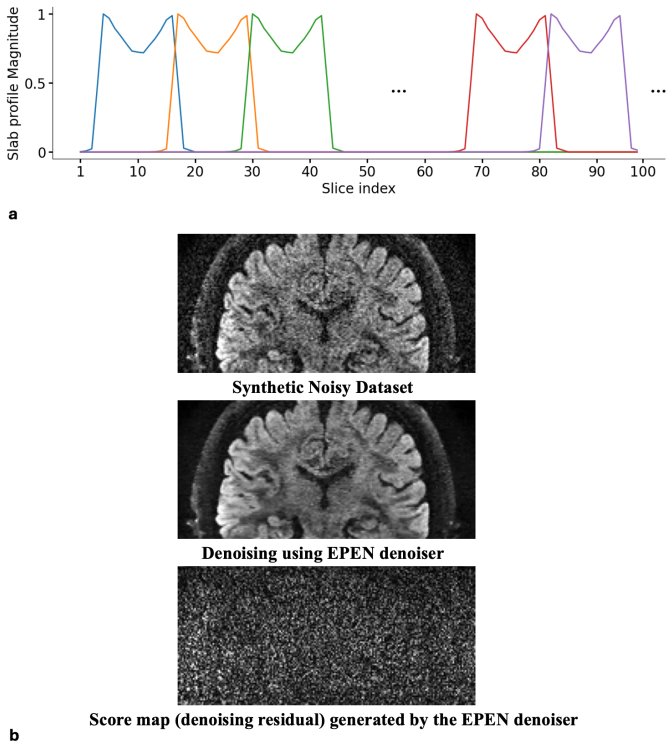
EPEN formulates multi-slab acquisition as a bilinear model with unknown image volume and slab profiles, then solves the resulting MAP objective containing a Gaussian data term, a CNN-based deep energy prior on clean diffusion-weighted images, and quadratic profile regularization. Alternating minimization produces the joint solution, and the learned energy gradient steers the reconstruction toward an artifact-free image distribution.
What carries the argument
The CNN-based deep energy prior that supplies the negative log distribution of clean diffusion-weighted images inside the MAP objective of the bilinear forward model.
If this is right
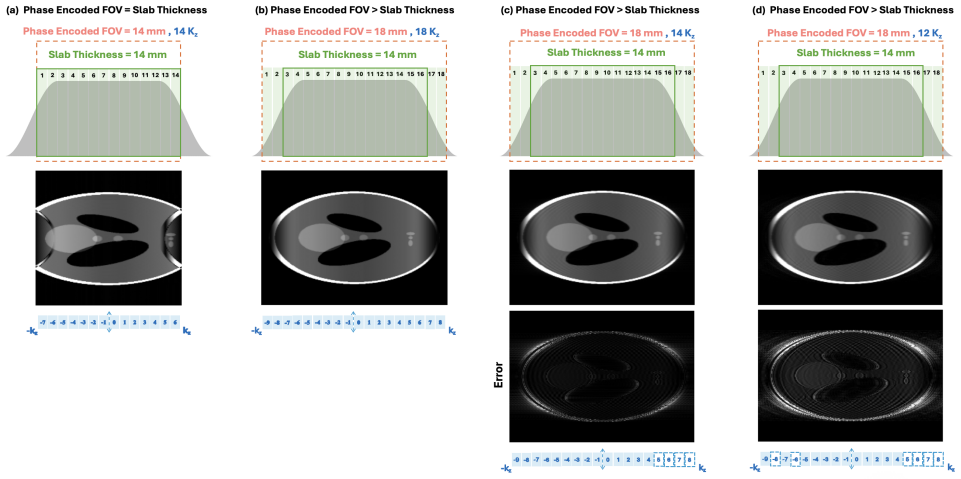
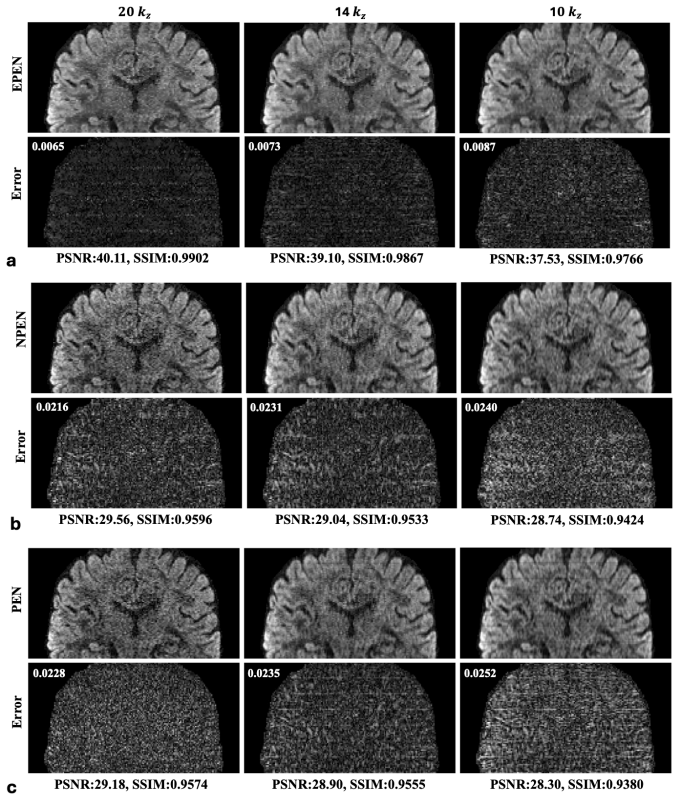
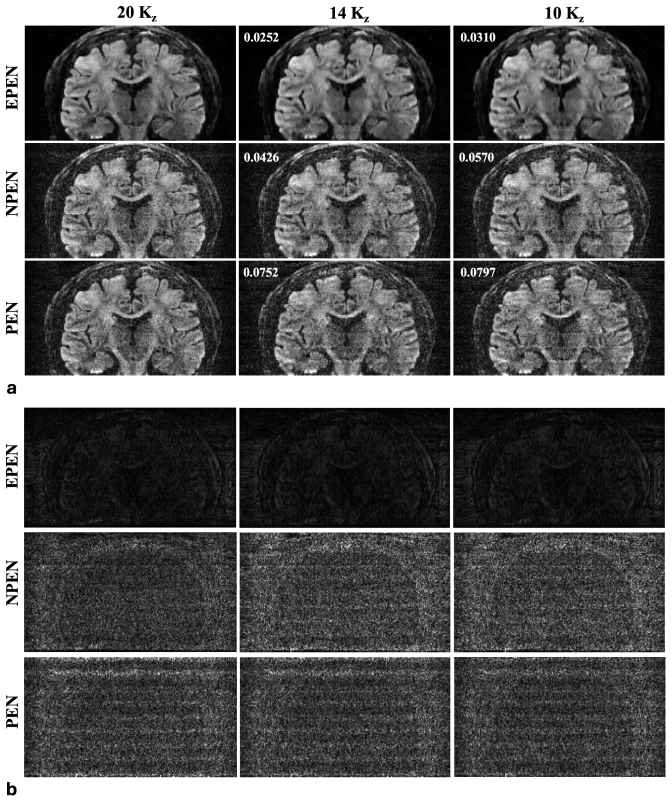
- Slab-boundary artifacts are reduced across multiple acceleration factors and slab configurations relative to conventional correction methods.
- Structural consistency of the reconstructed volumes improves while diffusion-weighted contrast is preserved.
- Reconstruction and slab-profile estimation occur inside one unified optimization rather than sequential post-processing steps.
- The nonconvex objective remains tractable through alternating minimization with conjugate-gradient image updates and closed-form profile updates.
Where Pith is reading between the lines
- If the energy prior generalizes across scanners and populations, the same framework could support even higher acceleration without separate calibration scans.
- The bilinear modeling approach may transfer to other multi-slab or multi-shot sequences such as T2-weighted or perfusion imaging.
- Training the prior on larger and more diverse diffusion data sets could further reduce residual artifacts at extreme undersampling rates.
Load-bearing premise
The CNN-based deep energy prior accurately represents the negative log distribution of clean diffusion-weighted images.
What would settle it
Reconstruction of new fully sampled multi-slab diffusion data sets in which EPEN still leaves visible slab-boundary discontinuities or altered diffusion contrast relative to the reference volumes.
Figures

read the original abstract
This work presents Energy-based Profile Encoding, EPEN, a joint reconstruction framework for high-resolution diffusion-weighted MRI from undersampled 3D multi-slab k-space acquisitions, designed to suppress slab-boundary artifacts while preserving fine anatomical detail. EPEN formulates the multi-slab acquisition process using a bilinear forward model in which both the diffusion-weighted image volume and slab excitation profiles are treated as unknown variables. Reconstruction is posed as a maximum a posteriori optimization problem with three components: a Gaussian data-fidelity term enforcing consistency with the acquired k-space measurements, a CNN-based deep energy prior that represents the negative log distribution of clean diffusion-weighted images, and a quadratic regularization term that constrains the estimated slab profiles toward an initial profile estimate. The gradient of the learned energy prior guides accelerated reconstruction toward an artifact-free image distribution. The resulting nonconvex objective is solved using alternating minimization, with image-volume updates performed through a majorize-minimize scheme using conjugate-gradient optimization and slab-profile updates estimated by regularized least squares. Across multiple acceleration factors and slab configurations, EPEN substantially reduced slab-boundary artifacts compared with conventional slab-boundary correction methods, while improving structural consistency and preserving diffusion-weighted contrast. These results demonstrate that EPEN enables robust joint 3D multi-slab diffusion MRI reconstruction and slab-profile correction within a unified optimization framework supported by deep energy-based image priors.
Editorial analysis
A structured set of objections, weighed in public.
Referee Report
Summary. The manuscript presents Energy-based Profile Encoding (EPEN), a joint reconstruction framework for high-resolution diffusion-weighted MRI from undersampled 3D multi-slab k-space acquisitions. It models the acquisition with a bilinear forward model where both the diffusion-weighted image volume and slab excitation profiles are unknowns. The reconstruction is formulated as a MAP optimization with Gaussian data-fidelity, a CNN-based deep energy prior representing the negative log distribution of clean DWI images, and quadratic regularization on slab profiles. The nonconvex objective is solved via alternating minimization with majorize-minimize and conjugate-gradient for images, and regularized least squares for profiles. The paper claims that EPEN substantially reduces slab-boundary artifacts across acceleration factors and slab configurations compared to conventional methods while preserving contrast.
Significance. If the quantitative claims hold and the deep prior is shown to encode the required distribution, the work could advance accelerated multi-slab DWI by unifying reconstruction and slab-profile correction in a single optimization framework. The bilinear model combined with the energy prior offers a principled way to handle slab-boundary artifacts without separate correction steps.
major comments (2)
- [Abstract] Abstract (paragraph describing the MAP objective): the central modeling assumption that the CNN-based deep energy prior accurately represents the negative log distribution of clean diffusion-weighted images is load-bearing for attributing artifact reduction to the prior gradient, yet the manuscript supplies no training corpus details, held-out likelihood or energy-gap metrics, or ablation removing the prior.
- [Abstract] Abstract: the claim of substantial artifact reduction 'across multiple acceleration factors and slab configurations' is presented without any quantitative metrics, error bars, dataset sizes, or statistical comparisons, preventing verification that the improvement exceeds what could arise from the data-fidelity or quadratic slab-profile terms alone.
Simulated Author's Rebuttal
We thank the referee for the constructive feedback. We address the two major comments below and will revise the abstract and manuscript to incorporate the requested details and quantitative support.
read point-by-point responses
-
Referee: [Abstract] Abstract (paragraph describing the MAP objective): the central modeling assumption that the CNN-based deep energy prior accurately represents the negative log distribution of clean diffusion-weighted images is load-bearing for attributing artifact reduction to the prior gradient, yet the manuscript supplies no training corpus details, held-out likelihood or energy-gap metrics, or ablation removing the prior.
Authors: We acknowledge that the abstract and current manuscript do not provide these supporting details for the deep energy prior. We will revise the manuscript to include training corpus details in the Methods, add held-out likelihood and energy-gap metrics, and include an ablation study removing the prior in the Results to better attribute the observed improvements. revision: yes
-
Referee: [Abstract] Abstract: the claim of substantial artifact reduction 'across multiple acceleration factors and slab configurations' is presented without any quantitative metrics, error bars, dataset sizes, or statistical comparisons, preventing verification that the improvement exceeds what could arise from the data-fidelity or quadratic slab-profile terms alone.
Authors: We agree that the abstract lacks the requested quantitative elements. We will revise the abstract to include specific metrics with error bars, dataset sizes, and statistical comparisons drawn from the experimental results to substantiate the claims and allow assessment of the prior's contribution beyond the other terms. revision: yes
Circularity Check
No circularity; derivation relies on external learned prior and empirical validation
full rationale
The abstract and description formulate reconstruction as MAP optimization with data fidelity, a CNN energy prior (representing negative log of clean images), and slab-profile regularization, solved via alternating minimization. No equations, predictions, or claims reduce by construction to fitted inputs, self-definitions, or self-citation chains. The energy prior is an independent learned component whose accuracy is an external modeling assumption, not a definitional tautology. Results are framed as empirical comparisons, making the chain self-contained against benchmarks.
Axiom & Free-Parameter Ledger
free parameters (1)
- quadratic regularization weight on slab profiles
axioms (2)
- domain assumption MRI acquisition follows the stated bilinear forward model
- domain assumption CNN energy function equals negative log probability of clean diffusion-weighted images
Reference graph
Works this paper leans on
-
[1]
Diffusion-weighted 3d multislab echo planar imaging for high signal-to-noise ratio efficiency and isotropic image resolution.Magnetic Resonance in Medicine, 70:1507–1514, 12 2013
Mathias Engstr¨om and Stefan Skare. Diffusion-weighted 3d multislab echo planar imaging for high signal-to-noise ratio efficiency and isotropic image resolution.Magnetic Resonance in Medicine, 70:1507–1514, 12 2013
2013
-
[2]
Miller, Rob H N Tijssen, David A
Robert Frost, Karla L. Miller, Rob H N Tijssen, David A. Porter, and Peter Jezzard. 3d multi-slab diffusion-weighted readout-segmented epi with real-time cardiac-reordered k-space acquisition.Magnetic Resonance in Medicine, 72, 2014
2014
-
[3]
Bruce, Hing-Chiu Chang, Christopher Petty, Nan-Kuei Chen, and Allen W
Iain P. Bruce, Hing-Chiu Chang, Christopher Petty, Nan-Kuei Chen, and Allen W. Song. 3d-mb-muse: A robust 3d multi-slab, multi-band and multi-shot reconstruction approach for ultrahigh resolution diffusion mri.NeuroImage, 159:46–56, 2017
2017
-
[4]
High-resolution whole-brain diffusion mri at 3t using simultaneous multi-slab (smslab) acquisition.NeuroImage, 237, 2021
Erpeng Dai, Simin Liu, and Hua Guo. High-resolution whole-brain diffusion mri at 3t using simultaneous multi-slab (smslab) acquisition.NeuroImage, 237, 2021
2021
-
[5]
Pisharady, Edward J
Steen Moeller, Sudhir Ramanna, Christophe Lenglet, Pramod K. Pisharady, Edward J. Auerbach, Lance Delabarre, Xiaoping Wu, Mehmet Akcakaya, and Kamil Ugurbil. Self-Navigation for 3D Multishot EPI with Data-Reference. Magnetic Resonance in Medicine, 84:1747–1762, 10 2020. 14/24
2020
-
[6]
Chu Yu Lee and Merry Mani. 2D CAIPI Accelerated 3D Multi-Slab Diffusion Weighted EPI Combined with qModeL Reconstruction for Fast High Resolution Microstructure Imaging.Magnetic Resonance Imaging, 111:57–66, 9 2024
2024
-
[7]
Miller, Jesper L.R
Ziyu Li, Karla L. Miller, Jesper L.R. Andersson, Jieying Zhang, Simin Liu, Hua Guo, and Wenchuan Wu. Sampling Strategies and Integrated Reconstruction for Reducing Distortion and Boundary Slice Aliasing in High-resolution 3D Diffusion MRI.Magnetic Resonance in Medicine, 90, 2023
2023
-
[8]
Miller, Xi Chen, Mark Chiew, and Wenchuan Wu
Ziyu Li, Karla L. Miller, Xi Chen, Mark Chiew, and Wenchuan Wu. Self-navigated 3D Diffusion MRI Using an Optimized CAIPI Sampling and Structured Low-Rank Reconstruction Estimated Navigator.IEEE Transactions on Medical Imaging, 2024
2024
-
[9]
Chu-Yu Lee, Reza Ghorbani, Mahsa Rajabi, and Merry Mani. Advanced microstructure imaging at high b-values and high resolution combining ultra-high performance gradient diffusion imaging and model-based deep learning demonstrated using 3d multi-slab acquisition.Magnetic Resonance in Medicine, 95(1):299–313, 2026
2026
-
[10]
Slab profile encoding (pen) for minimizing slab boundary artifact in three-dimensional diffusion-weighted multislab acquisition
Anh T Van, Murat Aksoy, Samantha J Holdsworth, Daniel Kopeinigg, Sjoerd B V os, and Roland Bammer. Slab profile encoding (pen) for minimizing slab boundary artifact in three-dimensional diffusion-weighted multislab acquisition. Magnetic resonance in medicine, 73(2):605–613, 2015
2015
-
[11]
Sense: sensitivity encoding for fast mri.Magnetic Resonance in Medicine: An Official Journal of the International Society for Magnetic Resonance in Medicine, 42(5):952–962, 1999
Klaas P Pruessmann, Markus Weiger, Markus B Scheidegger, and Peter Boesiger. Sense: sensitivity encoding for fast mri.Magnetic Resonance in Medicine: An Official Journal of the International Society for Magnetic Resonance in Medicine, 42(5):952–962, 1999
1999
-
[12]
Wenchuan Wu, Peter J Koopmans, Robert Frost, and Karla L Miller. Reducing slab boundary artifacts in three- dimensional multislab diffusion mri using nonlinear inversion for slab profile encoding (npen).Magnetic resonance in medicine, 76(4):1183–1195, 2016
2016
-
[13]
Slab boundary artifact correction in multislab imaging using convolutional-neural-network–enabled inversion for slab profile encoding
Jieying Zhang, Simin Liu, Erpeng Dai, Xinyu Ye, Diwei Shi, Yuhsuan Wu, Jie Lu, and Hua Guo. Slab boundary artifact correction in multislab imaging using convolutional-neural-network–enabled inversion for slab profile encoding. Magnetic Resonance in Medicine, 87(3):1546–1560, 2022
2022
-
[14]
The Bayesian Approach To Inverse Problems
Masoumeh Dashti and Andrew M Stuart. The bayesian approach to inverse problems.arXiv preprint arXiv:1302.6989, 2013
work page internal anchor Pith review Pith/arXiv arXiv 2013
-
[15]
Hyperparameter estimation in bayesian map estimation: parameterizations and consistency.The SMAI journal of computational mathematics, 6:69–100, 2020
Matthew M Dunlop, Tapio Helin, and Andrew M Stuart. Hyperparameter estimation in bayesian map estimation: parameterizations and consistency.The SMAI journal of computational mathematics, 6:69–100, 2020
2020
-
[16]
qmodel: A plug-and-play model-based reconstruction for highly accelerated multi-shot diffusion mri using learned priors.Magnetic resonance in medicine, 86(2):835–851, 2021
Merry Mani, Vincent A Magnotta, and Mathews Jacob. qmodel: A plug-and-play model-based reconstruction for highly accelerated multi-shot diffusion mri using learned priors.Magnetic resonance in medicine, 86(2):835–851, 2021
2021
-
[17]
Multi-scale energy (muse) framework for inverse problems in imaging
Jyothi Rikhab Chand and Mathews Jacob. Multi-scale energy (muse) framework for inverse problems in imaging. IEEE Transactions on Computational Imaging, 10:1250–1265, 2024
2024
-
[18]
Automatic differentiation in pytorch
Adam Paszke, Sam Gross, Soumith Chintala, Gregory Chanan, Edward Yang, Zachary DeVito, Zeming Lin, Alban Desmaison, Luca Antiga, and Adam Lerer. Automatic differentiation in pytorch. 2017
2017
-
[19]
Learning energy-based models in high-dimensional spaces with multiscale denoising-score matching.Entropy, 25(10):1367, 2023
Zengyi Li, Yubei Chen, and Friedrich T Sommer. Learning energy-based models in high-dimensional spaces with multiscale denoising-score matching.Entropy, 25(10):1367, 2023
2023
-
[20]
A connection between score matching and denoising autoencoders.Neural computation, 23(7):1661– 1674, 2011
Pascal Vincent. A connection between score matching and denoising autoencoders.Neural computation, 23(7):1661– 1674, 2011
2011
-
[21]
Denoising of diffusion mri using random matrix theory.Neuroimage, 142:394–406, 2016
Jelle Veraart, Dmitry S Novikov, Daan Christiaens, Benjamin Ades-Aron, Jan Sijbers, and Els Fieremans. Denoising of diffusion mri using random matrix theory.Neuroimage, 142:394–406, 2016
2016
-
[22]
Majorization-minimization algorithms in signal processing, communi- cations, and machine learning.IEEE Transactions on Signal Processing, 65(3):794–816, 2016
Ying Sun, Prabhu Babu, and Daniel P Palomar. Majorization-minimization algorithms in signal processing, communi- cations, and machine learning.IEEE Transactions on Signal Processing, 65(3):794–816, 2016
2016
-
[23]
An introduction to diffusion tensor image analysis.Neurosurgery Clinics of North America, 22(2):185, 2011
Lauren J O’Donnell and Carl-Fredrik Westin. An introduction to diffusion tensor image analysis.Neurosurgery Clinics of North America, 22(2):185, 2011
2011
-
[24]
Dipy, a library for the analysis of diffusion mri data.Frontiers in neuroinformatics, 8:8, 2014
Eleftherios Garyfallidis, Matthew Brett, Bagrat Amirbekian, Ariel Rokem, Stefan Van Der Walt, Maxime Descoteaux, Ian Nimmo-Smith, and Dipy Contributors. Dipy, a library for the analysis of diffusion mri data.Frontiers in neuroinformatics, 8:8, 2014
2014
-
[25]
Dsi studio: an integrated tractography platform and fiber data hub for accelerating brain research
Fang-Cheng Yeh. Dsi studio: an integrated tractography platform and fiber data hub for accelerating brain research. Nature methods, 22(8):1617–1619, 2025
2025
-
[26]
Solving inverse problems with score-based generative priors learned from noisy data
Asad Aali, Marius Arvinte, Sidharth Kumar, and Jonathan I Tamir. Solving inverse problems with score-based generative priors learned from noisy data. In2023 57th Asilomar Conference on Signals, Systems, and Computers, pages 837–843. IEEE, 2023
2023
-
[27]
Noise2Noise: Learning Image Restoration without Clean Data
Jaakko Lehtinen, Jacob Munkberg, Jon Hasselgren, Samuli Laine, Tero Karras, Miika Aittala, and Timo Aila. Noise2noise: Learning image restoration without clean data.arXiv preprint arXiv:1803.04189, 2018
work page internal anchor Pith review Pith/arXiv arXiv 2018
-
[28]
Denoising diffusion probabilistic models.Advances in neural information 15/24 processing systems, 33:6840–6851, 2020
Jonathan Ho, Ajay Jain, and Pieter Abbeel. Denoising diffusion probabilistic models.Advances in neural information 15/24 processing systems, 33:6840–6851, 2020
2020
-
[29]
Parameter relations for the shinnar-le roux selective excitation pulse design algorithm (nmr imaging).IEEE transactions on medical imaging, 10(1):53–65, 1991
John Pauly, Patrick Le Roux, Dwight Nishimura, and Albert Macovski. Parameter relations for the shinnar-le roux selective excitation pulse design algorithm (nmr imaging).IEEE transactions on medical imaging, 10(1):53–65, 1991. 16/24 SUPPORTING INFORMATION S1 ENERGY MODEL TRAINING DETAILS The energy model in EPEN is trained via denoising score matching (DS...
1991
discussion (0)
Sign in with ORCID, Apple, or X to comment. Anyone can read and Pith papers without signing in.