TimeLogic Challenge @ CVPR 2026: Strong MLLMs Meet Evidence-Seeking Agents for Temporal-Logic Video Question Answering
Pith reviewed 2026-06-28 11:53 UTC · model grok-4.3
The pith
An evidence-seeking agent with category-routed sampling policies reaches 77.13 percent accuracy on temporal-logic video questions without any training.
A machine-rendered reading of the paper's core claim, the machinery that carries it, and where it could break.
Core claim
The paper claims that an evidence-seeking agent, driven by a multi-granular sampling toolkit inside a Think-Act-Observe loop, can locate the precise visual evidence required for temporal-logic comparisons once every observation carries an absolute timestamp; a lightweight classifier routes questions to category-specific policies whose iteration depth and sampling budgets adapt to corpus statistics and clip length, yielding 77.13 AvgAcc on the TimeLogic test set in a training-free setting.
What carries the argument
The evidence-seeking agent that follows a Think-Act-Observe loop driven by a multi-granular sampling toolkit, with routing from a lightweight classifier to category-tailored policies.
If this is right
- Temporal relations reduce to numerical comparisons once observations carry absolute timestamps on a shared axis.
- Category-specific policies and iteration depths can handle distinct structures such as single-event comparisons versus multi-event chains.
- Sampling budgets that adapt to corpus characteristics and clip length improve the chance of capturing localized or dispersed evidence.
- The entire pipeline operates without task-specific training by coupling an existing multimodal model to the agent loop.
Where Pith is reading between the lines
- The same routing-plus-adaptive-sampling pattern could be tested on other video tasks that require precise timing, such as fine-grained action ordering or event causality.
- If the classifier's routing accuracy proves the main bottleneck, replacing it with a more capable router would be a direct next measurement.
- The timestamped observation format may transfer to non-video domains where events must be ordered across sparse records, such as log-file analysis.
Load-bearing premise
A lightweight classifier can reliably route questions to temporal categories whose tailored policies and adaptive sampling budgets will locate the precise evidence needed for correct temporal comparisons.
What would settle it
A held-out set of questions in which the classifier routes more than 20 percent of items to the wrong temporal category, or in which the adaptive sampler consistently misses narrow action boundaries, would produce accuracy well below 77.13 percent.
Figures

read the original abstract
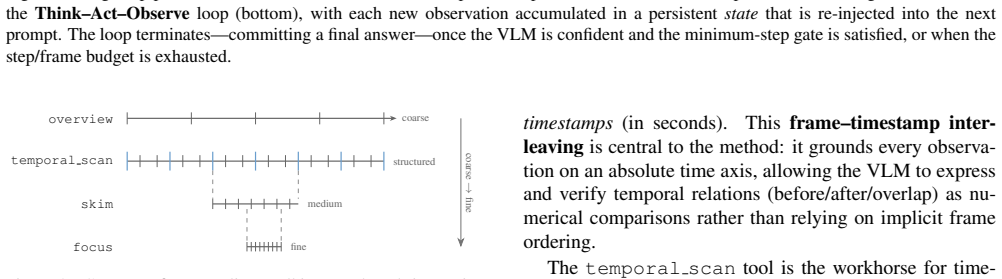
Temporal-logic video question answering requires a model to reason about when actions occur relative to one another, such as before, after, until, since, overlap, and multi-event chains, rather than merely what is present in a video. Standard vision-language models typically answer such questions in a single pass over a fixed, uniformly sampled set of frames, which is poorly matched to evidence that is often localized to narrow action boundaries or dispersed across several distant events. We present an evidence-seeking agent that treats temporal-logic VideoQA as active exploration. The agent follows a Think-Act-Observe loop driven by a multi-granular sampling toolkit, where every observation is interleaved with its absolute timestamp so that temporal relations reduce to numerical comparisons on a shared time axis. Its behavior is shaped by benchmark structure: a lightweight classifier routes each question to a temporal category, each with a tailored policy, iteration depth, and prompt, while sampling budgets adapt to corpus characteristics and clip length. The resulting training-free system couples Gemini 3.1 Pro with a temporal-reasoning policy and achieves 77.13 AvgAcc on the official TimeLogic test set.
Editorial analysis
A structured set of objections, weighed in public.
Referee Report
Summary. The manuscript introduces an evidence-seeking agent for temporal-logic VideoQA that operates via a Think-Act-Observe loop. A lightweight classifier routes each question to one of several temporal categories; each category has a tailored policy, iteration depth, and prompt. The agent uses a multi-granular sampling toolkit that interleaves observations with absolute timestamps, allowing temporal relations to be reduced to numerical comparisons. The resulting training-free system pairs this agent with Gemini 3.1 Pro and reports 77.13 AvgAcc on the official TimeLogic test set.
Significance. If the performance gain is shown to arise from the evidence-seeking mechanism rather than from the base MLLM or from oracle routing, the work would demonstrate a practical way to improve temporal reasoning in existing models without additional training. The training-free design and explicit use of timestamped evidence are positive features that could be adopted more broadly.
major comments (3)
- [Abstract / §3] Abstract and §3 (routing and policy description): the 77.13 AvgAcc result is presented as the outcome of the full agent pipeline, yet no accuracy, confusion matrix, or error rate is reported for the lightweight classifier that routes questions to temporal categories. Without this, it is impossible to determine whether the reported score can be attributed to the tailored policies and adaptive sampling or to frequent mis-routing.
- [Results] Results section: no ablation is supplied that compares the full system against (a) the base Gemini 3.1 Pro with uniform sampling, (b) oracle routing, or (c) a version that disables the Think-Act-Observe loop. Such controls are required to isolate the contribution of the evidence-seeking components to the claimed improvement.
- [§4] §4 (evaluation): the manuscript supplies only a single aggregate AvgAcc figure. No per-category breakdown, error analysis on multi-event or ambiguous questions, or comparison against other submitted systems on the TimeLogic leaderboard is provided, making it difficult to assess whether the method generalizes across the benchmark's temporal-relation types.
minor comments (2)
- [§3] The description of how absolute timestamps are interleaved with observations and how numerical comparisons are performed could be expanded with a short pseudocode example or concrete illustration.
- [§4] Clarify the exact definition of AvgAcc (e.g., whether it is macro-averaged across categories or micro-averaged across questions) and confirm it matches the official TimeLogic metric.
Simulated Author's Rebuttal
We thank the referee for the constructive and detailed feedback on our manuscript. We address each major comment point by point below, committing to revisions that strengthen the attribution of results to the evidence-seeking components while remaining faithful to the experiments performed.
read point-by-point responses
-
Referee: [Abstract / §3] Abstract and §3 (routing and policy description): the 77.13 AvgAcc result is presented as the outcome of the full agent pipeline, yet no accuracy, confusion matrix, or error rate is reported for the lightweight classifier that routes questions to temporal categories. Without this, it is impossible to determine whether the reported score can be attributed to the tailored policies and adaptive sampling or to frequent mis-routing.
Authors: We agree that the classifier's performance metrics are necessary to properly attribute the overall result. Although the classifier is intentionally lightweight and was tuned on a small held-out set of questions, its accuracy, confusion matrix, and per-category error rates were omitted from the original submission. We will add these statistics, along with a brief discussion of routing errors, to §3 in the revised manuscript. revision: yes
-
Referee: [Results] Results section: no ablation is supplied that compares the full system against (a) the base Gemini 3.1 Pro with uniform sampling, (b) oracle routing, or (c) a version that disables the Think-Act-Observe loop. Such controls are required to isolate the contribution of the evidence-seeking components to the claimed improvement.
Authors: We concur that controlled ablations are required to isolate the agent components. We will add results for the base Gemini 3.1 Pro under uniform sampling and for an ablated agent that removes the Think-Act-Observe loop. Oracle routing is more difficult to realize because ground-truth temporal-category labels are not provided by the benchmark; we will instead report a sensitivity analysis over routing accuracy and note this limitation explicitly. revision: partial
-
Referee: [§4] §4 (evaluation): the manuscript supplies only a single aggregate AvgAcc figure. No per-category breakdown, error analysis on multi-event or ambiguous questions, or comparison against other submitted systems on the TimeLogic leaderboard is provided, making it difficult to assess whether the method generalizes across the benchmark's temporal-relation types.
Authors: We accept that the current evaluation is too aggregate. We will expand §4 with a per-category AvgAcc table, a qualitative error analysis on multi-event and temporally ambiguous questions, and any publicly available leaderboard comparisons at the time of revision. If no other systems have been submitted, we will state this fact. revision: yes
Circularity Check
No circularity: empirical benchmark on external test set
full rationale
The paper reports an empirical accuracy (77.13 AvgAcc) obtained by running a described training-free agent (Gemini 3.1 Pro + Think-Act-Observe loop with category routing) on the official TimeLogic test set. No equations, parameter fits, self-citations, or uniqueness theorems appear in the provided text. The lightweight classifier is presented as a design choice whose reliability is an empirical question, not a derived claim that reduces to its own inputs. The result is therefore self-contained against the external benchmark.
Axiom & Free-Parameter Ledger
Reference graph
Works this paper leans on
-
[1]
Gemini 3.1 Pro: A smarter model for your most complex tasks.https://blog.google/ innovation - and - ai / models - and - research / gemini- models/gemini- 3- 1- pro/, 2026
Gemini Team. Gemini 3.1 Pro: A smarter model for your most complex tasks.https://blog.google/ innovation - and - ai / models - and - research / gemini- models/gemini- 3- 1- pro/, 2026. Google Blog, accessed June 1, 2026. 1, 4
2026
-
[2]
AGQA: A benchmark for compositional spatio-temporal reasoning
Madeleine Grunde-McLaughlin, Ranjay Krishna, and Ma- neesh Agrawala. AGQA: A benchmark for compositional spatio-temporal reasoning. InProceedings of the IEEE/CVF Conference on Computer Vision and Pattern Recognition,
-
[3]
The language of actions: Recovering the syntax and semantics of goal-directed human activities
Hilde Kuehne, Ali Arslan, and Thomas Serre. The language of actions: Recovering the syntax and semantics of goal-directed human activities. InProceedings of the IEEE Conference on Computer Vision and Pattern Recognition, pages 780–787,
-
[4]
Videoseek: Long-horizon video agent with tool- guided seeking,
Jingyang Lin, Jialian Wu, Jiang Liu, Ximeng Sun, Ze Wang, Xiaodong Yu, Jiebo Luo, Zicheng Liu, and Emad Barsoum. VideoSeek: Long-horizon video agent with tool-guided seek- ing.arXiv preprint arXiv:2603.20185, 2026. 1, 2
-
[5]
TimeL- ogic: A temporal logic benchmark for video qa, 2025
Sirnam Swetha, Hilde Kuehne, and Mubarak Shah. TimeL- ogic: A temporal logic benchmark for video qa, 2025. 1, 2
2025
-
[6]
Tenenbaum, and Chuang Gan
Bo Wu, Shoubin Yu, Zhenfang Chen, Joshua B. Tenenbaum, and Chuang Gan. STAR: A benchmark for situated reason- ing in real-world videos. InAdvances in Neural Information Processing Systems, 2021. 2
2021
-
[7]
ReAct: Synergizing rea- soning and acting in language models
Shunyu Yao, Jeffrey Zhao, Dian Yu, Nan Du, Izhak Shafran, Karthik Narasimhan, and Yuan Cao. ReAct: Synergizing rea- soning and acting in language models. InInternational Con- ference on Learning Representations, 2023. 1, 2
2023
-
[8]
Cross- task weakly supervised learning from instructional videos
Dimitri Zhukov, Jean-Baptiste Alayrac, Ramazan Gokberk Cinbis, David Fouhey, Ivan Laptev, and Josef Sivic. Cross- task weakly supervised learning from instructional videos. In Proceedings of the IEEE/CVF Conference on Computer Vi- sion and Pattern Recognition, 2019. 2
2019
discussion (0)
Sign in with ORCID, Apple, or X to comment. Anyone can read and Pith papers without signing in.