AI-Based KPI Prediction Methods in Future 6G Networks: A Survey
Pith reviewed 2026-06-28 13:45 UTC · model grok-4.3
The pith
This survey introduces a multi-dimensional taxonomy to classify data-driven methods for predicting key performance indicators in future 6G networks.
A machine-rendered reading of the paper's core claim, the machinery that carries it, and where it could break.
Core claim
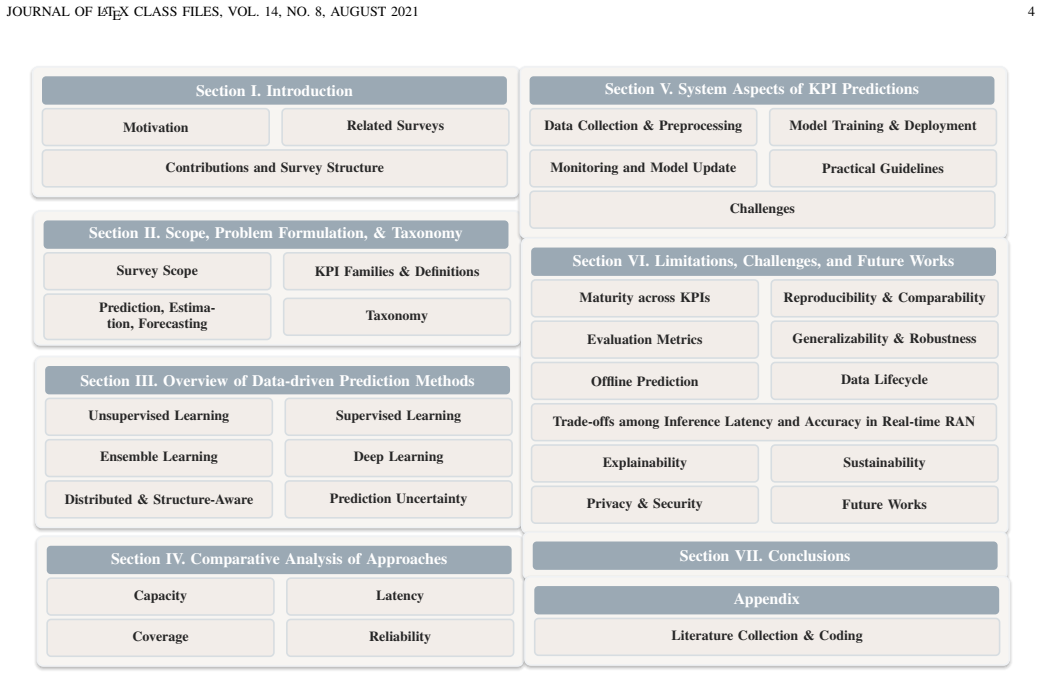
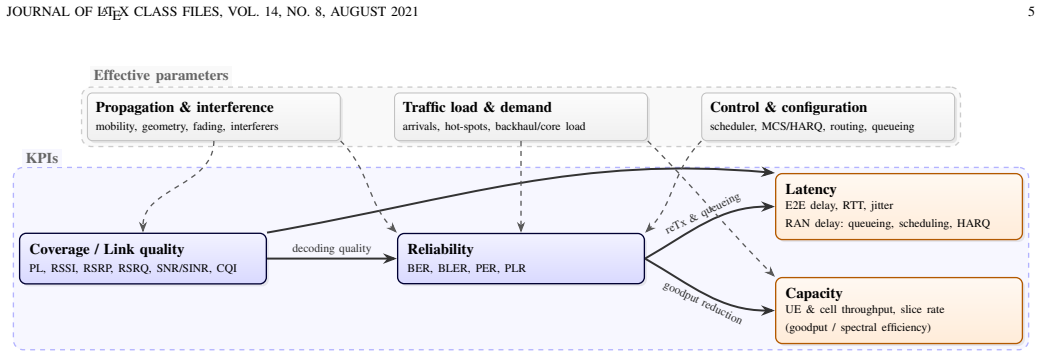
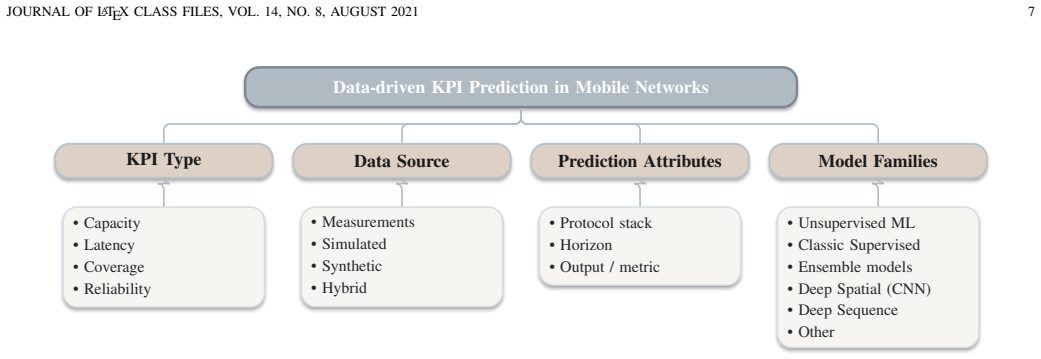
This survey provides the first comprehensive and systematic review of data-driven KPI prediction methods for future 6G networks by introducing a multi-dimensional taxonomy that classifies prediction approaches by KPI type, data source, the network protocol stack at which the KPI is predicted, prediction horizon, model family, and prediction objective; using this taxonomy the paper analyzes the state of the art, discusses enabling system aspects including data collection and learning architectures, examines deployment challenges, and outlines open research directions spanning new KPI definitions, probabilistic and explainable predictions.
What carries the argument
The multi-dimensional taxonomy classifying prediction approaches along six axes: KPI type, data source, network protocol stack, prediction horizon, model family, and prediction objective.
If this is right
- Researchers gain a common structure for comparing prediction methods across different KPIs, data sources, and time horizons.
- Gaps become visible in coverage for specific protocol stack layers or prediction objectives.
- Data collection and learning architecture choices are highlighted as prerequisites for practical deployment.
- Privacy, scalability, and sustainability emerge as shared barriers that future systems must address.
- Roadmap points to probabilistic predictions and explainable models as next steps for network automation.
Where Pith is reading between the lines
- The taxonomy could serve as a template for tracking how new 6G-specific KPIs are defined and predicted over time.
- Testing the taxonomy against simulation data from multiple network scenarios might reveal whether certain dimensions need refinement.
- Adoption of the survey's structure in standardization discussions could accelerate consistent requirements for predictive features.
- Linking the taxonomy to energy-efficiency metrics might connect KPI prediction directly to sustainability goals in network design.
Load-bearing premise
The chosen taxonomy dimensions and the papers selected for review are sufficient to represent the full state of the art without significant omissions or bias in coverage.
What would settle it
Identification of a substantial set of KPI prediction papers whose methods fall outside all six taxonomy categories or were not captured in the reviewed selection.
Figures

read the original abstract
The evolution from 5G to 5G-Advanced and the vision of 6G demand unprecedented levels of network performance, in which meeting stringent network Key Performance Indicators (KPIs), including capacity, latency, coverage, and reliability, is critical to supporting emerging applications such as autonomous driving, industrial automation, and immersive communications. Traditional reactive network management is insufficient in this context, driving the need for predictive, data-driven approaches. Machine Learning (ML) has emerged as a key enabler, enabling the forecasting of KPI trends from diverse data sources and thereby enabling proactive, AI-native automation in mobile networks. This survey provides the first comprehensive and systematic review of data-driven KPI prediction methods for future 6G networks. We introduce a multi-dimensional taxonomy that classifies prediction approaches by KPI type, data source, the network protocol stack at which the KPI is predicted, prediction horizon, model family, and prediction objective. Using this taxonomy, we analyze the state of the art across various KPIs, highlighting representative methods ranging from classical statistical models to deep learning and reinforcement learning. We further discuss enabling system aspects, including data collection and learning architectures, and examine deployment challenges, including data availability, scalability, privacy, and sustainability. Finally, we outline open research directions spanning new KPI definitions, probabilistic and explainable predictions. This survey aims to provide researchers and practitioners with a structured understanding of the KPI prediction landscape and a roadmap toward predictive network automation in future 6G systems.
Editorial analysis
A structured set of objections, weighed in public.
Referee Report
Summary. This survey claims to deliver the first comprehensive and systematic review of data-driven KPI prediction methods for 6G networks. It introduces a multi-dimensional taxonomy classifying methods by KPI type, data source, network protocol stack, prediction horizon, model family, and prediction objective. Using the taxonomy, the paper reviews representative approaches from classical statistical models through deep learning and reinforcement learning, discusses enabling aspects such as data collection and learning architectures, examines challenges including data availability, scalability, privacy and sustainability, and identifies open directions such as new KPI definitions and probabilistic/explainable predictions.
Significance. If the taxonomy and coverage are representative, the work supplies a structured map of the KPI-prediction literature that can accelerate research on proactive, AI-native network automation. The explicit multi-dimensional classification is a concrete contribution that helps organize disparate studies and surface gaps, directly supporting the shift from reactive to predictive management needed for 6G applications.
minor comments (1)
- The abstract and introduction repeatedly use the phrase 'first comprehensive'; a short explicit comparison table or paragraph contrasting this taxonomy with the scope of the two or three most closely related prior surveys would strengthen the claim without altering the central contribution.
Simulated Author's Rebuttal
We thank the referee for their positive assessment and recommendation to accept the manuscript. The review accurately captures the paper's contributions in providing a multi-dimensional taxonomy and structured overview of data-driven KPI prediction for 6G networks.
Circularity Check
No significant circularity in survey taxonomy or claims
full rationale
This is a literature survey with no equations, derivations, fitted parameters, or quantitative predictions. The multi-dimensional taxonomy is an author-proposed classification scheme for organizing existing work, not a result derived from or equivalent to its inputs by construction. No self-citation chains, uniqueness theorems, or ansatzes are invoked as load-bearing premises. The claim of providing the 'first comprehensive' review is a standard survey assertion whose validity rests on external coverage checks rather than internal reduction. The paper is self-contained as a review and receives the default non-circularity outcome.
Axiom & Free-Parameter Ledger
Reference graph
Works this paper leans on
-
[1]
Machine learning for large-scale optimization in JOURNAL OF LATEX CLASS FILES, VOL. 14, NO. 8, AUGUST 2021 24 6G wireless networks,
Y . Shi, L. Lian, Y . Shi, Z. Wang, Y . Zhou, L. Fu, L. Bai, J. Zhang, and W. Zhang, “Machine learning for large-scale optimization in JOURNAL OF LATEX CLASS FILES, VOL. 14, NO. 8, AUGUST 2021 24 6G wireless networks,”IEEE Communications Surveys & Tutorials, vol. 25, no. 4, pp. 2088–2132, 2023
2021
-
[2]
Co-creating a cyber-physical world with 6G,
Ericsson, “Co-creating a cyber-physical world with 6G,” Ericsson, Tech. Rep., 2024, white Paper. [Online]. Available: https://www.ericss on.com/en/reports-and-papers/white-papers/co-creating-a-cyber-physi cal-world
2024
-
[3]
Defining AI Native: A key enabler for advanced intelligent telecom networks,
Ericsson, “Defining AI Native: A key enabler for advanced intelligent telecom networks,” Ericsson, Tech. Rep., 2023, white Paper. [Online]. Available: https://www.ericsson.com/en/reports-and-papers/white-pap ers/ai-native
2023
-
[4]
The European vision for the 6G network ecosystem,
6G-IA and SNS JU, “The European vision for the 6G network ecosystem,” 6G Smart Networks and Services Industry Association (6G-IA), Tech. Rep., 11 2024, white Paper, Version 2.0. [Online]. Available: https://6g-ia.eu/wp-content/uploads/2024/12/6g-ia-vision-w hite-paper-v2.0.pdf
2024
-
[5]
Artificial-intelligence-enabled intelligent 6G networks,
H. Yang, A. Alphones, Z. Xiong, D. Niyato, J. Zhao, and K. Wu, “Artificial-intelligence-enabled intelligent 6G networks,”IEEE net- work, vol. 34, no. 6, pp. 272–280, 2020
2020
-
[6]
Machine Learning Paradigms for Next- Generation Wireless Networks,
C. Jiang, H. Zhang, Y . Ren, Z. Han, K.-C. Chen, and L. Hanzo, “Machine Learning Paradigms for Next- Generation Wireless Networks,”IEEE Wireless Communications, vol. 24, no. 2, pp. 98–105, 2017. [Online]. Available: https://ieeexplore.ieee.org/document/7792374
arXiv 2017
-
[7]
Intelligent O-RAN for beyond 5G and 6G wireless networks,
S. Niknam, A. Roy, H. S. Dhillon, S. Singh, R. Banerji, J. H. Reed, N. Saxena, and S. Yoon, “Intelligent O-RAN for beyond 5G and 6G wireless networks,” in2022 IEEE Globecom Workshops (GC Wkshps). IEEE, 2022, pp. 215–220
2022
-
[8]
Supporting intelligence in disaggregated open radio access networks: Architectural principles, AI/ML workflow, and use cases,
A. Giannopoulos, S. Spantideas, N. Kapsalis, P. Gkonis, L. Sarakis, C. Capsalis, M. Vecchio, and P. Trakadas, “Supporting intelligence in disaggregated open radio access networks: Architectural principles, AI/ML workflow, and use cases,”IEEE access, vol. 10, pp. 39 580– 39 595, 2022
2022
-
[9]
Toward deterministic communications in 6G networks: state of the art, open challenges and the way forward,
G. P. Sharma, D. Patel, J. Sachs, M. De Andrade, J. Farkas, J. Harmatos, B. Varga, H.-P. Bernhard, R. Muzaffar, M. Ahmedet al., “Toward deterministic communications in 6G networks: state of the art, open challenges and the way forward,”IEEE Access, vol. 11, pp. 106 898– 106 923, 2023
2023
-
[10]
A survey of self-organization in future cellular networks,
O. G. Aliu, A. Imran, M. A. Imran, and B. Evans, “A survey of self-organization in future cellular networks,”IEEE Communications Surveys & Tutorials, vol. 15, no. 1, pp. 336–361, 2012
2012
-
[11]
Under- standing O-RAN: Architecture, interfaces, algorithms, security, and re- search challenges,
M. Polese, L. Bonati, S. D’oro, S. Basagni, and T. Melodia, “Under- standing O-RAN: Architecture, interfaces, algorithms, security, and re- search challenges,”IEEE Communications Surveys & Tutorials, vol. 25, no. 2, pp. 1376–1411, 2023
2023
-
[12]
3GPP TS 28.105: Management and orchestration; artificial intelligence/ machine learning (AI/ML) management; stage 2 and stage 3,
3GPP, “3GPP TS 28.105: Management and orchestration; artificial intelligence/ machine learning (AI/ML) management; stage 2 and stage 3,” 3rd Generation Partnership Project (3GPP), Tech. Rep. TS 28.105, 2023, release 18. [Online]. Available: https: //www.3gpp.org/ftp/Specs/archive/28_series/28.105/
2023
-
[13]
Un- derstanding O-RAN: Architecture, interfaces, algorithms, security, and research challenges,
M. Polese, L. Bonati, S. D’Oro, S. Basagni, and T. Melodia, “Un- derstanding O-RAN: Architecture, interfaces, algorithms, security, and research challenges,”IEEE Communications Surveys & Tutorials, 2023
2023
-
[14]
Machine learning for 6G wireless networks: Carrying forward enhanced bandwidth, massive access, and ultrareliable/low-latency service,
J. Du, C. Jiang, J. Wang, Y . Ren, and M. Debbah, “Machine learning for 6G wireless networks: Carrying forward enhanced bandwidth, massive access, and ultrareliable/low-latency service,”IEEE Vehicular Technology Magazine, vol. 15, no. 4, pp. 122–134, 2020
2020
-
[15]
Machine Learning for Performance Prediction in Mobile Cellular Networks,
J. Riihijarvi and P. Mahonen, “Machine Learning for Performance Prediction in Mobile Cellular Networks,”IEEE Computational Intelligence Magazine, vol. 13, no. 1, pp. 51–60, 2018. [Online]. Available: https://ieeexplore.ieee.org/document/8253758
arXiv 2018
-
[16]
Machine Learning for Wireless Communication Channel Modeling: An Overview,
S. M. Aldossari and K.-C. Chen, “Machine Learning for Wireless Communication Channel Modeling: An Overview,”Wireless Personal Communications, vol. 106, no. 1, pp. 41–70, 2019. [Online]. Available: https://doi.org/10.1007/s11277-019-06275-4
-
[17]
A survey on client throughput prediction algorithms in wired and wireless networks,
J. Schmid, A. Höss, and B. W. Schuller, “A survey on client throughput prediction algorithms in wired and wireless networks,”ACM Comput- ing Surveys (CSUR), vol. 54, no. 9, pp. 1–33, 2021
2021
-
[18]
An overview of machine learning techniques for radiowave propagation modeling,
A. Seretis and C. D. Sarris, “An overview of machine learning techniques for radiowave propagation modeling,”IEEE Transactions on Antennas and Propagation, vol. 70, no. 6, pp. 3970–3985, 2021
2021
-
[19]
G. P. Koudouridis, Q. He, and G. Dán, “An architecture and performance evaluation framework for artificial intelligence solutions in beyond 5G radio access networks,”EURASIP Journal on Wireless Communications and Networking, vol. 2022, no. 1, p. 94, 2022. [Online]. Available: https://doi.org/10.1186/s13638-022-02164-w
-
[20]
Cellular traffic prediction with machine learning: A survey,
W. Jiang, “Cellular traffic prediction with machine learning: A survey,”Expert Systems with Applications, vol. 201, p. 117163, 2022. [Online]. Available: https://www.sciencedirect.com/science/article/pii/ S095741742200553X
2022
-
[21]
Deep learning for B5G open radio access network: Evolution, survey, case studies, and challenges,
B. Brik, K. Boutiba, and A. Ksentini, “Deep learning for B5G open radio access network: Evolution, survey, case studies, and challenges,” IEEE Open Journal of the Communications Society, vol. 3, pp. 228– 250, 2022
2022
-
[22]
Machine learning for QoS prediction in vehicular communication: Challenges and solution approaches,
A. Palaios, C. L. Vielhaus, D. F. Külzer, C. Watermann, R. Hernan- gomez, S. Partani, P. Geuer, A. Krause, R. Sattiraju, M. Kasparicket al., “Machine learning for QoS prediction in vehicular communication: Challenges and solution approaches,”IEEE Access, vol. 11, pp. 92 459– 92 477, 2023
2023
-
[23]
Mobility Prediction in Cellular Networks: A Survey,
N. Rajule, M. Venkatesan, R. Menon, and A. Kulkarni, “Mobility Prediction in Cellular Networks: A Survey,” in2023 International Conference on Recent Trends in Electronics and Communication (ICRTEC), 2023, pp. 1–9. [Online]. Available: https://ieeexplore.ieee. org/document/10111913
arXiv 2023
-
[24]
A survey on deep learning for cellular traffic prediction,
X. Wang, Z. Wang, K. Yang, Z. Song, C. Bian, J. Feng, and C. Deng, “A survey on deep learning for cellular traffic prediction,”Intelligent Computing, vol. 3, p. 0054, 2024
2024
-
[25]
A comparison of neural networks for wireless channel prediction,
O. Stenhammar, G. Fodor, and C. Fischione, “A comparison of neural networks for wireless channel prediction,”IEEE Wireless Communica- tions, vol. 31, no. 3, pp. 235–241, 2024
2024
-
[26]
Fault Prediction for Heterogeneous Telecommunication Networks Using Machine Learning: A Survey,
K. Murphy, A. Lavignotte, and C. Lepers, “Fault Prediction for Heterogeneous Telecommunication Networks Using Machine Learning: A Survey,”IEEE Transactions on Network and Service Management, vol. 21, no. 2, pp. 2515–2538, 2024. [Online]. Available: https://ieeexplore.ieee.org/document/10347460
arXiv 2024
-
[27]
Machine learning for radio propaga- tion modeling: A comprehensive survey,
M. Vasudevan and M. Yuksel, “Machine learning for radio propaga- tion modeling: A comprehensive survey,”IEEE Open Journal of the Communications Society, vol. 5, pp. 5123–5153, 2024
2024
-
[28]
Telecommunication management; Key Performance Indicators (KPI) for Evolved Universal Terrestrial Radio Access Network (E-UTRAN): Definitions,
3GPP, “Telecommunication management; Key Performance Indicators (KPI) for Evolved Universal Terrestrial Radio Access Network (E-UTRAN): Definitions,” 3rd Generation Partnership Project (3GPP), Technical Specification (TS) TS32.450, 10 2025, version 19.0.0. [Online]. Available: https://portal.3gpp.org/desktopmodules/Specificat ions/SpecificationDetails.asp...
2025
-
[29]
Toward 5G advanced: overview of 3GPP releases 17 & 18,
Ericsson, “Toward 5G advanced: overview of 3GPP releases 17 & 18,” Ericsson Technology Review, 2021, accessed: 2026-04-28
2021
-
[30]
How AI empowers intent-driven service orchestration and assurance,
Ericsson, “How AI empowers intent-driven service orchestration and assurance,” https://www.ericsson.com/en/blog/2024/11/how-ai-empow ers-intent-driven-service-orchestration-and-assurance, 2024, accessed: 2026-04-28
2024
-
[31]
Technical Specification Group Services and System Aspects; Telecommunication management; Performance Management (PM); Performance measurements for E-UTRAN and NR,
3GPP, “Technical Specification Group Services and System Aspects; Telecommunication management; Performance Management (PM); Performance measurements for E-UTRAN and NR,” 3GPP, Technical Specification TS 28.554, Jun. 2020, Version 16.7.0 (or closest matching edition used in this paper). [Online]. Available: https: //www.3gpp.org/ftp/Specs/archive/28_serie...
2020
-
[32]
5G; Management and orchestration; 5G performance measure- ments (TS 28.552 v16.9.0, Release 16),
3GPP, “5G; Management and orchestration; 5G performance measure- ments (TS 28.552 v16.9.0, Release 16),” 3rd Generation Partnership Project (3GPP), Tech. Rep. TS 28.552 v16.9.0, 2021, release 16
2021
-
[33]
Internet protocol data communication service — IP packet transfer and availability performance parameters,
ITU-T, “Internet protocol data communication service — IP packet transfer and availability performance parameters,” International Telecommunication Union, Recommendation ITU-T Y .1540, 2019, Use the publication year/edition you cite. [Online]. Available: https://www.itu.int/rec/T-REC-Y.1540
2019
-
[34]
5G; Management and orchestration; 5G end-to-end key per- formance indicators (KPI) (TS 128 554 v16.7.0),
3GPP, “5G; Management and orchestration; 5G end-to-end key per- formance indicators (KPI) (TS 128 554 v16.7.0),” European Telecom- munications Standards Institute, Tech. Rep. TS 128 554 v16.7.0, 2021, release 16
2021
-
[35]
NR; Physical layer measurements,
3rd Generation Partnership Project (3GPP), “NR; Physical layer measurements,” 3GPP, Technical Specification TS 38.215, 2023, Use the exact release/version used in your paper. [Online]. Available: https://www.3gpp.org/ftp/Specs/archive/38_series/38.215/
2023
-
[36]
E-UTRA; Physical layer measurements,
3GPP, “E-UTRA; Physical layer measurements,” 3GPP, Technical Specification TS 36.214, 2020, Use the exact release/version used in your paper. [Online]. Available: https://www.3gpp.org/ftp/Specs/archi ve/36_series/36.214/
2020
-
[37]
Service requirements for the 5G system; Stage 1,
3rd Generation Partnership Project (3GPP), “Service requirements for the 5G system; Stage 1,” 3GPP, Technical Specification TS 22.261, 2023, Use the exact release/version used in your paper. [Online]. Available: https://www.3gpp.org/ftp/Specs/archive/22_series/22.261/
2023
-
[38]
Minimum requirements related to technical performance for IMT-2020 radio interface(s),
ITU-R, “Minimum requirements related to technical performance for IMT-2020 radio interface(s),” International Telecommunication Union, Recommendation ITU-R M.2410, 2017, Often cited for IMT-2020 minimum performance requirements (e.g., reliability/latency targets). [Online]. Available: https://www.itu.int/rec/R-REC-M.2410 JOURNAL OF LATEX CLASS FILES, VOL....
2020
-
[39]
Multivariate observations,
J. MacQueen, “Multivariate observations,” inProceedings ofthe 5th Berkeley Symposium on Mathematical Statisticsand Probability, vol. 1, 1967, pp. 281–297
1967
-
[40]
Maximum likelihood from incomplete data via the EM algorithm,
A. P. Dempster, N. M. Laird, and D. B. Rubin, “Maximum likelihood from incomplete data via the EM algorithm,”Journal of the royal statistical society: series B (methodological), vol. 39, no. 1, pp. 1–22, 1977
1977
-
[41]
LIII. on lines and planes of closest fit to systems of points in space,
K. Pearson, “LIII. on lines and planes of closest fit to systems of points in space,”The London, Edinburgh, and Dublin philosophical magazine and journal of science, vol. 2, no. 11, pp. 559–572, 1901
1901
-
[42]
Breunig, Hans-Peter Kriegel, Raymond T
M. M. Breunig, H.-P. Kriegel, R. T. Ng, and J. Sander, “LOF: identifying density-based local outliers,” inProceedings of the 2000 ACM SIGMOD International Conference on Management of Data, ser. SIGMOD ’00. New York, NY , USA: Association for Computing Machinery, 2000, p. 93–104. [Online]. Available: https://doi.org/10.1145/342009.335388
-
[43]
Regression shrinkage and selection via the lasso,
R. Tibshirani, “Regression shrinkage and selection via the lasso,”Jour- nal of the Royal Statistical Society Series B: Statistical Methodology, vol. 58, no. 1, pp. 267–288, 1996
1996
-
[44]
Regression models and life-tables,
D. R. Cox, “Regression models and life-tables,”Journal of the Royal Statistical Society: Series B (Methodological), vol. 34, no. 2, pp. 187– 202, 1972
1972
-
[45]
Support-vector networks,
C. Cortes and V . Vapnik, “Support-vector networks,”Machine learning, vol. 20, no. 3, pp. 273–297, 1995
1995
-
[46]
Nearest neighbor pattern classification,
T. Cover and P. Hart, “Nearest neighbor pattern classification,”IEEE transactions on information theory, vol. 13, no. 1, pp. 21–27, 1967
1967
-
[47]
L. Breiman, “Random Forests,”Machine Learning, vol. 45, no. 1, p. 5–32, Oct. 2001. [Online]. Available: http://dx.doi.org/10.1023/A: 1010933404324
work page doi:10.1023/a: 2001
-
[48]
Y . Freund and R. E. Schapire, “A decision-theoretic generalization of on-line learning and an application to boosting,”Journal of Computer and System Sciences, vol. 55, no. 1, p. 119–139, Aug. 1997. [Online]. Available: http://dx.doi.org/10.1006/jcss.1997.1504
-
[49]
Greedy function approximation: A gradient boosting machine
J. H. Friedman, “Greedy function approximation: A gradient boosting machine.”The Annals of Statistics, vol. 29, no. 5, Oct. 2001. [Online]. Available: http://dx.doi.org/10.1214/aos/1013203451
-
[50]
T. Chen and C. Guestrin, “XGBoost: A scalable tree boosting system,” inProceedings of the 22nd ACM SIGKDD International Conference on Knowledge Discovery and Data Mining, ser. KDD ’16. New York, NY , USA: Association for Computing Machinery, 2016, p. 785–794. [Online]. Available: https://doi.org/10.1145/2939672.2939785
-
[51]
Lightgbm: A highly efficient gradient boosting decision tree,
G. Ke, Q. Meng, T. Finley, T. Wang, W. Chen, W. Ma, Q. Ye, and T.- Y . Liu, “Lightgbm: A highly efficient gradient boosting decision tree,” Advances in neural information processing systems, vol. 30, 2017
2017
-
[52]
Adam: A method for stochastic optimization,
D. P. Kingma and J. Ba, “Adam: A method for stochastic optimization,”
-
[53]
Available: https://arxiv.org/abs/1412.6980
[Online]. Available: https://arxiv.org/abs/1412.6980
-
[54]
Batch normalization: Accelerating deep network training by reducing internal covariate shift,
S. Ioffe and C. Szegedy, “Batch normalization: Accelerating deep network training by reducing internal covariate shift,” inInternational conference on machine learning. pmlr, 2015, pp. 448–456
2015
-
[55]
Dropout: a simple way to prevent neural networks from overfitting,
N. Srivastava, G. Hinton, A. Krizhevsky, I. Sutskever, and R. Salakhut- dinov, “Dropout: a simple way to prevent neural networks from overfitting,”The journal of machine learning research, vol. 15, no. 1, pp. 1929–1958, 2014
1929
-
[56]
Gradient-based learning applied to document recognition,
Y . Lecun, L. Bottou, Y . Bengio, and P. Haffner, “Gradient-based learning applied to document recognition,”Proceedings of the IEEE, vol. 86, no. 11, pp. 2278–2324, 1998
1998
-
[57]
Imagenet classification with deep convolutional neural networks,
A. Krizhevsky, I. Sutskever, and G. E. Hinton, “Imagenet classification with deep convolutional neural networks,”Advances in neural infor- mation processing systems, vol. 25, 2012
2012
-
[58]
, year = 1990, month = mar, journal =
J. L. Elman, “Finding structure in time,”Cognitive Science, vol. 14, no. 2, p. 179–211, Mar. 1990. [Online]. Available: http://dx.doi.org/10.1207/s15516709cog1402_1
-
[59]
S. Hochreiter and J. Schmidhuber, “Long Short-Term Memory,” Neural Computation, vol. 9, no. 8, p. 1735–1780, Nov. 1997. [Online]. Available: http://dx.doi.org/10.1162/neco.1997.9.8.1735
-
[60]
Attention is all you need,
A. Vaswani, N. Shazeer, N. Parmar, J. Uszkoreit, L. Jones, A. N. Gomez, L. Kaiser, and I. Polosukhin, “Attention is all you need,” in Proceedings of the 31st International Conference on Neural Informa- tion Processing Systems, ser. NIPS’17. Red Hook, NY , USA: Curran Associates Inc., 2017, p. 6000–6010
2017
-
[61]
BERT : Pre-training of Deep Bidirectional Transformers for Language Understanding
J. Devlin, M.-W. Chang, K. Lee, and K. Toutanova, “BERT: Pre-training of deep bidirectional Transformers for language understanding,” inProceedings of the 2019 Conference of the North. Association for Computational Linguistics, 2019, p. 4171–4186. [Online]. Available: http://dx.doi.org/10.18653/v1/N19-1423
-
[62]
Language models are unsupervised multitask learners,
A. Radford, J. Wu, R. Child, D. Luan, D. Amodei, I. Sutskeveret al., “Language models are unsupervised multitask learners,”OpenAI blog, vol. 1, no. 8, p. 9, 2019
2019
-
[63]
Communication-efficient learning of deep networks from decentral- ized data,
B. McMahan, E. Moore, D. Ramage, S. Hampson, and B. A. y Arcas, “Communication-efficient learning of deep networks from decentral- ized data,” inArtificial intelligence and statistics. PMLR, 2017, pp. 1273–1282
2017
-
[64]
Relational inductive biases, deep learning, and graph networks,
P. W. Battaglia, J. B. Hamrick, V . Bapst, A. Sanchez-Gonzalez, V . Zambaldi, M. Malinowski, A. Tacchetti, D. Raposo, A. Santoro, R. Faulkneret al., “Relational inductive biases, deep learning, and graph networks,”arXiv preprint arXiv:1806.01261, 2018
Pith/arXiv arXiv 2018
-
[65]
Probabilistic delay forecasting in 5G using recurrent and attention-based architec- tures,
S. Mostafavi, G. P. Sharma, A. Traboulsi, and J. Gross, “Probabilistic delay forecasting in 5G using recurrent and attention-based architec- tures,”arXiv preprint arXiv:2503.15297, 2025
arXiv 2025
-
[66]
E-LDAC: A high-accuracy method for predicting bursty latency in 5G networks,
Z. Zhang, H. Wang, H. Lv, and J. Sun, “E-LDAC: A high-accuracy method for predicting bursty latency in 5G networks,” in2024 IEEE 48th Annual Computers, Software, and Applications Conference (COMPSAC). IEEE, 2024, pp. 776–783
2024
-
[67]
Latency compensation and prediction for wireless train to ground communi- cation network based on hybrid LSTM model,
J. Duan, X. Wei, J. Zhou, T. Wang, X. Ge, and Z. Wang, “Latency compensation and prediction for wireless train to ground communi- cation network based on hybrid LSTM model,”IEEE Transactions on Intelligent Transportation Systems, vol. 25, no. 2, pp. 1637–1645, 2023
2023
-
[68]
Transnet: A high- accuracy network delay prediction model via transformer and GNN in 6G,
S. Ding, J. Li, Y . Wu, D. Wang, and M. Zhang, “Transnet: A high- accuracy network delay prediction model via transformer and GNN in 6G,” in2024 IEEE Wireless Communications and Networking Conference (WCNC). IEEE, 2024, pp. 1–6
2024
-
[69]
Modeling network end-to-end delay based on graph neural network,
W. Zhang, “Modeling network end-to-end delay based on graph neural network,” inProceedings of the 2025 International Conference on Artificial Intelligence and Computational Intelligence, 2025, pp. 465– 470
2025
-
[70]
Characterizing 5G user throughput via uncertainty modeling and crowdsourced measurements,
J. Albert-Smet, Z. Frias, L. Mendo, S. Melones, and E. Yraola, “Characterizing 5G user throughput via uncertainty modeling and crowdsourced measurements,”arXiv preprint arXiv:2510.09239, 2025
arXiv 2025
-
[71]
Uncertainty-aware RSRP pre- diction on MDT measurements through bayesian learning,
L. Eller, P. Svoboda, and M. Rupp, “Uncertainty-aware RSRP pre- diction on MDT measurements through bayesian learning,” in2024 IEEE International Black Sea Conference on Communications and Networking (BlackSeaCom). IEEE, 2024, pp. 236–241
2024
-
[72]
Data-driven predictive latency for 5G: A theoretical and experimental analysis using network mea- surements,
M. Skocaj, F. Conserva, N. S. Grande, A. Orsi, D. Micheli, G. Ghi- namo, S. Bizzarri, and R. Verdone, “Data-driven predictive latency for 5G: A theoretical and experimental analysis using network mea- surements,” in2023 IEEE 34th Annual International Symposium on Personal, Indoor and Mobile Radio Communications (PIMRC). IEEE, 2023, pp. 1–6
2023
-
[73]
Bayesian model selection for change point detection and clustering,
O. Mazhar, C. Rojas, C. Fischione, and M. R. Hesamzadeh, “Bayesian model selection for change point detection and clustering,” inInter- national Conference on Machine Learning. PMLR, 2018, pp. 3433– 3442
2018
-
[74]
Reliable narrowband interference detection via backward conformal prediction,
X. Su, M. Zhu, O. Simeone, M. Di Renzo, and C. Fischione, “Reliable narrowband interference detection via backward conformal prediction,” arXiv preprint arXiv:2605.02486, 2026
Pith/arXiv arXiv 2026
-
[75]
Classification of tabular data for 6G operations under an uncertainty quantification perspective,
K. Kapogiannis, J. Lakoumentas, I. Keramidi, K. Ramantas, and C. Verikoukis, “Classification of tabular data for 6G operations under an uncertainty quantification perspective,” in2025 IEEE Conference on Network Function Virtualization and Software-Defined Networking (NFV-SDN), 2025, pp. 1–6
2025
-
[76]
Task-oriented mulsemedia communication using unified perceiver and conformal prediction in 6G wireless sys- tems,
H. Guo and I. F. Akyildiz, “Task-oriented mulsemedia communication using unified perceiver and conformal prediction in 6G wireless sys- tems,”IEEE Transactions on Mobile Computing, vol. 24, no. 10, pp. 9980–9994, 2025
2025
-
[77]
Guaranteed dynamic scheduling of ultra-reliable low-latency traffic via conformal prediction,
K. M. Cohen, S. Park, O. Simeone, P. Popovski, and S. Shamai, “Guaranteed dynamic scheduling of ultra-reliable low-latency traffic via conformal prediction,”IEEE Signal Processing Letters, vol. 30, pp. 473–477, 2023
2023
-
[78]
Linkforecast: Cellular link bandwidth prediction in LTE networks,
C. Yue, R. Jin, K. Suh, Y . Qin, B. Wang, and W. Wei, “Linkforecast: Cellular link bandwidth prediction in LTE networks,”IEEE Transac- tions on Mobile Computing, vol. 17, no. 7, pp. 1582–1594, 2017
2017
-
[79]
PERCEIVE: Deep learning-based cellular uplink prediction using real-time scheduling patterns,
J. Lee, S. Lee, J. Lee, S. D. Sathyanarayana, H. Lim, J. Lee, X. Zhu, S. Ramakrishnan, D. Grunwald, K. Leeet al., “PERCEIVE: Deep learning-based cellular uplink prediction using real-time scheduling patterns,” inProceedings of the 18th International Conference on Mobile Systems, Applications, and Services, 2020, pp. 377–390
2020
-
[80]
Bandseer: Bandwidth prediction for cellular networks,
B. Denizer and O. Landsiedel, “Bandseer: Bandwidth prediction for cellular networks,” in2024 IEEE 49th Conference on Local Computer Networks (LCN). IEEE, 2024, pp. 1–8
2024
discussion (0)
Sign in with ORCID, Apple, or X to comment. Anyone can read and Pith papers without signing in.