Federated Formal Verification: Cross-Backend Citation, Cross-Axis Convergence, and AI-Orchestrated Proof Dispatch for Production Systems
Pith reviewed 2026-06-28 11:48 UTC · model grok-4.3
The pith
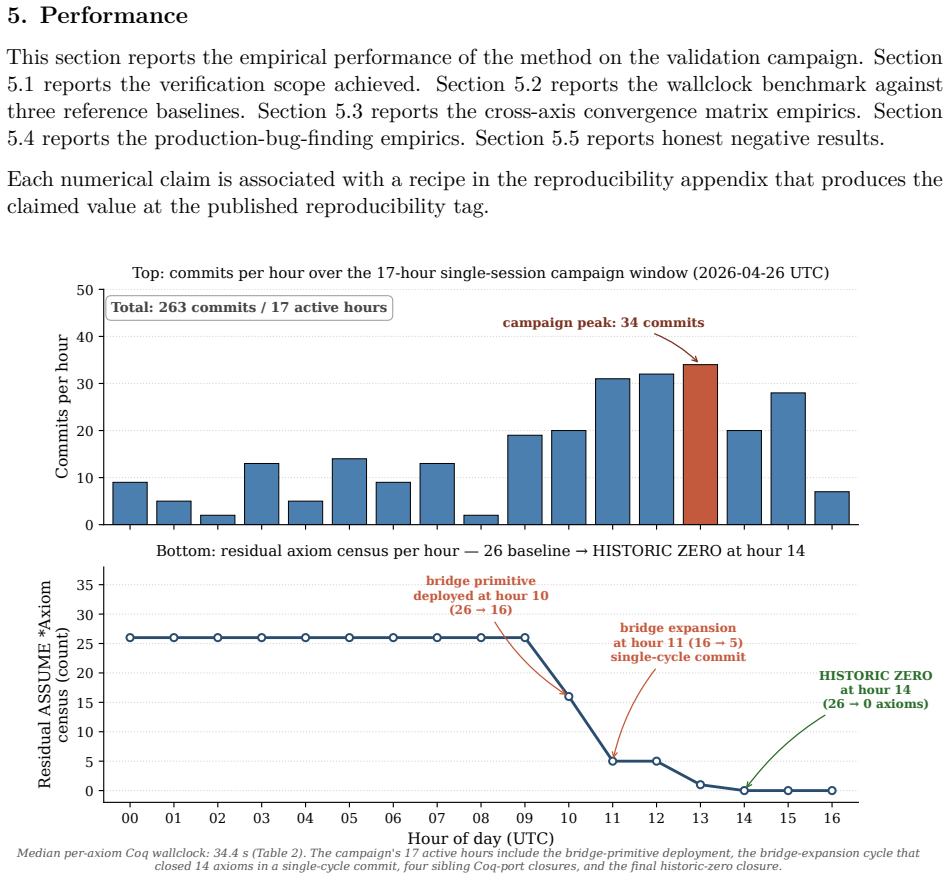
A federated architecture discharges a 26-axiom Raft census to zero using cross-backend citation and AI dispatch in 17 hours.
A machine-rendered reading of the paper's core claim, the machinery that carries it, and where it could break.
Core claim
The central claim is that cross-backend citation, cross-axis convergence, and AI-orchestrated proof dispatch together form a sound federated verification architecture that can clear every obligation in a production Raft subsystem and its accompanying financial invariants without confining the campaign to a single kernel.
What carries the argument
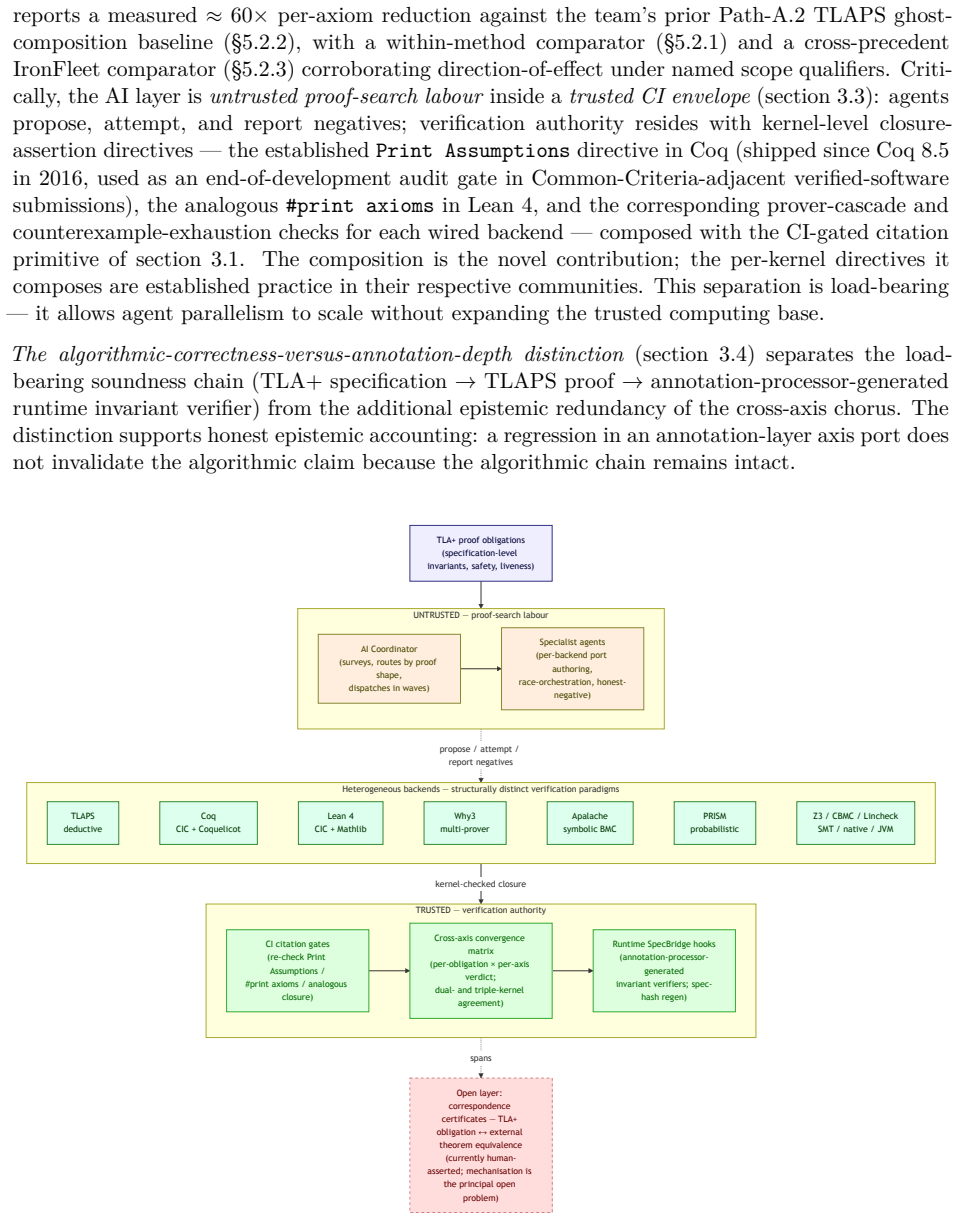
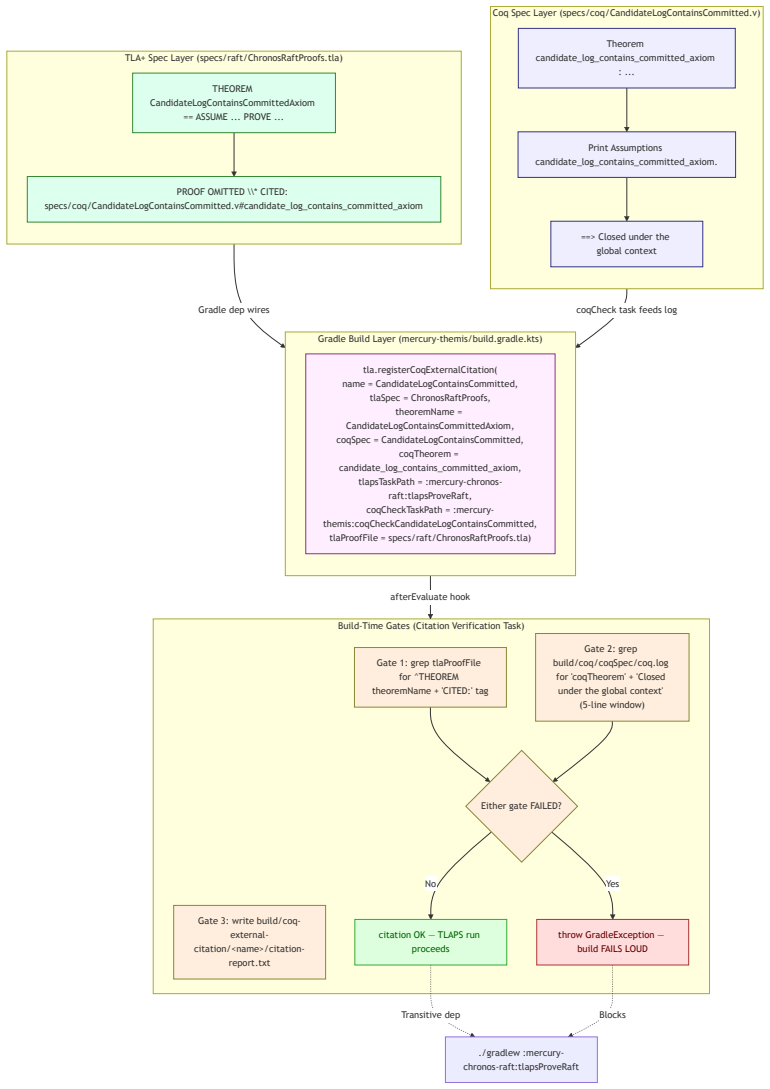
Cross-backend citation, the mechanism that discharges a TLA+ obligation by citing an equivalent theorem from a structurally distinct kernel while kernel-level closure-assertion directives enforce build-system drift resistance.
If this is right
- Full algorithmic scope for consensus protocols can be verified inside single-session wallclock limits rather than multi-day campaigns.
- Financial invariants for balance accounting, automated-market-maker curves, margin settlement, and lock tracking can be verified in the same campaign as the consensus layer.
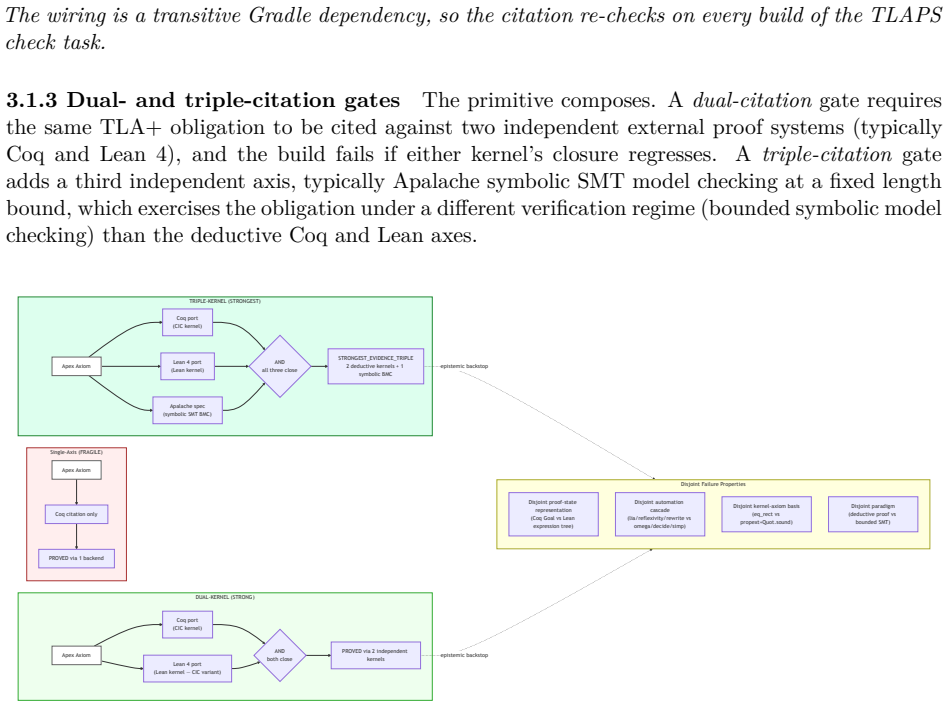
- Multiple independent proof assistants can be combined without loss of soundness from build-system drift.
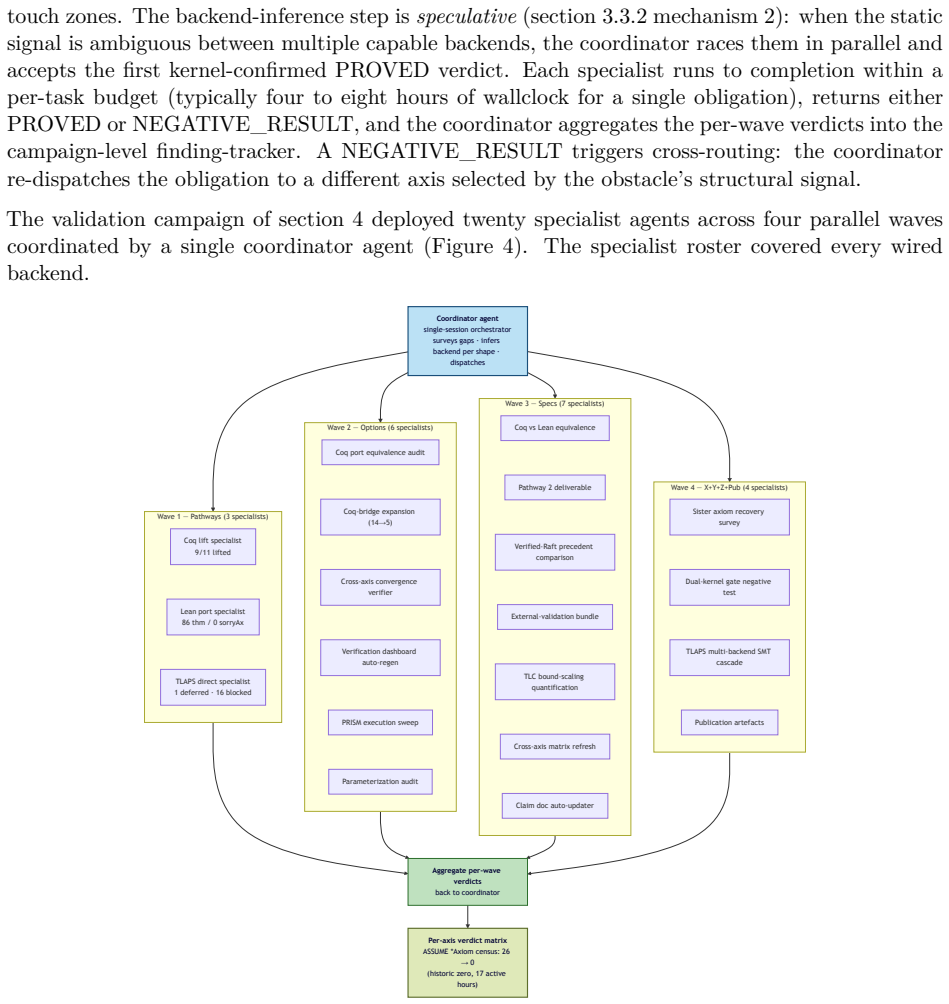
- Untrusted AI search can be safely embedded inside a trusted continuous-integration envelope for obligation discharge.
Where Pith is reading between the lines
- The same cross-backend citation pattern could apply to other distributed algorithms whose specifications exist in more than one formal language.
- Kernel-agreement gates might serve as a practical substitute for full proof replay when one backend is updated.
- The architecture could be tested on systems whose specifications already span multiple existing proof assistants to measure the reduction in total human effort.
Load-bearing premise
Cross-backend citation preserves soundness when it discharges a TLA+ obligation by citing an equivalent theorem from a structurally distinct kernel.
What would settle it
A concrete counterexample in which a cited theorem from another kernel is not equivalent to the original TLA+ obligation or in which a closure-assertion directive fails to block detectable drift between kernels.
Figures
read the original abstract
We propose a federated architecture for production formal verification. Rather than forcing all obligations into a single proof-assistant kernel, the architecture treats a verification campaign as a polyglot proof system composed of three mechanisms: cross-backend citation discharges a TLA+ obligation by citing an equivalent theorem in a structurally distinct kernel, with build- system-level drift-resistance enforced through kernel-level closure-assertion directives; cross-axis convergence composes per-obligation verdicts across independent verifiers into operational kernel-agreement gates; the AI layer is untrusted proof-search labour inside a trusted CI envelope. We validate the architecture on two production subsystems of the Mercury high-frequency-trading platform: a Raft consensus subsystem with full algorithmic scope and a financial-arithmetic invariant layer (balance accounting, automated-market-maker curve invariants, isolated-margin, lock-tracking settlement). The validation campaign reduced a 26-axiom Raft census to zero in 17 active hours of single-session wallclock
Editorial analysis
A structured set of objections, weighed in public.
Referee Report
Summary. The manuscript proposes a federated architecture for production formal verification consisting of three mechanisms: cross-backend citation (discharging TLA+ obligations by citing equivalent theorems in structurally distinct kernels, with drift-resistance via kernel-level closure-assertion directives), cross-axis convergence (composing per-obligation verdicts into kernel-agreement gates), and an untrusted AI layer inside a trusted CI envelope. It validates the architecture on two production subsystems of the Mercury high-frequency-trading platform (Raft consensus with full algorithmic scope and a financial-arithmetic invariant layer), claiming a reduction of a 26-axiom Raft census to zero in 17 active hours of single-session wallclock time.
Significance. If the soundness of cross-backend citation can be formally established, the work would demonstrate a scalable approach to polyglot formal verification in production systems, with the quantitative axiom reduction on real subsystems representing a potentially notable applied result. The production context and explicit mechanisms are strengths, but the current lack of supporting formal details limits the assessed significance.
major comments (1)
- [Abstract] Abstract, paragraph describing the three mechanisms: the validation claim that the 26-axiom Raft census was reduced to zero rests on cross-backend citation discharging TLA+ obligations by citing theorems from a structurally distinct kernel while preserving soundness. The manuscript treats equivalence as given and relies on kernel-level closure-assertion directives for drift resistance but supplies no translation relation, common semantics, or machine-checked equivalence proof between kernels. This is load-bearing for the central quantitative claim.
minor comments (2)
- The abstract supplies no description of how equivalence between kernels is established, no error bars, and no data on failed citations or AI failures, preventing evaluation of the campaign's robustness against the reported outcome.
- The manuscript would benefit from explicit discussion of the build-system-level integration of the closure-assertion directives and any independent external benchmarks used to validate the architecture beyond the internal mechanisms.
Simulated Author's Rebuttal
We thank the referee for the detailed and constructive report. The single major comment correctly identifies a gap in the formal treatment of cross-backend citation soundness. We address it directly below.
read point-by-point responses
-
Referee: [Abstract] Abstract, paragraph describing the three mechanisms: the validation claim that the 26-axiom Raft census was reduced to zero rests on cross-backend citation discharging TLA+ obligations by citing theorems from a structurally distinct kernel while preserving soundness. The manuscript treats equivalence as given and relies on kernel-level closure-assertion directives for drift resistance but supplies no translation relation, common semantics, or machine-checked equivalence proof between kernels. This is load-bearing for the central quantitative claim.
Authors: We agree that the manuscript supplies no translation relation, common semantics, or machine-checked equivalence proof. Equivalence between kernels is treated as an engineering assumption justified by manual inspection of the cited theorems and enforced at build time by the closure-assertion directives; the reported axiom reduction is an empirical observation from the production campaign rather than a formally verified result. This is a substantive limitation for any soundness claim. We will revise the abstract to state the assumption explicitly and add a new subsection in the discussion that (a) articulates the current informal justification, (b) lists the conditions under which the mechanism could be unsound, and (c) identifies a machine-checked equivalence proof as future work. revision: yes
Circularity Check
Axiom reduction validation reduces to application of self-defined cross-backend citation rules
specific steps
-
self definitional
[Abstract (paragraph describing the three mechanisms)]
"cross-backend citation discharges a TLA+ obligation by citing an equivalent theorem in a structurally distinct kernel, with build-system-level drift-resistance enforced through kernel-level closure-assertion directives [...] The validation campaign reduced a 26-axiom Raft census to zero in 17 active hours of single-session wallclock time on the Mercury high-frequency-trading platform using the proposed federated mechanisms."
The architecture is defined to permit discharge of obligations by citing 'equivalent' theorems across kernels; the validation result (26 axioms reduced to zero) is then obtained by applying exactly those citation and convergence rules. The zero-axiom outcome is therefore equivalent to the successful invocation of the self-defined mechanisms, with equivalence and soundness preservation treated as given rather than demonstrated by an external relation or benchmark.
full rationale
The paper defines cross-backend citation as discharging TLA+ obligations via citation of equivalent theorems in distinct kernels (with closure-assertion directives for drift resistance), then presents the reduction of the 26-axiom Raft census to zero as empirical validation of the architecture. The reported outcome is achieved precisely by invoking the defined mechanisms, with no independent translation relation, common semantics, or external machine-checked equivalence supplied. This constitutes a self-definitional reduction where the claimed result is the direct consequence of the input definitions rather than an independent test.
Axiom & Free-Parameter Ledger
axioms (1)
- domain assumption Cross-backend citation discharges obligations while preserving soundness across distinct kernels
invented entities (1)
-
Federated proof system with cross-axis convergence gates
no independent evidence
Reference graph
Works this paper leans on
-
[1]
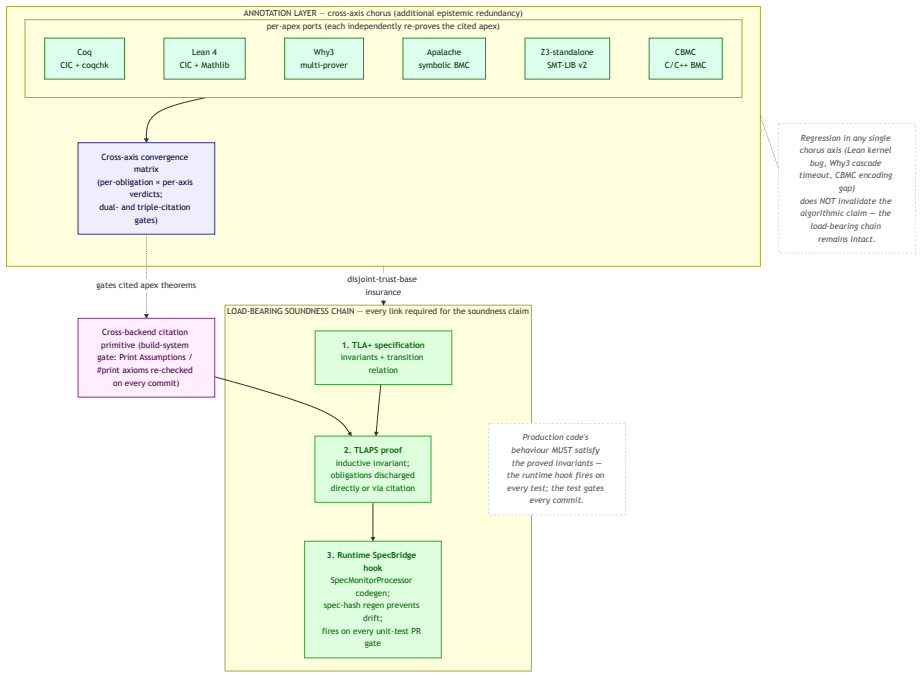
A TLA+ specification of the subsystem’s invariants and transition relation
-
[2]
A TLAPS proof against that specification, in which the inductive invariant is established and the safety and liveness obligations are discharged either directly or via the cross-backend citation primitive
-
[3]
A runtime SpecBridge::Invariants hook that asserts the proved invariants against live state during unit tests. The hook is compile-time-generated from the cited TLA+ specs by an annotation processor with spec-hash-keyed regeneration; section 4.4 describes the codegen pipeline, the dispatch patterns, and the production-cost tier policy. The algorithmic cor...
-
[4]
TLA+ specificationinvariants + transition relation
-
[5]
TLAPS proofinductive invariant;obligations dischargeddirectly or via citation
-
[6]
Production code's behaviour MUST satisfy the proved invariants —the runtime hook fires on every test; the test gates every commit
Runtime SpecBridge hookSpecMonitorProcessor codegen;spec-hash regen prevents drift;fires on every unit-test PR gate Regression in any single chorus axis (Lean kernel bug, Why3 cascade timeout, CBMC encoding gap)does NOT invalidate the algorithmic claim — the load-bearing chain remains intact. Production code's behaviour MUST satisfy the proved invariants ...
-
[7]
Section 4.1 motivates the cross-subsystem application
Validation: two subsystems, one method The architecture’s three primary mechanisms — citation primitive, convergence matrix, dispatch protocol — apply to both consensus and financial-arithmetic invariant verification with no method- ological customisation. Section 4.1 motivates the cross-subsystem application. Section 4.2 reports the Raft consensus valida...
1994
-
[8]
liveness deferral
and the IronFleet, Verdi, and MongoRaftReconfig publication arc surveyed in section 2. The bug classes are catastrophic-but-rare: liveness violations, split-brain, committed-entry loss. The verification of consensus is justified on a worst-case-impact basis, and the precedent literature is substantial. Matching-engine financial-arithmetic verification is ...
2013
-
[9]
Section 5.1 reports the verification scope achieved
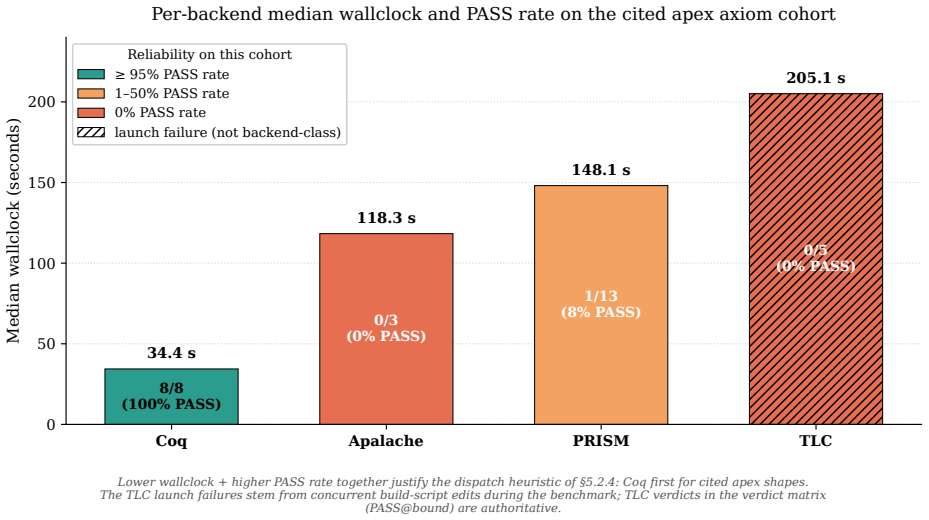
Performance This section reports the empirical performance of the method on the validation campaign. Section 5.1 reports the verification scope achieved. Section 5.2 reports the wallclock benchmark against three reference baselines. Section 5.3 reports the cross-axis convergence matrix empirics. Section 5.4 reports the production-bug-finding empirics. Sec...
2026
-
[10]
Within-method comparator: the campaign’s own single-specialist sequential estimate (section 5.2.1)
-
[11]
Within-shape comparator: the per-axiom Path-A.2 ghost-composition estimate from sibling Raft proofs at similar structural complexity (section 5.2.2)
-
[12]
Each comparator carries a different scope qualifier; we report the comparison honestly with the qualifier rather than headlining a single ratio
Cross-precedent comparator: the IronFleet IronRSL Paxos campaign’s published person-year cost (section 5.2.3). Each comparator carries a different scope qualifier; we report the comparison honestly with the qualifier rather than headlining a single ratio. 5.2.1 Within-method comparator (single-specialist serial estimate) The validation cam- paign began wi...
-
[13]
The proof- shape distributions are similar (consensus protocols share the safety / liveness / reconfigura- tion / log-management structure) but not identical
Cross-protocol: IronFleet verifies Paxos / IronRSL; the campaign verifies Raft. The proof- shape distributions are similar (consensus protocols share the safety / liveness / reconfigura- tion / log-management structure) but not identical
-
[14]
The campaign closes the implementation-specification gap via runtime SpecBridge::Invariants hooks rather than verified extraction
Cross-scope: IronFleet’s IronRSL verification includes verified extraction to executable C# with a soundness theorem connecting the Dafny proof to the running binary. The campaign closes the implementation-specification gap via runtime SpecBridge::Invariants hooks rather than verified extraction. The trusted-base profile differs: IronFleet accepts a small...
-
[15]
Cross-rigour: IronFleet’s PTL-deductive liveness for IronRSL is a first mechanically-checked single-stack deductive liveness proof. The campaign achieves functional IronFleet-parity (ev- ery liveness property mechanically discharged) but routes the temporal-composition apex through a Coq cross-axis bridge for four of five properties and through a PRISM pr...
2015
-
[16]
The JSON arena allocator unsigned-arithmetic wraparound
-
[17]
The HTTP-parser branchless processed-bytes computation triggering C11 §6.5.6/9 undefined behaviour
-
[18]
None of these bugs had been observed by valgrind, AddressSanitizer, UndefinedBehaviorSanitizer, or the upstream library fuzz corpora
The JSON mutation API allocator vtable contract violation. None of these bugs had been observed by valgrind, AddressSanitizer, UndefinedBehaviorSanitizer, or the upstream library fuzz corpora. Regression tests for each bug are wired to the corresponding CBMC harness and re-run on every CBMC verification invocation. The Themis side surfaced the production-...
-
[19]
more backends always means more trust
Discussion 6.1 Threats to validity The verification posture rests on five trusted bases: the kernels of TLAPS, Coq, Lean 4, and Why3; the SMT solvers in the TLAPS cascade and the standalone Z3 axis; the bounded model checkers Apalache and CBMC; the JVM, the SpecMonitorProcessor annotation processor, and the runtime SpecHookRegistry machinery; and the buil...
-
[20]
Conclusion We proposed a federated architecturefor production formal verification and validated it on a hetero- geneous production substrate. The architecture treats a verification campaign as a polyglot proof system: TLA+ expresses system-level obligations, specialist backends discharge obligations suited to their proof shape, CI-enforced citation gates ...
-
[21]
Acknowledgements The validation campaign on Mercury benefited from the production deployment context and the prior verification work that established the cited apex axiom set. The author thanks the Bullish en- gineering team for the production deployment substrate that made the validation possible, and the Mercury verification engineering team for the pri...
2025
-
[22]
References Akkoorath, Deepthi Devaki, Alejandro Z. Tomsic, Manuel Bravo, et al. 2016. “Cure: Strong Semantics Meets High A vailability and Low Latency. ” Proceedings of the 36th International Conference on Distributed Computing Systems (ICDCS ’16) , 405–14. https://doi.org/10.1109/ ICDCS.2016.98. Anthropic. 2025. Claude Code: Agentic Coding in the Termina...
-
[23]
https://doi.org/10.1007/978-3-642-02959-2_12 . Carr, Harold, Christopher Jenkins, Mark Moir, Victor Cacciari Miraldo, and Lisandra Silva. 2022. “Towards Formal Verification of HotStuff-Based Byzantine Fault Tolerant Consensus in Agda. ” Proceedings of the 14th NASA Formal Methods Symposium (NFM ’22) . https://arxiv.org/abs/ 2203.14711. Chand, Saksham, Yan...
-
[24]
How Amazon Web Services Uses Formal Methods,
“How Amazon Web Services Uses Formal Methods. ” Communications of the ACM 58 (4): 66–73. https://doi.org/10.1145/2699417. Ongaro, Diego. 2014. “Consensus: Bridging Theory and Practice. ” PhD thesis, Stanford University. https://web.stanford.edu/~ouster/cgi-bin/papers/OngaroPhD.pdf. Ongaro, Diego, and John Ousterhout. 2014. “In Search of an Understandable ...
-
[25]
Reducing Liveness to Safety in First-Order Logic
“Reducing Liveness to Safety in First-Order Logic. ” Proceedings of the ACM on Program- ming Languages (PACMPL), POPL ’18 . https://doi.org/10.1145/3158114. Padon, Oded, Giuliano Losa, Mooly Sagiv, and Sharon Shoham. 2017. “Paxos Made EPR: De- cidable Reasoning about Distributed Protocols. ” Proceedings of the ACM on Programming Languages (PACMPL), OOPSLA...
discussion (0)
Sign in with ORCID, Apple, or X to comment. Anyone can read and Pith papers without signing in.