The impact of sample insulation on estimating the heating power of magnetic nanoparticles by AC calorimetry
Pith reviewed 2026-06-28 11:44 UTC · model grok-4.3
The pith
Temperature rise in sample insulation creates systematic errors in AC calorimetry heating power estimates when environment temperature is held fixed.
A machine-rendered reading of the paper's core claim, the machinery that carries it, and where it could break.
Core claim
The authors demonstrate that temperature increase in the insulation leads to systematic errors when estimating the heating power by the corrected slope method if the temperature of the sample environment is kept fixed at its initial temperature in the data analysis. They propose that these errors are corrected by using a local temperature difference between the sample and the sample environment.
What carries the argument
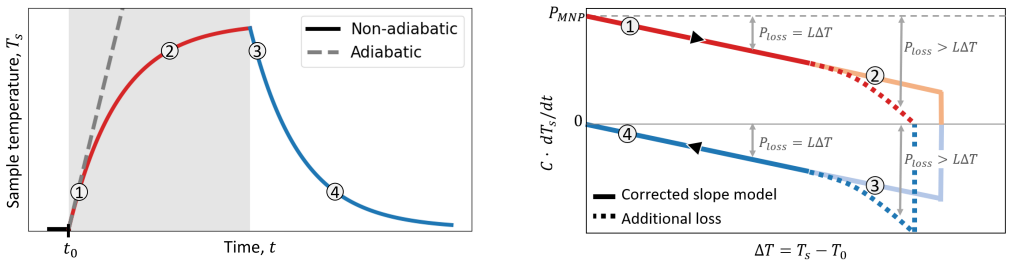
The corrected slope method in AC calorimetry, where the key mechanism is the choice of reference temperature (fixed initial environment value versus local sample-environment difference) when insulation heats during the measurement.
If this is right
- Heating power values obtained with the corrected slope method and fixed environment temperature will be biased when insulation is present.
- Using the local temperature difference removes the identified systematic error in the analysis.
- Accurate power estimates become available for hyperthermia applications once the local difference is adopted.
- Past data sets that used fixed environment temperature may need reprocessing if insulation was used.
Where Pith is reading between the lines
- Similar reference-temperature choices may introduce comparable biases in other thermal measurement setups for nanoparticles.
- Instrument designs could incorporate dedicated local sensors to make the corrected analysis automatic.
- The result suggests checking whether insulation effects appear in steady-state or different-frequency calorimetry protocols.
Load-bearing premise
That insulation temperature rise is the dominant error source and that switching to a local temperature difference removes the bias without new unaccounted effects from sensor placement or altered heat flow paths.
What would settle it
Perform paired AC calorimetry runs on the same nanoparticle sample, once analyzing with fixed initial environment temperature and once with local difference, then compare both results to an independent heating power measurement obtained without insulation or by a different technique such as direct calorimetry.
Figures
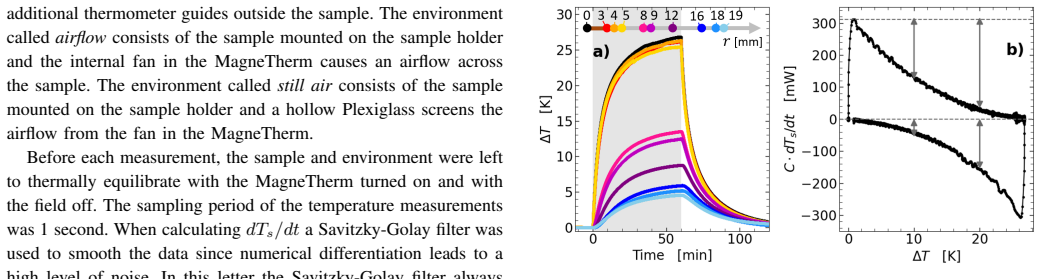
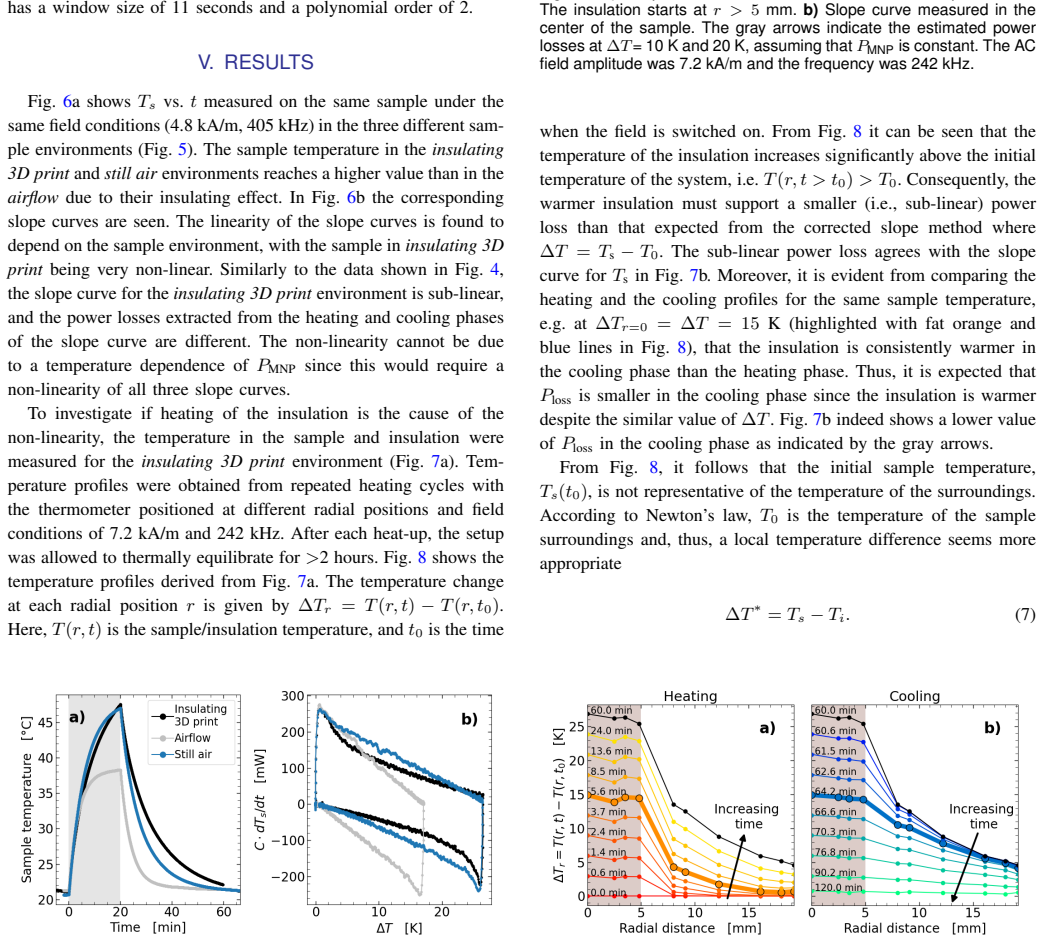
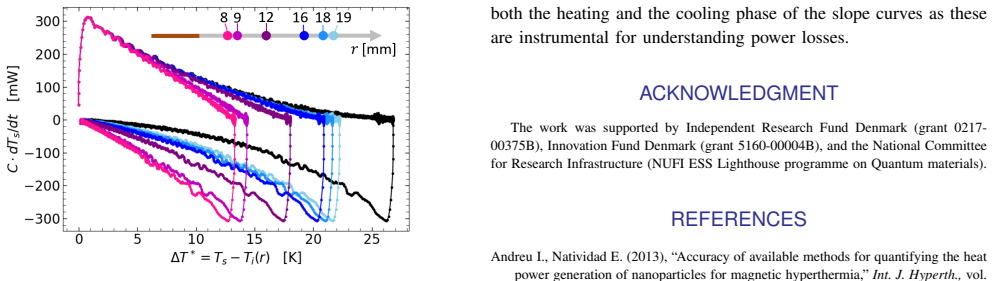
read the original abstract
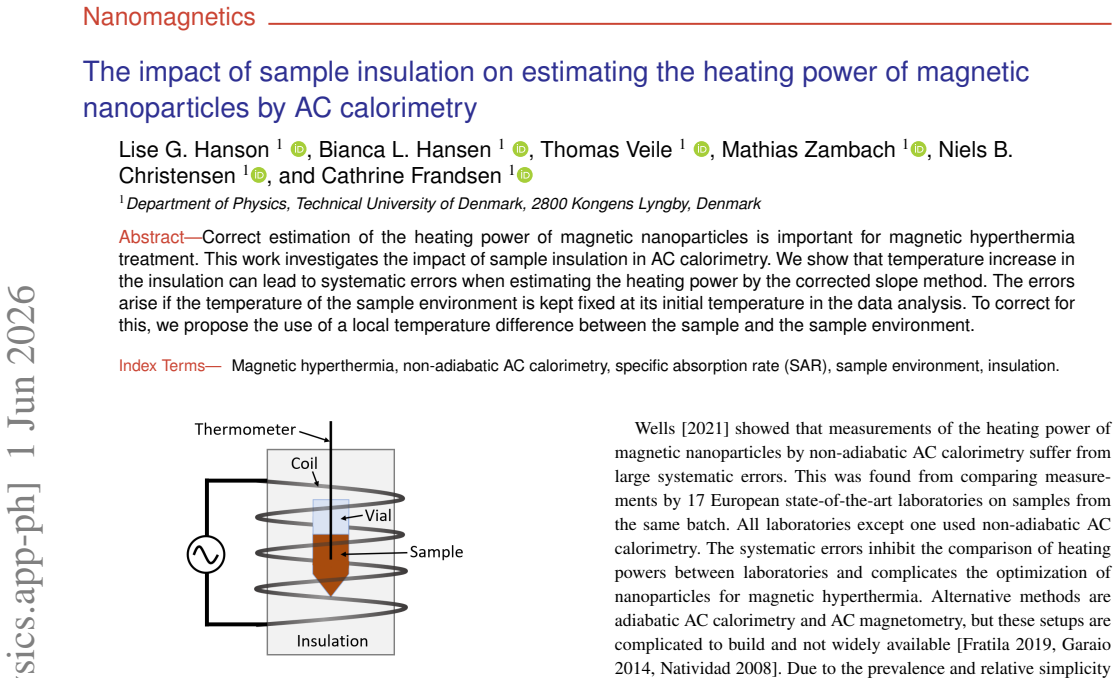
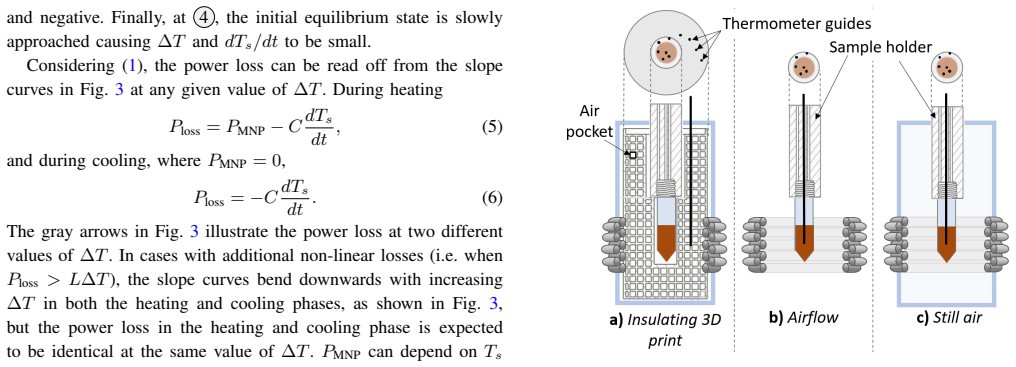
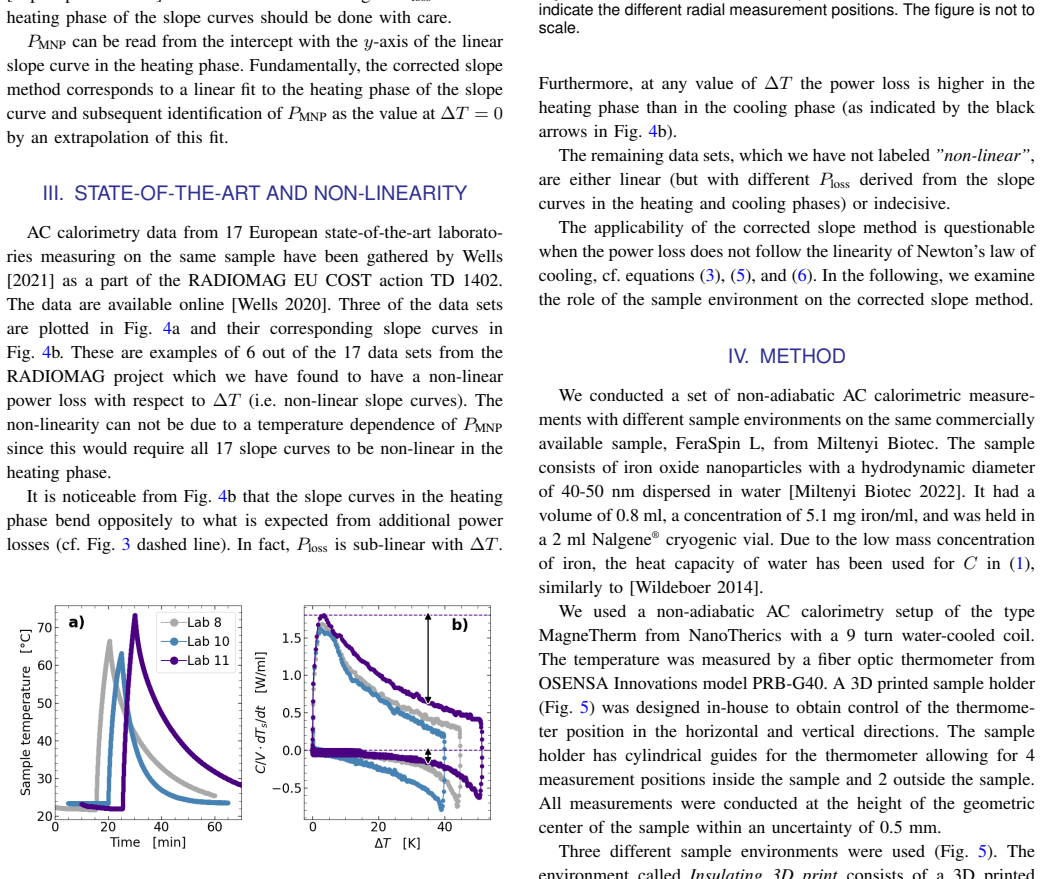
Correct estimation of the heating power of magnetic nanoparticles is important for magnetic hyperthermia treatment. This work investigates the impact of sample insulation in AC calorimetry. We show that temperature increase in the insulation can lead to systematic errors when estimating the heating power by the corrected slope method. The errors arise if the temperature of the sample environment is kept fixed at its initial temperature in the data analysis. To correct for this, we propose the use of a local temperature difference between the sample and the sample environment.
Editorial analysis
A structured set of objections, weighed in public.
Referee Report
Summary. The manuscript investigates the impact of sample insulation on AC calorimetry measurements of magnetic nanoparticle heating power. It claims that temperature rise in the insulation produces systematic errors in the corrected slope method when the sample-environment temperature is fixed at its initial value during analysis, and proposes that measuring a local temperature difference between the sample and its immediate environment removes this bias.
Significance. If the central observation and proposed correction are robust, the work would provide a practical, low-cost improvement to heating-power estimation protocols used in magnetic hyperthermia research. The strength lies in identifying an experimental artifact that is likely common in insulated-sample setups; adoption of the local-ΔT approach could reduce systematic offsets without requiring major changes to existing apparatus. No machine-checked proofs or parameter-free derivations are present, but the result is framed as a falsifiable experimental correction.
major comments (2)
- [section describing the local temperature difference method and associated data analysis] The central claim that the local-ΔT construction fully removes bias requires that the environment-temperature sensor does not alter dominant heat-flow paths or sample a different thermal boundary condition. No section of the manuscript reports tests in which the sensor position relative to the insulation layer is varied, nor any quantification of residual error under realistic placement offsets. This omission leaves the invariance of the corrected slope unverified and directly undermines the recommendation to switch to local ΔT.
- [Results] The manuscript supplies no quantitative error analysis, uncertainty budgets, or comparison of heating-power values obtained with fixed versus local environment temperature. Without these, it is impossible to judge the magnitude of the reported systematic error or the improvement achieved by the proposed fix.
minor comments (2)
- [Methods] Notation for the corrected slope method and the definition of local ΔT should be introduced with explicit equations rather than descriptive text only.
- [Figure captions] Figure captions should state the insulation material, thickness, and sensor locations so that the geometry underlying the claimed effect is reproducible.
Simulated Author's Rebuttal
We thank the referee for the detailed and constructive report. We address each major comment below, indicating where revisions will be made to the manuscript.
read point-by-point responses
-
Referee: [section describing the local temperature difference method and associated data analysis] The central claim that the local-ΔT construction fully removes bias requires that the environment-temperature sensor does not alter dominant heat-flow paths or sample a different thermal boundary condition. No section of the manuscript reports tests in which the sensor position relative to the insulation layer is varied, nor any quantification of residual error under realistic placement offsets. This omission leaves the invariance of the corrected slope unverified and directly undermines the recommendation to switch to local ΔT.
Authors: We agree that the manuscript lacks explicit tests varying the environment-temperature sensor position relative to the insulation and does not quantify residual errors from placement offsets. This limits verification of full invariance. In the revised manuscript we will add a dedicated discussion of sensor placement effects, including a qualitative analysis of how small offsets could influence the local ΔT measurement based on the thermal model already presented. We maintain that the local-ΔT method still removes the primary bias identified in the fixed-environment analysis, but we accept that additional experimental validation would be needed to fully support the recommendation. revision: partial
-
Referee: [Results] The manuscript supplies no quantitative error analysis, uncertainty budgets, or comparison of heating-power values obtained with fixed versus local environment temperature. Without these, it is impossible to judge the magnitude of the reported systematic error or the improvement achieved by the proposed fix.
Authors: We acknowledge the absence of a quantitative uncertainty budget and direct numerical comparisons between the two analysis approaches. In the revised manuscript we will add an error analysis section that includes propagated uncertainties for the heating-power estimates and explicit side-by-side tabulation (or plots) of values obtained with fixed versus local environment temperature, thereby quantifying both the systematic offset and the improvement from the proposed correction. revision: yes
Circularity Check
No significant circularity; experimental observation and correction are independent of fitted inputs or self-citations
full rationale
The manuscript reports an experimental observation that insulation temperature rise can bias the corrected slope method when sample-environment temperature is held fixed at its initial value, and proposes using a measured local ΔT as a practical fix. No load-bearing equations, derivations, or parameter fits are described that reduce the claimed error or correction to a self-definition, a renamed fit, or a self-citation chain. The result is presented as a direct consequence of heat-flow physics under the stated conditions and is externally falsifiable by calorimetry measurements; therefore the derivation chain is self-contained.
Axiom & Free-Parameter Ledger
Reference graph
Works this paper leans on
-
[1]
Andreu I., Natividad E. (2013), ``Accuracy of available methods for quantifying the heat power generation of nanoparticles for magnetic hyperthermia,'' Int. J. Hyperth., vol. 29, pp. 739-751, doi: 10.3109/02656736.2013.826825 https://dx.doi.org/ 10.3109/02656736.2013.826825
-
[2]
(1959), ``Conduction of heat in solids,'' 2nd ed, OUP, pp
Carslaw H., Jaeger J. (1959), ``Conduction of heat in solids,'' 2nd ed, OUP, pp. 18-21
1959
-
[3]
Chang D., Lim M., Goos J., Qiao R., Ng Y., Mansfeld F., Jackson M., Davis T. Kavallaris M. (2018), ``Biologically targeted magnetic hyperthermia: potential and limitations,'' Front. Pharmacol., vol. 9, pp. 831, doi: 10.3389/fphar.2018.00831 https://doi.org/10.3389/fphar.2018.00831
-
[4]
(2019), ``Nanomaterials for Magnetic and Optical Hyperthermia Applications,'' 1st ed., pp
Fratila R., Fuente, J. (2019), ``Nanomaterials for Magnetic and Optical Hyperthermia Applications,'' 1st ed., pp. 111-138, Elsevier, doi: 10.1016/C2017-0-00855-8 https://dx.doi.org/10.1016/C2017-0-00855-8
-
[5]
Garaio E., Collantes J., Garcia J., Plazaola F., Mornet S., Couillaud F., Sandre O. (2014), ``wide-frequency range AC magnetometer to measure the specific absorption rate in nanoparticles for magnetic hyperthermia,'' J. Magn. Magn. Mater., vol. 368, pp. 432-437, doi: 10.1016/j.jmmm.2013.11.021 https://doi.org/10.1016/j.jmmm.2013.11.021
-
[6]
(1957), ``Selective inductive heating of lymph nodes, '' Ann
Gilchrist K., Medal R., Shorey D., Hanselman C., Parrott C., Taylor B. (1957), ``Selective inductive heating of lymph nodes, '' Ann. Surg., vol. 146, pp. 596-606, doi: 10.1097/00000658-195710000-00007 https://doi.org/10.1097/00000658-195710000-00007
-
[7]
Huang S., Wang S., Gupta A., Borca-Tasciuc A., Salon S. (2012), ``On the measurement technique for specific absorption rate of nanoparticles in an alternating electromagnetic field'' Meas. Sci. Technol, vol. 23, pp. 035701, doi: 10.1088/0957-0233/23/3/035701 https://doi.org/10.1088/0957-0233/23/3/035701
-
[8]
Maier-Hauff K.,Ulrich F., Nestler D., Niehoff H., Wust P., Thiesen B., Orawa H., Budach V., Jordan A. (2011), ``Efficacy and safety of intratumoral thermotherapy using magnetic iron-oxide nanoparticles combined with external beam radiotherapy on patients with recurrent glioblastoma multiforme,'' J. Neurooncol., vol. 103, pp. 317-324, doi: 10.1007/s11060-0...
-
[9]
Miltenyi Biotec, https://www.miltenyibiotec.com/upload/assets/IM0001913.PDF https://www.miltenyibiotec.com/upload/assets/IM0001913.PDF Accessed: 2022-11-08
2022
-
[10]
Natividad E., Castro M., Mediano A. (2008), ``Accurate measurement of the specific absorption rate using a suitable adiabatic magnetothermal setup,'' Appl. Phys. Lett., vol. 92, pp. 093116, doi: 10.1063/1.2891084 https://doi.org/10.1063/1.2891084
-
[11]
Natividad E., Castro M., Mediano A. (2009), ``Adiabatic vs. non-adiabatic determination of specific absorption rate of ferrofluids,'' J. Magn. Magn. Mater., vol. 40, pp. 205-212, doi: 10.1016/j.jmmm.2009.02.072 https://doi.org/10.1016/j.jmmm.2009.02.072
-
[12]
(2020), ``Magnetic fluid hyperthermia simulations in evaluation of SAR calculation methods,'' Phys
Papadopoulosa C., Efthimiadoub E., Pissasc M., Fuentesd D., Boukosc N., Psycharisc V, Kordasc G., Loukopoulose V., Kagadisa G. (2020), ``Magnetic fluid hyperthermia simulations in evaluation of SAR calculation methods,'' Phys. Med., vol. 71, pp. 39-52, doi: 10.1016/j.ejmp.2020.02.011 https://doi.org/10.1016/j.ejmp.2020.02.011
-
[13]
Wells J., Ortega D., Steinhoff U. Dutz S., Garaio E., Sandre O., Natividad Eva., Cruz M.; Brero F., Southern P., Pankhurst Q., Spassov S., RADIOMAG consortium (2020), ``Radiomag Interlaboratory Comparison of Magnetic Hyperthermia Characterisation Measurements: Data,'' zenodo.org, doi: https://zenodo.org/record/4281154\#.Y34d2X3MI2x https://zenodo.org/reco...
arXiv 2020
-
[14]
Wang S., Huang S., Borca-Tasciuc D. (2021), ``Potential Sources of Errors in Measuring and Evaluating the Specific Loss Power of Magnetic Nanoparticles in an Alternating Magnetic Field,'' IEEE Trans. Magn., vol. 49, pp. 255-262, doi: 10.1109/TMAG.2012.2224648 https://doi.org/10.1109/TMAG.2012.2224648
-
[15]
Wells J., Ortega D., Steinhoff U., Dutz S., Garaio E., Sandre O., Natividad E., Cruz M., Brero F., Southern P. (2021), ``Challenges and recommendations for magnetic hyperthermia characterization measurements,'' Int. J. Hyperth., vol. 38, pp. 447-460, doi: 10.1080/02656736.2021.1892837 https://doi.org/10.1080/02656736.2021.1892837
-
[16]
Wildeboer R., Southern P., Pankhurst Q. (2014), ``On the reliable measurement of specific absorption rates and intrinsic loss parameters in magnetic hyperthermia materials,'' J. Phys. D, vol.47, pp. 495003, doi: 10.1088/0022-3727/47/49/495003 https://dx.doi.org/10.1088/0022-3727/47/49/495003
-
[17]
(1999), ``Newton's law of cooling,'' Contemp
Winterton R. (1999), ``Newton's law of cooling,'' Contemp. Phys., vol. 40, pp. 205-212, doi: 10.1080/001075199181549 https://doi.org/10.1080/001075199181549
discussion (0)
Sign in with ORCID, Apple, or X to comment. Anyone can read and Pith papers without signing in.