Guided Sensemaking: Agents in Collaborative Deliberation
Pith reviewed 2026-06-28 12:49 UTC · model grok-4.3
The pith
AI agents act as research partners to scaffold critical thinking and visualize arguments in collaborative deliberation without replacing user reasoning.
A machine-rendered reading of the paper's core claim, the machinery that carries it, and where it could break.
Core claim
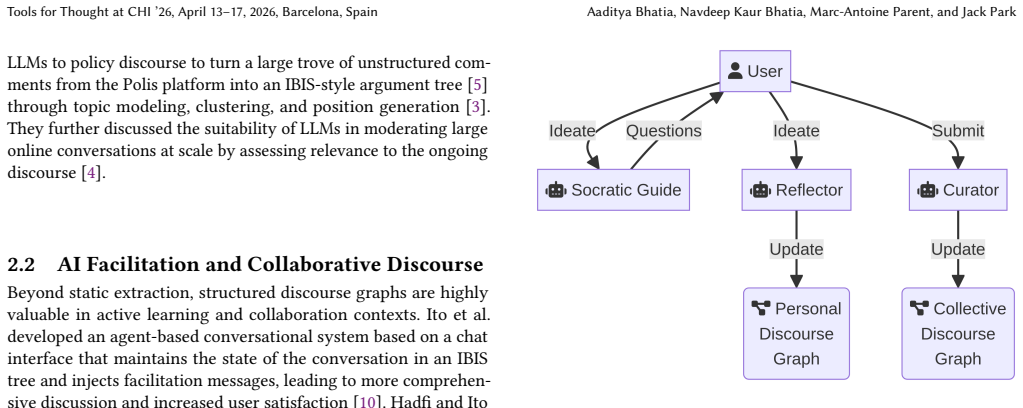
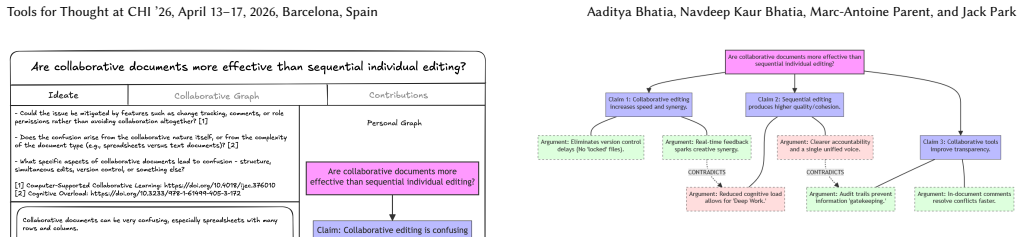
The paper claims that an AI-augmented multiagent discourse platform can facilitate the composition of well-thought-out ideas around a central question, provide scaffolding for critical thinking, and enable visualization of argumentative structure. Several interactive agents supply context-sensitive questioning prompts and expose thematic clusters, agreements, and points of contention without collapsing diverse perspectives. This positions generative AI not as a shortcut to answers but as a research partner that externalizes reasoning, preserves user agency, and fosters structured, traceable sensemaking in educational and civic contexts.
What carries the argument
Guided Sensemaking, the multiagent discourse platform whose interactive agents deliver context-sensitive questioning prompts and produce visualizations of argumentative structure.
If this is right
- Facilitates composition of well-thought-out ideas around a central question.
- Provides scaffolding for critical thinking through context-sensitive prompts.
- Enables visualization of argumentative structure that reveals clusters, agreements, and contention.
- Supports collaborative deliberation while keeping diverse perspectives intact.
- Fosters structured and traceable sensemaking suited to educational and civic use.
Where Pith is reading between the lines
- Classroom trials could measure whether repeated use of the prompts increases the depth of student-generated arguments over time compared with direct AI answer tools.
- The visualization layer might surface hidden group biases that text threads alone leave invisible.
- Similar agent scaffolding could be adapted to scientific team hypothesis development where tracing reasoning steps matters.
- Deployment logs from real groups would reveal whether participants actually revise their own views more often than they accept agent suggestions.
- keywords:[
Load-bearing premise
That interactive agents positioned as research partners will externalize reasoning and preserve user agency instead of letting convenience displace effortful thinking.
What would settle it
A controlled comparison in which users of the Guided Sensemaking platform generate arguments containing fewer original connections or less personal elaboration than users of ordinary chat-based AI would show the core claim does not hold.
Figures
read the original abstract
Generative AI systems are aggressively reshaping how students engage with information and perform cognitive work; convenience-oriented use has the potential to displace effortful reasoning, reflection, and learning, especially for those who lack domain expertise and effective human-AI interaction strategies. Current AI tools are heavily focused on chat-style interfaces geared towards answer generation and efficiency in a linear and fragmented stream of text, offering limited support for structured reflection, argument construction, and sensemaking in collaborative contexts. We introduce Guided Sensemaking, an AI-augmented multiagent discourse platform that facilitates composition of well-thought-out ideas around a central question, provides scaffolding for critical thinking, and enables visualization of argumentative structure to support critical thinking and collaborative deliberation. The system uses several interactive agents to provide context-sensitive questioning prompts and a scaffolding for thought that exposes thematic clusters, agreements, and points of contention without collapsing diverse perspectives. This paper proposes a conceptual design and interaction paradigm that positions generative AI not as a shortcut to answers but as a research partner that externalizes reasoning, preserves user agency, and fosters structured, traceable sensemaking in educational and civic contexts.
Editorial analysis
A structured set of objections, weighed in public.
Referee Report
Summary. The manuscript proposes Guided Sensemaking, a conceptual AI-augmented multiagent discourse platform for collaborative deliberation. It argues that current generative AI chat interfaces promote convenience-oriented use that displaces effortful reasoning and critical thinking. The design uses interactive agents to deliver context-sensitive questioning prompts, perform thematic clustering, and visualize agreements and points of contention around a central question, thereby positioning AI as a research partner that externalizes reasoning, preserves user agency, and supports structured sensemaking in educational and civic settings.
Significance. If the interaction paradigm can be realized and shown to achieve its stated goals, the work would offer a timely contribution to HCI and AI-mediated deliberation by providing a structured alternative to linear answer-generation interfaces. The conceptual framework explicitly targets the risk of reasoning displacement and introduces visualization of argumentative structure as a mechanism for maintaining diverse perspectives, which could inform future systems in education and civic discourse.
major comments (2)
- [Abstract] Abstract: The central claim that the multiagent design 'positions generative AI not as a shortcut to answers but as a research partner that externalizes reasoning, preserves user agency' is load-bearing yet unsupported; the manuscript provides only intended affordances (context-sensitive prompts, thematic clustering, agreement/contention visualization) with no implementation details, prompt examples, agent architecture, or pseudocode showing how scaffolding is enforced over answer generation.
- [Design proposal] System description (throughout the design proposal): No failure-mode analysis or discussion of how the agents would prevent collapse into convenience-oriented use is included, leaving the weakest assumption—that interactive agents will externalize reasoning without displacing effort—untested and unexamined despite being the core motivation.
minor comments (2)
- The manuscript would benefit from explicit comparison to existing argument-mapping and deliberation platforms (e.g., Kialo, Argdown) to clarify the novel contribution of the multiagent scaffolding.
- Notation for agent roles and interaction flows could be clarified with a diagram or table to improve readability of the conceptual design.
Simulated Author's Rebuttal
We thank the referee for the constructive feedback. As this is a conceptual design paper, we address the comments by clarifying the scope and committing to revisions that strengthen the presentation of the proposed paradigm without altering its conceptual nature.
read point-by-point responses
-
Referee: [Abstract] Abstract: The central claim that the multiagent design 'positions generative AI not as a shortcut to answers but as a research partner that externalizes reasoning, preserves user agency' is load-bearing yet unsupported; the manuscript provides only intended affordances (context-sensitive prompts, thematic clustering, agreement/contention visualization) with no implementation details, prompt examples, agent architecture, or pseudocode showing how scaffolding is enforced over answer generation.
Authors: The manuscript is framed as a conceptual design proposal, with the central claim describing the intended positioning and rationale of the interaction paradigm rather than results from an implemented system. To better support the claim within the conceptual scope, we will revise the abstract for precision and add an appendix containing illustrative prompt templates, a high-level agent interaction diagram, and pseudocode sketches for key scaffolding behaviors. revision: yes
-
Referee: [Design proposal] System description (throughout the design proposal): No failure-mode analysis or discussion of how the agents would prevent collapse into convenience-oriented use is included, leaving the weakest assumption—that interactive agents will externalize reasoning without displacing effort—untested and unexamined despite being the core motivation.
Authors: We agree that explicit consideration of failure modes strengthens a design proposal. We will add a new subsection to the design proposal that analyzes risks such as prompt dismissal or reversion to direct-answer behavior, and describe intended mitigations including persistent argument visualization, user-controlled agent activation, and mandatory reflection checkpoints. revision: yes
Circularity Check
No circularity: conceptual design proposal with no derivations or self-referential chains
full rationale
The paper is a conceptual design proposal for a multiagent discourse platform. It contains no equations, fitted parameters, predictions, or derivation chains of any kind. The central claims describe intended affordances of the proposed system (context-sensitive prompts, thematic clustering, visualization) rather than results derived from prior inputs or self-citations. No load-bearing self-citations, ansatzes, or renamings are present. This matches the default expectation of no significant circularity for non-empirical, non-mathematical design work.
Axiom & Free-Parameter Ledger
axioms (1)
- domain assumption Generative AI can be positioned as a research partner that externalizes reasoning and preserves user agency without displacing effortful thinking when given appropriate scaffolding.
invented entities (1)
-
Guided Sensemaking multiagent discourse platform
no independent evidence
Reference graph
Works this paper leans on
-
[1]
Lucas Anastasiou and Anna De Liddo. 2024. A Hybrid Human-AI Approach for Argument Map Creation From Transcripts. InProceedings of the First Work- shop on Language-driven Deliberation Technology (DELITE) @ LREC-COLING 2024, Annette Hautli-Janisz, Gabriella Lapesa, Lucas Anastasiou, Valentin Gold, Anna De Liddo, and Chris Reed (Eds.). ELRA and ICCL, Torino,...
2024
-
[2]
Lucas Anastasiou and Anna De Liddo. 2026. From Shallow Discourse to Structured Deliberation: The BCause Approach. InHuman-Computer Interaction – INTERACT 2025, Carmelo Ardito, Simone Diniz Junqueira Barbosa, Tayana Conte, André Freire, Isabela Gasparini, Philippe Palanque, and Raquel Prates (Eds.). Springer Nature Switzerland, Cham, 94–99. doi:10.1007/978...
-
[3]
Aaditya Bhatia. 2024. Advancing Policy Insights: Opinion Data Analysis and Discourse Structuring Using LLMs.Graduate Thesis and Dissertation 2023-2024 ETD2023, 204 (Jan. 2024), 100 pages. https://stars.library.ucf.edu/etd2023/204
2024
-
[4]
Aaditya Bhatia and Gita Sukthankar. 2024. Moderating Democratic Discourse with LLMs. InSocial, Cultural, and Behavioral Modeling, Robert Thomson, Aravind Guided Sensemaking: Agents in Collaborative Deliberation Tools for Thought at CHI ’26, April 13–17, 2026, Barcelona, Spain Hariharan, Scott Renshaw, Samer Al-khateeb, Annetta Burger, Patrick Park, and Ar...
-
[5]
Aaditya Bhatia and Gita Sukthankar. 2025. Using LLMs to Structure and Visualize Policy Discourse. InArtificial Intelligence for Research and Democracy, Wenpeng Yin, Jihyun Janice Ahn, Rui Zhang, Lifu Huang, Rafik Hadfi, Takayuki Ito, Susumu Ohnuma, and Shun Shiramatsu (Eds.). Vol. 14917. Springer Nature Singapore, Singapore, 69–76. doi:10.1007/978-981-97-...
-
[6]
Joel Chan, Matthew Akamatsu, David Vargas, Lukas Kawerau, and Michael Gartner. 2024. Steps Towards an Infrastructure for Scholarly Synthesis. arXiv:2407.20666 [cs.HC] doi:10.48550/arXiv.2407.20666
-
[7]
Kai Guo, Yuchun Zhong, Danling Li, and Samuel Kai Wah Chu. 2023. Effects of chatbot-assisted in-class debates on students’ argumentation skills and task mo- tivation.Computers & Education203 (Oct. 2023), 104862. doi:10.1016/j.compedu. 2023.104862
-
[8]
Rafik Hadfi and Takayuki Ito. 2022. Augmented Democratic Deliberation: Can Conversational Agents Boost Deliberation in Social Media?. InProceedings of the 21st International Conference on Autonomous Agents and Multiagent Systems (AAMAS ’22). International Foundation for Autonomous Agents and Multiagent Systems, Richland, SC, 1794–1798
2022
-
[9]
Yinya Huang, Meng Fang, Yu Cao, Liwei Wang, and Xiaodan Liang. 2021. DAGN: Discourse-Aware Graph Network for Logical Reasoning. InProceedings of the 2021 Conference of the North American Chapter of the Association for Computa- tional Linguistics: Human Language Technologies. Association for Computational Linguistics, Online, 5848–5855. doi:10.18653/v1/202...
-
[10]
Takayuki Ito, Rafik Hadfi, and Shota Suzuki. 2022. An Agent that Facilitates Crowd Discussion.Group Decision and Negotiation31, 3 (June 2022), 621–647. doi:10.1007/s10726-021-09765-8
-
[11]
David Krakauer. 2016. Will A.I. Harm Us? Better to Ask How We’ll Reckon With Our Hybrid Nature. https://nautil.us/will-ai-harm-us-better-to-ask-how-well- reckon-with-our-hybrid-nature-236098/
2016
-
[12]
Hao-Ping (Hank) Lee, Advait Sarkar, Lev Tankelevitch, Ian Drosos, Sean Rintel, Richard Banks, and Nicholas Wilson. 2025. The Impact of Generative AI on Critical Thinking: Self-Reported Reductions in Cognitive Effort and Confidence Effects From a Survey of Knowledge Workers. InProceedings of the 2025 CHI Conference on Human Factors in Computing Systems. AC...
-
[13]
Moeka Nomura, Takayuki Ito, and Shiyao Ding. 2024. Towards Collaborative Brain-storming among Humans and AI Agents: An Implementation of the IBIS- based Brainstorming Support System with Multiple AI Agents. InProceedings of the ACM Collective Intelligence Conference (CI ’24). Association for Computing Machinery, New York, NY, USA, 1–9. doi:10.1145/3643562.3672609
-
[14]
2019.The Thinker’s Guide to Socratic Questioning
Richard Paul. 2019.The Thinker’s Guide to Socratic Questioning. Rowman & Littlefield Publishers, Blue Ridge Summit
2019
-
[15]
Anjali Singh, Karan Taneja, Zhitong Guan, and Avijit Ghosh. 2025. Protecting Hu- man Cognition in the Age of AI. doi:10.48550/arXiv.2502.12447 arXiv:2502.12447
-
[16]
arXiv preprint arXiv:2306.11932 , year=
Christopher T. Small, Ivan Vendrov, Esin Durmus, Hadjar Homaei, Elizabeth Barry, Julien Cornebise, Ted Suzman, Deep Ganguli, and Colin Megill. 2023. Opportunities and Risks of LLMs for Scalable Deliberation with Polis. http: //arxiv.org/abs/2306.11932 arXiv:2306.11932 [cs]
-
[17]
Lev Tankelevitch, Viktor Kewenig, Auste Simkute, Ava Elizabeth Scott, Advait Sarkar, Abigail Sellen, and Sean Rintel. 2024. The Metacognitive Demands and Opportunities of Generative AI. InProceedings of the CHI Conference on Human Factors in Computing Systems. ACM, Honolulu HI USA, 1–24. doi:10.1145/3613904. 3642902
-
[18]
Charles Twardy and Philosophy Documentation Center. 2004. Argument Maps Improve Critical Thinking:.Teaching Philosophy27, 2 (2004), 95–116. doi:10. 5840/teachphil200427213 Received 12 February 2026; Accepted 26 February 2026; Revised 26 March 2026; Presented 16 April 2026
2004
discussion (0)
Sign in with ORCID, Apple, or X to comment. Anyone can read and Pith papers without signing in.