Dynamic Spectral Denoising with Global-Context Attention for Multi-Behavior Recommendation
Pith reviewed 2026-06-28 12:33 UTC · model grok-4.3
The pith
SpectraMB improves target behavior prediction in multi-behavior recommendation by purifying representations via dynamic spectral filtering before reliability-aware fusion.
A machine-rendered reading of the paper's core claim, the machinery that carries it, and where it could break.
Core claim
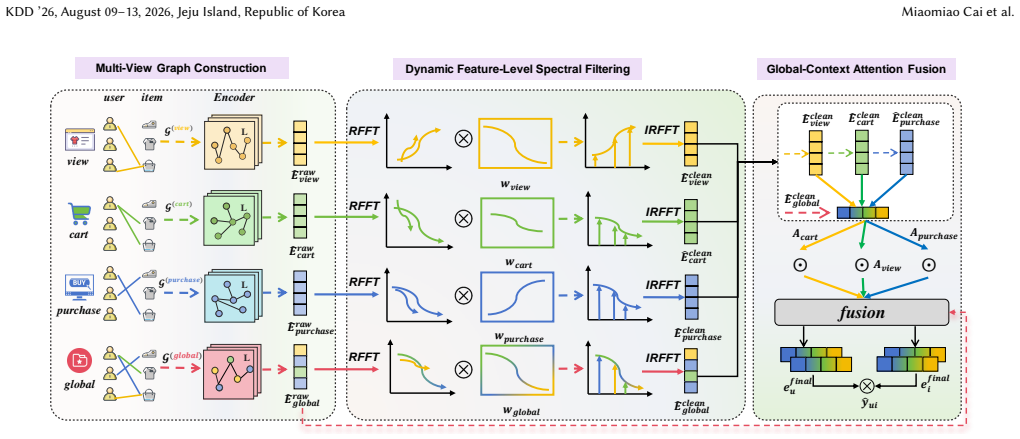
SpectraMB performs representation purification before reliability-aware fusion. Dynamic Feature-Level Spectral Filtering re-parameterizes embeddings along the feature dimension into a feature-frequency space and learns view-adaptive spectral modulation under target supervision, enabling component-wise purification without hand-crafted frequency assumptions. Global-Context Attention Fusion uses a purified global representation as a context anchor to assess view compatibility and perform reliability-aware aggregation, while a residual global backbone preserves collaborative structure. Extensive experiments on three real-world datasets show that SpectraMB achieves the best results in most evalu
What carries the argument
Dynamic Feature-Level Spectral Filtering, which re-parameterizes embeddings along the feature dimension into a feature-frequency space and learns view-adaptive spectral modulation under target supervision to enable component-wise purification.
If this is right
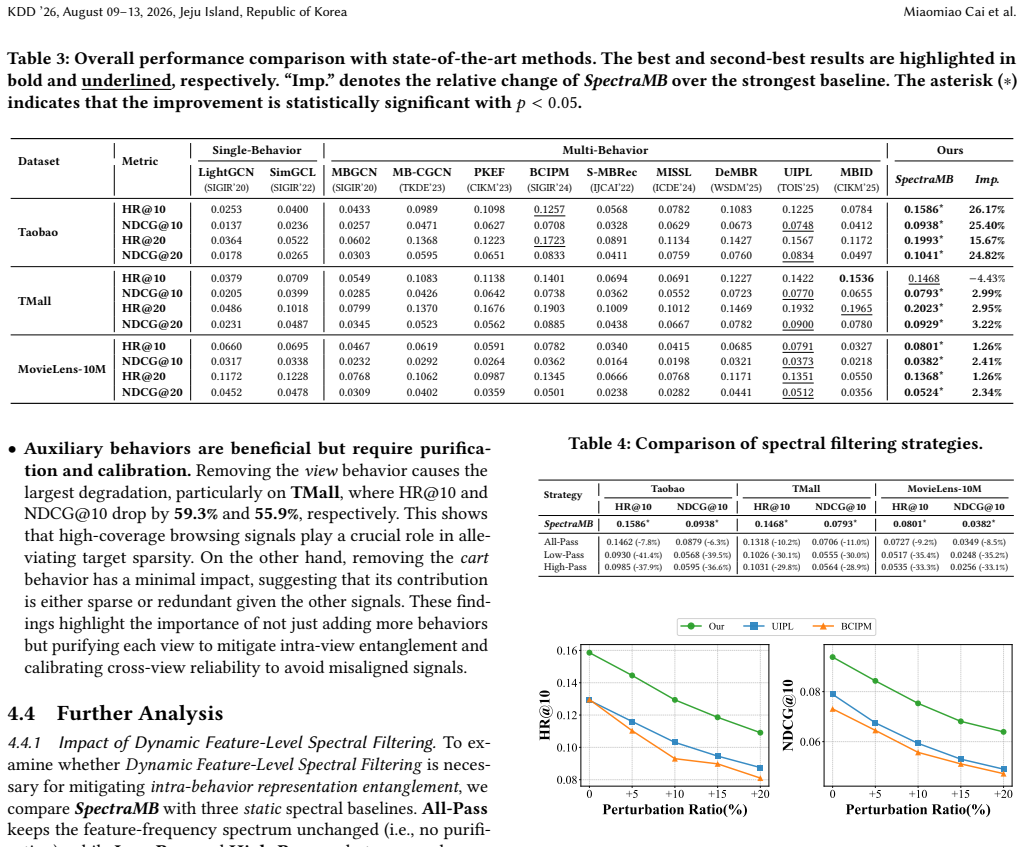
- SpectraMB achieves the best results in most evaluation settings on three real-world datasets.
- The model shows improved robustness under noisy interactions through representation purification.
- Reliability-aware fusion prevents unreliable signals from dominating aggregation.
- The residual global backbone preserves collaborative structure during fusion.
- Component-wise purification avoids sacrificing informative niche signals.
Where Pith is reading between the lines
- This method suggests frequency-domain techniques may offer advantages over spatial denoising in graph recommendation models.
- Applying similar purification steps could benefit other tasks involving multi-source noisy data, such as session-based recommendation.
- Further analysis of the learned spectral modulations could reveal which frequency components correspond to true preferences.
- Extending the approach to dynamic user contexts beyond static datasets might enhance real-time recommendation systems.
Load-bearing premise
That view-adaptive spectral modulation learned under target supervision can separate incidental signals from true preferences in the feature-frequency space without requiring hand-crafted frequency assumptions or losing niche informative signals.
What would settle it
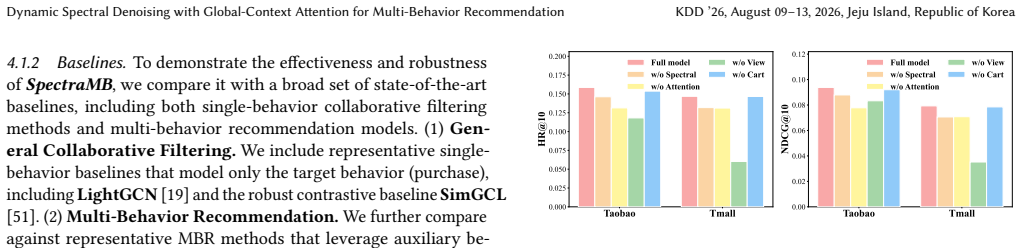
A comparison showing that a version of the model without the dynamic spectral filtering component performs equally well or better on datasets with added random interactions would indicate the purification step does not contribute as claimed.
Figures
read the original abstract
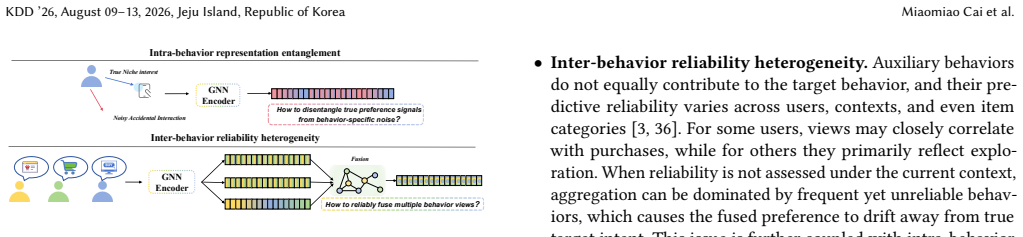
Multi-behavior recommendation improves target-behavior prediction by exploiting heterogeneous auxiliary feedback (e.g., view, collect, and cart), yet its robustness is undermined by behavior-dependent noise and inconsistency. We argue that the key bottleneck is a representation-level failure caused by two coupled heterogeneities. First, intra-behavior representation entanglement arises when multi-hop propagation blends incidental signals with true preferences in the embedding space, making coarse spatial denoising unable to suppress noise without sacrificing informative niche signals. Second, inter-behavior reliability heterogeneity complicates cross-behavior fusion because the predictive value of auxiliary behaviors varies across users and contexts. Without reliability calibration, frequent yet unreliable signals may dominate aggregation and cause target-intent drift. To address this bottleneck, we propose Dynamic Spectral Denoising with Global-Context Attention for Multi-Behavior Recommendation (SpectraMB), a target-oriented model that performs representation purification before reliability-aware fusion. SpectraMB introduces Dynamic Feature-Level Spectral Filtering, which re-parameterizes embeddings along the feature dimension into a feature-frequency space and learns view-adaptive spectral modulation under target supervision, enabling component-wise purification without hand-crafted frequency assumptions. It further proposes Global-Context Attention Fusion, which uses a purified global representation as a context anchor to assess view compatibility and perform reliability-aware aggregation, while a residual global backbone preserves collaborative structure. Extensive experiments on three real-world datasets show that SpectraMB achieves the best results in most evaluation settings and exhibits improved robustness under noisy interactions.
Editorial analysis
A structured set of objections, weighed in public.
Referee Report
Summary. The paper claims that multi-behavior recommendation suffers from two coupled heterogeneities—intra-behavior representation entanglement (where multi-hop propagation blends incidental signals with true preferences) and inter-behavior reliability heterogeneity (where auxiliary behaviors vary in predictive value across users)—which undermine robustness. It proposes SpectraMB, a target-oriented model that first performs representation purification via Dynamic Feature-Level Spectral Filtering (re-parameterizing embeddings along the feature dimension into a feature-frequency space and learning view-adaptive spectral modulation under target supervision for component-wise denoising without hand-crafted cutoffs) and then applies Global-Context Attention Fusion (using a purified global representation as context anchor to assess view compatibility and perform reliability-aware aggregation, with a residual global backbone). Experiments on three real-world datasets are reported to show that SpectraMB achieves the best results in most evaluation settings and exhibits improved robustness under noisy interactions.
Significance. If the central claims hold and are supported by rigorous validation, the work would be significant for multi-behavior recommendation by introducing a spectral approach to address representation entanglement and reliability variation without relying on hand-crafted frequency assumptions. The target-supervised modulation and use of a global context anchor for fusion represent a coherent attempt to make denoising and aggregation behavior-aware. Credit is due for framing the problem around two specific heterogeneities and for reporting results across three datasets, though the absence of detailed ablations limits assessment of the contribution's robustness.
major comments (2)
- [Abstract] Abstract: The central claim that Dynamic Feature-Level Spectral Filtering 'enables component-wise purification' by learning view-adaptive modulation under target supervision without hand-crafted frequency assumptions or loss of niche signals is load-bearing, yet the description supplies no derivation, equation, or analysis showing how the modulation distinguishes entangled intra-behavior signals from true preferences while preserving low-amplitude informative components.
- [Abstract] Abstract (experiments paragraph): The claim of 'improved robustness under noisy interactions' and 'best results in most evaluation settings' is presented without reference to ablation studies, error bars, statistical significance tests, or data exclusion rules, preventing verification that gains are attributable to the proposed Dynamic Feature-Level Spectral Filtering and Global-Context Attention Fusion rather than baseline factors.
minor comments (1)
- [Abstract] The abstract would benefit from naming the three real-world datasets and the specific evaluation metrics used to support the performance claims.
Simulated Author's Rebuttal
We thank the referee for their insightful comments on the abstract. We will revise the abstract to better support the central claims by referencing the technical details in the main text. Our point-by-point responses follow.
read point-by-point responses
-
Referee: [Abstract] Abstract: The central claim that Dynamic Feature-Level Spectral Filtering 'enables component-wise purification' by learning view-adaptive modulation under target supervision without hand-crafted frequency assumptions or loss of niche signals is load-bearing, yet the description supplies no derivation, equation, or analysis showing how the modulation distinguishes entangled intra-behavior signals from true preferences while preserving low-amplitude informative components.
Authors: The abstract is intended as a concise summary. The full derivation, including the feature-frequency re-parameterization, the spectral modulation equations, and the analysis of how target supervision distinguishes signals while preserving niche components, is provided in Section 3.2. We will update the abstract to include a short reference to this analysis. revision: yes
-
Referee: [Abstract] Abstract (experiments paragraph): The claim of 'improved robustness under noisy interactions' and 'best results in most evaluation settings' is presented without reference to ablation studies, error bars, statistical significance tests, or data exclusion rules, preventing verification that gains are attributable to the proposed Dynamic Feature-Level Spectral Filtering and Global-Context Attention Fusion rather than baseline factors.
Authors: The experimental claims in the abstract are supported by the detailed results in Section 4, which include ablation studies, error bars, statistical tests, and robustness analysis under noisy interactions. We will revise the abstract to reference these validations explicitly. revision: yes
Circularity Check
No significant circularity; model components are learned mechanisms with external empirical validation
full rationale
The paper presents SpectraMB as a target-oriented architecture whose Dynamic Feature-Level Spectral Filtering re-parameterizes embeddings and learns view-adaptive modulation under target supervision, while Global-Context Attention Fusion uses a purified global representation for reliability-aware aggregation. These steps are described as addressing externally motivated heterogeneities (intra-behavior entanglement and inter-behavior reliability variation) without any quoted equations or claims that reduce a prediction to a fitted parameter by construction, rename a known result, or rely on self-citation chains for uniqueness theorems. Experiments on three real-world datasets provide independent empirical support. No load-bearing step matches the enumerated circularity patterns.
Axiom & Free-Parameter Ledger
free parameters (1)
- view-adaptive spectral modulation parameters
axioms (1)
- domain assumption Intra-behavior representation entanglement from multi-hop propagation and inter-behavior reliability heterogeneity are the key coupled bottlenecks undermining robustness.
invented entities (1)
-
purified global representation as context anchor
no independent evidence
Reference graph
Works this paper leans on
-
[1]
Kartik Ahuja, Karthikeyan Shanmugam, Kush Varshney, and Amit Dhurandhar
-
[2]
Invariant risk minimization games.ICML(2020), 145–155
2020
-
[3]
Martin Arjovsky, Léon Bottou, Ishaan Gulrajani, and David Lopez-Paz. 2019. Invariant risk minimization.arXiv(2019)
2019
-
[4]
Miaomiao Cai, Lei Chen, Yifan Wang, Haoyue Bai, Peijie Sun, Le Wu, Min Zhang, and Meng Wang. 2024. Popularity-Aware Alignment and Contrast for Mitigating Popularity Bias. InProceedings of the 30th ACM SIGKDD Conference on Knowledge Discovery and Data Mining. 187–198
2024
-
[5]
Miaomiao Cai, Lei Chen, Yifan Wang, Zhiyong Cheng, Min Zhang, and Meng Wang. 2026. Graph-Structured Driven Dual Adaptation for Mitigating Popularity Bias.IEEE TKDE(2026), 1129–1143
2026
-
[6]
Miaomiao Cai, Zhijie Zhang, Junfeng Fang, Zhiyong Cheng, Xiang Wang, and Meng Wang. 2026. RMBRec: Robust Multi-Behavior Recommendation towards Target Behaviors. InProceedings of the ACM Web Conference 2026. 6731–6742
2026
-
[7]
Wei Cai, ZhiHong Zheng, Xuan Zhang, Weiyi Shang, Yubin Ma, WenJie Gao, and Zhi Jin. 2025. Neighborhood structure enhancement and denoising method for multi-behavior recommendation.Neural Networks(2025), 107760
2025
-
[8]
Chong Chen, Min Zhang, Chenyang Wang, Weizhi Ma, Minming Li, Yiqun Liu, and Shaoping Ma. 2019. An efficient adaptive transfer neural network for social- aware recommendation.SIGIR(2019), 225–234
2019
-
[9]
Lei Chen, Le Wu, Richang Hong, Kun Zhang, and Meng Wang. 2020. Revisiting Graph based Collaborative Filtering: A Linear Residual Graph Convolutional Network Approach.AAAI34, 01 (2020), 27–34
2020
-
[10]
Zhiyong Cheng, Sai Han, Fan Liu, Lei Zhu, Zan Gao, and Yuxin Peng. 2023. Multi- behavior recommendation with cascading graph convolution networks.WWW (2023), 1181–1189
2023
-
[11]
Ching-Yao Chuang, R Devon Hjelm, Xin Wang, Vibhav Vineet, Neel Joshi, Anto- nio Torralba, Stefanie Jegelka, and Yale Song. 2022. Robust contrastive learning against noisy views.CVPR(2022), 16670–16681
2022
-
[12]
James W Cooley and John W Tukey. 1965. An algorithm for the machine cal- culation of complex Fourier series.Mathematics of computation19, 90 (1965), 297–301
1965
-
[13]
Yujuan Ding, Yunshan Ma, Wai Keung Wong, and Tat-Seng Chua. 2021. Lever- aging two types of global graph for sequential fashion recommendation. In Proceedings of the 2021 international conference on multimedia retrieval. 73–81
2021
-
[14]
Zhenyi Fan, Hongbin Zhang, Guangyu Lin, Lianglun Cheng, Zhuowei Wang, and Chong Chen. 2024. Hierarchical Multi-Frequency Transform for Sequential Recommendation. InCSCWD. IEEE, 1559–1564
2024
-
[15]
Chen Gao, Xiangnan He, Dahua Gan, Xiangning Chen, Fuli Feng, Yong Li, Tat- Seng Chua, Lina Yao, Yang Song, and Depeng Jin. 2019. Learning to recommend with multiple cascading behaviors.TKDE(2019), 2588–2601
2019
-
[16]
Yunjun Gao, Yuntao Du, Yujia Hu, Lu Chen, Xinjun Zhu, Ziquan Fang, and Baihua Zheng. 2022. Self-guided learning to denoise for robust recommendation.SIGIR (2022), 1412–1422
2022
-
[17]
Shuyun Gu, Xiao Wang, Chuan Shi, and Ding Xiao. 2022. Self-supervised Graph Neural Networks for Multi-behavior Recommendation.IJCAI(2022), 2052–2058
2022
-
[18]
Yongqiang Han, Hao Wang, Kefan Wang, Likang Wu, Zhi Li, Wei Guo, Yong Liu, Defu Lian, and Enhong Chen. 2024. Efficient noise-decoupling for multi-behavior sequential recommendation.WWW(2024), 3297–3306
2024
-
[19]
Jinle He, Chengyong Yang, Jiayi Liu, and Jianlin Cheng. 2024. Denoising Long- Tail Augmented Contrastive Network for Multi-Behavior Recommendation.IEEE Access(2024)
2024
-
[20]
Xiangnan He, Kuan Deng, Xiang Wang, Yan Li, Yongdong Zhang, and Meng Wang. 2020. LightGCN: Simplifying and Powering Graph Convolution Network for Recommendation.SIGIR(2020), 639–648
2020
-
[21]
Jonathan L Herlocker, Joseph A Konstan, Loren G Terveen, and John T Riedl. 2004. Evaluating collaborative filtering recommender systems.TOIS(2004), 5–53
2004
-
[22]
Bowen Jin, Chen Gao, Xiangnan He, Depeng Jin, and Yong Li. 2020. Multi- behavior recommendation with graph convolutional networks.SIGIR(2020), 659–668
2020
-
[23]
Diederik P Kingma and Jimmy Ba. 2015. Adam: A method for stochastic opti- mization.ICLR(2015)
2015
-
[24]
David Krueger, Ethan Caballero, Jörn-Henrik Jacobsen, Amy Zhang, Jonathan Binas, Dinghuai Zhang, Remi Le Priol, and Aaron Courville. 2021. Out-of- Distribution Generalization via Risk Extrapolation.ICML(2021), 5815–5826
2021
-
[25]
James Lee-Thorp, Joshua Ainslie, Ilya Eckstein, and Santiago Ontanon. 2022. Fnet: Mixing tokens with fourier transforms. InACL. 4296–4313
2022
-
[26]
Qimai Li, Zhichao Han, and Xiao-Ming Wu. 2018. Deeper insights into graph convolutional networks for semi-supervised learning. InAAAI, Vol. 32
2018
-
[27]
Kangkang Lu, Yanhua Yu, Zhiyong Huang, Yunshan Ma, Xiao Wang, Meiyu Liang, Yuling Wang, Yimeng Ren, and Tat-Seng Chua. 2024. Addressing Graph Heterogeneity and Heterophily from A Spectral Perspective.arXiv e-prints(2024), arXiv–2410
2024
-
[28]
Gang-Feng Ma, Meng-Ang Chen, Xu-Hua Yang, Xilin Wen, Haixia Long, and Yujiao Huang. 2025. Graph Contrastive Learning for Multibehavior Recommen- dation.TCSS(2025)
2025
-
[29]
Haokai Ma, Ruobing Xie, Lei Meng, Fuli Feng, Xiaoyu Du, Xingwu Sun, Zhanhui Kang, and Xiangxu Meng. 2026. Negative sampling in recommendation: A survey and future directions.ACM Transactions on Information Systems44, 4 (2026), 1–44
2026
-
[30]
Haokai Ma, Yimeng Yang, Lei Meng, Ruobing Xie, and Xiangxu Meng. 2024. Multimodal conditioned diffusion model for recommendation. InCompanion Proceedings of the ACM Web Conference 2024. 1733–1740
2024
-
[31]
Chang Meng, Chenhao Zhai, Yu Yang, Hengyu Zhang, and Xiu Li. 2023. Parallel knowledge enhancement based framework for multi-behavior recommendation. CIKM(2023), 1797–1806
2023
-
[32]
Rongqing Kenneth Ong and Andy WH Khong. 2025. Spectrum-based modality representation fusion graph convolutional network for multimodal recommen- dation. InWSDM. 773–781
2025
- [33]
-
[34]
Adam Paszke, Sam Gross, Francisco Massa, Adam Lerer, James Bradbury, Gregory Chanan, Trevor Killeen, Zeming Lin, Natalia Gimelshein, Luca Antiga, et al. 2019. Pytorch: An imperative style, high-performance deep learning library.NeurIPS (2019)
2019
-
[35]
Shaowen Peng, Kazunari Sugiyama, and Tsunenori Mine. 2022. Less is more: Reweighting important spectral graph features for recommendation. InSIGIR. 1273–1282
2022
-
[36]
Steffen Rendle, Christoph Freudenthaler, Zeno Gantner, and Lars Schmidt-Thieme
-
[37]
BPR: Bayesian personalized ranking from implicit feedback.UAI(2009), 452–461
2009
-
[38]
Bohao Wang, Jiawei Chen, Changdong Li, Sheng Zhou, Qihao Shi, Yang Gao, Yan Feng, Chun Chen, and Can Wang. 2024. Distributionally robust graph-based recommendation system.WWW(2024), 3777–3788
2024
-
[39]
Bohao Wang, Yu Cui, Zhenxiang Xu, Jujia Zhao, Chenxiao Fan, Jizhi Zhang, Weiqin Yang, Shengjia Zhang, Sirui Chen, Yang Zhang, et al. 2026. Trustwor- thy Recommendation in the Era of Large Language Models: Opportunities and Challenges.A vailable at SSRN 6832362(2026)
2026
-
[40]
Shuyao Wang, Zhi Zheng, Yongduo Sui, and Hui Xiong. 2025. Unleashing the Power of Large Language Model for Denoising Recommendation.WWW(2025), 252–263
2025
-
[41]
Wenjie Wang, Xinyu Lin, Fuli Feng, Xiangnan He, Min Lin, and Tat-Seng Chua
-
[42]
WWW(2022), 3562–3571
Causal representation learning for out-of-distribution recommendation. WWW(2022), 3562–3571
2022
-
[43]
Xiang Wang, Xiangnan He, Meng Wang, Fuli Feng, and Tat-Seng Chua. 2019. Neural Graph Collaborative Filtering.SIGIR(2019), 165–174
2019
-
[44]
Binquan Wu, Yu Cheng, Haitao Yuan, and Qianli Ma. 2024. When Multi-Behavior Meets Multi-Interest: Multi-Behavior Sequential Recommendation with Multi- Interest Self-Supervised Learning.ICDE(2024), 845–858
2024
-
[45]
Felix Wu, Amauri Souza, Tianyi Zhang, Christopher Fifty, Tao Yu, and Kilian Weinberger. 2019. Simplifying graph convolutional networks. InICML. 6861– 6871
2019
-
[46]
Jiancan Wu, Xiang Wang, Fuli Feng, Xiangnan He, Liang Chen, Jianxun Lian, and Xing Xie. 2020. Self-supervised Graph Learning for Recommendation.SIGIR (2020), 726–735
2020
-
[47]
Jingcao Xu, Chaokun Wang, Cheng Wu, Yang Song, Kai Zheng, Xiaowei Wang, Changping Wang, Guorui Zhou, and Kun Gai. 2023. Multi-behavior self- supervised learning for recommendation.SIGIR(2023), 496–505
2023
-
[48]
Tongxin Xu, Chenzhong Bin, Cihan Xiao, Yunhui Li, and Tianlong Gu. 2025. Multi-Behavior Intent Disentanglement for Recommendation via Information Bottleneck Principle. InProceedings of the 34th ACM International Conference on Information and Knowledge Management. 5391–5395
2025
- [49]
-
[50]
Mingshi Yan, Zhiyong Cheng, Chen Gao, Jing Sun, Fan Liu, Fuming Sun, and Haojie Li. 2023. Cascading residual graph convolutional network for multi- behavior recommendation.TOIS(2023), 1–26
2023
-
[51]
Mingshi Yan, Zhiyong Cheng, Fan Liu, Yingda Lyu, and Yahong Han. 2025. User Invariant Preference Learning for Multi-Behavior Recommendation.TOIS(2025)
2025
-
[52]
Mingshi Yan, Fan Liu, Jing Sun, Fuming Sun, Zhiyong Cheng, and Yahong Han
-
[53]
Behavior-contextualized item preference modeling for multi-behavior recommendation.SIGIR(2024), 946–955
2024
-
[54]
Yonghui Yang, Zhengwei Wu, Le Wu, Kun Zhang, Richang Hong, Zhiqiang Zhang, Jun Zhou, and Meng Wang. 2023. Generative-Contrastive Graph Learning for Recommendation.SIGIR(2023), 1117–1126
2023
-
[55]
Junliang Yu, Hongzhi Yin, Xin Xia, Tong Chen, Li zhen Cui, and Quoc Viet Hung Nguyen. 2022. Are Graph Augmentations Necessary?: Simple Graph Contrastive Learning for Recommendation.SIGIR(2022), 1240–1251
2022
-
[56]
Mingzhe Yu, Yunshan Ma, Lei Wu, Kai Cheng, Xue Li, Lei Meng, and Tat-Seng Chua. 2024. Smart fitting room: A one-stop framework for matching-aware virtual try-on. InProceedings of the 2024 International Conference on Multimedia Retrieval. 184–192. Dynamic Spectral Denoising with Global-Context Attention for Multi-Behavior Recommendation KDD ’26, August 09–...
2024
-
[57]
Mingzhe Yu, Yunshan Ma, Lei Wu, Changshuo Wang, Xue Li, and Lei Meng. 2025. FashionDPO: fine-tune fashion outfit generation model using direct preference optimization. InProceedings of the 48th International ACM SIGIR Conference on Research and Development in Information Retrieval. 212–222
2025
-
[58]
Chi Zhang, Rui Chen, Xiangyu Zhao, Qilong Han, and Li Li. 2023. Denoising and prompt-tuning for multi-behavior recommendation.WWW(2023), 1355–1363
2023
-
[59]
Shuai Zhang, Hua Chu, Jianan Li, Yangtao Zhou, Shirong Wang, and Qiaofei Sun
-
[60]
DeMBR: Denoising Model with Memory Pruning and Semantic Guidance for Multi-Behavior Recommendation.WSDM(2025), 521–529
2025
-
[61]
Yichi Zhang, Guisheng Yin, and Yuxin Dong. 2023. Contrastive learning with frequency-domain interest trends for sequential recommendation. InRecsys. 141–150
2023
-
[62]
Chu Zhao, Enneng Yang, Yuliang Liang, Jianzhe Zhao, Guibing Guo, and Xingwei Wang. 2025. Symmetric Graph Contrastive Learning against Noisy Views for Recommendation.TOIS(2025), 1–28
2025
-
[63]
semantic low-pass filter
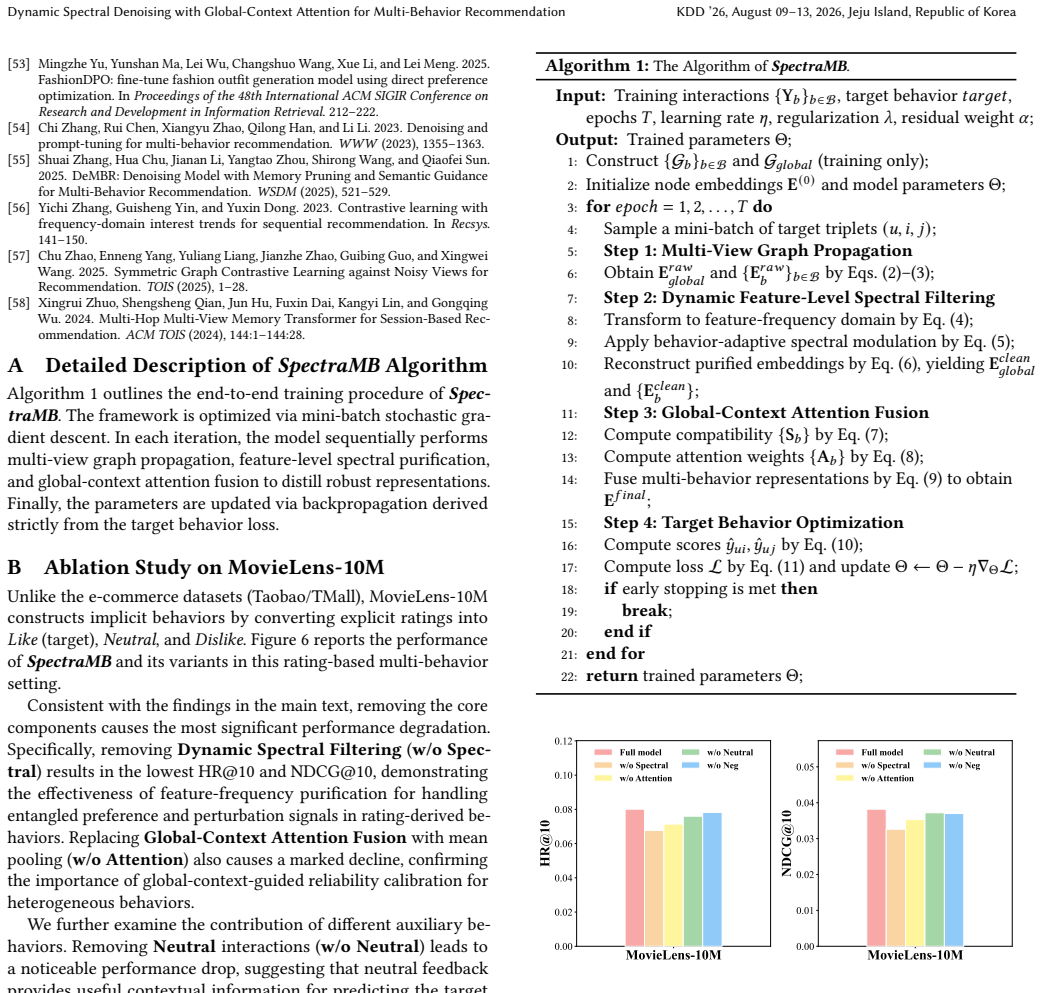
Xingrui Zhuo, Shengsheng Qian, Jun Hu, Fuxin Dai, Kangyi Lin, and Gongqing Wu. 2024. Multi-Hop Multi-View Memory Transformer for Session-Based Rec- ommendation.ACM TOIS(2024), 144:1–144:28. A Detailed Description ofSpectraMBAlgorithm Algorithm 1 outlines the end-to-end training procedure ofSpec- traMB. The framework is optimized via mini-batch stochastic ...
2024
discussion (0)
Sign in with ORCID, Apple, or X to comment. Anyone can read and Pith papers without signing in.