Fostering Emotional Perspective-Taking: An Exploration of Affective Face-Tracking Interactions in the VR Narrative Rekindle
Pith reviewed 2026-06-28 12:41 UTC · model grok-4.3
The pith
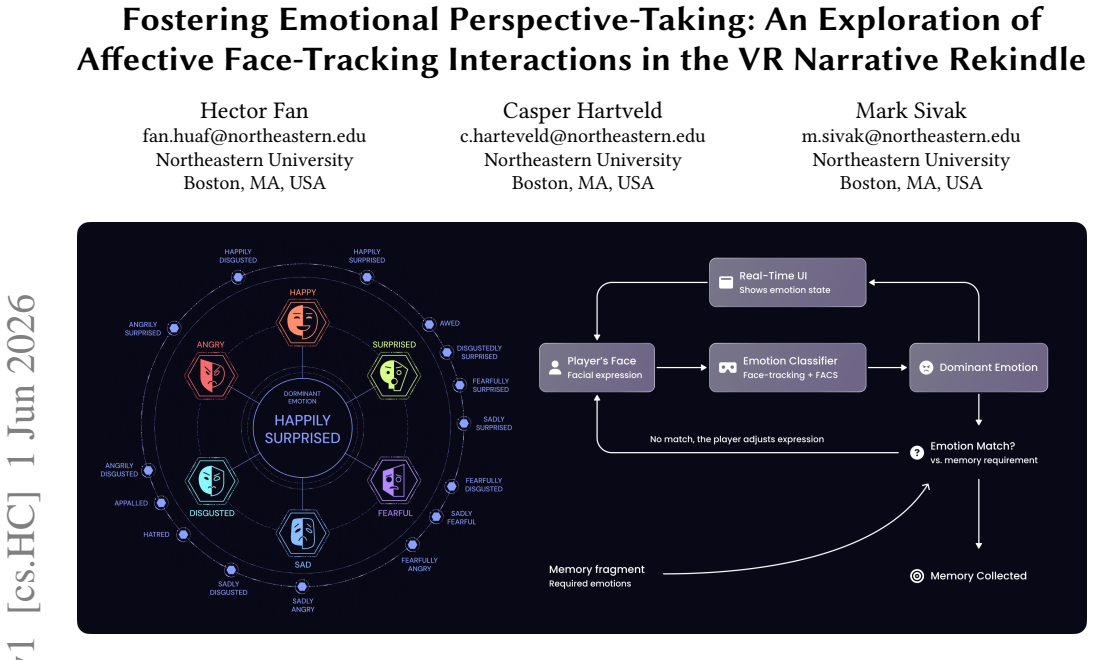
VR face-tracking recognizes player emotions to foster perspective-taking with story characters in narrative experiences.
A machine-rendered reading of the paper's core claim, the machinery that carries it, and where it could break.
Core claim
The paper claims that by using a VR headset's built-in face-tracking to recognize player emotional states and translate them into narrative elements, an affective interaction model can foster emotional perspective-taking between the player and their story character, deepening emotional connection and narrative engagement in the specific VR experience Rekindle.
What carries the argument
The affective interaction model that interprets face-tracking data as emotional states to influence narrative progression and character embodiment for emotional perspective-taking.
If this is right
- The model influences the core narrative experience rather than just system parameters like difficulty.
- Focus on a specific authored narrative allows tailored emotional mechanics.
- Player emotional states can be leveraged to increase connection to the embodied character.
- Real-time biometric data from consumer VR can be integrated into IDN design.
- Existing superficial uses of emotion input are insufficient for deep engagement.
Where Pith is reading between the lines
- This approach might be tested in other VR narratives beyond Rekindle to see if the effect generalizes.
- Combining face-tracking with other biometrics like eye-tracking could enhance the model further.
- Designers could create stories where the character's reactions mirror detected player emotions to build empathy.
- The method raises questions about privacy in using personal biometric data in entertainment.
Load-bearing premise
Face-tracking data from VR headsets can be accurately interpreted as specific emotional states and effectively translated into narrative mechanics that produce measurable increases in perspective-taking and engagement.
What would settle it
An experiment comparing the affective model to a non-emotion-tracking version of the same narrative showing no significant difference in measures of emotional connection or narrative engagement.
Figures
read the original abstract
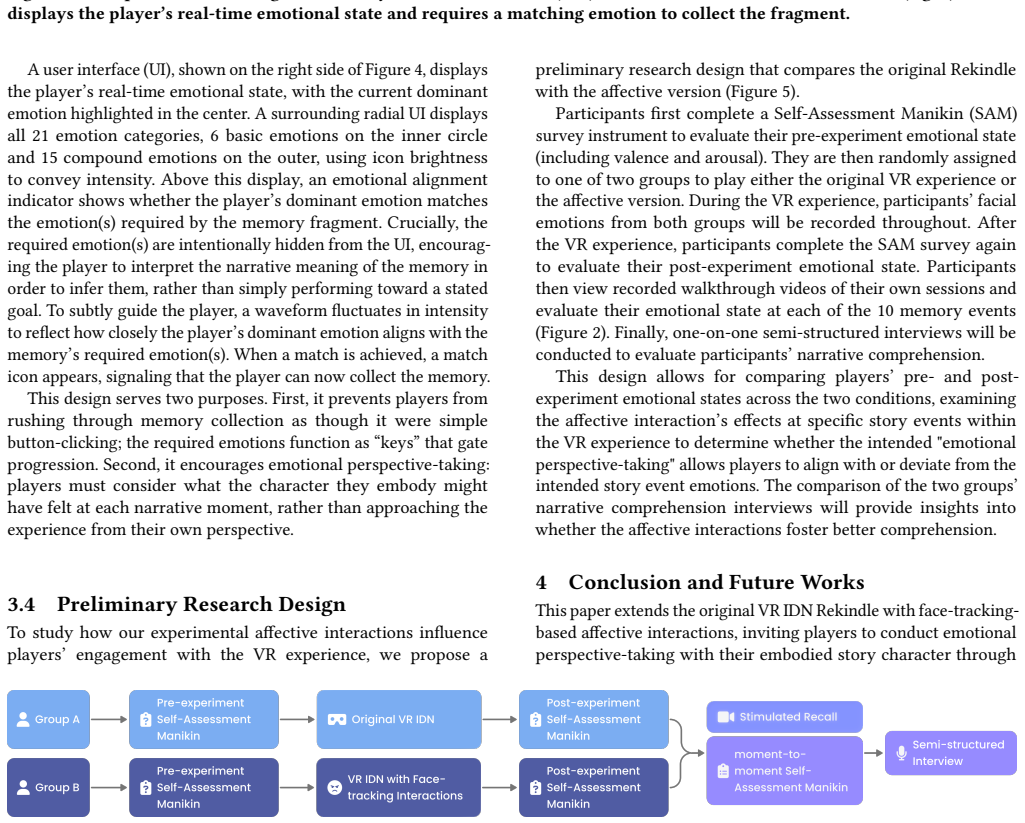
Interest in leveraging emotions in Interactive Digital Narrative (IDN) has been growing, and Virtual Reality (VR) offers rich access to real-time biometric data such as facial expressions; yet this capability remains underexplored in novel IDN design. Existing approaches typically treat emotion input superficially, such as adjusting system difficulty or aesthetics, but rarely influence how players experience the narrative itself. Prior work also lacks a focus on a specific authored narrative. We propose an experimental affective interaction model that uses a VR headset's built-in face-tracking capability to recognize player emotional states, fostering "emotional perspective-taking" between the player and their embodied story character, thereby deepening the player's emotional connection to the character and their narrative engagement with the VR experience.
Editorial analysis
A structured set of objections, weighed in public.
Referee Report
Summary. The manuscript proposes an experimental affective interaction model for the VR narrative 'Rekindle' that uses a VR headset's built-in face-tracking to recognize player emotional states. The model is intended to foster 'emotional perspective-taking' between the player and their embodied story character, thereby deepening emotional connection and narrative engagement. The work is framed as an exploration addressing gaps in Interactive Digital Narrative (IDN) design, where prior approaches treat emotion input superficially rather than integrating it into the narrative itself.
Significance. If implemented and shown to function as described, the proposal could advance IDN research by demonstrating a deeper integration of consumer-grade biometric data into authored narratives, moving beyond adjustments to difficulty or aesthetics. This has potential to open new avenues for emotional engagement in VR storytelling, provided the mapping from face-tracking to narrative mechanics can be made concrete and testable.
major comments (1)
- [Abstract] Abstract: The central claim that the model fosters emotional perspective-taking and deepens narrative engagement rests on the unelaborated assumption that face-tracking data can be reliably mapped to specific emotional states and then translated into narrative mechanics; no details on the recognition algorithm, state-to-mechanics mapping, or concrete narrative examples from 'Rekindle' are supplied, leaving the feasibility of the proposal unassessable.
Simulated Author's Rebuttal
We thank the referee for the constructive feedback on our manuscript. We address the major comment point by point below.
read point-by-point responses
-
Referee: [Abstract] Abstract: The central claim that the model fosters emotional perspective-taking and deepens narrative engagement rests on the unelaborated assumption that face-tracking data can be reliably mapped to specific emotional states and then translated into narrative mechanics; no details on the recognition algorithm, state-to-mechanics mapping, or concrete narrative examples from 'Rekindle' are supplied, leaving the feasibility of the proposal unassessable.
Authors: We agree that the abstract does not sufficiently preview the technical and narrative details elaborated in Sections 3 and 4 of the manuscript. The work is framed as a design exploration of a proposed affective interaction model rather than a validated implementation. In the revised version we will expand the abstract to include: (1) a high-level description of the recognition approach using the headset's built-in facial action unit tracking mapped to valence-arousal dimensions via established libraries; (2) one or two concrete examples of state-to-mechanics mappings drawn from the Rekindle narrative (e.g., detected player sadness modulating the embodied character's empathetic responses in key dialogue branches); and (3) an explicit statement that the model is offered as a testable design framework. These additions will make the proposal's feasibility more readily assessable while preserving its exploratory character. revision: yes
Circularity Check
No significant circularity; design proposal with no derivations or self-referential fits
full rationale
The paper is an explicit design proposal for an affective VR interaction model rather than a quantitative derivation or empirical claim. It contains no equations, fitted parameters, or load-bearing self-citations that reduce any result to its own inputs by construction. The central proposal identifies reliability of face-tracking and narrative impact as open questions to be addressed, not premises treated as established. This matches the default expectation of no circularity for non-derivational work.
Axiom & Free-Parameter Ledger
Reference graph
Works this paper leans on
-
[1]
Fred Charles, Samuel Lemercier, Thurid Vogt, Nikolaus Bee, Maurizio Mancini, Jérôme Urbain, Marc Price, Elisabeth André, Catherine Pélachaud, and Marc Cavazza. 2007. Affective Interactive Narrative in the CALLAS Project. InVirtual Storytelling. Using Virtual Reality Technologies for Storytelling, Marc Cavazza and Stéphane Donikian (Eds.). Springer, Berlin...
-
[2]
Shichuan Du, Yong Tao, and Aleix M. Martinez. 2014. Compound Facial Expres- sions of Emotion.Proceedings of the National Academy of Sciences111, 15 (2014). doi:10.1073/pnas.1322355111
-
[3]
Paul Ekman and Wallace V. Friesen. 1978. Facial Action Coding System. (1978). doi:10.1037/t27734-000
-
[4]
Hector Fan and Jay David Bolter. 2024. Rekindle: Enhancing Interactive Narra- tive in Virtual Reality with Coherent, Agency-driven Interactions. InExtended Abstracts of the CHI Conference on Human Factors in Computing Systems. ACM, Honolulu HI USA, 1–5. doi:10.1145/3613905.3648673
-
[5]
Flying Mollusk. 2015. Nevermind
2015
-
[6]
Stephen Gilroy, Julie Porteous, Fred Charles, and Marc Cavazza. 2012. Exploring Passive User Interaction for Adaptive Narratives. InProceedings of the 2012 ACM International Conference on Intelligent User Interfaces. ACM, Lisbon Portugal, 119–128. doi:10.1145/2166966.2166990
-
[7]
GoodbyeWorld Games. 2021. Before Your Eyes
2021
-
[8]
Andreas Halbig and Marc Erich Latoschik. 2021. A Systematic Review of Physi- ological Measurements, Factors, Methods, and Applications in Virtual Reality. Frontiers in Virtual Reality2 (2021). doi:10.3389/frvir.2021.694567
-
[9]
Samory Houzangbe, Olivier Christmann, Geoffrey Gorisse, and Simon Richir. 2018. Fear as a Biofeedback Game Mechanic in Virtual Reality: Effects on Engagement and Perceived Usability. InProceedings of the 13th International Conference on the Foundations of Digital Games (FDG ’18). Association for Computing Machinery, New York, NY, USA, 1–6. doi:10.1145/323...
-
[10]
Noam Knoller. 2010. Agency and the Art of Interactive Digital Storytelling. In Interactive Storytelling, Ruth Aylett, Mei Yii Lim, Sandy Louchart, Paolo Petta, and Mark Riedl (Eds.). Springer, Berlin, Heidelberg, 264–267. doi:10.1007/978-3- 642-16638-9_38
-
[11]
Liting Kway and Alex Mitchell. 2018. Perceived Agency as Meaningful Expression of Playable Character Personality Traits in Storygames. InInteractive Storytelling, Rebecca Rouse, Hartmut Koenitz, and Mads Haahr (Eds.). Springer International Publishing, Cham, 230–239. doi:10.1007/978-3-030-04028-4_23
-
[12]
Stacy Marsella, Jonathan Gratch, and Jeff Rickel. 2004. Expressive Behaviors for Virtual Worlds. InLife-Like Characters, M. Gabbay, Jörg Siekmann, Hel- mut Prendinger, and Mitsuru Ishizuka (Eds.). Springer Berlin Heidelberg, Berlin, Heidelberg, 317–360. doi:10.1007/978-3-662-08373-4_14
-
[13]
Random graphs and branching processes
Stacy C. Marsella. 2003. Interactive Pedagogical Drama: Carmen’s Bright IDEAS Assessed. InIntelligent Virtual Agents, Thomas Rist, Ruth S. Aylett, Daniel Ballin, and Jeff Rickel (Eds.). Springer, Berlin, Heidelberg, 1–4. doi:10.1007/978-3-540- 39396-2_1
-
[14]
Stacy C Marsella, W Lewis Johnson, and Catherine M LaBore. 2003. Interactive Pedagogical Drama for Health Interventions. In11th International Conference on Artificial Intelligence in Education, Sydney, Australia. 341–348
2003
-
[15]
Meta Platforms, Inc. 2025. Face Tracking for Movement SDK for Unity. Meta Platforms, Inc
2025
-
[16]
Janet H. Murray. 2017.Hamlet on the Holodeck: The Future of Narrative in Cy- berspace(updated edition ed.). MIT Press, Cambridge, MA, USA
2017
-
[17]
Nice Dream. 2025. Goodnight Universe
2025
-
[18]
Thorben Ortmann, Qi Wang, and Larissa Putzar. 2023. Facial Emotion Recognition in Immersive Virtual Reality: A Systematic Literature Review. InProceedings of the 16th International Conference on PErvasive Technologies Related to Assistive Environments (PETRA ’23). Association for Computing Machinery, New York, NY, USA, 77–82. doi:10.1145/3594806.3594861
-
[19]
Clore, and Allan Collins
Andrew Ortony, Gerald L. Clore, and Allan Collins. 2022.The Cognitive Structure of Emotions. Cambridge University Press, Cambridge, United Kingdom ; New York, NY
2022
-
[20]
Semi Ryu, Miles Popiela, Henry Bryant, Matthew Labella, Hanna Chou, Chrystine Rayburn, and Alberto Cano. 2025. SentimentVoice: Integrating Emotion AI and VR in Performing Arts. InProceedings of the Special Interest Group on Computer Graphics and Interactive Techniques Conference Immersive Pavilion (SIGGRAPH Immersive Pavilion ’25). Association for Computi...
discussion (0)
Sign in with ORCID, Apple, or X to comment. Anyone can read and Pith papers without signing in.