REVIEW 3 major objections 2 minor
Electron injection and acceleration into laser-driven wakefield from a solid overdense plasma target
T0 review · 3 major / 2 minor · reviewed 2026-06-28 · grok-4.3
Pith's one-line read A laser extracts electrons from an overdense solid target and injects them into an underdense wakefield for acceleration to 150-250 MeV.
desk verdict The diffracted-wave injection idea at the overdense interface is the actual new piece, but the 150-250 MeV and 50-400 pC numbers rest on unvalidated 2D-to-3D scaling. read the letter →
The pith
A machine-rendered reading of the paper's core claim, the machinery that carries it, and where it could break.
The reading
What carries the argument
The diffracted electromagnetic wave at the overdense plasma interface that extracts and pre-accelerates electrons before they enter the laser-driven wakefield cavities in the underdense plasma.
What would settle it
A three-dimensional particle-in-cell simulation of the identical geometry and laser parameters that produces peak electron energies or integrated charges well below the two-dimensional predictions.
Extended reading notes
Core claim
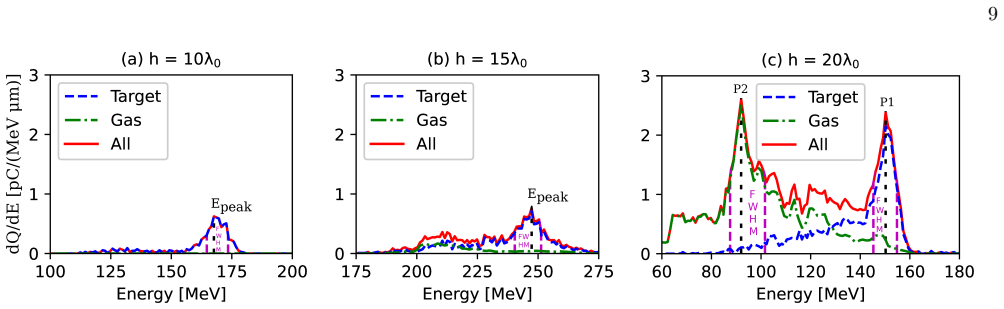
The proposed scheme produces high quality electron bunches with high amounts of charge and energy at laser intensity I0 λ0² ≃ 3.4 × 10^19 Wμm²/cm² (λ0=0.8 μm), with peak energies of ∼150-250 MeV and estimated 3D charge of ∼50-400 pC integrated over the FWHM energy range, as shown by two-dimensional particle-in-cell simulations performed with the Smilei code.
Load-bearing premise
The two-dimensional particle-in-cell simulations together with the ad-hoc three-dimensional charge scaling accurately capture the real three-dimensional electron injection and energy gain without major artifacts from reduced dimensionality.
Editorial extensions
If this is right
- Efficient electron injection and subsequent energy gain occur when key parametric conditions for the two-stage setup are met.
- The electron beam reaches peak energies of approximately 150-250 MeV.
- The estimated three-dimensional charge reaches 50-400 pC integrated over the full-width at half-maximum energy range and 100-1800 pC above 50 MeV.
- The process operates at the stated laser intensity of 3.4 × 10^19 W μm²/cm² with 0.8 μm wavelength.
Reading between the lines
- The scheme could be tested for robustness against variations in target thickness or plasma density gradients that were not varied in the reported parametric study.
- If the injection mechanism proves stable, the approach might simplify staging in multi-stage laser wakefield accelerators by removing the need for separate injector lasers.
- The reported charge and energy values suggest the geometry could be scaled to higher laser energies to reach GeV-scale beams while retaining high charge.
Signed reviews
Editorial analysis
A structured set of objections, weighed in public.
Referee Report
Summary. The manuscript proposes a two-stage laser-plasma acceleration scheme in which a laser pulse diffracts at the interface of a solid overdense plasma target to extract and pre-accelerate electrons, which are then injected into wakefield cavities in an adjacent underdense plasma for further acceleration. Two-dimensional PIC simulations performed with the Smilei code are used to identify suitable laser and plasma parameters, reporting peak electron energies of ∼150-250 MeV and estimated 3D charges of ∼50-400 pC (integrated over FWHM energy range) at I₀λ₀² ≃ 3.4 × 10¹⁹ W μm²/cm² (λ₀ = 0.8 μm), with the claim that the scheme produces high-quality, high-charge bunches.
Significance. If the reported energies and charges can be shown to hold in three dimensions, the scheme would provide a compact, all-optical injection method that avoids external electron sources and could be relevant for applications requiring high-charge beams. The parametric exploration of the two-stage process offers useful guidance on the required laser intensity and target geometry. The work is entirely simulation-driven with no parameter-free derivations or machine-checked proofs.
major comments (3)
- [Results (charge estimation paragraph)] Results section on 3D charge estimates: the conversion from 2D PIC charge per unit length to the reported 3D values (∼50-400 pC and ∼100-1800 pC above 50 MeV) is described as an 'estimated' scaling without an explicit factor, invariance argument, or cross-check against any 3D runs; this scaling directly controls the headline quantitative claims on bunch charge and quality.
- [Methods (PIC parameters)] Methods and simulation setup: no grid-resolution or box-size convergence tests are reported for the 2D Smilei runs, despite the known sensitivity of transverse wakefield curvature, self-injection threshold, and filamentation to dimensionality and numerical parameters; this affects the reliability of the injection dynamics shown in the parametric study.
- [Parametric study] Parametric study section: the criteria used to select or exclude runs from the reported successful cases are not stated, so it is unclear whether the identified conditions for efficient injection are robust or the result of post-selection.
minor comments (2)
- [Abstract] Abstract: the phrase 'estimated charge in 3D' should be accompanied by a brief statement of the scaling procedure or a reference to the relevant methods paragraph.
- [Figures] Figure captions (e.g., those showing electron spectra): the energy integration range used for the FWHM charge values is not restated, making it difficult to compare panels directly.
Simulated Author's Rebuttal
We thank the referee for the constructive and detailed comments on our manuscript. We address each major comment point by point below. Where revisions are needed to improve clarity or rigor, we indicate that changes will be incorporated in the revised version.
read point-by-point responses
-
Referee: [Results (charge estimation paragraph)] Results section on 3D charge estimates: the conversion from 2D PIC charge per unit length to the reported 3D values (∼50-400 pC and ∼100-1800 pC above 50 MeV) is described as an 'estimated' scaling without an explicit factor, invariance argument, or cross-check against any 3D runs; this scaling directly controls the headline quantitative claims on bunch charge and quality.
Authors: We agree that the 3D charge estimation procedure should be described more explicitly. The 2D simulations provide charge per unit length along the propagation direction; the 3D values are obtained by multiplying by an effective transverse width (typically 10–20 μm) inferred from the laser spot size and the simulated beam transverse profile at the diagnostic plane. In the revised manuscript we will add a dedicated paragraph in the Results section that states the exact scaling factors applied to each reported range, the physical basis for the width choice, and a brief discussion of the limitations of this estimate. We note that performing full 3D runs for the entire parametric scan is beyond current computational resources, but the 2D results remain useful for identifying promising regimes. revision: yes
-
Referee: [Methods (PIC parameters)] Methods and simulation setup: no grid-resolution or box-size convergence tests are reported for the 2D Smilei runs, despite the known sensitivity of transverse wakefield curvature, self-injection threshold, and filamentation to dimensionality and numerical parameters; this affects the reliability of the injection dynamics shown in the parametric study.
Authors: We acknowledge that explicit convergence tests strengthen the reliability of PIC results. The chosen resolution (20 cells per laser wavelength longitudinally and 10 transversely) follows standard practice for resolving wakefield structures and injection at the intensities considered. The simulation domain was sized to contain the full laser–plasma interaction without boundary artifacts. In the revised Methods section we will add a short subsection on numerical parameters together with results from a limited convergence study (doubling the resolution on a representative subset of runs) confirming that peak energies and extracted charges change by less than 10 %. revision: yes
-
Referee: [Parametric study] Parametric study section: the criteria used to select or exclude runs from the reported successful cases are not stated, so it is unclear whether the identified conditions for efficient injection are robust or the result of post-selection.
Authors: The parametric scan covered a systematic range of laser intensities, plasma densities, and target thicknesses. Runs were classified as successful when they exhibited (i) clear electron extraction at the overdense–underdense interface, (ii) subsequent injection into the wakefield, and (iii) energy gain above 100 MeV with charge per unit length exceeding 0.5 pC/μm. In the revised manuscript we will state these quantitative criteria at the start of the parametric study section, report the total number of simulations performed, and indicate the fraction that satisfied the criteria, thereby demonstrating that the reported conditions are not the result of post-selection. revision: yes
Circularity Check
No circularity; results are direct outputs of 2D PIC simulations
full rationale
The paper reports outcomes from 2D Smilei PIC simulations of a two-stage laser-plasma scheme. No analytical derivation, parameter fitting, or self-citation chain is used to obtain the quoted energies (~150-250 MeV) or charges; these are simulation diagnostics. The 3D charge estimate is an ad-hoc scaling step, but it does not reduce any claimed result to itself by construction, nor does it match any of the enumerated circularity patterns. The work is self-contained against external benchmarks in the sense that its central claims are simulation outputs rather than closed-form predictions.
Assumptions & free parameters
free parameters (1)
- laser intensity I0 λ0² =
3.4e19
assumptions (1)
- domain assumption 2D PIC simulations with Smilei accurately model the electron extraction and wakefield injection dynamics
Cite this review
Pith. "Pith review of Electron injection and acceleration into laser-driven wakefield from a solid overdense plasma target." pith.science (2026). https://pith.science/paper/Z6IBUBL6
@misc{pith2026260602454,
  author       = {Pith},
  title        = {Pith review of: Electron injection and acceleration into laser-driven wakefield from a solid overdense plasma target},
  year         = {2026},
  howpublished = {\url{https://pith.science/paper/Z6IBUBL6}},
  note         = {Machine review of arXiv:2606.02454}
}
abstract
A laser-plasma acceleration scheme combining electron extraction from a solid overdense target with wakefield acceleration in an adjacent underdense plasma region is presented. A laser pulse excites a diffracted electromagnetic wave at the overdense plasma interface, extracting and pre-accelerating electrons, which are then injected into laser-driven wakefield cavities in the underdense plasma. A parametric study identifies key conditions enabling efficient electron injection and energy gain in this two stage acceleration configuration. Two-dimensional particle-in-cell simulations performed with the Smilei code show that the proposed scheme produces electron bunches with a tunable trade-off between charge, energy, and beam quality at laser intensity $I_0 \lambda_0^2 \simeq 3.4 \times 10^{19}$ W$\mu$m$^2$/cm$^2$ ($\lambda_0=0.8 \mu$m). According to the parameters used, the electron beam is accelerated to peak energies of $\sim150-250$ MeV with an estimated charge in 3D of $\sim50-400$ pC integrated over the full width at half maximum energy range, and $\sim100-1800$ pC with energies above $50$ MeV.
Figures


Figures from the paper (7 more)


Reviewed June 28, 2026 · model on record in the stance chip above.
Discussion (0). Continue with ORCID to comment.