Sharp-interface Simulations of Energetic Multiphase Flows with Large Density and Viscosity Ratios
Pith reviewed 2026-06-28 12:32 UTC · model grok-4.3
The pith
SynDRoM synchronizes momentum fluxes to remove spurious velocities in high-density-ratio sharp-interface flows.
A machine-rendered reading of the paper's core claim, the machinery that carries it, and where it could break.
Core claim
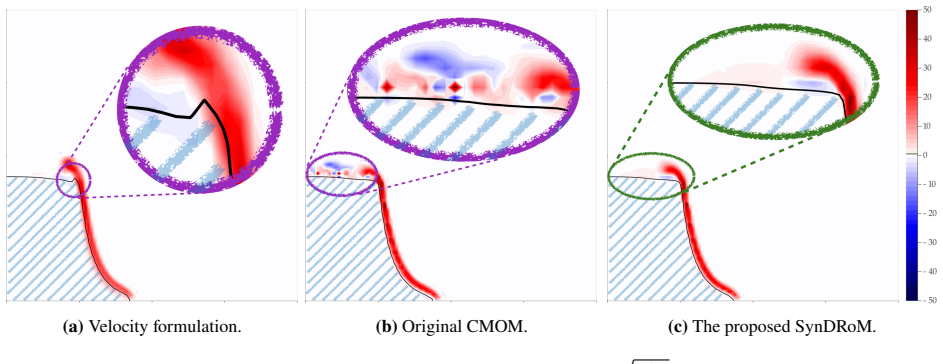
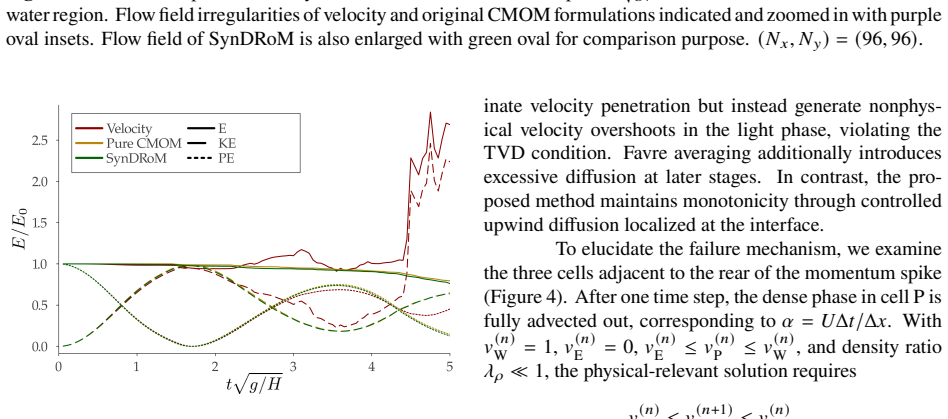
The Synchronized Donor-Region of Momentum fluxes (SynDRoM) replaces conventional shock-capturing by synchronizing donor regions to enforce monotonicity of the advected velocity field; this eliminates spurious velocity oscillations in CMOM-based sharp-interface simulations of large density ratio flows without loss of physical fidelity, as shown in scalar transport and interfacial shear instability cases, while a bounded kinetic viscosity limiter removes additional instabilities from improper interface viscosity estimates.
What carries the argument
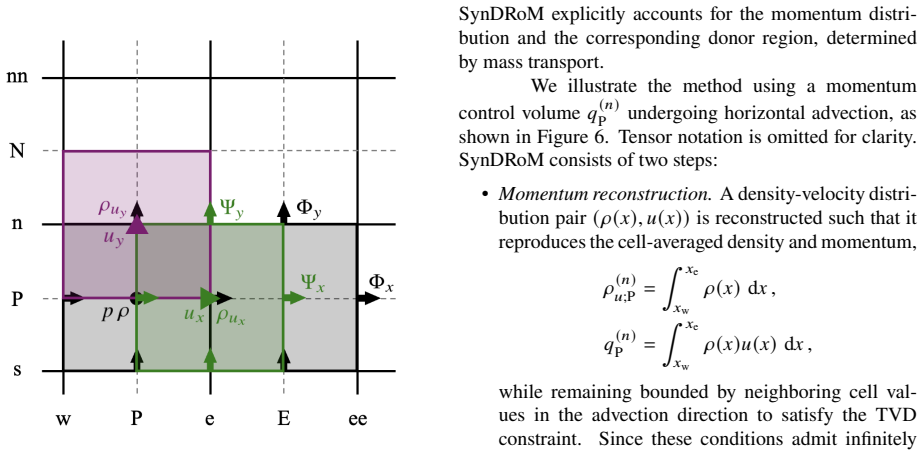
SynDRoM, which synchronizes the donor regions for momentum fluxes to enforce monotonicity of the transported velocity field.
If this is right
- Spurious velocity oscillations are eliminated in scalar transport and interfacial shear instability test cases.
- Numerical instabilities from improper viscosity estimation near the interface are addressed at finite time steps.
- The combined schemes enable assessment of performance on breaking wave simulations.
- Momentum conservation and semi-discrete energy conservation from the underlying CMOM framework are retained.
Where Pith is reading between the lines
- The monotonicity approach could be tested on other discontinuous transport problems such as compressible multiphase flows.
- Further checks in fully three-dimensional air-entrainment cases would show whether the limiter scales without new artifacts.
- The same donor-region synchronization idea might stabilize other sharp-interface conservation laws beyond momentum.
Load-bearing premise
The monotonicity enforcement in SynDRoM and the viscosity limiter preserve physical fidelity and do not introduce new artifacts when applied to complex three-dimensional breaking wave simulations.
What would settle it
A breaking wave simulation that still shows persistent spurious velocity oscillations or clear deviation from expected physical interface motion after applying SynDRoM and the viscosity limiter.
Figures
read the original abstract
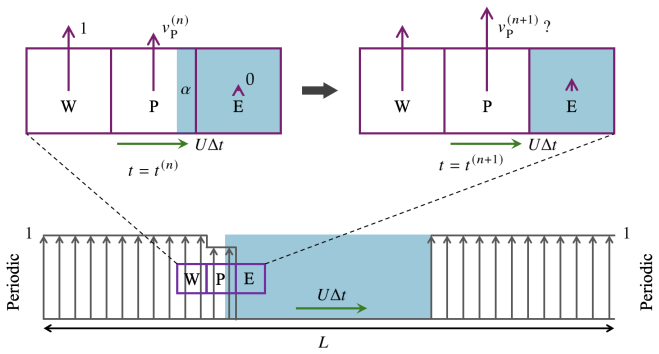
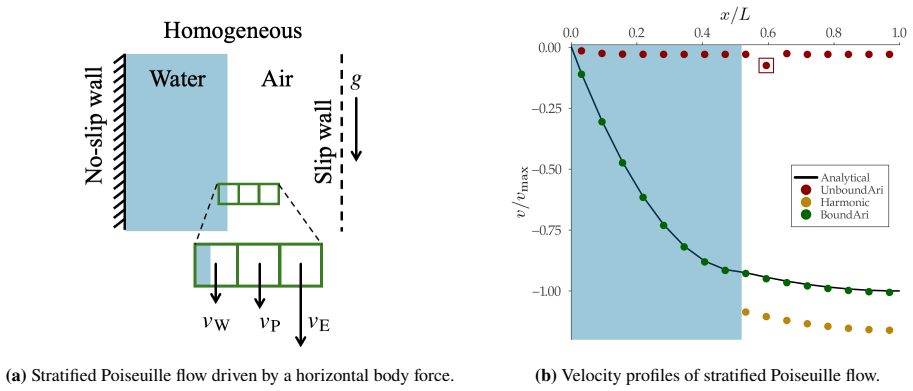
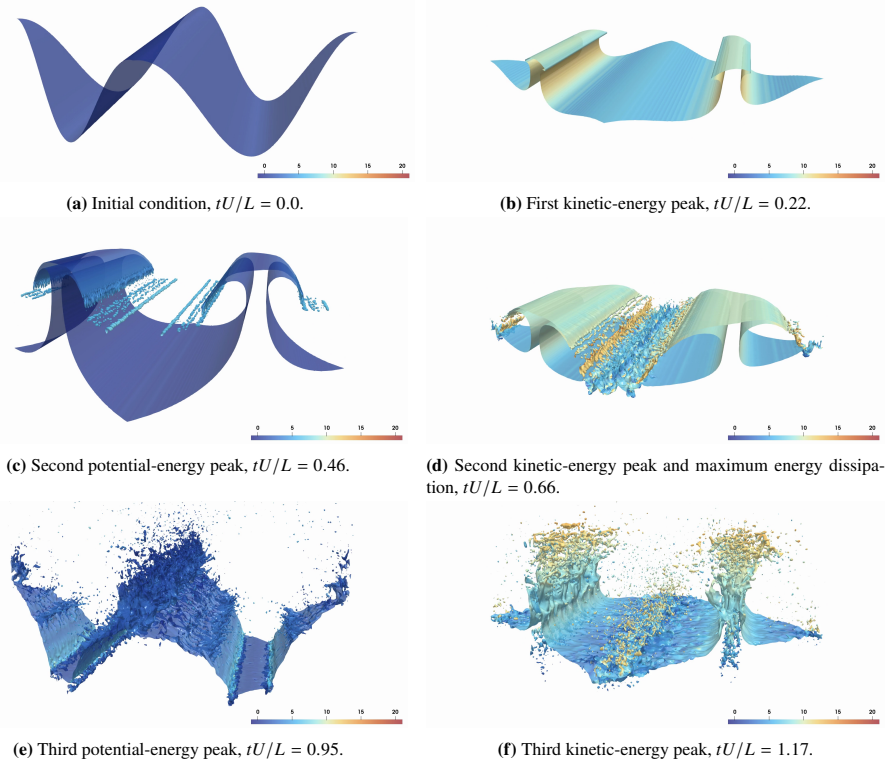
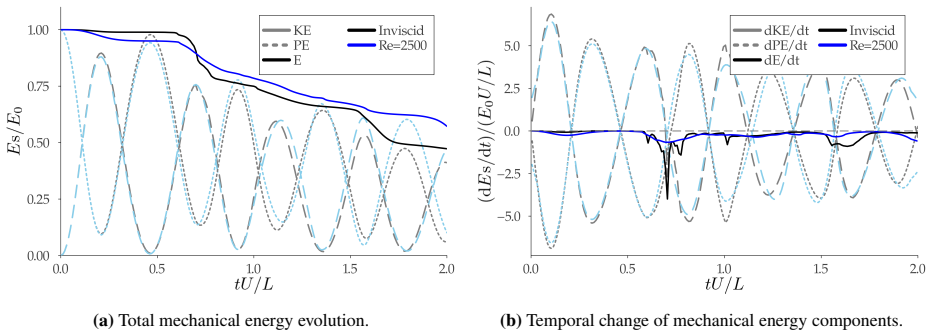
Flows with high density ratios, such as wave breaking and air entrainment in maritime applications, remain challenging to simulate due to their energetic and strongly nonlinear nature. In such regimes, maintaining numerical robustness is difficult when using the commonly adopted velocity-based formulation. The Consistent Mass-Momentum (CMOM) transport framework improves numerical robustness by enforcing fundamental physical properties, most notably momentum conservation and semi-discrete energy-conserving. However, CMOM replaces the advection of a continuous velocity field with that of a discontinuous momentum field. When combined with sharp interface methods, this leads to severe momentum shocks, for which conventional shock-capturing schemes are ineffective. To reconcile physical fidelity with numerical robustness, this work proposes a Synchronized Donor-Region of Momentum fluxes (SynDRoM) that enforces monotonicity of the transported velocity field. The resulting algorithm effectively eliminates spurious velocity oscillations without sacrificing physical fidelity, as demonstrated through scalar transport and interfacial shear instability test cases. Beyond difficulties from large density ratio, improper estimation of viscosity in the vicinity of the interface can introduce numerical instabilities at finite time steps, thereby undermining overall robustness. To address this issue, a viscosity limiter based on the bounded kinetic viscosity concept is introduced and validated using a gravity-driven plane shear flow. Finally, a breaking wave simulation is performed to assess the combined performance of the proposed physics-preserving numerical schemes for multiphase flows.
Editorial analysis
A structured set of objections, weighed in public.
Referee Report
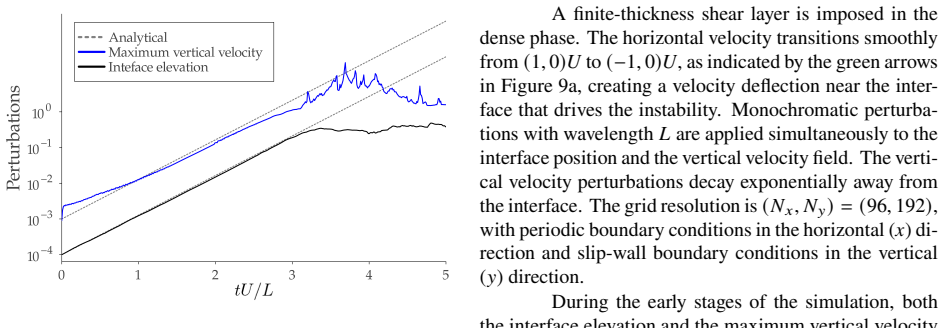
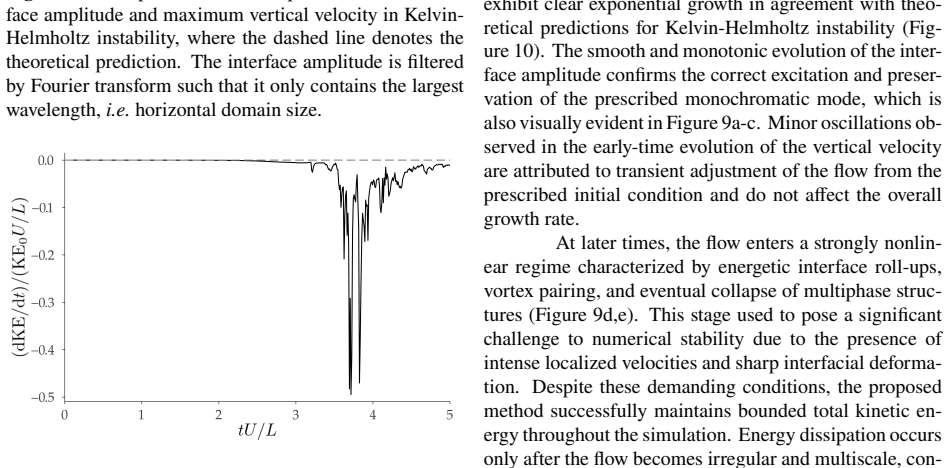
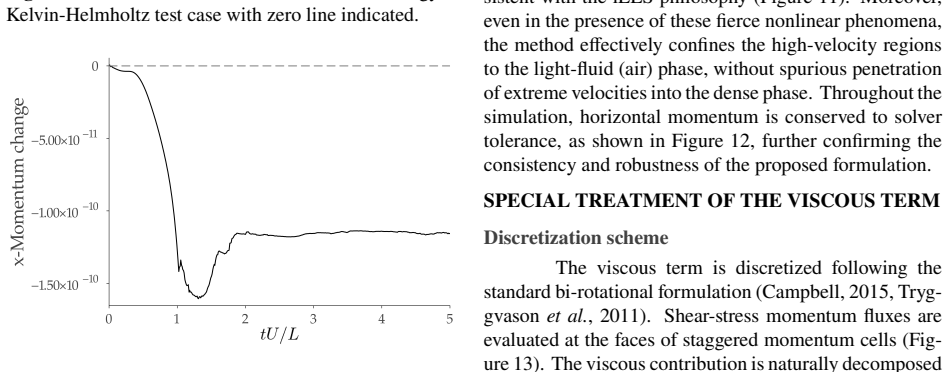
Summary. The paper introduces the Synchronized Donor-Region of Momentum fluxes (SynDRoM) scheme to enforce monotonicity on the velocity field within the Consistent Mass-Momentum (CMOM) framework for sharp-interface multiphase simulations at large density/viscosity ratios. It also proposes a bounded-kinetic-viscosity limiter to stabilize interface viscosity estimates. These are tested on scalar transport, 2-D interfacial shear instability, gravity-driven plane shear flow, and a 3-D breaking-wave case, with the central claim that spurious velocity oscillations are eliminated while physical fidelity is preserved.
Significance. If the quantitative support for fidelity preservation holds, the methods would offer a practical route to stable, momentum-conserving simulations of energetic flows such as wave breaking and air entrainment, where standard velocity-based and shock-capturing approaches fail. The targeted fixes for momentum shocks and interface viscosity are directly relevant to maritime and multiphase CFD applications.
major comments (2)
- [breaking-wave simulation subsection] Breaking-wave simulation subsection: the claim that SynDRoM and the viscosity limiter preserve physical fidelity in complex 3-D cases rests solely on a qualitative description of the simulation having been 'performed to assess combined performance.' No quantitative diagnostics (kinetic-energy spectra, air-entrainment volume fractions, wave-height decay rates, or comparison against experimental or reference data) are reported, leaving the central fidelity assertion unsupported for the most demanding test.
- [scalar transport and interfacial shear instability sections] Scalar-transport and interfacial-shear-instability sections: while the abstract states that these cases demonstrate elimination of spurious oscillations 'without sacrificing physical fidelity,' the provided description supplies no error norms, convergence rates, or direct comparison against analytic or high-resolution reference solutions that would quantify any alteration introduced by the monotonicity constraint.
minor comments (2)
- [Introduction] The abstract and introduction use 'semi-discrete energy-conserving' without an explicit statement of the discrete energy identity being preserved; a short derivation or reference to the precise CMOM energy statement would clarify the property being retained.
- [SynDRoM description] Notation for the donor-region fluxes in SynDRoM is introduced without an accompanying schematic or explicit stencil diagram, making the synchronization step difficult to reconstruct from the text alone.
Simulated Author's Rebuttal
We thank the referee for the constructive feedback identifying the need for stronger quantitative support of the physical-fidelity claims. We respond to each major comment below and will revise the manuscript accordingly.
read point-by-point responses
-
Referee: [breaking-wave simulation subsection] Breaking-wave simulation subsection: the claim that SynDRoM and the viscosity limiter preserve physical fidelity in complex 3-D cases rests solely on a qualitative description of the simulation having been 'performed to assess combined performance.' No quantitative diagnostics (kinetic-energy spectra, air-entrainment volume fractions, wave-height decay rates, or comparison against experimental or reference data) are reported, leaving the central fidelity assertion unsupported for the most demanding test.
Authors: We acknowledge that the breaking-wave subsection currently offers only a qualitative assessment. In the revised manuscript we will add quantitative diagnostics such as kinetic-energy spectra, air-entrainment volume fractions, and wave-height decay rates, together with comparisons to available experimental or reference data, to substantiate the fidelity claim for this demanding case. revision: yes
-
Referee: [scalar transport and interfacial shear instability sections] Scalar-transport and interfacial-shear-instability sections: while the abstract states that these cases demonstrate elimination of spurious oscillations 'without sacrificing physical fidelity,' the provided description supplies no error norms, convergence rates, or direct comparison against analytic or high-resolution reference solutions that would quantify any alteration introduced by the monotonicity constraint.
Authors: The current sections demonstrate oscillation removal through direct visual comparison with expected physical behavior. To quantify any effect of the monotonicity constraint, the revised manuscript will include error norms, convergence rates, and comparisons against analytic or high-resolution reference solutions for both test cases. revision: yes
Circularity Check
No circularity: independent algorithmic proposals validated on external test cases
full rationale
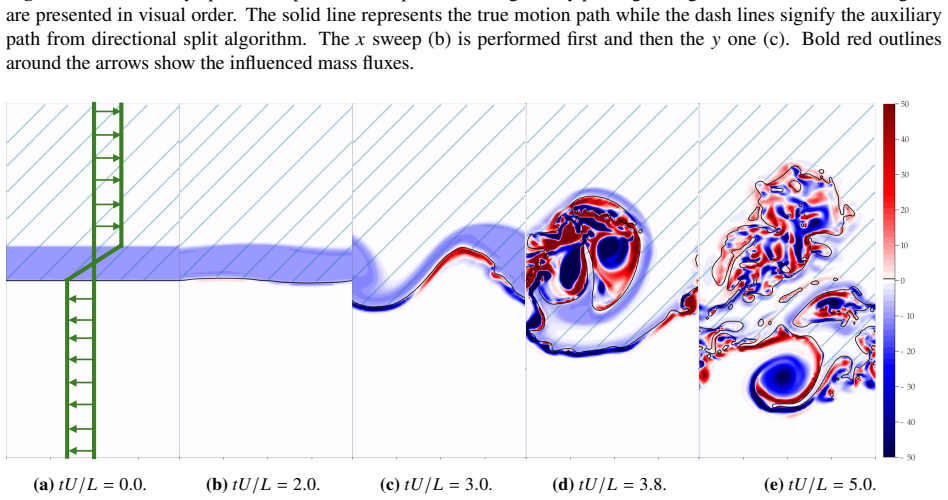
The paper introduces SynDRoM for monotonicity enforcement and a bounded kinetic viscosity limiter as new components within the CMOM framework. These are validated on scalar transport, interfacial shear instability, gravity-driven shear flow, and a breaking wave case, with claims of preserved physical fidelity resting on those external demonstrations rather than any self-referential definitions, fitted inputs renamed as predictions, or load-bearing self-citations that reduce the central result to its inputs by construction. No equations or steps in the provided text exhibit the enumerated circular patterns.
Axiom & Free-Parameter Ledger
axioms (2)
- standard math Standard conservation laws for mass and momentum hold in the fluid system.
- domain assumption The chosen test cases sufficiently represent the challenges of energetic real-world flows.
Reference graph
Works this paper leans on
-
[1]
Numerical Study of Air Cavity Characteristics of Bow Wave Breaking of
Mao, Tian-Yi and Bao, Feng-Jun and Wang, Jian-Hua and Wan, De-Cheng and Wang, Zhao-Jie , year =. Numerical Study of Air Cavity Characteristics of Bow Wave Breaking of. Journal of Hydrodynamics , volume =
-
[2]
and Yu, Xiangming and Yue, Dick K.-P
Hendrickson, Kelli and Weymouth, Gabriel D. and Yu, Xiangming and Yue, Dick K.-P. , year =. Wake behind a Three-Dimensional Dry Transom Stern. Journal of Fluid Mechanics , volume =
-
[3]
and Young, Yin L
Harwood, Casey M. and Young, Yin L. and Ceccio, Steven L. , year =. Ventilated Cavities on a Surface-Piercing Hydrofoil at Moderate. Journal of Fluid Mechanics , volume =
-
[4]
and O'Shea, Thomas T
Dommermuth, Douglas G. and O'Shea, Thomas T. and Brucker, Kyle A. and Chevalier, Kristine L. and Yue, Dick K. P. and Hendrickson, Kelli and Weymouth, Gabriel David , year =. Computational. 2009
2009
-
[5]
2007 , doi =
Ship motions using single-phase level set with dynamic overset grids , journal =. 2007 , doi =
2007
-
[6]
Computational Ship Hydrodynamics:
Stern, Frederick and Yang, Jianming and Wang, Zhaoyuan and. Computational Ship Hydrodynamics:. 2013 , journal =
2013
-
[7]
Geraint , title =
Jin, Qiu and Hudson, Dominic and Price, W. Geraint , title =. Journal of Fluids Engineering , volume =. 2021 , doi =
2021
-
[8]
Fedkiw, Ronald P and Aslam, Tariq and Merriman, Barry and Osher, Stanley , year =. A. Journal of Computational Physics , volume =
-
[9]
and Wyatt, Donald , year =
Fu, Thomas and Ratcliffe, Toby and O'Shea, Thomas and Brucker, Kyle and Graham, R. and Wyatt, Donald , year =. A. Proceedings of 28th
-
[10]
The Ghost Fluid Method for
Peltonen, Petteri and Kanninen, Pekka and Laurila, Erkki and Vuorinen, Ville , year =. The Ghost Fluid Method for. Ocean Engineering , volume =
-
[11]
1998 , journal =
A Volume-Tracking Method for Incompressible Multifluid Flows with Large Density Variations , author =. 1998 , journal =
1998
-
[12]
2012 , journal =
Consistent Mass and Momentum Transport for Simulating Incompressible Interfacial Flows with Large Density Ratios Using the Level Set Method , author =. 2012 , journal =
2012
-
[13]
2023 , journal =
Conservation of Energy in the Direct Numerical Simulation of Interface-Resolved Multiphase Flows , author =. 2023 , journal =
2023
-
[14]
A New Efficient Momentum Preserving
Zuzio, Davide and Orazzo, Annagrazia and Estival. A New Efficient Momentum Preserving. 2020 , journal =
2020
-
[15]
Arrufat, T. and. A Mass-Momentum Consistent,. 2021 , journal =
2021
-
[16]
2021 , journal =
Consistent, Energy-Conserving Momentum Transport for Simulations of Two-Phase Flows Using the Phase Field Equations , author =. 2021 , journal =
2021
-
[17]
and Veldman, Arthur E
Remmerswaal, Ronald A. and Veldman, Arthur E. P. , year =. Towards a Sharp, Structure Preserving Two-Velocity Model for Two-Phase Flow: Transport of Mass and Momentum , shorttitle =
-
[18]
2023 , journal =
Two-Phase Free-Surface Flow Interaction with Moving Bodies Using a Consistent, Momentum Preserving Method , author =. 2023 , journal =
2023
-
[19]
2011 , publisher =
Direct Numerical Simulations of Gas--Liquid Multiphase Flows , author =. 2011 , publisher =
2011
-
[20]
Weymouth, G. D. and Yue, Dick K.-P. , year =. Conservative. Journal of Computational Physics , volume =
-
[21]
2015 , school =
A Mechanistic Investigation of Nonlinear Interfacial Instabilities Leading to Slug Formation in Multiphase Flows , author =. 2015 , school =
2015
-
[22]
On the Computation of Viscous Terms for Incompressible Two-Phase Flows with
Lalanne, Benjamin and Villegas, Lucia Rueda and Tanguy, S. On the Computation of Viscous Terms for Incompressible Two-Phase Flows with. 2015 , journal =
2015
-
[23]
Journal of Computational Physics , author =
Volume of fluid (. Journal of Computational Physics , author =. 1981 , pages =. doi:10.1016/0021-9991(81)90145-5 , number =
-
[24]
Computers & Fluids , author =
A mass-momentum consistent coupling for mesh-adaptive two-phase flow simulations , volume =. Computers & Fluids , author =. 2023 , pages =
2023
-
[25]
2013 , month = jul, journal =
A Consistent Rescaled Momentum Transport Method for Simulating Large Density Ratio Incompressible Multiphase Flows Using Level Set Methods , author =. 2013 , month = jul, journal =
2013
-
[26]
A Consistent Adaptive Level Set Framework for Incompressible Two-Phase Flows with High Density Ratios and High
Zeng, Yadong and Liu, Han and Gao, Qiang and Almgren, Ann and Bhalla, Amneet Pal Singh and Shen, Lian , year =. A Consistent Adaptive Level Set Framework for Incompressible Two-Phase Flows with High Density Ratios and High. Journal of Computational Physics , volume =
-
[27]
Numerical Simulation of Droplets, Bubbles and Waves: State of the Art , shorttitle =
Fuster, Daniel and Agbaglah, Gilou and Josserand, Christophe and Popinet, St. Numerical Simulation of Droplets, Bubbles and Waves: State of the Art , shorttitle =. 2009 , journal =
2009
-
[28]
2024 , journal =
Numerical Investigation of Mixed-Phase Turbulence Induced by a Plunging Jet , author =. 2024 , journal =
2024
-
[29]
2008 , journal =
Bubble-Induced Skin-Friction Drag Reduction and the Abrupt Transition to Air-Layer Drag Reduction , author =. 2008 , journal =
2008
-
[30]
Calado, A and Balaras, E , date =. Direct. Proceedings of 35th
-
[31]
Hendrickson, Kelli and Gaylo, Declan B and Yue, Dick Kuai-Ping , date =. Large. Proceedings of 35th
-
[32]
and Valle, N
Trias, F. and Valle, N. and Gorobets, A. and Oliva, A. , year =. Symmetry-. 14th
-
[33]
and Hendrickson, Kelli and Terwisga, Tom J
Huang, Tzu-Yao and Lidtke, Artur K. and Hendrickson, Kelli and Terwisga, Tom J. C. Characterizing Numerical Surface Tension in the Conservative Volume-of-Fluid Method , booktitle =. 2024 , volume =
2024
-
[34]
A Generalized High-Order Momentum Preserving (
Desmons, Florian and Coquerelle, Mathieu , year =. A Generalized High-Order Momentum Preserving (. Journal of Computational Physics , volume =
-
[35]
Nangia, Nishant and Griffith, Boyce E. and Patankar, Neelesh A. and Bhalla, Amneet Pal Singh , year =. A Robust Incompressible. Journal of Computational Physics , volume =. doi:10.1016/j.jcp.2019.03.042 , urldate =
-
[36]
Strang, Gilbert , year =. On the. SIAM Journal on Numerical Analysis , shortjournal =
-
[37]
Practical Splitting Methods for the Adaptive Integration of Nonlinear Evolution Equations
Auzinger, Winfried and Hofstätter, Harald and Ketcheson, David and Koch, Othmar , year =. Practical Splitting Methods for the Adaptive Integration of Nonlinear Evolution Equations. BIT Numerical Mathematics , shortjournal =
-
[38]
A Robust Upwind Discretization Method for Advection, Diffusion and Source Terms , booktitle =
Koren, Barry , year =. A Robust Upwind Discretization Method for Advection, Diffusion and Source Terms , booktitle =
-
[39]
2015 , month = jan, journal =
A Generic Framework for Design of Interface Capturing Schemes for Multi-Fluid Flows , author =. 2015 , month = jan, journal =
2015
-
[40]
and Welch, J
Harlow, Francis H. and Welch, J. Eddie , year =. Numerical. The Physics of Fluids , volume =
-
[41]
Sweby, P. K. , year =. High. SIAM Journal on Numerical Analysis , shortjournal =
-
[42]
LeVeque, Randall J. , year=. Finite Volume Methods for Hyperbolic Problems , publisher=
-
[43]
2003 , journal =
Symmetry-Preserving Discretization of Turbulent Flow , author =. 2003 , journal =
2003
-
[44]
Proceedings of the Royal Society of London
Vertical Jets from Standing Waves. Proceedings of the Royal Society of London. Series A: Mathematical, Physical and Engineering Sciences , volume =
-
[45]
Numerical
Remmerswaal, Ronald , year = 2023, school =. Numerical
2023
-
[46]
Communications on Pure and Applied Mathematics , volume =
On Finite-difference Approximations and Entropy Conditions for Shocks , author =. Communications on Pure and Applied Mathematics , volume =
-
[47]
Methods for Multiphase Flows with High Density Ratio , booktitle =
-
[48]
2013 , journal =
A Monotonicity Preserving Conservative Sharp Interface Flow Solver for High Density Ratio Two-Phase Flows , author =. 2013 , journal =
2013
-
[49]
A Mass and Momentum Conserving Unsplit Semi-
Owkes, Mark and Desjardins, Olivier , year =. A Mass and Momentum Conserving Unsplit Semi-. Journal of Computational Physics , volume =
-
[50]
2022 , journal =
A Consistent Mass-Momentum Advection Method for the Simulation of Large-Density-Ratio Two-Phase Flows , author =. 2022 , journal =
2022
-
[51]
Hendrickson, Kelli , year =. Navier-
-
[52]
Drop-Surface Interactions , author =
Navier-Stokes Numerical Algorithms for Free-Surface Flow Computations: An Overview , shorttitle =. Drop-Surface Interactions , author =
-
[53]
Rational Constitutive Law for the Viscous Stress Tensor in Incompressible Two-Phase Flows:
Magnaudet, Jacques and Bruhier, Hadrien and Mer, Samuel and Bonometti, Thomas , year = 2025, month = jul, journal =. Rational Constitutive Law for the Viscous Stress Tensor in Incompressible Two-Phase Flows:
2025
-
[54]
Weymouth and Bernat Font , keywords =
Gabriel D. Weymouth and Bernat Font , keywords =. WaterLily.jl: A differentiable and backend-agnostic Julia solver for incompressible viscous flow around dynamic bodies , journal =. 2025 , issn =. doi:10.1016/j.cpc.2025.109748 , url =
-
[55]
On a symmetry-preserving unconditionally stable projection method on collocated unstructured grids for incompressible flows , journal =. 2025 , issn =. doi:https://doi.org/10.1016/j.jcp.2024.113631 , url =
-
[56]
Boundary Data Immersion Method for
Weymouth, Gabriel David and Yue, Dick Kuai-Ping , year =. Boundary Data Immersion Method for. Journal of Computational Physics , volume =
discussion (0)
Sign in with ORCID, Apple, or X to comment. Anyone can read and Pith papers without signing in.