AI and physics-based weather forecasting: A comparative study
Pith reviewed 2026-06-28 11:40 UTC · model grok-4.3
The pith
Raw physics-based ensemble forecasts outperform raw AI-based ones for wind speed at all horizons.
A machine-rendered reading of the paper's core claim, the machinery that carries it, and where it could break.
Core claim
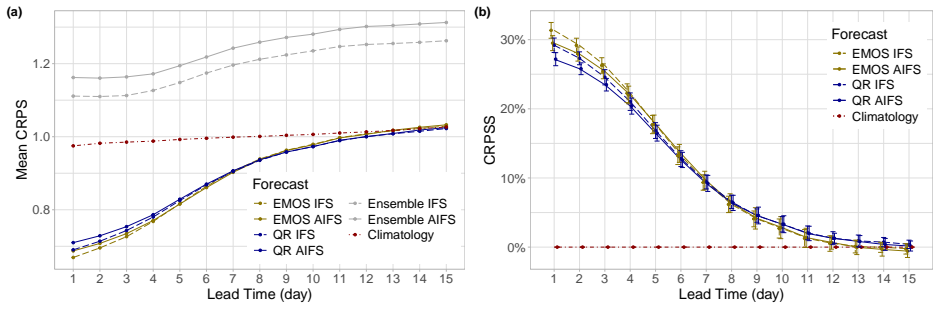
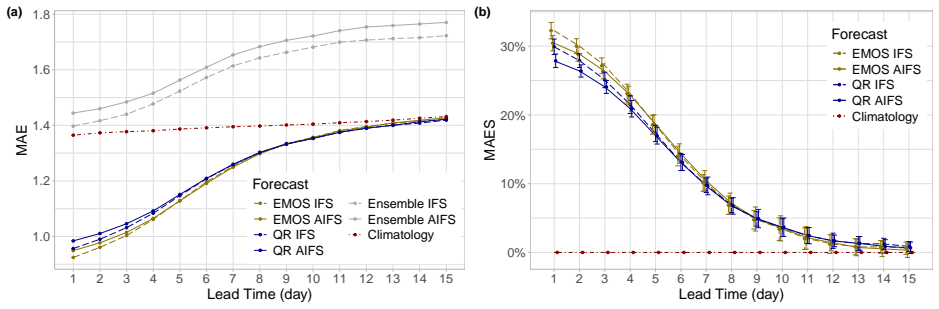
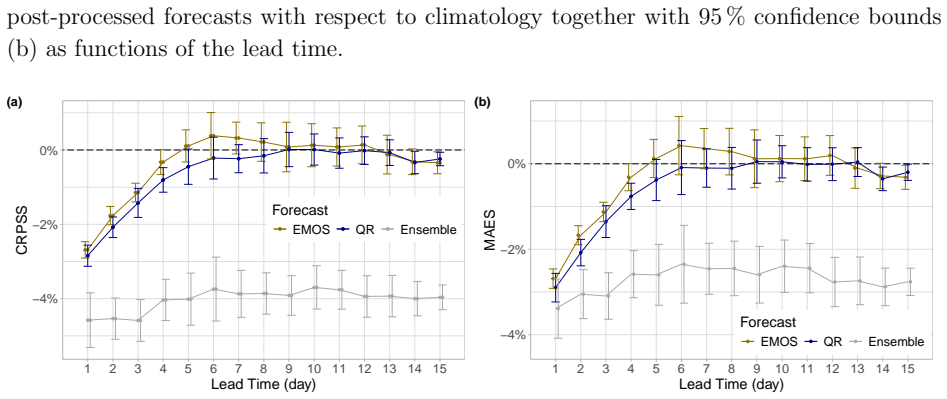
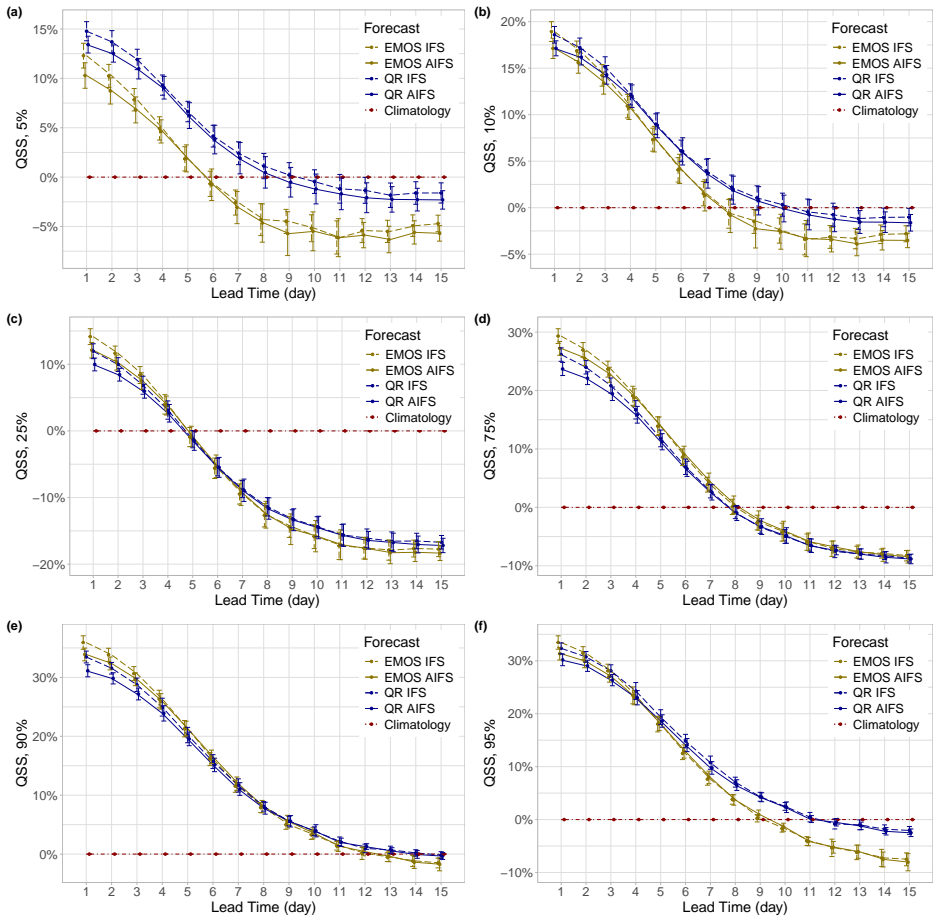
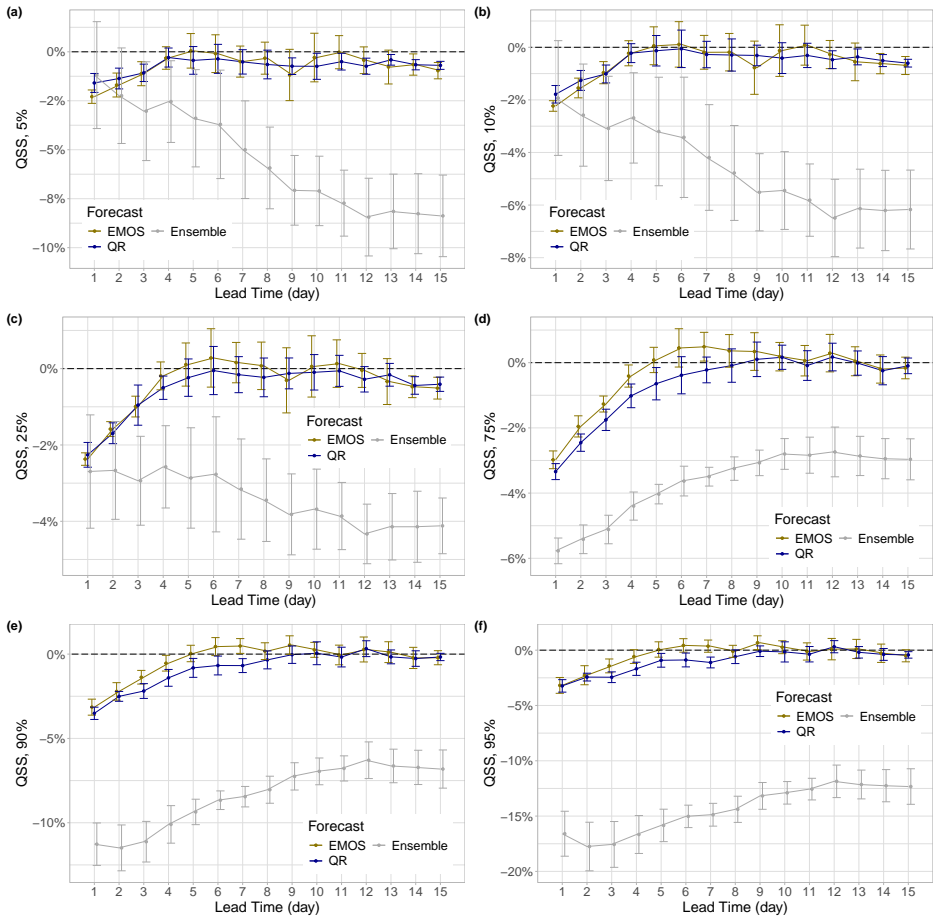
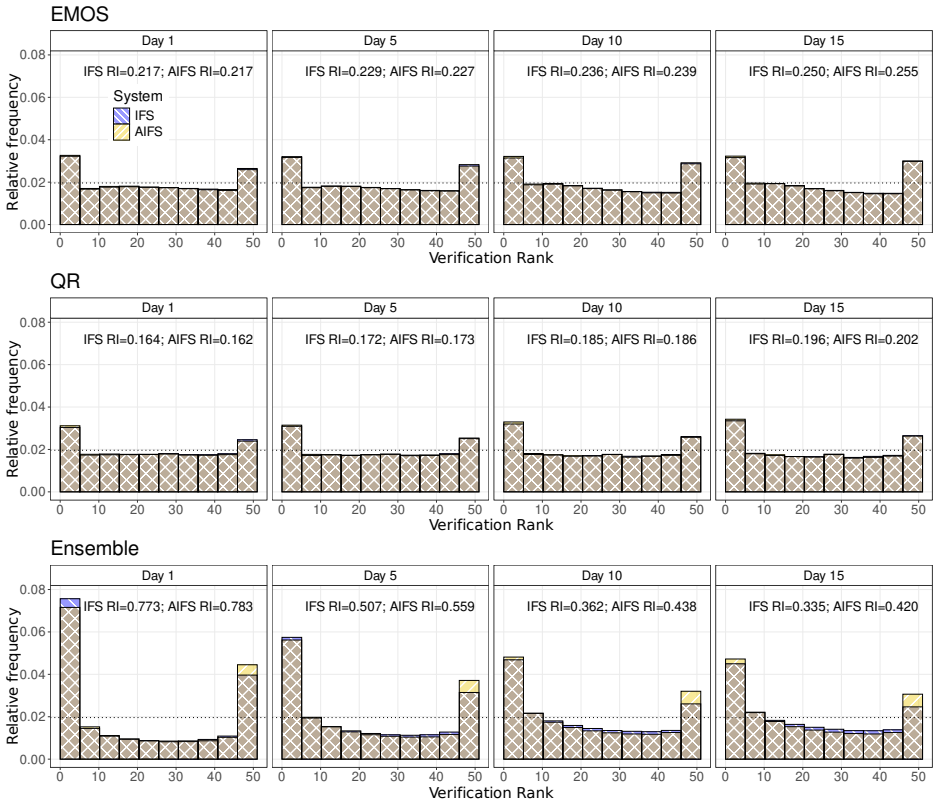
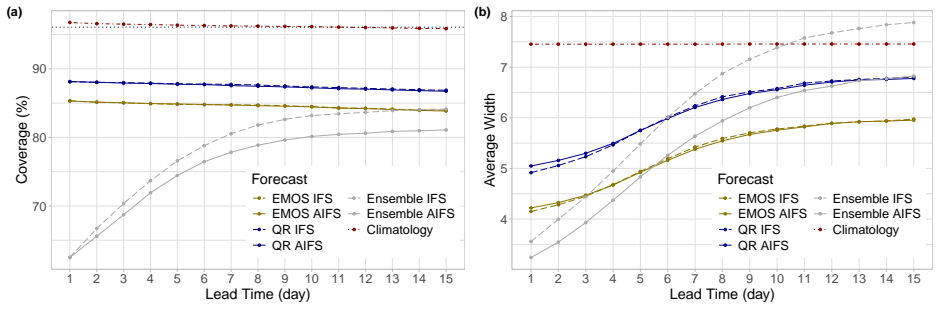
The predictive performance of raw physics-based ensemble forecasts proves to be substantially superior to the skill of the raw AI predictions for all investigated forecast horizons. Post-processing significantly improves the skill of both, and across most verification metrics the parametric method is superior to the non-parametric one especially for short lead times. Compared to the raw ensemble the differences in skill between the matching physics-based and AI predictions are substantially decreased by post-processing and are mostly significant at short lead times when the physics-based forecasts outperform their AI counterparts.
What carries the argument
The comparison of raw and post-processed ensemble forecasts from the two models using ensemble model output statistics and quantile regression applied to observations at thousands of stations.
If this is right
- Post-processing reduces the skill differences between physics-based and AI-based predictions.
- The parametric post-processing method outperforms the non-parametric one for most metrics at short lead times.
- The superiority of the physics-based model over the AI one holds after correction but is mostly limited to short horizons.
- Both models benefit from post-processing but the relative ordering changes little at longer leads.
Where Pith is reading between the lines
- Operational decisions on model choice for wind speed may favor physics-based approaches for accuracy-critical short-range applications.
- Similar comparisons for other variables like temperature could reveal if the pattern is specific to wind speed.
- Hybrid systems that use AI for efficiency but apply physics corrections might close the gap further.
- Energy and speed savings of AI models may need to be weighed against accuracy losses in ensemble forecasting.
Load-bearing premise
The post-processing methods were applied in an identical unbiased manner to both sets of forecasts so that any remaining skill difference reflects the models rather than tuning differences.
What would settle it
If separate optimization of post-processing parameters for the AI model closes or reverses the performance gap with the physics-based model, the claim of inherent superiority would be challenged.
Figures
read the original abstract
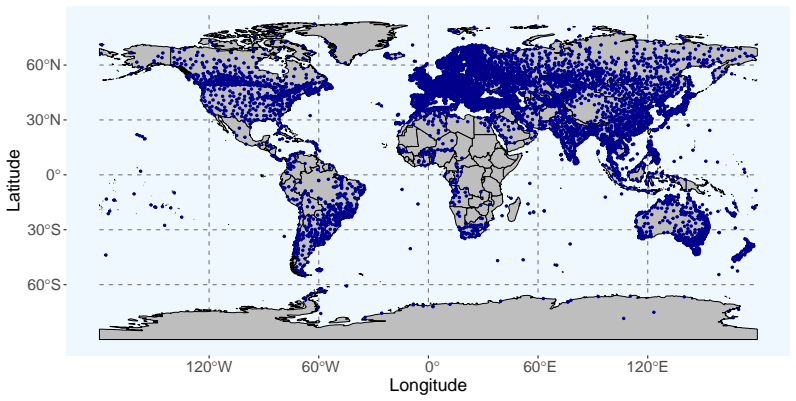
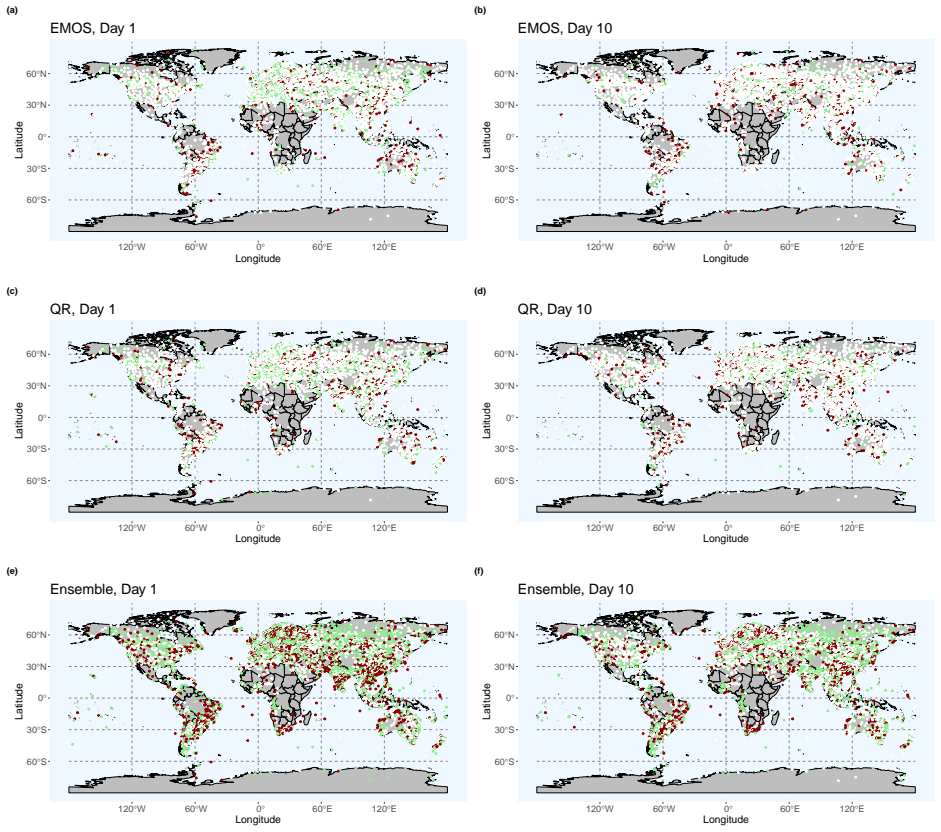
In the last few years, AI-based models have become the centre of attention in weather forecasting due to their increasing accuracy and efficiency. Pioneering among weather services, ECMWF has developed its Artificial Intelligence Forecasting System (AIFS) model, which was first to provide data-driven ensemble forecasts in June 2024. Since July 2025, the AIFS ensemble model has been operational and runs in parallel with ECMWF's physics-based Integrated Forecasting System (IFS), which is considered the gold standard in weather prediction. The new AIFS model can generate forecasts ten times faster than the classical numerical weather prediction model, while consuming approximately a thousand times less energy. We present the results of our systematic assessment of the performance of the IFS and AIFS models by comparing the accuracy of raw and post-processed medium-range 10-m wind-speed ensemble forecasts generated operationally by the two models for the period between July and November 2025 for more than 9000 synoptic observation stations across the globe. The post-processed case involves the parametric ensemble model output statistics (EMOS) as well as the non-parametric quantile regression (QR) approach to correct any systematic inaccuracies in the raw forecasts. The predictive performance of raw IFS ensemble forecasts proves to be substantially superior to the skill of the raw AIFS predictions for all investigated forecast horizons. As expected, post-processing significantly improves the skill of both IFS and AIFS predictions, and, across most verification metrics, EMOS is superior to QR, especially for short lead times. Compared to the raw ensemble, the differences in skill between the matching IFS and AIFS predictions are substantially decreased by post-processing and are mostly significant at short lead times, when the IFS forecasts outperform their AIFS counterparts.
Editorial analysis
A structured set of objections, weighed in public.
Referee Report
Summary. The manuscript compares raw and post-processed 10-m wind-speed ensemble forecasts from ECMWF's physics-based IFS and AI-based AIFS models over July–November 2025 at >9000 global synoptic stations. It reports that raw IFS substantially outperforms raw AIFS at all horizons; both EMOS and QR post-processing improve skill (with EMOS generally superior to QR); and post-processing substantially reduces the IFS–AIFS skill gap, with remaining differences mostly significant only at short lead times.
Significance. If the post-processing methods were applied identically and without model-specific optimization, the study supplies operationally relevant evidence on the relative skill of the new AIFS ensemble versus the established IFS for an important surface variable, together with the practical effect of standard post-processing techniques on the performance gap.
major comments (2)
- [Abstract / Methods] Abstract and methods: the claim that post-processing 'substantially decreased' the IFS–AIFS skill difference rests on EMOS and QR having been applied in an identical, unbiased manner to both ensembles. No information is supplied on shared training windows, ensemble-size handling, hyper-parameter selection, or whether separate rolling windows or objective functions were used for the weaker AIFS; differential tuning would make the observed convergence non-diagnostic of intrinsic model properties.
- [Verification / Results] Verification section: station selection criteria, handling of missing data, and exact implementation details for EMOS (distribution parameters) and QR (quantile coefficients) are not described, preventing assessment of whether verification metrics were computed consistently across models and whether uncertainty quantification was included.
minor comments (2)
- [Abstract] The abstract states 'more than 9000 synoptic observation stations' but does not specify the exact number or any quality-control filters applied.
- [Methods] Clarify whether the same ensemble members were used for both models when computing verification metrics such as CRPS or Brier scores.
Simulated Author's Rebuttal
We thank the referee for the constructive comments on our manuscript. We address the major comments point-by-point below. Where details were omitted, we will incorporate them in a revised version to ensure full reproducibility and transparency.
read point-by-point responses
-
Referee: [Abstract / Methods] Abstract and methods: the claim that post-processing 'substantially decreased' the IFS–AIFS skill difference rests on EMOS and QR having been applied in an identical, unbiased manner to both ensembles. No information is supplied on shared training windows, ensemble-size handling, hyper-parameter selection, or whether separate rolling windows or objective functions were used for the weaker AIFS; differential tuning would make the observed convergence non-diagnostic of intrinsic model properties.
Authors: We confirm that post-processing was applied in an identical, unbiased manner to both ensembles. The same rolling training window (previous 30 days of forecasts), ensemble-size handling (both models use 51 members, with no subsampling), and hyper-parameter selection (CRPS minimization for EMOS; pinball loss for QR, with identical quantile levels) were used without any model-specific optimization or separate objective functions. We will add an explicit subsection to the Methods describing these choices to remove any ambiguity. revision: yes
-
Referee: [Verification / Results] Verification section: station selection criteria, handling of missing data, and exact implementation details for EMOS (distribution parameters) and QR (quantile coefficients) are not described, preventing assessment of whether verification metrics were computed consistently across models and whether uncertainty quantification was included.
Authors: We will expand the Verification section with the requested details: stations were selected if they had at least 80% complete observations in the July–November 2025 period; missing forecast–observation pairs were excluded on a case-by-case basis. EMOS used a truncated normal distribution with location and scale parameters estimated by CRPS minimization. QR fitted coefficients for the 0.1, 0.5 and 0.9 quantiles via pinball loss. Uncertainty was quantified via 1000 bootstrap resamples of the verification set; we will report the resulting intervals. revision: yes
Circularity Check
No circularity: empirical comparison of independent forecast systems
full rationale
The paper conducts a direct empirical evaluation of raw and post-processed ensemble forecasts from two distinct models (IFS and AIFS) against synoptic observations over a fixed period. No mathematical derivations, fitted parameters renamed as predictions, or self-citations are used to establish the central claims. All reported skill differences follow from standard verification metrics applied to held-out data. The post-processing step (EMOS/QR) is described as a correction applied to both ensembles; even if implementation details vary, this does not constitute a circular reduction of any claimed result to its own inputs. The analysis is self-contained against external benchmarks.
Axiom & Free-Parameter Ledger
free parameters (2)
- EMOS distribution parameters
- QR quantile coefficients
axioms (1)
- domain assumption Standard assumptions of ensemble model output statistics and quantile regression hold for both IFS and AIFS ensembles
Reference graph
Works this paper leans on
-
[1]
Calibration of wind speed ensemble forecasts for power generation , author =. Id. 2021 , doi =
2021
-
[2]
Quarterly Journal of the Royal Meteorological Society , volume =
A two-step machine learning approach to statistical post-processing of weather forecasts for power generation , author =. Quarterly Journal of the Royal Meteorological Society , volume =. 2024 , doi =
2024
-
[3]
25 years of ensemble forecasting
Introduction to the special issue on “25 years of ensemble forecasting” , author =. Quarterly Journal of the Royal Meteorological Society , volume =. 2018 , doi =
2018
-
[4]
Ensemble forecasting and the need for calibration , editor =
Buizza, Roberto , booktitle =. Ensemble forecasting and the need for calibration , editor =. 2018 , publisher =
2018
-
[5]
St. Statistical postprocessing for weather forecasts -- review, challenges and avenues in a big data world , journal =. doi:10.1175/BAMS-D-19-0308.1 , pages =
-
[6]
Monthly Weather Review , year =
Roberto Buizza and Pieter Leopold Houtekamer and Gerald Pellerin and Zoltan Toth and Yuejian Zhu and Mozheng Wei , title =. Monthly Weather Review , year =. doi:10.1175/MWR2905.1 , pages=
-
[7]
2024 , publisher=
IFS Documentation CY49R1 -- Part V: Ensemble Prediction System , author=. 2024 , publisher=
2024
-
[8]
Journal of the Royal Statistical Society: Series B (Statistical Methodology) , volume =
Probabilistic forecasts, calibration and sharpness , author =. Journal of the Royal Statistical Society: Series B (Statistical Methodology) , volume =. 2007 , doi =
2007
-
[9]
Gneiting, Tilmann and Raftery, Adrian E , title =. Journal of the American Statistical Association , volume =. doi:10.1198/016214506000001437 , pages =
-
[10]
Gneiting, Tilmann and Raftery, Adrian E and Westveld, Anton H and Goldman, Tom , title =. Monthly Weather Review , volume =. doi:10.1175/MWR2904.1 , pages =
-
[11]
Monthly Weather Review , volume =
Rasp, Stephan and Lerch, Sebastian , title =. Monthly Weather Review , volume =. doi:10.1175/MWR-D-18-0187.1 , pages =
-
[12]
Wilks, Daniel S. , year=. Statistical Methods in the Atmospheric Sciences , edition =
-
[13]
Evaluating probabilistic forecasts with
Alexander Jordan and Fabian Kr. Evaluating probabilistic forecasts with. doi:10.18637/jss.v090.i12 , journal =
-
[14]
Log-normal distribution based
Baran, S. Log-normal distribution based. Quarterly Journal of the Royal Meteorological Society , doi=
-
[15]
Environmetrics , volume=
Truncated generalized extreme value distribution-based ensemble model output statistics model for calibration of wind speed ensemble forecasts , author=. Environmetrics , volume=. 2021 , doi =
2021
-
[16]
and Gneiting, Tilmann , title =
Thorarinsdottir, Thordis L. and Gneiting, Tilmann , title =. Journal of the Royal Statistical Society: Series A (Statistics in Society) , number =. doi:10.1111/j.1467-985X.2009.00616.x , pages =
-
[17]
Tellus A: Dynamic Meteorology and Oceanography , volume=
Comparison of non-homogeneous regression models for probabilistic wind speed forecasting , author=. Tellus A: Dynamic Meteorology and Oceanography , volume=. 2013 , doi=
2013
-
[18]
Raftery , title =
Tilmann Gneiting and Adrian E. Raftery , title =. Science , volume =. 2005 , doi =
2005
-
[19]
Calibration of medium-range weather forecasts , author=. 2014 , journal=. doi:10.21957/8xna7glta , OPTurl=
-
[20]
Accurate medium-range global weather forecasting with 3D neural networks , volume =
Kaifeng Bi and Lingxi Xie and Hengheng Zhang and Xin Chen and Xiaotao Gu and Qi Tian , doi =. Accurate medium-range global weather forecasting with 3D neural networks , volume =. Nature , pages =
-
[21]
Kurth, Thorsten and Subramanian, Shashank and Harrington, Peter and Pathak, Jaideep and Mardani, Morteza and Hall, David and Miele, Andrea and Kashinath, Karthik and Anandkumar, Anima , title =. 2023 , isbn =. doi:10.1145/3592979.3593412 , booktitle =
-
[22]
Science , volume =
Remi Lam and Alvaro Sanchez-Gonzalez and Matthew Willson and Peter Wirnsberger and Meire Fortunato and Ferran Alet and Suman Ravuri and Timo Ewalds and Zach Eaton-Rosen and Weihua Hu and Alexander Merose and Stephan Hoyer and George Holland and Oriol Vinyals and Jacklynn Stott and Alexander Pritzel and Shakir Mohamed and Peter Battaglia , title =. Science...
2023
-
[23]
2024 , journal=
AIFS: a new ECMWF forecasting system , author=. 2024 , journal=
2024
-
[24]
Andersson and Andrew El-Kadi and Dominic Masters and Timo Ewalds and Jacklynn Stott and Shakir Mohamed and Peter Battaglia and Remi Lam and Matthew Willson , doi =
Ilan Price and Alvaro Sanchez-Gonzalez and Ferran Alet and Tom R. Andersson and Andrew El-Kadi and Dominic Masters and Timo Ewalds and Jacklynn Stott and Shakir Mohamed and Peter Battaglia and Remi Lam and Matthew Willson , doi =. Probabilistic weather forecasting with machine learning , volume =. Nature , pages =
-
[25]
Simon Lang and Mihai Alexe and Mariana C. A. Clare and Christopher Roberts and Rilwan Adewoyin and Zied Ben Bouallègue and Matthew Chantry and Jesper Dramsch and Peter D. Dueben and Sara Hahner and Pedro Maciel and Ana Prieto-Nemesio and Cathal O'Brien and Florian Pinault and Jan Polster and Baudouin Raoult and Steffen Tietsche and Martin Leutbecher , yea...
-
[26]
Raftery and Tilmann Gneiting and Fadoua Balabdaoui and Michael Polakowski , title =
Adrian E. Raftery and Tilmann Gneiting and Fadoua Balabdaoui and Michael Polakowski , title =. Monthly Weather Review , volume =. doi:10.1175/MWR2906.1 , pages =
-
[27]
Raftery and Tilmann Gneiting , title =
Chris Fraley and Adrian E. Raftery and Tilmann Gneiting , title =. Monthly Weather Review , year =. doi:10.1175/2009MWR3046.1 , pages=
-
[28]
McLean Sloughter and Tilmann Gneiting and Adrian E
J. McLean Sloughter and Tilmann Gneiting and Adrian E. Raftery , title =. Journal of the American Statistical Association , volume =. 2010 , doi =
2010
-
[29]
Probabilistic wind speed forecasting using Bayesian model averaging with truncated normal components , journal =
S. Probabilistic wind speed forecasting using Bayesian model averaging with truncated normal components , journal =. 2014 , doi =
2014
-
[30]
Constrained quantile regression splines for ensemble postprocessing
Bremnes, John Bj. Constrained quantile regression splines for ensemble postprocessing. , journal =. doi:10.1175/MWR-D-18-0420.1 , pages =
-
[31]
Ensemble postprocessing using quantile function regression based on neural networks and
John Bjørnar Bremnes , doi =. Ensemble postprocessing using quantile function regression based on neural networks and. Monthly Weather Review , pages =
-
[32]
Politis, Dimitris N. and Romano, Joseph P. , title =. Journal of the American Statistical Association , volume =. doi:10.1080/01621459.1994.10476870 , pages =
-
[33]
Journal of Business & Economic Statistics , Year =
Diebold, Francis X. and Mariano, Roberto S. , title =. Journal of Business and Economic Statistics , volume =. doi:10.1080/07350015.1995.10524599 , pages =
-
[34]
Benjamini, Yoav and Hochberg, Yosef , title =. Journal of the Royal Statistical Society: Series B (Methodological) , volume =. doi:10.1111/j.2517-6161.1995.tb02031.x , pages =
-
[35]
Wilks, Daniel S. , title =. Bulletin of the American Meteorological Society , volume =. doi:10.1175/BAMS-D-15-00267.1 , pages =
-
[36]
2005 , publisher =
Quantile Regression , author =. 2005 , publisher =
2005
-
[37]
Uccellini and Eugenia Kalnay and Kenneth Carey and Lauren Morone , title =
Kristine Harper and Louis W. Uccellini and Eugenia Kalnay and Kenneth Carey and Lauren Morone , title =. Bulletin of the American Meteorological Society , year =. doi:10.1175/BAMS-88-5-639 , pages=
-
[38]
Hersbach, Hans and Bell, Bill and Berrisford, Paul and Hirahara, Shoji and Hor\'anyi, Andr\'as and Mu\ noz-Sabater, Joaquín and Nicolas, Julien and Peubey, Carole and Radu, Raluca and Schepers, Dinand and Simmons, Adrian and Soci, Cornel and Abdalla, Saleh and Abellan, Xavier and Balsamo, Gianpaolo and Bechtold, Peter and Biavati, Gionata and Bidlot, Jean...
-
[39]
Thomas Haiden and Martin Janousek and Fr\'ed\'eric Vitart and Fernando Prates and Michael Maier-Gerber and Cathy Wing Yi Li and Matthieu Chevallier , year=. Evaluation of. ECMWF Technical Memorandum , publisher=. doi:10.21957/51e665e5c8 , OPTurl=
-
[40]
, booktitle =
Wilks, Daniel S. , booktitle =. Univariate Ensemble Postprocessing , editor =. 2018 , publisher =
2018
-
[41]
Monthly Weather Review , volume =
Petra Friederichs and Andreas Hense , title =. Monthly Weather Review , volume =. doi:10.1175/MWR3403.1 , pages =
-
[42]
Bright and Yanbo Shen and Bai Liu and Xingli Liu and Martin J
Mengmeng Song and Dazhi Yang and Sebastian Lerch and Xiang’ao Xia and Gokhan Mert Yagli and Jamie M. Bright and Yanbo Shen and Bai Liu and Xingli Liu and Martin J. Non-crossing quantile regression neural network as a calibration tool for ensemble weather forecasts , volume =. doi:10.1007/s00376-023-3184-5 , journal =
-
[43]
Hamill and Michael Scheuerer , title =
Thomas M. Hamill and Michael Scheuerer , title =. Monthly Weather Review , volume =. doi:10.1175/MWR-D-18-0147.1 , pages =
-
[44]
Quarterly Journal of the Royal Meteorological Society , volume =
Bert Van Schaeybroeck and St\'ephane Vannitsem , title =. Quarterly Journal of the Royal Meteorological Society , volume =. doi:10.1002/qj.2397 , pages =
-
[45]
Calibrated Ensemble Forecasts Using Quantile Regression Forests and Ensemble Model Output Statistics , volume =
Maxime Taillardat and Olivier Mestre and Michaël Zamo and Philippe Naveau , doi =. Calibrated Ensemble Forecasts Using Quantile Regression Forests and Ensemble Model Output Statistics , volume =. Monthly Weather Review , pages =
-
[46]
Machine-learning-based probabilistic forecasting of solar irradiance in
Baran, S. Machine-learning-based probabilistic forecasting of solar irradiance in. Advances in Statistical Climatology, Meteorology and Oceanography , volume =. 2025 , number =
2025
-
[47]
Monthly Weather Review , volume =
Machine learning methods for postprocessing ensemble forecasts of wind gusts: A systematic comparison , author =. Monthly Weather Review , volume =. 2022 , doi =
2022
-
[48]
Comparison of Model Output Statistics and Neural Networks to Postprocess Wind Gusts , booktitle=
Primo, Cristina and Schulz, Benedikt and Lerch, Sebastian and Hess, Reinhold , editor=. Comparison of Model Output Statistics and Neural Networks to Postprocess Wind Gusts , booktitle=. 2026 , ublisher=. doi:10.1007/978-3-032-01279-1_8 , isbn=
-
[49]
Martin J. Post-processing of ensemble photovoltaic power forecasts with distributional and quantile regression methods , journal =. 2026 , issn =. doi:10.1016/j.solener.2026.114361 , OPTurl =
-
[50]
Carl G. Justus and W. R. Hargraves and Amir Mikhail and Denise Graber , title =. Journal of Applied Meteorology and Climatology , year =. doi:10.1175/1520-0450(1978)017<0350:MFEWSF>2.0.CO;2 , pages=
-
[51]
A. Garcia and J.L. Torres and E. Prieto and A. Fitting wind speed distributions: a case study , journal =. 1998 , issn =. doi:10.1016/S0038-092X(97)00116-3 , OPTurl =
-
[52]
and Zhou, Yongmei and Deng, Xingxiu and Stull, Roland B
Delle Monache, Luca and Hacker, Joshua P. and Zhou, Yongmei and Deng, Xingxiu and Stull, Roland B. , title =. Journal of Geophysical Research: Atmospheres , volume =. doi:10.1029/2005JD006917 , year =
-
[53]
Journal of Applied Meteorology , volume=
Hedging and skill scores for probability forecasts , author=. Journal of Applied Meteorology , volume=. doi:10.1175/1520-0450(1973)012<3C0215:HASSFP>3E2.0.CO;2 , year=
-
[54]
Environmental and Ecological Statistics , volume=
Estimating growth charts via nonparametric quantile regression: a practical framework with application in ecology , author=. Environmental and Ecological Statistics , volume=. doi:10.1007/s10651-012-0232-1 , year=
-
[55]
and Lerch, Sebastian and Mayr, Georg J
Lang, Moritz N. and Lerch, Sebastian and Mayr, Georg J. and Simon, Thorsten and Stauffer, Reto and Zeileis, Achim , title =. Nonlinear Processes in Geophysics , volume =. 2020 , number =
2020
-
[56]
Geophysical Research Letters , volume=
Trends in the predictive performance of raw ensemble weather forecasts , author=. Geophysical Research Letters , volume=. doi:10.1002/2014GL062472 , year=
-
[57]
Journal of the Royal Statistical Society: Series C (Applied Statistics) , volume=
Similarity-based semilocal estimation of post-processing models , author=. Journal of the Royal Statistical Society: Series C (Applied Statistics) , volume=. doi:10.1111/rssc.12153 , year=
-
[58]
Weather and Forecasting , volume=
Parametric postprocessing of dual-resolution precipitation forecasts , author=. Weather and Forecasting , volume=. 2023 , publisher=. doi:10.1175/WAF-D-23-0003.1 , number=
-
[59]
Clustering-Based Spatial Interpolation of Parametric Postprocessing Models , journal =
S. Clustering-Based Spatial Interpolation of Parametric Postprocessing Models , journal =. 2024 , publisher =. doi:10.1175/WAF-D-24-0016.1 , pages=
-
[60]
Statistical post-processing of heat index ensemble forecasts: Is there a royal road? , journal =
Baran, S. Statistical post-processing of heat index ensemble forecasts: Is there a royal road? , journal =. doi:10.1002/qj.3853 , OPTurl =
-
[61]
Statistical Modelling , year =
Multiple smoothing parameters selection in additive regression quantiles , author =. Statistical Modelling , year =. doi:10.1177/1471082X20929 , OPTurl =
discussion (0)
Sign in with ORCID, Apple, or X to comment. Anyone can read and Pith papers without signing in.