Inverse energy transfer in decaying MHD turbulence: A shell-to-shell analysis
Pith reviewed 2026-06-29 15:05 UTC · model grok-4.3
The pith
Large magnetic scales in decaying MHD turbulence receive energy directly from the integral scale through increasingly non-local transfers, resulting in self-similar multiplicative growth independent of net helicity.
A machine-rendered reading of the paper's core claim, the machinery that carries it, and where it could break.
Core claim
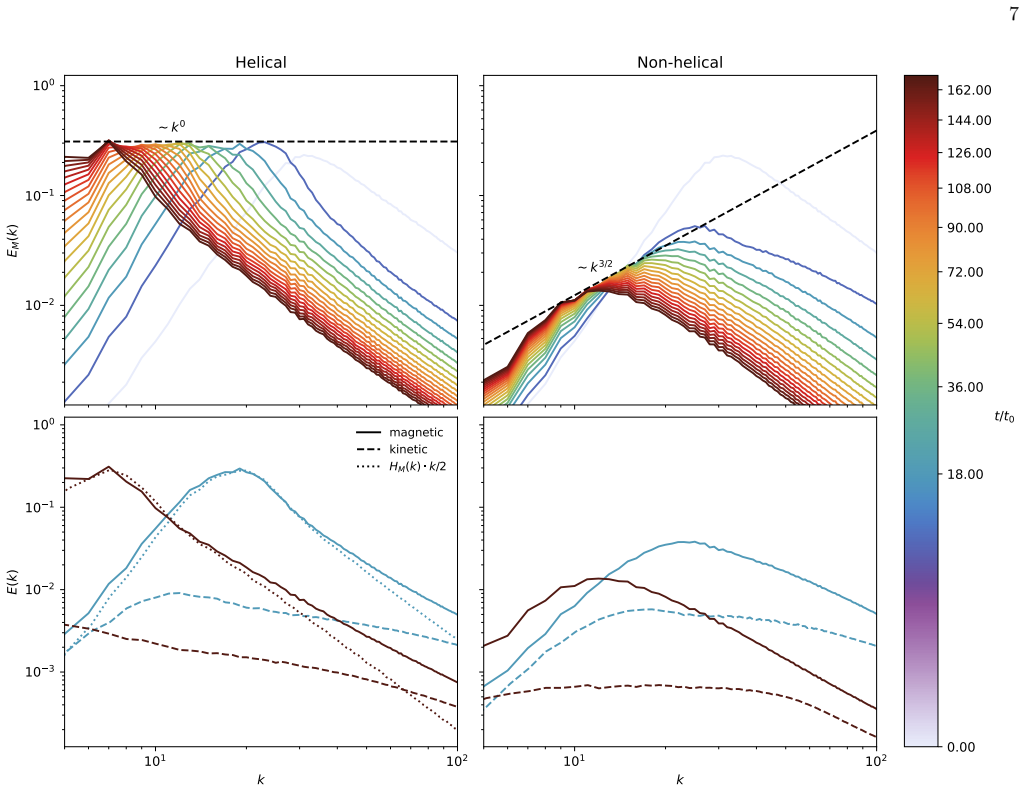
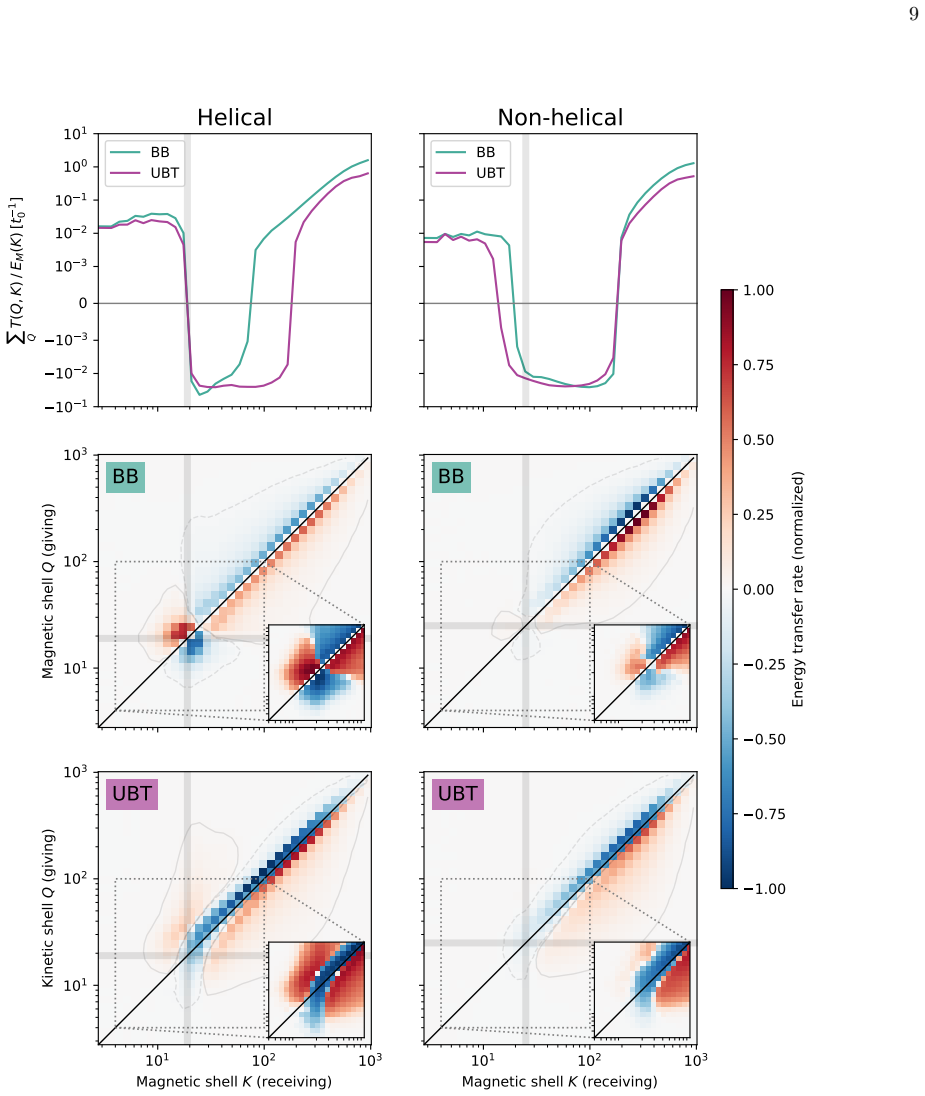
Using shell-to-shell analysis, the study finds that large magnetic scales receive energy directly from the integral scale in both magnetic and kinetic reservoirs. This leads to increasingly non-local transfer for larger receiving scales. The rate of energy increase in each receiving scale is proportional to its energy, resulting in self-similar, multiplicative growth. This holds independent of magnetic net-helicity. For vanishing net-helicity, inverse transfer occurs only within each helical sector. Contributions from kinetic-magnetic and magnetic-magnetic energy-exchange are similar in magnitude. The findings are consistent with the Hosking integral theory explaining inverse transfer as mer
What carries the argument
Shell-to-shell transfer functions that measure energy exchanges between wavenumber shells in the kinetic and magnetic fields.
If this is right
- Large magnetic scales gain energy directly rather than through a cascade of intermediate scales.
- The growth at each scale is multiplicative and self-similar.
- Kinetic-magnetic and magnetic-magnetic transfers are comparable in strength.
- Inverse transfer remains confined to same-helicity sectors when net helicity vanishes.
- The mechanism supports conservation of the Hosking integral via equal-helicity island merging.
Where Pith is reading between the lines
- This implies that simple scaling laws might describe the evolution of large-scale magnetic structures in decaying turbulence.
- The non-local nature could mean that inverse transfer persists even in systems with limited scale ranges.
- Similar analyses might reveal inverse transfers in other decaying turbulent systems beyond MHD.
- Simulations with higher resolution at large scales could test if the direct transfer persists.
Load-bearing premise
The simulations accurately capture the physical decaying MHD turbulence at large scales without numerical dissipation or artifacts dominating the transfer functions.
What would settle it
A measurement showing that energy at large magnetic scales increases at a rate not proportional to the energy present there, or that transfers to those scales come primarily from intermediate scales rather than directly from the integral scale.
Figures
read the original abstract
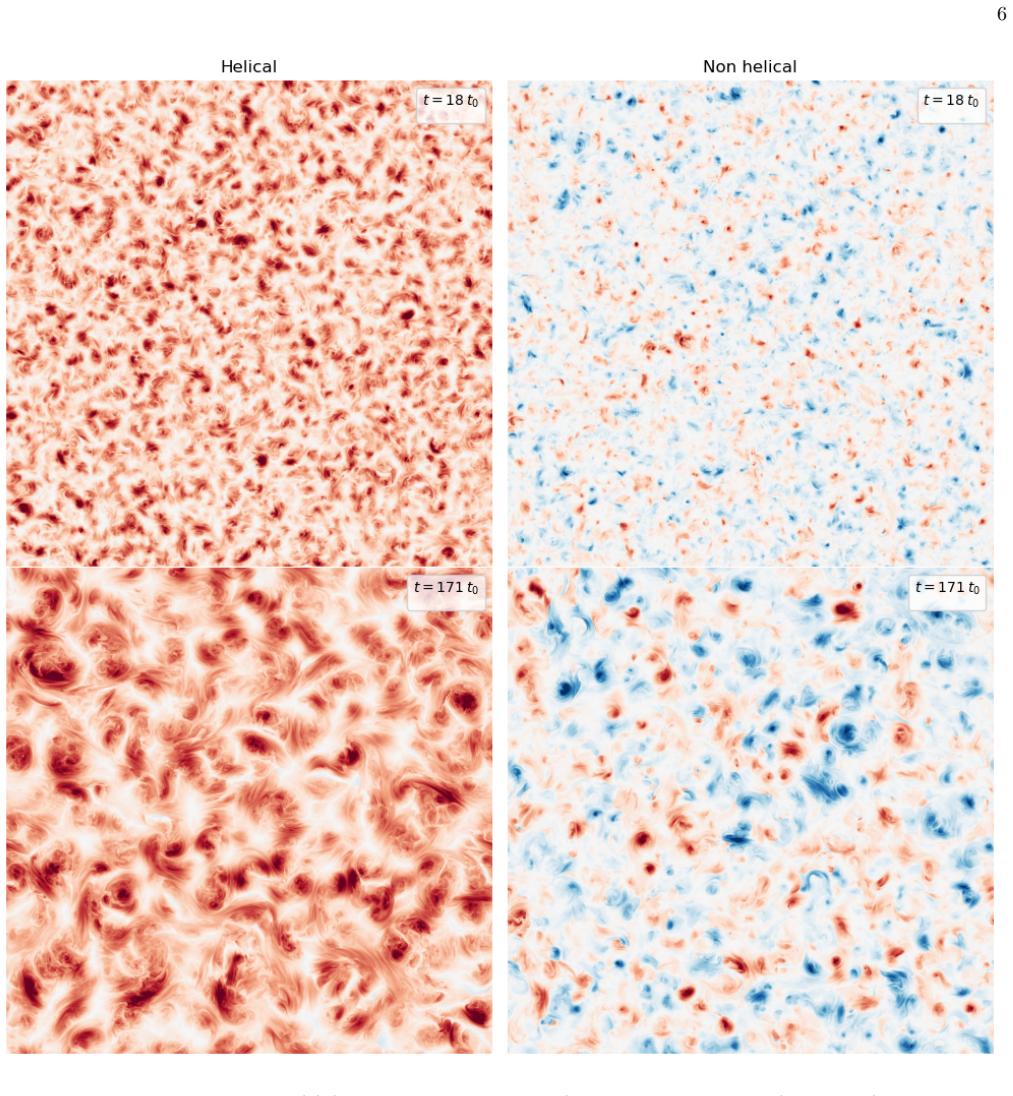
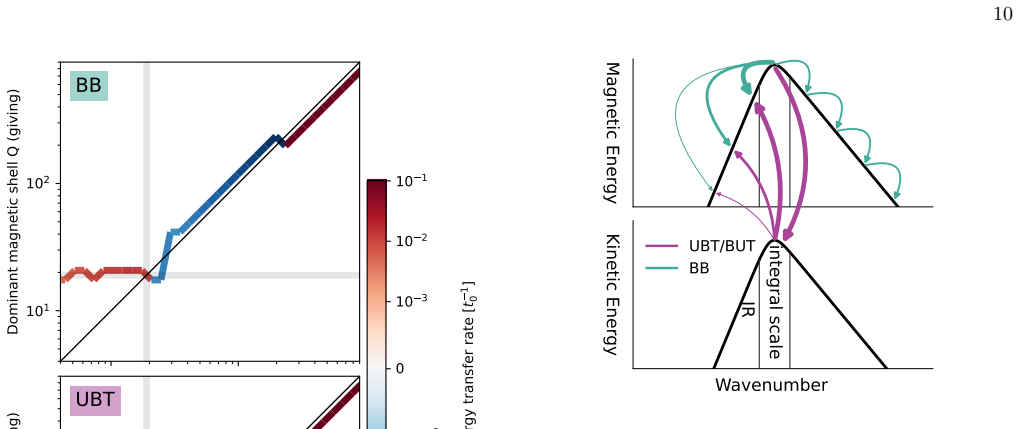
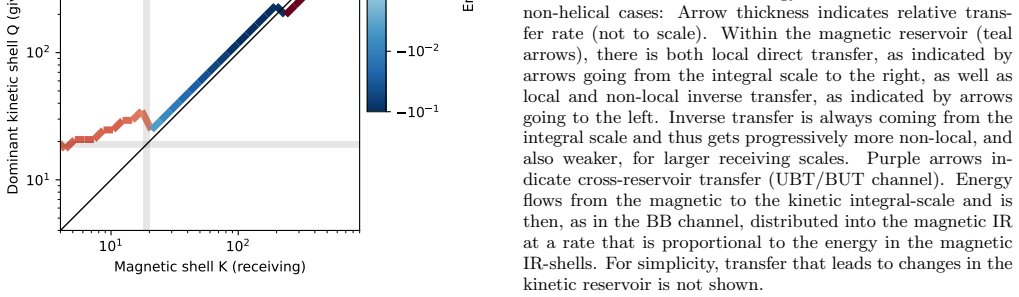
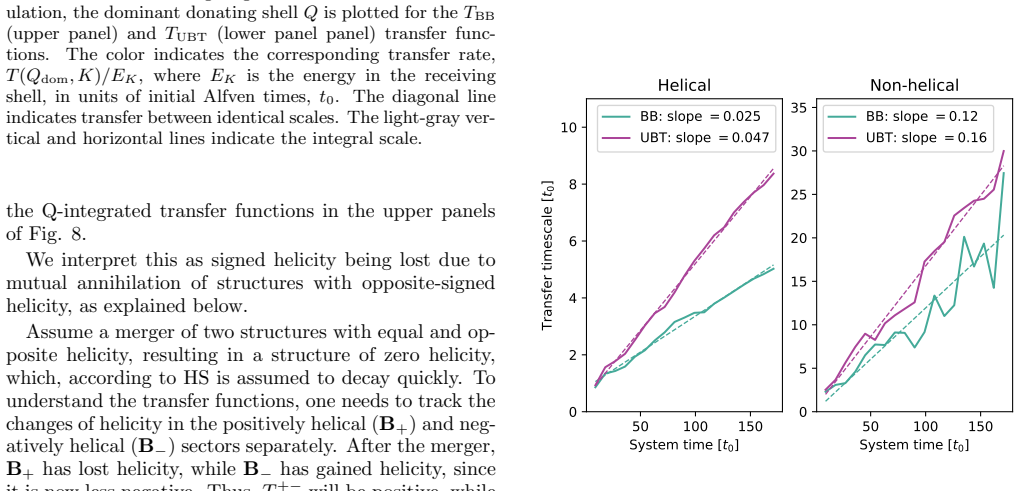
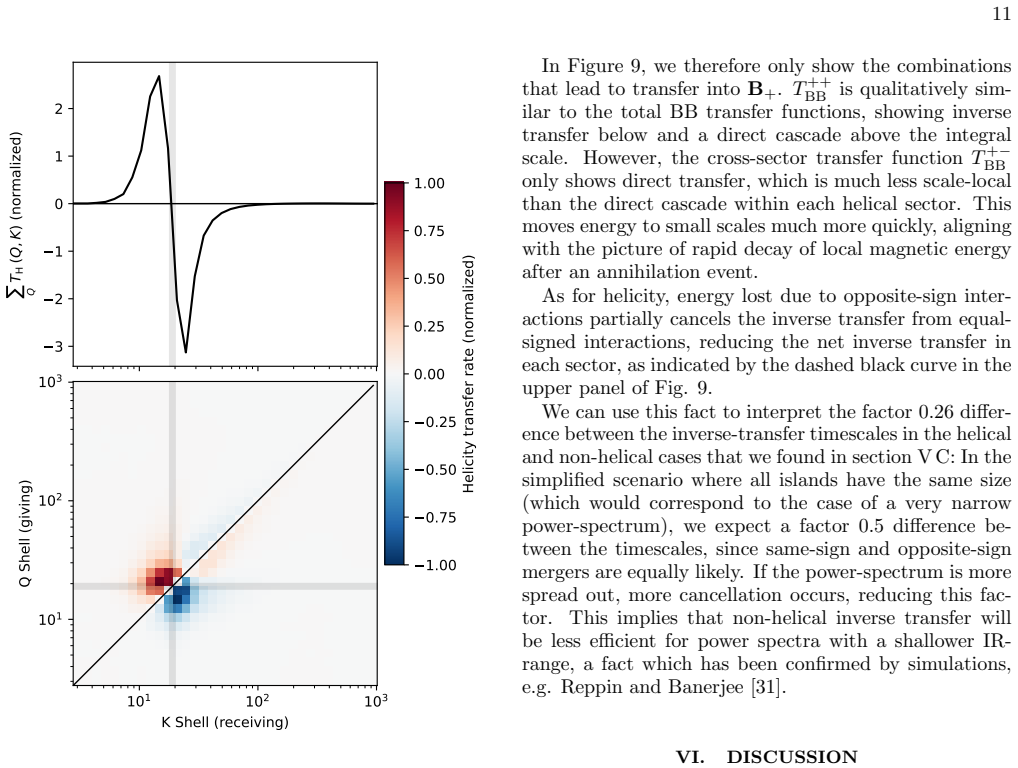
In decaying magnetohydrodynamic turbulence, energy can be transported from small to large scales, known as inverse transfer. We explore the mechanism behind this phenomenon using shell-to-shell transfer functions. Independent of magnetic net-helicity, large magnetic scales receive energy directly from the integral scale in both the magnetic and kinetic reservoirs, leading to increasingly non-local transfer for larger receiving scales. The resulting rate of energy increase in each receiving scale is proportional to its energy, resulting in self-similar, multiplicative growth. Even though the system is magnetically dominated, contributions from kinetic-magnetic and magnetic-magnetic energy-exchange are similar in magnitude. In the case of vanishing net-helicity, transfer functions between the positively and negatively helical parts of the field are computed. We find that inverse transfer only occurs within each helical sector, not across them. Our findings are consistent with the theory underlying the conservation of the Hosking integral, which explains inverse transfer as merging of local magnetic islands with equal-signed helicity.
Editorial analysis
A structured set of objections, weighed in public.
Referee Report
Summary. The paper claims that in decaying MHD turbulence, inverse energy transfer occurs through direct non-local transfers from the integral scale to large magnetic scales in both the kinetic and magnetic energy reservoirs. This leads to increasingly non-local transfer for larger receiving scales, with the rate of energy increase at each scale proportional to its energy (self-similar multiplicative growth). The process is independent of net magnetic helicity, occurs only within each helical sector (not across them), and is consistent with conservation of the Hosking integral via merging of equal-signed helicity islands. Kinetic-magnetic and magnetic-magnetic exchanges contribute similarly despite magnetic dominance.
Significance. If the simulation-based transfer functions are free of numerical artifacts, the work supplies a concrete mechanism for inverse transfer in decaying MHD turbulence, explaining the observed self-similar growth and linking it to the Hosking integral. This strengthens theoretical understanding of large-scale magnetic field generation in astrophysical contexts and provides testable predictions for the scaling of transfer rates with receiving-scale energy.
major comments (2)
- [Simulation methods and transfer-function extraction] The central claim that transfers T(k|p) from the integral-scale shell produce dE(k)/dt ∝ E(k) with no significant numerical contamination rests on the fidelity of large-scale shell-to-shell transfers. The manuscript provides no explicit details on grid resolution at low k, dealiasing procedures, or tests for finite-box effects and residual numerical dissipation, which are load-bearing for the non-local inverse-transfer conclusion (see abstract and the section presenting the transfer functions).
- [Results on energy-exchange channels] The statement that kinetic-magnetic and magnetic-magnetic contributions are similar in magnitude is presented as a key result, yet the supporting quantitative comparison (e.g., ratios or integrated values across shells) is not shown in a table or figure that would allow verification of the equality.
minor comments (2)
- [Introduction and methods] Notation for the shell-to-shell transfer functions T(k|p) should be defined explicitly at first use, including the precise definition of the shells and the sign convention for positive/negative transfer.
- [Abstract] The abstract asserts independence from net helicity; the corresponding figures or text should include a brief statement of the helicity values used in the runs to make this claim immediately verifiable.
Simulated Author's Rebuttal
We thank the referee for their constructive comments and positive assessment of the significance of our work. We address each major comment below and will revise the manuscript accordingly.
read point-by-point responses
-
Referee: [Simulation methods and transfer-function extraction] The central claim that transfers T(k|p) from the integral-scale shell produce dE(k)/dt ∝ E(k) with no significant numerical contamination rests on the fidelity of large-scale shell-to-shell transfers. The manuscript provides no explicit details on grid resolution at low k, dealiasing procedures, or tests for finite-box effects and residual numerical dissipation, which are load-bearing for the non-local inverse-transfer conclusion (see abstract and the section presenting the transfer functions).
Authors: We agree that additional explicit details on the numerical setup are required to substantiate the claims about the absence of numerical artifacts in the large-scale transfers. In the revised manuscript we will add a new subsection (or expanded paragraph in the methods) that specifies the grid resolution at low wavenumbers, the dealiasing procedure used, and the tests performed for finite-box effects and residual numerical dissipation. These additions will include quantitative diagnostics confirming that the reported non-local inverse transfers are not contaminated by numerics. revision: yes
-
Referee: [Results on energy-exchange channels] The statement that kinetic-magnetic and magnetic-magnetic contributions are similar in magnitude is presented as a key result, yet the supporting quantitative comparison (e.g., ratios or integrated values across shells) is not shown in a table or figure that would allow verification of the equality.
Authors: We acknowledge that while the abstract and main text state the similarity of the kinetic-magnetic and magnetic-magnetic contributions, we did not provide explicit quantitative comparisons (ratios or integrated values). In the revised version we will add a figure or table that directly displays these ratios or integrated transfer values across the relevant shells, allowing straightforward verification of the claimed similarity. revision: yes
Circularity Check
No circularity: claims rest on direct computation of transfer functions from decaying MHD simulations
full rationale
The paper's central results (non-local inverse transfer from integral scale, dE(k)/dt ∝ E(k) leading to multiplicative growth, equal kinetic-magnetic and magnetic-magnetic channels) are obtained by post-processing shell-to-shell transfer functions T(k|p) extracted from the time evolution of the simulated fields. No parameters are fitted to data and then relabeled as predictions; no self-citation chain supplies a uniqueness theorem or ansatz that forces the reported scalings; the Hosking-integral consistency is presented as an external check rather than an input. The derivation chain is therefore self-contained against the simulation data and does not reduce to its own inputs by construction.
Axiom & Free-Parameter Ledger
axioms (2)
- standard math The MHD equations govern the evolution of the system.
- domain assumption Shell-to-shell transfer functions accurately measure energy exchanges between scales.
Reference graph
Works this paper leans on
-
[1]
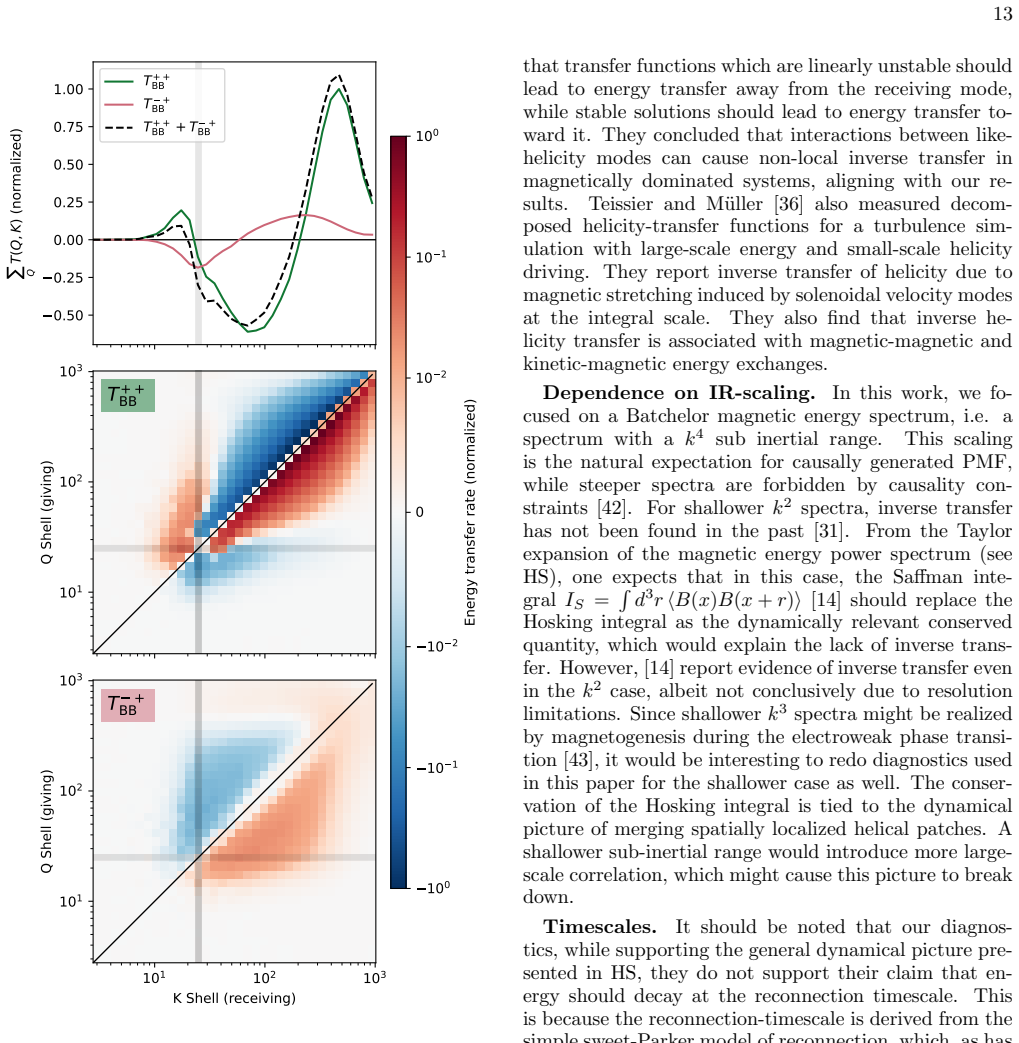
Important parameters are summarized in table II. IV. SHELL-TO-SHELL TRANSFER FORMALISM To calculate the transfers, we use an open source en- ergy transfer analysis framework [32]. In the incompress- ible limit, i.e., with homogeneous pressure and density ρ= 1, the shell-to-shell energy transfer functions are [18–20], TBB(Q, K) =− Z BK(U· ∇)B Q dV TUU(Q, K...
2048
-
[2]
Quantum Uni- verse
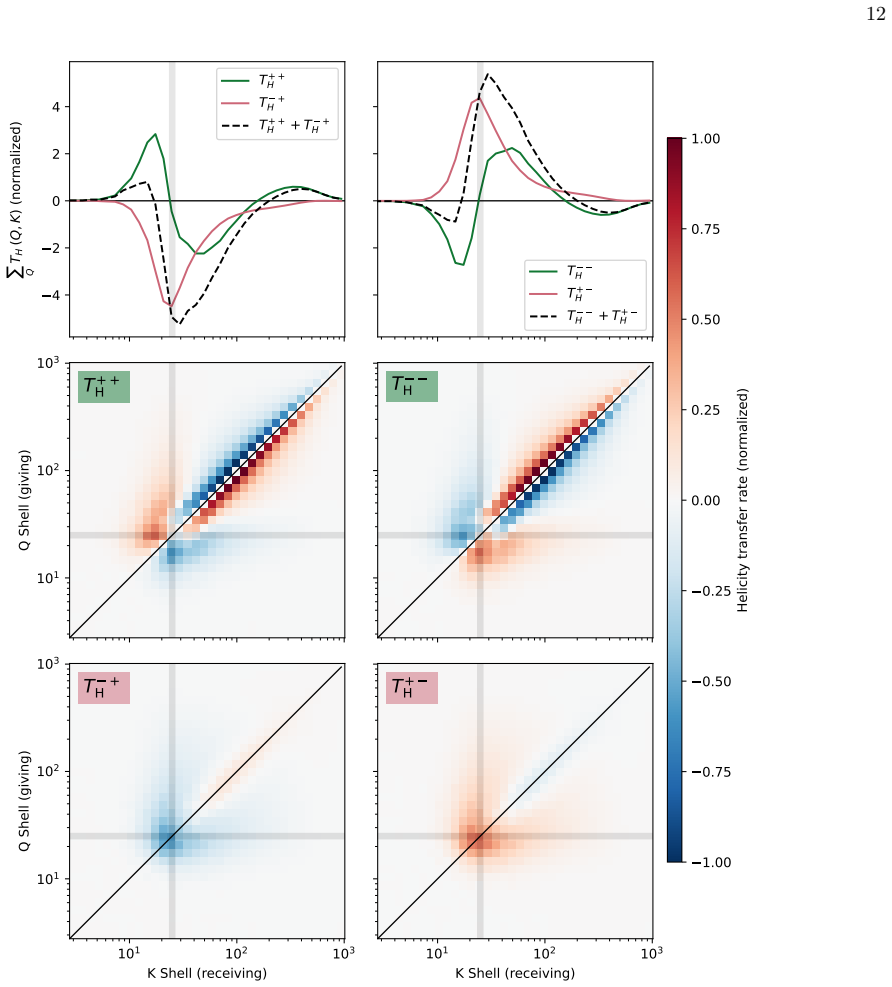
does not constrain the direct transfer in each sector. We furthermore findT −− H =−T ++ H , since in the case of vanishing total helicity, negatively and positively helical structures should be equally abundant, as can also be seen in figure 1, and their dynamics will be the same. Mergers of negatively helical structures lead to inverse transfer of negati...
2026
- [3]
-
[4]
Banerjee and K
R. Banerjee and K. Jedamzik, Phys. Rev. D70, 123003 (2004)
2004
-
[5]
Cosmological Magnetic Fields: Their Generation, Evolution and Observation
R. Durrer and A. Neronov, Astron. Astrophys. Rev.21, 62 (2013), arXiv:1303.7121 [astro-ph.CO]
work page internal anchor Pith review Pith/arXiv arXiv 2013
-
[6]
Subramanian, Reports on Progress in Physics79, 076901 (2016)
K. Subramanian, Reports on Progress in Physics79, 076901 (2016)
2016
-
[7]
C. H. K. Chen, A. Mallet, T. A. Yousef, A. A. Schekochihin, and T. S. Horbury, Monthly No- tices of the Royal Astronomical Society415, 3219 (2011), https://academic.oup.com/mnras/article- pdf/415/4/3219/4895690/mnras0415-3219.pdf
2011
-
[8]
Kolmogorov, Akademiia Nauk SSSR Doklady30, 301 (1941)
A. Kolmogorov, Akademiia Nauk SSSR Doklady30, 301 (1941)
1941
-
[9]
L. Woltjer, Proceedings of the National Academy of Sciences44, 489 (1958), https://www.pnas.org/doi/pdf/10.1073/pnas.44.6.489
-
[10]
Kahniashvili, A
T. Kahniashvili, A. Brandenburg, A. G. Tevzadze, and B. Ratra, Phys. Rev. D81, 123002 (2010)
2010
-
[11]
Pouquet, U
A. Pouquet, U. Frisch, and J. L´ eorat, Journal of Fluid Mechanics77, 321–354 (1976)
1976
-
[12]
Christensson, M
M. Christensson, M. Hindmarsh, and A. Brandenburg, Phys. Rev. E64, 056405 (2001)
2001
-
[13]
M¨ uller, S
W.-C. M¨ uller, S. K. Malapaka, and A. Busse, Phys. Rev. E85, 015302 (2012)
2012
-
[14]
Brandenburg, T
A. Brandenburg, T. Kahniashvili, and A. G. Tevzadze, Phys. Rev. Lett.114, 075001 (2015)
2015
-
[15]
D. N. Hosking and A. A. Schekochihin, Phys. Rev. X11, 041005 (2021)
2021
-
[16]
A. Brandenburg, R. Sharma, and T. Vachaspati, Journal of Plasma Physics89, 905890606 (2023), arXiv:2307.04602 [physics.plasm-ph]
-
[17]
For spectra with a shallower subinertial range, the dy- namics may instead be controlled by other conserved quantities, such as the Saffman integral in thek 2 case [14]
-
[18]
Waleffe, Physics of Fluids A: Fluid Dynamics4, 350 (1992)
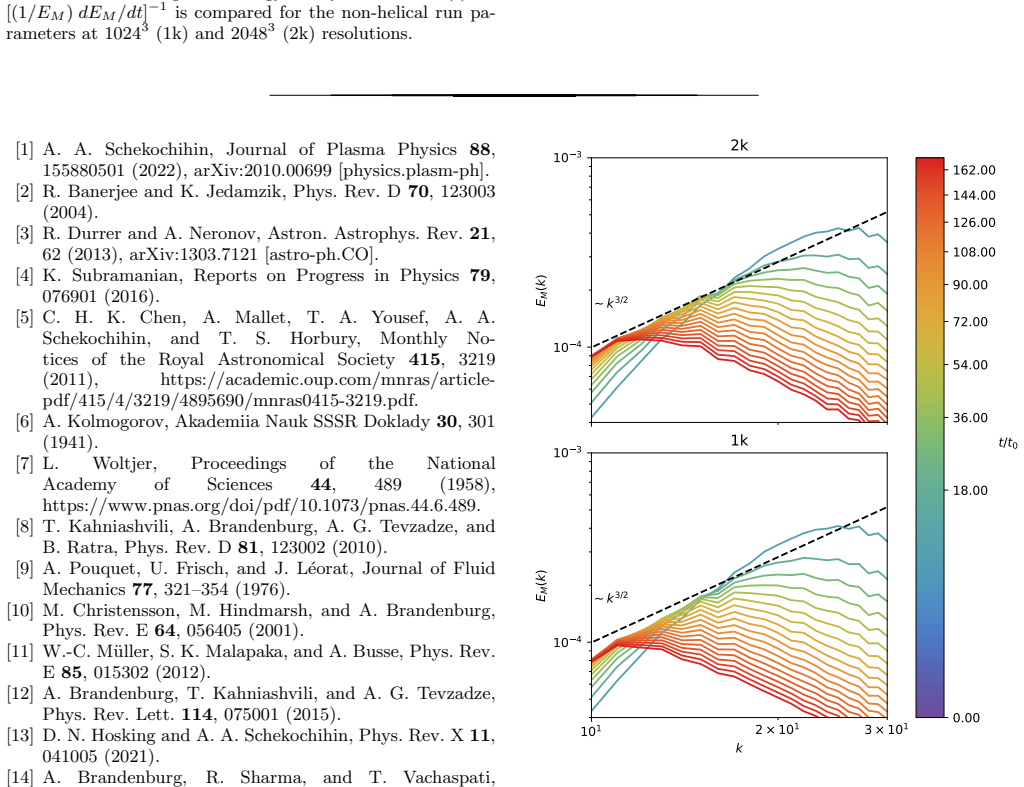
F. Waleffe, Physics of Fluids A: Fluid Dynamics4, 350 (1992). 10 4 10 3 EM(k) k3/2 2k 101 2 × 101 3 × 101 k 10 4 10 3 EM(k) k3/2 1k 0.00 18.00 36.00 54.00 72.00 90.00 108.00 126.00 144.00 162.00 t/t0 FIG. 11. The magnetic energy power spectrum evolution is compared for the non-helical run parameters at 2048 3 (2k) and 10243 (1k) resolutions
1992
-
[19]
Linkmann, A
M. Linkmann, A. Berera, M. McKay, and J. J¨ ager, Jour- nal of Fluid Mechanics791, 61–96 (2016)
2016
-
[20]
Alexakis, P
A. Alexakis, P. D. Mininni, and A. Pouquet, Phys. Rev. E72, 046301 (2005). 16
2005
-
[21]
G. Dar, M. K. Verma, and V. Eswaran, Physica D: Non- linear Phenomena157, 207 (2001)
2001
-
[22]
On the locality of MHD turbulence scale fluxes
B. Teaca, D. Carati, and J. Andrzej Domaradzki, Physics of Plasmas18, 112307 (2011), arXiv:1108.3937 [physics.flu-dyn]
work page internal anchor Pith review Pith/arXiv arXiv 2011
-
[23]
Grete, B
P. Grete, B. W. O’Shea, K. Beckwith, W. Schmidt, and A. Christlieb, Physics of Plasmas24, 092311 (2017)
2017
-
[24]
J. K. J. Hew, D. N. Hosking, C. Federrath, J. R. Beattie, and N. Kriel, Journal of Plasma Physics92, 10.1017/s0022377826101275 (2026)
-
[25]
Subramanian and A
K. Subramanian and A. Brandenburg, The Astrophysical Journal648, L71 (2006). [24]AthenaPKis available and maintained at https://github.com/parthenon-hpc-lab/athenapk and commit ca99dd4 was used for the simulations
2006
-
[26]
Grete, J
P. Grete, J. C. Dolence, J. M. Miller, J. Brown, B. Ryan, A. Gaspar, F. Glines, S. Swaminarayan, J. Lippuner, C. J. Solomon, G. Shipman, C. Junghans, D. Holladay, J. M. Stone, and L. F. Roberts, The International Jour- nal of High Performance Computing Applications37, 465 (2023)
2023
-
[27]
Miyoshi and K
T. Miyoshi and K. Kusano, Journal of Computational Physics208, 315 (2005)
2005
-
[28]
Dedner, F
A. Dedner, F. Kemm, D. Kr¨ oner, C.-D. Munz, T. Schnitzer, and M. Wesenberg, Journal of Computa- tional Physics175, 645 (2002)
2002
-
[29]
Grete, B
P. Grete, B. W. O’Shea, and K. Beckwith, The Astro- physical Journal Letters942, L34 (2023)
2023
-
[30]
Ayala, S
A. Ayala, S. Tomov, A. Haidar, and J. Dongarra, in Computational Science – ICCS 2020, edited by V. V. Krzhizhanovskaya, G. Z´ avodszky, M. H. Lees, J. J. Don- garra, P. M. A. Sloot, S. Brissos, and J. Teixeira (Springer International Publishing, Cham, 2020) pp. 262–275
2020
-
[31]
Brandenburg, A., Neronov, A., and Vazza, F., A&A687, A186 (2024)
2024
-
[32]
Reppin and R
J. Reppin and R. Banerjee, Physical review. E96 5-1, 053105 (2017)
2017
-
[33]
It is available athttps://github.com/ pgrete/energy-transfer-analysisand makes use of thempi4py-fftlibrary [53]
The framework implements the formalism described in Greteet al.[21]. It is available athttps://github.com/ pgrete/energy-transfer-analysisand makes use of thempi4py-fftlibrary [53]
-
[34]
Aluie and G
H. Aluie and G. L. Eyink, Physics of Fluids21, 115108 (2009)
2009
-
[35]
Alexakis, P
A. Alexakis, P. D. Mininni, and A. Pouquet, The Astro- physical Journal640, 335 (2006)
2006
-
[36]
Plunian, R
F. Plunian, R. Stepanov, and M. K. Verma, Journal of Plasma Physics85, 905850507 (2019)
2019
-
[37]
Teissier and W.-C
J.-M. Teissier and W.-C. M¨ uller, Journal of Fluid Me- chanics921, A7 (2021)
2021
-
[38]
A. Brandenburg and G. Larsson, Atmosphere14, 10.3390/atmos14060932 (2023)
-
[39]
Non-zero val- ues across the diagonal are thus due to numerical errors, which are primarily caused by taking the gradients in equation 23 in real space on a discrete mesh
SinceT BB(Q, K) is asymmetric inQandK, the values at the diagonal are expected to be zero. Non-zero val- ues across the diagonal are thus due to numerical errors, which are primarily caused by taking the gradients in equation 23 in real space on a discrete mesh. They there- fore only meaningfully affect the high-kmodes
-
[40]
Grete, B
P. Grete, B. W. O’Shea, and K. Beckwith, The Astro- physical Journal909, 148 (2021)
2021
-
[41]
2, explaining why a very small amount of direct helicity-transfer is still possible
Note that even for the initially fully helical setup, helicity is no longer fully saturated at largekat later times, as can be seen in Fig. 2, explaining why a very small amount of direct helicity-transfer is still possible
-
[42]
P. Bhat, M. Zhou, and N. F. Loureiro, Monthly Notices of the Royal Astronomical Society501, 3074 (2020), https://academic.oup.com/mnras/article- pdf/501/2/3074/35573300/staa3849.pdf
2020
-
[43]
Durrer and C
R. Durrer and C. Caprini, Journal of Cosmology and As- troparticle Physics2003(11), 010
-
[44]
Vachaspati, Reports on Progress in Physics84, 074901 (2021)
T. Vachaspati, Reports on Progress in Physics84, 074901 (2021)
2021
-
[45]
Armua, A
A. Armua, A. Berera, and J. Calder´ on-Figueroa, Phys. Rev. E107, 055206 (2023)
2023
- [46]
- [47]
-
[48]
J. M. Wagstaff and R. Banerjee, Phys. Rev. D92, 123004 (2015), arXiv:1508.01683 [astro-ph.CO]
work page internal anchor Pith review Pith/arXiv arXiv 2015
-
[49]
C. R. Trott, D. Lebrun-Grandi´ e, D. Arndt, J. Ciesko, V. Dang, N. Ellingwood, R. Gayatri, E. Harvey, D. S. Hollman, D. Ibanez, N. Liber, J. Madsen, J. Miles, D. Po- liakoff, A. Powell, S. Rajamanickam, M. Simberg, D. Sun- derland, B. Turcksin, and J. Wilke, IEEE Transactions on Parallel and Distributed Systems33, 805 (2022)
2022
-
[50]
M. J. Turk, B. D. Smith, J. S. Oishi, S. Skory, S. W. Skill- man, T. Abel, and M. L. Norman, ApJS192, 9 (2011), arXiv:1011.3514 [astro-ph.IM]
work page internal anchor Pith review Pith/arXiv arXiv 2011
-
[51]
C. R. Harris, K. J. Millman, S. J. van der Walt, R. Gom- mers, P. Virtanen, D. Cournapeau, E. Wieser, J. Tay- lor, S. Berg, N. J. Smith, R. Kern, M. Picus, S. Hoyer, M. H. van Kerkwijk, M. Brett, A. Haldane, J. F. del R´ ıo, M. Wiebe, P. Peterson, P. G´ erard-Marchant, K. Shep- pard, T. Reddy, W. Weckesser, H. Abbasi, C. Gohlke, and T. E. Oliphant, Nature...
2020
-
[52]
Virtanen, R
P. Virtanen, R. Gommers, T. E. Oliphant, M. Haber- land, T. Reddy, D. Cournapeau, E. Burovski, P. Pe- terson, W. Weckesser, J. Bright, S. J. van der Walt, M. Brett, J. Wilson, K. J. Millman, N. Mayorov, A. R. J. Nelson, E. Jones, R. Kern, E. Larson, C. J. Carey, ˙I. Po- lat, Y. Feng, E. W. Moore, J. VanderPlas, D. Laxalde, J. Perktold, R. Cimrman, I. Henr...
2020
-
[53]
J. D. Hunter, Computing in Science & Engineering9, 90 (2007)
2007
-
[54]
Dalcin, M
L. Dalcin, M. Mortensen, and D. E. Keyes, Journal of Parallel and Distributed Computing128, 137 (2019)
2019
discussion (0)
Sign in with ORCID, Apple, or X to comment. Anyone can read and Pith papers without signing in.