Late-Time Cosmology and Structure Formation in Quadratic f(Q) Gravity
Pith reviewed 2026-06-28 12:01 UTC · model grok-4.3
The pith
Quadratic f(Q) gravity weakens effective gravity at late times through a time-dependent G_eff, suppressing structure growth and lowering the predicted S8.
A machine-rendered reading of the paper's core claim, the machinery that carries it, and where it could break.
Core claim
The quadratic correction in f(Q) generates a time-dependent weakening of gravity that suppresses both linear growth and nonlinear halo abundance, thereby reducing the predicted value of S8 while the background expansion remains compatible with current distance data.
What carries the argument
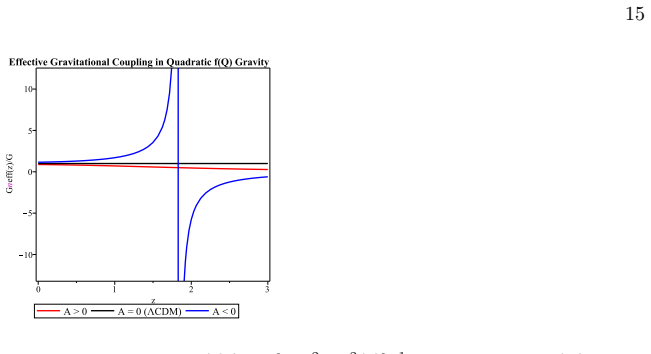
The effective gravitational coupling G_eff(z) obtained by linearizing the quadratic f(Q) field equations around a Friedmann background and inserted into the Poisson equation.
If this is right
- The background Hubble rate admits an exact algebraic expression that can be fitted directly to distance indicators.
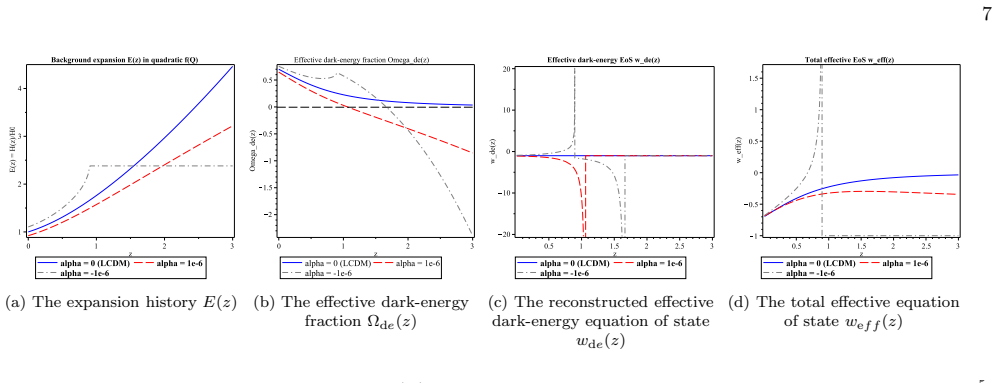
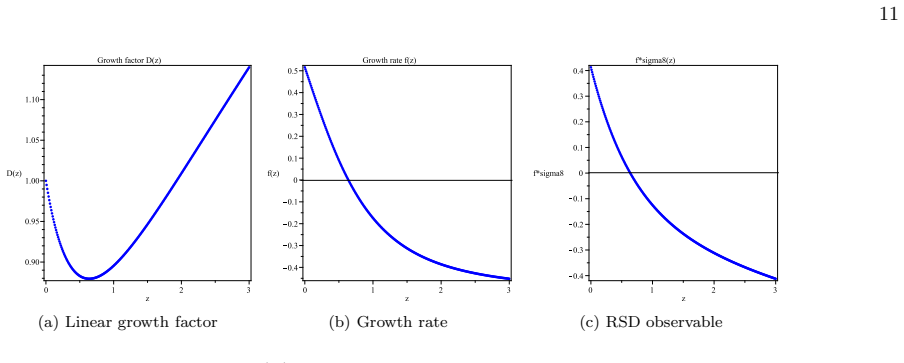
- Positive α produces a monotonic suppression of the linear growth factor and of fσ8(z) relative to ΛCDM.
- The increased spherical-collapse threshold reduces the halo mass function at fixed mass, lowering the integrated S8.
- The same parameter α that fits background data simultaneously drives the S8 reduction without additional dark-energy fields.
Where Pith is reading between the lines
- If future weak-lensing surveys confirm a lower S8, the model supplies a concrete modified-gravity mechanism that does not require a separate dynamical dark-energy component.
- The absence of an explicit screening mechanism suggests the predicted suppression may be testable in galaxy clusters or voids where the effective G_eff remains unscreened.
- The algebraic H(z) solution could be used to forecast constraints from next-generation BAO or supernova surveys on the single parameter α.
Load-bearing premise
The linear modification to the Poisson equation and the spherical-collapse threshold remain valid descriptions of structure formation even when screening, higher-order perturbations, or baryonic effects are present.
What would settle it
A measurement of fσ8(z) at redshift 0.4–0.6 that lies above the ΛCDM prediction by more than the amount suppressed by the model for the α values allowed by background data would rule out the claimed alleviation of the S8 tension.
Figures
read the original abstract
We investigate the cosmological evolution associated with the quadratic symmetric teleparallel gravity framework, \( f(Q)=Q+\alpha Q^{2}+\beta \) where the relation \(Q\propto H^{2}\) generates an additional \(H^{4}\) contribution to the Friedmann equation. Using the exact algebraic solution for $H(z)$, we reconstruct the effective dark-energy sector and compare the background evolution with $\Lambda$CDM using Type Ia supernovae, BAO, and cosmic-chronometer data. At the perturbative level, the model modifies the Poisson equation through a time-dependent effective gravitational coupling $G_{\textrm eff}(z)=G\big[1+\tfrac{2}{3}A E^{2}(z)\big]^{-1}$, where $A=18\alpha H_{0}^{2}$. For $\alpha>0$ this produces a weakened gravitational interaction, suppressing the linear growth factor $D(z)$, the growth rate $f(z)$, and the RSD observable $f\sigma_{8}(z)$. In the nonlinear regime, the reduced gravitational strength increases the spherical-collapse threshold and suppresses the halo mass function, leading to a lower predicted value of $S_{8}=\sigma_{8}\sqrt{\Omega_{m}/0.3}$. Thus, the quadratic $f(Q)$ extension can reproduce mild deviations from $\Lambda$CDM at the background level while naturally alleviating the $S_{8}$ tension, offering a viable modified-gravity explanation for recent observational hints of dynamical dark energy.
Editorial analysis
A structured set of objections, weighed in public.
Referee Report
Summary. The manuscript investigates quadratic f(Q) gravity with f(Q)=Q+αQ²+β, deriving an exact algebraic solution for H(z) that permits fitting background evolution to SNIa, BAO and cosmic-chronometer data with mild deviations from ΛCDM. It introduces a time-dependent effective gravitational coupling G_eff(z)=G[1+(2/3)A E²(z)]^{-1} (A=18α H0²) that weakens gravity for α>0, suppressing the linear growth factor D(z), fσ8(z) and, via an increased spherical-collapse threshold, the halo mass function, thereby lowering the predicted S8 and offering a modified-gravity resolution of the S8 tension.
Significance. If the G_eff derivation and the validity of the linear and spherical-collapse approximations hold without screening or higher-order effects, the exact H(z) solution and the linked background-plus-perturbation phenomenology would constitute a concrete, falsifiable modified-gravity explanation for both dynamical-dark-energy hints and the S8 discrepancy.
major comments (3)
- [Abstract / perturbative analysis] The G_eff(z) expression is stated in the abstract and perturbative discussion but no derivation from the quadratic term in the action or the resulting field equations is supplied; this is load-bearing for the claimed suppression of D(z), fσ8 and S8.
- [Nonlinear regime / structure formation] The assumption that the linear Poisson modification via G_eff remains accurate into the nonlinear regime, that the spherical-collapse threshold is simply rescaled, and that no screening, vector modes or extra degrees of freedom appear is not justified or tested; this directly underpins the predicted reduction in halo abundance and S8.
- [Background fit and parameter A] A is proportional to the same α that is adjusted to fit the background data, so the suppression of S8 is a direct consequence of that fit rather than an independent prediction; this weakens the claim that the model 'naturally alleviates' the tension.
minor comments (2)
- [Notation] The definition of the dimensionless Hubble parameter E(z) should be stated explicitly on first use.
- [References] Additional references to existing f(Q) literature and to other modified-gravity resolutions of the S8 tension would improve context.
Simulated Author's Rebuttal
We thank the referee for the careful and constructive review of our manuscript on quadratic f(Q) gravity. We address each major comment below, indicating where revisions will be made to improve clarity and rigor.
read point-by-point responses
-
Referee: [Abstract / perturbative analysis] The G_eff(z) expression is stated in the abstract and perturbative discussion but no derivation from the quadratic term in the action or the resulting field equations is supplied; this is load-bearing for the claimed suppression of D(z), fσ8 and S8.
Authors: We agree that an explicit step-by-step derivation of G_eff from the quadratic term in the action and the perturbed field equations is necessary for transparency. In the revised manuscript we will insert a dedicated subsection in the perturbative analysis that starts from the modified Einstein equations for f(Q) = Q + αQ² + β, linearizes the metric perturbations, and arrives at the time-dependent effective coupling G_eff(z) = G[1 + (2/3)A E²(z)]^{-1}. This addition will directly support the subsequent claims about suppressed growth. revision: yes
-
Referee: [Nonlinear regime / structure formation] The assumption that the linear Poisson modification via G_eff remains accurate into the nonlinear regime, that the spherical-collapse threshold is simply rescaled, and that no screening, vector modes or extra degrees of freedom appear is not justified or tested; this directly underpins the predicted reduction in halo abundance and S8.
Authors: We recognize that extending the linear G_eff modification into the nonlinear regime without explicit checks for screening, vector modes, or extra degrees of freedom constitutes an approximation whose validity range is not fully quantified in the present work. We will add a paragraph in the structure-formation section that states these assumptions explicitly, references analogous treatments in other modified-gravity models, and notes that N-body simulations would be required for definitive validation. The claims on halo abundance will be qualified accordingly. revision: partial
-
Referee: [Background fit and parameter A] A is proportional to the same α that is adjusted to fit the background data, so the suppression of S8 is a direct consequence of that fit rather than an independent prediction; this weakens the claim that the model 'naturally alleviates' the tension.
Authors: We disagree that the S8 suppression is merely a tautological consequence of the background fit. The single parameter α simultaneously sources the H⁴ term in the Friedmann equation (constrained by SNIa+BAO+CC data) and determines the functional form of G_eff(z) through the perturbed field equations; once α is fixed by background observations, the growth suppression follows deterministically from the model dynamics without additional free parameters. We will expand the discussion section to emphasize this direct linkage and thereby clarify why the alleviation can still be regarded as natural within the model. revision: no
Circularity Check
No significant circularity; derivation self-contained
full rationale
The paper derives an algebraic H(z) from the quadratic f(Q) action, fits α (via A=18α H0²) to background data (SN+BAO+CC), then uses the identical α to compute G_eff(z) and the resulting suppression of D(z), fσ8(z) and halo abundance. This is a standard single-parameter model prediction linking background and perturbations; the S8 outcome is not forced by construction or by renaming a fit. No self-citations, no self-definitional steps, and no fitted-input-called-prediction pattern appear in the provided derivation chain. The analysis remains independent of the target S8 observable.
Axiom & Free-Parameter Ledger
free parameters (2)
- α
- β
axioms (1)
- domain assumption Q is proportional to H² in a flat FLRW background
Reference graph
Works this paper leans on
-
[1]
( 4) with respect to the metric gµν , keeping the connection fixed
Metric variation We first vary the action given by Eq. ( 4) with respect to the metric gµν , keeping the connection fixed. The variation of the action is δS = 1 16πG ∫ d4x [ δ(√ − g) (f (Q) + Lm) + √ − g fQ δQ + √ − g δLm ] . (9) Using the fact δ(√ − g) = − 1 2 √ − g gµν δgµν and defining the matter energy–momentum tensor in the usual way , i.e., Tµν ≡ − 2√ ...
-
[2]
Furthermore, modifications in the background expansion influence the suppressio n or enhancement of structure growth, which is closely related to the S8 tension
5 ≲ z ≲ 2 affect the reconstruction of the sound horizon and the calibratio n of the BAO scale, potentially shifting the inferred value of H0 and thereby offering a possible mechanism to alleviate the Hubble tens ion. Furthermore, modifications in the background expansion influence the suppressio n or enhancement of structure growth, which is closely related ...
-
[3]
( 28) for H(z)
Replace the background Friedmann equation with the algebraic so lution of Eq. ( 28) for H(z)
-
[4]
Modify the Poisson equation in perturbations.c by replacing G with Gef f(a) = G/F (Q)
-
[5]
Set Ψ = Φ at linear order, reflecting the absence of anisotropic st ress
-
[6]
Evolve the matter perturbations using the modified source term in Eq. ( 39)
-
[7]
Compute the predictions for f (z), σ8(z), and f σ8(z) for comparison with RSD data. G. Summary The inclusion of linear perturbations shows that quadratic f (Q) gravity predicts scale-independent but time-varying modifications to the effective gravitational coupling, leading to distin ctive signatures in the linear growth of structure. For α > 0, the model n...
-
[8]
( 48) quantifies the rate at which the Hubble parameter evolves relative to its magnitude
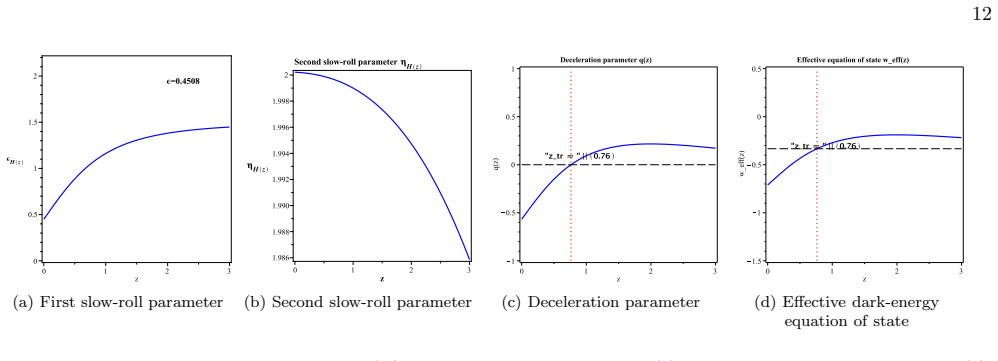
Slow-Roll Parameter ǫH (z) The first flow parameter ǫH(z) given by Eq. ( 48) quantifies the rate at which the Hubble parameter evolves relative to its magnitude. At intermediate redshifts, 0 . 5 ≲ z ≲ 2, the parameter increases mildly due to the growing influence of the quadratic correction, which scales as H 4. At higher redshifts the parameter gradually dec...
-
[9]
( 49) measures how rapidly ǫH (z) evolves
Second Slow-Roll Parameter ηH (z) The second flow parameter ηH (z) given by Eq. ( 49) measures how rapidly ǫH (z) evolves. The evolution of ηH (z) typically displays a smooth feature or “bump” at intermediate reds hifts where the quadratic term modifies the slope of H(z) most strongly. 13 Table I. Present-day values of the Hubble flow parameters for both the...
-
[10]
8, consistent with observational constraints ( ztr ∼ 0
Deceleration Parameter q(z) Using the background evolution of the quadratic f (Q) model, we obtain ztr ≈ 0. 8, consistent with observational constraints ( ztr ∼ 0. 6 0 . 9)
-
[11]
( 51) behaves effectively like a nearly de Sitter phase today
Effective Dark-Energy Equation of State wde(z) The reconstructed equation of state of the effective dark-ener gy sector given wde(z) given by Eq. ( 51) behaves effectively like a nearly de Sitter phase today. At intermediate redsh ifts, wde(z) departs mildly from − 1, reflecting the dynamical evolution of the effective dark-energy density induc ed by the αH 4 ...
-
[12]
(59) In the quadratic f (Q) model the quantity σ8 is directly modified by the growth factor: σ8(A) = σ8, 0D(z = 0; A), (60) where D(0; A) < 1 for A > 0
3 . (59) In the quadratic f (Q) model the quantity σ8 is directly modified by the growth factor: σ8(A) = σ8, 0D(z = 0; A), (60) where D(0; A) < 1 for A > 0. Thus the model predicts a suppressed amplitude of matter fluct uations. This naturally lowers the predicted S8 relative to ΛCDM, helping to alleviate the well-known discrepancy betw een weak-lensing mea...
-
[13]
the weaker effective gravitational coupling Gef f(z) slows the growth of linear perturbations
-
[14]
the suppressed nonlinear collapse reduces the abundance of ma ssive halos, lowering the lensing signal. These effects provide a new observational signature of the quadr atic f (Q) model and offer a potential mechanism for reconciling geometric probes of the expansion history with measure ments of the large-scale matter distribution. D. Summary The nonlinear...
-
[16]
A. G. Riess et al. , Astronomical Journal 116, 1009 (1998) , arXiv:astro-ph/9805201 [astro-ph]
Pith/arXiv arXiv 1998
-
[17]
S. Perlmutter et al. , Astrophysical Journal 517, 565 (1999) , arXiv:astro-ph/9812133 [astro-ph]
Pith/arXiv arXiv 1999
-
[18]
D. J. Eisenstein et al. , Astrophysical Journal 633, 560 (2005) , arXiv:astro-ph/0501171 [astro-ph]
Pith/arXiv arXiv 2005
-
[19]
DESI Collaboration, A. G. Adame, et al. , Journal of Cosmology and Astroparticle Physics (2025), jC AP 02 (2025), arXiv:2404.03002 [astro-ph.CO]
Pith/arXiv arXiv 2025
-
[20]
M. Moresco et al. , Journal of Cosmology and Astroparticle Physics 2016, 014 (2016) , arXiv:1601.01701 [astro-ph.CO]
Pith/arXiv arXiv 2016
-
[21]
A. G. Riess, S. Casertano, W. Yuan, L. M. Macri, and D. Scol nic, Astrophysical Journal 876, 85 (2019) , arXiv:1903.07603 [astro-ph.CO]
Pith/arXiv arXiv 2019
-
[22]
Verde, T
L. Verde, T. Treu, and A. G. Riess, Nature Astronomy 3, 891 (2019)
2019
-
[23]
E. Di Valentino, O. Mena, S. Pan, L. Visinelli, W. Yang, A. Melchiorri, D. F. Mota, A. G. Riess, and J. Silk, Classical and Quantum Gravity 38, 153001 (2021) , arXiv:2103.01183 [astro-ph.CO]
Pith/arXiv arXiv 2021
-
[24]
C. Heymans et al. , Astronomy & Astrophysics 646, A140 (2021) , arXiv:2007.15632 [astro-ph.CO]
arXiv 2021
-
[25]
T. M. C. Abbott et al. , Physical Review D 98, 043526 (2018) , arXiv:1708.01530 [astro-ph.CO]
Pith/arXiv arXiv 2018
-
[26]
M. Chevallier and D. Polarski, International Journal of Modern Physics D 10, 213 (2001) , arXiv:gr-qc/0009008 [gr-qc]
Pith/arXiv arXiv 2001
-
[27]
E. V. Linder, Physical Review Letters 90, 091301 (2003) , arXiv:astro-ph/0208512 [astro-ph]
Pith/arXiv arXiv 2003
-
[28]
R. R. Caldwell, R. Dave, and P. J. Steinhardt, Physical Review Letters 80, 1582 (1998) , arXiv:astro-ph/9708069 [astro-ph]
Pith/arXiv arXiv 1998
-
[29]
R. R. Caldwell, Physics Letters B 545, 23 (2002) , arXiv:astro-ph/9908168 [astro-ph]
Pith/arXiv arXiv 2002
-
[30]
G. G. L. Nashed and E. N. Saridakis, JCAP 05, 017 (2022) , arXiv:2111.06359 [gr-qc]
arXiv 2022
-
[31]
G.-B. Zhao et al. , Nature Astronomy 1, 627 (2017) , arXiv:1701.08165 [astro-ph.CO]
Pith/arXiv arXiv 2017
-
[32]
V. Poulin, T. L. Smith, T. Karwal, and M. Kamionkowski, Physical Review Letters 122, 221301 (2019) , arXiv:1811.04083 [astro-ph.CO]
Pith/arXiv arXiv 2019
-
[33]
D. M. Scolnic et al. , Astrophysical Journal 859, 101 (2018) , arXiv:1710.00845 [astro-ph.CO]
Pith/arXiv arXiv 2018
-
[34]
D. Brout et al. , Astrophysical Journal 938, 110 (2022) , arXiv:2202.04077 [astro-ph.CO]
Pith/arXiv arXiv 2022
-
[35]
J. Beltr´ an Jim´ enez, L. Heisenberg, and T. S. Koivisto , Physical Review D 98, 044048 (2018) , arXiv:1710.03116 [gr-qc]
Pith/arXiv arXiv 2018
-
[36]
J. Beltr´ an Jim´ enez, L. Heisenberg, and T. S. Koivisto , Universe 5, 173 (2019) , arXiv:1903.06830 [hep-th]
Pith/arXiv arXiv 2019
-
[37]
T. Harko, N. Myrzakulov, R. Myrzakulov, and S. Shahidi, Physical Review D 98, 084043 (2018) , arXiv:1807.06861 [gr-qc]
Pith/arXiv arXiv 2018
- [38]
-
[39]
Y. Xu, G. Li, T. Harko, and S.-D. Liang, European Physical Journal C 79, 708 (2019) , arXiv:1908.04760 [gr-qc]
arXiv 2019
-
[40]
W. El Hanafy and G. L. Nashed, Astrophys. Space Sci. 361, 197 (2016) , arXiv:1410.2467 [hep-th]
Pith/arXiv arXiv 2016
-
[41]
F. K. Anagnostopoulos, S. Basilakos, and E. N. Saridaki s, Physics Letters B 822, 136634 (2021) , arXiv:2104.15123 [gr-qc]
arXiv 2021
-
[42]
Akaike, IEEE Transactions on Automatic Control 19, 716 (1974)
H. Akaike, IEEE Transactions on Automatic Control 19, 716 (1974)
1974
-
[43]
K. P. Burnham and D. R. Anderson, Model Selection and Multimodel Inference: A Practical Info rmation-Theoretic Approach (Springer, 2002)
2002
-
[45]
A. Lewis and S. Bridle, Physical Review D 66, 103511 (2002) , arXiv:astro-ph/0205436 [astro-ph]
Pith/arXiv arXiv 2002
-
[46]
Lesgourgues, arXiv e-prints (2011), arXiv:1104.2932 [astro-ph.IM]
J. Lesgourgues, arXiv e-prints (2011), arXiv:1104.2932 [astro-ph.IM]
Pith/arXiv arXiv 2011
-
[47]
B. Audren, J. Lesgourgues, K. Benabed, and S. Prunet, Journal of Cosmology and Astroparticle Physics 2013, 001 (2013) , arXiv:1210.7183 [astro-ph.CO]
Pith/arXiv arXiv 2013
-
[48]
J. A. Gonzalez, F. S. Guzman, and O. Sarbach, Class. Quant. Grav. 26, 015010 (2009) , arXiv:0806.0608 [gr-qc]
Pith/arXiv arXiv 2009
-
[49]
G. G. L. Nashed, Chin. Phys. Lett. 29, 050402 (2012) , arXiv:1111.0003 [physics.gen-ph]
Pith/arXiv arXiv 2012
-
[50]
L. Hui, J. P. Ostriker, S. Tremaine, and E. Witten, Phys. Rev. D 95, 043541 (2017) , arXiv:1610.08297 [astro-ph.CO]
Pith/arXiv arXiv 2017
-
[51]
P. Svrcek and E. Witten, JHEP 06, 051 (2006) , arXiv:hep-th/0605206
Pith/arXiv arXiv 2006
-
[52]
L. Hui, D. Kabat, X. Li, L. Santoni, and S. S. C. Wong, JCAP 06, 038 (2019) , arXiv:1904.12803 [gr-qc]
Pith/arXiv arXiv 2019
-
[53]
G. G. L. Nashed, Astrophys. J. 950, 129 (2023) , arXiv:2306.10273 [gr-qc]
arXiv 2023
-
[54]
K. Tomonari and S. Bahamonde, Eur. Phys. J. C 84, 349 (2024) , [Erratum: Eur.Phys.J.C 84, 508 (2024)], arXiv:2308.06469 [gr-qc]
arXiv 2024
- [55]
-
[56]
J. Beltr´ an Jim´ enez and T. S. Koivisto,Int. J. Geom. Meth. Mod. Phys. 19, 2250108 (2022) , arXiv:2202.01701 [gr-qc]
arXiv 2022
- [57]
-
[58]
G. G. L. Nashed, Fortsch. Phys. 72, 2400037 (2024) , arXiv:2501.09373 [gr-qc]
arXiv 2024
-
[59]
S. W. Hawking, Nature 248, 30 (1974)
1974
-
[60]
M. Y. Khlopov, Res. Astron. Astrophys. 10, 495 (2010) , arXiv:0801.0116 [astro-ph]
Pith/arXiv arXiv 2010
- [61]
-
[62]
D. Yoshida and J. Soda, PTEP 2018, 041E01 (2018) , arXiv:1710.09198 [hep-th]
Pith/arXiv arXiv 2018
-
[63]
B. Carr and F. Kuhnel, SciPost Phys. Lect. Notes 48, 1 (2022) , arXiv:2110.02821 [astro-ph.CO]
arXiv 2022
-
[64]
T. Jacobson, Phys. Rev. Lett. 83, 2699 (1999) , arXiv:astro-ph/9905303
Pith/arXiv arXiv 1999
-
[65]
M. S. Turner, Phys. Rev. D 28, 1243 (1983)
1983
-
[66]
G. G. L. Nashed, S. D. Odintsov, and V. K. Oikonomou, Eur. Phys. J. C 81, 528 (2021) , arXiv:2106.13607 [gr-qc]
arXiv 2021
-
[67]
L. Amendola and R. Barbieri, Phys. Lett. B 642, 192 (2006) , arXiv:hep-ph/0509257
Pith/arXiv arXiv 2006
-
[68]
W. Hu, R. Barkana, and A. Gruzinov, Phys. Rev. Lett. 85, 1158 (2000) , arXiv:astro-ph/0003365. 18
Pith/arXiv arXiv 2000
-
[69]
A. Arvanitaki, S. Dimopoulos, S. Dubovsky, N. Kaloper, and J. March-Russell, Phys. Rev. D 81, 123530 (2010) , arXiv:0905.4720 [hep-th]
Pith/arXiv arXiv 2010
-
[70]
Dine and W
M. Dine and W. Fischler, Phys. Lett. B 120, 137 (1983)
1983
-
[71]
Preskill, M
J. Preskill, M. B. Wise, and F. Wilczek, Phys. Lett. B 120, 127 (1983)
1983
-
[72]
L. F. Abbott and P. Sikivie, Phys. Lett. B 120, 133 (1983)
1983
-
[73]
A. R. Zhitnitsky, Sov. J. Nucl. Phys. 31, 260 (1980)
1980
-
[74]
G. G. L. Nashed, Eur. Phys. J. C 83, 698 (2023) , arXiv:2308.08565 [gr-qc]
arXiv 2023
-
[75]
M. Dine, W. Fischler, and M. Srednicki, Phys. Lett. B 104, 199 (1981)
1981
-
[76]
M. A. Shifman, A. I. Vainshtein, and V. I. Zakharov, Nucl. Phys. B 166, 493 (1980)
1980
-
[77]
J. E. Kim, Phys. Rev. Lett. 43, 103 (1979)
1979
-
[78]
Weinberg, Phys
S. Weinberg, Phys. Rev. Lett. 40, 223 (1978)
1978
-
[79]
Wilczek, Phys
F. Wilczek, Phys. Rev. Lett. 40, 279 (1978)
1978
-
[80]
R. D. Peccei and H. R. Quinn, Phys. Rev. Lett. 38, 1440 (1977)
1977
-
[81]
O. H. E. Philcox, Phys. Rev. D 106, 063501 (2022) , arXiv:2206.04227 [astro-ph.CO]
arXiv 2022
-
[82]
T. Takahashi and J. Soda, Phys. Rev. Lett. 102, 231301 (2009) , arXiv:0904.0554 [hep-th]
Pith/arXiv arXiv 2009
discussion (0)
Sign in with ORCID, Apple, or X to comment. Anyone can read and Pith papers without signing in.