The Role of Stellar Spin in Repeating Partial Tidal Disruption Events
Pith reviewed 2026-06-28 12:59 UTC · model grok-4.3
The pith
Initial rapid prograde spin of the star produces successively dimmer outbursts in repeating partial tidal disruptions.
A machine-rendered reading of the paper's core claim, the machinery that carries it, and where it could break.
Core claim
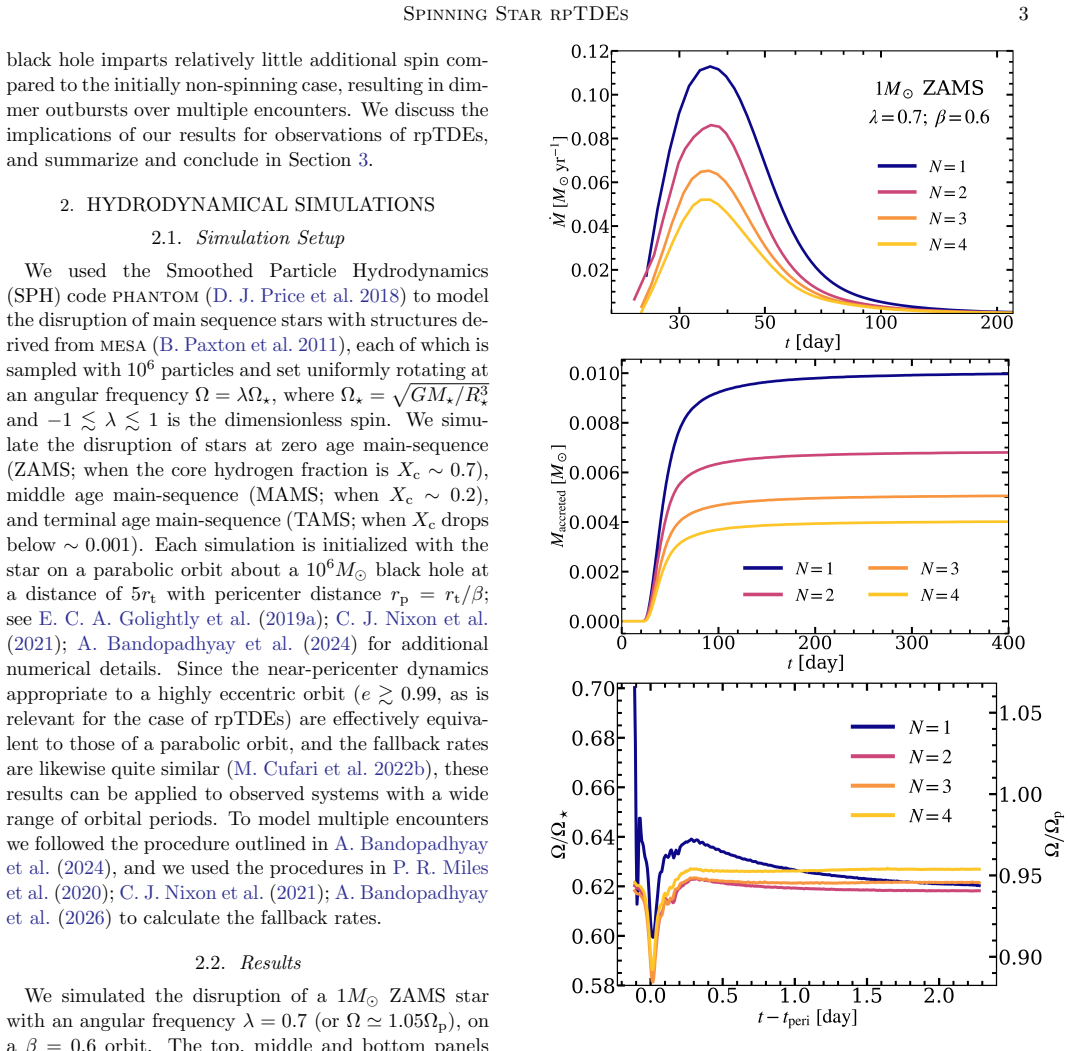
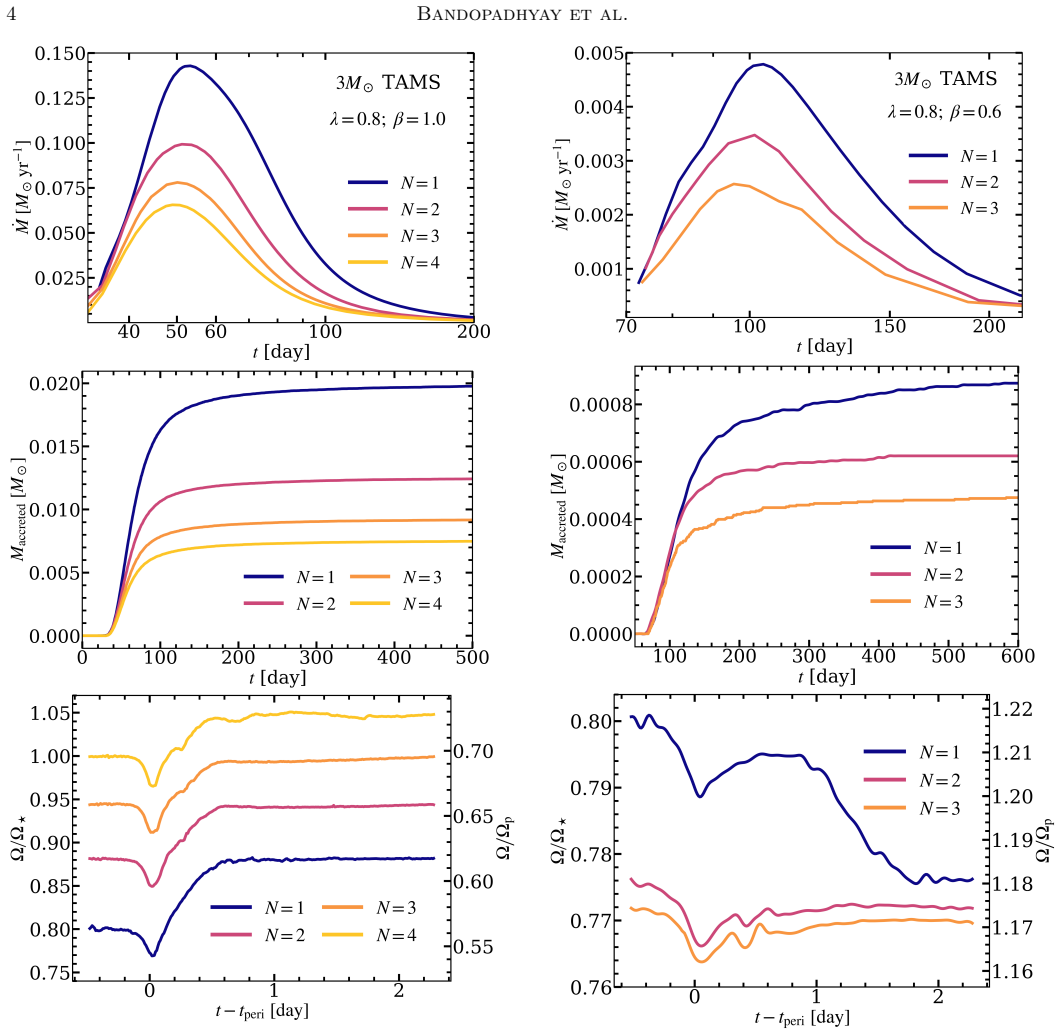
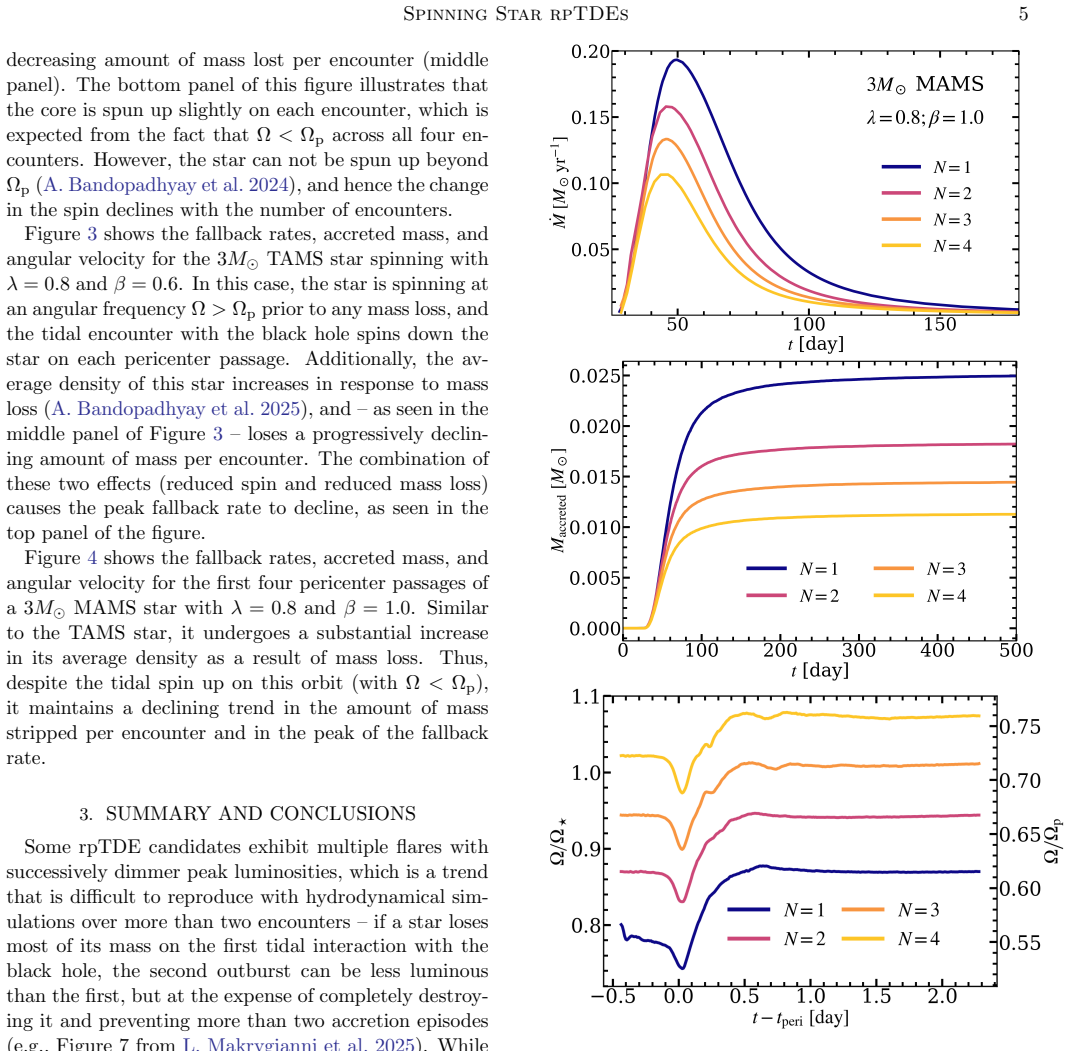
When a main-sequence star enters its first encounter with a supermassive black hole already spinning at tens of percent of breakup speed in the prograde direction, each successive partial stripping removes progressively less mass. The resulting light curve therefore exhibits a clear decline in peak luminosity from one outburst to the next. Simulations of stars more massive than one solar mass around a million-solar-mass black hole recover this dimming only for high, aligned spins.
What carries the argument
The magnitude and direction of the star's spin relative to orbital angular momentum, which alters the star's internal structure and the amount of mass removed at each pericenter passage.
If this is right
- High prograde spin recovers the observed dimming trend across multiple encounters.
- Low or retrograde spin does not produce the same decline in outburst strength.
- The dimming therefore constitutes indirect evidence that the Hills binary-breakup process seeds the stars in rpTDEs.
Where Pith is reading between the lines
- Light-curve morphology of rpTDEs could be used to infer the spin distribution of stars on tight orbits around supermassive black holes.
- The same spin dependence may determine whether a star survives many encounters or is eventually fully disrupted.
Load-bearing premise
The star begins its first encounter already rotating rapidly because it formed through the breakup of a tight, tidally locked binary.
What would settle it
A set of simulations with zero initial stellar spin that nevertheless produces a clear sequence of dimmer outbursts would falsify the proposed mechanism.
Figures
read the original abstract
The repeated tidal stripping of a star by a supermassive black hole, known as a repeating partial tidal disruption event (rpTDE), can give rise to a transient that rebrightens months to years after the first outburst. Among the rpTDE candidates so far observed, some exhibit dimmer peak luminosities during each successive outburst, which is a trend that has not been reproduced from theoretical models when the star survives more than one encounter with the black hole. Here we suggest that this trend can be recovered if the partially disrupted star is initially (i.e., prior to its first mass-stripping event) rapidly rotating, which is expected if the star was placed on its orbit through the Hills breakup of a tidally locked and tight binary. We test this hypothesis with hydrodynamical simulations of high-mass ($\geqslant 1 M_{\odot}$) main sequence stars repeatedly partially disrupted by a $10^6 M_{\odot}$ black hole, and demonstrate that successively dimmer outbursts are indeed recovered for high (tens of percent breakup) and prograde (i.e., aligned with the orbital angular momentum) stellar spins. Our results provide strong indirect evidence for the operation of the Hills mechanism in seeding the stars in rpTDEs.
Editorial analysis
A structured set of objections, weighed in public.
Referee Report
Summary. The manuscript claims that the observed trend of successively dimmer peak luminosities in some repeating partial tidal disruption events (rpTDEs) can be reproduced if the star begins with high (tens of percent of breakup) prograde spin prior to the first encounter. This initial spin state is posited as a natural outcome of the Hills mechanism acting on a tidally locked tight binary. Hydrodynamical simulations of ≥1 M⊙ main-sequence stars around a 10^6 M⊙ black hole are used to demonstrate that only high prograde spins recover the dimming trend, providing what the authors describe as strong indirect evidence for Hills seeding of rpTDE stars.
Significance. If the reported spin dependence is robust, the work supplies a concrete physical mechanism that can explain an otherwise unexplained observational trend in rpTDE candidates and connects the events to binary dynamics near supermassive black holes. The forward nature of the hydrodynamical simulations (no fitting or self-referential equations) is a methodological strength that permits direct comparison with future observations of spin-sensitive signatures.
major comments (2)
- [Introduction] Introduction and abstract: the statement that high prograde spin 'is expected' from the Hills breakup of a tidally locked tight binary is asserted without any supporting calculation, reference, or citation. This assumption is load-bearing for the claim of 'strong indirect evidence' for the Hills mechanism; without it the simulation results demonstrate only a possible spin dependence, not evidence for a specific seeding channel.
- [Methods] Simulation methods (likely §2 or §3): the manuscript provides no information on the hydrodynamical code, spatial resolution, initial stellar structure model, or the procedure used to convert simulated mass-loss rates into luminosity. These details are required to evaluate whether the recovered dimming trend for high prograde spins is converged and independent of numerical choices.
minor comments (1)
- Figure captions and axis labels should explicitly state the spin parameter values (fraction of breakup speed and direction) for each run to allow immediate comparison with the text.
Simulated Author's Rebuttal
We thank the referee for their constructive and detailed report. We address each major comment below and will revise the manuscript accordingly to improve clarity and completeness.
read point-by-point responses
-
Referee: [Introduction] Introduction and abstract: the statement that high prograde spin 'is expected' from the Hills breakup of a tidally locked tight binary is asserted without any supporting calculation, reference, or citation. This assumption is load-bearing for the claim of 'strong indirect evidence' for the Hills mechanism; without it the simulation results demonstrate only a possible spin dependence, not evidence for a specific seeding channel.
Authors: We acknowledge that the expectation of high prograde spin arising from the Hills breakup of a tidally locked tight binary is asserted in the introduction and abstract without an explicit supporting calculation or citation. This is a valid observation, as the interpretation as 'strong indirect evidence' for the Hills mechanism depends on this being a natural outcome. We will revise the introduction to include a short justification based on angular momentum conservation during binary disruption and relevant references to the literature on the Hills mechanism and tidally locked binaries, thereby strengthening the connection without altering the simulation results. revision: yes
-
Referee: [Methods] Simulation methods (likely §2 or §3): the manuscript provides no information on the hydrodynamical code, spatial resolution, initial stellar structure model, or the procedure used to convert simulated mass-loss rates into luminosity. These details are required to evaluate whether the recovered dimming trend for high prograde spins is converged and independent of numerical choices.
Authors: We agree that the methods section is missing these critical details, which are necessary for assessing convergence and reproducibility. We will expand the methods section to specify the hydrodynamical code, the spatial resolution employed, the initial stellar structure models, and the procedure for converting mass-loss rates to luminosity estimates. These additions will allow evaluation of whether the dimming trend for high prograde spins is robust. revision: yes
Circularity Check
No circularity; forward hydrodynamical simulations test spin hypothesis independently
full rationale
The paper's core result—that high prograde stellar spins produce successively dimmer outbursts—is obtained directly from hydrodynamical simulations of repeated partial disruptions. This is a forward-modeling output, not a fitted parameter, self-defined quantity, or result derived from self-citations. The initial-spin assumption (from Hills breakup of a tidally locked binary) is presented as the hypothesis under test rather than an input that forces the outcome by construction. No equations reduce the claimed prediction to the inputs, and no load-bearing self-citation or ansatz smuggling is present in the derivation chain. The paper is self-contained against external benchmarks via explicit simulation setup.
Axiom & Free-Parameter Ledger
free parameters (1)
- initial stellar spin fraction of breakup speed
axioms (2)
- domain assumption The star survives more than one partial disruption encounter
- domain assumption Hydrodynamical codes accurately model the interaction between stellar spin, orbital motion, and mass stripping
Reference graph
Works this paper leans on
-
[1]
2014, ApJ, 793, 38, doi: 10.1088/0004-637X/793/1/38
Arcavi, I., Gal-Yam, A., Sullivan, M., et al. 2014, ApJ, 793, 38, doi: 10.1088/0004-637X/793/1/38
-
[2]
Bandopadhyay, A., Coughlin, E. R., & Nixon, C. J. 2025, ApJ, 987, 16, doi: 10.3847/1538-4357/add9a5
-
[3]
Bandopadhyay, A., Coughlin, E. R., & Nixon, C. J. 2026, ApJ, 998, 81, doi: 10.3847/1538-4357/ae31e3
-
[4]
Pasham, D. R. 2024, ApJ, 974, 80, doi: 10.3847/1538-4357/ad6a5a
-
[5]
Cufari, M., Coughlin, E. R., & Nixon, C. J. 2022a, ApJL, 929, L20, doi: 10.3847/2041-8213/ac6021
-
[6]
Cufari, M., Coughlin, E. R., & Nixon, C. J. 2022b, ApJ, 924, 34, doi: 10.3847/1538-4357/ac32be
-
[7]
Cufari, M., Nixon, C. J., & Coughlin, E. R. 2023, MNRAS, 520, L38, doi: 10.1093/mnrasl/slad001
-
[8]
Dai, L., Blandford, R. D., & Eggleton, P. P. 2013, MNRAS, 434, 2940, doi: 10.1093/mnras/stt1208
-
[9]
Ge, H., Hjellming, M. S., Webbink, R. F., Chen, X., & Han, Z. 2010, ApJ, 717, 724, doi: 10.1088/0004-637X/717/2/724
-
[10]
2021, ARA&A, 59, 21, doi: 10.1146/annurev-astro-111720-030029
Gezari, S. 2021, ARA&A, 59, 21, doi: 10.1146/annurev-astro-111720-030029
-
[11]
Gezari, S., Cenko, S. B., & Arcavi, I. 2017, ApJL, 851, L47, doi: 10.3847/2041-8213/aaa0c2
-
[12]
Golightly, E. C. A., Coughlin, E. R., & Nixon, C. J. 2019a, ApJ, 872, 163, doi: 10.3847/1538-4357/aafd2f
-
[13]
Golightly, E. C. A., Nixon, C. J., & Coughlin, E. R. 2019b, ApJL, 882, L26, doi: 10.3847/2041-8213/ab380d
-
[14]
2023, arXiv e-prints, arXiv:2308.13019, doi: 10.48550/arXiv.2308.13019
Guolo, M., Gezari, S., Yao, Y., et al. 2023, arXiv e-prints, arXiv:2308.13019, doi: 10.48550/arXiv.2308.13019
-
[15]
2024, ApJ, 966, 160, doi: 10.3847/1538-4357/ad2f9f
Guolo, M., Gezari, S., Yao, Y., et al. 2024, ApJ, 966, 160, doi: 10.3847/1538-4357/ad2f9f
-
[16]
Hammerstein, E., van Velzen, S., Gezari, S., et al. 2023, ApJ, 942, 9, doi: 10.3847/1538-4357/aca283
-
[17]
Hills, J. G. 1975, Nature, 254, 295, doi: 10.1038/254295a0
-
[18]
Hills, J. G. 1988, Nature, 331, 687, doi: 10.1038/331687a0
-
[19]
T., Auchettl, K., Hoogendam, W
Hinkle, J. T., Auchettl, K., Hoogendam, W. B., et al. 2024, arXiv e-prints, arXiv:2412.15326, doi: 10.48550/arXiv.2412.15326
-
[20]
Hjellming, M. S., & Webbink, R. F. 1987, ApJ, 318, 794, doi: 10.1086/165412
-
[21]
Ho, A. Y. Q., Yao, Y., Matsumoto, T., et al. 2025, ApJ, 989, 54, doi: 10.3847/1538-4357/ade8f2
-
[22]
Holoien, T. W. S., Prieto, J. L., Bersier, D., et al. 2014, MNRAS, 445, 3263, doi: 10.1093/mnras/stu1922
-
[23]
2022, ApJL, 939, L33, doi: 10.3847/2041-8213/ac9c63
Lin, Z., Jiang, N., Kong, X., et al. 2022, ApJL, 939, L33, doi: 10.3847/2041-8213/ac9c63
-
[24]
2024, ApJL, 971, L26, doi: 10.3847/2041-8213/ad638e
Lin, Z., Jiang, N., Wang, T., et al. 2024, ApJL, 971, L26, doi: 10.3847/2041-8213/ad638e
-
[25]
2024, MNRAS, 527, 4317, doi: 10.1093/mnras/stad3470
Linial, I., & Quataert, E. 2024, MNRAS, 527, 4317, doi: 10.1093/mnras/stad3470
-
[26]
2025, ApJ, 979, 40, doi: 10.3847/1538-4357/ad9b0b
Liu, C., Yarza, R., & Ramirez-Ruiz, E. 2025, ApJ, 979, 40, doi: 10.3847/1538-4357/ad9b0b
-
[27]
2023, A&A, 669, A75, doi: 10.1051/0004-6361/202244805
Liu, Z., Malyali, A., Krumpe, M., et al. 2023, A&A, 669, A75, doi: 10.1051/0004-6361/202244805
-
[28]
Liu, Z., Ryu, T., Goodwin, A. J., et al. 2024, A&A, 683, L13, doi: 10.1051/0004-6361/202348682
-
[29]
2023, MNRAS, 524, 6247, doi: 10.1093/mnras/stad2203
Lu, W., & Quataert, E. 2023, MNRAS, 524, 6247, doi: 10.1093/mnras/stad2203
-
[30]
2025, ApJL, 987, L20, doi: 10.3847/2041-8213/ade155
Makrygianni, L., Arcavi, I., Newsome, M., et al. 2025, ApJL, 987, L20, doi: 10.3847/2041-8213/ade155
-
[31]
2024, ApJ, 961, 211, doi: 10.3847/1538-4357/ad18bb
Masterson, M., De, K., Panagiotou, C., et al. 2024, ApJ, 961, 211, doi: 10.3847/1538-4357/ad18bb
-
[32]
2024, ApJ, 960, 39, doi: 10.3847/1538-4357/acfee0
Ramirez-Ruiz, E. 2024, ApJ, 960, 39, doi: 10.3847/1538-4357/acfee0
-
[33]
Miles, P. R., Coughlin, E. R., & Nixon, C. J. 2020, ApJ, 899, 36, doi: 10.3847/1538-4357/ab9c9f
-
[34]
2022, MNRAS, 515, 5604, doi: 10.1093/mnras/stac2206
Nicholl, M., Lanning, D., Ramsden, P., et al. 2022, MNRAS, 515, 5604, doi: 10.1093/mnras/stac2206
-
[35]
Nixon, C. J., Coughlin, E. R., & Miles, P. R. 2021, ApJ, 922, 168, doi: 10.3847/1538-4357/ac1bb8
-
[36]
Pasham, D., Coughlin, E. R., Guolo, M., et al. 2024, ApJL, 971, L31, doi: 10.3847/2041-8213/ad57b3 Spinning Star rpTDEs 9
-
[37]
Pasham, D. R., & van Velzen, S. 2018, ApJ, 856, 1, doi: 10.3847/1538-4357/aab361
-
[38]
R., Lucchini, M., Laskar, T., et al
Pasham, D. R., Lucchini, M., Laskar, T., et al. 2023, Nature Astronomy, 7, 88, doi: 10.1038/s41550-022-01820-x
-
[39]
Pasham, D. R., Coughlin, E. R., Zajaˇ cek, M., et al. 2024, ApJL, 963, L47, doi: 10.3847/2041-8213/ad2a5c
-
[40]
2011, ApJS, 192, 3, doi: 10.1088/0067-0049/192/1/3
Paxton, B., Bildsten, L., Dotter, A., et al. 2011, ApJS, 192, 3, doi: 10.1088/0067-0049/192/1/3
-
[41]
Payne, A. V., Shappee, B. J., Hinkle, J. T., et al. 2021, ApJ, 910, 125, doi: 10.3847/1538-4357/abe38d
-
[42]
Price, D. J., Wurster, J., Tricco, T. S., et al. 2018, PASA, 35, e031, doi: 10.1017/pasa.2018.25
-
[43]
Rees, M. J. 1988, Nature, 333, 523, doi: 10.1038/333523a0
-
[44]
2025, ApJL, 992, L18, doi: 10.3847/2041-8213/ae0a26
Sfaradi, I., Margutti, R., Chornock, R., et al. 2025, ApJL, 992, L18, doi: 10.3847/2041-8213/ae0a26
-
[45]
Somalwar, J. J., Ravi, V., Yao, Y., et al. 2025, ApJ, 985, 175, doi: 10.3847/1538-4357/adcc19
-
[46]
Sun, J., Guo, H., Gu, M., et al. 2025, ApJ, 982, 150, doi: 10.3847/1538-4357/adb724 van Velzen, S., Gezari, S., Hammerstein, E., et al. 2021, ApJ, 908, 4, doi: 10.3847/1538-4357/abc258
-
[47]
2025, arXiv e-prints, arXiv:2510.26561, doi: 10.48550/arXiv.2510.26561
Wang, Y., Wang, T., Huang, S., et al. 2025, arXiv e-prints, arXiv:2510.26561, doi: 10.48550/arXiv.2510.26561
-
[48]
Wevers, T., Pasham, D. R., van Velzen, S., et al. 2021, ApJ, 912, 151, doi: 10.3847/1538-4357/abf5e2
-
[49]
Wevers, T., Coughlin, E. R., Pasham, D. R., et al. 2023, ApJL, 942, L33, doi: 10.3847/2041-8213/ac9f36
-
[50]
Yao, P. Z., & Quataert, E. 2025, arXiv e-prints, arXiv:2505.10611, doi: 10.48550/arXiv.2505.10611
work page internal anchor Pith review Pith/arXiv arXiv doi:10.48550/arxiv.2505.10611 2025
-
[51]
2023, arXiv e-prints, arXiv:2303.06523, doi: 10.48550/arXiv.2303.06523
Yao, Y., Ravi, V., Gezari, S., et al. 2023, arXiv e-prints, arXiv:2303.06523, doi: 10.48550/arXiv.2303.06523
-
[52]
2025, ApJL, 985, L48, doi: 10.3847/2041-8213/add7de
Yao, Y., Chornock, R., Ward, C., et al. 2025, ApJL, 985, L48, doi: 10.3847/2041-8213/add7de
-
[53]
Zalamea, I., Menou, K., & Beloborodov, A. M. 2010, MNRAS, 409, L25, doi: 10.1111/j.1745-3933.2010.00930.x
discussion (0)
Sign in with ORCID, Apple, or X to comment. Anyone can read and Pith papers without signing in.