Closing the Gap: Can Novice Statistics and Data Science Students Collaborate as Effectively as an Expert?
Pith reviewed 2026-06-28 11:10 UTC · model grok-4.3
The pith
Novice students matched or exceeded an expert on key parts of the ASCCR collaboration framework after short projects.
A machine-rendered reading of the paper's core claim, the machinery that carries it, and where it could break.
Core claim
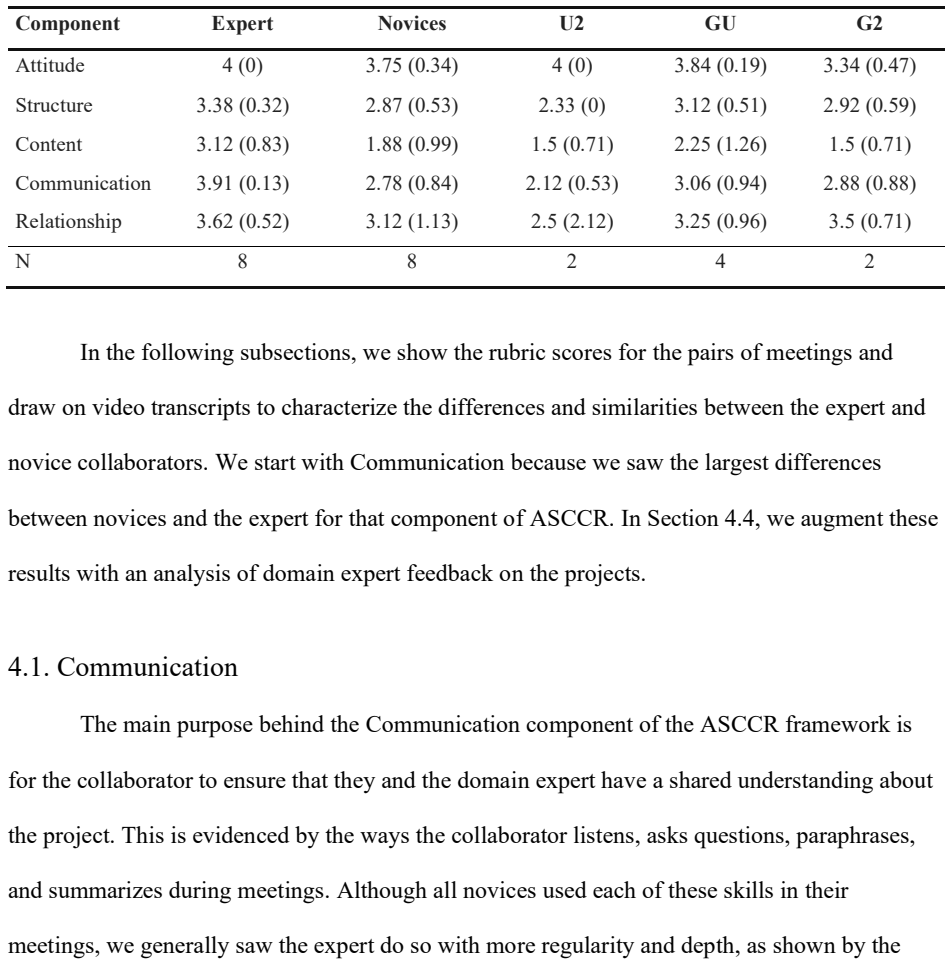
The study found that novice students scored nearly as well as the expert on the Attitude, Structure, and Relationship components of the ASCCR framework in initial collaboration meetings with domain experts. Although they did not initially match on Content or Communication, they closed those gaps over the course of the projects. By the end, the novices received higher overall domain expert feedback scores than the expert, supporting the claim that novices can become effective collaborators in a very short time.
What carries the argument
The ASCCR framework, which divides collaboration skills into Attitude, Structure, Content, Communication, and Relationship components and supplies a rubric for scoring real meetings.
If this is right
- Novices can acquire effective collaboration skills through brief, structured projects instead of extended experience.
- The ASCCR framework can be integrated into statistics and data science courses, consulting labs, and capstone projects to teach these skills.
- Domain experts may give higher overall ratings to novice collaborators once projects are completed.
- Initial weaknesses in content and communication can be overcome quickly with repeated practice under the framework.
- Programs can shift some training emphasis from long apprenticeships toward short, measurable collaboration exercises.
Where Pith is reading between the lines
- If the pattern holds, hiring managers could treat recent graduates as ready for client-facing work sooner than current practice assumes.
- The approach could be tested in non-academic settings such as industry data teams to see whether similar rapid improvement occurs outside university projects.
- Structured frameworks might reduce the typical ramp-up time for new data scientists in cross-functional teams.
- Replication with different rater pools or project types would clarify how much the results depend on the specific experts and topics involved.
Load-bearing premise
Rubric scores from videos and domain expert surveys give a fair, unbiased measure of collaboration quality that can be compared directly between novices and the expert.
What would settle it
A larger study with blinded raters across matched projects in which novices consistently scored lower on two or more ASCCR components without closing the gap would undermine the central claim.
Figures
read the original abstract
The ASCCR (Attitude-Structure-Content-Communication-Relationship) framework was recently developed to teach collaboration skills to statisticians and data scientists. However, its effectiveness in real-world settings has not yet been systematically evaluated. To assess this, we evaluated novice undergraduate and graduate students' performances in initial collaboration meetings with real domain experts and compared them to an expert collaborator. Using video recordings, rubric scores, and domain expert feedback surveys, we found that novices performed surprisingly well compared to the expert. Specifically, novices scored nearly as well as the expert on the Attitude, Structure, and Relationship components of the ASCCR framework. Although novices did not initially perform as well on the Content or Communication aspects, they were able to close the gap. By the end of the collaboration projects, the novices had higher overall domain expert feedback scores than the expert. The primary implication of our study is that novices can become effective collaborators in a very short time. We discuss our findings' practical implications and provide recommendations for integrating the ASCCR framework into statistics and data science collaboration, consulting, and capstone courses.
Editorial analysis
A structured set of objections, weighed in public.
Referee Report
Summary. The manuscript presents an empirical study evaluating the ASCCR framework for collaboration skills in statistics and data science. It compares novice students' performance in collaboration meetings with domain experts to that of an expert, using video recordings scored with a rubric and domain expert feedback surveys. The central claim is that novices performed nearly as well as the expert on Attitude, Structure, and Relationship components, closed the gap on Content and Communication, and achieved higher overall feedback scores by the end of the projects, suggesting that novices can become effective collaborators quickly.
Significance. If the methodological concerns are addressed, the findings would provide valuable empirical support for the ASCCR framework's effectiveness in real-world settings. This could have significant implications for integrating collaboration training into statistics and data science curricula, particularly in consulting and capstone courses, by demonstrating that effective collaboration skills can be developed in a short time frame.
major comments (3)
- [Methods] Methods section: The description provides no indication that domain experts or video raters were blinded to novice/expert status. Unblinded evaluation directly threatens the validity of the 'nearly as well' and 'higher overall' claims, as expectancy or leniency effects could systematically inflate novice scores.
- [Results] Results section: No sample sizes, statistical tests, inter-rater reliability coefficients, or error bars are reported for the rubric or feedback comparisons. This absence makes it impossible to evaluate whether the data support the central claim that novices closed the gap and ultimately outperformed the expert.
- [Methods] Study design: There is no mention of matching or controlling for project complexity, domain, or duration across novice and expert cases. Without such controls, raw score comparisons between groups are confounded and cannot support the conclusion that novices performed comparably or better.
minor comments (2)
- [Abstract] Abstract: Include at least summary statistics or effect sizes for the component scores to allow readers to gauge the practical magnitude of 'nearly as well' performance.
- [Introduction] Introduction: Briefly recap the five ASCCR components for readers who have not encountered the framework.
Simulated Author's Rebuttal
We thank the referee for their constructive comments on our manuscript. We address each of the major comments below and indicate the revisions we will make to the manuscript.
read point-by-point responses
-
Referee: [Methods] Methods section: The description provides no indication that domain experts or video raters were blinded to novice/expert status. Unblinded evaluation directly threatens the validity of the 'nearly as well' and 'higher overall' claims, as expectancy or leniency effects could systematically inflate novice scores.
Authors: We acknowledge this limitation in our study design. The expert collaborator was a member of the research team, making blinding to status impossible for the domain expert feedback surveys. Video raters were also not blinded. In the revised manuscript, we will add explicit statements in the Methods section describing the lack of blinding and include a dedicated paragraph in the Limitations section discussing potential expectancy effects and how the rubric training and longitudinal design (closing the gap over time) may help mitigate concerns. We agree this is an important point and appreciate the opportunity to clarify it. revision: partial
-
Referee: [Results] Results section: No sample sizes, statistical tests, inter-rater reliability coefficients, or error bars are reported for the rubric or feedback comparisons. This absence makes it impossible to evaluate whether the data support the central claim that novices closed the gap and ultimately outperformed the expert.
Authors: We apologize for these omissions in the original submission. The revised Results section will include the sample sizes (number of novice students and projects, and the single expert case), the specific statistical tests employed for comparisons (e.g., Wilcoxon rank-sum tests or similar, as appropriate for the data), inter-rater reliability coefficients (such as Fleiss' kappa or intraclass correlation), and error bars or confidence intervals on all relevant figures and tables. These additions will enable readers to fully assess the strength of the evidence supporting our claims. revision: yes
-
Referee: [Methods] Study design: There is no mention of matching or controlling for project complexity, domain, or duration across novice and expert cases. Without such controls, raw score comparisons between groups are confounded and cannot support the conclusion that novices performed comparably or better.
Authors: The referee raises a valid concern regarding potential confounding variables. Our study compared novice collaborations across multiple projects to a single expert collaboration on one project. In the revised Methods section, we will provide detailed descriptions of all projects, including their domains, durations, and complexity levels to the extent possible. We will also expand the Discussion to address this as a limitation and note that the expert case serves as a benchmark rather than a perfectly matched control. Future research could incorporate matched designs, but the current findings offer initial evidence of novice performance. revision: partial
Circularity Check
No circularity: empirical comparison with no derivations or self-referential reductions
full rationale
This is a purely empirical study comparing novice and expert collaboration performance via video rubric scores and domain-expert surveys. No equations, derivations, predictions, or first-principles results are claimed. The ASCCR framework is adopted as an external measurement instrument; the central claims (novices scored nearly as well on Attitude/Structure/Relationship and closed gaps on Content/Communication) rest on direct data comparisons rather than any reduction to fitted inputs or self-citation chains. Self-citation of the framework's development is present but not load-bearing for the performance conclusions, satisfying the rule that externally falsifiable empirical measures do not trigger circularity.
Axiom & Free-Parameter Ledger
axioms (2)
- domain assumption The ASCCR framework components (Attitude, Structure, Content, Communication, Relationship) can be reliably scored from video recordings of collaboration meetings.
- domain assumption Domain expert feedback surveys provide an unbiased measure of collaboration effectiveness.
Reference graph
Works this paper leans on
-
[1]
Teaching Statistics and Data Science Collaboration via a Community of Practice,
Alzen, J. L., Cho, K. J., and Vance, E. A. (2024), “Teaching Statistics and Data Science Collaboration via a Community of Practice,” Journal of Statistics and Data Science Education, 1–13. https://doi.org/10.1080/26939169.2024.2422821. Alzen, J. L., Trumble, I. M., Cho, K. J., and Vance, E. A. (2023), “Training Interdisciplinary Data Science Collaborators...
-
[2]
https://doi.org/10.1080/10691898.2008.11889557. Sharp, J. L., Griffith, E. H., and Higgs, M. D. (2021), “Setting the Stage: Statistical Collaboration Videos for Training the Next Generation of Applied Statisticians,” Journal of Statistics and Data Science Education, 29, 165–170. https://doi.org/10.1080/26939169.2021.1934202. Sima, A. P., Rodriguez, V. A.,...
-
[3]
https://doi.org/10.1080/10691898.2008.11889564. Vance, E. A. (2015), “Recent Developments and Their Implications for the Future of Academic Statistical Consulting Centers,” The American Statistician, 69, 127–137. https://doi.org/10.1080/00031305.2015.1033990. Vance, E. A. (2019), “Content of collaborations QQQ,” Collaboration in a Bag, 1–4. https://doi.or...
discussion (0)
Sign in with ORCID, Apple, or X to comment. Anyone can read and Pith papers without signing in.