The mass of the neutron star in 4U 1820-30 revisited
Pith reviewed 2026-06-28 12:49 UTC · model grok-4.3
The pith
Interpreting the 3.8 keV feature in 4U 1820-30 as a redshifted line creates tension with equation-of-state benchmarks unless the neutron star is unusually massive.
A machine-rendered reading of the paper's core claim, the machinery that carries it, and where it could break.
Core claim
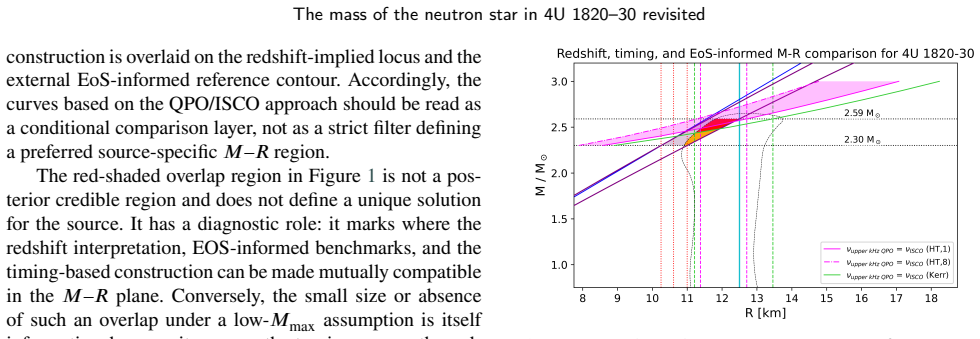
The redshift interpretation of the 3.8 keV feature, the touchdown-flux estimates, and the QPO/ISCO interpretation do not naturally select the same mass-radius sector for this source under these assumptions. Reconciling them requires auxiliary assumptions with high leverage on the inferred compactness. If the maximum neutron-star mass is restricted to low values (≤ 2.3 M⊙), the redshift-implied locus shows at most marginal overlap with the EoS-informed contour, indicating substantial tension. Allowing a higher maximum mass enlarges the parameter space and can restore compatibility with that benchmark, but such high masses remain in tension with previous touchdown-flux estimates.
What carries the argument
The compactness value 1+z ≃ 1.72 derived from the 3.8 keV absorption feature, mapped onto the mass-radius plane with rotational corrections and compared to an EoS-informed 95% contour.
If this is right
- When maximum mass is capped at 2.3 solar masses, the redshift locus overlaps only marginally with the NICER-derived contour.
- Higher maximum masses allow overlap with the contour but conflict with touchdown-flux estimates.
- The redshift, touchdown flux and highest QPO frequency interpretations select different mass-radius sectors.
- Auxiliary assumptions are needed to reconcile the indicators.
Where Pith is reading between the lines
- Future high-resolution X-ray spectroscopy could confirm or refute the iron-line identification independently of the mass-radius comparison.
- A precise mass measurement from other methods, such as binary dynamics, would directly test the redshift-derived compactness.
- The tension suggests that multi-indicator analyses may be required to constrain neutron-star properties reliably in similar systems.
Load-bearing premise
The 3.8 keV absorption feature is a gravitationally redshifted, highly ionized iron line that directly implies a compactness of 1+z approximately 1.72.
What would settle it
A direct measurement of the neutron-star mass in 4U 1820-30 below approximately 2 solar masses combined with a radius inconsistent with the high-compactness locus would falsify the redshift interpretation.
Figures
read the original abstract
We revisit the mass of the neutron star in the ultracompact binary 4U 1820--30 in light of a recently reported transient absorption feature at about 3.8 keV, interpreted as a gravitationally redshifted, highly ionized iron line and implying \(1+z\simeq1.72\), a very high stellar compactness. We examine whether the mass-radius locus implied by this interpretation can be made compatible with external EoS-informed benchmarks and timing-based estimates. We map the compactness implied by the redshift onto the mass-radius plane, including rotational effects, and compare the resulting region with an EoS-informed 95\% reference contour derived from NICER data of several neutron-star systems. While we do not perform a statistically self-consistent joint mass-radius inference for 4U 1820--30, we present a quantitative conditional consistency test in a common \(M-R\) framework, comparing published inputs under explicitly stated assumptions. We find that, if the maximum neutron-star mass is restricted to low values \((\leq 2.3\,M_{\odot})\), the redshift-implied locus shows at most marginal overlap with the EoS-informed contour, indicating substantial tension. Allowing a higher maximum mass enlarges the parameter space and can restore compatibility with that benchmark. However, such high masses remain in tension with previous touchdown-flux estimates, although they are not necessarily excluded by interpretations based on the highest detected quasi-periodic oscillation frequency. We conclude that the redshift interpretation of the 3.8 keV feature, the touchdown-flux estimates, and the QPO/ISCO interpretation do not naturally select the same mass-radius sector for this source under these assumptions. Reconciling them requires auxiliary assumptions with high leverage on the inferred compactness.
Editorial analysis
A structured set of objections, weighed in public.
Referee Report
Summary. The manuscript revisits the neutron star in the ultracompact binary 4U 1820-30 using a transient absorption feature at ~3.8 keV interpreted as a gravitationally redshifted highly ionized iron line (1+z ≃ 1.72). It maps the implied compactness (including rotational effects) onto the M-R plane and performs a conditional consistency test against an EoS-informed 95% contour derived from NICER observations of several sources. The central finding is that, for M_max ≤ 2.3 M⊙, the redshift-implied locus shows at most marginal overlap with the contour (substantial tension), while higher M_max can restore compatibility but remains in tension with prior touchdown-flux estimates (though not necessarily with the highest QPO frequency interpretation). The analysis is explicitly conditional on the line identification and does not claim a joint statistical inference.
Significance. If the line identification holds, the work usefully illustrates how different observational constraints on this source (redshift, NICER EoS contour, touchdown flux, QPO) do not converge on a common M-R sector under standard assumptions, thereby motivating auxiliary assumptions with high leverage on compactness. The explicit statement of assumptions, use of published inputs, and framing as a conditional test rather than a new inference are strengths that allow the result to be evaluated on its own terms.
major comments (2)
- [Abstract] Abstract: the claim of 'substantial tension' when M_max ≤ 2.3 M⊙ rests on the qualitative statement of 'at most marginal overlap' with the NICER 95% contour, but no quantitative measure of overlap, error propagation, or statistical test is described; this makes the tension assessment difficult to evaluate rigorously and is load-bearing for the central conditional claim.
- [Abstract] Abstract: the mapping of the redshift-implied compactness onto the M-R plane (including rotation) is presented as the basis for all subsequent comparisons, yet the manuscript does not detail the specific equations or assumptions used to generate the locus from 1+z ≃ 1.72; without these, the conditional test cannot be reproduced or assessed for internal consistency.
minor comments (1)
- [Abstract] The abstract states that conclusions are conditional on the line identification but could more explicitly flag that the entire tension analysis is invalidated if the 3.8 keV feature is not a surface redshifted Fe line.
Simulated Author's Rebuttal
We thank the referee for their careful review and for recognizing the conditional nature of our analysis. We address the two major comments below. Both points identify areas where additional rigor and documentation will strengthen the manuscript, and we have revised accordingly.
read point-by-point responses
-
Referee: [Abstract] Abstract: the claim of 'substantial tension' when M_max ≤ 2.3 M⊙ rests on the qualitative statement of 'at most marginal overlap' with the NICER 95% contour, but no quantitative measure of overlap, error propagation, or statistical test is described; this makes the tension assessment difficult to evaluate rigorously and is load-bearing for the central conditional claim.
Authors: We agree that the tension assessment would benefit from a quantitative metric. In the revised manuscript we will add an explicit calculation of the fractional overlap (in the M-R plane) between the redshift-implied locus and the NICER 95% contour for the M_max ≤ 2.3 M⊙ case, together with a brief description of how the locus boundaries were propagated from the stated 1+z uncertainty. This will be presented as a supplementary quantitative check while preserving the conditional framing of the test. revision: yes
-
Referee: [Abstract] Abstract: the mapping of the redshift-implied compactness onto the M-R plane (including rotation) is presented as the basis for all subsequent comparisons, yet the manuscript does not detail the specific equations or assumptions used to generate the locus from 1+z ≃ 1.72; without these, the conditional test cannot be reproduced or assessed for internal consistency.
Authors: We accept that the mapping procedure requires explicit documentation. The revised manuscript will include a new subsection (or expanded paragraph in Section 2) that states the redshift-to-compactness relation, the approximate rotational corrections employed (including the adopted spin frequency and the form of the frame-dragging term), and the geometric construction of the allowed M-R band. All assumptions will be listed so that the locus can be regenerated from the published 1+z value. revision: yes
Circularity Check
No circularity; conditional consistency test uses external published inputs and benchmarks
full rationale
The paper maps compactness from the assumed 1+z ≃ 1.72 (from the transient 3.8 keV feature interpreted as redshifted Fe line) onto the M-R plane including rotation, then compares the locus to an EoS-informed 95% contour from NICER data on other neutron stars and to prior touchdown-flux and QPO estimates. It explicitly states it does not perform joint inference and presents only a conditional test under stated assumptions. No equations reduce any result to a fitted parameter defined by the same data, no self-citation chains justify load-bearing premises, and no ansatz or uniqueness theorem is smuggled in. The line identification is an external assumption, not derived internally.
Axiom & Free-Parameter Ledger
free parameters (1)
- maximum neutron-star mass threshold =
2.3 M_sun
axioms (2)
- domain assumption The 3.8 keV absorption feature is a gravitationally redshifted highly ionized iron line with 1+z ≃ 1.72
- domain assumption The 95% reference contour derived from NICER data of several neutron-star systems is a valid EoS-informed benchmark
Reference graph
Works this paper leans on
-
[1]
The Hartle-Thorne circular geodesics
Abramowicz, M.A., Almergren, G.J.E., Kluzniak, W., Thampan, A.V.,2003. TheHartle-Thornecirculargeodesics. arXive-prints,gr– qc/0312070doi:10.48550/arXiv.gr-qc/0312070,arXiv:gr-qc/0312070
work page internal anchor Pith review doi:10.48550/arxiv.gr-qc/0312070 2003
-
[2]
Alsing,J.,Silva,H.O.,Berti,E.,2018. Evidenceforamaximummass cut-off in the neutron star mass distribution and constraints on the equationofstate. MonthlyNoticesoftheRoyalAstronomicalSociety 478, 1377–1391. doi:10.1093/mnras/sty1065,arXiv:1709.07889
work page internal anchor Pith review Pith/arXiv arXiv doi:10.1093/mnras/sty1065 2018
-
[3]
Anderson, S.F., Margon, B., Deutsch, E.W., Downes, R.A., Allen, R.G., 1997. Time-Resolved Ultraviolet Observations of the Globular Cluster X-Ray Source in NGC 6624: The Shortest Known Period Binary System. The Astrophysical Journall 482, L69–L72. doi:10. 1086/310672,arXiv:astro-ph/9703180
Pith/arXiv arXiv 1997
-
[4]
Unveiling the reflectionspectrumintheultracompactLMXB4U1820–30
Anitra,A.,Gnarini,A.,DiSalvo,T.,Iaria,R.,Sanna,A.,Burderi,L., Marino,A.,DelSanto,M.,Matt,G.,Ursini,F.,Bianchi,S.,Capitanio, F., Fabiani, S., Tarana, A., Di Marco, A., 2025. Unveiling the reflectionspectrumintheultracompactLMXB4U1820–30. Astron- omy and Astrophysics 697, A83. doi:10.1051/0004-6361/202554097, arXiv:2504.02626
-
[5]
Stellar Evolution in Close Binaries: Processes and Outcomes
Benvenuto, O., De Vito, M., Koninckx, L., Echeveste, M., Novarino, M., Horvath, J., 2025. Stellar Evolution in Close Binaries: Processes and Outcomes. Astronomische Nachrichten 346, e70034. doi:10. 1002/asna.70034,arXiv:2512.10543
arXiv 2025
-
[6]
Revisitingtherhoades–ruffinibound
Blaschke,D.,Wojcik,A.,2026. Revisitingtherhoades–ruffinibound. arXiv e-printsarXiv:2604.03204
Pith/arXiv arXiv 2026
-
[7]
Bobrikova, A., Forsblom, S.V., 2025. Accretion Onto Weakly Mag- netized Neutron Stars: Polarization Theory and Its Application to X- Ray Burster GX 13+1. Astronomische Nachrichten 346, e20240128. doi:10.1002/asna.20240128
-
[8]
Implications of latest NICER data for the neutron star equation of state
Brandes, L., Weise, W., 2025. Implications of latest NICER data for the neutron star equation of state. Physical Review D 111, 034005. doi:10.1103/PhysRevD.111.034005,arXiv:2412.05923
-
[9]
General Relativistic Fluid Spheres
Buchdahl,H.A.,1959. GeneralRelativisticFluidSpheres. Phys.Rev. 116, 1027. doi:10.1103/PhysRev.116.1027
-
[10]
Cackett, E.M., Miller, J.M., Raymond, J., Homan, J., van der Klis, M., Méndez, M., Steeghs, D., Wijnands, R., 2008. Investigating the Nature of Absorption Lines in the Chandra X-Ray Spectra of the Neutron Star Binary 4U 1820-30. The Astrophysical Journal 677, 1233–1240. doi:10.1086/529483,arXiv:astro-ph/0703371
work page internal anchor Pith review Pith/arXiv arXiv doi:10.1086/529483 2008
-
[11]
An Overview of Compact Star Popula- tions and Some of Its Open Problems
de Sá, L.M.d., Bernardo, A., Bachega, R.R.A., Rocha, L.S., Moraes, P.R.S., Horvath, J.E., 2023. An Overview of Compact Star Popula- tions and Some of Its Open Problems. Galaxies 11, 19. doi:10.3390/ galaxies11010019,arXiv:2301.07780
arXiv 2023
-
[12]
Weakly Magnetized Accreting Neutron Stars as Seen by IXPE
Di Marco, A., 2025. Weakly Magnetized Accreting Neutron Stars as Seen by IXPE. Astronomische Nachrichten 346, e20240126. doi:10.1002/asna.20240126
-
[13]
Fan, Y.Z., Han, M.Z., Jiang, J.L., Shao, D.S., Tang, S.P., 2024. Maximum gravitational mass M 𝑇 𝑂𝑉=2.2 5−0.07+0.08M⊙ inferred at about 3% precision with multimessenger data of neutron stars. Physical Review D 109, 043052. doi:10.1103/PhysRevD.109.043052, arXiv:2309.12644
-
[14]
Futamoto, K., Mitsuda, K., Takei, Y., Fujimoto, R., Yamasaki, N.Y.,
-
[15]
Detection of Highly Ionized O and Ne Absorption Lines in the X-Ray Spectrum of 4U 1820-303 in the Globular Cluster NGC
-
[16]
The Astrophysical Journal 605, 793–799. doi:10.1086/381087, arXiv:astro-ph/0310867
work page internal anchor Pith review Pith/arXiv arXiv doi:10.1086/381087
-
[17]
Goluchová,K.,Török,G.,Urbanec,M.,Urbancová,G.,Šrámková,E.,
-
[18]
Innermost stable circular orbits around compact stars: Terms M G B de Avellar et al.:Preprint submitted to ElsevierPage 7 of 8 The mass of the neutron star in 4U 1820–30 revisited that are quadratic in spin, in: RAGtime 17-19: Workshops on Black Holes and Neutron Stars, pp. 23–32
-
[19]
The Mass and Radius of the Neutron Star in 4U 1820-30
Güver,T.,Wroblewski,P.,Camarota,L.,Özel,F.,2010.TheMassand RadiusoftheNeutronStarin4U1820-30. TheAstrophysicalJournal 719,1807–1812.doi:10.1088/0004-637X/719/2/1807,arXiv:1002.3825
work page internal anchor Pith review Pith/arXiv arXiv doi:10.1088/0004-637x/719/2/1807 2010
-
[20]
Slowly Rotating Relativistic Stars
Hartle, J., B., Thorne, K.S., 1968. Slowly Rotating Relativistic Stars. II. Models for Neutron Stars and Supermassive Stars . The Astrophysical Journal 153, 807. doi:10.1086/149707
-
[21]
Horvath, J.E., Rocha, L.S., Bernardo, A.L.C., de Avellar, M.G.B., Valentim, R., 2022. Birth Events, Masses and the Maximum Mass ofCompactStars,in:Vasconcellos,C.A.Z.(Ed.),Astrophysicsinthe XXI Century with Compact Stars. Edited by C.A.Z. Vasconcellos. eISBN 978-981-12-2094-4.. Singapore: World Scientific, pp. 1–51. doi:10.1142/9789811220944_0001
-
[22]
A light strange star in the remnant HESS J1731−347: Minimal consis- tency checks
Horvath, J.E., Rocha, L.S., de Sá, L.M., Moraes, P.H.R.S., Barão, L.G., de Avellar, M.G.B., Bernardo, A., Bachega, R.R.A., 2023. A light strange star in the remnant HESS J1731−347: Minimal consis- tency checks. Astronomy and Astrophysics 672, L11. doi:10.1051/ 0004-6361/202345885,arXiv:2303.10264
arXiv 2023
-
[23]
The Masses of Neutron Stars, in: Alsabti, A.W., Murdin, P
Horvath, J.E., Valentim, R., 2017. The Masses of Neutron Stars, in: Alsabti, A.W., Murdin, P. (Eds.), Handbook of Supernovae. Springer International Publishing AG, p. 1317. doi:10.1007/ 978-3-319-21846-5_67
2017
-
[24]
Iaria, R., Di Salvo, T., Anitra, A., Barra, F., Sanna, A., Maraventano, C., Miceli, C., Leone, W., Burderi, L., 2025. A mysterious feature in the NICER spectrum of 4U 1820-30: A gravitationally redshifted absorption line? arXiv e-prints , arXiv:2511.20499doi:10.48550/ arXiv.2511.20499,arXiv:2511.20499
arXiv 2025
-
[25]
A Comprehensive Study of Thermonuclear X-Ray Bursts from 4U 1820–30 with NICER: Accretion Disk Interactions and a Candidate Burst Oscillation
Jaisawal,G.,FundaBostanci,Z.,Boztepe,T.,Gülver,T.,Strohmayer, T.E., Ballantyne, D., Beck, J., Gögüs, E., Altamirano, D., Arzou- manian, Z., Chakrabarty, D., Gendreau, K., Guillot, S., Ludlam, R., Ng, M., Sanna, A., Chenevez, J., 2024. A Comprehensive Study of Thermonuclear X-Ray Bursts from 4U 1820–30 with NICER: Accretion Disk Interactions and a Candidat...
2024
-
[26]
Strong-Field Gravity and X-Ray Observations of 4U 1820-30
Kaaret, P., Piraino, S., Bloser, P.F., Ford, E.C., Grindlay, J.E., San- tangelo, A., Smale, A.P., Zhang, W., 1999. Strong-Field Gravity and X-Ray Observations of 4U 1820-30. The Astrophysical Journal 520, L37–L40
1999
-
[27]
Kim, M., Kim, Y.M., Sung, K.H., Lee, C.H., Kwak, K., 2021. Measuring the masses and radii of neutron stars in low-mass X- ray binaries: Effects of the atmospheric composition and touchdown radius. Astronomy and Astrophysics 650, A139. doi:10.1051/ 0004-6361/202038126,arXiv:2104.00263
arXiv 2021
-
[28]
Mass and radius estimation for the neutron star in the X-ray burster 4U 1820-30
Kuśmierek, K., Madej, J., Kuulkers, E., 2011. Mass and radius estimation for the neutron star in the X-ray burster 4U 1820-30 . MonthlyNoticesoftheRoyalAstronomicalSociety415,3344–3348
2011
-
[29]
Grav- itation
Misner, C.W., Thorne, K.S., Wheeler, J.A., Kaiser, D.I., 2018. Grav- itation. Princeton University Press
2018
-
[30]
TheelusiveInnermostStableCircularOrbit:Now youseeit,nowyoudon’t
Méndez,M.,2007. TheelusiveInnermostStableCircularOrbit:Now youseeit,nowyoudon’t. AIPConferenceProceedings924,563–570
2007
-
[31]
Soft equations of state for neutron-star matter ruled out by EXO 0748 - 676
Özel, F., 2006. Soft equations of state for neutron-star matter ruled out by EXO 0748 - 676. Nature 441, 1115–1117. doi:10.1038/ nature04858,arXiv:astro-ph/0605106
Pith/arXiv arXiv 2006
-
[32]
Masses, Radii, and Equation of State of Neutron Stars
Özel,F., Freire,P., 2016. Masses, Radii,andthe EquationofState of NeutronStars. AnnualReviewofAstronandAstrophys54,401–440. doi:10.1146/annurev-astro-081915-023322,arXiv:1603.02698
work page internal anchor Pith review Pith/arXiv arXiv doi:10.1146/annurev-astro-081915-023322 2016
-
[33]
The Mass and Radius of the Neutron Star in EXO 1745-248
Özel, F., Güver, T., Psaltis, D., 2009. The Mass and Radius of the Neutron Star in EXO 1745-248. The Astrophysical Journal 693, 1775–1779. doi:10.1088/0004-637X/693/2/1775,arXiv:0810.1521
work page internal anchor Pith review Pith/arXiv arXiv doi:10.1088/0004-637x/693/2/1775 2009
-
[34]
Özel, F., Psaltis, D., Güver, T., Baym, G., Heinke, C., Guillot, S.,
-
[35]
The Dense Matter Equation of State from Neutron Star Radius andMassMeasurements. TheAstrophysicalJournal820,28. doi:10. 3847/0004-637X/820/1/28,arXiv:1505.05155
-
[36]
Maximum mass of a neutron star
Rhoades, Clifford E., J., Ruffini, R., 1974. Maximum mass of a neutron star. Physical Review Letters 32, 324–327. doi:10.1103/ PhysRevLett.32.324
1974
-
[37]
Rocha, L.S., Bachega, R.R.A., Horvath, J.E., Moraes, P.H.R.S.,
-
[38]
arXiv e-prints , arXiv:2107.08822doi:10.48550/arXiv.2107.08822,arXiv:2107.08822
The maximum mass of neutron stars may be higher than expected: an inference from binary systems. arXiv e-prints , arXiv:2107.08822doi:10.48550/arXiv.2107.08822,arXiv:2107.08822
-
[39]
Mass Distribution and Maximum Mass of Neutron Stars: Effects of Orbital Inclination Angle
Rocha, L.S., Horvath, J.E., de Sá, L.M., Chinen, G.Y., Barão, L., de Avellar, M.G.B., 2023. Mass Distribution and Maximum Mass of Neutron Stars: Effects of Orbital Inclination Angle. Universe 10, 3. doi:10.3390/universe10010003,arXiv:2312.13244
-
[40]
The Astrophysical Journal 996, id.101–id.106
Romani, R., Beleznay, M., Filippenko, A., Bink, T., Zheng, W.K., 2026.PSRJ0952-0607:TighteningaRecord-highNeutronStarMass. The Astrophysical Journal 996, id.101–id.106
2026
-
[41]
GX339-4: a new black hole candidate
Samimi, J., Share, G., Wood, K., Meekins, J., Evans, W., Shulman, S., Bryam, E., Chubb, T., Fiedman, T., 1979. GX339-4: a new black hole candidate. Nature 278, 434–436
1979
-
[42]
Discovery of Kilohertz Quasi-periodic Oscillations from 4U 1820-303 with Rossi X-Ray Timing Explorer
Smale, A.P., Zhang, W., White, N.E., 1997. Discovery of Kilohertz Quasi-periodic Oscillations from 4U 1820-303 with Rossi X-Ray Timing Explorer. The Astrophysical Journall 483, L119–L122. doi:10.1086/310749
-
[43]
The Equation of State from Observed Masses and Radii of Neutron Stars
Steiner, A.W., Lattimer, J.M., Brown, E.F., 2010. The Equation of State from Observed Masses and Radii of Neutron Stars. The Astrophysical Journal 722, 33–54. doi:10.1088/0004-637X/722/1/33, arXiv:1005.0811
work page internal anchor Pith review Pith/arXiv arXiv doi:10.1088/0004-637x/722/1/33 2010
-
[44]
TheDiscoveryof 15– 30HertzQuasi-periodicOscillationsintheX-Rayfluxof4U1820-30
Stella,L., White,N.E., Priedhorsky,W., 1987. TheDiscoveryof 15– 30HertzQuasi-periodicOscillationsintheX-Rayfluxof4U1820-30. The Astrophysical Journall 315, L49. doi:10.1086/184859
-
[45]
Basic parameters of the helium- accretingX-rayburstingneutronstarin4U1820-30.MonthlyNotices of the Royal Astronomical Society 472, 3905–3913
Suleimanov, V., Kajava, J., Molkov, S., Nättilä, J., Lutovinov, A., Werner, K., Poutanen, J., 2017. Basic parameters of the helium- accretingX-rayburstingneutronstarin4U1820-30.MonthlyNotices of the Royal Astronomical Society 472, 3905–3913
2017
-
[46]
A Neutron Star Stiff Equation of State Derived from Cooling Phases of theX-rayBursterKS1731-260
Suleimanov, V., Poutanen, J., Revnivtsev, M., Werner, K., 2011. A Neutron Star Stiff Equation of State Derived from Cooling Phases of theX-rayBursterKS1731-260. TheAstrophysicalJournal742,122. doi:10.1088/0004-637X/742/2/122
-
[47]
The Formation of Ultra-short Period Binaries in GlobularClusters.TheAstrophysicalJournall312,L23.doi:10.1086/ 184812
Verbunt, F., 1987. The Formation of Ultra-short Period Binaries in GlobularClusters.TheAstrophysicalJournall312,L23.doi:10.1086/ 184812. M G B de Avellar et al.:Preprint submitted to ElsevierPage 8 of 8
1987
discussion (0)
Sign in with ORCID, Apple, or X to comment. Anyone can read and Pith papers without signing in.