Zero-Poisson Ratio Elastomeric Substrates for Distortion-Free Stretchable Displays
Pith reviewed 2026-06-28 09:14 UTC · model grok-4.3
The pith
Embedding line-patterned hard PDMS in soft PDMS creates a near-zero Poisson ratio substrate that stops transverse contraction in stretchable displays.
A machine-rendered reading of the paper's core claim, the machinery that carries it, and where it could break.
Core claim
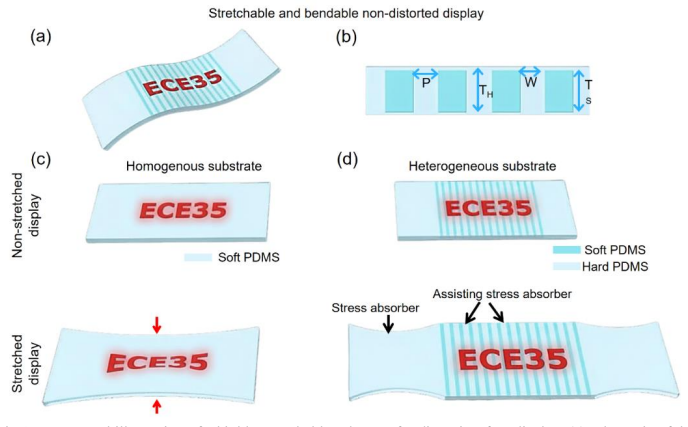
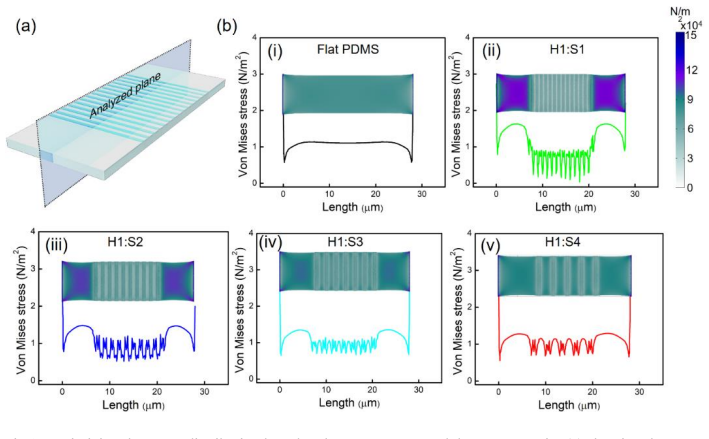
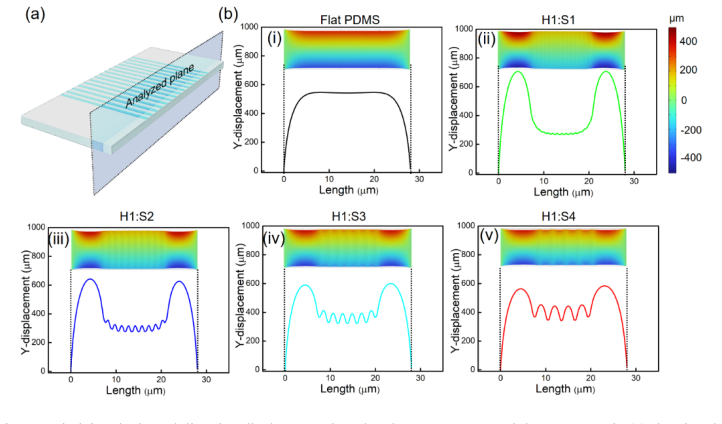
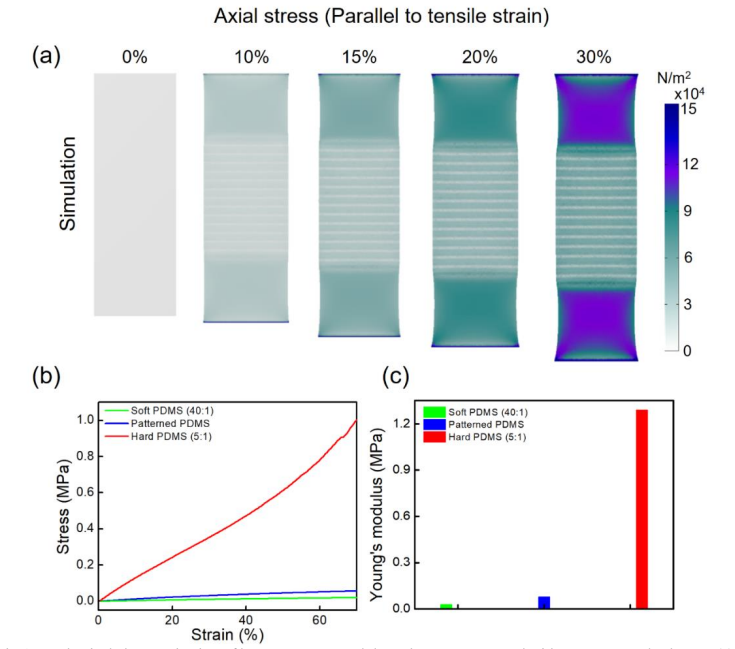
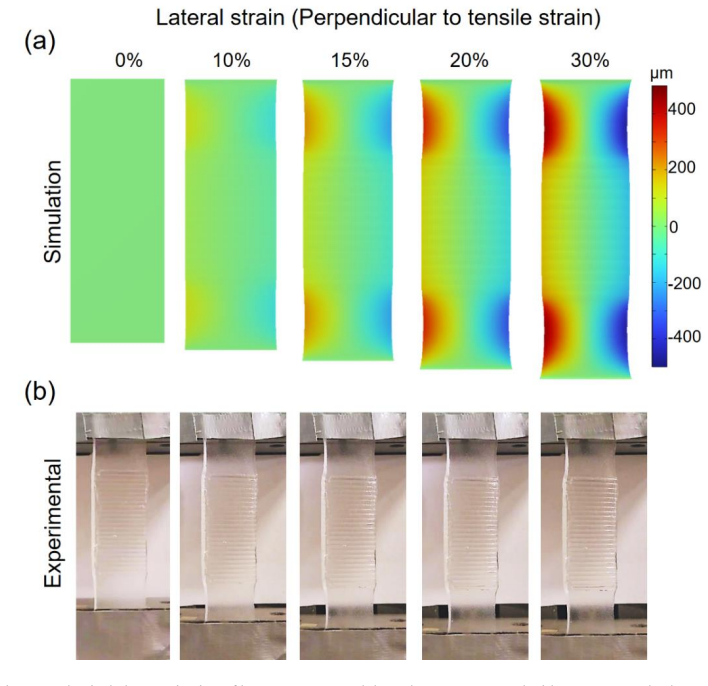
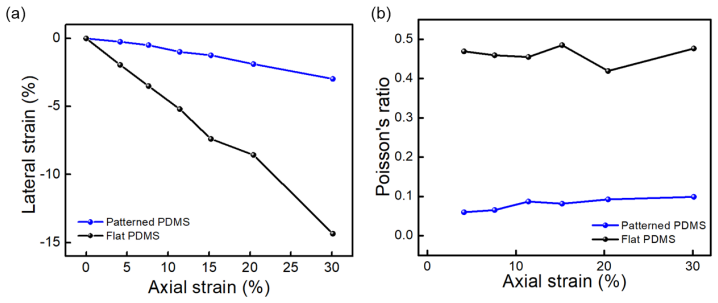
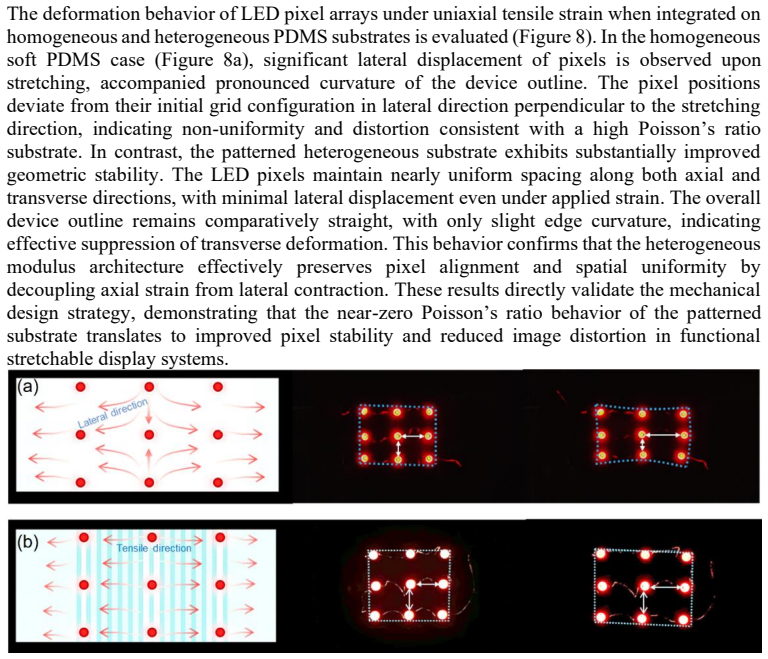
The substrate consists of line-patterned hard polydimethylsiloxane (PDMS) embedded within a soft PDMS matrix, producing spatially heterogeneous strain distribution during stretching. In this architecture, the soft PDMS functions as a strain-absorbing medium, while the embedded hard PDMS patterns suppress lateral deformation perpendicular to the applied strain. As a result, the structure significantly dampens transverse contraction and realizes a near-zero effective Poisson ratio. LED arrays integrated onto the heterogeneous substrate exhibit minimal vertical and lateral distortion during tensile deformation, enabling mechanically stable operation of stretchable light-emitting displays.
What carries the argument
Line-patterned hard PDMS embedded in a soft PDMS matrix that creates heterogeneous strain distribution to suppress transverse contraction.
If this is right
- LED arrays on the substrate maintain stable alignment with minimal vertical and lateral distortion under tensile strain.
- The design supports mechanically stable stretchable light-emitting displays without wrapping or shrinkage.
- The heterogeneous modulus approach supplies a simple, scalable route to robust stretchable display platforms.
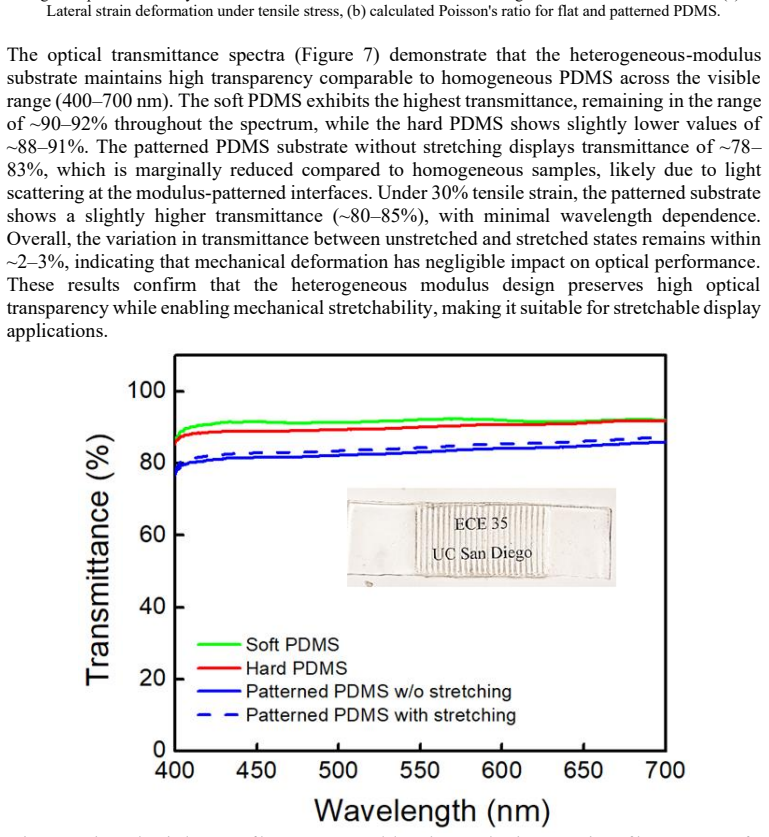
- Optical transparency and mechanical softness remain intact despite the added hard patterns.
Where Pith is reading between the lines
- The same hard-line patterning could be rotated or varied in spacing to control Poisson ratio along multiple axes for sensors or soft robotics.
- Repeated stretch cycles would likely reveal fatigue limits at the hard-soft interfaces that the current single-strain tests leave unexamined.
- Scaling the pattern to larger areas might allow distortion-free displays big enough for full wearable sleeves or curved surfaces.
Load-bearing premise
The hard PDMS patterns block lateral deformation perpendicular to the stretch direction while the soft matrix still absorbs strain and keeps the material transparent and soft.
What would settle it
Stretching the substrate with mounted LEDs and measuring transverse contraction or visible device distortion comparable to uniform soft PDMS would disprove the near-zero Poisson ratio claim.
Figures
read the original abstract
Stretchable displays are critical for emerging wearable electronics, soft sensors, and next-generation AR/VR interfaces. Although recent advances have enabled foldable, twistable, and rollable displays, intrinsically stretchable substrates often exhibit significant lateral contraction under tensile strain due to their high Poisson ratio, leading to unintended wrapping, distortion, and shrinkage. Here, we report a transparent heterogeneous-modulus elastomeric substrate designed to achieve near-zero Poisson ratio while maintaining mechanical softness and optical transparency. The substrate consists of line-patterned hard polydimethylsiloxane (PDMS) embedded within a soft PDMS matrix, producing spatially heterogeneous strain distribution during stretching. In this architecture, the soft PDMS functions as a strain-absorbing medium, while the embedded hard PDMS patterns suppress lateral deformation perpendicular to the applied strain. As a result, the structure significantly dampens transverse contraction and realizes a near-zero effective Poisson ratio. To demonstrate the utility of this platform for stretchable optoelectronics, LED arrays were integrated onto the heterogeneous substrate. The devices exhibit minimal vertical and lateral distortion during tensile deformation, enabling mechanically stable operation of stretchable light-emitting displays. This heterogeneous modulus strategy provides a simple, scalable approach to mechanically robust stretchable display platforms.
Editorial analysis
A structured set of objections, weighed in public.
Referee Report
Summary. The manuscript describes a heterogeneous-modulus elastomeric substrate formed by embedding line-patterned hard PDMS within a soft PDMS matrix. This architecture is claimed to produce spatially heterogeneous strain that suppresses transverse contraction, yielding a near-zero effective Poisson ratio while preserving optical transparency and mechanical compliance. Integration of LED arrays on the substrate is presented as a demonstration that the devices undergo minimal distortion under tensile strain.
Significance. If the near-zero Poisson ratio is quantitatively confirmed, the approach would constitute a simple, scalable route to Poisson-ratio engineering in elastomeric substrates for stretchable optoelectronics, directly addressing lateral contraction that otherwise causes wrapping and distortion in wearable or conformable displays.
major comments (2)
- [Abstract] Abstract: The central claim that the structure 'realizes a near-zero effective Poisson ratio' is unsupported by any reported numerical values for the Poisson ratio, measured transverse strains, applied strain magnitudes, error bars, or experimental protocols; these data are load-bearing for validating that the hard PDMS lines suppress lateral deformation as asserted.
- [Abstract] Abstract: The LED-array demonstration is described only qualitatively ('minimal vertical and lateral distortion' and 'mechanically stable operation'); without quantitative metrics (e.g., pixel displacement vs. strain, comparison to homogeneous PDMS controls, or strain range tested), the practical utility of the substrate cannot be assessed.
Simulated Author's Rebuttal
We thank the referee for these constructive comments on the abstract. Both points identify opportunities to make the central claims more quantitatively explicit, and we will revise the abstract accordingly while ensuring the supporting data already present in the main text and figures are properly highlighted.
read point-by-point responses
-
Referee: [Abstract] Abstract: The central claim that the structure 'realizes a near-zero effective Poisson ratio' is unsupported by any reported numerical values for the Poisson ratio, measured transverse strains, applied strain magnitudes, error bars, or experimental protocols; these data are load-bearing for validating that the hard PDMS lines suppress lateral deformation as asserted.
Authors: The main text (Results section) and associated figures report the transverse strain versus applied uniaxial strain for the heterogeneous substrate, together with the derived effective Poisson ratio, error bars from multiple samples, and the strain range tested. The abstract, however, states the claim without these numbers. We will revise the abstract to include the measured effective Poisson ratio (near zero), representative transverse-strain values, the applied-strain range, and a concise reference to the measurement protocol. revision: yes
-
Referee: [Abstract] Abstract: The LED-array demonstration is described only qualitatively ('minimal vertical and lateral distortion' and 'mechanically stable operation'); without quantitative metrics (e.g., pixel displacement vs. strain, comparison to homogeneous PDMS controls, or strain range tested), the practical utility of the substrate cannot be assessed.
Authors: Quantitative metrics for pixel displacement under strain, direct comparison to homogeneous PDMS controls, and the tested strain range are provided in the device-characterization section and supplementary figures. The abstract summarizes these results only qualitatively. We will revise the abstract to incorporate the key quantitative figures (maximum observed pixel displacement, strain range, and control comparison) so that the practical utility is evident from the abstract itself. revision: yes
Circularity Check
No significant circularity; purely descriptive architecture
full rationale
The manuscript contains no equations, derivations, fitted parameters, or self-citations. The central claim—that line-patterned hard PDMS in a soft matrix suppresses transverse strain to yield near-zero effective Poisson ratio—follows directly from the stated geometry and material contrast without any reduction to prior inputs or self-referential modeling. The description is self-contained and externally falsifiable via standard composite mechanics.
Axiom & Free-Parameter Ledger
Reference graph
Works this paper leans on
-
[1]
Contactless user-interactive sensing display for human-human and human-machine interactions
He J, Wei R, Ma X, et al. Contactless user-interactive sensing display for human-human and human-machine interactions. Adv Mater 2024;36:e2401931
2024
-
[2]
Coaxial Electroluminochromic Fibers with Dynamic RGB Switching for Pixelated Smart Textiles
Y.Zhao, F.Lan, Y.Li, et al. “Coaxial Electroluminochromic Fibers with Dynamic RGB Switching for Pixelated Smart Textiles.” Adv. Mater.37, no. 37 (2025): 37, 2505012. https://doi.org/10.1002/adma.202505012
-
[3]
Choi, H.W., Shin, DW., Yang, J. et al. Smart textile lighting/display system with multifunctional fibre devices for large scale smart home and IoT applications. Nat Commun 13, 814 (2022). https://doi.org/10.1038/s41467- 022-28459-6
-
[4]
Ultraflexible organic photonic skin
Tomoyuki Yokota et al. Ultraflexible organic photonic skin. Sci. adv .2, e1501856(2016). DOI:10.1126/sciadv.1501856
-
[5]
Park, J., Heo, S., Park, K. et al. Research on flexible display at Ulsan National Institute of Science and Technology. npj Flex Electron 1, 9 (2017). https://doi.org/10.1038/s41528-017-0006-9
-
[6]
Jeon, C. H., Park, J. W., Kang, B. W., Jang, S. H., Kwon, K. J., Hong, S. K., … Jang, J. (2023). Analysis of heat diffusion considering driving images on 6-inch flexible AMOLED display. Journal of Information Display, 24(3), 169–175. https://doi.org/10.1080/15980316.2023.2169378
-
[7]
J. H.Koo, D. C.Kim, H. J.Shim, T.-H.Kim, D.-H.Kim, Flexible and Stretchable Smart Display: Materials, Fabrication, Device Design, and System Integration, Adv. Funct. Mater.2018, 28, 1801834. https://doi.org/10.1002/adfm.201801834
-
[8]
Kim, D.W., Kim, S.W., Lee, G. et al. Fabrication of practical deformable displays: advances and challenges. Light Sci Appl 12, 61 (2023). https://doi.org/10.1038/s41377-023-01089-3
-
[9]
Lee, Y., Guan, W., Hsieh, E.Y. and Nam, S. (2024), Opportunities for Nanomaterials in Stretchable and Free- Form Displays. Small Sci., 4: 2300143. https://doi.org/10.1002/smsc.202300143
-
[10]
Myung Sub Lim, Minwoo Nam, Seungyeop Choi, Yongmin Jeon, Young Hyun Son, Sung-Min Lee, and Kyung Cheol Choi, Nano Letters 2020 20 (3), 1526-1535, DOI: 10.1021/acs.nanolett.9b03657
-
[11]
Standalone real-time health monitoring patch based on a stretchable organic optoelectronic system
Yeongjun Lee et al. Standalone real-time health monitoring patch based on a stretchable organic optoelectronic system. Sci. Adv. 7, eabg9180 (2021). DOI:10.1126/sciadv.abg9180
-
[12]
J.Byun, S.Chung, Y.Hong, Artificial Soft Elastic Media with Periodic Hard Inclusions for Tailoring Strain- Sensitive Thin-Film Responses, Adv. Mater.2018, 30, 1802190. https://doi.org/10.1002/adma.201802190
-
[13]
D.Yin, N.-R.Jiang, Z.-Y.Chen, Y.-F.Liu, Y.-G.Bi, X.-L.Zhang, J.Feng, H.-B.Sun, Roller-Assisted Adhesion Imprinting for High-Throughput Manufacturing of Wearable and Stretchable Organic Light-Emitting Devices. Adv. Optical Mater.2020, 8, 1901525. https://doi.org/10.1002/adom.201901525
-
[14]
Chen Du, Yiqiang Wang, and Zhan Kang, Auxetic Kirigami Metamaterials upon Large Stretching, ACS Applied Materials & Interfaces 2023 15 (15), 19190-19198, DOI: 10.1021/acsami.3c00946
-
[15]
Greaves, G., Greer, A., Lakes, R. et al. Poisson's ratio and modern materials. Nature Mater 10, 823–837 (2011). https://doi.org/10.1038/nmat3134
-
[16]
Roderic Lakes, Foam Structures with a Negative Poisson's Ratio. Science 235, 1038-1040(1987). DOI:10.1126/science.235.4792.1038
-
[17]
Young-Joo Lee, Seung-Min Lim, Seol-Min Yi, Jeong-Ho Lee, Sung-gyu Kang, Gwang-Mook Choi, Heung Nam Han, Jeong-Yun Sun, In-Suk Choi, Young-Chang Joo, Auxetic elastomers: Mechanically programmable meta-elastomers with an unusual Poisson’s ratio overcome the gauge limit of a capacitive type strain sensor,Extreme Mechanics Letters, , 31 (2019), p. 100516
2019
-
[18]
Fohtung, Moussa N'Gom, Thomas A
Abdoulaye Ndao, Edwin B. Fohtung, Moussa N'Gom, Thomas A. Searles, Kimani Toussaint, Yanne K. Chembo; Synergistic integration of metasurfaces and quantum photonics: Pathways to next-generation technologies. Appl. Phys. Rev. 1 December 2025; 12 (4): 041318. https://doi.org/10.1063/5.0226259
-
[19]
Abdoulaye Ndao, Roland Salut, Miguel Suarez, Fadi I Baida, Plasmonless polarization-selective metasurfaces in the visible range, J. Opt. 20 045003, 2018
2018
-
[20]
Taylor, M., Francesconi, L., Gerendás, M., Shanian, A., Carson, C. and Bertoldi, K. (2014), Low Porosity Metallic Periodic Structures with Negative Poisson's Ratio. Adv. Mater., 26: 2365-2370. https://doi.org/10.1002/adma.201304464
-
[21]
Libanori, R
R. Libanori, R. M. Erb, A. Reiser, H. Le Ferrand, M. J. Suess, R. Spolenak, A. R. Studart, Nat. Commun. 2012, 3, 1265
2012
-
[22]
Hybridized metamaterial platform for nano-scale sensing,
Jun-Hee Park, Ashok Kodigala, Abdoulaye Ndao, and Boubacar Kanté, "Hybridized metamaterial platform for nano-scale sensing," Opt. Express 25, 15590-15598 (2017)
2017
-
[23]
W., Grima, J
Smith, C. W., Grima, J. N. & Evans, K. E., A novel mechanism for generating auxetic behaviour in reticulated foams: missing rib foam model. Acta. Mater. 48, 4349–4356 (2000)
2000
-
[24]
First-principles pseudopotential calculations of the elastic properties of diamond, Si, and Ge
Fukumoto, A. First-principles pseudopotential calculations of the elastic properties of diamond, Si, and Ge. Phys. Rev. B 42, 7462–7469 (1990)
1990
-
[25]
Artificial soft elastic media with periodic hard inclusions for tailoring strain- sensitive thin-film responses
Byun J, Chung S, Hong Y. Artificial soft elastic media with periodic hard inclusions for tailoring strain- sensitive thin-film responses. Adv Mater 2018;30:e1802190
2018
-
[26]
A Ndao, J Salvi, R Salut, M-P Bernal, T Alaridhee, A Belkhir and F I Baida, Resonant optical transmission through sub-wavelength annular apertures caused by a plasmonic transverse electromagnetic (TEM) mode, 2014 J. Opt. 16 125009
2014
-
[27]
Near-unity uniformity and efficiency broadband meta-beam-splitter/combiner,
Saeed Hemayat, Liyi Hsu, Jeongho Ha, and Abdoulaye Ndao, "Near-unity uniformity and efficiency broadband meta-beam-splitter/combiner," Opt. Express 31, 3984-3997 (2023)
2023
-
[28]
Structural innovations in printed, flexible, and stretchable electronics
Yin L, Lv J, Wang J. Structural innovations in printed, flexible, and stretchable electronics. Adv Mater Technol 2020;5:2000694
2020
-
[29]
Planar dielectric cylindrical lens at 800 nm and the role of fabrication imperfections,
Jeongho Ha, Abdoulaye Ndao, Liyi Hsu, Jun-Hee Park, and Boubacar Kante, "Planar dielectric cylindrical lens at 800 nm and the role of fabrication imperfections," Opt. Express 26, 23178-23184 (2018)
2018
-
[30]
Observation of robust subwavelength phase singularity in chiral medium,
Jun-Hee Park, Jeongho Ha, Liyi Hsu, et al. "Observation of robust subwavelength phase singularity in chiral medium," Advanced Photonics 7(3), 035001 (17 Mar 2025) https://doi.org/10.1117/1.AP.7.3.035001
-
[31]
A Ndao, J Salvi, R Salut, MP Bernal, T Alaridhee, A Belkhir, FI Baida, Journal of Optics 16 (12), 125009
-
[32]
A Nauman, JC Choi, YM Cho, JW Lee, JH Na, HR Kim, Materials & Design, 237, 112515, 2024
2024
-
[33]
Auxetic elastomers: mechanically programmable meta-elastomers with an unusual Poisson’s ratio overcome the gauge limit of a capacitive type strain sensor
Lee Y, Lim S, Yi S, et al. Auxetic elastomers: mechanically programmable meta-elastomers with an unusual Poisson’s ratio overcome the gauge limit of a capacitive type strain sensor. Extreme Mech Lett 2019;31:100516
2019
-
[34]
Topologically engineered strain redistribution in elastomeric substrates for dually tunable anisotropic plasmomechanical responses
Nauman A, Khaliq HS, Choi JC, Lee JW, Kim HR. Topologically engineered strain redistribution in elastomeric substrates for dually tunable anisotropic plasmomechanical responses. ACS Appl Mater Interfaces 2024;16:6337-47
2024
-
[35]
Y.Jeong, J.-H.Sun, J.Byun, J.Oh, S
J.-C.Choi, H. Y.Jeong, J.-H.Sun, J.Byun, J.Oh, S. J.Hwang, P.Lee, D. W.Lee, J. G.Son, S.Lee, S.Chung, Bidirectional Zero Poisson's Ratio Elastomers with Self-Deformable Soft Mechanical Metamaterials for Stretchable Displays. Adv. Funct. Mater.2024, 34, 2406725. https://doi.org/10.1002/adfm.202406725
-
[37]
Choi, J.-C., Lee, D.W., Jeong, H.Y., Yang, J., Jeong, S., Kim, W., Son, J.G., Kim, H., Hong, Y. and Chung, S. (2025), Depth-Modulus Engineered Meta-Elastomers for Multiaxial Strain Programming in Stretchable Displays. Small Struct., 6: 2400513. https://doi.org/10.1002/sstr.202400513
-
[38]
H., Lee, D
Park, D. H., Lee, D. W., Jeong, H. Y., Choi, J. C., & Chung, S. (2025). Auxetic mechanical metamaterials: efficient strain engineering for highly reliable free-form displays. Journal of Information Display, 26(4), 447–
2025
-
[39]
https://doi.org/10.1080/15980316.2025.2539686
-
[40]
Gao, Y.; Yu, L.; Yeo, J. C.; Lim, C. T. Flexible Hybrid Sensors for Health Monitoring: Materials and Mechanisms to Render Wearability. Adv. Mater. 2020, 32, 1902133 DOI: 10.1002/adma.201902133
-
[41]
Bertoldi, V
K. Bertoldi, V. Vitelli, J. Christensen, M. V. Hecke, Nat. Rev. Mater. 2017, 2, 1
2017
-
[42]
Asad Nauman, Jun-Chan Choi, Jae-Won Lee, Young-Min Cho, Min-Seok Kim, Bilal ud din Khan, Dong Yeol Hyeon, HakSu Jang, Kwi-Il Park, Hak-Rin Kim, Stretchable anisotropic piezoelectric sensors with modulus engineering for monitoring multiaxial joint motion, Materials & Design, 2025, 254 , 114120 https://doi.org/10.1016/j.matdes.2025.114120
discussion (0)
Sign in with ORCID, Apple, or X to comment. Anyone can read and Pith papers without signing in.