Dynamics of vapor bubble train in flow boiling heat transfer in microchannels
Pith reviewed 2026-06-28 08:38 UTC · model grok-4.3
The pith
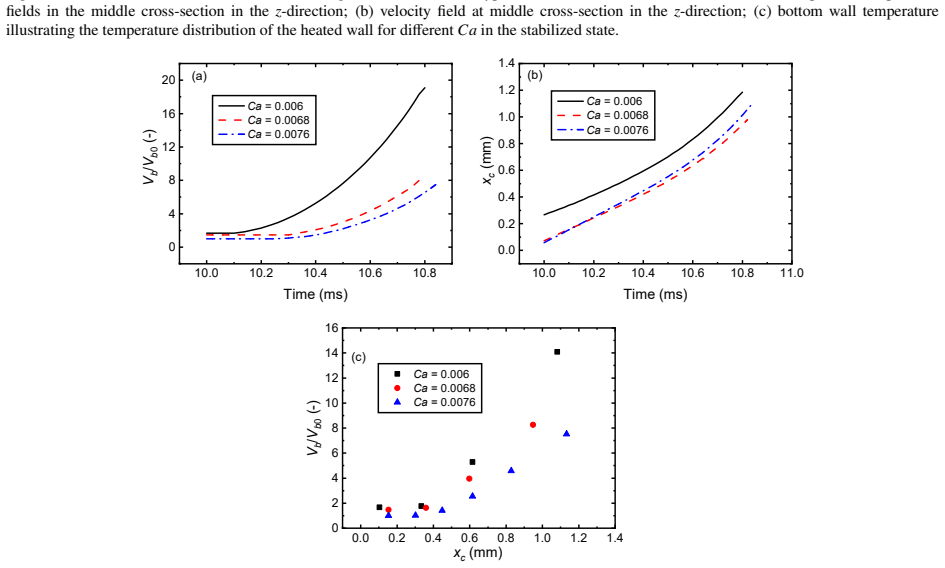
Numerical simulations show vapor bubble trains in microchannel flow boiling have frequency and growth rates set by initial vapor-liquid ratio and wall heat flux.
A machine-rendered reading of the paper's core claim, the machinery that carries it, and where it could break.
Core claim
The dynamics of vapor bubble trains in microchannel flow boiling are governed by the initial vapor-liquid volume ratio, which controls frequency and size-dependent growth, and by heat flux and latent heat, which control vaporization-driven expansion; upstream vaporization specifically accelerates downstream bubble movement.
What carries the argument
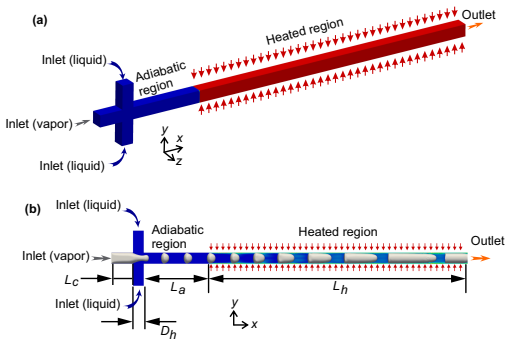
Numerical simulation of monodispersed vapor bubble trains generated by upstream flow-focusing to capture bubble-bubble interactions under constant wall heat flux.
If this is right
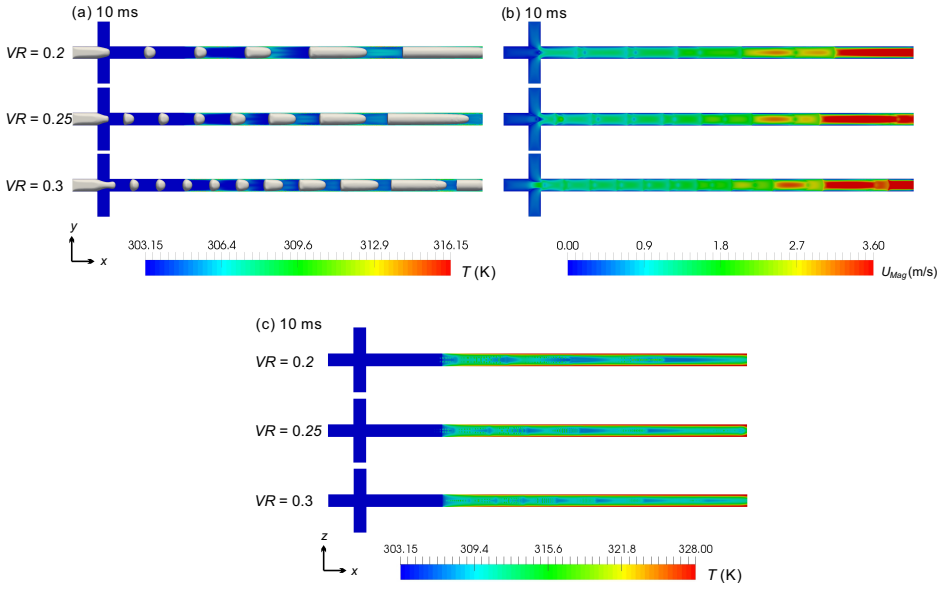
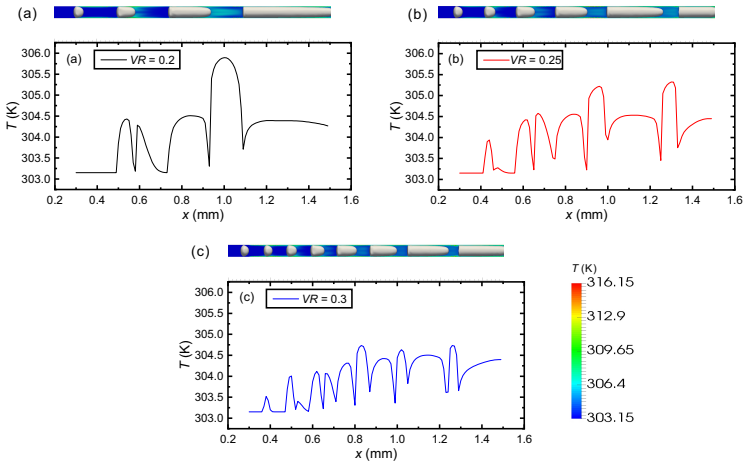
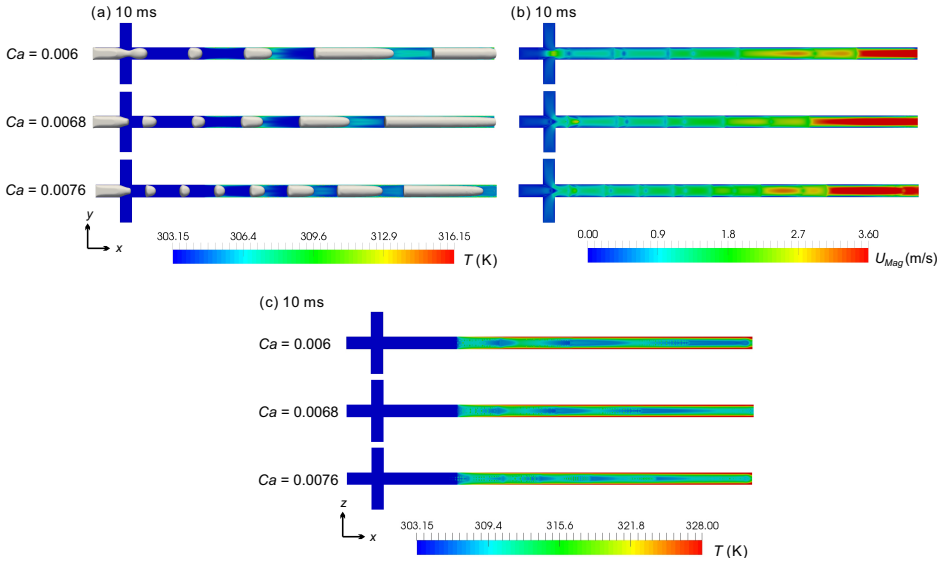
- Bubble frequency rises as the initial vapor-liquid volume ratio increases.
- Bubble growth rate falls with higher initial vapor-liquid volume ratio because of smaller individual bubble size.
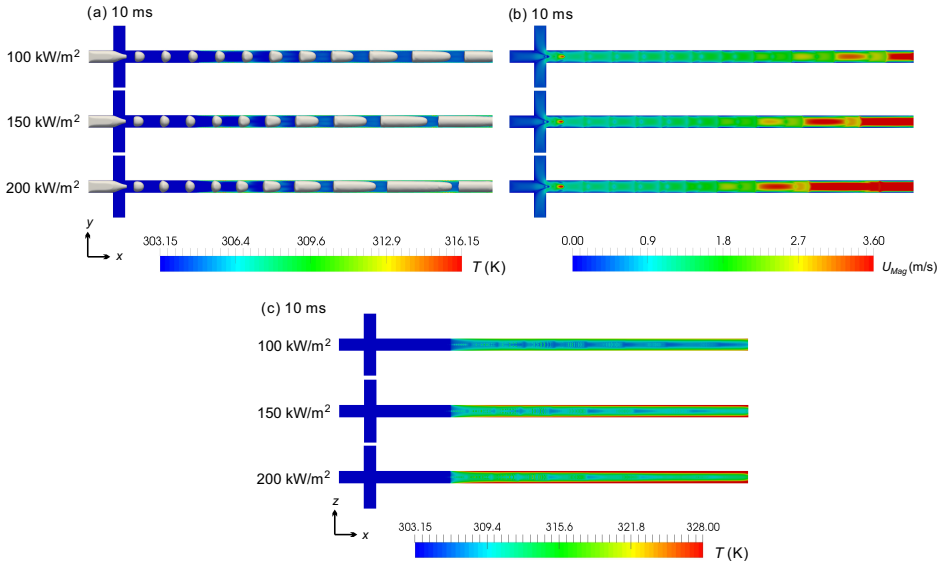
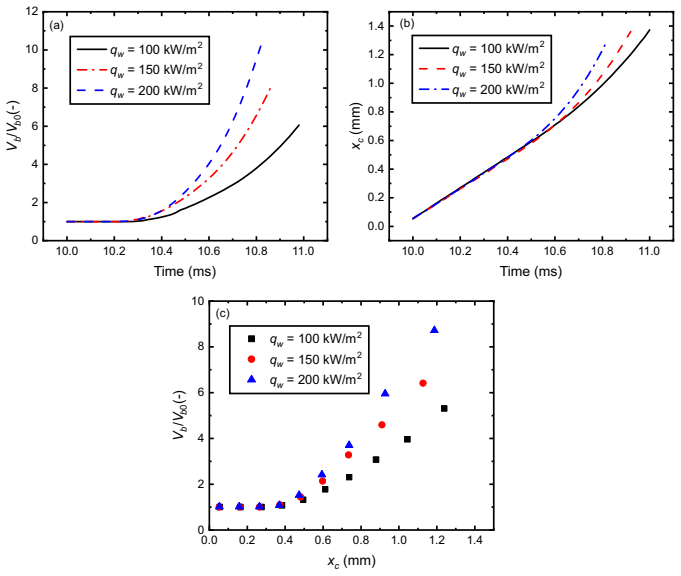
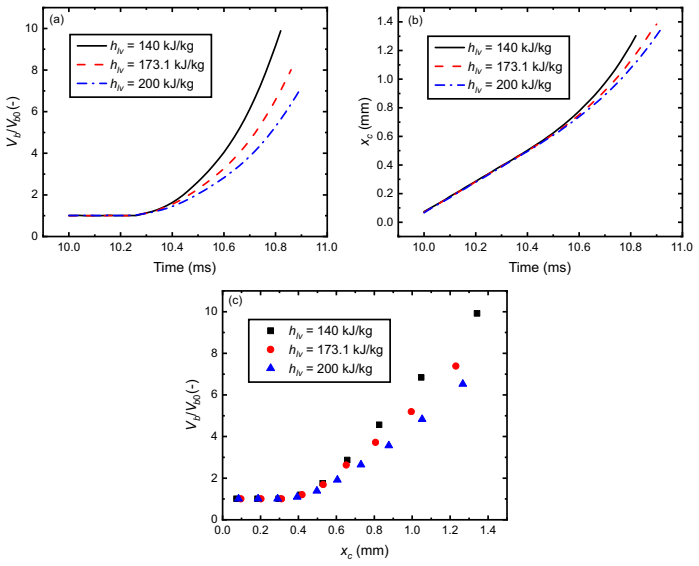
- Bubble train growth rate rises when wall heat flux increases or latent heat of the fluid decreases.
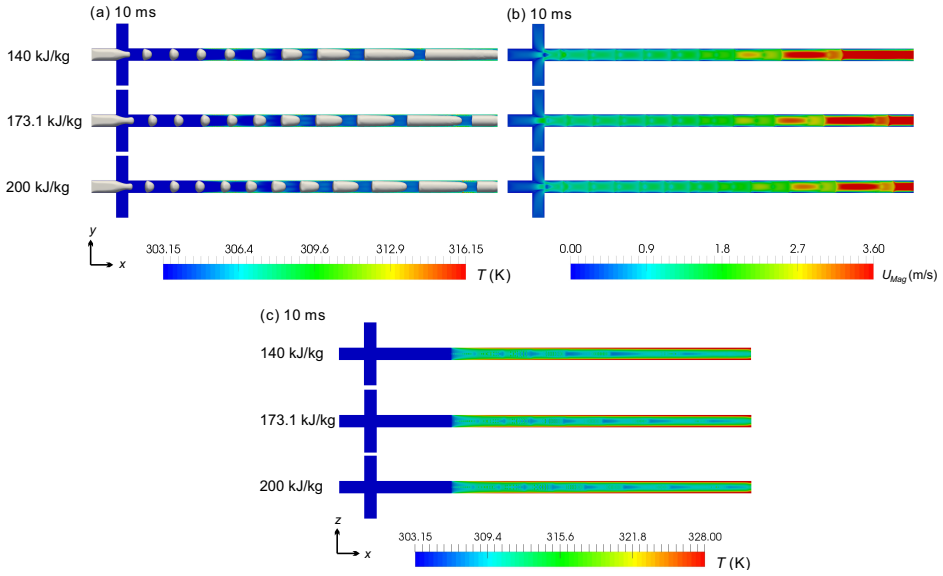
- Vaporization in the upstream region expands bubbles and accelerates their motion farther downstream.
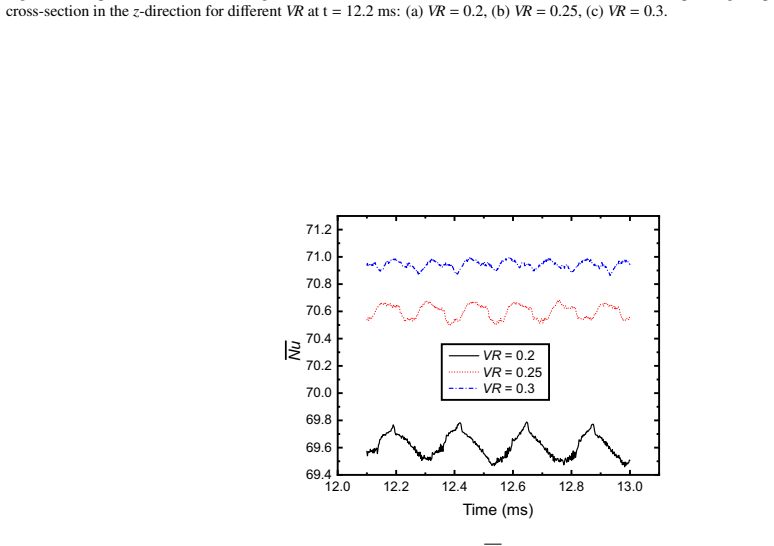
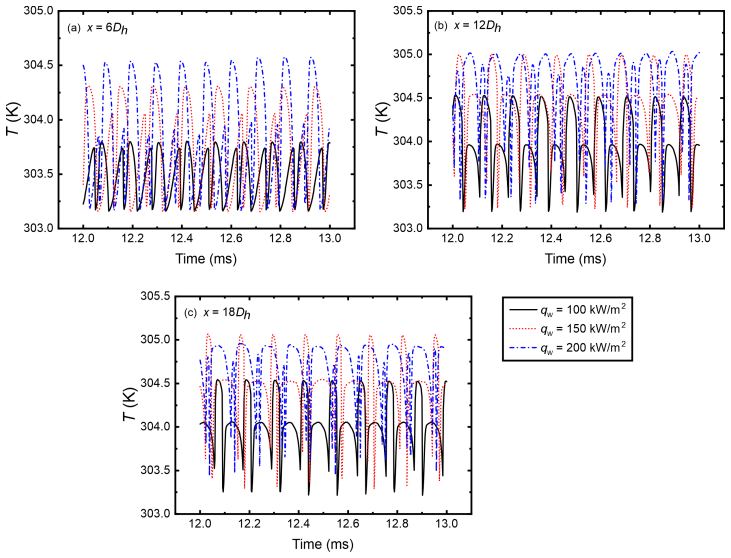
- Wall temperature and Nusselt number fluctuate periodically each time a bubble passes.
Where Pith is reading between the lines
- The identified upstream-to-downstream acceleration mechanism implies that bubble trains could produce more uniform heat removal than isolated bubbles in long channels.
- The periodic fluctuations suggest that time-averaged heat transfer models for microchannel design may need to incorporate bubble passage frequency explicitly.
- Extending the approach to varying channel geometries could test whether the same ratio and heat-flux scalings hold when confinement effects change.
Load-bearing premise
The flow-focusing method used to create the bubble trains produces interaction patterns that match those in real microchannel flow boiling without additional validation.
What would settle it
An experiment measuring bubble frequency, growth rate, and downstream velocity in a microchannel flow boiling setup without imposed flow-focusing, then checking whether the measured values match the simulated trends for the same vapor-liquid ratio and heat flux.
Figures
read the original abstract
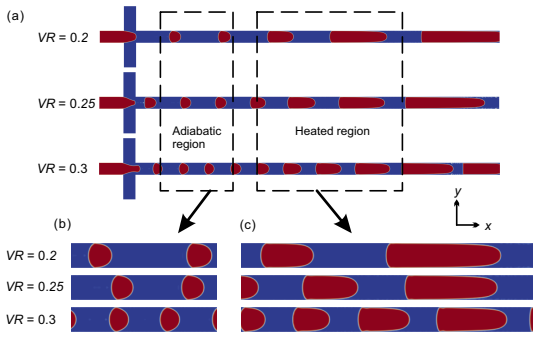
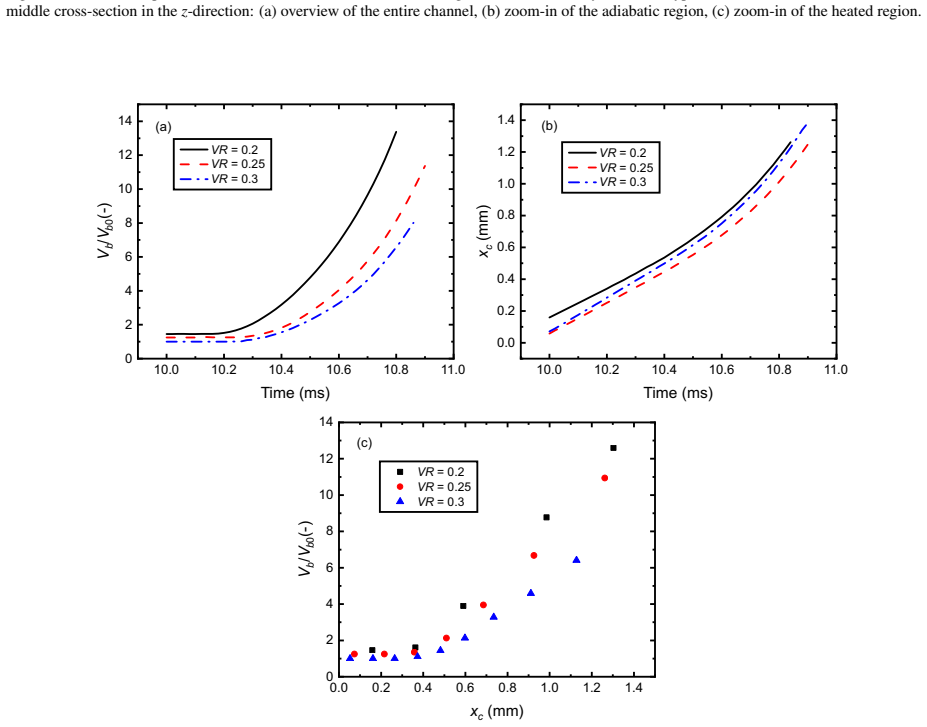
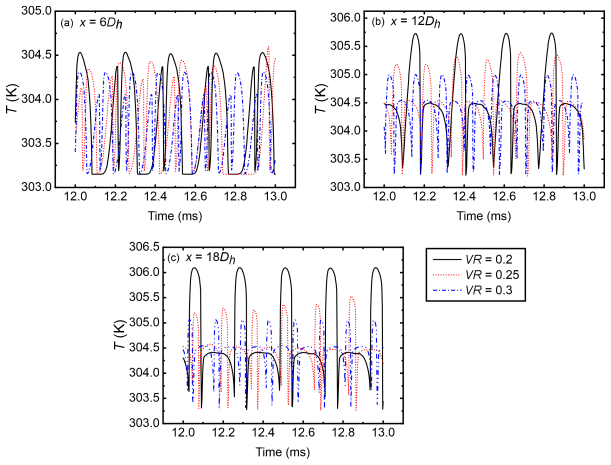
Microchannel flow boiling is a promising technique for micro-device thermal management, and understanding the bubble dynamics in microchannel flow boiling is important for the applications. Previous studies only focused on single, isolated bubbles, but the bubbles in microchannel flow boiling applications often exist as bubble trains, in which the bubbles interact with each other. Here, we investigate numerically vapor bubble trains in microchannel flow boiling by adopting the flow-focusing technique to form monodispersed bubbles in the upstream of the microchannel. With increasing the initial vapor-liquid volume ratio, the bubble frequency increases while the growth rate of the bubbles decreases because of the reduced bubble size. With increasing the heat flux on the wall or reducing the latent heat of the working fluid, the bubble train growth rate increases because of the increased vaporization rate. The vaporization of the fluid in the upstream causes the bubble expansion and accelerates the bubble movement in the downstream. The wall temperature and the Nusselt number fluctuate because of the periodic pass-through of bubbles.
Editorial analysis
A structured set of objections, weighed in public.
Referee Report
Summary. The paper numerically studies vapor bubble trains in microchannel flow boiling by using flow-focusing to generate monodispersed bubbles upstream of the heated section. It reports that increasing the initial vapor-liquid volume ratio raises bubble frequency but lowers growth rate (due to smaller bubbles), that higher wall heat flux or lower latent heat increases train growth rate via enhanced vaporization, and that upstream vaporization drives downstream expansion and acceleration; wall temperature and Nusselt number fluctuate periodically with bubble passage.
Significance. If the simulated trains reproduce the statistics and interactions of wall-nucleated bubbles, the parametric trends on frequency, growth rate, and upstream-downstream coupling could inform design of microchannel heat sinks. The work addresses a gap relative to single-bubble studies, but its significance is constrained by the absence of any demonstrated equivalence between flow-focused and wall-nucleated trains.
major comments (2)
- [Numerical setup / Methods] The central claims (bubble frequency vs. volume ratio, growth rate vs. heat flux/latent heat, upstream vaporization accelerating downstream motion) rest on the premise that flow-focused trains are representative of real microchannel boiling. No section validates that the resulting size distribution, spacing, or wake dynamics match those measured in wall-nucleated experiments; the method injects bubbles at fixed upstream conditions and then applies wall heat flux, decoupling nucleation from the heat-transfer process that produces bubbles in applications.
- [Abstract / Results] The abstract states that 'the vaporization of the fluid in the upstream causes the bubble expansion and accelerates the bubble movement in the downstream,' yet the provided description contains no equations, mesh details, boundary conditions, or error analysis supporting the causal attribution; all trends are stated as outcomes without visible derivation.
minor comments (2)
- [Abstract] The abstract reports trends without citing the specific volume ratios, heat fluxes, or fluids examined; adding these values would improve traceability.
- [Figures] Figure captions and axis labels should explicitly state the nondimensional groups used (e.g., vapor-liquid volume ratio definition) to allow direct comparison with prior single-bubble work.
Simulated Author's Rebuttal
We thank the referee for the constructive comments. We respond to each major comment below and note revisions where the manuscript will be updated.
read point-by-point responses
-
Referee: [Numerical setup / Methods] The central claims (bubble frequency vs. volume ratio, growth rate vs. heat flux/latent heat, upstream vaporization accelerating downstream motion) rest on the premise that flow-focused trains are representative of real microchannel boiling. No section validates that the resulting size distribution, spacing, or wake dynamics match those measured in wall-nucleated experiments; the method injects bubbles at fixed upstream conditions and then applies wall heat flux, decoupling nucleation from the heat-transfer process that produces bubbles in applications.
Authors: Our study intentionally adopts flow-focusing to generate controlled, monodispersed bubble trains upstream of the heated section. This setup isolates the effects of initial vapor-liquid volume ratio, heat flux, and latent heat on train dynamics and interactions, which is the paper's focus. We agree that no direct quantitative validation against wall-nucleated experimental statistics (size distribution, spacing, wake) is provided, as the work is purely numerical. In revision we will add a limitations subsection that discusses the differences between flow-focused and wall-nucleated trains, cites relevant experimental literature on microchannel bubble trains, and clarifies the scope of applicability of the reported trends. revision: partial
-
Referee: [Abstract / Results] The abstract states that 'the vaporization of the fluid in the upstream causes the bubble expansion and accelerates the bubble movement in the downstream,' yet the provided description contains no equations, mesh details, boundary conditions, or error analysis supporting the causal attribution; all trends are stated as outcomes without visible derivation.
Authors: The abstract is a concise summary; the full manuscript contains the governing equations, mesh details, boundary conditions, and mesh-independence/error analysis in the Methods section, with the upstream-downstream coupling demonstrated via simulation results (velocity and phase fields). The causal statement is an interpretation of those results. We will revise the abstract to phrase the claim more precisely as an observation supported by the simulations and will ensure the Results section explicitly ties the observed expansion and acceleration to the upstream vaporization mechanism. revision: yes
Circularity Check
No circularity: simulation outputs are direct results of the numerical setup
full rationale
The paper reports parametric trends from a numerical simulation of bubble trains generated via flow-focusing upstream of a heated microchannel section. No analytical derivations, fitted parameters, self-citations invoked as uniqueness theorems, or renamings of known results appear in the provided text. The reported effects (frequency vs. volume ratio, growth rate vs. heat flux/latent heat) are direct consequences of the imposed boundary conditions and phase-change model rather than quantities that reduce to the inputs by construction. This is the expected outcome for a self-contained simulation study without load-bearing analytical steps.
Axiom & Free-Parameter Ledger
Reference graph
Works this paper leans on
-
[1]
T. G. Karayiannis, M. M. Mahmoud, Flow boiling in microchannels: Fundamentals and applications, Applied Thermal Engineering 115 (2017) 1372–1397.doi:10.1016/j.applthermaleng.2016.08.063
-
[2]
I. Mudawar, Recent advances in high-flux, two-phase thermal management, Journal of Thermal Science and Engineering Applications 5 (2) (2013) 021012.doi:10.1115/1.4023599
-
[3]
P. Valeh-e Sheyda, M. Rahimi, E. Karimi, M. Asadi, Application of two-phase flow for cooling of hybrid microchannel PV cells: A comparative study, Energy Conversion and Management 69 (2013) 122–130. doi:10.1016/j.enconman.2013.01.029
-
[4]
H. Wu, S. Zhou, D. Wang, Y . Yang, L. Liu, H. Mao, B. Shu, Predictive modeling for microchannel flow boiling heat transfer under the dual effect of gravity and surface modification, Processes 12 (5) (2024) 1028.doi: 10.3390/pr12051028
-
[5]
I. Mudawar, Two-phase microchannel heat sinks: theory, applications, and limitations, Journal of Electronic Packaging 133 (4) (2011) 041002.doi:10.1115/1.4005300
-
[6]
J. R. Thome, Boiling in microchannels: a review of experiment and theory, International Journal of Heat and Fluid Flow 25 (2) (2004) 128–139.doi:10.1016/j.ijheatfluidflow.2003.11.005
-
[7]
C. Huh, C. W. Choi, M. H. Kim, Elongated bubble behavior during flow boiling in a microchannel, Journal of Mechanical Science and Technology 21 (11) (2007) 1819.doi:10.1007/BF03177438. 17
- [8]
-
[9]
T. Harirchian, S. V . Garimella, Boiling heat transfer and flow regimes in microchannels—a comprehensive understanding, Journal of Electronic Packaging 133 (1) (2011) 011001.doi:10.1115/1.4002721
-
[10]
J. R. Thome, A. Cioncolini, Two-phase flow pattern maps for microchannels, World Scientific, 2015, pp. 47–84. doi:10.1142/9789814623216_0020
-
[11]
L. Cheng, G. Xia, Fundamental issues, mechanisms and models of flow boiling heat transfer in microscale channels, International Journal of Heat and Mass Transfer 108 (2017) 97–127.doi:10.1016/j. ijheatmasstransfer.2016.12.003
work page doi:10.1016/j 2017
-
[12]
S. T. Kadam, I. Hassan, R. Kumar, M. A. Rahman, Bubble dynamics in microchannel: An overview of the state-of-the-art, Meccanica 56 (3) (2021) 481–513.doi:10.1007/s11012-020-01300-4
-
[13]
R. Revellin, V . Dupont, T. Ursenbacher, J. R. Thome, I. Zun, Characterization of diabatic two-phase flows in microchannels: Flow parameter results for R-134a in a 0.5mm channel, International Journal of Multiphase Flow 32 (7) (2006) 755–774.doi:10.1016/j.ijmultiphaseflow.2006.02.016
-
[14]
A. Mukherjee, S. G. Kandlikar, Numerical simulation of growth of a vapor bubble during flow boiling of water in a microchannel, Microfluidics and Nanofluidics 1 (2) (2005) 137–145.doi:10.1007/s10404-004-0021-8
-
[15]
A. Mukherjee, S. G. Kandlikar, Z. J. Edel, Numerical study of bubble growth and wall heat transfer during flow boiling in a microchannel, International Journal of Heat and Mass Transfer 54 (15-16) (2011) 3702–3718. doi:10.1016/j.ijheatmasstransfer.2011.01.030
-
[16]
R. Zhuan, W. Wang, Flow pattern of boiling in micro-channel by numerical simulation, International Journal of Heat and Mass Transfer 55 (5) (2012) 1741–1753.doi:10.1016/j.ijheatmasstransfer.2011.11.029
-
[17]
A. Ferrari, M. Magnini, J. R. Thome, Numerical analysis of slug flow boiling in square microchannels, International Journal of Heat and Mass Transfer 123 (2018) 928–944.doi: 10.1016/j.ijheatmasstransfer.2018.03.012
-
[18]
Y . Luo, W. Li, K. Zhou, K. Sheng, S. Shao, Z. Zhang, J. Du, W. J. Minkowycz, Three-dimensional numerical simulation of saturated annular flow boiling in a narrow rectangular microchannel, International Journal of Heat and Mass Transfer 149 (2020) 119246.doi:10.1016/j.ijheatmasstransfer.2019.119246
-
[19]
Z. Guo, B. S. Haynes, D. F. Fletcher, Numerical simulation of annular flow boiling in microchannels, The Journal of Computational Multiphase Flows 8 (1) (2016) 61–82.doi:10.1177/1757482X16634205
-
[20]
A. Priy, I. Ahmad, M. K. Khan, M. Pathak, Bubble interaction and heat transfer characteristics of microchannel flow boiling with single and multiple cavities, Journal of Thermal Science and Engineering Applications 16 (6) (2024) 061010.doi:10.1115/1.4065187
-
[21]
X. Zhang, Y . Zhang, C. Yang, J. Liu, B. Liu, Z. Zhou, Study of flow and heat transfer performance of nanofluids in curved microchannels with different curvatures, Numerical Heat Transfer, Part A: Applications (2024) 1– 22doi:10.1080/10407782.2024.2321520
-
[22]
O. A. Odumosu, H. Xu, T. Wang, Z. Che, Growth of elongated vapor bubbles during flow boiling heat transfer in wavy microchannels, Applied Thermal Engineering 223 (2023) 119987.doi:10.1016/j.applthermaleng. 2023.119987
-
[23]
Z. Zhang, G. Zhang, M. Wei, Y . Zhang, M. Tian, Numerical simulation of boiling behavior in vertical microchannels, Physics of Fluids 35 (9) (2023) 092011.doi:10.1063/5.0167304. 18
-
[24]
A. H. Rajkotwala, L. L. Boer, E. A. J. F. Peters, C. W. M. van der Geld, J. G. M. Kuerten, J. A. M. Kuipers, M. W. Baltussen, A numerical study of flow boiling in a microchannel using the local front reconstruction method, AIChE Journal 68 (4) (2022) e17598.doi:10.1002/aic.17598
-
[25]
Q. Liu, W. Wang, B. Palm, C. Wang, X. Jiang, On the dynamics and heat transfer of bubble train in micro- channel flow boiling, International Communications in Heat and Mass Transfer 87 (2017) 198–203.doi: 10.1016/j.icheatmasstransfer.2017.07.002
-
[26]
M. Magnini, J. R. Thome, Computational study of saturated flow boiling within a microchannel in the slug flow regime, Journal of Heat Transfer 138 (2) (2016) 021502.doi:10.1115/1.4031234
-
[27]
S. S. Bertsch, E. A. Groll, S. V . Garimella, Effects of heat flux, mass flux, vapor quality, and saturation temperature on flow boiling heat transfer in microchannels, International Journal of Multiphase Flow 35 (2) (2009) 142–154.doi:10.1016/j.ijmultiphaseflow.2008.10.004
-
[28]
P. Zhu, L. Wang, Passive and active droplet generation with microfluidics: a review, Lab on a Chip 17 (1) (2017) 34–75.doi:10.1039/C6LC01018K
-
[29]
C. N. Baroud, F. Gallaire, R. Dangla, Dynamics of microfluidic droplets, Lab on a Chip 10 (16) (2010) 2032– 2045.doi:10.1039/C001191F
-
[30]
H. Scheufler, J. Roenby, TwoPhaseFlow: A framework for developing two phase flow solvers in OpenFOAM, OpenFOAM®Journal 3 (2023) 200–224.doi:10.51560/ofj.v3.80
-
[31]
J. U. Brackbill, D. B. Kothe, C. Zemach, A continuum method for modeling surface tension, Journal of Computational Physics 100 (2) (1992) 335–354.doi:10.1016/0021-9991(92)90240-y
-
[32]
S. Hardt, F. Wondra, Evaporation model for interfacial flows based on a continuum-field representation of the source terms, Journal of Computational Physics 227 (11) (2008) 5871–5895.doi:10.1016/j.jcp.2008.02. 020
-
[33]
Y . Luo, J. Zhang, W. Li, E. Sokolova, Y . Li, W. Minkowycz, Numerical investigation of the bubble growth in horizontal rectangular microchannels, Numerical Heat Transfer, Part A: Applications 71 (12) (2017) 1175–1188. doi:10.1080/10407782.2017.1350538
-
[34]
S. L. Anna, Droplets and bubbles in microfluidic devices, Annual Review of Fluid Mechanics 48 (2016) 285– 309.doi:10.1146/annurev-fluid-122414-034425
-
[35]
S. L. Anna, N. Bontoux, H. A. Stone, Formation of dispersions using “flow focusing” in microchannels, Applied Physics Letters 82 (3) (2003) 364–366.doi:10.1063/1.1537519
-
[36]
T. Moragues, D. Arguijo, T. Beneyton, C. Modavi, K. Simutis, A. R. Abate, J.-C. Baret, A. J. deMello, D. Densmore, A. D. Griffiths, Droplet-based microfluidics, Nature Reviews Methods Primers 3 (1) (2023) 32. doi:10.1038/s43586-023-00212-3
-
[37]
Z. Che, T. N. Wong, N.-T. Nguyen, C. Yang, Three dimensional features of convective heat transfer in droplet- based microchannel heat sinks, International Journal of Heat and Mass Transfer 86 (2015) 455–464.doi: 10.1016/j.ijheatmasstransfer.2015.03.030. 19
discussion (0)
Sign in with ORCID, Apple, or X to comment. Anyone can read and Pith papers without signing in.