Linear Stability Analysis of convective flows in Rotating Baroclinic Annulus with Localized Peripheral Heating: A Floquet-BiGlobal Approach
Pith reviewed 2026-06-28 08:28 UTC · model grok-4.3
The pith
A Floquet-BiGlobal analysis shows that cross-modal baroclinic energy release and shear production drive instability in a rotating annulus with localized heating.
A machine-rendered reading of the paper's core claim, the machinery that carries it, and where it could break.
Core claim
The non-axisymmetric base state generated by localized heating invalidates classical axisymmetric theory; instead, Floquet-Bloch theory combined with BiGlobal formulation in the meridional plane reveals that instability is driven by cross-modal baroclinic energy release and shear production through coupled azimuthal modes.
What carries the argument
Floquet-BiGlobal eigenvalue formulation, in which the non-axisymmetric base state is expanded in azimuthal Fourier harmonics and perturbations are expressed as quasi-periodic Bloch modes coupling all azimuthal wavenumbers.
If this is right
- The full linearized perturbation equations must account for coupling between all azimuthal wavenumbers via the base-state harmonics.
- A modal energy budget analysis isolates baroclinic release and shear production as the dominant mechanisms.
- The BiGlobal block-operator structure after pressure elimination and solenoidal projection enables computation of the coupled modes.
Where Pith is reading between the lines
- Applying this method to different heating localizations could map how asymmetry strength affects the critical parameters for onset.
- The Bloch-mode framework may extend to other rotating flows with azimuthal asymmetries such as in atmospheric or oceanic models.
- The derived energy budget could suggest parameter regimes where specific modes are suppressed or enhanced.
Load-bearing premise
The non-axisymmetric base state can be expanded in azimuthal Fourier harmonics and perturbations can be expressed as quasi-periodic Bloch modes that couple all azimuthal wavenumbers through the base-state harmonics.
What would settle it
Direct numerical simulation of the time-dependent linearized Navier-Stokes equations in the full 3D annulus geometry that yields different growth rates or eigenmodes from the Floquet-BiGlobal predictions would falsify the analysis.
Figures
read the original abstract
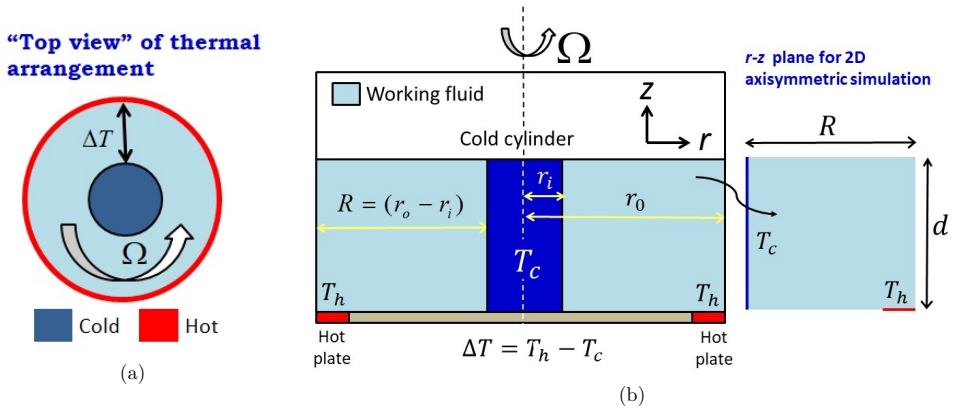
We investigate the linear stability of a rotating fluid annulus subjected to localized heating at the outer periphery of the bottom surface and uniform cooling at the inner cylindrical wall through a rigorous stability analysis. The localized forcing generates a non-axisymmetric base state, invalidating the classical normal-mode decomposition. We employ Floquet-Bloch theory in the azimuthal coordinate combined with a BiGlobal eigenvalue formulation in the meridional plane. The non-axisymmetric base state is expanded in azimuthal Fourier harmonics; perturbations are expressed as quasi-periodic Bloch modes that couple all azimuthal wavenumbers through base-state harmonics. Full linearised perturbation equations, the BiGlobal block-operator structure, pressure elimination, solenoidal projection, and the modal energy budget are derived. Instability is driven by cross-modal baroclinic energy release and shear production - mechanisms absent in classical axisymmetric theory.
Editorial analysis
A structured set of objections, weighed in public.
Referee Report
Summary. The paper develops a Floquet-BiGlobal linear stability formulation for a rotating fluid annulus with localized peripheral heating that produces a non-axisymmetric base state. The base flow is expanded in azimuthal Fourier harmonics; perturbations are written as quasi-periodic Bloch modes that couple all azimuthal wavenumbers. The manuscript derives the full linearized equations, the block-operator structure in the meridional plane, pressure elimination, solenoidal projection, and a modal energy budget, concluding that the instability is sustained by cross-modal baroclinic energy release and shear production absent from classical axisymmetric theory.
Significance. If the energy-budget derivation is shown to isolate the claimed cross-modal transfers without contamination from the projection or truncation, the work supplies a concrete numerical framework for stability problems in which localized forcing breaks axisymmetry. The explicit construction of the Bloch-coupled operator and the associated energy integrals could be reusable for other rotating or baroclinic configurations where classical normal-mode analysis is inapplicable.
major comments (2)
- [Abstract / modal energy budget derivation] Abstract and the section deriving the modal energy budget: the central claim that instability growth is attributable to cross-modal baroclinic release and shear production (absent under axisymmetric reduction) rests on the energy integrals correctly separating inter-modal from intra-modal contributions after solenoidal projection. No verification, error analysis, or numerical test demonstrating that these terms vanish when the base-state harmonics are set to zero is supplied, leaving the distinction from classical theory unconfirmed.
- [Floquet-Bloch formulation] The Bloch quasi-periodicity assumption (perturbations couple all azimuthal wavenumbers through base-state harmonics): while formally consistent with the non-axisymmetric base state, the manuscript provides no explicit check that the resulting energy pathways remain physically faithful once the projection is applied; any mixing of intra- and inter-modal terms would undermine the reported mechanism.
minor comments (1)
- [Numerical formulation] Notation for the block-operator matrix and the Fourier truncation level should be stated explicitly (e.g., number of retained base-state harmonics and perturbation wavenumbers) to allow reproducibility of the eigenvalue problem.
Simulated Author's Rebuttal
We thank the referee for the constructive comments, which help clarify the presentation of our Floquet-BiGlobal analysis. We respond to each major comment below, agreeing that additional verification would strengthen the manuscript, and we will incorporate the suggested checks in the revised version.
read point-by-point responses
-
Referee: [Abstract / modal energy budget derivation] Abstract and the section deriving the modal energy budget: the central claim that instability growth is attributable to cross-modal baroclinic release and shear production (absent under axisymmetric reduction) rests on the energy integrals correctly separating inter-modal from intra-modal contributions after solenoidal projection. No verification, error analysis, or numerical test demonstrating that these terms vanish when the base-state harmonics are set to zero is supplied, leaving the distinction from classical theory unconfirmed.
Authors: The referee is correct that the current manuscript lacks an explicit numerical test or error analysis confirming that cross-modal terms vanish when base-state harmonics are zero. The modal energy budget is obtained by taking the inner product of the linearized equations (after solenoidal projection to remove pressure) with the complex-conjugate velocity field and integrating over the meridional domain; because the projection operator is linear and the base flow is decomposed into Fourier harmonics, the resulting integrals separate intra-modal and inter-modal contributions by construction. To make this separation explicit and confirm the distinction from classical axisymmetric theory, we will add a new subsection in the revised manuscript that performs the requested numerical test: the base-state harmonics are artificially set to zero, the coupled system reduces to independent modes, and the cross-modal baroclinic and shear-production integrals are shown to be numerically zero within truncation error. This will directly address the concern. revision: yes
-
Referee: [Floquet-Bloch formulation] The Bloch quasi-periodicity assumption (perturbations couple all azimuthal wavenumbers through base-state harmonics): while formally consistent with the non-axisymmetric base state, the manuscript provides no explicit check that the resulting energy pathways remain physically faithful once the projection is applied; any mixing of intra- and inter-modal terms would undermine the reported mechanism.
Authors: We acknowledge that the manuscript does not supply an explicit numerical check that the projection preserves the separation of energy pathways. The Bloch quasi-periodic form is substituted into the linearized equations, yielding a block-operator eigenvalue problem in the meridional plane; the solenoidal projection is applied to the velocity field prior to forming the energy integrals, so it cannot introduce artificial mixing between intra- and inter-modal terms. Nevertheless, to demonstrate physical fidelity, the revised manuscript will include a short validation: the full coupled energy budget will be compared against a single-wavenumber truncation (where inter-modal coupling is absent by definition), confirming that the reported cross-modal baroclinic release and shear production remain unchanged within the truncation tolerance. This will be presented alongside the existing derivation of the block operators. revision: yes
Circularity Check
No circularity: derivation of Floquet-BiGlobal linear operator and energy budget is self-contained
full rationale
The paper derives the linearized perturbation equations, BiGlobal block-operator structure, pressure elimination, solenoidal projection, and modal energy budget directly from the governing equations applied to a non-axisymmetric base state expanded in azimuthal Fourier harmonics and Bloch modes. The claimed cross-modal baroclinic and shear mechanisms follow from the structure of those derived integrals (which vanish under axisymmetric reduction by construction of the Fourier coupling). No self-definitional loops, fitted inputs renamed as predictions, load-bearing self-citations, uniqueness theorems imported from prior author work, or ansatzes smuggled via citation appear in the derivation chain. The result is a standard linear stability formulation whose outputs are not equivalent to its inputs by definition.
Axiom & Free-Parameter Ledger
Forward citations
Cited by 1 Pith paper
-
Influence of Aspect ratio in the Convection in Rotating Annulus In the Presence of Localized Heating
2D axisymmetric simulations show Nu scales as Ra^{1/4} with weak rotational influence at moderate/high Ra, rotational suppression at low Ra/high Ta, and heat transfer increasing with aspect ratio Γ up to 1.
Reference graph
Works this paper leans on
-
[1]
Deterministic nonperiodic flow,
E. N. Lorenz, “Deterministic nonperiodic flow,” J. Atmos. Sci., vol. 20, pp. 130–141, 1963
1963
-
[2]
Ghil and S
M. Ghil and S. Childress, Topics in Geophysical Fluid Dynamics, Springer, New York, 1987
1987
-
[3]
A.K. Banerjee, Axisymmetric Study of Convec- tion in Rotating Annulus in the Presence of Local- ized Heating, Physics of Fluids, Vol. 36, Issue 12, 126621, December 2024. doi: https://doi.org/ 10.1063/5.0239746
-
[4]
A.K. Banerjee, A. Bhattacharya, S. Balasubrama- nian, Investigation of Heat Transfer Characteris- tics in a Rotating Convection System with Bidirec- tional Thermal Gradients, ASME J. Heat Trans- fer, January 2021; 143(1):011802. doi: https:// doi.org/10.1115/1.4048825
-
[5]
A.K. Banerjee, A. Bhattacharya, S. Balasubra- manian, Experimental Study of Rotating Con- vection in the Presence of Bi-directional Ther- mal Gradients with Localized Forcing, AIP Ad- vances, Vol. 8, Issue 11, 115324, 2018. doi: https: //doi.org/10.1063/1.5061808
-
[6]
Swarnakar, A.K
S. Swarnakar, A.K. Banerjee, A. Bhattacharya, S. Balasubramanian, Numerical Investigation of Rotating Convection in a New Configuration with Bidirectional Thermal Gradients, in: T. Prabu, P. Viswanathan, A. Agrawal, J. Banerjee (eds.), Fluid Mechanics and Fluid Power, Lecture Notes in Mechanical Engineering, Springer, Sin- gapore, 2021. doi: https://doi.o...
2021
-
[7]
Kaiser, Heat Transfer by Symmetrical Ro- tating Annulus Convection, Journal of the Atmospheric Sciences, Vol
J. Kaiser, Heat Transfer by Symmetrical Ro- tating Annulus Convection, Journal of the Atmospheric Sciences, Vol. 28, pp. 929– 932, 1971. doi: https://doi.org/10.1175/ 1520-0469(1971)028<0929:HTBSRA>2.0.CO;2
1971
-
[8]
Hide and W
R. Hide and W. Fowlis, Thermal Convection in a Rotating Annulus of Liquid: Effect of Viscosity on the Transition Between Axisymmetric and Non-Axisymmetric Flow Regimes, Journal of the Atmospheric Sciences, Vol. 22, pp. 541– 558, 1965. doi: https://doi.org/10.1175/ 1520-0469(1965)022<0541:TCIARA>2.0.CO;2
1965
-
[9]
R. Hide, P. Mason, and R. Plumb, Ther- mal Convection in a Rotating Fluid Subject to a Horizontal Temperature Gradient: Spa- tial and Temporal Characteristics of Fully Developed Baroclinic Waves, Journal of the Atmospheric Sciences, Vol. 34, pp. 930– 950, 1977. doi: https://doi.org/10.1175/ 1520-0469(1977)034<0930:TCIARF>2.0.CO;2
1977
-
[10]
Aspect ratio dependence in the convection in rotating annulus in the presence of localized heating,
A. K. Banerjee and S. Swarnakar, “Aspect ratio dependence in the convection in rotating annulus in the presence of localized heating,” in Recent Ad- vances in Thermal and Fluid Science, A. K. Par- wani, D. K. Gupta, V. M. Patel, and S. Ray, Eds., Lecture Notes in Mechanical Engineering, Springer, Singapore, 2026, doi: 10.1007/978-981- 96-8508-0_1
-
[11]
A. K. Banerjee, “An integrated laboratory and axisymmetric numerical study of convection in a rotating annulus with bi-directional thermal forc- ings,” in Recent Advances in Thermal and Fluid Science, A. K. Parwani, D. K. Gupta, V. M. Pa- tel, and S. Ray, Eds., Lecture Notes in Mechan- ical Engineering, Springer, Singapore, 2026, doi: 10.1007/978-981-96-8508-0_3
-
[12]
A.K. Banerjee, S. Tirodkar, A. Bhattacharya, S. Balasubramanian, Convection in Rotating Flows with Simultaneous Imposition of Ra- dial and Vertical Temperature Gradients, VIII th Intl. Symp. on Stratified Flows, August 29– September 1, 2016, San Diego, CA, USA. arXiv:1611.00807
Pith/arXiv arXiv 2016
-
[13]
H.T. Rossby, On thermal convection driven by non-uniform heating from below: an experimen- tal study, Deep Sea Research and Oceanographic Abstracts, Vol. 12, pp. 9–16, 1965. doi: https: //doi.org/10.1016/0011-7471(65)91336-7
-
[14]
Experimental study of rotating convection in a novel configuration,
A. K. Banerjee, A. Bhattacharya, and S. Bal- asubramanian, “Experimental study of rotating convection in a novel configuration,” in Proc. 5th Int. Conf. on Computational Methods for Thermal Problems (ThermaComp2018), Bangalore, India, Jul. 9–11, 2018, ISSN 2305-6924
2018
-
[15]
Effect of rotation and baroclinicity on heat transport and turbulent convection in an- nular flow,
A. K. Banerjee, A. Bhattacharya, and S. Bala- subramanian, “Effect of rotation and baroclinicity on heat transport and turbulent convection in an- nular flow,” in Proc. 6th Int. Congress on Compu- tational Mechanics and Simulation (ICCMS), IIT Bombay, India, Jun. 27–Jul. 1, 2016
2016
-
[16]
Banerjee, S
A.K. Banerjee, S. Swarnakar, Numerical Influ- ence of Aspect ratio in the Convection in Rotat- ing Annulus In the Presence of Localized Heating, FMFP Lecture Notes in Mechanical Engineering, Springer Singapore, 2026 (under review) 7
2026
discussion (0)
Sign in with ORCID, Apple, or X to comment. Anyone can read and Pith papers without signing in.