GEM Production at the FTD in Bonn
Pith reviewed 2026-06-28 08:07 UTC · model grok-4.3
The pith
The FTD in Bonn has set up a production line for 10 cm x 10 cm GEM foils that achieves uniform hole sizes and leakage currents below 1 nA at 600 V.
A machine-rendered reading of the paper's core claim, the machinery that carries it, and where it could break.
Core claim
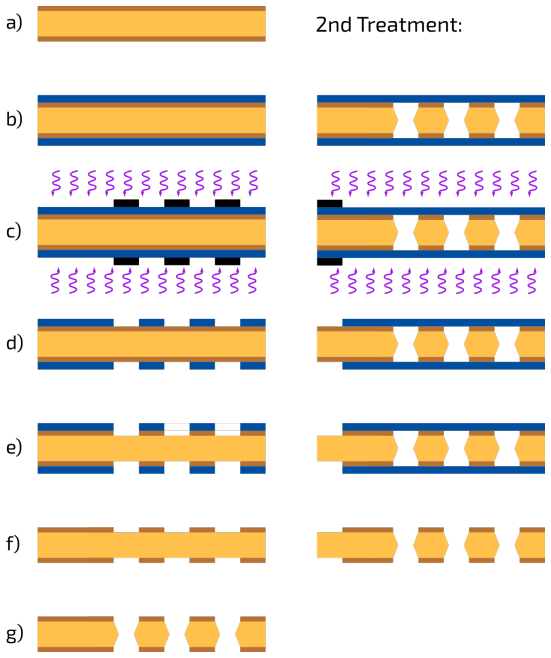
The fabrication process utilizing a double-mask photolithographic technique on 50 μm polyimide cladded on both sides with 5 μm copper, together with the chemical etching procedure that achieves uniform hole geometries with outer hole diameters of 70 μm and inner hole diameters of 50 μm, combined with semi-automated optical inspection and high-voltage leakage current tests, produces foils with uniform hole size distributions and leakage currents of less than 1 nA at 600 V in air with no discharge hotspots, confirming that the production chain is capable of delivering high-performance foils suitable for research and development purposes.
What carries the argument
Double-mask photolithographic technique followed by chemical etching to control hole diameters on copper-clad polyimide, validated by optical inspection and high-voltage leakage testing.
If this is right
- The production chain can supply GEM foils that meet the performance requirements for gaseous detectors.
- Local fabrication removes dependence on distant suppliers for small-scale R&D quantities.
- The same process supports repeated production runs for detector prototyping.
- Quality protocols provide a repeatable way to verify foil suitability before detector assembly.
Where Pith is reading between the lines
- The established line could be used to test variations in hole geometry or substrate thickness for specific detector applications.
- If scaled, the method might reduce turnaround time for custom foil designs in ongoing experiments.
- Combining these foils with other locally produced detector elements could simplify full detector construction at the same site.
Load-bearing premise
The chemical etching procedure will reliably produce the target outer hole diameter of 70 μm and inner hole diameter of 50 μm with sufficient uniformity across the 10 cm x 10 cm foil area without post-etch adjustments or high failure rates.
What would settle it
Measuring leakage currents above 1 nA at 600 V or observing non-uniform hole sizes or discharge hotspots during quality control on multiple produced foils would show the production chain does not deliver the claimed performance.
Figures
read the original abstract
This manuscript describes the establishment of a local production line for 10 cm x 10 cm Gas Electron Multiplier (GEM) foils at the Forschungs- und Technologiezentrum Detektorphysik (FTD) at the university of Bonn. GEM foils are widely used in modern gaseous detectors, providing high-gain signal amplification and high-rate capability. Our fabrication process utilizes a double-mask photolithographic technique on 50 $\mu$m polyimide cladded on both sides with 5 $\mu$m copper. The chemical etching procedure that is required to achieve uniform hole geometries with outer hole diameters of 70 $\mu$m and inner hole diameters of 50 $\mu$m will be described. Quality control protocols, including semi-automated optical inspection and high-voltage leakage current tests, demonstrate that foils produced at our facility achieve uniform hole size distributions and leakage currents of less than 1 nA at 600 V in air with no discharge hotspots. These results confirm that the production chain is capable of delivering high-performance foils suitable for research and development purposes.
Editorial analysis
A structured set of objections, weighed in public.
Referee Report
Summary. The manuscript describes the establishment of a local production line for 10 cm × 10 cm GEM foils at the FTD in Bonn. It details a double-mask photolithographic process on 50 μm polyimide with 5 μm copper cladding and the chemical etching steps needed to reach target outer/inner hole diameters of 70/50 μm. Quality-control results from semi-automated optical inspection and high-voltage leakage tests are reported to show uniform hole-size distributions together with leakage currents below 1 nA at 600 V in air and no discharge hotspots, leading to the conclusion that the facility can supply high-performance foils for R&D use.
Significance. If the quantitative QC data are supplied and shown to be reproducible, the work would be useful to the detector community by documenting an accessible European source of GEM foils and by making the process parameters available for replication or adaptation in other R&D settings.
major comments (1)
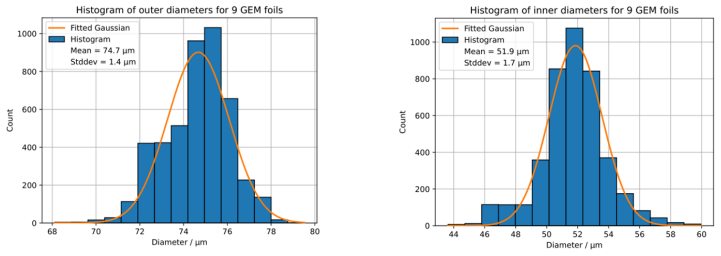
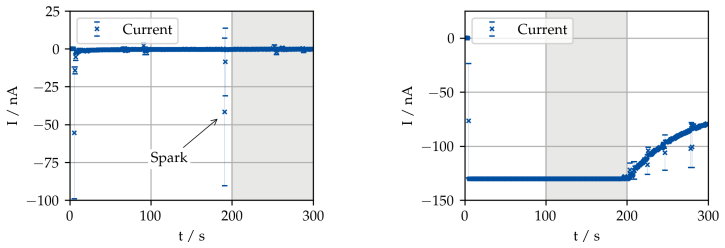
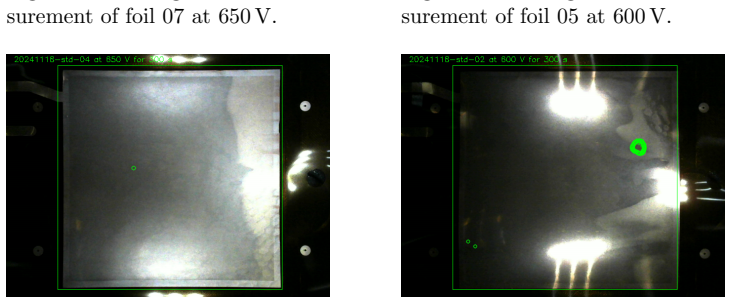
- [Quality-control / Results description] The quality-control results (optical inspection and HV leakage measurements) are stated only qualitatively in the abstract and process description; no hole-diameter histograms, standard deviations, number of foils or holes sampled, or comparison with commercial reference foils are provided. This absence prevents assessment of whether the claimed uniformity and <1 nA leakage performance are statistically supported.
Simulated Author's Rebuttal
We thank the referee for the constructive feedback. We agree that the quality-control section requires quantitative data to support the claims of uniformity and low leakage, and we will revise the manuscript to include the requested details.
read point-by-point responses
-
Referee: [Quality-control / Results description] The quality-control results (optical inspection and HV leakage measurements) are stated only qualitatively in the abstract and process description; no hole-diameter histograms, standard deviations, number of foils or holes sampled, or comparison with commercial reference foils are provided. This absence prevents assessment of whether the claimed uniformity and <1 nA leakage performance are statistically supported.
Authors: We acknowledge that the current manuscript presents the QC results only qualitatively. In the revised version we will add hole-diameter histograms (with mean, standard deviation and sample size), specify the number of foils and holes inspected, report the number of foils tested for leakage current, and include a direct comparison to commercial reference foils using the same measurement protocols. These additions will provide the statistical basis for the stated performance. revision: yes
Circularity Check
No significant circularity
full rationale
This is a purely experimental methods paper describing a GEM foil fabrication process and associated quality-control measurements. No equations, derivations, fitted parameters, or model-based predictions appear anywhere in the text. The central claims rest directly on reported optical inspection data and leakage-current test results, which are independent measurements rather than reductions of any prior input by construction. No self-citations, uniqueness theorems, or ansatzes are invoked. The work is therefore self-contained against external benchmarks and receives the default non-circularity finding.
Axiom & Free-Parameter Ledger
Reference graph
Works this paper leans on
-
[1]
GEM: A new concept for electron amplification in gas de- tectors
F. Sauli. “GEM: A new concept for electron amplification in gas de- tectors”. In:Nucl. Instrum. Meth. A386 (1997), pp. 531–534.doi: 10.1016/S0168-9002(96)01172-2
-
[2]
The upgrade of the ALICE TPC with GEMs and continuous readout
J. Adolfsson et al. “The upgrade of the ALICE TPC with GEMs and continuous readout”. In:JINST16.03 (2021), P03022.doi:10.1088/ 1748-0221/16/03/P03022. arXiv:2012.09518 [physics.ins-det]
arXiv 2021
-
[3]
Development of the CMS detector for the CERN LHC Run 3
Aram Hayrapetyan et al. “Development of the CMS detector for the CERN LHC Run 3”. In:JINST19.05 (2024), P05064.doi:10.1088/ 1748-0221/19/05/P05064. arXiv:2309.05466 [physics.ins-det]
arXiv 2024
-
[4]
Construction, test and commissioning of the triple- GEM tracking detector for COMPASS
C. Altunbas et al. “Construction, test and commissioning of the triple- GEM tracking detector for COMPASS”. In:Nucl. Instrum. Meth. A 490 (2002), pp. 177–203.doi:10.1016/S0168-9002(02)00910-5
-
[5]
Progress on large area GEMs (VCI 2010)
Marco Villa et al. “Progress on large area GEMs”. In:Nucl. Instrum. Meth. A628 (2011). Ed. by Thomas Bergauer et al., pp. 182–186.doi: 10.1016/j.nima.2010.06.312. arXiv:1007.1131 [physics.ins-det]
work page internal anchor Pith review Pith/arXiv arXiv doi:10.1016/j.nima.2010.06.312 2011
-
[7]
I. Giomataris et al. “Micromegas in a bulk”. In:Nucl. Instrum. Meth. A560 (2006), pp. 405–408.doi:10 . 1016 / j . nima . 2005 . 12 . 222. arXiv:physics/0501003
Pith/arXiv arXiv 2006
-
[8]
A floating multi-channel picoammeter for mi- cropattern gaseous detector current monitoring
A. Utrobicic et al. “A floating multi-channel picoammeter for mi- cropattern gaseous detector current monitoring”. In:Nucl. Instrum. Meth. A801 (2015), pp. 21–26.doi:10.1016/j.nima.2015.08.021
-
[9]
Development of a Spark-Detection System for the Qual- ity Assurance of Large-Area GEM-Foils
M. Ball et al. “Development of a Spark-Detection System for the Qual- ity Assurance of Large-Area GEM-Foils”. In:J. Phys. Conf. Ser.1498 (2020). Ed. by Paul Colas, Theopisti Dafni, and Esther Ferrer Ribas, p. 012056.doi:10.1088/1742-6596/1498/1/012056
-
[10]
Study of long-term sustained operation of gaseous detectors for the high rate environment in CMS
Jeremie Alexandre Merlin. “Study of long-term sustained operation of gaseous detectors for the high rate environment in CMS”. PhD thesis. Strasbourg U., Apr. 2016
2016
-
[11]
Optical quality assurance of GEM foils
T. Hild´ en et al. “Optical quality assurance of GEM foils”. In:Nucl. Instrum. Meth. A770 (2015), pp. 113–122.doi:10.1016/j.nima. 2014.10.015. arXiv:1704.06691 [physics.ins-det]. 13
work page internal anchor Pith review Pith/arXiv arXiv doi:10.1016/j.nima 2015
discussion (0)
Sign in with ORCID, Apple, or X to comment. Anyone can read and Pith papers without signing in.