Optimizing Proof-Search via Linearization for G\"odel-L\"ob Logic with Tree-Hypersequents
Pith reviewed 2026-06-28 07:53 UTC · model grok-4.3
The pith
A linearization method decides validity for Gödel-Löb logic in tree-hypersequent systems in PSPACE.
A machine-rendered reading of the paper's core claim, the machinery that carries it, and where it could break.
Core claim
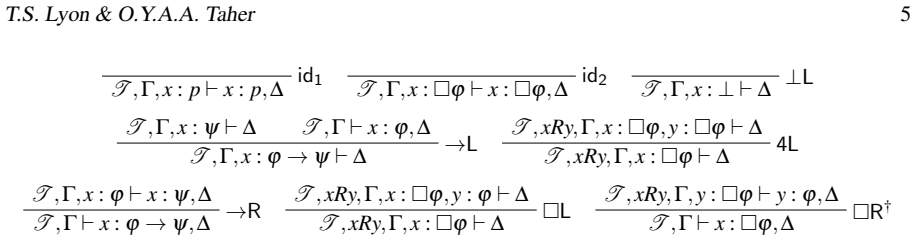
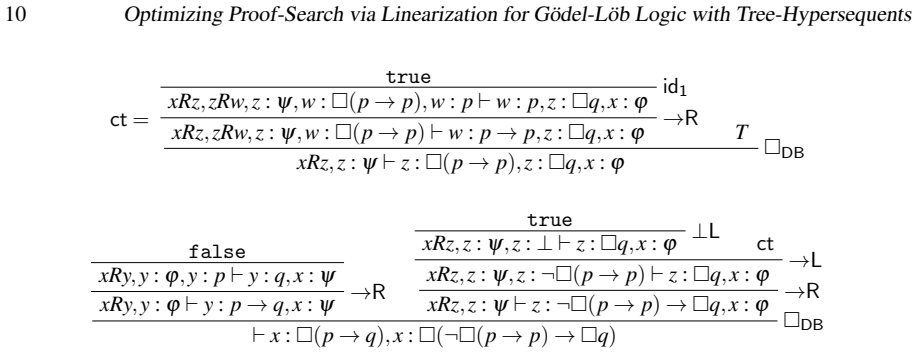
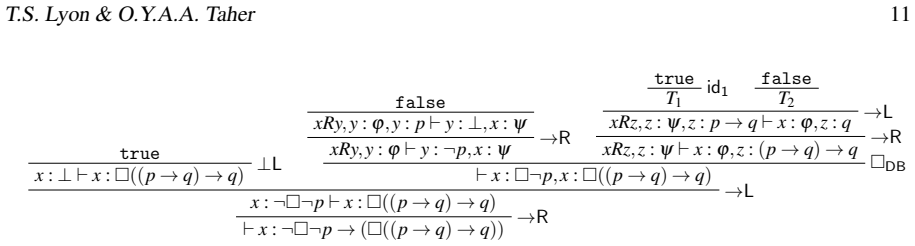
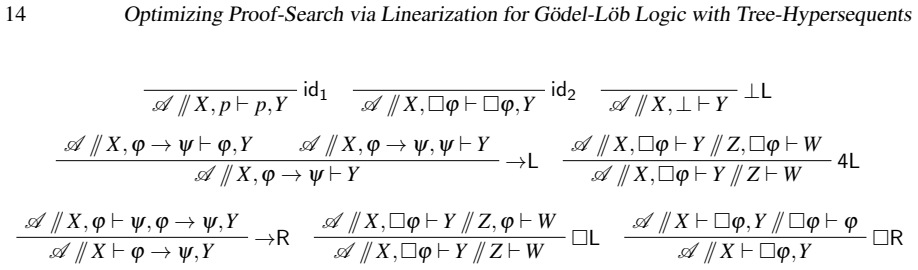
We introduce a linearization method for the tree-hypersequent system CSGL that constructs only a single branch of a derivation and of a tree sequent at a time. This yields a PSPACE proof-search algorithm for deciding validity in Gödel-Löb logic. When proof-search fails, fragments of tree sequents can be combined to extract finite counter-models. Every valid formula has a proof consisting solely of line sequents, which correspond to linear nested sequents.
What carries the argument
The linearization method, which constructs only a single branch of a derivation and of a tree sequent at a time.
Load-bearing premise
The linearization method preserves completeness and allows systematic extraction of finite counter-models from failed searches.
What would settle it
A valid Gödel-Löb formula for which the linearization search fails to find a line-sequent proof, or an invalid formula where combining search fragments does not produce a finite counter-model that refutes it.
Figures

read the original abstract
We answer a question posed by Poggiolesi concerning a syntactic decidability proof for GL in the tree-hypersequent system CSGL, and resolve a challenge identified by Maggesi and Perini Brogi, who sought a PSPACE proof-search algorithm for GL in expressive sequent-based formalisms. We work with a notational variant of CSGL formulated in terms of (labeled) tree sequents. Our answer is complexity-optimal: we present a proof-search algorithm that decides the (in)validity of formulae and runs in PSPACE, matching the known PSPACE-completeness of GL. To achieve this, we introduce a "linearization method," which constructs only a single branch of a derivation and of a tree sequent at a time, avoiding the exponential blowup typical of naive proof-search in sequent formalisms. We show how to systematically combine fragments of tree sequents generated during proof-search to extract finite counter-models, which serves as a theoretical device for establishing the correctness of the algorithm when proof-search fails. Finally, we show that every valid formula admits a proof consisting solely of line sequents, which correspond to linear nested sequents. This establishes a connection between depth-first proof-search and linear nested sequent calculi. Our results not only answer the aforementioned questions, but also provide new insights into proof-search and correctness arguments in tree sequent systems for modal logics.
Editorial analysis
A structured set of objections, weighed in public.
Referee Report
Summary. The paper claims to resolve open questions on syntactic decidability and PSPACE proof-search for Gödel-Löb logic (GL) by presenting a proof-search algorithm on a labeled tree-sequent variant of the CSGL system. The algorithm uses a linearization method that constructs only a single branch of a derivation and of a tree sequent at a time to avoid exponential blowup, decides (in)validity in PSPACE (matching the known lower bound), systematically combines fragments of tree sequents to extract finite counter-models when search fails (serving as the correctness device), and shows that every valid formula has a proof consisting solely of line sequents (corresponding to linear nested sequents).
Significance. If the linearization method and counter-model extraction are shown to preserve completeness, the result would be significant: it supplies a complexity-optimal syntactic decision procedure for GL in an expressive tree-hypersequent formalism, directly answering questions posed by Poggiolesi and by Maggesi-Perini Brogi. The connection drawn between depth-first search and linear nested sequents, together with the explicit use of counter-model construction as a theoretical device, would constitute a concrete contribution to proof-search techniques for modal logics.
major comments (1)
- [Abstract] Abstract (linearization method): the claim that fragments generated by single-branch search can be 'systematically combined' to extract every finite GL countermodel is load-bearing for the PSPACE-completeness result, yet the description provides no explicit invariant (e.g., a simulation relation between the linearized search tree and the full branching hypersequent tree) that would guarantee coverage of countermodels whose shortest realization requires simultaneous exploration of two sibling subtrees.
minor comments (1)
- [Abstract] The abstract refers to 'line sequents' without an immediate definition or pointer to the section where the correspondence to linear nested sequents is formalized; a brief inline gloss would improve readability.
Simulated Author's Rebuttal
We thank the referee for their detailed reading and for identifying this point about the abstract's presentation of the linearization method. We respond to the single major comment below.
read point-by-point responses
-
Referee: [Abstract] Abstract (linearization method): the claim that fragments generated by single-branch search can be 'systematically combined' to extract every finite GL countermodel is load-bearing for the PSPACE-completeness result, yet the description provides no explicit invariant (e.g., a simulation relation between the linearized search tree and the full branching hypersequent tree) that would guarantee coverage of countermodels whose shortest realization requires simultaneous exploration of two sibling subtrees.
Authors: We agree that the abstract is concise and does not itself exhibit the invariant. The manuscript body (Sections 3–5) supplies the required details: the linearization procedure is defined so that each single-branch search fragment records the necessary labels and modal accessibility information; the combination step is shown to reconstruct any finite countermodel by a simulation relation that maps the collected fragments onto the full tree-hypersequent tree. This relation is proved to be total for failed searches, thereby covering countermodels that would require simultaneous exploration of sibling subtrees. The PSPACE bound follows directly from the space-efficient representation of the single branch plus the polynomial-time combination routine. Nevertheless, to make the abstract self-contained on this load-bearing claim, we will revise it to include a one-sentence reference to the simulation invariant used in the counter-model extraction. revision: yes
Circularity Check
No circularity: linearization method and PSPACE bound rest on independent completeness argument and external complexity result
full rationale
The paper introduces a linearization technique for single-branch search in labeled tree sequents for GL, proves correctness via systematic counter-model extraction from failed searches, and shows that valid formulas have line-sequent proofs. The PSPACE upper bound is matched directly against the known PSPACE-completeness of GL (an external result). No equation or definition reduces the central claim to a fitted parameter, self-referential renaming, or load-bearing self-citation chain; the derivation is self-contained against the external benchmark.
Axiom & Free-Parameter Ledger
axioms (1)
- domain assumption The tree-hypersequent system CSGL is sound and complete for Gödel-Löb logic
Reference graph
Works this paper leans on
-
[1]
55–67, doi:https://doi.org/10.1016/j.entcs.2009.02.029
Pietro Abate & Rajeev Goré (2009):The Tableau Workbench.Electronic Notes in Theoretical Com- puter Science231, pp. 55–67, doi:https://doi.org/10.1016/j.entcs.2009.02.029. Available athttps://www. sciencedirect.com/science/article/pii/S1571066109000346. Proceedings of the 5th Workshop on Methods for Modalities (M4M5 2007)
-
[2]
Arnon Avron (1984):On modal systems having arithmetical interpretations.Journal of Symbolic Logic 49(3), p. 935–942, doi:10.2307/2274147
-
[3]
551–577, doi:10.1007/s00153-009-0137-3
Kai Brünnler (2009):Deep Sequent Systems for Modal Logic.Archive for Mathematical Logic48(6), pp. 551–577, doi:10.1007/s00153-009-0137-3
-
[4]
Bull (1992):Cut Elimination for Propositional Dynamic Logic without *.Zeitschrift für Mathe- matische Logik und Grundlagen der Mathematik38(2), pp
Robert A. Bull (1992):Cut Elimination for Propositional Dynamic Logic without *.Zeitschrift für Mathe- matische Logik und Grundlagen der Mathematik38(2), pp. 85–100
1992
-
[5]
Oxford University Press
Alexander Chagrov & Michael Zakharyaschev (1997):Modal logic. Oxford University Press
1997
-
[6]
In:abstract, British Logic Colloquium
Rajeev Goré & Jack Kelly (2007):Automated proof search in Gödel-Löb provability logic. In:abstract, British Logic Colloquium
2007
-
[7]
In Thomas Bolander, Torben Braüner, Silvio Ghilardi & Lawrence S
Rajeev Goré & Revantha Ramanayake (2012):Labelled Tree Sequents, Tree Hypersequents and Nested (Deep) Sequents. In Thomas Bolander, Torben Braüner, Silvio Ghilardi & Lawrence S. Moss, editors: Advances in Modal Logic 9, College Publications, pp. 279–299. Available athttp://www.aiml.net/ volumes/volume9/Gore-Ramanayake.pdf
2012
-
[8]
In Nicola Olivetti, editor:Automated Reasoning with Analytic Tableaux and Related Methods,Lecture Notes in Computer Science4548, Springer Berlin Heidelberg, Berlin, Heidelberg, pp
Ryo Ishigaki & Kentaro Kikuchi (2007):Tree-Sequent Methods for Subintuitionistic Predicate Logics. In Nicola Olivetti, editor:Automated Reasoning with Analytic Tableaux and Related Methods,Lecture Notes in Computer Science4548, Springer Berlin Heidelberg, Berlin, Heidelberg, pp. 149–164
2007
-
[9]
Ryo Kashima (1994):Cut-free sequent calculi for some tense logics.Studia Logica53(1), pp. 119–135
1994
-
[10]
In Hans De Nivelle, editor: Automated Reasoning with Analytic Tableaux and Related Methods,Lecture Notes in Computer Science 9323, Springer International Publishing, Cham, pp
Björn Lellmann (2015):Linear Nested Sequents, 2-Sequents and Hypersequents. In Hans De Nivelle, editor: Automated Reasoning with Analytic Tableaux and Related Methods,Lecture Notes in Computer Science 9323, Springer International Publishing, Cham, pp. 135–150
2015
-
[11]
Björn Lellmann & Elaine Pimentel (2015):Proof Search in Nested Sequent Calculi. In Martin Davis, Ansgar Fehnker, Annabelle McIver & Andrei V oronkov, editors:Logic for Programming, Artificial Intelligence, and Reasoning, Springer Berlin Heidelberg, Berlin, Heidelberg, pp. 558–574
2015
-
[12]
Björn Lellmann & Francesca Poggiolesi (2024):Nested Sequents or Tree-Hypersequents—A Survey. In Yale Weiss & Romina Birman, editors:Saul Kripke on Modal Logic, Springer International Publishing, Cham, pp. 243–301, doi:10.1007/978-3-031-57635-5_11
-
[13]
Tim Lyon, Alwen Tiu, Rajeev Goré & Ranald Clouston (2020):Syntactic interpolation for tense logics and bi-intuitionistic logic via nested sequents. In Maribel Fernández & Anca Muscholl, editors:28th EACSL Annual Conference on Computer Science Logic (CSL 2020),Leibniz International Proceedings in Informat- ics (LIPIcs)152, Schloss Dagstuhl – Leibniz-Zentru...
-
[14]
Lyon (2025):Unifying Sequent Systems for Gödel-Löb Provability Logic via Syntactic Transforma- tions
Tim S. Lyon (2025):Unifying Sequent Systems for Gödel-Löb Provability Logic via Syntactic Transforma- tions. In Jörg Endrullis & Sylvain Schmitz, editors:33rd EACSL Annual Conference on Computer Sci- ence Logic (CSL 2025),Leibniz International Proceedings in Informatics (LIPIcs)326, Schloss Dagstuhl – Leibniz-Zentrum für Informatik, Dagstuhl, Germany, pp....
-
[15]
Lyon & Lucía Gómez Álvarez (2022):Automating Reasoning with Standpoint Logic via Nested Sequents
Tim S. Lyon & Lucía Gómez Álvarez (2022):Automating Reasoning with Standpoint Logic via Nested Sequents. In:Proceedings of the 19th International Conference on Principles of Knowledge Representation and Reasoning, pp. 257–266, doi:10.24963/kr.2022/26
-
[16]
Tim S. Lyon & Piotr Ostropolski-Nalewaja (2024):Foundations for an Abstract Proof Theory in the Context of Horn Rules.arXiv preprint. Available athttps://arxiv.org/abs/2304.05697. 16Optimizing Proof-Search via Linearization for Gödel-Löb Logic with Tree-Hypersequents
arXiv 2024
-
[17]
Journal of Automated Reasoning67(3), p
Marco Maggesi & Cosimo Perini Brogi (2023):Mechanising Gödel–Löb Provability Logic in HOL Light. Journal of Automated Reasoning67(3), p. 29, doi:10.1007/s10817-023-09677-z. Available athttps:// doi.org/10.1007/s10817-023-09677-z
-
[18]
Akinori Maniwa & Ryo Kashima (2024):Syntactic Cut-Elimination for Provability Logic GL via Nested Se- quents. In Andrzej Indrzejczak & Michał Zawidzki, editors:Proceedings of the Workshop on Non-Classical Logics: Theory and Applications (NCL 2024),Electronic Proceedings in Theoretical Computer Science415, pp. 93–108, doi:10.4204/EPTCS.415.11
-
[19]
Springer New York, NY , doi:https://doi.org/10.1007/b115304
Grigori Mints (2000):A Short Introduction to Intuitionistic Logic. Springer New York, NY , doi:https://doi.org/10.1007/b115304
-
[20]
25–60, doi:10.1007/s11787-014-0097-1
Sara Negri (2014):Proofs and Countermodels in Non-Classical Logics.Logica Universalis8(1), pp. 25–60, doi:10.1007/s11787-014-0097-1
-
[21]
Francesca Poggiolesi (2009):The Method of Tree-Hypersequents for Modal Propositional Logic. In David Makinson, Jacek Malinowski & Heinrich Wansing, editors:Towards Mathematical Philosophy,Trends in logic28, Springer, pp. 31–51, doi:10.1007/978-1-4020-9084-4_3
-
[22]
593–611, doi:10.1017/S1755020309990244
Francesca Poggiolesi (2009):A Purely Syntactic and Cut-free Sequent Calculus for the Modal Logic of Provability.The Review of Symbolic Logic2(4), p. 593–611, doi:10.1017/S1755020309990244
-
[23]
Rosen (2012):Discrete Mathematics and Its Applications, 7 edition
Kenneth H. Rosen (2012):Discrete Mathematics and Its Applications, 7 edition. McGraw–Hill, New York
2012
-
[24]
G. Sambin & S. Valentini (1980):A Modal Sequent Calculus for a Fragment of Arithmetic.Studia Logica: An International Journal for Symbolic Logic39(2/3), pp. 245–256. Available athttp://www.jstor.org/ stable/20014984
arXiv 1980
-
[25]
The Sequential Approach.Jour- nal of Philosophical Logic11(3), pp
Giovanni Sambin & Silvio Valentini (1982):The Modal Logic of Provability. The Sequential Approach.Jour- nal of Philosophical Logic11(3), pp. 311–342. Available athttp://www.jstor.org/stable/30226252
arXiv 1982
-
[26]
Uppsala: Filosofiska Föreningen och Filosofiska Institutionen vid Uppsala Universitet
Krister Segerberg (1971):An Essay in Classical Modal Logic. Uppsala: Filosofiska Föreningen och Filosofiska Institutionen vid Uppsala Universitet
1971
-
[27]
D. S. Shamkanov (2014):Circular proofs for the Gödel-Löb provability logic.Mathematical Notes96(3), pp. 575–585, doi:10.1134/S0001434614090326
-
[28]
Alex K Simpson (1994):The Proof Theory and Semantics of Intuitionistic Modal Logic. Ph.D. thesis, Uni- versity of Edinburgh. College of Science and Engineering. School of Informatics
1994
-
[29]
Solovay (1976):Provability interpretations of modal logic.Israel Journal of Mathematics25(3), pp
Robert M. Solovay (1976):Provability interpretations of modal logic.Israel Journal of Mathematics25(3), pp. 287–304, doi:10.1007/BF02757006. Available athttps://doi.org/10.1007/BF02757006
-
[30]
In Thomas Bolander, Torben Braüner, Silvio Ghilardi & Lawrence S
Alwen Tiu, Egor Ianovski & Rajeev Goré (2012):Grammar Logics in Nested Sequent Calculus: Proof Theory and Decision Procedures. In Thomas Bolander, Torben Braüner, Silvio Ghilardi & Lawrence S. Moss, editors:Advances in Modal Logic 9, College Publications, pp. 516–537
2012
-
[31]
Springer Science & Business Media
Luca Viganò (2000):Labelled Non-Classical Logics. Springer Science & Business Media. A Additional Material for Section 4 Computation Tree.For the sake of completeness, we add the formal definition of the computation treect(x:ϕ) = (V,E,L)corresponding toprove(⊢x:ϕ). We define(V,E)root-first based on the number of recursive calls inprove(⊢x:ϕ). Initially, o...
2000
discussion (0)
Sign in with ORCID, Apple, or X to comment. Anyone can read and Pith papers without signing in.