Acenaphthene Derivatives as Signatures of C₁₁H₉^+ Reactivity with Methylated Naphthalenes
Pith reviewed 2026-06-28 09:17 UTC · model grok-4.3
The pith
C11H9+ ions react with dimethylnaphthalenes to form products that photofragment to the acenaphthylene radical cation, indicating pathways for pentagonal rings in cold PAH growth.
A machine-rendered reading of the paper's core claim, the machinery that carries it, and where it could break.
Core claim
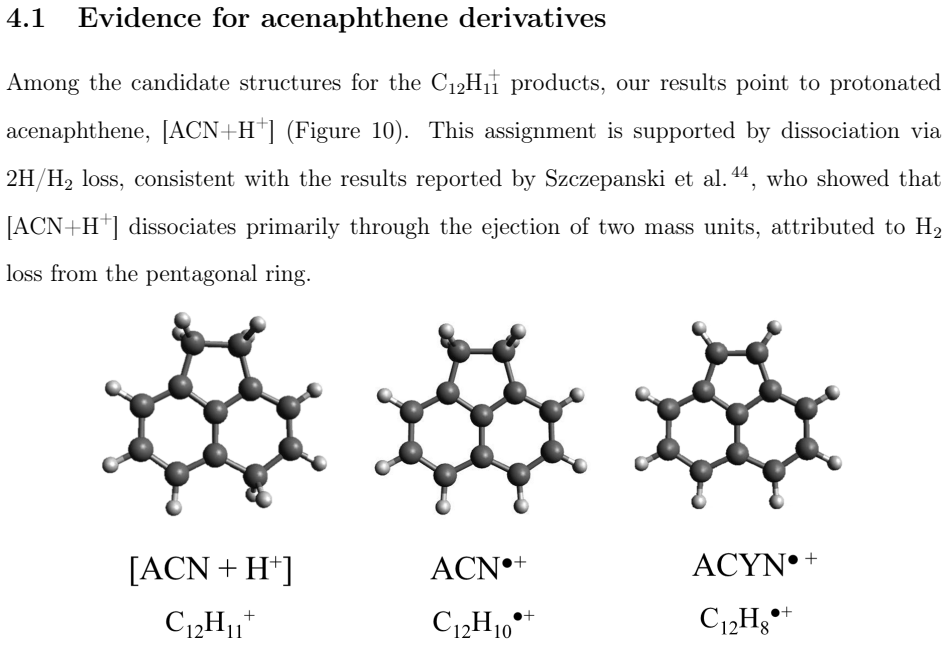
Benzylium-type C11H9+ reacts with diMeNp to yield C12H11+ and C13H13+ whose subsequent photofragmentation yields C12H8•+; the combination of mass spectrometry, irradiation behavior, and DFT assigns this fragment to the acenaphthylene radical cation and demonstrates that the preceding ion-molecule complexes promote C-C bond formation and pentagonal-ring closure during PAH growth.
What carries the argument
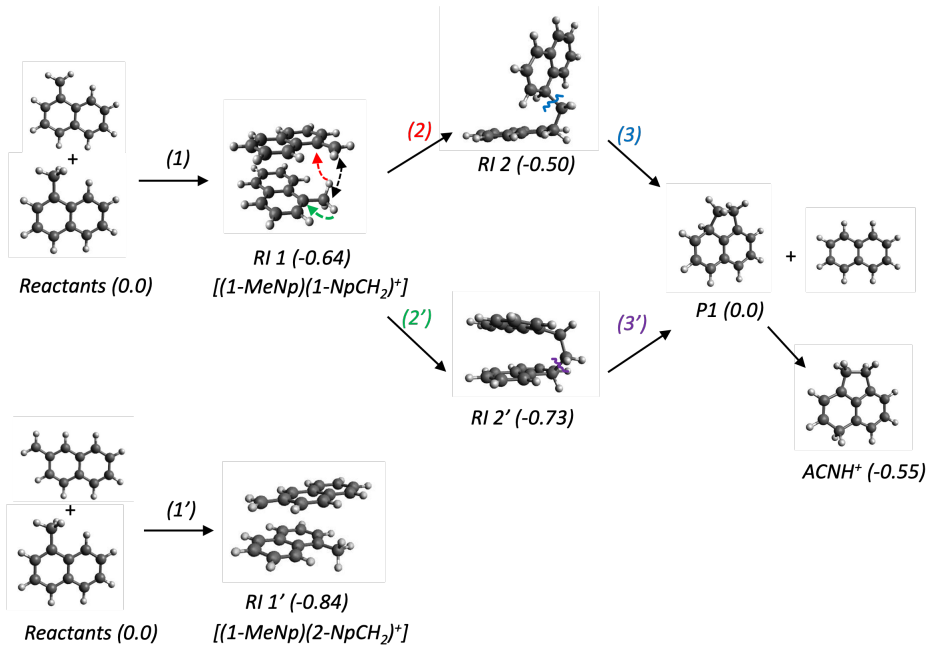
Long-lived ion-molecule complexes between benzylium-like C11H9+ and dimethylnaphthalenes that enable C-C coupling and five-membered ring closure.
If this is right
- The observed chemistry supplies new constraints on the reactivity of benzylium-type ions with methylated naphthalenes.
- Pentagonal rings can form efficiently in PAH growth at low pressure and low temperature through these ion-molecule pathways.
- The route produces acenaphthylene-like species that match species recently detected in the TMC-1 cloud.
Where Pith is reading between the lines
- This mechanism could operate in other cold interstellar environments where methylated PAHs are present, broadening the routes to non-planar or curved PAH structures.
- Similar complex-mediated coupling might be tested with other C11H9+ isomers or larger methylated aromatics to map additional ring-closure channels.
- Astronomical searches could target specific acenaphthene derivatives as tracers of this low-temperature growth channel.
Load-bearing premise
The assignment of the observed C12H8•+ photofragment specifically to the acenaphthylene radical cation structure depends on the accuracy of the supporting DFT calculations for these ions.
What would settle it
Observation of photofragmentation mass spectra or UV-visible behavior from the reaction products that match a different C12H8+ isomer but not the acenaphthylene radical cation.
Figures

read the original abstract
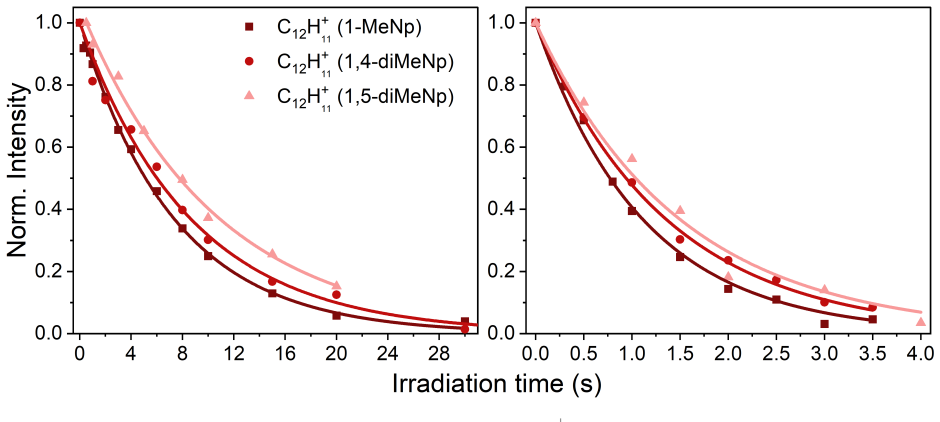
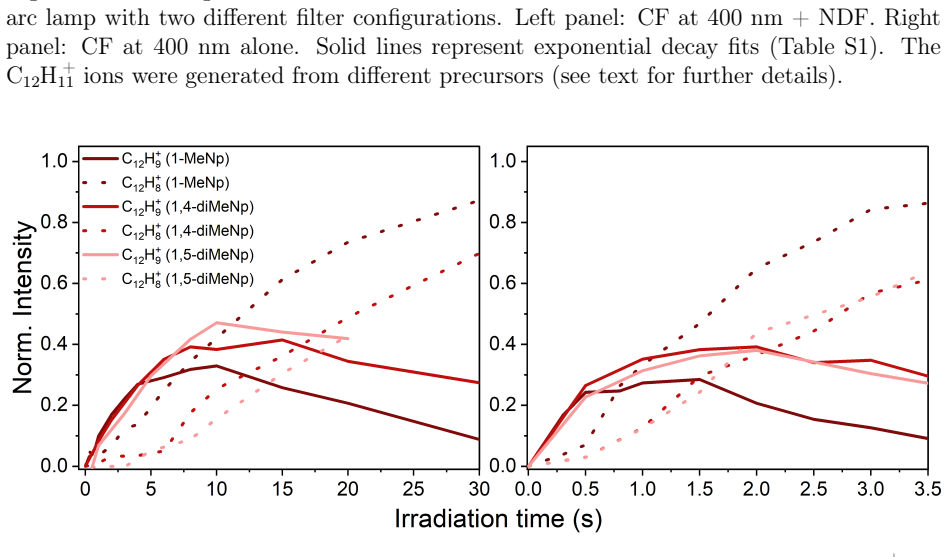
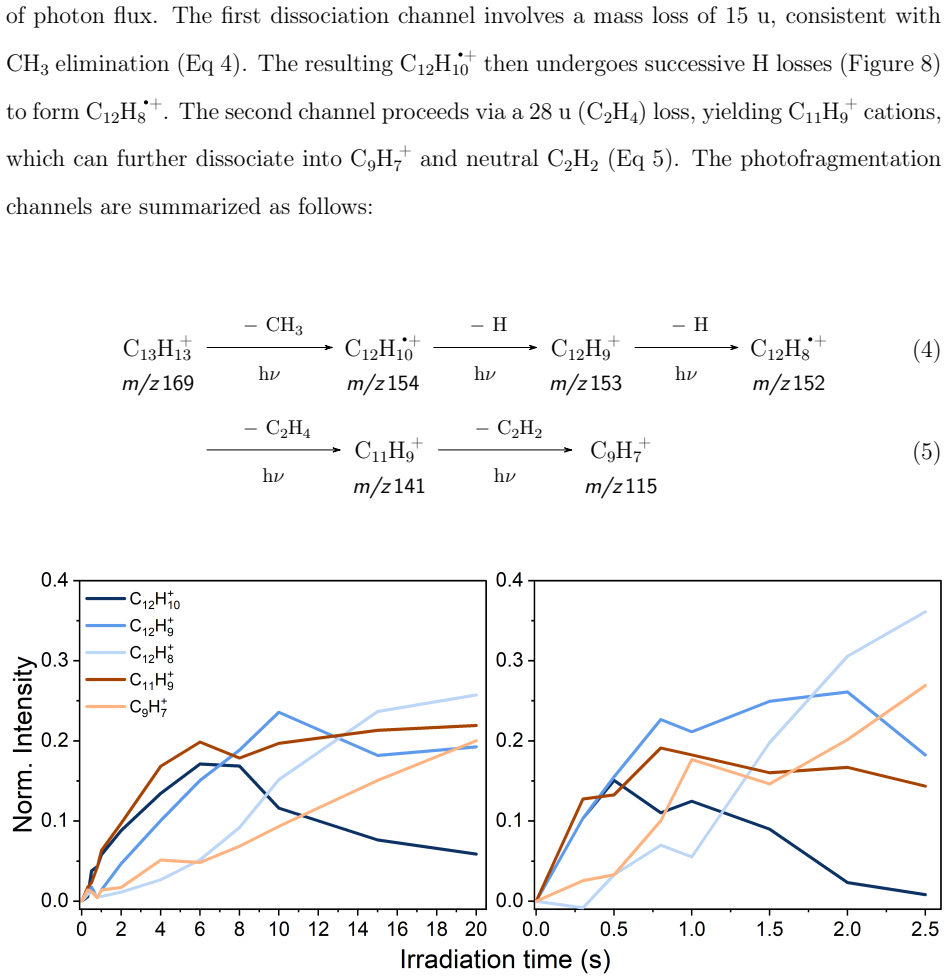
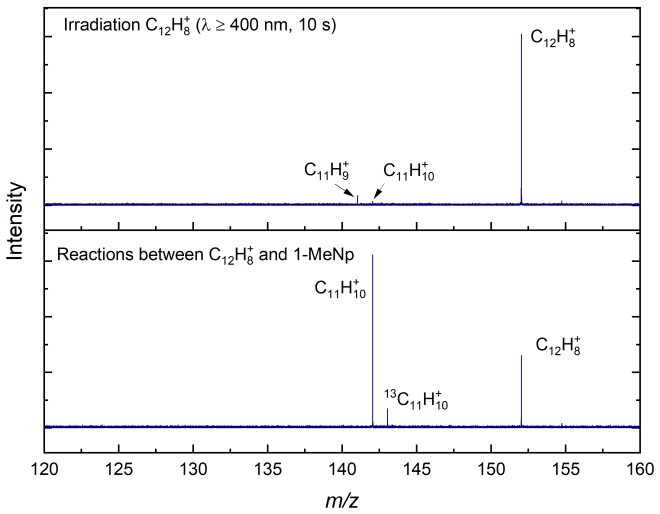
C$_{11}$H$_9^+$ ion is the dominant fragment cation formed from methyl-naphthalene (MeNp) and dimethyl-naphthalene (diMeNp). Using the multiplex capabilities of PIRENEA, a setup dedicated to laboratory astrophysics, we studied the reactivity of the benzylium-like isomers of C$_{11}$H$_9^+$ with diMeNp under isolated conditions relevant to radiative association. Two reaction products are observed, C$_{12}$H$_{11}^+$ -- also formed in the reaction with MeNp -- and C$_{13}$H$_{13}^+$, with branching ratios that depend on the specific diMeNp isomer. The reaction products were subsequently exposed to UV-visible irradiation to gain insight into their structures. The acenaphthylene radical cation, C$_{12}$H$_{8}^{\bullet +}$, was identified as the most stable photofragment. We show that this experimental approach, supported by density functional theory calculations and molecular dynamics simulations, provides new constraints on the chemistry of benzylium-type species. We highlight the role that long-lived ion-molecule complexes can have in promoting C-C coupling and the formation of a pentagonal cycle. Moreover, the chemistry uncovered here highlights new pathways for the formation of pentagonal rings during PAH growth under low-pressure and cold conditions. In particular, it can lead to efficient formation of acenaphthylene-like species, recently detected in the TMC-1 cold cloud.
Editorial analysis
A structured set of objections, weighed in public.
Referee Report
Summary. The manuscript reports experimental observations using the PIRENEA setup of the reactivity of benzylium-like C₁₁H₉⁺ isomers with dimethyl-naphthalene (diMeNp) isomers under isolated, low-pressure conditions. Two products are detected—C₁₂H₁₁⁺ (also seen with methyl-naphthalene) and C₁₃H₁₃⁺—with branching ratios that vary by diMeNp isomer. UV-visible irradiation of the products yields a photofragment assigned to the acenaphthylene radical cation C₁₂H₈•⁺ as the most stable structure, supported by DFT calculations and molecular dynamics simulations. The work argues that long-lived ion-molecule complexes promote C-C coupling and pentagonal-ring formation, providing new pathways for PAH growth relevant to cold interstellar environments such as TMC-1.
Significance. If the structural assignments are robust, the results supply new experimental constraints on benzylium-type ion chemistry under conditions relevant to radiative association, highlighting the role of complexes in pentagon formation and linking directly to the recent detection of acenaphthylene-like species in TMC-1. The multiplexed PIRENEA approach and combination of mass spectrometry with photofragmentation offer strengths in probing low-pressure, cold regimes not easily accessed otherwise.
major comments (2)
- [Abstract and photofragmentation results] The central claim that the observed reactivity opens efficient pathways to acenaphthylene-like species under cold, low-pressure conditions rests on assigning the dominant C₁₂H₈•⁺ photofragment specifically to the acenaphthylene radical cation structure. This assignment is supported by mass spectrometry, UV-visible irradiation behavior, and DFT calculations identifying acenaphthylene as the most stable isomer, but no higher-level reference calculations (e.g., CCSD(T)), comparisons to experimental spectra of authentic C₁₂H₈⁺ isomers, or assessment of functional/basis-set dependence are reported (Abstract; results on photofragmentation).
- [Abstract and experimental section] The manuscript does not report error bars, raw spectra, full calibration details, or discussion of possible post-selection of isomers, which limits evaluation of whether these factors affect the structural assignment and branching ratios (Abstract; experimental methods description).
minor comments (1)
- [Abstract] Notation for the photofragment is given as C₁₂H₈•⁺ in the abstract but should be checked for consistency with the main text when defining radical cations.
Simulated Author's Rebuttal
We thank the referee for their careful reading of the manuscript and for the constructive comments, which have helped us improve the clarity and robustness of our presentation. We respond to each major comment below.
read point-by-point responses
-
Referee: [Abstract and photofragmentation results] The central claim that the observed reactivity opens efficient pathways to acenaphthylene-like species under cold, low-pressure conditions rests on assigning the dominant C₁₂H₈•⁺ photofragment specifically to the acenaphthylene radical cation structure. This assignment is supported by mass spectrometry, UV-visible irradiation behavior, and DFT calculations identifying acenaphthylene as the most stable isomer, but no higher-level reference calculations (e.g., CCSD(T)), comparisons to experimental spectra of authentic C₁₂H₈⁺ isomers, or assessment of functional/basis-set dependence are reported (Abstract; results on photofragmentation).
Authors: The structural assignment is supported by the consistent identification of acenaphthylene as the lowest-energy isomer across the DFT calculations, the observed photofragmentation channel under UV-visible irradiation, and the molecular dynamics simulations that link the ion-molecule complex to pentagon formation. While we recognize that CCSD(T) calculations and direct spectral comparisons to authentic reference isomers would provide additional confirmation, these lie beyond the computational and experimental scope of the present study. We have added an explicit assessment of functional and basis-set dependence in the revised results section to address concerns regarding the reliability of the DFT energetics. revision: partial
-
Referee: [Abstract and experimental section] The manuscript does not report error bars, raw spectra, full calibration details, or discussion of possible post-selection of isomers, which limits evaluation of whether these factors affect the structural assignment and branching ratios (Abstract; experimental methods description).
Authors: We agree that these details strengthen the manuscript. In the revised version we have added error bars to the branching ratios reported in the abstract and main text, included representative raw mass spectra as supplementary material, expanded the experimental methods section with full calibration procedures, and added a paragraph discussing the isomer selection and any potential post-selection effects. revision: yes
Circularity Check
No significant circularity; central claims rest on new experimental mass spectra, photofragmentation data, and independent DFT support rather than self-referential definitions or fitted inputs.
full rationale
The paper's derivation chain begins with experimental observation of reaction products C12H11+ and C13H13+ from C11H9+ + diMeNp, followed by UV-visible irradiation yielding C12H8•+ as the dominant photofragment. Structural assignment to acenaphthylene is presented as the most stable isomer per DFT, but this is an external computational check rather than a self-definition or renaming of inputs. No equations reduce a prediction to a fitted parameter by construction, no uniqueness theorem is imported from self-citation, and no ansatz is smuggled via prior work. The abstract and provided context show the chemistry conclusions (pentagonal ring formation pathways) are directly constrained by the new PIRENEA data under isolated conditions. This is the common case of a self-contained experimental study; the reader's score of 2.0 is consistent with possible minor self-citation that is not load-bearing on the central claim.
Axiom & Free-Parameter Ledger
axioms (2)
- domain assumption The benzylium-like isomers of C11H9+ are the dominant reactive forms under the experimental conditions.
- domain assumption DFT calculations and MD simulations provide reliable structural assignments for the photofragments.
Reference graph
Works this paper leans on
-
[1]
Ion-molecule routes towards cycles in TMC-1: An automated study of the C2H4 + CH2CCH+ reaction. Astron. Astrophys. , keywords =. doi:10.1051/0004-6361/202557647 , archivePrefix =. 2510.27501 , primaryClass =
-
[2]
Correction for dispersion and. J. Chem. Phys. , author =. 2009 , pages =. doi:10.1063/1.3152882 , language =
-
[3]
A consistent and accurate. J. Chem. Phys. , author =. 2010 , pages =. doi:10.1063/1.3382344 , number =
-
[4]
Density-functional thermochemistry. J. Chem. Phys. , author =. 1993 , pages =. doi:10.1063/1.464913 , language =
-
[5]
Uechi, Guy T. and Dunbar, Robert C. , title =. The Journal of Chemical Physics , volume =. 1992 , month =. doi:10.1063/1.462247 , url =
-
[6]
Aysina, Julia and Maranzana, Andrea and Tonachini, Glauco and Tosi, Paolo and Ascenzi, Daniela , title =. J. Chem. Phys. , volume =. 2013 , month =. doi:10.1063/1.4807486 , url =
-
[7]
Ascenzi, Daniela and Cont, Nives and Guella, Graziano and Franceschi, Pietro and Tosi, Paolo , title =. J. Phys. Chem. A , volume =. 2007 , doi =
2007
-
[8]
Growth of polyaromatic molecules via ion-molecule reactions: An experimental and theoretical mechanistic study. J. Chem. Phys. , keywords =. doi:10.1063/1.3505553 , adsurl =
-
[9]
and Schrauwen, Johanna G
Rap, Daniël B. and Schrauwen, Johanna G. M. and Redlich, Britta and Br. Noncovalent Interactions Steer the Formation of Polycyclic Aromatic Hydrocarbons , journal =. 2024 , doi =
2024
-
[10]
Low-temperature nitrogen-bearing polycyclic aromatic hydrocarbon formation routes validated by infrared spectroscopy. Nat. Astron. , year = 2022, month = jul, volume =. doi:10.1038/s41550-022-01713-z , adsurl =
-
[11]
Adamo, Carlo and Barone, Vincenzo , title =. J. Chem. Phys. , volume =. 1999 , month =. doi:10.1063/1.478522 , url =
-
[12]
Formation of the methyl cation by photochemistry in a protoplanetary disk. Nature , keywords =. doi:10.1038/s41586-023-06307-x , archivePrefix =. 2401.03296 , primaryClass =
-
[13]
Unusual Chemical Processes in Interstellar Chemistry: Past and Present. Front. astron. space sci. , year = 2021, month = dec, volume =. doi:10.3389/fspas.2021.776942 , adsurl =
-
[14]
Zins, Emilie-Laure and Pepe, Claude and Schröder, Detlef. Methylene-transfer reactions of benzylium/tropylium ions with neutral toluene studied by means of ion-trap mass spectrometry. Faraday Discuss. 2010. doi:10.1039/B907236E
-
[15]
The PAH 3.4 micron feature as a tracer of shielding in the Orion Bar and NGC 6240. Mon. Not. Roy. Astron. Soc. , keywords =. 2025. doi:10.1093/mnras/staf2047 , archivePrefix =. 2511.13395 , primaryClass =
-
[16]
PDRs4All. VII. The 3.3 m aromatic infrared band as a tracer of physical properties of the interstellar medium in galaxies. Astron. Astrophys. , keywords =. doi:10.1051/0004-6361/202348974 , archivePrefix =. 2402.16535 , primaryClass =
-
[17]
The photochemical production of aromatics in the atmosphere of Titan. Icarus , keywords =. doi:10.1016/j.icarus.2019.03.024 , adsurl =
-
[18]
Heavy Positive Ion Groups in Titan's Ionosphere from Cassini Plasma Spectrometer IBS Observations. Planet. Sci. , keywords =. doi:10.3847/PSJ/abd404 , archivePrefix =. 2009.08749 , primaryClass =
-
[19]
Organic chemistry in Titan's upper atmosphere and its astrobiological consequences: I. Views towards Cassini plasma spectrometer (CAPS) and ion neutral mass spectrometer (INMS) experiments in space. Planet. Space Sci. , keywords =. doi:10.1016/j.pss.2015.01.015 , adsurl =
-
[20]
The Process of Tholin Formation in Titan s Upper Atmosphere. Science , keywords =. doi:10.1126/science.1139727 , adsurl =
-
[21]
My search for carbocations and their role in chemistry (Nobel lecture) , author=. Angew. Chem., Int. Ed. Engl. , volume=. 1995 , publisher=
1995
-
[22]
The spatial distribution of an aromatic molecule, C _ 6 H _ 5 CN, in the cold dark cloud TMC-1. Astron. Astrophys. , keywords =. doi:10.1051/0004-6361/202346722 , archivePrefix =. 2305.15315 , primaryClass =
-
[23]
ACS Earth and Space Chemistry , volume=
Recurrent fluorescence of polycyclic aromatic hydrocarbon isomers: A comparative study , author=. ACS Earth and Space Chemistry , volume=. 2025 , publisher=
2025
-
[24]
Reactions of benzyl ions with alkanes, alkenes, and aromatic compounds , author=. Int. J. Mass Spectrom. Ion Phys. , volume=. 1980 , publisher=
1980
-
[25]
Gas phase benzyl cations from toluene precursors , author=. J. Am. Chem. Soc. , volume=. 1974 , publisher=
1974
-
[26]
Berry, Jennifer L. and Ugelow, Melissa S. and Tolbert, Margaret A. and Browne, Eleanor C. , title =. The Astrophysical Journal Letters , abstract =. 2019 , month =. doi:10.3847/2041-8213/ab4b5b , url =
-
[27]
Westlake, J. H. and Waite Jr., J. H. and Carrasco, N. and Richard, M. and Cravens, T. , title =. J. Geophys. Res. Space Phys. , volume =. doi:https://doi.org/10.1002/2014JA020208 , url =. https://agupubs.onlinelibrary.wiley.com/doi/pdf/10.1002/2014JA020208 , abstract =
-
[28]
F.J. Crary and B.A. Magee and K. Mandt and J.H. Waite and J. Westlake and D.T. Young , keywords =. Heavy ions, temperatures and winds in Titan's ionosphere: Combined Cassini CAPS and INMS observations , journal =. 2009 , issn =. doi:https://doi.org/10.1016/j.pss.2009.09.006 , url =
-
[29]
Discovery of fulvenallene in TMC-1 with the QUIJOTE line survey. Astron. Astrophys. , keywords =. doi:10.1051/0004-6361/202244399 , archivePrefix =. 2207.09369 , primaryClass =
-
[30]
Variations of the 8.6 and 11.3 MU M Emission Bands within NGC 1333: Evidence for PAH Cations. Astrophys. J. Letter , keywords =. doi:10.1086/309986 , adsurl =
-
[31]
Balucani, N. and Asvany, O. and Chang, A. H. H. and Lin, S. H. and Lee, Y. T. and Kaiser, R. I. and Bettinger, H. F. and Schleyer, P. v. R. and Schaefer, H. F., III , title =. J. Chem. Phys. , volume =. 1999 , month =. doi:10.1063/1.480070 , url =
-
[32]
The Formation and Depletion of Molecules in Dense Interstellar Clouds. Astrophys. J. , year = 1973, month = oct, volume =. doi:10.1086/152436 , adsurl =
-
[33]
Chemistry of Dark Clouds: Databases, Networks, and Models
Chemistry of Dark Clouds: Databases, Networks, and Models. Chemical Reviews , keywords =. doi:10.1021/cr4001176 , archivePrefix =. 1310.3651 , primaryClass =
work page internal anchor Pith review Pith/arXiv arXiv doi:10.1021/cr4001176
-
[34]
Science , year = 2023, month = dec, volume =
Polycyclic aromatic hydrocarbons in samples of Ryugu formed in the interstellar medium. Science , year = 2023, month = dec, volume =. doi:10.1126/science.adg6304 , adsurl =
-
[35]
Unprecedented Molecular Diversity Revealed in Meteoritic Insoluble Organic Matter: The Paris Meteorite's Case. Planet. Sci. J. , keywords =. doi:10.3847/PSJ/abb60f , adsurl =
-
[36]
Isotopic evidence from an Antarctic carbonaceous chondrite for two reaction pathways of extraterrestrial PAH formation. Earth Planet. Sci. Lett. , keywords =. doi:10.1016/S0012-821X(00)00316-2 , adsurl =
-
[37]
Polycylcic Aromatic Hydrocarbons (PAH's) in dense cloud chemistry
Polycyclic Aromatic Hydrocarbons in Dense Cloud Chemistry. Astrophys. J. , keywords =. doi:10.1086/587734 , archivePrefix =. 0802.3757 , primaryClass =
work page internal anchor Pith review Pith/arXiv arXiv doi:10.1086/587734
-
[38]
The ion chemistry of interstellar clouds , author=. Chem. Rev. , volume=. 1992 , publisher=
1992
-
[39]
The chemistry of interstellar space
Herbst, Eric. The chemistry of interstellar space. Chem. Soc. Rev. 2001. doi:10.1039/A909040A
-
[40]
Nathan D. Marsh and Mary J. Wornat and Lawrence T. Scott and Atena Necula and Arthur L. Lafleur and Elaine F. Plummer , title =. Polycyclic Aromatic Compounds , volume =. 2000 , publisher =. doi:10.1080/10406630008233852 , URL =
-
[41]
Laboratory rotational spectroscopy and astronomical search of ethynyl substituted naphthalene. Mon. Not. Roy. Astron. Soc. , keywords =. doi:10.1093/mnras/stac3698 , archivePrefix =. 2212.06876 , primaryClass =
-
[42]
Aromatic cycles are widespread in cold clouds. Astron. Astrophys. , keywords =. doi:10.1051/0004-6361/202347524 , archivePrefix =. 2308.15951 , primaryClass =
-
[43]
Detections of interstellar aromatic nitriles 2-cyanopyrene and 4-cyanopyrene in TMC-1. Nat. Astron. , keywords =. doi:10.1038/s41550-024-02410-9 , archivePrefix =. 2410.00670 , primaryClass =
-
[44]
Discovery of the Seven-ring Polycyclic Aromatic Hydrocarbon Cyanocoronene (C _ 24 H _ 11 CN) in GOTHAM Observations of TMC-1. Astrophys. J. Letter , keywords =. doi:10.3847/2041-8213/adc911 , archivePrefix =. 2504.05232 , primaryClass =
-
[45]
Detection of interstellar 1-cyanopyrene: A four-ring polycyclic aromatic hydrocarbon. Science , keywords =. doi:10.1126/science.adq6391 , archivePrefix =. 2410.00657 , primaryClass =
-
[46]
Pure hydrocarbon cycles in TMC-1: Discovery of ethynyl cyclopropenylidene, cyclopentadiene, and indene. Astron. Astrophys. , keywords =. doi:10.1051/0004-6361/202141156 , archivePrefix =. 2104.13991 , primaryClass =
-
[47]
Discovery of the Pure Polycyclic Aromatic Hydrocarbon Indene (c- C9H8 ) with GOTHAM Observations of TMC-1. Astrophys. J. Letter , keywords =. doi:10.3847/2041-8213/abfd3a , archivePrefix =. 2104.15117 , primaryClass =
-
[48]
West, Brandi and Joblin, Christine and Blanchet, Valerie and Bodi, Andras and Sztáray, Bálint and Mayer, Paul M , title =. J. Phys. Chem. A , volume =. 2014 , doi =
2014
-
[49]
M. J. Frisch and G. W. Trucks and H. B. Schlegel and G. E. Scuseria and M. A. Robb and J. R. Cheeseman and G. Scalmani and V. Barone and G. A. Petersson and H. Nakatsuji and X. Li and M. Caricato and A. V. Marenich and J. Bloino and B. G. Janesko and R. Gomperts and B. Mennucci and H. P. Hratchian and J. V. Ortiz and A. F. Izmaylov and J. L. Sonnenberg an...
2016
-
[50]
Ion Dissociation Dynamics of 1, 2, 3, 4-Tetrahydronaphthalene: Tetralin as a Test Case For Hydrogenated Polycyclic Aromatic Hydrocarbons , author=. J. Phys. Chem. A , volume=. 2019 , publisher=
2019
-
[51]
Astrophys
Competitive dehydrogenation and backbone fragmentation of superhydrogenated PAHs: a laboratory study , author=. Astrophys. J. , volume=. 2021 , publisher=
2021
-
[52]
Andrea Nobili and Luna. On the radical behavior of large polycyclic aromatic hydrocarbons in soot formation and oxidation , journal =. 2022 , issn =. doi:https://doi.org/10.1016/j.combustflame.2021.111692 , url =
-
[53]
Single-atom catalysis in space. II. Ketene-acetaldehyde-ethanol and methane synthesis via Fischer-Tropsch chain growth. Astron. Astrophys. , keywords =. doi:10.1051/0004-6361/202449378 , adsurl =
-
[54]
Low-temperature Formation of Carbonaceous Dust Grains from PAHs. Astrophys. J. , keywords =. doi:10.3847/1538-4357/ab62b7 , adsurl =
-
[55]
Methylacetylene (CH _ 3 CCH) and propene (C _ 3 H _ 6 ) formation in cold dense clouds: A case of dust grain chemistry. Mol. Astrophys. , keywords =. doi:10.1016/j.molap.2016.03.001 , archivePrefix =. 1603.02703 , primaryClass =
work page internal anchor Pith review Pith/arXiv arXiv doi:10.1016/j.molap.2016.03.001 2016
-
[56]
Cain and Joaquin Camacho and Denis J
Jeremy P. Cain and Joaquin Camacho and Denis J. Phares and Hai Wang and Alexander Laskin , keywords =. Evidence of aliphatics in nascent soot particles in premixed ethylene flames , journal =. 2011 , issn =. doi:https://doi.org/10.1016/j.proci.2010.06.164 , url =
-
[57]
Discovery of interstellar phenalene (c-C _ 13 H _ 10 ): A new piece in the chemical puzzle of PAHs in space. Astron. Astrophys. , keywords =. doi:10.1051/0004-6361/202556687 , archivePrefix =. 2508.13857 , primaryClass =
-
[58]
ACS Earth Space Chem
Cui, Weikai and Herbst, Eric , title =. ACS Earth Space Chem. , volume =. 2024 , doi =
2024
-
[59]
François Robert and Sylvie Derenne and Guillaume Lombardi and Khaled Hassouni and Armelle Michau and Peter Reinhardt and Rémi Duhamel and Adriana Gonzalez and Kasia Biron , title =. Proc. Natl. Acad. Sci. , volume =. 2017 , doi =. https://www.pnas.org/doi/pdf/10.1073/pnas.1615767114 , abstract =
-
[60]
Structure of photodissociation fronts in star-forming regions revealed by Herschel observations of high-J CO emission lines. Astron. Astrophys. , keywords =. doi:10.1051/0004-6361/201832611 , archivePrefix =. 1801.03893 , primaryClass =
work page internal anchor Pith review Pith/arXiv arXiv doi:10.1051/0004-6361/201832611
-
[61]
Impact of PAH photodissociation on the formation of small hydrocarbons in the Orion Bar and the horsehead PDRs. Mon. Not. Roy. Astron. Soc. , keywords =. doi:10.1093/mnras/staa2026 , archivePrefix =. 2007.06568 , primaryClass =
-
[62]
Liu, Peng and Lin, He and Yang, Yang and Shao, Can and Guan, Bin and Huang, Zhen , title =. J. Phys. Chem. A , volume =. 2015 , doi =
2015
-
[63]
Mixed aliphatic and aromatic composition of evaporating very small grains in NGC 7023 revealed by the 3.4/3.3 m ratio. Astron. Astrophys. , keywords =. doi:10.1051/0004-6361/201425590 , archivePrefix =. 1502.04941 , primaryClass =
work page internal anchor Pith review Pith/arXiv arXiv doi:10.1051/0004-6361/201425590
-
[64]
JWST's NIR spectroscopic view of the Orion Bar
PDRs4All: III. JWST's NIR spectroscopic view of the Orion Bar. Astron. Astrophys. , keywords =. doi:10.1051/0004-6361/202348244 , archivePrefix =. 2310.08720 , primaryClass =
-
[65]
PDRs4All. IV. An embarrassment of riches: Aromatic infrared bands in the Orion Bar. Astron. Astrophys. , keywords =. doi:10.1051/0004-6361/202346662 , archivePrefix =. 2308.16733 , primaryClass =
-
[66]
PDRs4All: XII. Far-ultraviolet-driven formation of simple hydrocarbon radicals and their relation with polycyclic aromatic hydrocarbons. Astron. Astrophys. , keywords =. doi:10.1051/0004-6361/202453350 , archivePrefix =. 2503.03353 , primaryClass =
-
[67]
Metal-catalyst-free gas-phase synthesis of long-chain hydrocarbons , author=. Nat. Commun. , volume=. 2021 , publisher=
2021
-
[68]
Fragmentation of isolated ions by multiple photon absorption: A quantitative study. J. Chem. Phys. , year = 1997, month = mar, volume =. doi:10.1063/1.473545 , adsurl =
-
[69]
Joblin, C and Wenzel, G and Rodriguez Castillo, S and Simon, A and Sabbah, H and Bonnamy, A and Toublanc, D and Mulas, G and Ji, M and Giuliani, A and Nahon, L , Title=. J. Phys. Conf. Ser. , Volume=. 2020 , Month=jan, DOI=
2020
-
[70]
Elstner, M. and Porezag, D. and Jungnickel, G. and Elsner, J. and Haugk, M. and Frauenheim, T. and Suhai, S. and Seifert, G. , Title=. Phys. Rev. B , Volume=. 1998 , Month=. doi:10.1103/PhysRevB.58.7260 , Url=
-
[71]
Rapacioli and T
M. Rapacioli and T. Heine and L. Dontot and M. Yusef Buey and F. Louisnard and J. Cuny and M. Morinière and C. Dubosq and S. Patchkovskii and J. Frenzel and E. Michoulier and H. Duarte and T. Minneva and F. Spiegelman and L. Zchekhov and D. Salahub
-
[72]
and Rapacioli, M
Simon, A. and Rapacioli, M. and Rouaut, G. and Trinquier, G. and Gadéa, F. X. , title =. Phil. Trans. R. Soc. A. , volume =. 2017 , doi =
2017
-
[73]
Kuznetsov, Oleg V. and Evseev, Mikhail M. and Medvedkov, Iakov A. and Tolstov, Georgiy I. and Khvatov, Nikolay A. and Antonov, Ivan O. and Kaiser, Ralf I. and Mebel, Alexander M. and Azyazov, Valeriy N. , title =. Chemistry – A European Journal , volume =. ASAP , keywords =. doi:https://doi.org/10.1002/chem.202502477 , url =. https://chemistry-europe.onli...
-
[74]
Mario Commodo and Katharina Kaiser and Gianluigi. On the early stages of soot formation: Molecular structure elucidation by high-resolution atomic force microscopy , journal =. 2019 , issn =. doi:https://doi.org/10.1016/j.combustflame.2019.03.042 , url =
-
[75]
M. V. Vinitha and V. R. Mundlapati and A. Marciniak and M. Carlos and H. Sabbah and A. Bonnamy , title =. J. Phys. Chem. A , year =
-
[76]
Photodissociation of aliphatic PAH derivatives under relevant astrophysical conditions. Astron. Astrophys. , keywords =. doi:10.1051/0004-6361/202140737 , archivePrefix =. 2103.03890 , primaryClass =
-
[77]
Protonation effect on the electronic structure of small PAHs: Acenaphthylene and Acenaphthene , author=. Chem. Phys. Lett. , volume=. 2011 , publisher=
2011
-
[78]
Vibronic absorption spectra of dimethylnaphthalene cations in solid argon , author=. J. Phys. Chem. , volume=. 1985 , publisher=
1985
-
[79]
Conversion of acenaphthalene to phenalene via methylation: A theoretical study , author=. Combust. Flame. , volume=. 2020 , publisher=
2020
-
[80]
Role of methyl radicals in the growth of PAHs , author=. J. Am. Soc. Mass Spectrom. , volume=. 2010 , publisher=
2010
discussion (0)
Sign in with ORCID, Apple, or X to comment. Anyone can read and Pith papers without signing in.