An Efficient Parity-Blocked Method for Band-Structure Computation of 3D Anisotropic Phononic Crystals
Pith reviewed 2026-06-28 08:55 UTC · model grok-4.3
The pith
Body-diagonal shifts on even grids preserve two parity invariants that split the discrete velocity space into four independent blocks whose spectra merge to the full solution.
A machine-rendered reading of the paper's core claim, the machinery that carries it, and where it could break.
Core claim
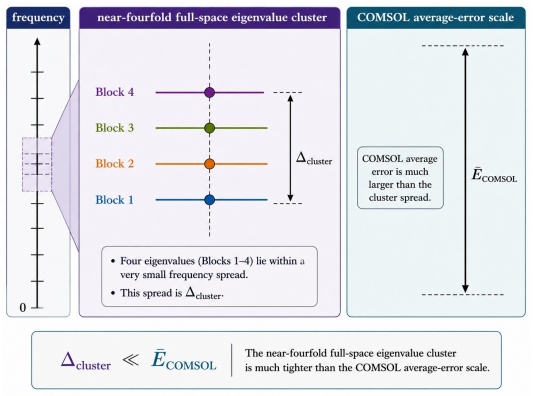
On even grids, when the stiffness and mass matrices are nodewise local multiplication matrices, the body-diagonal shifts preserve two independent parity invariants. The discrete velocity space is then decomposed exactly into four mutually independent block subspaces, and the full discrete spectrum can be recovered by solving the four smaller eigenvalue problems and merging their spectra.
What carries the argument
Two independent parity invariants preserved by body-diagonal shifts on even grids, which decompose the discrete velocity space into four mutually independent block subspaces.
If this is right
- The full discrete spectrum is recovered exactly by merging the four block spectra.
- Wall-clock time decreases substantially while the spectrum is preserved.
- Anisotropic derivative coupling is handled inside the Hermitian formulation without separate interpolation closures.
- The unified Fourier SVD framework supports Gamma-point zero-mode treatment, shift-invert Krylov iteration, and GPU matrix-vector products.
Where Pith is reading between the lines
- If similar nodewise locality holds in other staggered discretizations, parity blocking could be applied to related elastic or acoustic wave problems.
- The four independent blocks are amenable to separate parallel execution, potentially scaling to larger crystal domains.
- The Fourier SVD organization may simplify extraction of dispersion curves or group velocities once the blocks are solved.
Load-bearing premise
The grid is even and the stiffness and mass matrices remain strictly nodewise local multiplication matrices after the body-diagonal shifts.
What would settle it
Solve the full-space eigenvalue problem and the four block problems separately on the same even grid; if the merged block spectra do not coincide exactly with the full spectrum, the claimed exact decomposition fails.
Figures
read the original abstract
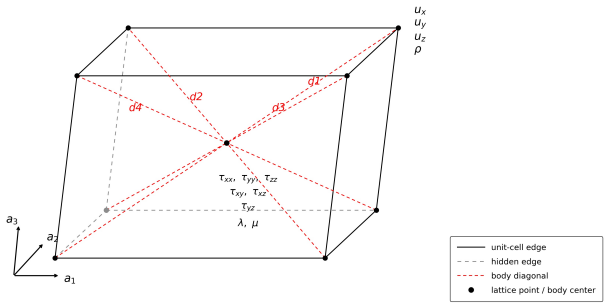
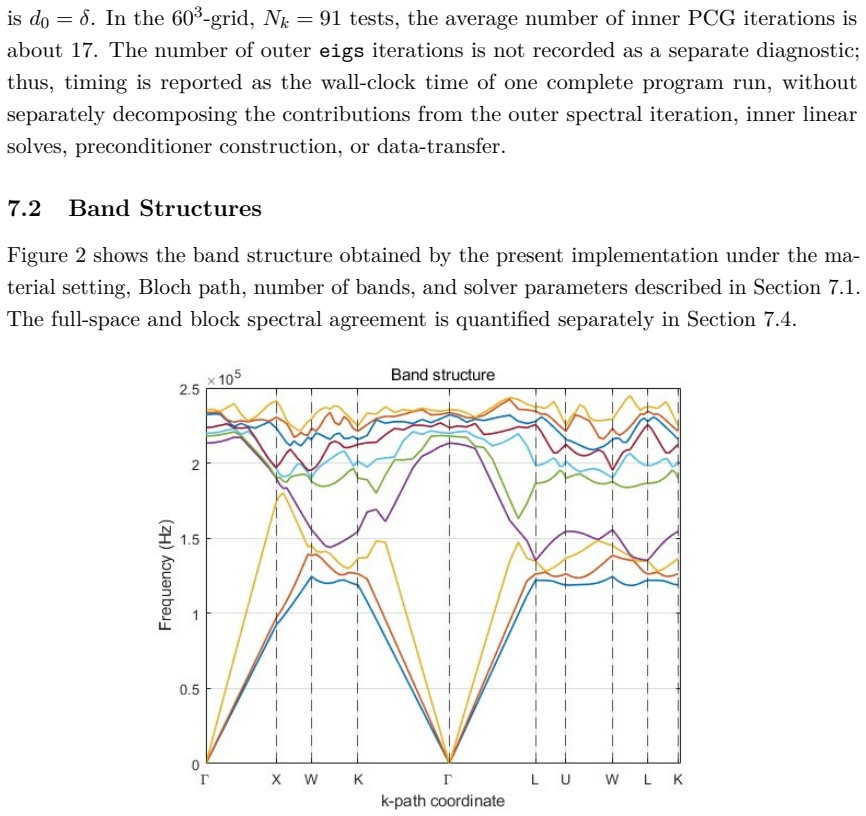
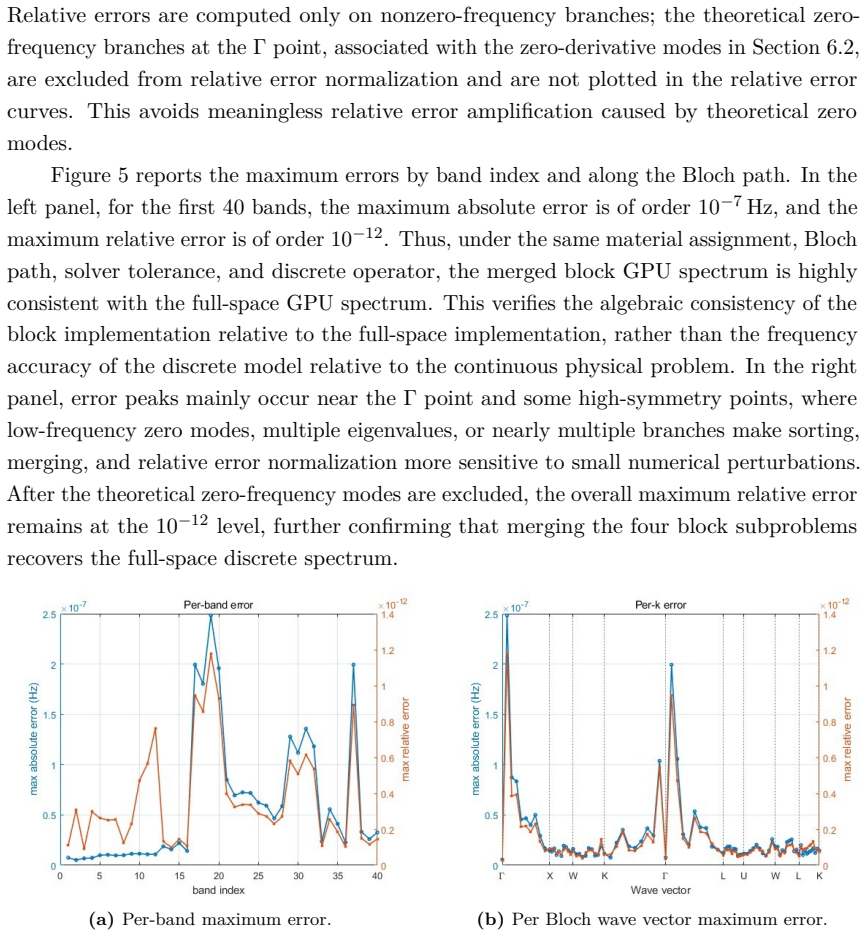
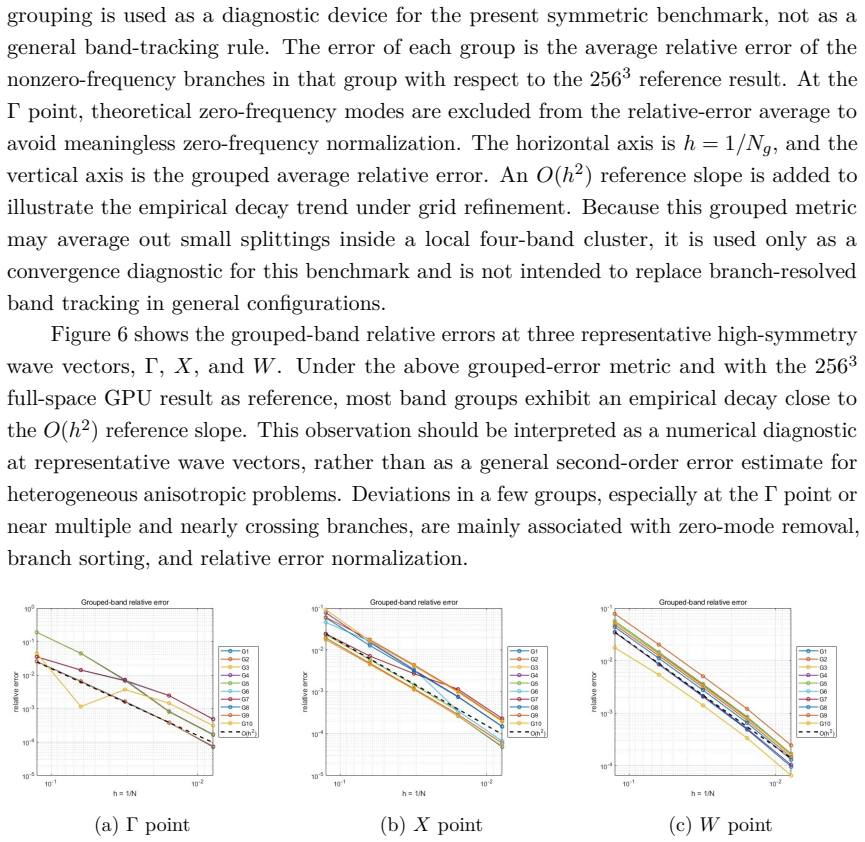
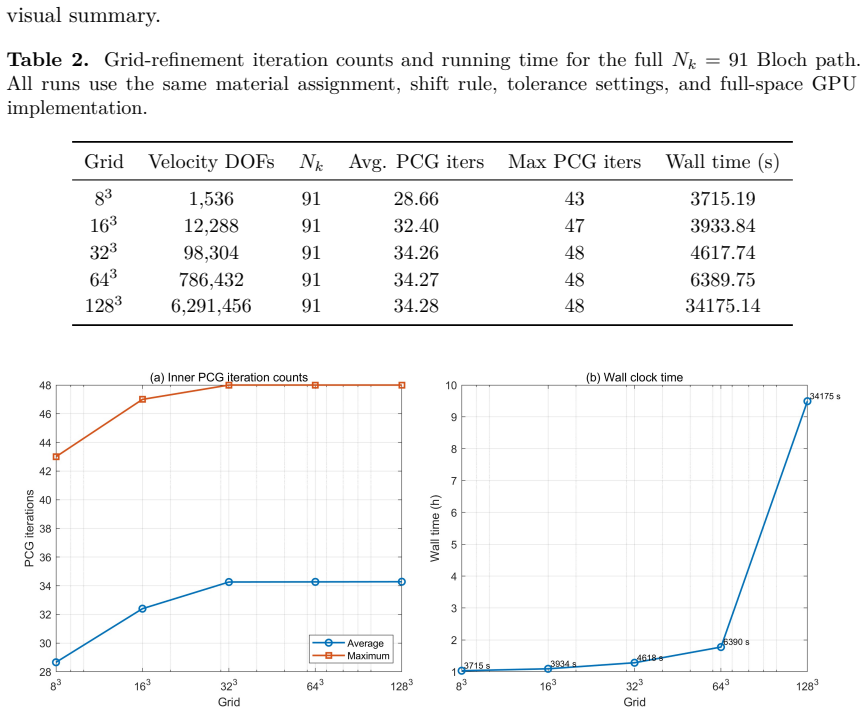
Band-structure calculations for three-dimensional anisotropic phononic crystals require the repeated solution of large elastic generalized eigenvalue problems along Bloch paths. In standard staggered-grid discretizations, anisotropic coupling may involve derivative components located at incompatible grid positions, so additional interpolation or averaging closures are often introduced. This paper proposes a parity-blocked rotated staggered discretization based on four Bloch-periodic body-diagonal differences. The directional derivatives are reconstructed from these diagonal differences, leading to a Hermitian $B_hC_hB_h^H$ generalized eigenvalue formulation that incorporates anisotropic derivative coupling without separate interpolation closures. On even grids, when the stiffness and mass matrices are nodewise local multiplication matrices, the body-diagonal shifts preserve two independent parity invariants. The discrete velocity space is then decomposed exactly into four mutually independent block subspaces, and the full discrete spectrum can be recovered by solving the four smaller eigenvalue problems and merging their spectra. The full and block formulations are further organized in a unified Fourier SVD framework, which supports $\Gamma$-point zero-mode treatment, shift-invert Krylov iteration, inner PCG solves, and GPU matrix-vector products. Numerical experiments for a three-dimensional two-phase anisotropic phononic crystal show that the block implementation preserves the full-space spectrum while substantially reducing the wall-clock time. The results demonstrate that the proposed method provides a structured and efficient solver for large-scale band-structure computations of three-dimensional anisotropic phononic crystals.
Editorial analysis
A structured set of objections, weighed in public.
Referee Report
Summary. The paper proposes a parity-blocked rotated staggered discretization for band-structure computations of 3D anisotropic phononic crystals. Directional derivatives are reconstructed from four Bloch-periodic body-diagonal differences, yielding a Hermitian B_h C_h B_h^H generalized eigenvalue formulation that avoids separate interpolation closures for anisotropy. On even grids, when stiffness and mass matrices are nodewise local multiplication matrices, body-diagonal shifts preserve two independent parity invariants. This exactly decomposes the discrete velocity space into four mutually independent block subspaces whose spectra can be merged to recover the full discrete spectrum. The approach is organized in a unified Fourier SVD framework supporting Γ-point zero-mode treatment, shift-invert Krylov methods, and GPU matrix-vector products. Numerical experiments on a three-dimensional two-phase anisotropic phononic crystal confirm that the block implementation preserves the full-space spectrum while reducing wall-clock time.
Significance. If the exact decomposition holds under the stated conditions, the method provides a structured, parameter-free reduction of problem size for large-scale 3D elastic eigenvalue problems, enabling substantial efficiency gains without sacrificing spectrum accuracy. The unified Fourier SVD framework and avoidance of ad-hoc interpolation closures are strengths. The numerical validation of spectrum matching between full and block formulations is a positive indicator of practical utility for phononic crystal computations.
major comments (1)
- [Abstract and discretization construction] Abstract and discretization construction: the exact block decomposition into four mutually independent subspaces (and thus the efficiency claim) is conditioned on stiffness and mass matrices remaining strictly nodewise local multiplication matrices after the body-diagonal shifts. The anisotropic reconstruction via the B_h C_h B_h^H form and material tensor sampling must be shown to preserve this multiplication property; any introduced non-local coupling would couple the parity sectors and invalidate exact independence. The reported numerical spectrum agreement is necessary but insufficient to confirm the structural property holds for the tested two-phase crystal.
minor comments (2)
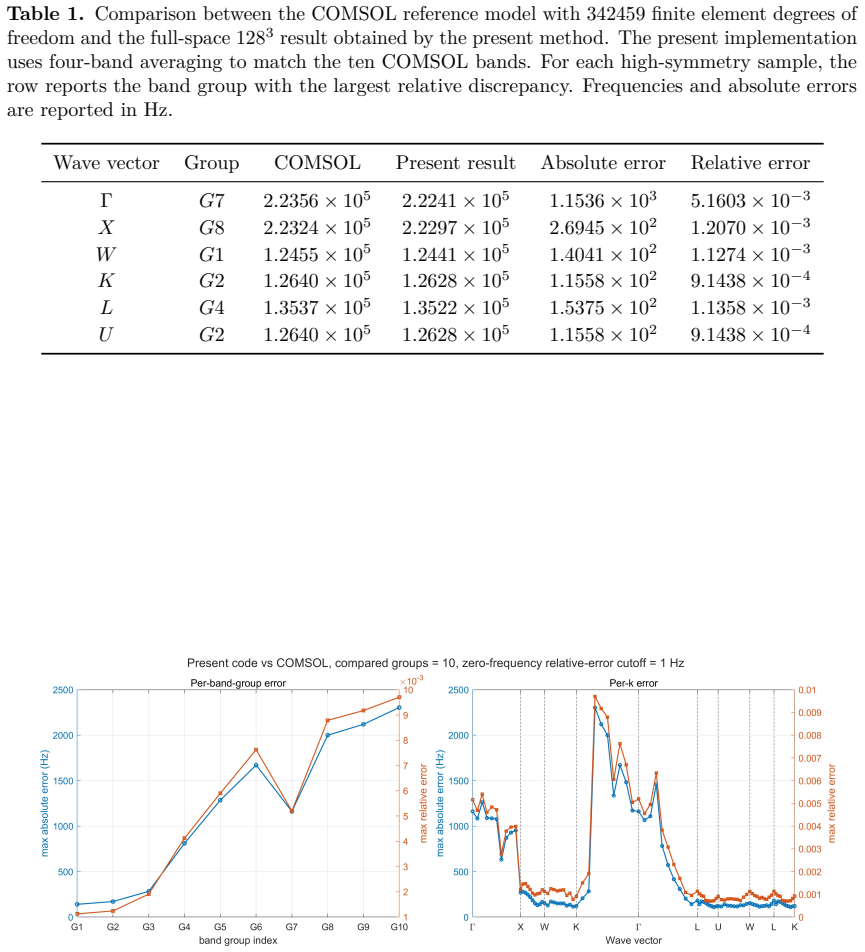
- The abstract states that the block spectra match the full-space spectra but does not report quantitative metrics such as maximum eigenvalue deviation or relative error across the Bloch path; adding these would strengthen the numerical validation section.
- Notation for the four body-diagonal difference operators and the explicit form of the parity invariants could be introduced earlier to improve readability of the decomposition argument.
Simulated Author's Rebuttal
We thank the referee for the careful reading and constructive comment. We address the major point below and will strengthen the manuscript accordingly.
read point-by-point responses
-
Referee: [Abstract and discretization construction] Abstract and discretization construction: the exact block decomposition into four mutually independent subspaces (and thus the efficiency claim) is conditioned on stiffness and mass matrices remaining strictly nodewise local multiplication matrices after the body-diagonal shifts. The anisotropic reconstruction via the B_h C_h B_h^H form and material tensor sampling must be shown to preserve this multiplication property; any introduced non-local coupling would couple the parity sectors and invalidate exact independence. The reported numerical spectrum agreement is necessary but insufficient to confirm the structural property holds for the tested two-phase crystal.
Authors: We agree that an explicit verification is needed. In the construction, C_h is obtained by direct nodal sampling of the anisotropic material tensor and is therefore a strictly diagonal multiplication matrix. The operator B_h is assembled exclusively from local body-diagonal finite-difference stencils; no auxiliary interpolation or averaging is introduced. Consequently, the composite B_h C_h B_h^H remains nodewise local, and the body-diagonal shifts continue to preserve the two independent parity invariants. We will insert a concise remark (new paragraph in Section 3.2) proving that the anisotropic sampling introduces no non-local coupling. This analytical step, together with the reported numerical spectrum agreement, confirms the exact four-block decomposition. revision: yes
Circularity Check
No significant circularity; derivation is self-contained from grid parity properties.
full rationale
The paper introduces a new rotated staggered discretization using four Bloch-periodic body-diagonal differences to reconstruct directional derivatives in a Hermitian B_h C_h B_h^H form. The block decomposition into four independent subspaces follows directly from the stated preservation of two parity invariants on even grids, conditional on the stiffness and mass matrices remaining nodewise local multiplication matrices after shifts. This is a mathematical property of the discretization, not a reduction to fitted inputs, self-cited uniqueness theorems, or ansatzes smuggled via citation. The full spectrum recovery by merging block spectra is derived explicitly from the grid structure and verified numerically against the full-space problem for the tested crystal, rendering the chain self-contained without circular steps.
Axiom & Free-Parameter Ledger
axioms (2)
- domain assumption Staggered-grid discretizations of elastic operators remain Hermitian when directional derivatives are reconstructed from body-diagonal differences.
- domain assumption On even grids with nodewise local multiplication matrices, body-diagonal shifts preserve two independent parity invariants.
Reference graph
Works this paper leans on
-
[1]
R. Bansal and M. K. Sen. Finite-difference modelling of S-wave splitting in anisotropic media.Geophysical Prospecting, 56(3):293–312, 2008. doi: 10.1111/j.1365-2478.2007. 00693.x
-
[2]
H. Bernth and C. H. Chapman. A comparison of the dispersion relations for anisotropic elastodynamic finite-difference grids.Geophysics, 76(3):WA43–WA50, 2011. doi: 10.1190/1.3555067
-
[3]
H. Chen, X. Wang, and H. Zhao. A rotated staggered grid finite-difference with the absorbing boundary condition of a perfectly matched layer.Chinese Science Bulletin, 51(19):2304–2314, 2006. doi: 10.1007/s11434-006-2127-8
-
[4]
K. Gao and L. Huang. An improved rotated staggered-grid finite-difference method with fourth-order temporal accuracy for elastic-wave modeling in anisotropic media. Journal of Computational Physics, 350:361–386, 2017. doi: 10.1016/j.jcp.2017.08.053
-
[5]
M. I. Hussein, M. J. Leamy, and M. Ruzzene. Dynamics of phononic materials and structures: Historical origins, recent progress, and future outlook.Applied Mechanics Reviews, 66(4):040802, 2014. doi: 10.1115/1.4026911
-
[6]
Silicon: Mechanical properties, elastic constants, lattice vibrations
Ioffe Institute. Silicon: Mechanical properties, elastic constants, lattice vibrations. Ioffe Institute, New Semiconductor Materials database, 2026. URLhttps://www. ioffe.ru/SVA/NSM/Semicond/Si/mechanic.html. Accessed 2026-05-20
2026
-
[7]
E. F. M. Koene, J. O. A. Robertsson, and F. Andersson. Anisotropic elastic finite- difference modeling of sources and receivers on Lebedev grids.Geophysics, 86(2): A21–A27, 2021. doi: 10.1190/geo2020-0522.1
-
[8]
M. S. Kushwaha, P. Halevi, L. Dobrzynski, and B. Djafari-Rouhani. Acoustic band structure of periodic elastic composites.Physical Review Letters, 71(13):2022–2025,
2022
-
[9]
doi: 10.1103/PhysRevLett.71.2022
-
[10]
V. Laude, Y. Achaoui, S. Benchabane, and A. Khelif. Evanescent Bloch waves and the complex band structure of phononic crystals.Physical Review B, 80:092301, 2009. doi: 10.1103/PhysRevB.80.092301
-
[11]
V. Lisitsa and D. Vishnevskiy. Lebedev scheme for the numerical simulation of wave propagation in 3d anisotropic elasticity.Geophysical Prospecting, 58(4):619–635, 2010. doi: 10.1111/j.1365-2478.2009.00862.x
-
[12]
X.-L. Lyu, H. Tian, T. Li, and W.-W. Lin. Fast SVD-based linear elastic eigenvalue problem solver for band structures of 3D phononic crystals.Journal of Scientific Computing, 99:20, 2024. doi: 10.1007/s10915-024-02483-8
-
[13]
Pabst and E
W. Pabst and E. Gregorová. Elastic properties of silica polymorphs – a review. Ceramics–Silikáty, 57(3):167–184, 2013. URLhttps://www.ceramics-silikaty.cz/ 2013/pdf/2013_03_167.pdf. 31
2013
-
[14]
E. H. Saenger and T. Bohlen. Finite-difference modeling of viscoelastic and anisotropic wave propagation using the rotated staggered grid.Geophysics, 69(2):583–591, 2004. doi: 10.1190/1.1707078
-
[15]
E. H. Saenger, N. Gold, and S. A. Shapiro. Modeling the propagation of elastic waves using a modified finite-difference grid.Wave Motion, 31(1):77–92, 2000. doi: 10.1016/S0165-2125(99)00023-2
-
[16]
M. M. Sigalas and E. N. Economou. Elastic and acoustic wave band structure.Journal of Sound and Vibration, 158(2):377–382, 1992. doi: 10.1016/0022-460X(92)90059-7
-
[17]
J. Virieux. SH-wave propagation in heterogeneous media: Velocity–stress finite- difference method.Exploration Geophysics, 15(4):265–276, 1984. doi: 10.1071/ EG984265A
1984
-
[18]
J. Virieux. P-SV wave propagation in heterogeneous media: Velocity–stress finite- difference method.Geophysics, 51(4):889–901, 1986. doi: 10.1190/1.1442147
-
[19]
L. Wang, H. Zheng, M. Zhao, L. Shi, and S. Hou. Petrov–Galerkin method for the band structure computation of anisotropic and piezoelectric phononic crystals.Applied Mathematical Modelling, 89:1090–1105, 2021. doi: 10.1016/j.apm.2020.08.026
-
[20]
T.-T. Wu, Z.-G. Huang, and S. Lin. Surface and bulk acoustic waves in two-dimensional phononic crystals consisting of materials with general anisotropy.Physical Review B, 69:094301, 2004. doi: 10.1103/PhysRevB.69.094301
-
[21]
T.-T. Wu, Z.-C. Hsu, and Z.-G. Huang. Band gaps and the electromechanical coupling coefficient of a surface acoustic wave in a two-dimensional piezoelectric phononic crystal.Physical Review B, 71:064303, 2005. doi: 10.1103/PhysRevB.71.064303
-
[22]
J. Yan, L. Wang, Y. Zhang, M. Zhao, and L. Shi. A FEM towards 3D multi- component elastic interface problems and phononic crystals with nested and intersected scatterer geometries.Journal of Computational Physics, 534:114017, 2025. doi: 10.1016/j.jcp.2025.114017
-
[23]
L. Yang, H. Yan, and H. Liu. Optimal rotated staggered-grid finite-difference schemes for elastic wave modeling in TTI media.Journal of Applied Geophysics, 122:40–52,
-
[24]
doi: 10.1016/j.jappgeo.2015.08.007
-
[25]
W. Zhang, Y. Shen, and L. Zhao. Three-dimensional anisotropic seismic wave modelling in spherical coordinates by a collocated-grid finite-difference method.Geophysical Journal International, 188(3):1359–1381, 2012. doi: 10.1111/j.1365-246X.2011.05331.x. 32
discussion (0)
Sign in with ORCID, Apple, or X to comment. Anyone can read and Pith papers without signing in.