X-ray Fractional Orbital Angular Momentum from Coherent Magnetic Scattering
Pith reviewed 2026-06-28 08:51 UTC · model grok-4.3
The pith
Resonant coherent X-ray scattering from artificial spin ice with charge-1 topological defects produces fractional orbital angular momentum at magnetic diffraction peaks.
A machine-rendered reading of the paper's core claim, the machinery that carries it, and where it could break.
Core claim
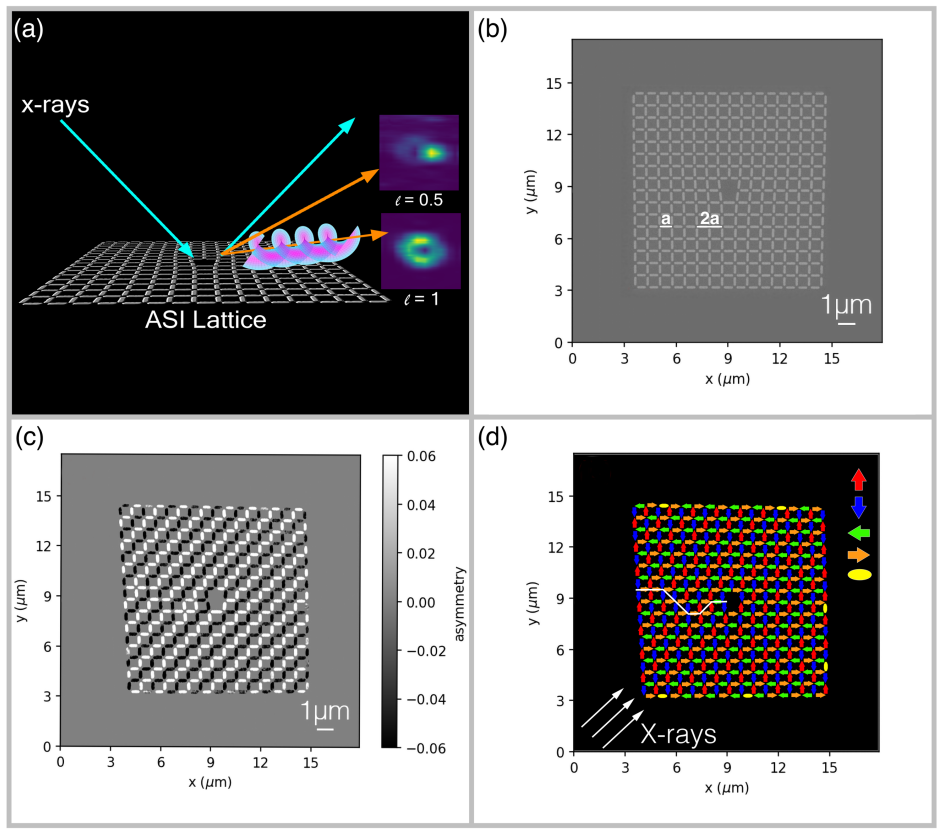
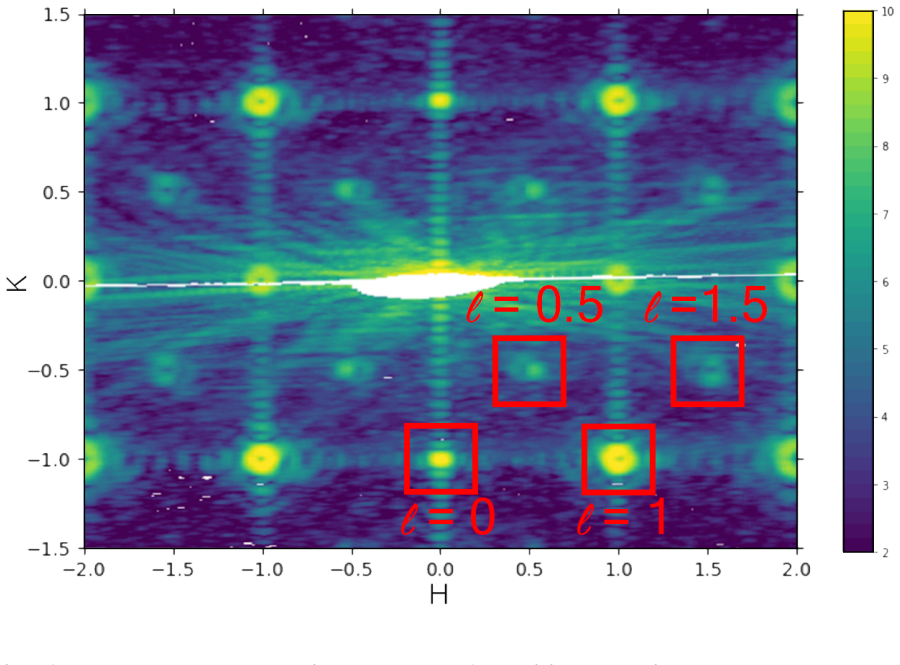
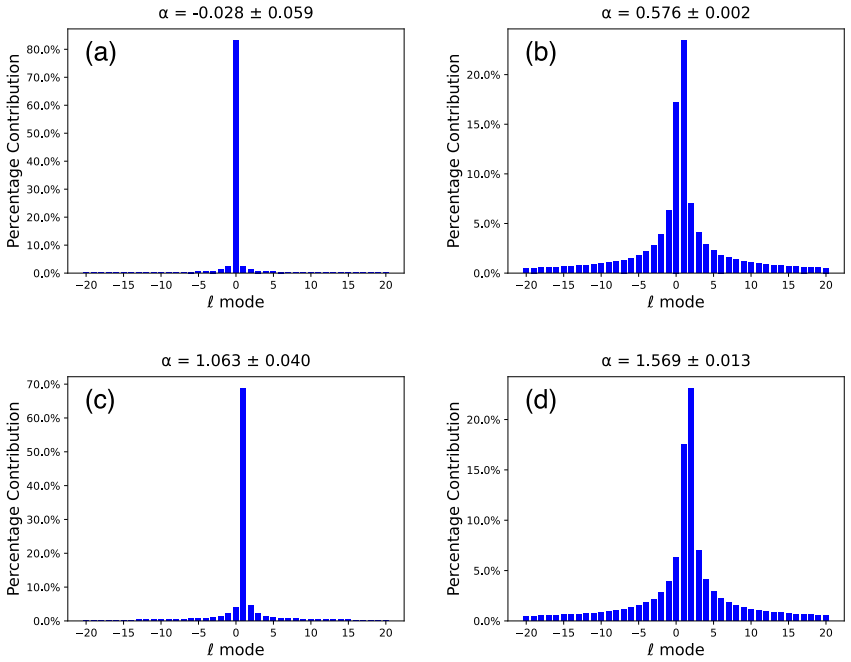
Resonant, coherent X-ray scattering from ASIs with topological defects of charge 1 yields integer-valued X-ray OAM at structural charge peaks and fractional X-ray OAM at magnetic peaks.
What carries the argument
The doubling of the period in the antiferromagnetic ground state relative to the structural lattice, which converts the topological defect's phase jump into fractional OAM only for the magnetic scattering channel.
If this is right
- Structural scattering channels always produce integer OAM regardless of defect charge.
- Magnetic scattering channels produce fractional OAM precisely when the defect charge is odd.
- Protected superdomain walls supply the stable phase discontinuity needed for the fractional beam.
- Thermally active lattices allow the fractional OAM beam to rotate dynamically through fluctuations in the discontinuity position.
Where Pith is reading between the lines
- Magnetic diffraction could serve as a tunable source of fractional OAM beams whose quantum value is set by the defect charge parity.
- Extending the same period-doubling logic to other ordered spin systems might generate fractional OAM in additional scattering geometries.
Load-bearing premise
The antiferromagnetic ground state period is exactly twice the structural period, producing a half-integer phase shift at odd-charge defects.
What would settle it
If resonant scattering from charge-1 defect ASIs showed only integer OAM values at both structural and magnetic peaks, the claim of period-doubling-induced fractional magnetic OAM would be false.
Figures
read the original abstract
Artificial spin ice (ASI) based on a square lattice with a topological defect are known to generate orbital angular momentum (OAM) in diffracted X-ray beams. A previous investigation of ASI with even-charge topological defects showed both charge and magnetic X-ray scattering yield photon OAM, but these were confined to integer OAM values. However, the period of the square ASI's antiferromagnetic ground state is twice the period of the structural ground state, which should lead to fractional OAM from magnetic scattering when the topological defect has odd-charge. We employed photoemission electron microscopy to confirm that these ASIs order into antiferromagnetic ground states with protected superdomain walls that provide the phase discontinuity required for fractional OAM. Resonant, coherent X-ray scattering from ASIs with topological defects of charge 1 yields integer-valued X-ray OAM at structural charge peaks and fractional X-ray OAM at magnetic peaks. For thermally active ASIs, the fractional OAM beam exhibits fluctuations in the position of the phase discontinuity and thus dynamic rotation of the beam.
Editorial analysis
A structured set of objections, weighed in public.
Referee Report
Summary. The paper reports resonant coherent X-ray scattering experiments on square artificial spin ice (ASI) arrays containing charge-1 topological defects. PEEM imaging confirms antiferromagnetic ordering with protected superdomain walls. The central experimental result is that structural (charge) diffraction peaks produce integer-valued X-ray OAM while magnetic peaks produce fractional OAM, consistent with the doubling of the real-space period in the AFM state. Thermally active samples additionally show fluctuations in the position of the phase discontinuity, leading to dynamic rotation of the fractional-OAM beam.
Significance. If the reported separation of integer and fractional OAM holds, the work provides a concrete experimental realization of fractional X-ray OAM generated specifically by magnetic scattering from odd-charge topological defects. The use of PEEM to directly verify the AFM configuration and superdomain walls supplies an important control that links the observed OAM to the period-doubling mechanism. This extends earlier results on even-charge defects and demonstrates a route to magnetic control of X-ray OAM, with possible relevance to coherent X-ray optics and studies of topological spin textures.
minor comments (2)
- [§3] §3 (Experimental Methods): the description of the coherent X-ray scattering geometry and detector distance should include the numerical aperture or q-range explicitly so that the angular acceptance for OAM measurement is clear.
- [Figure 4] Figure 4: the color scale and contour levels for the reconstructed OAM phase maps are not labeled; adding a scale bar and explicit integer/fractional annotations would improve readability of the integer-vs-fractional distinction.
Simulated Author's Rebuttal
We thank the referee for the supportive summary and recommendation of minor revision. The provided referee summary accurately captures the experimental demonstration of integer OAM at structural peaks and fractional OAM at magnetic peaks arising from period doubling in the AFM state of charge-1 defect square ASI.
Circularity Check
No significant circularity
full rationale
The manuscript is an experimental report of resonant coherent X-ray scattering and PEEM imaging on square ASI samples with charge-1 defects. The central observation (integer OAM at structural peaks, fractional OAM at magnetic peaks) follows directly from the measured AFM period doubling and superdomain walls, both verified in situ by PEEM. No equations, fitted parameters, or derivations are presented that reduce to their own inputs. The cited prior work on even-charge defects supplies context but is not load-bearing for the present claim; the period-doubling property is a standard, independently established feature of square ASI antiferromagnetism. The derivation chain is therefore self-contained against external benchmarks.
Axiom & Free-Parameter Ledger
axioms (1)
- domain assumption The antiferromagnetic ground state period is twice the structural period for square ASI.
Reference graph
Works this paper leans on
-
[1]
A note on diffrac\on by a disloca\on,
1 X-ray Fractional Orbital Angular Momentum from Coherent Magnetic Scattering P . D. Montgomery1,*, J. S. Woods2, M. R. McCarter1,4, R. Divan3, D. Czaplewski3, W.-K. Kwok2, U. Welp2, R. V . Chopdekar4, S. Roy4, A. Barbour6, C. Mazzoli6, L. E. De Long5, and J. T. Hastings1,5 1Electrical and Computer Engineering, University of Kentucky, Lexington, KY 40506,...
discussion (0)
Sign in with ORCID, Apple, or X to comment. Anyone can read and Pith papers without signing in.