Disentangling conviction and conformity: a Bayesian ideal point model of voting behaviour in online debates
Pith reviewed 2026-06-28 07:47 UTC · model grok-4.3
The pith
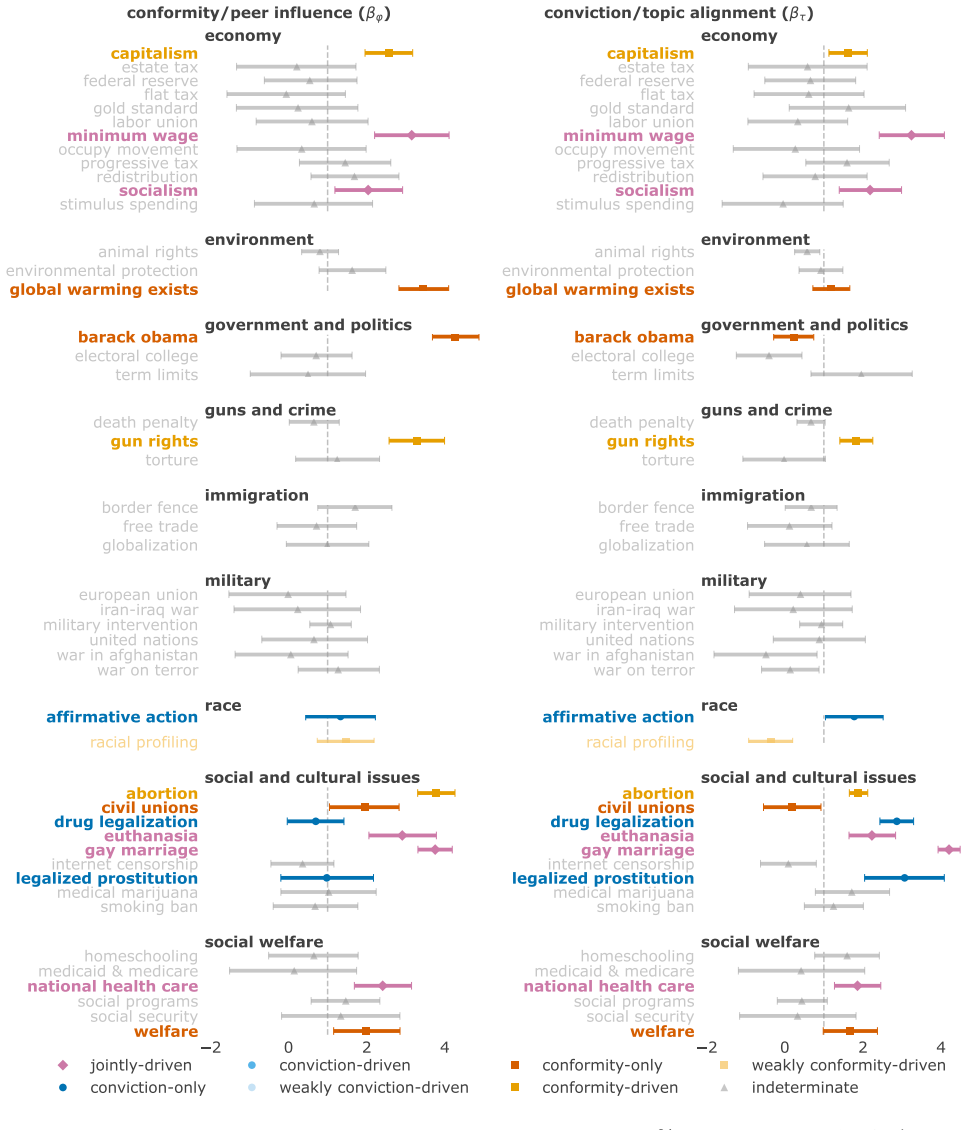
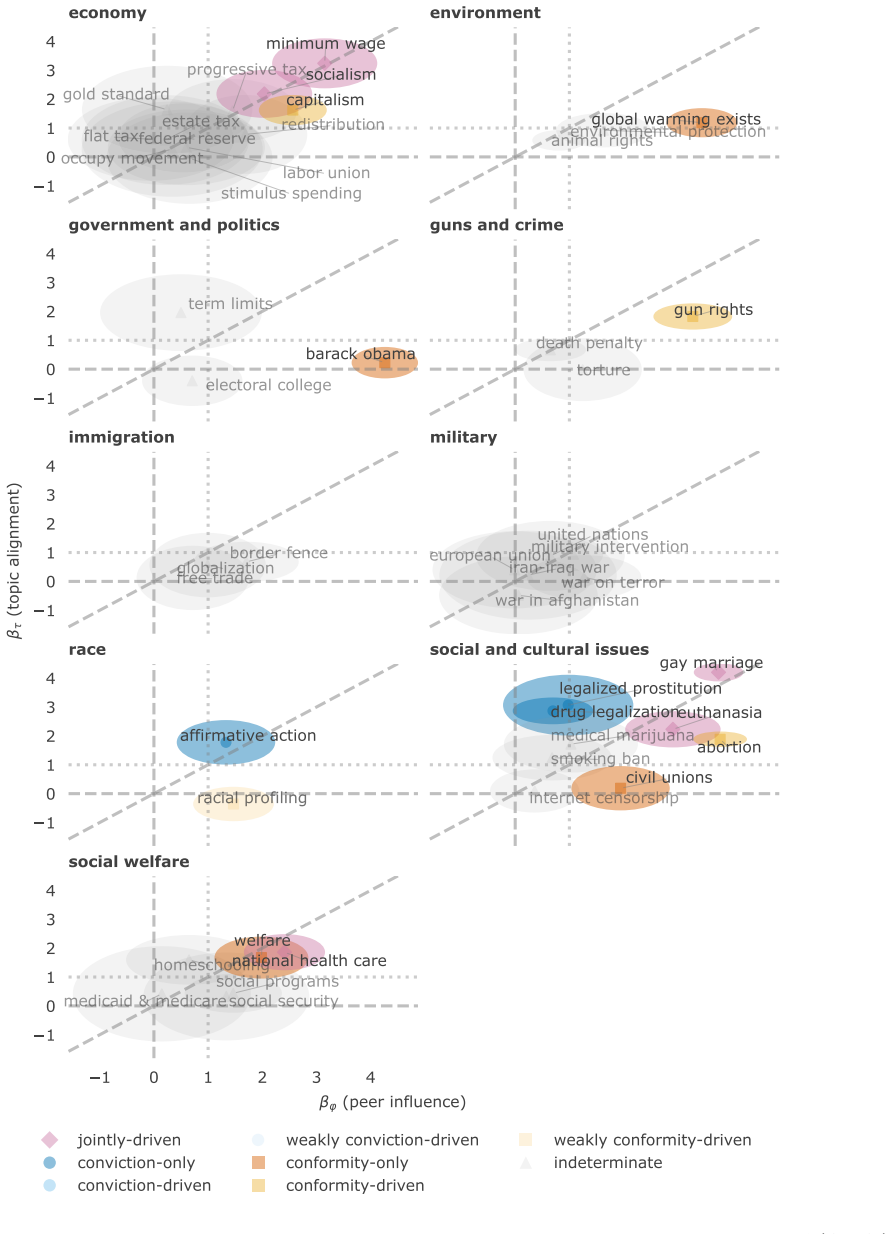
A Bayesian model of online debate votes finds conviction dominates on personal freedom topics while conformity dominates on moral issues like abortion and global warming.
A machine-rendered reading of the paper's core claim, the machinery that carries it, and where it could break.
Core claim
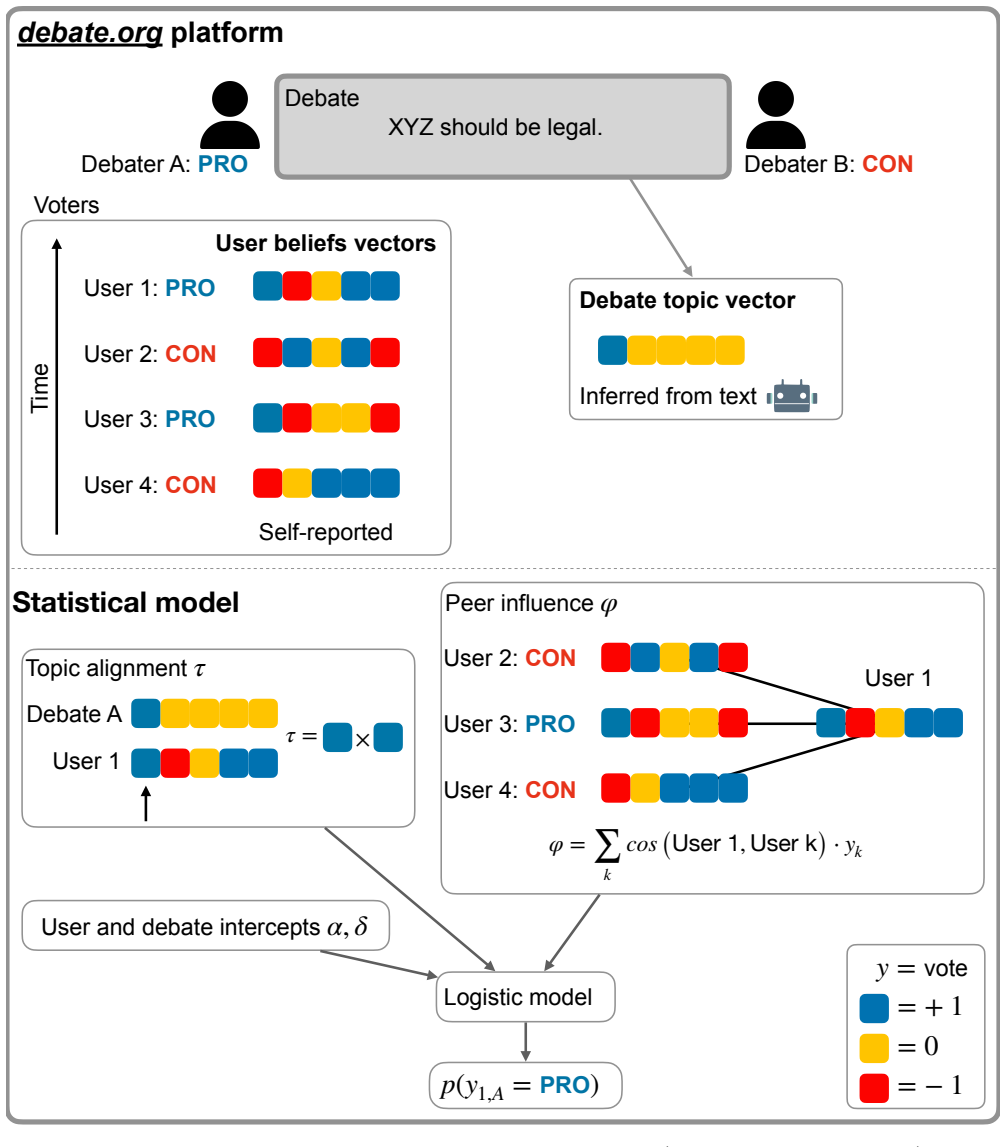
The central claim is that voting behaviour in online debates exhibits substantial heterogeneity across topics in the relative strength of conviction versus conformity. Conviction, reflecting prior ideological beliefs, is the dominant driver on issues tied to personal freedoms and lifestyle choices such as drug legalisation and legalised prostitution. Conformity, reflecting peer influence, is the dominant driver on several topics widely regarded as cases of moral conviction, including abortion, gun rights, and global warming.
What carries the argument
Bayesian logistic regression model inspired by ideal point models, which estimates and quantifies the relative contribution of prior ideological beliefs versus peer influence to each observed vote.
If this is right
- Votes on personal freedom topics such as drug legalisation reflect individual priors more than immediate group pressure.
- Votes on moral topics such as abortion and global warming shift more readily with changes in the peer environment.
- The stability of expressed opinions in online discourse varies systematically by topic according to which mechanism dominates.
- Platform features that alter peer visibility would affect voting patterns differently across topic categories.
Where Pith is reading between the lines
- Platform designers could test interface changes that reduce peer cues on moral topics to increase the weight of conviction.
- The same model applied to other debate sites might show whether the observed topic split is platform-specific or general.
- Longitudinal tracking of individual users could test whether conformity effects produce lasting shifts in underlying beliefs.
- Robustness checks using human-coded topic labels would directly test sensitivity to the LLM inference step.
Load-bearing premise
The Bayesian ideal point model structure together with the LLM-inferred topic and stance labels is sufficient to accurately separate and quantify the distinct contributions of prior beliefs versus peer influence.
What would settle it
Re-estimating the model after replacing the LLM topic labels with an alternative classification method or after altering the model specification produces a reversal or disappearance of the reported dominance patterns for the listed topics.
Figures
read the original abstract
Online debate platforms offer a unique window into the mechanisms driving opinion formation: they capture both explicit political preferences and the peer environment in which those preferences are expressed. In this work, I develop a Bayesian logistic regression model, inspired by ideal point models from political science, to disentangle two competing mechanisms of voting behaviour in online debates: conviction, driven by prior ideological beliefs, and conformity, driven by peer influence. I apply this framework to the Debate.org dataset, comprising approximately 341k votes across 78k debates on 48 socio-political topics. As the debate platform does not provide predefined topic labels for each debate, I infer the topic and stance from the debate text using large language models, and, with a Bayesian approach, I quantify the relative contribution of each mechanism. I find substantial heterogeneity across topics: conviction dominates on issues tied to personal freedoms and lifestyle choices, such as drug legalisation and legalised prostitution, while conformity dominates on several topics widely regarded as paradigmatic cases of moral conviction, including abortion, gun rights, and global warming. These results have implications for the stability of online political discourse and the design of deliberative platforms.
Editorial analysis
A structured set of objections, weighed in public.
Referee Report
Summary. The paper develops a Bayesian logistic regression model inspired by ideal point models to disentangle conviction (prior ideological beliefs) from conformity (peer influence) in ~341k votes across 78k debates on Debate.org. Topics and stances are inferred via LLMs from debate text (no predefined labels exist). The model quantifies relative contributions per topic and reports substantial heterogeneity: conviction dominates on personal-freedom/lifestyle topics (e.g., drug legalisation), while conformity dominates on paradigmatic moral-conviction topics (abortion, gun rights, global warming).
Significance. If the separation of mechanisms holds, the work offers a scalable, quantitative approach to studying opinion formation in online platforms and challenges the assumption that topics like abortion or climate change are uniformly conviction-driven. The large dataset and Bayesian framing are strengths; reproducible code or parameter-free derivations are not mentioned.
major comments (3)
- [Methods] Methods (LLM topic/stance inference): No human validation, inter-annotator agreement, or sensitivity checks on the LLM labels are described. Because these labels produce the 48-topic partition that drives the headline conviction-vs-conformity heterogeneity, systematic label bias would propagate directly into the central claim.
- [Model and Results] Model identification and results: The conviction and conformity parameters are estimated from the same voting data used to report dominance; the manuscript should show (via equations or posterior checks) that the topic/stance covariates achieve genuine separation rather than post-hoc attribution of residuals. Without this, the reported topic-specific dominance lacks a clear falsification test.
- [Results] Results (topic heterogeneity): The classification of topics into conviction- or conformity-dominated groups should be accompanied by uncertainty measures (e.g., posterior probabilities or credible intervals on the relative contributions) so that borderline cases do not drive the narrative contrast with "paradigmatic moral conviction" topics.
minor comments (2)
- [Abstract] Abstract mentions the modeling approach but omits any equation or key identification assumption; a one-sentence statement of the logistic form would improve accessibility.
- [Methods] Notation for the two free parameters per user/debate should be introduced consistently when first defined.
Simulated Author's Rebuttal
We thank the referee for their constructive comments. We address each major comment below and indicate the revisions we will make.
read point-by-point responses
-
Referee: [Methods] Methods (LLM topic/stance inference): No human validation, inter-annotator agreement, or sensitivity checks on the LLM labels are described. Because these labels produce the 48-topic partition that drives the headline conviction-vs-conformity heterogeneity, systematic label bias would propagate directly into the central claim.
Authors: We agree the manuscript lacks explicit validation of the LLM-inferred topics and stances. In revision we will add a new subsection reporting (i) a small-scale human annotation study on a random sample of debates to compute inter-annotator agreement and accuracy against LLM labels, and (ii) sensitivity checks across alternative prompts and models. These additions will quantify potential label bias and its propagation to the topic partition. revision: yes
-
Referee: [Model and Results] Model identification and results: The conviction and conformity parameters are estimated from the same voting data used to report dominance; the manuscript should show (via equations or posterior checks) that the topic/stance covariates achieve genuine separation rather than post-hoc attribution of residuals. Without this, the reported topic-specific dominance lacks a clear falsification test.
Authors: The model is a Bayesian logistic regression with user-level ideal-point parameters capturing conviction (prior ideological position) and debate-level peer-influence parameters capturing conformity; topic and stance enter as covariates that modulate the relative weight of each term. To demonstrate genuine separation we will insert the full generative equations and add posterior predictive checks plus simulation recovery experiments showing that the two mechanisms are identifiable and not merely partitioning residuals. These checks will serve as the requested falsification test. revision: yes
-
Referee: [Results] Results (topic heterogeneity): The classification of topics into conviction- or conformity-dominated groups should be accompanied by uncertainty measures (e.g., posterior probabilities or credible intervals on the relative contributions) so that borderline cases do not drive the narrative contrast with "paradigmatic moral conviction" topics.
Authors: We accept that uncertainty quantification is needed. We will revise the results section and figures to report, for each of the 48 topics, credible intervals on the relative contribution of conviction versus conformity together with the posterior probability that one mechanism dominates the other. This will allow readers to evaluate the robustness of the highlighted contrasts, including for abortion, gun rights, and global warming. revision: yes
Circularity Check
No significant circularity; model fit produces empirical estimates without self-referential reduction.
full rationale
The paper specifies a Bayesian logistic regression (ideal-point style) whose conviction parameter is a user-specific prior-ideology term and whose conformity term captures peer influence; both are estimated from the observed votes on LLM-labeled debates. The reported topic-level dominance findings are direct posterior summaries of those fitted parameters rather than quantities defined in terms of themselves or forced by construction. No self-citations, uniqueness theorems, or ansatzes imported from prior author work appear in the abstract or described derivation; the separation of mechanisms is imposed by model structure and the results are falsifiable against the same data. This is standard empirical modeling with no load-bearing circular step.
Axiom & Free-Parameter Ledger
free parameters (2)
- conviction and conformity parameters in logistic regression
- ideal point locations for users and debates
axioms (2)
- domain assumption Voting can be modeled as a logistic function of latent ideal points plus separate conviction and conformity terms
- domain assumption LLM-inferred topics and stances accurately reflect debate content without systematic bias
Reference graph
Works this paper leans on
-
[1]
A Corpus for Modeling User and Language Effects in Argumentation on Online Debating
Durmus, Esin and Cardie, Claire. A Corpus for Modeling User and Language Effects in Argumentation on Online Debating. Proceedings of the 57th Annual Meeting of the Association for Computational Linguistics. 2019. doi:10.18653/v1/P19-1057
-
[2]
Exploring the Role of Prior Beliefs for Argument Persuasion
Durmus, Esin and Cardie, Claire. Exploring the Role of Prior Beliefs for Argument Persuasion. Proceedings of the 2018 Conference of the North A merican Chapter of the Association for Computational Linguistics: Human Language Technologies, Volume 1 (Long Papers). 2018. doi:10.18653/v1/N18-1094
-
[3]
Birds of the Same Feather Tweet Together: Bayesian Ideal Point Estimation Using Twitter Data , volume=. Political Analysis , author=. 2015 , pages=. doi:10.1093/pan/mpu011 , number=
-
[4]
Jost and Jonathan Nagler and Joshua A
Pablo Barberá and John T. Jost and Jonathan Nagler and Joshua A. Tucker and Richard Bonneau , title =. Psychological Science , volume =. 2015 , doi =
2015
-
[5]
2003 , publisher =
Bayesian data analysis , author =. 2003 , publisher =
2003
-
[6]
Stan Modeling Language Users Guide and Reference Manual , year =
-
[7]
Current Trends in Bayesian Methodology with Applications , editor =
Betancourt, Michael and Girolami, Mark , title =. Current Trends in Bayesian Methodology with Applications , editor =. 2015 , pages =
2015
-
[8]
Political Psychology , volume =
Boutyline, Andrei and Willer, Robb , title =. Political Psychology , volume =. doi:https://doi.org/10.1111/pops.12337 , url =. https://onlinelibrary.wiley.com/doi/pdf/10.1111/pops.12337 , abstract =
-
[9]
Sentence- BERT : Sentence Embeddings using S iamese BERT -Networks
Reimers, Nils and Gurevych, Iryna. Sentence- BERT : Sentence Embeddings using S iamese BERT -Networks. Proceedings of the 2019 Conference on Empirical Methods in Natural Language Processing and the 9th International Joint Conference on Natural Language Processing (EMNLP-IJCNLP). 2019. doi:10.18653/v1/D19-1410
-
[10]
American Political Science Review , author=
The Statistical Analysis of Roll Call Data , volume=. American Political Science Review , author=. 2004 , pages=. doi:10.1017/S0003055404001194 , number=
-
[11]
Multidimensional Analysis of Roll Call Data via Bayesian Simulation: Identification, Estimation, Inference, and Model Checking , volume=. Political Analysis , author=. 2001 , pages=. doi:10.1093/polana/9.3.227 , number=
-
[12]
Poole and Howard Rosenthal , journal =
Keith T. Poole and Howard Rosenthal , journal =. A Spatial Model for Legislative Roll Call Analysis , urldate =
-
[13]
, author =
A study of normative and informational social influences upon individual judgment. , author =. The journal of abnormal and social psychology , volume =. 1955 , publisher =
1955
-
[14]
Skitka, Linda J. , title =. Social and Personality Psychology Compass , volume =. doi:https://doi.org/10.1111/j.1751-9004.2010.00254.x , url =. https://compass.onlinelibrary.wiley.com/doi/pdf/10.1111/j.1751-9004.2010.00254.x , year =
-
[15]
Aaron M. McCright and Riley E. Dunlap , title =. The Sociological Quarterly , volume =. 2011 , publisher =. doi:10.1111/j.1533-8525.2011.01198.x , URL =
-
[16]
Nature Climate Change , volume =
Growing polarization around climate change on social media , author =. Nature Climate Change , volume =. 2022 , publisher =
2022
-
[17]
The ANES Guide to Public Opinion and Electoral Behavior , year =
-
[18]
The Emotional Dog and Its Rational Tail: A Social Intuitionist Approach to Moral Judgment , booktitle=
Haidt, Jonathan , editor=. The Emotional Dog and Its Rational Tail: A Social Intuitionist Approach to Moral Judgment , booktitle=. 2008 , pages=
2008
-
[19]
Brandt and Christine Reyna and John R
Mark J. Brandt and Christine Reyna and John R. Chambers and Jarret T. Crawford and Geoffrey Wetherell , title =. Current Directions in Psychological Science , volume =. 2014 , doi =
2014
-
[20]
Saltzstein , journal =
Elliot Turiel and Carolyn Hildebrandt and Cecilia Wainryb and Herbert D. Saltzstein , journal =. Judging Social Issues: Difficulties, Inconsistencies, and Consistencies , urldate =
-
[21]
Taylor , title =
Lev Muchnik and Sinan Aral and Sean J. Taylor , title =. Science , volume =. 2013 , doi =
2013
-
[22]
Salganik and Peter Sheridan Dodds and Duncan J
Matthew J. Salganik and Peter Sheridan Dodds and Duncan J. Watts , title =. Science , volume =. 2006 , doi =
2006
-
[23]
Cialdini, Robert B. and Goldstein, Noah J. Social Influence: Compliance and Conformity. Annual Review of Psychology. 2004. doi:https://doi.org/10.1146/annurev.psych.55.090902.142015
-
[24]
Public opinion quarterly , volume =
Affect, not ideology: A social identity perspective on polarization , author =. Public opinion quarterly , volume =. 2012 , publisher =
2012
-
[25]
, author =
Heuristic versus systematic information processing and the use of source versus message cues in persuasion. , author =. Journal of personality and social psychology , volume =. 1980 , publisher =
1980
-
[26]
Journal of Political Economy , volume =
Bikhchandani, Sushil and Hirshleifer, David and Welch, Ivo , title =. Journal of Political Economy , volume =. 1992 , doi =
1992
-
[27]
2009 , publisher =
Going to extremes: How like minds unite and divide , author =. 2009 , publisher =
2009
-
[28]
Proceedings of the National Academy of Sciences , volume =
Jan Lorenz and Heiko Rauhut and Frank Schweitzer and Dirk Helbing , title =. Proceedings of the National Academy of Sciences , volume =. 2011 , doi =
2011
-
[29]
Adamic, Lada A. and Glance, Natalie , title =. Proceedings of the 3rd International Workshop on Link Discovery , pages =. 2005 , isbn =. doi:10.1145/1134271.1134277 , abstract =
-
[30]
Nature Human Behaviour , volume =
Political polarization of news media and influencers on Twitter in the 2016 and 2020 US presidential elections , author =. Nature Human Behaviour , volume =. 2023 , publisher =
2016
-
[31]
Proceedings of the National Academy of Sciences , volume =
Petter Törnberg , title =. Proceedings of the National Academy of Sciences , volume =. 2022 , doi =
2022
-
[32]
Skitka, Linda J. and Hanson, Brittany E. and Morgan, G. Scott and Wisneski, Daniel C. The Psychology of Moral Conviction. Annual Review of Psychology. 2021. doi:https://doi.org/10.1146/annurev-psych-063020-030612
-
[33]
1984 , publisher =
The spatial theory of voting: An introduction , author =. 1984 , publisher =
1984
-
[34]
2004 , publisher =
Item response theory: Parameter estimation techniques , author =. 2004 , publisher =
2004
-
[35]
Nicholas P. Aramovich and Brad L. Lytle and Linda J. Skitka , title =. Social Influence , volume =. 2012 , publisher =. doi:10.1080/15534510.2011.640199 , URL =
-
[36]
Journal of the American Statistical Association , year =
Luca Alessandro Silva and Giacomo Zanella , title =. Journal of the American Statistical Association , volume =. 2024 , publisher =. doi:10.1080/01621459.2023.2257893 , URL =
-
[37]
Nature Human Behaviour , volume =
A semantic embedding space based on large language models for modelling human beliefs , author =. Nature Human Behaviour , volume =. 2025 , publisher =
2025
-
[38]
arXiv preprint arXiv:2603.11253 , year =
LLMs Can Infer Political Alignment from Online Conversations , author =. arXiv preprint arXiv:2603.11253 , year =
-
[39]
A Methodological Guide on Using Large Language Models for Text Annotation in the Social Sciences and Humanities with Python and R , doi =
Fang, Qixiang and Garcia-Bernardo, Javier and Kesteren, Erik-Jan , year =. A Methodological Guide on Using Large Language Models for Text Annotation in the Social Sciences and Humanities with Python and R , doi =
-
[40]
2026 , eprint=
Emergence of Stereotypes and Affective Polarization from Belief Network Dynamics , author=. 2026 , eprint=
2026
-
[41]
Proceedings of the National Academy of Sciences , volume =
Matteo Cinelli and Gianmarco De Francisci Morales and Alessandro Galeazzi and Walter Quattrociocchi and Michele Starnini , title =. Proceedings of the National Academy of Sciences , volume =. 2021 , doi =
2021
discussion (0)
Sign in with ORCID, Apple, or X to comment. Anyone can read and Pith papers without signing in.